Bava Metzia 16b: Talmud study for Daf Yomi
Study the Talmud for Daf Yomi with scanned pages, Hebrew text, English translations from Sefaria and AI-generated French translations.
Passage selection and English or AI-generated French translation are available where the scan has annotations. Daf Study is independent of Torah-Box and Sefaria.
Browse Bava Metzia · בבא מציעא · All tractatesBava Metzia 16b text and translations
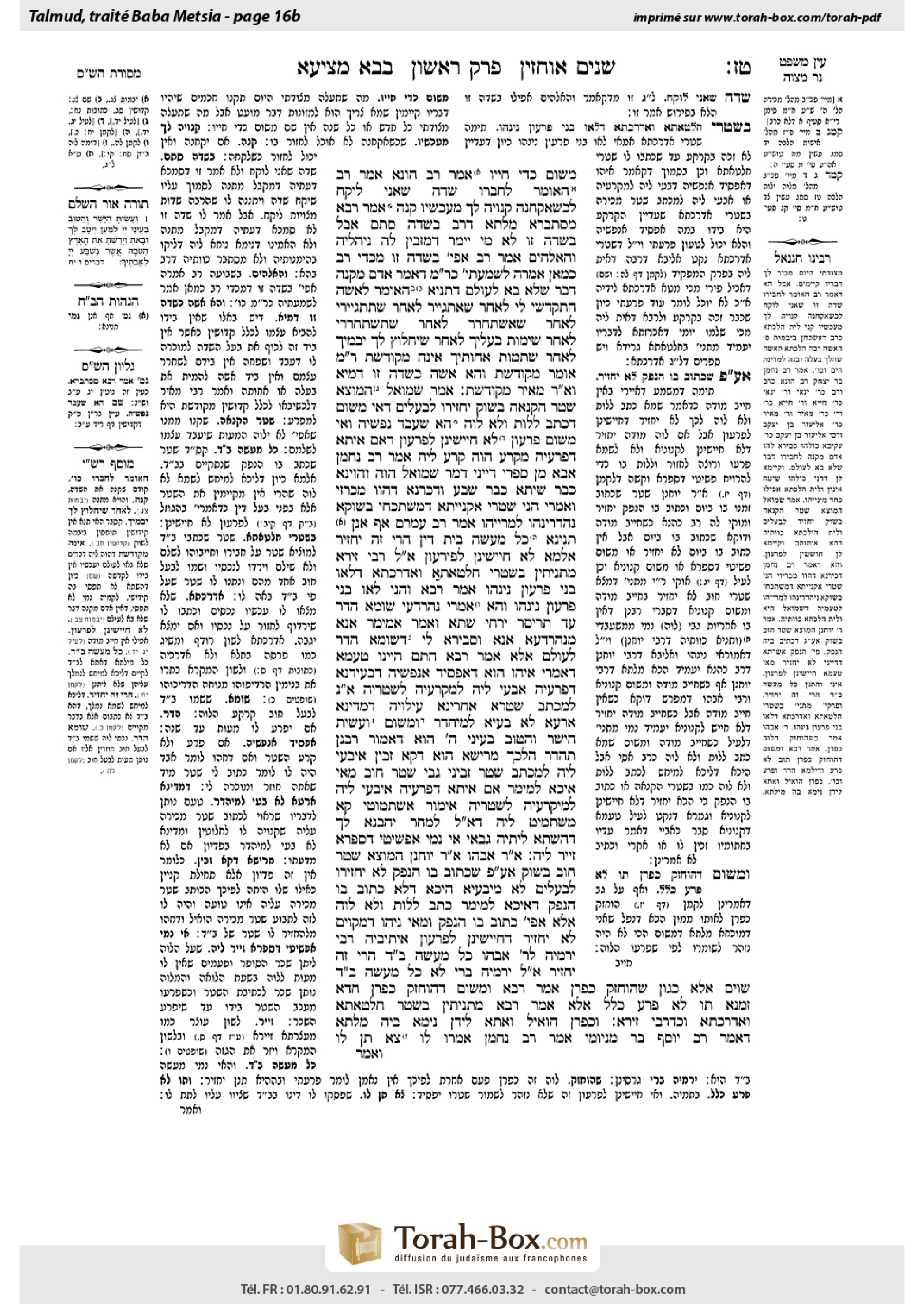
This page of Bava Metzia includes the Aramaic text, an English translation and an AI-generated French translation, alongside the scan above.
בבא מציעא י״ו ב · Aramaic and Hebrew text
מִשּׁוּם כְּדֵי חַיָּיו.
אָמַר רַב הוּנָא אָמַר רַב: הָאוֹמֵר לַחֲבֵרוֹ שָׂדֶה שֶׁאֲנִי לוֹקֵחַ, לִכְשֶׁאֶקָּחֶנָּה, קְנוּיָה לָךְ מֵעַכְשָׁיו – קָנָה.
אָמַר רָבָא: מִסְתַּבְּרָא מִלְּתֵאּ דְרַב בְּשָׂדֶה סְתָם. אֲבָל בְּשָׂדֶה זוֹ – לָא. מִי יֵימַר דִּמְזַבֵּין לַהּ נִיהֲלֵיהּ.
וְהָאֱלֹהִים! אָמַר רַב: אֲפִילּוּ בְּ״שָׂדֶה זוֹ״ מִכְּדֵי רַב כְּמַאן אַמְרַהּ לִשְׁמַעְתֵּיהּ – כְּרַבִּי מֵאִיר, דְּאָמַר: אָדָם מַקְנֶה דָּבָר שֶׁלֹּא בָּא לָעוֹלָם.
דְּתַנְיָא: הָאוֹמֵר לְאִשָּׁה ״הִתְקַדְּשִׁי לִי לְאַחַר שֶׁאֶתְגַּיֵּיר״, ״לְאַחַר שֶׁתִּתְגַּיְּירִי״, ״לְאַחַר שֶׁאֶשְׁתַּחְרֵר״, ״לְאַחַר שֶׁתִּשְׁתַּחְרְרִי״, ״לְאַחַר שֶׁיָּמוּת בַּעְלִיךְ״, ״לְאַחַר שֶׁיַּחְלוֹץ לָךְ יְבָמִיךְ״, ״לְאַחַר שֶׁתָּמוּת אֲחוֹתִיךְ״ – אֵינָהּ מְקוּדֶּשֶׁת.
רַבִּי מֵאִיר אוֹמֵר: מְקוּדֶּשֶׁת.
וְהָא אִשָּׁה כְּ״שָׂדֶה זוֹ״ דָּמְיָא, וְאָמַר רַבִּי מֵאִיר: מְקוּדֶּשֶׁת.
אָמַר שְׁמוּאֵל: הַמּוֹצֵא שְׁטַר הַקְנָאָה בַּשּׁוּק – יַחְזִירוֹ לַבְּעָלִים. דְּאִי מִשּׁוּם דְּכָתַב לִלְוֹת וְלֹא לָוָה – הָא שַׁעְבֵּד נַפְשֵׁיהּ. וְאִי מִשּׁוּם פֵּרָעוֹן – לָא חָיְישִׁינַן לְפֵרָעוֹן, דְּאִם אִיתָא דְּפַרְעֵיהּ – מִקְרָע הֲוָה קָרַע לֵיהּ.
אָמַר רַב נַחְמָן: אַבָּא מִן סָפְרֵי דַּיָּינֵי דְּמָר שְׁמוּאֵל הֲוָה, וַהֲוֵינָא כְּבַר שֵׁיתָא כְּבַר שְׁבַע, וּדְכִירְנָא דַּהֲווֹ מַכְרְזִי וְאָמְרִי: הָנֵי שְׁטָרֵי אַקְנְיָיתָא דְּמִשְׁתַּכְחִי בְּשׁוּקָא, נַהְדְּרִינְהוּ לְמָרַיְיהוּ.
אָמַר רַב עַמְרָם: אַף אֲנַן תְּנֵינָא. כׇּל מַעֲשֵׂה בֵּית דִּין – הֲרֵי זֶה יַחְזִיר, אַלְמָא לָא חָיְישִׁינַן לְפֵרָעוֹן. אֲמַר לֵיהּ רַבִּי זֵירָא: מַתְנִיתִין בִּשְׁטָרֵי חַלְטָאתָא וְאַדְרַכְתָּא, דְּלָאו בְּנֵי פֵרָעוֹן נִינְהוּ.
אָמַר רָבָא: וְהָנֵי לָאו בְּנֵי פֵרָעוֹן נִינְהוּ? וְהָא אָמְרִי נְהַרְדָּעֵי: שׁוּמָא הָדַר עַד תְּרֵיסַר יַרְחֵי שַׁתָּא. וְאָמַר אַמֵּימָר: אֲנָא מִנְּהַרְדְּעָא אֲנָא, וּסְבִירָא לִי דְּשׁוּמָא הָדַר לְעוֹלָם.
אֶלָּא אָמַר רָבָא, הָתָם הַיְינוּ טַעְמָא: דַּאֲמַרִי אִיהוּ הוּא דְּאַפְסֵיד אַנַּפְשֵׁיהּ, דִּבְעִידָּנָא דְּפַרְעֵיהּ אִבְּעִי לֵיהּ לְמִקְרְעֵיהּ לִשְׁטָרֵיהּ, אִי נָמֵי לְמִכְתַּב שְׁטָרָא אַחֲרִינָא עִילָּוֵיהּ.
דְּמִדִּינָא אַרְעָא לָא בָּעֲיָא לְמֶיהְדַּר, וּמִשּׁוּם ״וְעָשִׂיתָ הַיָּשָׁר וְהַטּוֹב בְּעֵינֵי ה׳״ הוּא דַּאֲמוּר רַבָּנַן תֶּהְדַּר. הִלְכָּךְ מֵרֵישָׁא הוּא דְּקָא זָבֵין, אִיבְּעִי לֵיהּ לְמִכְתַּב שְׁטַר זְבִינֵי.
גַּבֵּי שְׁטַר חוֹב מַאי אִיכָּא לְמֵימַר? אִם אִיתָא דְּפַרְעֵיהּ, אִיבְּעִי לֵיהּ לְמִיקְרְעֵיהּ לִשְׁטָרֵיהּ. אֵימוֹר אִשְׁתְּמוֹטֵי קָא מִשְׁתְּמִיט לֵיהּ, דְּאָמַר לֵיהּ: לִמְחַר יָהֵבְנָא לָךְ דְּהַשְׁתָּא לֵיתֵיהּ גַּבַּאי, אִי נָמֵי אַפְּשִׁיטֵי דְסָפְרָא זָיֵיר לֵיהּ.
אָמַר רַבִּי אֲבָהוּ אָמַר רַבִּי יוֹחָנָן: הַמּוֹצֵא שְׁטַר חוֹב בַּשּׁוּק, אַף עַל פִּי שֶׁכָּתוּב בּוֹ הֶנְפֵּק – לֹא יַחְזִירוֹ לַבְּעָלִים.
לָא מִיבַּעְיָא הֵיכָא דְּלֹא כָּתוּב בּוֹ הֶנְפֵּק, דְּאִיכָּא לְמֵימַר כָּתַב לִלְוֹת וְלֹא לָוָה. אֶלָּא אֲפִילּוּ כָּתוּב בּוֹ הֶנְפֵּק, וּמַאי נִיהוּ? דִּמְקוּיָּם – לֹא יַחְזִיר, דְּחָיְישִׁינַן לְפֵרָעוֹן.
אֵיתִיבֵיהּ רַבִּי יִרְמְיָה לְרַבִּי אֲבָהוּ: כׇּל מַעֲשֵׂה בֵּית דִּין הֲרֵי זֶה יַחְזִיר! אֲמַר לֵיהּ יִרְמְיָה בְּרִי: לֹא כׇּל מַעֲשֵׂה בֵּית דִּין שָׁוִים, אֶלָּא כְּגוֹן שֶׁהוּחְזַק כַּפְרָן.
אָמַר רָבָא: וּמִשּׁוּם דְּהוּחְזַק כַּפְרָן חֲדָא זִמְנָא תּוּ לָא פָּרַע כְּלָל?! אֶלָּא אָמַר רָבָא: מַתְנִיתִין בִּשְׁטַר חַלְטָאתָא וְאַדְרַכְתָּא, וְכִדְרַבִּי זֵירָא.
וְכַפְרָן, הוֹאִיל וַאֲתָא לִידַן נֵימָא בֵיהּ מִלְּתָא. דְּאָמַר רַב יוֹסֵף בַּר מִנְיוֹמֵי אָמַר רַב נַחְמָן, אָמְרוּ לוֹ: ״צֵא תֵּן לוֹ״,
Bava Metzia 16b · English translation
the Sages instituted an ordinance that the sale is effective because of their concern for his immediate livelihood.
§ The Gemara continues to discuss the matter of selling property that one does not yet own. Rav Huna says that Rav says: With regard to one who says to another: With regard to the field that I am about to buy, when I buy it, it will be retroactively transferred to your ownership from now, the stipulation takes effect, and once he buys it, the second party has acquired the field.
Rava said: The statement of Rav is reasonable only with regard to an unspecified field, as one is capable of buying a field. But with regard to a case where one says to another that he is selling him this specific field that is not yet in his possession, the transaction does not take effect, as who is to say that the current owner will sell it to him? Since it is not in his power alone to purchase the field, it is tantamount to an entity that has not yet come into being, and therefore he cannot sell it to anyone.
The Gemara emphatically rejects Rava’s qualification of Rav’s statement in the form of an oath: By God! Rav said his statement even in a case where the seller said: This field. After all, in accordance with whose opinion did Rav state his halakha? It was in accordance with the opinion of Rabbi Meir, who says that a person can transfer ownership of an entity that has not yet come into the world.
As it is taught in a baraita: With regard to one who says to a woman: Be betrothed to me after I convert, or: After you convert, or if he is a slave and says: After I am freed, or if she is a maidservant and he says: After you are freed, or if he says to a married woman: After your husband dies, or if he says to a widow waiting for her yavam to perform the ritual through which he frees her from her levirate bonds [ḥalitza]: After your yavam performs ḥalitza with you, or if he says to his wife’s sister: After your sister dies (see Leviticus 18:18), in all these cases she is not betrothed. Since he cannot betroth her at the present moment, his attempt at betrothal is ineffective.
Rabbi Meir says: She is betrothed. Rabbi Meir holds that one can acquire that which is not yet available, and the acquisition will take effect once the item is available. In this case as well, the betrothal will take effect once it becomes possible for her to become betrothed to him.
And isn’t the case of betrothing a specific woman comparable to the case of selling this specific field? And yet, Rabbi Meir says that she is betrothed. It is therefore clear that Rav, who accepts the opinion of Rabbi Meir, holds that the sale is effective even if the seller specified a particular field.
§ Shmuel says: With regard to one who finds a deed of transfer, i.e., a promissory note that establishes a lien on the debtor’s property from the date it is written, regardless of whether or not he borrows the money at that time, in the marketplace, he must return it to its owner, i.e., the creditor, as, if one were to be concerned because of the possibility that the debtor wrote the note intending to borrow money, but did not borrow it in the end, he is nevertheless liable, since he committed himself to pay at the time it was written. And if one were to be concerned because of the possibility that repayment had already taken place, this is not a justified concern, as in general we are not concerned that there was repayment, as, if it were so that the debtor had repaid it, he certainly would have torn up the note.
Rav Naḥman said: My father was one of the scribes of the judges of Mar Shmuel, and I was about six or seven years old, and I remember that they made an announcement, saying: Those deeds of transfer that are found in the marketplace should be returned to their owners, the creditors, in accordance with the opinion of Shmuel.
Rav Amram said: We, too, learn similarly in a mishna (20a): One must return any court enactment, i.e., a promissory note that has been authenticated by the court, to its owner. Apparently, we are not concerned that there may have been repayment. Rabbi Zeira said to him: The mishna is not proof for Shmuel’s ruling, as it is stated not with regard to all court enactments but with regard to bills of foreclosure, which award property to a creditor as payment for the debt owed to him, and bills of authorization to locate and seize property from the debtor, both of which are not subject to repayment.
Rava said to him: And are these bills not subject to repayment? But didn’t the Sages of Neharde’a say that after property is repossessed in order to pay an unpaid debt based on the court’s appraisal of its value, the property is returned if the debtor pays the debt until twelve months of the year have passed after the repossession? And furthermore, Ameimar said: I am from Neharde’a, and nevertheless, I hold that property repossessed based on an appraisal of an article’s value can always be returned. If the debtor pays his debt, he can reclaim his property at any point. Consequently, even bills of foreclosure or authorization might be obsolete, and nevertheless the mishna states that one who finds them must return them to the creditor.
Rather, Rava said that the mishna is not proof for the ruling of Shmuel for a different reason: There, this is the reason that the documents are returned: As I can say that if the debtor has already repaid his debt, it is he who caused the loss to himself, as at the time he repaid his debt he should have either ripped up the document, or alternatively, he should have demanded of the creditor to write another document for the debtor’s redeemed property, returning it to him.
The reason for a new document to be written is that according to the letter of the law, the land need not be returned by the creditor to the debtor, and it is due to the principle: “You shall do that which is right and good in the eyes of the Lord” (Deuteronomy 6:18), that the Sages said that the land should be returned. Therefore, it is as though the debtor is purchasing it anew, and the creditor must write a bill of sale.
The Gemara explains why this reasoning is not applicable to deeds of transfer or other promissory notes. With regard to a found promissory note, what is there to say to justify returning it to the creditor? That if it is so that the debtor repaid the debt, he should have ripped up the promissory note? This is not so, as one could say that the creditor avoided returning the note, as he said to him: Tomorrow I will give you the note, as it is not with me now. Alternatively, the creditor may have held back the note as security for the debtor’s payment of the fee of the scribe who wrote the promissory note. Consequently, it is possible that the debtor was never given back the note and was unable to rip it up, through no fault of his own.
§ Rabbi Abbahu says that Rabbi Yoḥanan says: With regard to one who finds a promissory note in the marketplace, even if a ratification of the court is written in it, he may not return it to the owner, i.e., the creditor.
The Gemara explains: It is not necessary to say that one should not return the promissory note in a case where a ratification is not written in it, as in that case there is room to say that the debtor wrote it intending to borrow money, but he did not end up borrowing it, and therefore the creditor has no rights to the promissory note. But even if a ratification is written in it, one should not return it. And what is this authorization? It is an approval that the promissory note has been ratified by the court, which examined the note and the signatures of the witnesses and found everything to be in order. The reason one may not return the promissory note to the creditor is that we are concerned that repayment has already taken place.
Rabbi Yirmeya raised an objection to Rabbi Abbahu from the mishna that states (20a): One must return any court enactment, i.e., a promissory note that has been authenticated by the court, to its owner. Apparently there is no concern about repayment. Rabbi Abbahu said to him: Yirmeya, my son, not all court enactments are equal. Rather, the ruling that one must return such a document applies only in a case where the debtor has the presumptive status of one who denies his debts, and therefore, if he claims the debt was repaid, his claim is not accepted.
In response to this explanation of that mishna, Rava said: But does it necessarily follow that just because a debtor assumed the presumptive status of one who denies his debts after one time that he did so, he will never again repay a debt that he owes, and therefore the promissory note should be returned to his creditor? Rather, Rava said: The mishna is referring to a bill of foreclosure, or a bill of authorization, which are not subject to repayment, in accordance with the explanation of Rabbi Zeira.
The Gemara adds: And with regard to the topic of one who denies his debts, since it came to us, let us say something about it. As Rav Yosef bar Minyumi said that Rav Naḥman said: If the court said to the litigant against whom they ruled: Go and give the other litigant what you owe him,
Bava Metzia 16b · Traduction française (IA)
les Sages ont institué un ordonnance selon laquelle la vente est efficace en raison de leur préoccupation pour la subsistance immédiate de l'acheteur.
§ La Guemara continue à discuter de la question de la vente d'une propriété que l'on ne possède pas encore. Rav Huna dit que Rav dit : En ce qui concerne celui qui dit à un autre : Concernant le champ que je vais acheter, lorsque je l'achèterai, il sera transféré retroactivement à votre propriété à partir de maintenant, la stipulation est efficace, et une fois qu'il l'achète, le second partie a acquis le champ.
Rava dit : La déclaration de Rav est raisonnable uniquement concernant un champ indéterminé, car on est capable d'acheter un champ. Mais concernant un cas où l'on dit à un autre qu'on lui vend ce champ spécifique qui n'est pas encore en son possession, la transaction ne prend effet, car qui peut dire que l'actuel propriétaire le vendra à lui ? Puisque ce n'est pas en son seul pouvoir d'acheter le champ, cela équivaut à une entité qui n'a pas encore été créée, et par conséquent on ne peut pas le vendre à quelqu'un.
La Guemara rejette fermement la qualification de Rava de la déclaration de Rav sous la forme d'un serment : Par Dieu ! Rav a dit sa déclaration même dans un cas où le vendeur disait : Ce champ. En effet, selon quel avis Rav a-t-il énoncé sa halakha ? C'était selon l'avis de Rabbi Meir, qui dit qu'une personne peut transférer la propriété d'une entité qui n'a pas encore été créée.
Comme il est enseigné dans une baraïta : Concernant celui qui dit à une femme : Sois mariée à moi après que j'aie été converti, ou : Après que tu aies été convertie, ou s'il est un esclave et dit : Après que je sois libéré, ou si elle est une servante et il dit : Après que tu sois libérée, ou s'il dit à une femme mariée : Après que ton mari meure, ou s'il dit à une veuve attendant que son yavam accomplisse le rituel par lequel il la libère de ses liens leviriques [ḥalitza] : Après que ton yavam ait accompli ḥalitza avec toi, ou s'il dit à sa sœur de la femme : Après que ta sœur meure (voir Lévitique 18:18), dans tous ces cas elle n'est pas mariée. Puisque il ne peut pas la marier à l'instant présent, son tentative de mariage est inefficace.
Rabbi Meir dit : Elle est mariée. Rabbi Meir considère que l'on peut acquérir ce qui n'est pas encore disponible, et l'acquisition prend effet une fois que l'objet est disponible. Dans ce cas également, le mariage prend effet une fois qu'il devient possible qu'elle devienne mariée à lui.
Et n'est-ce pas le cas de l'union d'une femme spécifique comparable à celui de la vente de ce champ spécifique ? Et pourtant, Rabbi Meir dit qu'elle est unie. Il est donc clair que Rav, qui accepte l'opinion de Rabbi Meir, considère que la vente est efficace même si le vendeur a spécifié un champ particulier.
§ Shmuel dit : Concernant celui qui trouve un acte de transfert, c'est-à-dire une note de promesse établissant un droit de gage sur la propriété du débiteur à la date où elle est écrite, indépendamment de ce qu'il emprunte l'argent à ce moment-là, dans le marché, il doit le rendre à son propriétaire, c'est-à-dire au créancier, car, si l'on est préoccupé par la possibilité que le débiteur ait écrit la note en pensant emprunter de l'argent, mais n'ait pas emprunté en fin de compte, il est néanmoins responsable, car il s'est engagé à payer à la date où elle a été écrite. Et si l'on est préoccupé par la possibilité que le remboursement ait déjà eu lieu, cela n'est pas une préoccupation justifiée, car, en général, nous ne sommes pas préoccupés par le fait que le remboursement ait eu lieu, car, si c'était le cas que le débiteur l'ait remboursé, il aurait certainement déchiré la note.
Rav Naḥman dit : Mon père était l'un des scribes des juges de Mar Shmuel, et j'avais six ou sept ans, et je me souviens qu'ils ont fait une proclamation, disant : Ces actes de transfert trouvés sur le marché doivent être rendus à leurs propriétaires, les créanciers, selon l'avis de Shmuel.
Rav Amram dit : Nous aussi, nous apprenons de la même manière dans une mitsna (20a) : On doit rendre tout acte du tribunal, c'est-à-dire une note de promesse authentifiée par le tribunal, à son propriétaire. Apparemment, nous ne sommes pas préoccupés par la possibilité qu'il y ait eu un remboursement. Rabbi Zeira dit à lui : La mitsna n'est pas une preuve pour la décision de Shmuel, car il est dit sans regarder tous les actes du tribunal mais concernant les billets de saisie, qui attribuent la propriété à un créancier comme paiement de la dette qu'il lui doit, et les billets d'autorisation de localiser et de saisir la propriété du débiteur, tous deux ne sont pas soumis au remboursement.
Rava dit à lui : Et ces billets ne sont-ils pas soumis au remboursement ? Mais n'ont pas dit les Sages de Neharde’a que, après que la propriété ait été reprise pour payer une dette non remboursée selon l'appréciation du tribunal de sa valeur, la propriété est rendue si le débiteur rembourse la dette jusqu'à ce que douze mois de l'année aient passé après la reprise ? Et de plus, Ameimar dit : Je viens de Neharde’a, et pourtant, je considère que la propriété reprise selon l'appréciation de la valeur d'un objet peut toujours être rendue. Si le débiteur rembourse sa dette, il peut récupérer sa propriété à tout moment. Par conséquent, même les billets de saisie ou d'autorisation peuvent être obsolètes, et pourtant la mitsna dit que celui qui les trouve doit les rendre au créancier.
Plutôt, Rava dit que la mitsna n'est pas une preuve pour la décision de Shmuel pour une autre raison : Là, cette est la raison pour laquelle les documents sont rendus : Car je peux dire que si le débiteur a déjà remboursé sa dette, c'est lui qui a causé la perte à lui-même, car à l'époque où il a remboursé sa dette, il aurait dû soit déchirer le document, ou autrement, il aurait demandé au créancier d'écrire un autre document pour la propriété rachetée du débiteur, le lui rendant.
La raison d'écrire un nouveau document est que, selon la lettre de la loi, la terre n'a pas besoin d'être rendue par le créancier au débiteur, et c'est en vertu du principe : « Tu feras ce qui est droit et bon aux yeux du Seigneur » (Deutéronome 6 : 18), que les Sages ont dit que la terre devait être rendue. Ainsi, cela revient à ce que le débiteur achète la terre à nouveau, et le créancier doit écrire un acte de vente.
La Guemara explique pourquoi ce raisonnement ne s'applique pas aux actes de transfert ou à d'autres notes de promesse. En ce qui concerne une note de promesse trouvée, qu'y a-t-il à dire pour justifier de la rendre au créancier ? Que si c'est le cas que le débiteur a remboursé la dette, il devrait avoir déchiré la note de promesse ? Ce n'est pas le cas, car on pourrait dire que le créancier a évité de rendre la note, en disant au débiteur : Demain je te donnerai la note, car elle n'est pas avec moi maintenant. Alternativement, le créancier pourrait avoir gardé la note en tant que garantie pour le paiement de la rémunération du scribe qui a rédigé la note de promesse. Ainsi, il est possible que le débiteur n'ait jamais été rendu la note et qu'il n'ait pas pu la déchirer, sans faute de sa part.
§ Rabbi Abbahu dit que Rabbi Yoḥanan dit : En ce qui concerne celui qui trouve une note de promesse sur le marché, même si un acte de ratification du tribunal est écrit dedans, il ne peut pas la rendre à l'propriétaire, c'est-à-dire au créancier.
La Guemara explique : Il n'est pas nécessaire de dire qu'on ne doit pas rendre la note de promesse dans le cas où une ratification n'est pas écrite dedans, car dans ce cas, on peut dire que le débiteur l'a écrite en pensant emprunter de l'argent, mais il n'a pas finalement emprunté, et donc le créancier n'a aucun droit sur la note de promesse. Mais même si une ratification est écrite dedans, on ne doit pas la rendre. Et qu'est-ce que cette ratification ? C'est une approbation que la note de promesse a été ratifiée par le tribunal, qui a examiné la note et les signatures des témoins et a trouvé tout à l'ordre. La raison pour laquelle on ne peut pas rendre la note de promesse au créancier est que nous craignons que le remboursement ait déjà eu lieu.
Rabbi Yirmeya a soulevé une objection contre Rabbi Abbahu à partir de la mitsna qui stipule (20a) : On doit rendre tout acte du tribunal, c'est-à-dire une note de promesse authentifiée par le tribunal, à son propriétaire. Apparemment, il n'y a pas de crainte concernant le remboursement. Rabbi Abbahu a dit à lui : Yirmeya, mon fils, tous les actes du tribunal ne sont pas égaux. Plutôt, la décision selon laquelle on doit rendre tel document s'applique uniquement dans le cas où le débiteur a le statut présomptif de celui qui nie ses dettes, et donc, si il affirme que la dette a été remboursée, sa déclaration n'est pas acceptée.
En réponse à cette explication de cette mitsna, Rava a dit : Mais est-ce nécessairement le cas que, juste parce que le débiteur a assumé le statut présomptif de celui qui nie ses dettes une fois, il fasse ainsi à jamais, et donc la note de promesse devrait être rendue à son créancier ? Plutôt, Rava a dit : La mitsna fait référence à un acte de saisine ou à un acte d'autorisation, qui ne sont pas soumis au remboursement, conformément à l'explication de Rabbi Zeira.
La Guemara ajoute : Et en ce qui concerne le sujet de celui qui nie ses dettes, puisque cela nous est arrivé, disons quelque chose à ce sujet. Comme Rav Yosef bar Minyumi a dit que Rav Naḥman a dit : Si le tribunal a dit au litigant contre qui ils ont rendu un jugement : Va et donne à l'autre litigant ce que tu dois lui,
Traduction française générée par IA à partir de l’édition anglaise de Sefaria. Vérifie toujours un passage avec le texte source.
Text from Sefaria: William Davidson Edition - Vocalized Aramaic (CC BY NC); William Davidson Edition - English (CC BY NC).