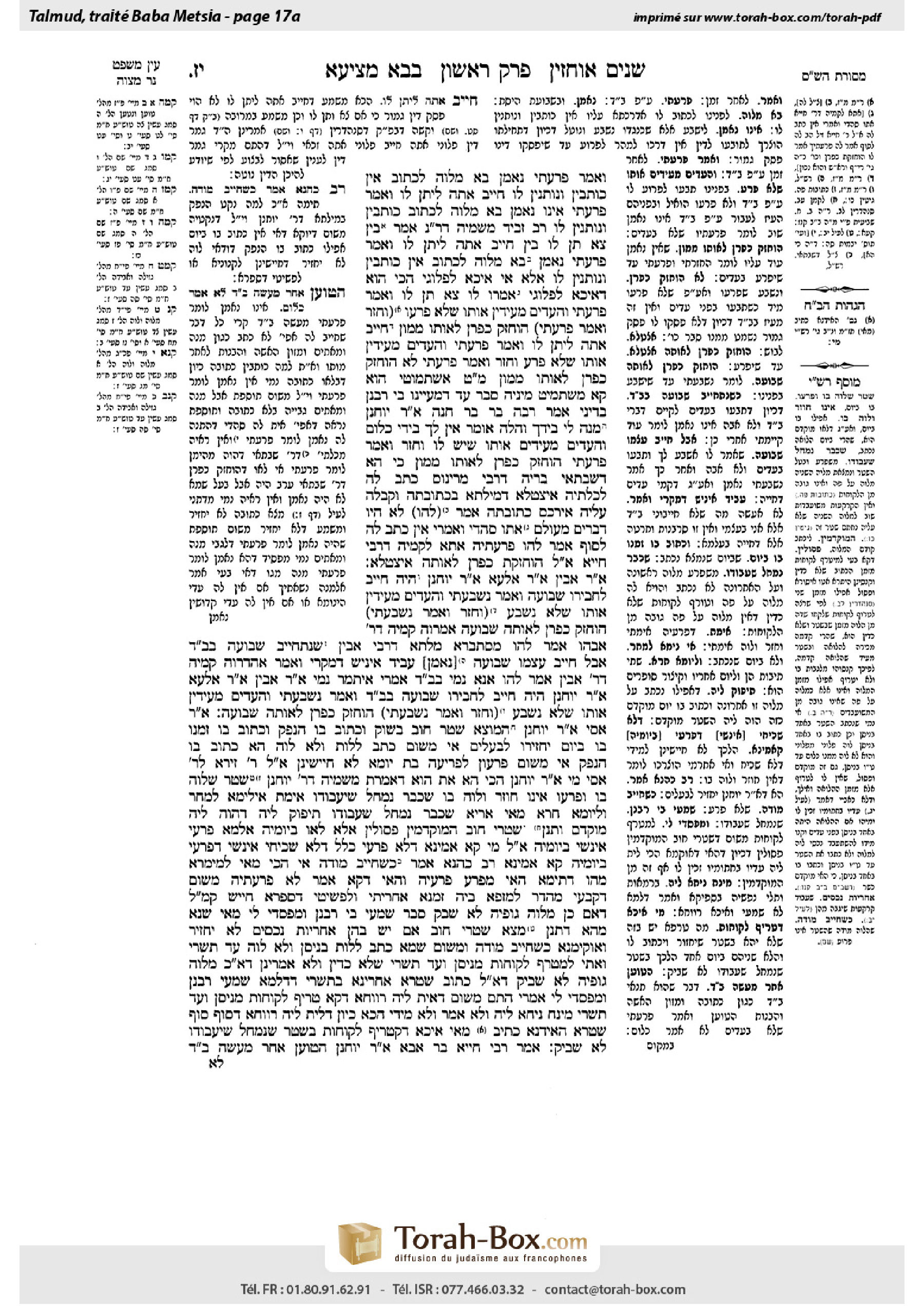
Bava Metzia 17a: Talmud study for Daf Yomi
Study the Talmud for Daf Yomi with scanned pages, Hebrew text, English translations from Sefaria and AI-generated French translations.
Passage selection and English or AI-generated French translation are available where the scan has annotations. Daf Study is independent of Torah-Box and Sefaria.
Browse Bava Metzia · בבא מציעא · All tractatesBava Metzia 17a text and translations
This page of Bava Metzia includes the Aramaic text, an English translation and an AI-generated French translation, alongside the scan above.
בבא מציעא י״ז א · Aramaic and Hebrew text
וְאָמַר ״פָּרַעְתִּי״ – נֶאֱמָן. בָּא מַלְוֶה לִכְתּוֹב – אֵין כּוֹתְבִין וְנוֹתְנִין לוֹ.
״חַיָּיב אַתָּה לִיתֵּן לוֹ״ וְאָמַר ״פָּרַעְתִּי״ – אֵינוֹ נֶאֱמָן. בָּא מַלְוֶה לִכְתּוֹב – כּוֹתְבִין וְנוֹתְנִין לוֹ.
רַב זְבִיד מִשְּׁמֵיהּ דְּרַב נַחְמָן אָמַר: בֵּין ״צֵא תֵּן לוֹ״, בֵּין ״חַיָּיב אַתָּה לִיתֵּן לוֹ״, וְאָמַר ״פָּרַעְתִּי״ – נֶאֱמָן. בָּא מַלְוֶה לִכְתּוֹב – אֵין כּוֹתְבִין וְנוֹתְנִין לוֹ.
אֶלָּא אִי אִיכָּא לְפַלּוֹגֵי – הָכִי הוּא דְּאִיכָּא לְפַלּוֹגֵי: אָמְרוּ לוֹ ״צֵא תֵּן לוֹ״, וְאָמַר ״פָּרַעְתִּי״, וְהָעֵדִים מְעִידִין אוֹתוֹ שֶׁלֹּא פְּרָעוֹ, וְחָזַר וְאָמַר ״פָּרַעְתִּי״ – הוּחְזַק כַּפְרָן לְאוֹתוֹ מָמוֹן.
״חַיָּיב אַתָּה לִיתֵּן לוֹ״, וְאָמַר ״פָּרַעְתִּי״, וְהָעֵדִים מְעִידִין אוֹתוֹ שֶׁלֹּא פָּרַע, וְחָזַר וְאָמַר ״פָּרַעְתִּי״ – לֹא הוּחְזַק כַּפְרָן לְאוֹתוֹ מָמוֹן.
מַאי טַעְמָא? אִשְׁתְּמוֹטֵי הוּא קָא מִשְׁתְּמִיט מִינֵּיהּ, סָבַר עַד דִּמְעַיְּינוּ בִּי רַבָּנַן בְּדִינִי.
אָמַר רַבָּה בַּר בַּר חָנָה אָמַר רַבִּי יוֹחָנָן: ״מָנֶה לִי בְּיָדְךָ״, וְהַלָּה אוֹמֵר: ״אֵין לְךָ בְּיָדִי כְּלוּם״, וְהָעֵדִים מְעִידִים אוֹתוֹ שֶׁיֵּשׁ לוֹ, וְחָזַר וְאָמַר: ״פָּרַעְתִּי״ – הוּחְזַק כַּפְרָן לְאוֹתוֹ מָמוֹן.
כִּי הָא דְּשַׁבְּתַאי בְּרֵיהּ דְּרַבִּי מָרִינוּס כְּתַב לַהּ לְכַלְּתֵיהּ אִיצְטְלָא דְמֵילָתָא בִּכְתוּבְּתַהּ, וְקַבְּלַהּ עֲלֵיהּ. אִירְכַס כְּתוּבְּתַהּ. אֲמַר לַהּ: ״לָא הָיוּ דְּבָרִים מֵעוֹלָם״. אֲתוֹ סָהֲדֵי וְאָמְרִי: אִין כְּתַב לַהּ. לְסוֹף אֲמַר לְהוּ: ״פְּרַעְתִּיהָ״. אֲתָא לְקַמֵּיהּ דְּרַבִּי חִיָּיא, אֲמַר לֵיהּ: הוּחְזַקְתָּ כַּפְרָן לְאוֹתָהּ אִיצְטְלָא.
אָמַר רַבִּי אָבִין אָמַר רַבִּי אִלְעָא אָמַר רַבִּי יוֹחָנָן: הָיָה חַיָּיב לַחֲבֵירוֹ שְׁבוּעָה, וְאָמַר ״נִשְׁבַּעְתִּי״, וְהָעֵדִים מְעִידִין אוֹתוֹ שֶׁלֹּא נִשְׁבַּע, וְחָזַר וְאָמַר ״נִשְׁבַּעְתִּי״ – הוּחְזַק כַּפְרָן לְאוֹתָהּ שְׁבוּעָה.
אַמְרוּהָ קַמֵּיהּ דְּרַבִּי אֲבָהוּ, אֲמַר לְהוּ: מִסְתַּבְּרָא מִלְּתָא דְּרַבִּי אָבִין שֶׁנִּתְחַיֵּיב שְׁבוּעָה בְּבֵית דִּין, אֲבָל חִיֵּיב עַצְמוֹ שְׁבוּעָה – [נֶאֱמָן]. עָבֵיד אִינִישׁ דְּמִקְּרֵי וְאָמַר. אַהְדְּרוּהָ קַמֵּיהּ דְּרַבִּי אָבִין, אֲמַר לְהוּ: אֲנָא נָמֵי בְּבֵית דִּין אֲמַרִי.
אִיתְּמַר נָמֵי, אָמַר רַבִּי אָבִין אָמַר רַבִּי אִלְעָא אָמַר רַבִּי יוֹחָנָן: הָיָה חַיָּיב לַחֲבֵירוֹ שְׁבוּעָה בְּבֵית דִּין וְאָמַר ״נִשְׁבַּעְתִּי״ וְהָעֵדִים מְעִידִין אוֹתוֹ שֶׁלֹּא נִשְׁבַּע, וְחָזַר וְאָמַר ״נִשְׁבַּעְתִּי״ – הוּחְזַק כַּפְרָן לְאוֹתָהּ שְׁבוּעָה.
אָמַר רַבִּי אַסִּי אָמַר רַבִּי יוֹחָנָן: הַמּוֹצֵא שְׁטַר חוֹב בַּשּׁוּק, וְכָתוּב בּוֹ הֶנְפֵּק, וְכָתוּב בּוֹ זְמַנּוֹ בּוֹ בַּיּוֹם – יַחְזִירוֹ לַבְּעָלִים.
אִי מִשּׁוּם כָּתַב לִלְוֹת וְלֹא לָוָה – הָא כָּתוּב בּוֹ הֶנְפֵּק. אִי מִשּׁוּם פֵּרָעוֹן – לִפְרִיעָה בַּת יוֹמָא לָא חָיְישִׁינַן.
אֲמַר לֵיהּ רַבִּי זֵירָא לְרַבִּי אַסִּי: מִי אָמַר רַבִּי יוֹחָנָן הָכִי? הָא אַתְּ הוּא דְּאָמְרַתְּ מִשְּׁמֵיהּ דְּרַבִּי יוֹחָנָן: שְׁטָר שֶׁלָּוָה בּוֹ וּפְרָעוֹ – אֵינוֹ חוֹזֵר וְלֹוֶה בּוֹ, שֶׁכְּבָר נִמְחַל שִׁיעְבּוּדוֹ.
אֵימַת? אִילֵּימָא לִמְחַר וּלְיוֹמָא חָרָא, מַאי אִרְיָא שֶׁכְּבָר נִמְחַל שִׁעְבּוּדוֹ? תִּיפּוֹק לֵיהּ דְּהָוֵה לֵיהּ מוּקְדָּם, וּתְנַן: שִׁטְרֵי חוֹב הַמּוּקְדָּמִין – פְּסוּלִין.
אֶלָּא לָאו בְּיוֹמֵיהּ. אַלְמָא פָּרְעִי אִינָשֵׁי בְּיוֹמֵיהּ!
אֲמַר לֵיהּ: מִי קָא אָמֵינָא דְּלָא פָּרְעִי כְּלָל, דְּלָא שְׁכִיחִי אִינָשֵׁי דְּפָרְעִי בְּיוֹמֵיהּ קָא אָמֵינָא.
רַב כָּהֲנָא אָמַר: כְּשֶׁחַיָּיב מוֹדֶה. אִי הָכִי מַאי לְמֵימְרָא?
מַהוּ דְּתֵימָא: הַאי מִפְרָע פַּרְעֵיהּ, וְהַאי דְּקָא אָמַר לָא פְּרַעְתֵּיהּ, מִשּׁוּם דְּקָבָעֵי מֶהְדַּר לְמֵזְפָא בֵּיהּ זִמְנָא אַחֲרִיתִי, וְלִפְשִׁיטֵי דְסָפְרָא חָיֵישׁ, קָא מַשְׁמַע לַן דְּאִם כֵּן מַלְוֶה גּוּפֵיהּ לָא שָׁבֵק. סָבַר: שָׁמְעִי בֵּי רַבָּנַן וּמַפְסְדִי לִי.
מַאי שְׁנָא מֵהָא דִּתְנַן: מָצָא שִׁטְרֵי חוֹב, אִם יֵשׁ בָּהֶן אַחְרָיוּת נְכָסִים – לֹא יַחֲזִיר,
וְאוֹקִימְנָא, כְּשֶׁחַיָּיב מוֹדֶה. וּמִשּׁוּם שֶׁמָּא כָּתַב לִלְוֹת בְּנִיסָן וְלֹא לָוָה עַד תִּשְׁרֵי, וְאָתֵי לְמִטְרַף לָקוֹחוֹת מִנִּיסָן וְעַד תִּשְׁרֵי שֶׁלֹּא כַּדִּין.
וְלָא אָמְרִינַן דְּאִם כֵּן מַלְוֶה גּוּפֵיהּ לָא שָׁבֵיק. דְּאָמַר לֵיהּ: כְּתוֹב שְׁטָרָא אַחֲרִינָא בְּתִשְׁרִי, דְּדִלְמָא שָׁמְעִי רַבָּנַן וּמַפְסְדִי לִי!
אָמְרִי: הָתָם, מִשּׁוּם דְּאִית לֵיהּ רַוְוחָא דְּקָא טָרֵיף לָקוֹחוֹת מִנִּיסָן וְעַד תִּשְׁרֵי, מֵינָח נִיחָא לֵיהּ וְלָא אָמַר וְלָא מִידֵּי. הָכָא, כֵּיוָן דְּלֵית לֵיהּ רַוְוחָא, דְּסוֹף סוֹף שְׁטָרָא הָאִידָּנָא כְּתִיב, מַאי אִיכָּא – דְּקָטָרֵיף לָקוֹחוֹת? בִּשְׁטָר שֶׁנִּמְחַל שִׁיעְבּוּדוֹ לָא שָׁבֵיק.
אָמַר רַבִּי חִיָּיא בַּר אַבָּא אָמַר רַבִּי יוֹחָנָן: הַטּוֹעֵן אַחַר מַעֲשֵׂה בֵּית דִּין –
Bava Metzia 17a · English translation
and later on the debtor said: I repaid him, his claim is deemed credible. He must take an oath and is exempt from payment. Therefore, if the creditor comes and asks the court to write an authorization for him to appropriate the property of the debtor, they do not write an authorization and give the document to him.
By contrast, if the court merely said: You are liable to give him what you owe him, but did not complete the process by saying: Go and give it to him, and later on the debtor said: I repaid the debt, his claim is not deemed credible. The assumption is that since he did not pay on his own without the need for litigation, he does not intend to pay until the court finalizes its verdict against him. Therefore, since the debtor is suspected of lying, the creditor takes an oath and collects what he is owed. In this case, if the creditor comes and asks the court to write an authorization for him to appropriate the property of the debtor, they write the document and give it to him.
Rav Zevid says in the name of Rabbi Naḥman: Both in the case where the court said: Go and give him what you owe him, and in the case where the court said: You are liable to give him, if the debtor subsequently said: I repaid the debt, his claim is deemed credible. Therefore, if the creditor comes and asks the court to write an authorization, they do not write the document and give it to him.
Rather, if there is room to make a distinction between different cases, this is how there is room to distinguish between them: If the court said to the debtor: Go and give him what you owe him, and subsequently the debtor said: I repaid the debt, and the witnesses testify concerning him that he did not repay it when the debt was demanded in their presence, and later the debtor said again: I repaid the debt, in such a case, the debtor has assumed the presumptive status of one who denies his debts with regard to that money, and he is no longer believed when he claims that he repaid the debt unless witnesses substantiate his claim.
By contrast, if the court said: You are liable to give him what you owe him, and subsequently the debtor said: I repaid the debt, and the witnesses testify concerning him that he did not repay the debt when it was demanded in their presence, and later the debtor said again: I repaid, in this case, the debtor does not assume the presumptive status of one who denies his debts with regard to that money. His claim that he repaid the debt in the absence of witnesses is accepted after he takes an oath to that effect.
What is the reason that he is not presumed to be lying? It is because before the court verdict was finalized, the debtor was merely trying to evade the creditor, thinking to himself: Since the court has not yet finalized the verdict, I can delay payment until the Sages in the court investigate my case further, as I am not actually liable to pay until the verdict is finalized.
Rabba bar bar Ḥanna says that Rabbi Yoḥanan says: If one says to another: I have one hundred dinars in your possession that you borrowed from me, and the other says in response: Nothing of yours is in my possession, and the witnesses testify concerning him that, in fact, he does have such a debt, and subsequently the debtor said: I repaid the debt, in that case the debtor assumes the presumptive status of one who denies his debts with regard to that money.
It is like the ruling in this case, where Shabbtai, son of Rabbi Marinus, wrote a pledge to give his daughter-in-law a cloak [itztela] of fine wool [demileta] in her marriage contract, and he accepted upon himself the status of a guarantor for the contract. Her marriage contract was lost, and there was a disagreement between the parties as to its content. Shabbtai said to her: These matters never occurred; I never wrote that I would give you such a cloak. Witnesses then came and said: Yes, he did write her this pledge. Ultimately, he said to them: I paid it, i.e., I gave her the cloak. This case came before Rabbi Ḥiyya. He said to Shabbtai: You have assumed the presumptive status of one who denies his debts with regard to that cloak. His claim was therefore not accepted, even by means of an oath.
Rabbi Avin says that Rabbi Ela says that Rabbi Yoḥanan says: If one was obligated to take an oath to counter another person’s claim brought against him, and later he said: I took the oath, and the witnesses testify against him that he did not take an oath when it was demanded of him in their presence, and the defendant subsequently said again: I took the oath, he assumes the status of one who denies his obligations with regard to that oath.
The Rabbis stated this ruling before Rabbi Abbahu. He said to them: Rabbi Avin’s statement is reasonable in a case where one was obligated by a court to take an oath. But if one voluntarily obligated himself to take an oath, and he later claims that he took the oath, he is deemed credible. This is because a person is prone to say incidentally that he will take an oath and then change his mind; this does not render him a liar. The Rabbis then brought Rabbi Abbahu’s analysis back to Rabbi Avin and presented it before him. Rabbi Avin said to them: I also said this halakha specifically with regard to one who was obligated by a court to take an oath, as Rabbi Abbahu explained.
It was also stated that Rabbi Avin says that Rabbi Ela says that Rabbi Yoḥanan says: If one was obligated by a court to take an oath to counter the claim of another person, and he subsequently said: I took the oath, and the witnesses testify against him that he did not take an oath when it was demanded of him in their presence, and later the defendant said again: I took the oath, he has assumed that status of one who denies his obligations with regard to that oath. This wording is explicitly in accordance with Rabbi Abbahu’s explanation.
§ Rabbi Asi says that Rabbi Yoḥanan says: With regard to one who finds a promissory note in the marketplace, and a ratification is written in it, and the date of the loan is written in it, and evidently it was written on that same day, he must return it to the owner, i.e., the creditor.
The Gemara explains why there is no concern that perhaps the debtor does not owe the money: If one were to be concerned because perhaps the debtor wrote the promissory note intending to borrow money, but he ultimately did not borrow it, this is not a concern, as a ratification is written in the promissory note. Since only the creditor would have brought the note for ratification, it is clear that the loan occurred. And if one were to be concerned because perhaps there was repayment, this is not a concern, as we are not concerned that there was repayment on the same day that the loan was taken, since normally one would not take a loan for less than one day.
Rabbi Zeira said to Rabbi Asi: Does Rabbi Yoḥanan actually say this? Isn’t it you who said in the name of Rabbi Yoḥanan that one who borrowed money and wrote a promissory note for the loan, and subsequently repaid the debt, may not reuse it to borrow another time, as its lien is already forgiven by virtue of the repayment? A promissory note is valid only for the debt for which it was written.
Rabbi Zeira explains: When did the debtor take the second loan? If we say that it was the day after the first loan, when the promissory note was written, or another later date, then Rabbi Yoḥanan’s statement is difficult. Why does he specifically give as the reason for the promissory note’s disqualification: As its lien is already forgiven? Instead, he should derive the disqualification of the promissory note from the fact that it is antedated, i.e., dated prior to the actual loan, and we learned in a mishna (Shevi’it 10:5): Antedated promissory notes are invalid. Therefore, Rabbi Yoḥanan could not have been referring to a case where the second loan took place after the date of the first loan.
Rather, is Rabbi Yoḥanan’s statement not referring to a case where the second loan took place on the same day as the first loan? Evidently, people do occasionally repay their loans on the same day as they take the loan.
Rabbi Asi said to him: Did I say that people do not repay their loans on the same day at all? Rather, I said that it is uncommon for people to repay their loans on the same day. Therefore, if a note is found on the same day it was written, it is reasonable to assume that it has not yet been repaid, even though there is a remote possibility that it has.
Rav Kahana says an alternative explanation: Rabbi Yoḥanan is referring to a case when the liable party, i.e., the debtor, admits to the debt. The Gemara asks: If that is so, what is the purpose of stating that the note may be returned? This is obvious.
The Gemara answers: Lest you say that even if this debtor admits to the debt, perhaps he actually repaid it, and the fact that the debtor says: I did not repay it, is because he wants to go back and use the promissory note to borrow money again. And the reason he prefers to claim that he did not repay the first debt is that he is concerned about saving the scribe’s fee that he would have to pay for another promissory note. Therefore, Rabbi Yoḥanan teaches us that this possibility need not be taken into account, as, if that were so, the creditor himself would not allow such a scheme. He would be afraid to act in such a manner, thinking: The Sages will hear about me that I reused the note, and will cause me to lose the payment owed to me.
The Gemara asks: In what way is this case different from that which we learned in a mishna (12b): With regard to one who found promissory notes, if they include a property guarantee for a loan, he may not return them to the creditor.
And we interpreted this mishna as referring to a case when the liable party admits to the debt. And the reason the promissory notes may not be returned is due to the concern that perhaps the debtor wrote the note in order to borrow the money in Nisan, but he ultimately did not borrow it until Tishrei, and the creditor will come to unlawfully repossess land from purchasers who bought the debtor’s land between Nisan and Tishrei. He is entitled to collect land only from those who bought land from the debtor after the loan took place, causing the lien on the debtor’s land to take effect.
The Gemara points out the contradiction between this mishna and Rabbi Kahana’s explanation of Rabbi Yoḥanan’s statement: And this indicates that we do not say that if that were so, if the promissory note were antedated, the creditor himself would not allow the debtor to use it, as he would say to him: Write another note dated properly in Tishrei, lest the Sages hear about the fact that the date is incorrect and disqualify the promissory note, causing me to lose the money.
The Gemara answers: The Sages say that there, in the case of the mishna, since the creditor benefits by using this promissory note, as he can repossess land from purchasers who bought from the debtor between Nisan and Tishrei, it is satisfactory to him, and he does not say anything to the debtor about using this promissory note. By contrast, here, in the case to which Rabbi Yoḥanan is referring, since the creditor does not benefit from reusing the promissory note, as ultimately, the note is written for the current date, what is there for him to repossess from purchasers by means of the note that he cannot repossess by means of a new promissory note? Therefore, he would not allow the debtor to borrow more money from him with a promissory note whose lien was forgiven, as this would result only in risk and have no potential benefit.
§ Rabbi Ḥiyya bar Abba says that Rabbi Yoḥanan says: With regard to one who claims to have repaid a debt that has already been established by a court enactment, i.e., a rabbinic ordinance obligating one to pay a debt, e.g., the main sum in a marriage contract, but he has no witnesses,
Bava Metzia 17a · Traduction française (IA)
et plus tard le débiteur dit : J'ai remboursé, sa revendication est considérée comme crédible. Il doit prendre serment et est exempt de paiement. Ainsi, si le créancier vient demander au tribunal d'écrire un document d'autorisation pour qu'il puisse approprier la propriété du débiteur, ils n'écrivent pas le document et ne lui donnent pas le document.
Par contraste, si le tribunal a simplement dit : Tu es tenu de lui donner ce que tu dois, mais n'a pas achevé le processus en disant : Va lui donner, et plus tard le débiteur dit : J'ai remboursé, sa revendication n'est pas considérée comme crédible. On suppose que puisqu'il n'a pas payé de lui-même sans avoir besoin de recours, il ne veut pas payer jusqu'à ce que le tribunal ait rendu son verdict contre lui. Ainsi, puisque le débiteur est soupçonné de mentir, le créancier prend serment et récupère ce qu'il doit. Dans ce cas, si le créancier vient demander au tribunal d'écrire un document d'autorisation pour qu'il puisse approprier la propriété du débiteur, ils écrivent le document et le lui donnent.
Rav Zevid dit au nom de Rabbi Naḥman : Quand le tribunal a dit : Va lui donner ce que tu dois, et quand le tribunal a dit : Tu es tenu de lui donner, si le débiteur dit ensuite : J'ai remboursé, sa revendication est considérée comme crédible. Ainsi, si le créancier vient demander au tribunal d'écrire un document d'autorisation, ils n'écrivent pas le document et ne lui donnent pas le document.
Plutôt, si l'on peut faire une distinction entre des cas différents, c'est ainsi qu'il y a de la place pour distinguer entre eux : Si le tribunal a dit au débiteur : Va lui donner ce que tu dois, et ensuite le débiteur a dit : J'ai remboursé, et les témoins témoignent contre lui qu'il n'a pas remboursé lorsqu'on lui a demandé en leur présence, et plus tard le débiteur a dit à nouveau : J'ai remboursé, dans ce cas, le débiteur a assumé le statut présomptif de celui qui nie ses dettes concernant cet argent, et il n'est plus cru quand il affirme avoir remboursé, sauf si des témoins soutiennent sa revendication.
Par contraste, si le tribunal a dit : Tu es tenu de lui donner ce que tu dois, et ensuite le débiteur a dit : J'ai remboursé, et les témoins témoignent contre lui qu'il n'a pas remboursé lorsqu'on lui a demandé en leur présence, et plus tard le débiteur a dit à nouveau : J'ai remboursé, dans ce cas, le débiteur ne prend pas le statut présomptif de celui qui nie ses dettes concernant cet argent. Sa revendication qu'il a remboursé en l'absence de témoins est acceptée après qu'il ait pris serment à cet égard.
Quelle est la raison pour laquelle il n'est pas présomptivement considéré comme menteur ? C'est parce que, avant que le verdict du tribunal ne soit finalisé, le débiteur cherchait simplement à éviter le créancier, pensant à lui-même : Puisque le tribunal n'a pas encore rendu son verdict, je peux reporter le paiement jusqu'à ce que les Sages du tribunal enquêtent davantage sur mon cas, car je ne suis pas réellement tenu de payer jusqu'au verdict final.
Rabba bar bar Ḥanna dit que Rabbi Yoḥanan dit : Si l'un dit à l'autre : J'ai un cent dinars en votre possession que vous avez empruntés à moi, et l'autre répond : Rien de vôtre n'est en mon possession, et les témoins témoignent contre lui qu'il a effectivement un tel débit, et ensuite le débiteur dit : J'ai remboursé, dans ce cas, le débiteur assume le statut présomptif de celui qui nie ses dettes concernant cet argent.
C'est comme la décision dans ce cas, où Shabbtai, fils de Rabbi Marinus, a écrit une promesse de lui donner à sa belle-fille un manteau de laine fine dans son contrat de mariage, et il a accepté le statut de garant pour le contrat. Son contrat de mariage a été perdu, et il y avait un désaccord entre les parties concernant son contenu. Shabbtai a dit à elle : Ces choses n'ont jamais eu lieu ; je n'ai jamais écrit que je lui donnerais un tel manteau. Les témoins sont ensuite venus et ont dit : Oui, il lui a écrit cette promesse. Finalement, il a dit à eux : J'ai payé, c'est-à-dire j'ai donné le manteau à elle. Ce cas a été soumis à Rabbi Ḥiyya. Il a dit à Shabbtai : Tu as assumé le statut présomptif de celui qui nie ses dettes concernant ce manteau. Sa revendication n'a donc pas été acceptée, même par serment.
Rabbi Avin dit que Rabbi Ela dit que Rabbi Yoḥanan dit : Si l'un était tenu de prendre serment pour contester une revendication d'une autre personne, et ensuite il a dit : J'ai pris serment, et les témoins témoignent contre lui qu'il n'a pas pris serment lorsqu'on lui a demandé en leur présence, et le défendeur a dit à nouveau : J'ai pris serment, il assume le statut de celui qui nie ses obligations concernant ce serment.
Les Rabbins ont formulé cette décision devant Rabbi Abbahu. Il a dit à eux : La déclaration de Rabbi Avin est raisonnable dans le cas où l'on était tenu par un tribunal à prendre serment. Mais si l'on s'est volontairement engagé à prendre serment, et qu'il affirme ensuite avoir pris serment, il est considéré comme crédible. C'est parce qu'une personne a tendance à dire par hasard qu'elle prendra serment et puis changera d'avis ; cela ne le rend pas menteur. Les Rabbins ont ensuite rapporté l'analyse de Rabbi Abbahu à Rabbi Avin et l'ont présentée devant lui. Rabbi Avin a dit à eux : Je disais aussi cette halakha spécifiquement concernant celui qui était tenu par un tribunal à prendre serment, comme Rabbi Abbahu l'a expliqué.
Il a également été dit que Rabbi Avin dit que Rabbi Ela dit que Rabbi Yoḥanan dit : Si l'on était tenu par un tribunal à prendre serment pour contester la revendication d'une autre personne, et qu'il a dit ensuite : J'ai pris serment, et les témoins témoignent contre lui qu'il n'a pas pris serment lorsqu'on lui a demandé en leur présence, et que le défendeur a dit à nouveau : J'ai pris serment, il a assumé le statut de celui qui nie ses obligations concernant ce serment. Cette formulation est explicitement conforme à l'explication de Rabbi Abbahu.
§ Rabbi Asi dit que Rabbi Yoḥanan dit : Concernant celui qui trouve une note de promesse de prêt dans le marché, et qu'une ratification est écrite dessus, et la date du prêt est écrite dessus, et il est évident qu'elle a été écrite le même jour, il doit la rendre à l'propriétaire, c'est-à-dire au créancier.
La Guemara explique pourquoi il n'y a pas de crainte que le débiteur ne doive pas l'argent : Si l'on craignait que le débiteur ait écrit la note de promesse de prêt en pensant emprunter de l'argent, mais qu'il n'a finalement pas emprunté, cela n'est pas un problème, car une ratification est écrite sur la note de promesse de prêt. Seul le créancier aurait apporté la note pour la ratification, ce qui montre clairement que le prêt s'est effectué. Et si l'on craignait que le prêt ait été remboursé, cela n'est pas un problème, car nous ne craignons pas qu'il ait été remboursé le même jour où le prêt a été pris, car normalement, on ne prend pas un prêt moins d'un jour.
Rabbi Zeira dit à Rabbi Asi : Rabbi Yoḥanan dit vraiment cela ? N'est-ce pas toi qui as dit en nom de Rabbi Yoḥanan que celui qui a emprunté de l'argent et a écrit une note de promesse de prêt pour le prêt, et qui a ensuite remboursé la dette, ne peut pas la réutiliser pour emprunter à nouveau, car son garantie est déjà annulée par le remboursement ? Une note de promesse de prêt est valide uniquement pour la dette pour laquelle elle a été écrite.
Le Rabbi Zeira explique : Quand le débiteur a-t-il pris le second prêt ? Si nous disons qu'il était le lendemain du premier prêt, lorsque la note de promesse de prêt a été écrite, ou une date ultérieure, alors l'affirmation du Rabbi Yoḥanan est difficile. Pourquoi donne-t-il spécifiquement comme raison de l'invalidité de la note de promesse de prêt : car sa garantie est déjà annulée ? Au contraire, il devrait déduire l'invalidité de la note de promesse de prêt du fait qu'elle est antérieure, c'est-à-dire datée avant le prêt réel, et nous avons appris dans une mitsva (Shevi’it 10:5) : Les notes de promesse de prêt antérieures sont invalides. Par conséquent, le Rabbi Yoḥanan ne pouvait pas faire référence à un cas où le second prêt s'est produit après la date du premier prêt.
Plutôt, le Rabbi Yoḥanan ne parle-t-il pas d'un cas où le second prêt s'est produit le même jour que le premier ? Évidemment, les gens peuvent parfois rembourser leurs prêts le même jour où ils les prennent.
Le Rabbi Asi lui répondit : Ai-je dit que les gens ne remboursent jamais leurs prêts le même jour ? Plutôt, j'ai dit que c'est peu courant que les gens remboursent leurs prêts le même jour. Par conséquent, si une note est trouvée le même jour où elle a été écrite, il est raisonnable d'assumer qu'elle n'a pas encore été remboursée, même si la possibilité qu'elle l'ait été est lointaine.
Rav Kahana dit une autre explication : Rabbi Yoḥanan parle d'un cas où la partie responsable, c'est-à-dire le débiteur, admet la dette. La Guemara demande : Si c'est ainsi, à quoi sert-il de dire que la note peut être rendue ? Cela est évident.
La Guemara répond : Pour éviter que vous ne disiez que même si ce débiteur admet la dette, peut-être qu'il a effectivement remboursé, et que le fait qu'il dise : Je n'ai pas remboursé, est parce qu'il veut revenir et utiliser la note de promesse de prêt pour emprunter à nouveau. Et la raison pour laquelle il préfère affirmer qu'il n'a pas remboursé la dette précédente est qu'il craint de devoir payer la prime du scribe pour une autre note de promesse de prêt. Par conséquent, Rabbi Yoḥanan nous enseigne que cette possibilité n'a pas besoin d'être prise en compte, car, si c'était le cas, le créancier lui-même ne permettrait pas un tel système. Il serait craintif d'agir ainsi, pensant : Les Sages apprendront que j'ai réutilisé la note, et causeront que je perde le paiement dû à moi.
La Guemara demande : Dans quelle mesure ce cas diffère-t-il de celui que nous avons appris dans une mitsna (12b) : Concernant celui qui trouve des notes de promesse de prêt, si elles incluent une garantie de propriété pour un prêt, il ne peut pas les rendre au créancier.
Et nous avons interprété cette mitsna comme faisant référence à un cas où la partie responsable admet la dette. Et la raison pour laquelle les notes de promesse de prêt ne peuvent pas être rendues est due à la crainte que le débiteur ait écrit la note afin d'emprunter de l'argent en Nisan, mais qu'il n'ait finalement emprunté qu'en Tishrei, et que le créancier vienne à s'approprier illégalement des terres des acheteurs qui ont acheté la terre du débiteur entre Nisan et Tishrei. Il est autorisé à réclamer des terres uniquement auprès de ceux qui ont acheté la terre du débiteur après le prêt, ce qui rend efficace la garantie sur la terre du débiteur.
La Guemara souligne la contradiction entre cette mitsna et l'explication du Rav Kahana sur l'affirmation du Rabbi Yoḥanan : Et cela montre que nous ne disons pas que si c'était le cas, c'est-à-dire si la note de promesse de prêt était antérieure, le créancier lui-même ne permettrait pas au débiteur d'utiliser cette note, car il dirait à lui : Écris une autre note datée correctement en Tishrei, de peur que les Sages apprennent que la date est incorrecte et invalident la note de promesse de prêt, ce qui entraînerait que je perde l'argent.
La Guemara répond : Les Sages disent que là, dans le cas de la mitsna, puisque le créancier bénéficie d'utiliser cette note de promesse de prêt, car il peut s'approprier des terres des acheteurs qui ont acheté la terre du débiteur entre Nisan et Tishrei, cela lui convient, et il ne dit rien au débiteur à ce sujet. En revanche, ici, dans le cas auquel le Rabbi Yoḥanan fait référence, puisque le créancier ne bénéficie pas d'utiliser à nouveau la note de promesse de prêt, car finalement, la note est écrite pour la date actuelle, à quoi bon s'approprier des terres des acheteurs par la note, puisqu'il peut s'approprier des terres par une nouvelle note de promesse de prêt ? Par conséquent, il ne permettrait pas au débiteur d'emprunter de l'argent avec une note de promesse de prêt dont la garantie a été annulée, car cela entraînerait uniquement un risque sans bénéfice potentiel.
§ Rabbi Ḥiyya bar Abba dit que Rabbi Yoḥanan dit : En ce qui concerne celui qui affirme avoir remboursé une dette qui a déjà été établie par un édict du tribunal, c'est-à-dire une ordonnance rabbinique obligeant à payer une dette, par exemple la somme principale d'un contrat de mariage, mais qui n'a pas de témoins,
Traduction française générée par IA à partir de l’édition anglaise de Sefaria. Vérifie toujours un passage avec le texte source.
Text from Sefaria: William Davidson Edition - Vocalized Aramaic (CC BY NC); William Davidson Edition - English (CC BY NC).