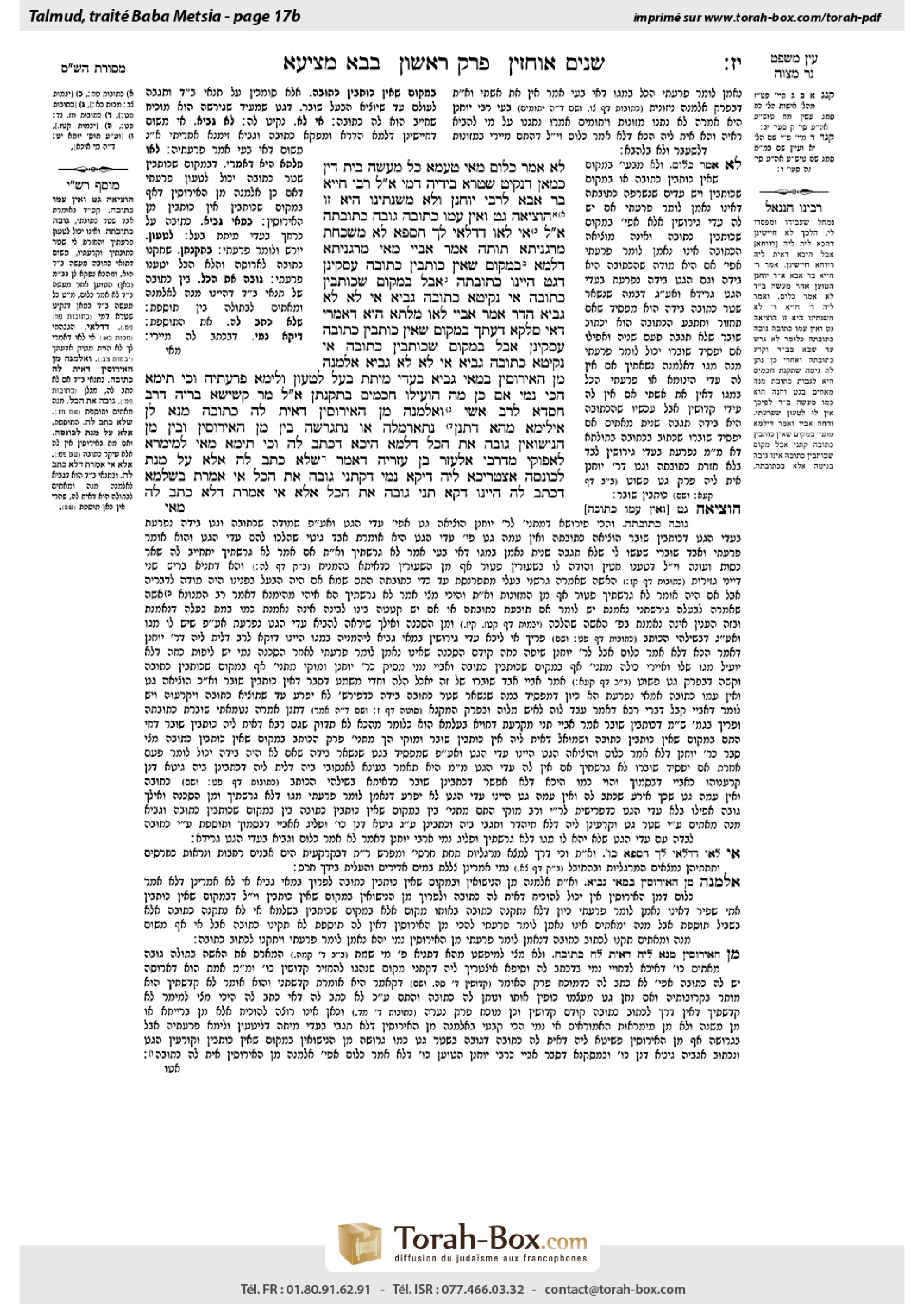
Bava Metzia 17b: Talmud study for Daf Yomi
Study the Talmud for Daf Yomi with scanned pages, Hebrew text, English translations from Sefaria and AI-generated French translations.
Passage selection and English or AI-generated French translation are available where the scan has annotations. Daf Study is independent of Torah-Box and Sefaria.
Browse Bava Metzia · בבא מציעא · All tractatesBava Metzia 17b text and translations
This page of Bava Metzia includes the Aramaic text, an English translation and an AI-generated French translation, alongside the scan above.
בבא מציעא י״ז ב · Aramaic and Hebrew text
לֹא אָמַר כְּלוּם. מַאי טַעְמָא? כׇּל מַעֲשֵׂה בֵּית דִּין – כְּמַאן דְּנָקֵיט שְׁטָרָא בִּידֵיהּ דָּמֵי.
אֲמַר לֵיהּ רַבִּי חִיָּיא בַּר אַבָּא לְרַבִּי יוֹחָנָן: וְלֹא מִשְׁנָתֵינוּ הִיא זוֹ? הוֹצִיאָה גֵּט וְאֵין עִמּוֹ כְּתוּבָּה – גּוֹבָה כְּתוּבָּתָהּ.
אֲמַר לֵיהּ: אִי לָאו דְּדַלַּאי לָךְ חַסְפָּא, לָא מַשְׁכַּחַתְּ מַרְגָּנִיתָא תּוּתַהּ.
אָמַר אַבָּיֵי: מַאי מַרְגָּנִיתָא? דִּלְמָא בִּמְקוֹם שֶׁאֵין כּוֹתְבִין כְּתוּבָּה עָסְקִינַן, דְּגֵט הַיְינוּ כְּתוּבְּתַהּ. אֲבָל בִּמְקוֹם שֶׁכּוֹתְבִין כְּתוּבָּה, אִי נְקִיטָא כְּתוּבָּה – גָּבְיָא, אִי לָא – לָא גָּבְיָא.
הֲדַר אָמַר אַבָּיֵי: לָאו מִלְּתָא הִיא דְּאָמְרִי, דְּאִי סָלְקָא דַעְתָּךְ בִּמְקוֹם שֶׁאֵין כּוֹתְבִין כְּתוּבָּה עָסְקִינַן, אֲבָל בִּמְקוֹם שֶׁכּוֹתְבִין כְּתוּבָּה, אִי נְקִיטָא כְּתוּבָּה – גָּבְיָא, אִי לָא – לָא גָּבְיָא, אַלְמָנָה מִן הָאֵירוּסִין בְּמַאי גָּבְיָא?
בְּעֵדֵי מִיתַת בַּעַל – לִטְעוֹן וְלֵימָא: פְּרַעְתִּיהָ. וְכִי תֵּימָא: הָכִי נָמֵי, אִם כֵּן מָה הוֹעִילוּ חֲכָמִים בְּתַקָּנָתָן?
אֲמַר לֵיהּ מָר קַשִּׁישָׁא בְּרֵיהּ דְּרַב חִסְדָּא לְרַב אָשֵׁי: וְאַלְמָנָה מִן הָאֵירוּסִין, דְּאִית לַהּ כְּתוּבָּה מְנָא לַן?
אִילֵּימָא מֵהָא דִּתְנַן: נִתְאַרְמְלָה אוֹ נִתְגָּרְשָׁה, בֵּין מִן הָאֵירוּסִין וּבֵין מִן הַנִּישּׂוּאִין – גּוֹבָה אֶת הַכֹּל, דִּלְמָא הֵיכָא דִּכְתַב לַהּ?
וְכִי תֵּימָא: מַאי לְמֵימְרָא?! לְאַפּוֹקֵי מִדְּרַבִּי אֶלְעָזָר בֶּן עֲזַרְיָה, דְּאָמַר שֶׁלֹּא כָּתַב לָהּ אֶלָּא עַל מְנָת לְכוֹנְסָהּ אִצְטְרִיכָא לֵיהּ.
דַּיְקָא נָמֵי, דְּקָתָנֵי: גּוֹבָה אֶת הַכֹּל. אִי אָמְרַתְּ בִּשְׁלָמָא דִּכְתַב לַהּ, הַיְינוּ דְּקָא תָּנֵי גּוֹבֶה אֶת הַכֹּל. אֶלָּא אִי אָמְרַתְּ דְּלָא כְּתַב לַהּ,
Bava Metzia 17b · English translation
he has said nothing. His claim is not accepted. What is the reason that he is not believed? It is because one who is owed any money based on a court enactment is considered like one who is holding a promissory note in his hand, against which a claim of repayment is not accepted without supporting evidence.
Rabbi Ḥiyya bar Abba said to Rabbi Yoḥanan: But what are you adding? Isn’t this principle stated in a mishna (Ketubot 88b), which teaches: If a woman produced a bill of divorce, and there was no accompanying marriage contract, she collects payment of her marriage contract? This is an example of Rabbi Yoḥanan’s principle that a court enactment enables one to collect a debt even without the relevant document.
Rabbi Yoḥanan said to him: True, this mishna is a source for my principle; but had I not lifted up the shard for you, you would not have found a pearl beneath it. In other words, if Rabbi Yoḥanan had not pointed out the principle, Rabbi Ḥiyya bar Abba would not have realized that it was underlying the ruling of the mishna.
Abaye said: What qualifies this proof as a pearl? It is not a compelling proof, as perhaps in the mishna we are dealing with a place where they do not write a marriage contract, as in such a place, a woman’s bill of divorce is the same as her marriage contract. But in a place where they do write a marriage contract, if she is holding a marriage contract then she collects payment, and if not, she does not collect payment. There is no proof from the mishna in support of Rabbi Yoḥanan’s principle.
Abaye then said: What I said is not correct. As, if it enters your mind that we are dealing with a place where they do not write a marriage contract, but in a place where they do write a marriage contract, if she is holding a marriage contract then she collects payment, and if not she does not collect payment, then through what means does a widow from her betrothal collect payment of her marriage contract? She has neither a marriage contract nor a bill of divorce.
If it is suggested that she can collect payment by means of witnesses to the death of her husband, let the husband’s heir, from whom she is demanding payment, claim and say: I paid it; she has no proof that she did not receive the money. And if you would say that indeed, the heir can claim that he has paid what he owes, if so, what did the Sages accomplish with their ordinance that a widow from betrothal receives payment of her marriage contract? The heirs can always exempt themselves.
Mar Kashisha, son of Rav Ḥisda, said to Rav Ashi, questioning the underlying assumption of Abaye: And from where do we derive that a widow from her betrothal has the right to receive payment of her marriage contract?
If we say that this halakha is derived from that which we learned in a mishna (Ketubot 54b): If a woman became widowed or divorced, whether from betrothal or from marriage, she collects all that she is entitled to, both the main sum of her marriage contract instituted by the Sages and the additional sum that her husband added; that mishna cannot serve as a source for the halakha that a widow from her betrothal has the right to receive payment of her marriage contract. As perhaps the mishna is referring to a case where the husband wrote a marriage contract for her, but if he did not, she does not receive any money at all.
And if you would say: In that case, what is the purpose of stating this halakha since it is obvious that she can collect payment if she has a written contract, then one could respond that it is stated to exclude the opinion of Rabbi Elazar ben Azarya, who says that a widow from betrothal does not receive that which the husband committed to pay in the marriage contract, as he wrote the marriage contract only on the condition that he would marry her. He did not intend to obligate himself in a situation where he died before their marriage. Therefore, it was necessary for the mishna to mention that a widow from betrothal who has a written marriage contract collects payment.
The language of the mishna is also precise according to this understanding, as it teaches: She collects all that she is entitled to. Granted, if you say that the mishna is referring to a case where the husband wrote her a marriage contract, this is why the mishna teaches that she collects all that she is entitled to, i.e., even the amount that the husband added to the main sum of the marriage contract. But if you say that it is referring a case where he did not write her a marriage contract,
Bava Metzia 17b · Traduction française (IA)
Il n'a dit rien. Sa revendication n'est pas acceptée. Pourquoi n'est-il pas cru ? C'est parce qu'une personne qui est dû de l'argent en vertu d'une décision de tribunal est considérée comme quelqu'un qui tient une note de remboursement entre ses mains, contre laquelle une revendication de remboursement n'est pas acceptée sans preuve d'appui.
Rabbi Ḥiyya bar Abba a dit à Rabbi Yoḥanan : Mais que rajoutes-tu là ? N'est-ce pas ce principe qui est mentionné dans une mitsna (Ketubot 88b), qui enseigne : Si une femme a produit un divorce, et s'il n'y avait pas de contrat de mariage accompagnant, elle récupère le paiement du contrat de mariage ? C'est un exemple du principe de Rabbi Yoḥanan selon lequel une décision de tribunal permet à quelqu'un de récupérer une créance même sans le document pertinent.
Rabbi Yoḥanan a dit à lui : C'est vrai, cette mitsna est une source pour mon principe ; mais si je n'avais pas soulevé le fragment pour toi, tu n'aurais pas trouvé un diamant sous celui-ci. En d'autres termes, si Rabbi Yoḥanan n'avait pas indiqué le principe, Rabbi Ḥiyya bar Abba ne serait pas entré en possession du fait que ce principe sous-tendait la décision de la mitsna.
Abaye a dit : Qu'est-ce qui rend ce témoignage un joyau ? Ce n'est pas un témoignage convaincant, car peut-être dans la mitsva nous parlons d'un lieu où l'on ne rédige pas de contrat de mariage, comme dans ce lieu, la déclaration de divorce d'une femme est la même que son contrat de mariage. Mais dans un lieu où l'on rédige un contrat de mariage, si elle tient un contrat de mariage, elle récupère le paiement, et si non, elle ne récupère pas le paiement. Il n'y a pas de témoignage tiré de la mitsva en faveur du principe de Rabbi Yoḥanan.
Abaye a ensuite dit : Ce que j'ai dit n'est pas correct. En effet, si vous pensez que nous parlons d'un lieu où l'on ne rédige pas de contrat de mariage, mais dans un lieu où l'on rédige un contrat de mariage, si elle tient un contrat de mariage, elle récupère le paiement, et si non, elle ne récupère pas le paiement, alors par quel moyen une veuve de son fiancage récupère-t-elle le paiement de son contrat de mariage ? Elle n'a ni contrat de mariage ni déclaration de divorce.
Si l'on suggère qu'elle peut récupérer le paiement grâce aux témoins de la mort de son mari, laissez le fils du mari, à qui elle demande le paiement, réclamer et dire : J'ai payé ; elle n'a pas de preuve qu'elle n'ait pas reçu l'argent. Et si vous dites que, en effet, le fils peut réclamer qu'il a payé ce qu'il doit, alors, si tel est le cas, à quoi bon l'ordonnance des Sages qui permet à une veuve de son fiancage de récupérer le paiement de son contrat de mariage ? Les héritiers peuvent toujours s'écarter.
Mar Kashisha, fils de Rav Ḥisda, a dit à Rav Ashi, en questionnant l'hypothèse sous-jacente d'Abaye : Et d'où dérivons-nous que la veuve de son fiancage a le droit de recevoir le paiement de son contrat de mariage ?
Si nous disons que cette halakha est dérivée de ce que nous avons appris dans une mitsva (Ketubot 54b) : Si une femme est devenue veuve ou divorcée, qu'elle soit veuve de fiancage ou de mariage, elle récupère tout ce à quoi elle a droit, à la fois la somme principale de son contrat de mariage instituée par les Sages et la somme supplémentaire que son mari a ajoutée ; cette mitsva ne peut pas servir de source pour la halakha que la veuve de son fiancage a le droit de recevoir le paiement de son contrat de mariage. Car peut-être la mitsva parle d'un cas où le mari a rédigé un contrat de mariage pour elle, mais si ce n'est pas le cas, elle ne reçoit aucun argent du tout.
Et si vous dites : Dans ce cas, à quoi sert de mentionner cette halakha puisque c'est évident qu'elle peut récupérer le paiement si elle a un contrat écrit, on pourrait répondre que c'est mentionné pour exclure l'opinion de Rabbi Elazar ben Azarya, qui dit qu'une veuve de fiancage ne reçoit pas ce que son mari a promis dans le contrat de mariage, car il a rédigé le contrat de mariage uniquement sous la condition qu'il allait l'épouser. Il n'avait pas l'intention de s'engager dans une situation où il est mort avant leur mariage. C'est pourquoi il était nécessaire que la mitsva mentionne que la veuve de fiancage qui a un contrat de mariage écrit récupère le paiement.
La formulation de la Michna est aussi précise selon cette compréhension, car elle enseigne : Elle récupère tout ce à quoi elle a droit. En effet, si vous dites que la Michna parle d'un cas où le mari a rédigé un contrat de mariage pour elle, c'est pourquoi la Michna enseigne qu'elle récupère tout ce à quoi elle a droit, c'est-à-dire même la somme que le mari a ajoutée à la somme principale du contrat de mariage. Mais si vous dites qu'il s'agit d'un cas où il n'a pas rédigé un contrat de mariage pour elle,
Traduction française générée par IA à partir de l’édition anglaise de Sefaria. Vérifie toujours un passage avec le texte source.
Text from Sefaria: William Davidson Edition - Vocalized Aramaic (CC BY NC); William Davidson Edition - English (CC BY NC).