Bava Metzia 18a: Talmud study for Daf Yomi
Study the Talmud for Daf Yomi with scanned pages, Hebrew text, English translations from Sefaria and AI-generated French translations.
Passage selection and English or AI-generated French translation are available where the scan has annotations. Daf Study is independent of Torah-Box and Sefaria.
Browse Bava Metzia · בבא מציעא · All tractatesBava Metzia 18a text and translations
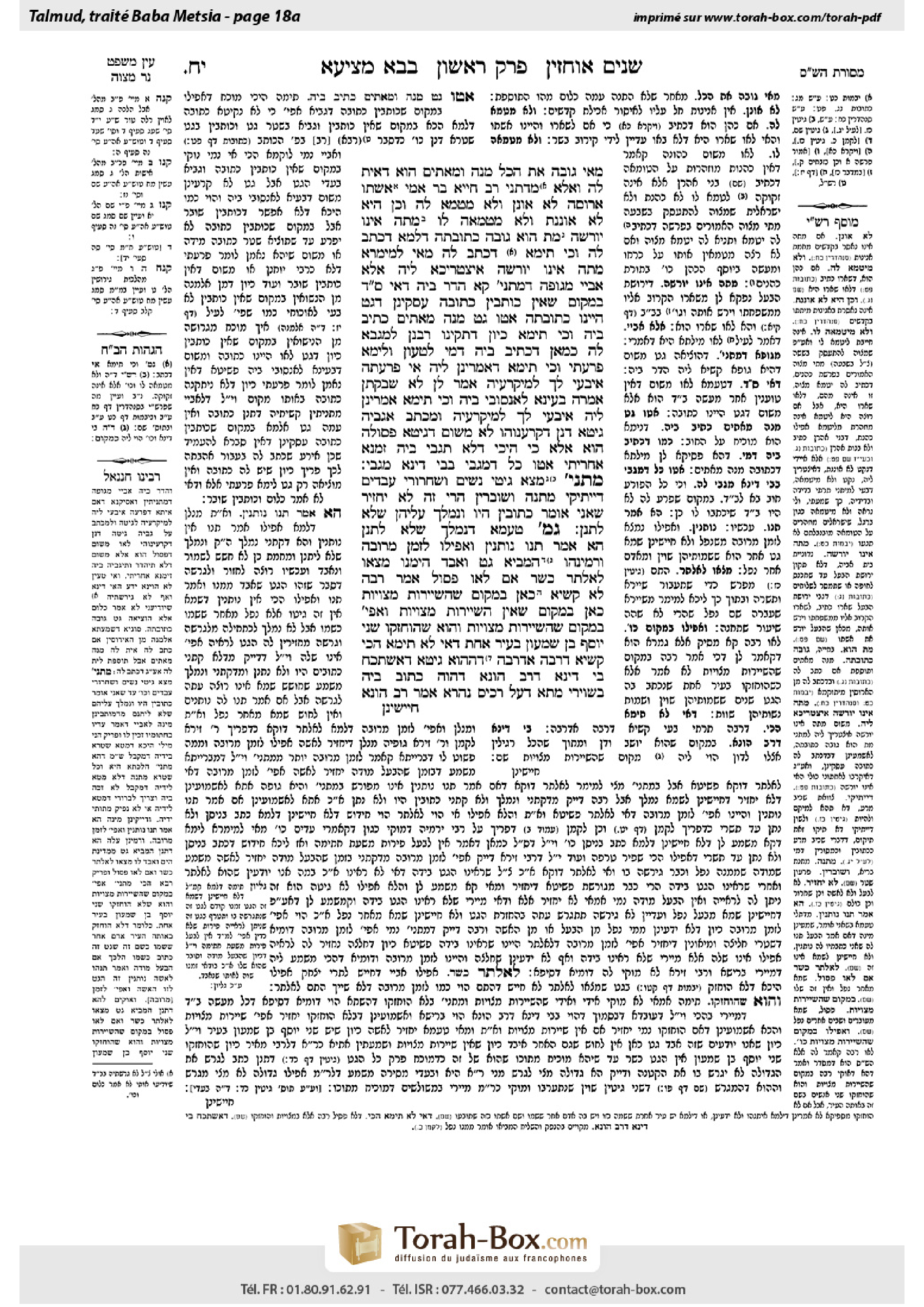
This page of Bava Metzia includes the Aramaic text, an English translation and an AI-generated French translation, alongside the scan above.
בבא מציעא י״ח א · Aramaic and Hebrew text
מַאי ״גּוֹבָה אֶת הַכֹּל״? מָנֶה וּמָאתַיִם הוּא דְּאִית לַהּ.
וְאֶלָּא, מִדְּתָנֵי רַב חִיָּיא בַּר אַמֵּי: אִשְׁתּוֹ אֲרוּסָה, לֹא אוֹנֵן וְלֹא מִטַּמֵּא לָהּ, וְכֵן הִיא לֹא אוֹנֶנֶת וְלֹא מִטַּמְּאָה לוֹ. מֵתָה – אֵינוֹ יוֹרְשָׁהּ, מֵת הוּא – גּוֹבָה כְּתוּבָּתָהּ.
דִּלְמָא דִּכְתַב לַהּ, וְכִי תֵּימָא: דִּכְתַב לַהּ, מַאי לְמֵימְרָא? מֵתָה אֵינוֹ יוֹרְשָׁהּ אִיצְטְרִיכָא לֵיהּ.
אֶלָּא אַבָּיֵי מִגּוּפַהּ דְּמַתְנִיתִין קָא הָדַר בֵּיהּ, דְּאִי סָלְקָא דַּעְתָּךְ בִּמְקוֹם שֶׁאֵין כּוֹתְבִין כְּתוּבָה עָסְקִינַן, דְּגֵט הַיְינוּ כְּתוּבְּתַהּ, אַטּוּ גֵּט מָנֶה מָאתַיִם כְּתִיב בֵּיהּ?
וְכִי תֵּימָא: כֵּיוָן דְּתַקִּינוּ רַבָּנַן לְמִגְבֵּא (לַהּ) [בֵּיהּ] כְּמַאן דִּכְתִיב בֵּיהּ דָּמֵי, לִטְעוֹן וְלֵימָא פָּרַעְתִּי.
וְכִי תֵּימָא דְּאָמְרִינַן לֵיהּ: אִי פְּרַעְתַּהּ אִיבְּעִי לָךְ לְמִיקְרְעֵיהּ, אָמַר לַן: לָא שְׁבַקְתַּן, אָמְרָה: בָּעֵינָא לְאִנְּסוֹבֵי בֵּיהּ.
וְכִי תֵּימָא אָמְרִינַן לֵיהּ: אִיבְּעִי לָךְ לְמִיקְרְעֵיהּ וּמִכְתַּב אַגַּבֵּיהּ, גִּיטָּא דְּנַן דִּקְרַעְנוּהּו לָא מִשּׁוּם דְּגִיטָּא פְּסוּלָה הוּא, אֶלָּא כִּי הֵיכִי דְּלָא תִּגְבֵּי בֵּיהּ זִמְנָא אַחֲרִיתִי. אַטּוּ כֹּל דְּמַגְבֵּי, בְּבֵי דִינָא מַגְבֵּי?
מַתְנִי׳ מָצָא גִּיטֵּי נָשִׁים וְשִׁחְרוּרֵי עֲבָדִים, דְּיָיתֵיקֵי, מַתָּנָה, וְשׁוֹבָרִין – הֲרֵי זֶה לֹא יַחֲזִיר. שֶׁאֲנִי אוֹמֵר: כְּתוּבִין הָיוּ, וְנִמְלַךְ עֲלֵיהֶן שֶׁלֹּא לִתְּנָן.
גְּמָ׳ טַעְמָא דְּנִמְלַךְ שֶׁלֹּא לִתְּנָן, הָא אָמַר: ״תְּנוּ״ – נוֹתְנִין, וַאֲפִילּוּ לִזְמַן מְרוּבֶּה.
וּרְמִינְהוּ: הַמֵּבִיא גֵּט, וְאָבַד הֵימֶנּוּ – מְצָאוֹ לְאַלְתַּר כָּשֵׁר, אִם לָאו – פָּסוּל.
אָמַר רַבָּה, לָא קַשְׁיָא: כָּאן – בִּמְקוֹם שֶׁהַשְּׁיָירוֹת מְצוּיוֹת, כָּאן – בִּמְקוֹם שֶׁאֵין הַשַּׁיָּירוֹת מְצוּיוֹת.
וַאֲפִילּוּ בִּמְקוֹם שֶׁהַשְּׁיָירוֹת מְצוּיוֹת – וְהוּא שֶׁהוּחְזְקוּ שְׁנֵי יוֹסֵף בֶּן שִׁמְעוֹן בְּעִיר אַחַת.
דְּאִי לָא תֵּימָא הָכִי, קַשְׁיָא דְּרַבָּה אַדְּרַבָּה. דְּהָהוּא גִּיטָּא דְּאִשְׁתְּכַח בֵּי דִינָא דְּרַב הוּנָא, דַּהֲוָה כְּתִוב בֵּיהּ בִּשְׁוִירֵי מָתָא דְּעַל רָכִיס נַהֲרָא. אָמַר רַב הוּנָא:
Bava Metzia 18a · English translation
then what is meant by the wording: She collects all that she is entitled to? What she has is only the main sum of the marriage contract of one hundred or two hundred dinars that she can collect. Clearly, the mishna is referring to a case where the husband wrote a marriage contract, and it does not indicate that a betrothed widow receives payment of her marriage contract.
And if one would say that the marriage contract of a betrothed woman is instead derived from that which Rav Ḥiyya bar Ami teaches, that is also difficult. He teaches: One does not enter acute mourning on the day of the death of his betrothed wife, nor may he become ritually impure at her funeral if she dies, if he is a priest; and similarly, she does not enter acute mourning for him if he dies, and she may not become ritually impure at his funeral. If she dies, he does not inherit her property. If he dies, she collects payment of her marriage contract.
If it is derived from here that a betrothed woman receives payment of a marriage contract, this is not proof, as perhaps this too is referring to a case where he wrote a marriage contract for her. And if you would say that if it is referring to a case where he wrote her a marriage contract, what is the purpose of stating this? One could answer that while this clause is obvious, it was necessary for Rav Ḥiyya bar Ami to state that conversely, if she dies, he does not inherit her property.
Rather, Abaye retracted his objection to Rabbi Yoḥanan’s proof from the mishna, not because of the case of a widow from betrothal, but due to an indication from within the mishna itself. Because if it enters your mind that we are dealing with a place where they do not write a marriage contract, where a woman’s bill of divorce is effectively her marriage contract, and therefore she can use her bill of divorce to collect payment of her marriage contract, that does not make sense; is it written in a bill of divorce that the husband is liable to pay the wife the one hundred or two hundred dinars she is owed? In fact, this is not written in a bill of divorce.
And even if you would say that since the Sages instituted that she use the bill of divorce to collect her marriage contract, it is considered as though the liability of the husband to pay one hundred or two hundred dinars is written in it, and it would still be problematic to say that the bill of divorce is sufficient for her to collect payment. The husband should still be able to claim that he is exempt, and say: I already paid it.
And if you would say that if the husband would state such a claim, we would say to him: If, in fact, you paid her, you should have torn up the bill of divorce, and he could respond and say to us: She did not allow me to tear it up, because she said: I need the bill of divorce to remarry, by using it as proof that I am divorced.
And if you would say that we would then say to him: You should have torn up the bill of divorce and written on the back of it: The reason that we tore up this bill of divorce is not because it is an invalid bill of divorce, but rather it is in order that the woman not collect payment of her marriage contract again with it, this suggestion is not always applicable. Does everyone who collects payment of a marriage contract collect payment in court, where it is possible to write such a legal statement? Therefore, the suggestion that a bill of divorce serves as a marriage contract remains untenable. This leads to the conclusion that the basis for collecting payment of a marriage contract where such a document does not exist must be a court enactment, in accordance with the interpretation of Rabbi Yoḥanan.
MISHNA: If one found bills of divorce, or bills of manumission of slaves, or wills, or deeds of a gift, or receipts, he may not return these items to the one who is presumed to have lost them, as I say it is possible that they were written and then the writer reconsidered about them and decided not to deliver them.
GEMARA: It can be inferred from the mishna that the only reason that these documents are not returned is that there is a concern that the person obligated by the document reconsidered with regard to them and decided not to deliver them. But if the writer says: Give this found document to the intended recipient, the finder must give it to him. And since the mishna places no limitation on this, presumably this is the halakha even if a long time passed since it was lost, and there is no concern that perhaps the document belongs to someone else with the same name.
And the Gemara raises a contradiction from a mishna (Gittin 27a): With regard to an agent who was bringing a bill of divorce to a woman, and it was lost by him, if he found it immediately, the bill of divorce is still valid. If not, then it is not valid, as it is possible that the bill of divorce that he found is not the same one that he lost, and this second bill of divorce belongs to someone else whose name and wife’s name are identical to the names of the husband and wife in the lost bill of divorce.
Rabba says: This is not difficult, because there, in tractate Gittin, the mishna is stated with regard to a place where caravans passing through are common, and there is a concern that the found bill of divorce belongs to someone else with the identical name. By contrast, the mishna here is stated with regard to a place where caravans passing through are uncommon, so there is no such concern.
The Gemara adds: And even in a place where caravans passing through are common, there is not always a concern that the bill of divorce may belong to another man with an identical name, and this concern is only where it has been established that there are two men named, for example, Yosef ben Shimon in that one city.
As, if you do not say so, that this concern is taken into account only in a place where it is known that there are two people with this same name, then there is a difficulty presented in the form of a contradiction between this statement of Rabba and another statement of Rabba. As there was a certain bill of divorce that was found in the court of Rav Huna, in which it was written that the bill of divorce was written in Sheviri City, which is located on the Rakhis River. Rav Huna said about this:
Bava Metzia 18a · Traduction française (IA)
alors que signifie l'expression : elle réclame tout ce à quoi elle a droit ? Ce qu'elle possède est seulement la somme principale du contrat de mariage d'une centaine ou de deux cents dinars qu'elle peut récupérer. Il est clair que la mitsna fait référence à un cas où l'époux a rédigé un contrat de mariage, et elle ne suggère pas que la veuve fiancée reçoive le paiement du contrat de mariage.
Et si l'on disait que le contrat de mariage de la fiancée est dérivé de ce que Rav Ḥiyya bar Ami enseigne, à savoir que l'on ne commence pas la douleur aiguë le jour de la mort de sa fiancée, ni ne peut devenir impur à son enterrement si elle meurt, si l'on est un prêtre ; et de même, elle ne commence pas la douleur aiguë pour lui si il meurt, et elle ne peut pas devenir impur à son enterrement. Si elle meurt, il ne hérite pas de ses biens. Si il meurt, elle récupère le paiement de son contrat de mariage.
Si l'on en déduit ici que la fiancée reçoit le paiement du contrat de mariage, cela ne constitue pas une preuve, car peut-être cela aussi fait référence à un cas où l'époux a rédigé un contrat de mariage pour elle. Et si l'on disait que cela fait référence à un cas où l'époux a rédigé un contrat de mariage pour elle, à quoi cela sert-il de le dire ? On pourrait répondre que bien que cette clause soit évidente, il était nécessaire que Rav Ḥiyya bar Ami l'ait dit pour préciser le contraire, à savoir que si elle meurt, il ne hérite pas de ses biens.
Plutôt, Abaye a retiré son objection contre la preuve de Rabbi Yoḥanan tirée de la Michna, pas à cause du cas de la veuve fiancée, mais à cause d'une indication à l'intérieur même de la Michna. Parce que si l'idée vous vient que nous sommes en présence d'un lieu où l'on ne rédige pas de contrat de mariage, où la déclaration de divorce d'une femme est effectivement son contrat de mariage, et donc elle peut utiliser sa déclaration de divorce pour récupérer le paiement de son contrat de mariage, cela n'a pas de sens ; est-il écrit dans une déclaration de divorce que l'époux est tenu de payer à la femme la centaine ou les deux cents dinars qu'elle doit ? En réalité, cela n'est pas écrit dans une déclaration de divorce.
Et même si l'on disait que, puisque les Sages ont institué qu'elle utilise la déclaration de divorce pour récupérer le paiement de son contrat de mariage, on considère cela comme si la responsabilité de l'époux de payer cent ou deux cents dinars était écrite dedans, et il resterait problématique de dire que la déclaration de divorce suffit à la récupérer. L'époux devrait pouvoir prétendre qu'il est exempt et dire : J'ai déjà payé.
Et si l'on disait que, si l'époux faisait une telle déclaration, on lui dirait : Si, en effet, vous l'avez payé, vous auriez dû déchirer la déclaration de divorce, et il pourrait répondre et dire : Elle n'a pas permis que je la déchire, car elle a dit : J'ai besoin de la déclaration de divorce pour me remarier, en l'utilisant comme preuve que je suis divorcé.
Et si l'on disait que nous dirions alors à lui : Vous auriez dû déchirer la déclaration de divorce et écrire sur l'arrière : La raison pour laquelle nous avons déchiré cette déclaration de divorce n'est pas parce qu'il s'agit d'une déclaration de divorce invalide, mais plutôt pour que la femme ne récupère pas à nouveau le paiement de son contrat de mariage avec elle, cette suggestion n'est pas toujours applicable. Tout le monde qui récupère le paiement d'un contrat de mariage récupère-t-il ce paiement en justice, où il est possible d'écrire une telle déclaration légale ? Ainsi, la suggestion que la déclaration de divorce sert de contrat de mariage reste inacceptable. Cela mène à la conclusion que la base du paiement d'un contrat de mariage où aucun document n'existe doit être une ordonnance de la cour, conformément à l'interprétation de Rabbi Yoḥanan.
MICHNA : Si l'on trouve des déclarations de divorce, ou des déclarations de manumission des esclaves, ou des testaments, ou des actes de don, ou des reçus, on ne doit pas rendre ces objets à la personne qui est supposée les avoir perdus, car je dis qu'il est possible qu'ils aient été rédigés et que l'auteur ait ensuite réfléchi et décidé de ne pas les livrer.
GUEMARA : On peut en déduire de la mitsva que la seule raison pour laquelle ces documents ne sont pas rendus est que l'on craint que la personne obligée par le document ait réfléchi à leur sujet et ait décidé de ne pas les livrer. Mais si l'auteur dit : Donnez ce document trouvé à la personne destinataire, le trouver doit le lui donner. Et puisque la mitsva ne précise pas de limitation à cela, on peut supposer que c'est la halakha même si un long temps s'est écoulé depuis qu'ils ont été perdus, et qu'il n'y a pas de crainte qu'ils appartiennent à quelqu'un d'autre avec le même nom.
Et la Guemara soulève une contradiction à partir d'une Michna (Gittin 27a) : Concernant un agent qui apportait une déclaration de divorce à une femme et qui l'avait perdue, si il la retrouve immédiatement, la déclaration de divorce est toujours valide. Si non, alors elle ne l'est pas, car il est possible que la déclaration de divorce trouvée ne soit pas la même que celle perdue, et cette deuxième déclaration de divorce appartienne à quelqu'un d'autre dont les noms et celui de la femme sont identiques à ceux de l'époux et de la femme de la déclaration de divorce perdue.
Rabba dit : Ce n'est pas difficile, car là, dans le traité Gittin, la Michna est formulée dans un lieu où les caravanes passant par là sont nombreuses, et il y a une crainte que la déclaration de divorce trouvée appartienne à quelqu'un d'autre avec le même nom. Par contraste, la Michna ici est formulée dans un lieu où les caravanes passant par là sont rares, donc il n'y a pas cette crainte.
La Guemara ajoute : Et même dans un lieu où les caravanes passant par là sont nombreuses, il n'y a pas toujours de crainte que la déclaration de divorce appartienne à un autre homme avec un même nom, et cette crainte n'existe que là où il a été établi qu'il y a deux hommes nommés, par exemple Yosef ben Shimon, dans cette même ville.
Si vous ne dites pas cela, cela signifie que cette préoccupation est prise en compte uniquement dans un lieu où il est connu qu'il y a deux personnes portant ce même nom. Il y a alors une difficulté sous la forme d'une contradiction entre cette déclaration de Rabba et une autre déclaration de Rabba. Il y avait un certain acte de divorce trouvé dans la cour de Rav Huna, dans lequel il était écrit que l'acte de divorce avait été rédigé dans la ville de Sheviri, située sur le fleuve Rakhis. Rav Huna a dit à ce sujet :
Traduction française générée par IA à partir de l’édition anglaise de Sefaria. Vérifie toujours un passage avec le texte source.
Text from Sefaria: William Davidson Edition - Vocalized Aramaic (CC BY NC); William Davidson Edition - English (CC BY NC).