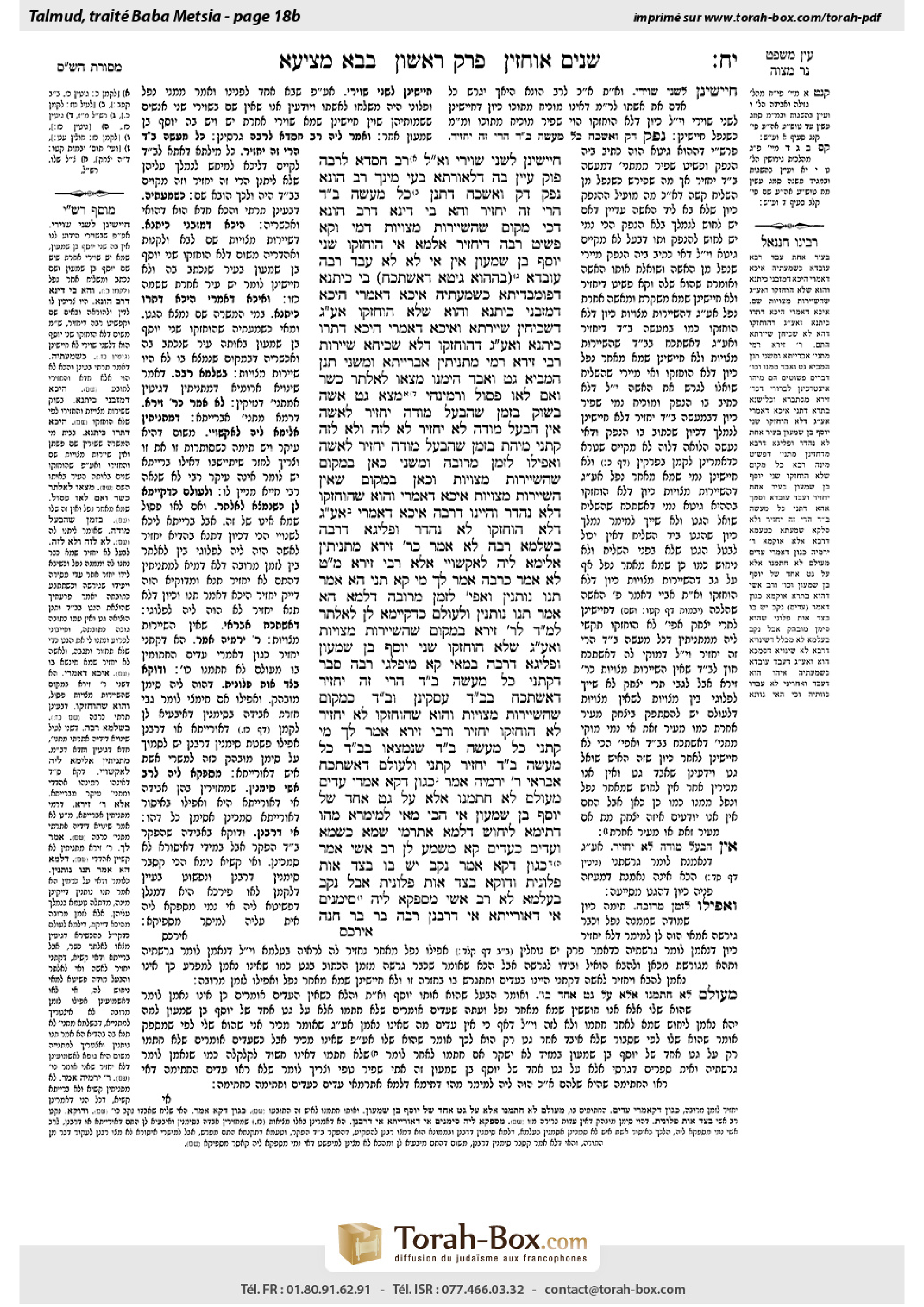
Bava Metzia 18b: Talmud study for Daf Yomi
Study the Talmud for Daf Yomi with scanned pages, Hebrew text, English translations from Sefaria and AI-generated French translations.
Passage selection and English or AI-generated French translation are available where the scan has annotations. Daf Study is independent of Torah-Box and Sefaria.
Browse Bava Metzia · בבא מציעא · All tractatesBava Metzia 18b text and translations
This page of Bava Metzia includes the Aramaic text, an English translation and an AI-generated French translation, alongside the scan above.
בבא מציעא י״ח ב · Aramaic and Hebrew text
חָיְישִׁינַן לִשְׁנֵי שְׁוִירֵי, וַאֲמַר לֵיהּ רַב חִסְדָּא לְרַבָּה: פּוֹק עַיֵּין בָּהּ, דִּלְאוּרְתָּא בָּעֵי מִינָּךְ רַב הוּנָא. נְפַק, דַּק וְאַשְׁכַּח. דִּתְנַן: כׇּל מַעֲשֵׂה בֵּית דִּין – הֲרֵי זֶה יַחֲזִיר.
וְהָא בֵּי דִינָא דְּרַב הוּנָא, דְּכִי מְקוֹם שֶׁהַשְּׁיָירוֹת מְצוּיוֹת דָּמֵי, וְקָא פָּשֵׁיט רַבָּה דְּיַחְזִיר, אַלְמָא אִי הוּחְזְקוּ שְׁנֵי יוֹסֵף בֶּן שִׁמְעוֹן – אִין, אִי לָא – לָא.
עֲבַד רַבָּה עוֹבָדָא בְּהָהוּא גִּיטָּא דְּאִשְׁתְּכַח בֵּי כִיתָּנָא דְּפוּמְבְּדִיתָא כִּשְׁמַעְתֵּיהּ.
אִיכָּא דְּאָמְרִי: הֵיכָא דִּמְזַבְּנִי כִּיתָּנָא וְהוּא שֶׁלֹּא הוּחְזְקוּ, אַף עַל גַּב דִּשְׁכִיחָן שְׁיָירָתָא.
וְאִיכָּא דְּאָמְרִי: הֵיכָא דְּתָרוּ כִּיתָּנָא וְאַף עַל גַּב דְּהוּחְזְקוּ, דְּלָא (שְׁכִיחָא שְׁיָירוֹת).
רַבִּי זֵירָא רָמֵי מַתְנִיתִין אַבָּרַיְיתָא וּמְשַׁנֵּי. תְּנַן: הַמֵּבִיא גֵּט וְאָבַד הֵימֶנּוּ, מְצָאוֹ לְאַלְתַּר – כָּשֵׁר, וְאִם לָאו – פָּסוּל. וּרְמִינְהִי: מָצָא גֵּט אִשָּׁה בַּשּׁוּק, בִּזְמַן שֶׁהַבַּעַל מוֹדֶה – יַחְזִיר לְאִשָּׁה. אֵין הַבַּעַל מוֹדֶה – לֹא יַחְזִיר לֹא לָזֶה וְלֹא לָזֶה.
קָתָנֵי מִיהַת בִּזְמַן שֶׁהַבַּעַל מוֹדֶה – יַחְזִיר לָאִשָּׁה, וַאֲפִילּוּ לִזְמַן מְרוּבֶּה!
וּמְשַׁנֵּי: כָּאן בִּמְקוֹם שֶׁהַשְּׁיָירוֹת מְצוּיוֹת, וְכָאן בִּמְקוֹם שֶׁאֵין הַשְּׁיָירוֹת מְצוּיוֹת.
אִיכָּא דְּאָמְרִי: וְהוּא שֶׁהוּחְזְקוּ דְּלָא נַהְדַּר, וְהַיְינוּ דְּרַבָּה. אִיכָּא דְּאָמְרִי: אַף עַל גַּב דְּלָא הוּחְזְקוּ לָא נַהְדַּר, וּפְלִיגָא דְּרַבָּה.
בִּשְׁלָמָא רַבָּה לָא אָמַר כְּרַבִּי זֵירָא, מַתְנִיתִין אַלִּימָא לֵיהּ לְאַקְשׁוֹיֵי. אֶלָּא רַבִּי זֵירָא, מַאי טַעְמָא לָא אָמַר כְּרַבָּה?
אָמַר לָךְ, מִי קָא תָנֵי: הָא אָמַר ״תְּנוּ״ – נוֹתְנִין וַאֲפִילּוּ לִזְמַן מְרוּבֶּה? דִּלְמָא הָא אָמַר ״תְּנוּ״ – נוֹתְנִין, וּלְעוֹלָם כִּדְקַיְימָא לַן לְאַלְתַּר.
לְמַאן דְּאָמַר לְרַבִּי זֵירָא בִּמְקוֹם שֶׁהַשְּׁיָירוֹת מְצוּיוֹת, וְאַף עַל גַּב שֶׁלֹּא הוּחְזְקוּ שְׁנֵי יוֹסֵף בֶּן שִׁמְעוֹן, וּפְלִיגָא דְּרַבָּה, בְּמַאי קָא מִיפַּלְגִי?
רַבָּה סָבַר דְּקָתָנֵי כׇּל מַעֲשֵׂה בֵּית דִּין הֲרֵי זֶה יַחְזִיר, דְּאִשְׁתְּכַח בְּבֵית דִּין עָסְקִינַן, וּבֵית דִּין כִּמְקוֹם שֶׁהַשְּׁיָירוֹת מְצוּיוֹת, וְהוּא שֶׁהוּחְזְקוּ – לֹא יַחְזִיר, לֹא הוּחְזְקוּ – יַחְזִיר.
וְרַבִּי זֵירָא אָמַר לָךְ: מִי קָתָנֵי ״כׇּל מַעֲשֵׂה בֵּית דִּין שֶׁנִּמְצְאוּ בְּבֵית דִּין״? ״כׇּל מַעֲשֵׂה בֵּית דִּין יַחְזִיר״ קָתָנֵי, וּלְעוֹלָם דְּאִשְׁתְּכַח אַבָּרַאי.
רַבִּי יִרְמְיָה אָמַר, כְּגוֹן דְּקָא אָמְרִי עֵדִים: מֵעוֹלָם לֹא חָתַמְנוּ אֶלָּא עַל גֵּט אֶחָד שֶׁל יוֹסֵף בֶּן שִׁמְעוֹן.
אִי הָכִי, מַאי לְמֵימְרָא? מַהוּ דְּתֵימָא לֵיחוּשׁ דִּלְמָא אִתְרְמִי שְׁמָא כִּשְׁמָא, וְעֵדִים כְּעֵדִים, קָא מַשְׁמַע לַן.
רַב אָשֵׁי אָמַר, כְּגוֹן דְּקָא אָמַר: נֶקֶב יֵשׁ בּוֹ בְּצַד אוֹת פְּלוֹנִית.
וְדַוְקָא בְּצַד אוֹת פְּלוֹנִית, אֲבָל נֶקֶב בְּעָלְמָא – לָא.
רַב אָשֵׁי מְסַפְּקָא לֵיהּ סִימָנִים אִי דְּאוֹרָיְיתָא אִי דְּרַבָּנַן.
רַבָּה בַּר בַּר חָנָה
Bava Metzia 18b · English translation
We are concerned about the possibility that there are two cities named Sheviri and that this bill of divorce may belong to someone else who lives in the other Sheviri, and therefore it should not be returned. And Rav Ḥisda said to Rabba about this issue: Go out and examine this halakha, as in the evening Rav Huna will ask you about it. He went out, examined it, and discovered a relevant source, as we learned in a mishna (20a): One must return any court enactment, i.e., a promissory note that has been authenticated by the court, to its owner. Since the bill of divorce was found in the court, it is in this category and must be returned.
The Gemara concludes its proof that even in a place where passing caravans are common, the concern that the bill of divorce belongs to another couple applies only if it is known that there is another couple in the same locale with the same names as those written in the bill of divorce: And the court of Rav Huna is comparable to a place where passing caravans are common, as many people from different places pass through for judgment. And yet, Rabba resolved that if one finds a bill of divorce there, he should return it. Evidently he holds that if it is established that there are two people named Yosef ben Shimon in the city, then there is indeed a concern and the document should not be returned, but if not, there is no concern.
The Gemara relates that Rabba performed an action, i.e., issued a practical ruling, with regard to a certain bill of divorce that was found in a flax house in the city of Pumbedita, in accordance with his halakha, and he instructed that the bill of divorce should be returned.
There is disagreement as to the exact details of the case. There are those who say that this occurred in the place where people sell flax, and it is specifically because it was not established that two couples with the same names lived in the city where the bill of divorce was written that Rabba ruled that the bill of divorce should be returned despite the fact that passing caravans are common there.
And there are those who say that it occurred in the place where people soak flax, and he ruled that the bill of divorce should be returned even though it was established that there were two couples with the same names living in the city where the bill of divorce was written, as passing caravans are uncommon there.
Similarly, Rabbi Zeira raises a contradiction between the mishna and a baraita, and he resolves the contradiction employing the same distinction. We learned in the mishna: With regard to an agent who was bringing a bill of divorce to a woman and he lost it, if he found it immediately, the bill of divorce is still valid, but if not, it is not valid. And Rabbi Zeira raises a contradiction between this mishna and a baraita that states: If one found a woman’s bill of divorce in the marketplace, in a case when the husband admits that he wrote and gave it to the wife, the finder must return it to the wife; but if the husband does not admit to this, he may return it neither to this one, the husband, nor to that one, the wife.
In any event, the baraita teaches that in a case when the husband admits that he wrote it, the finder must return it to the wife, and this is the halakha even if it was found after a long time.
And Rabbi Zeira answers that here, in the case of the mishna, the bill of divorce is valid only if it is found immediately, as it is a case where it is found in a place where passing caravans are common. And there, in the baraita, the bill of divorce can be returned even if it was found after a long time, as it is a case where it is found in a place where passing caravans are uncommon.
The Gemara compares the rulings of Rabba and Rabbi Zeira. There are those who say, with regard to Rabbi Zeira’s statement that the finder should not return the bill of divorce in a place where passing caravans are common: And this applies specifically in a case where it is established that there are two couples in the town with the same names. In that case, Rabbi Zeira holds that the bill of divorce should not be returned, and this is the same ruling as that of Rabba. And there are those who say: In a place where passing caravans are common, even if it is not established that there are two couples with the same names, the bill of divorce should not be returned, and Rabbi Zeira disagrees with the ruling of Rabba.
The Gemara asks: Granted, Rabba does not state his explanation in accordance with that of Rabbi Zeira and raise a contradiction from the baraita, as he holds that a mishna serves as a stronger basis for raising a difficulty than a baraita, as the Mishna, redacted by Rabbi Yehuda HaNasi, employs more precise language; but what is the reason that Rabbi Zeira does not state his explanation in accordance with that of Rabba and raise a contradiction from the Mishna?
The Gemara answers: Rabbi Zeira could have said to you: Does the mishna actually teach that if the one who wrote the document says: Give it to the intended recipient, the finder must give it to him, and that this is the halakha even if a long time passed since it was lost? This was only an inference from the mishna. Perhaps the mishna merely means to indicate that if the writer says: Give it to the intended recipient, the finder must give it to him, but actually, this is to be understood as we maintain in the mishna in Gittin, that this halakha applies only if the document was found immediately. Therefore, Rabbi Zeira posed his question from the baraita.
The Gemara asks: According to the one who says that according to the opinion of Rabbi Zeira a document may not be returned in a place where passing caravans are common, and this is the halakha even if it was not established that there are two people named Yosef ben Shimon in town, and he disagrees with Rabba, with regard to what do Rabbi Zeira and Rabba disagree? What is the foundation of their dispute?
The Gemara answers: Rabba maintains his opinion based on the mishna (20a) that teaches: One must return any court enactment. He understands that we are dealing with a document that was found in court, and a court is equivalent to a place where passing caravans are common. And therefore, he maintains that it is specifically in a place where it is established that there are two people with the same name that the finder should not return the document to its presumed owner; but in a place where it is not established that there are two people with the same name, he should return it.
And Rabbi Zeira, who disagrees with Rabba, could have said to you: Does the mishna teach that one must return any court enactment that was found in court? It teaches that one must return any court enactment, without specifying the location where the court enactment was found, and it is actually referring to a case where the documents were found outside the court. If it was found inside the court, it should not be returned. Therefore, Rabbi Zeira was not convinced by Rabba’s proof.
Rabbi Yirmeya states an alternative resolution to the contradiction between the mishna here and the baraita, on the one hand, and the mishna in Gittin on the other: A found bill of divorce should be returned only in a case where the witnesses who signed the bill of divorce say: We have never signed a bill of divorce of a person named Yosef ben Shimon other than this one, in which case there is no concern that the bill of divorce belongs to someone else.
The Gemara asks: If that is so, what is the purpose of stating that one returns the bill of divorce? Since it clearly belongs to him, there is no question that it must be returned to him. The Gemara answers that it is necessary lest you say that one should be concerned that perhaps it happened that another bill of divorce was written in which the names of the husband and the wife are identical to the names of the husband and wife of the second bill of divorce, and the names of the witnesses on that bill of divorce are identical to the names of the witnesses on this bill of divorce, when in fact they are different witnesses. To counter this, the mishna teaches us that this is not a concern.
Rav Ashi stated another resolution to the contradiction: The bill of divorce should be returned only in a case where the person claiming to have lost it provides a clear-cut distinguishing mark, e.g., he says: There is a hole in the bill of divorce next to such and such a letter.
The Gemara comments: And Rav Ashi permits one to return such a bill of divorce specifically when the one claiming to have lost it says that the hole is next to such and such a letter, as that is a clear-cut distinguishing mark. But if he said only that it had a hole without mentioning its precise location, one should not return the bill of divorce, as that is not considered a clear-cut distinguishing mark.
The Gemara explains: Rav Ashi is uncertain whether a lost item is returned to its owner on the basis of distinguishing marks by Torah law or whether it is by rabbinic law. Therefore, in the case of a bill of divorce, he holds that one may rely only on a clear-cut distinguishing mark, as everyone agrees that a lost item is returned to its owner on the basis of a clear-cut distinguishing mark by Torah law.
The Gemara relates that Rabba bar bar Ḥana
Bava Metzia 18b · Traduction française (IA)
Nous nous inquiétons du fait qu'il puisse exister deux villes nommées Sheviri et que ce contrat de divorce puisse appartenir à quelqu'un d'autre vivant dans l'autre Sheviri, et donc il ne devrait pas être rendu. Rav Ḥisda a dit à Rabba à propos de cette question : Sortez et examinez cette halakha, car en soirée Rav Huna vous posera cette question. Il est sorti, a examiné et a découvert une source pertinente, comme nous l'avons appris dans une mitsna (20a) : On doit rendre à son propriétaire tout document établi par la cour, c'est-à-dire un billet de change authentifié par la cour. Puisque ce contrat de divorce a été trouvé dans la cour, il appartient à cette catégorie et doit être rendu.
La Guemara conclut sa preuve que même dans un lieu où les caravanes passent fréquemment, l'inquiétude selon laquelle le contrat de divorce appartient à un autre couple s'applique uniquement si l'on sait qu'il existe un autre couple dans le même lieu avec les mêmes noms que ceux inscrits dans le contrat de divorce : Et la cour de Rav Huna est comparable à un lieu où les caravanes passent fréquemment, car de nombreuses personnes de différentes villes passent par là pour être jugées. Et pourtant, Rabba a décidé que si l'on trouve un contrat de divorce là, il devrait être rendu. Il est évident qu'il considère que si l'on établit qu'il existe deux personnes nommées Yosef ben Shimon dans la ville, alors il y a une inquiétude et le document ne devrait pas être rendu, mais si ce n'est pas le cas, il n'y a pas d'inquiétude.
La Guemara rapporte que Rabba a accompli une action, c'est-à-dire a rendu un jugement pratique, concernant un certain contrat de divorce trouvé dans une maison de lin à la ville de Pumbedita, conformément à sa halakha, et il a ordonné que le contrat de divorce soit rendu.
Il existe un désaccord sur les détails exacts du cas. Certains disent que cela s'est produit dans le lieu où l'on vend du lin, et c'est précisément parce que cela n'a pas été établi qu'il y avait deux couples avec les mêmes noms dans la ville où le contrat de divorce a été rédigé que Rabba a décidé que le contrat de divorce devrait être rendu malgré le fait que des caravanes passent fréquemment là.
Et d'autres disent que cela s'est produit dans le lieu où l'on immerge du lin, et il a décidé que le contrat de divorce devrait être rendu même s'il a été établi qu'il y avait deux couples avec les mêmes noms vivant dans la ville où le contrat de divorce a été rédigé, car les caravanes passent rarement là.
De même, Rabbi Zeira soulève une contradiction entre la mitsna et une baraïta, et il résout cette contradiction en utilisant la même distinction. Nous avons appris dans la mitsna : Concernant un agent qui apportait un contrat de divorce à une femme et qui l'a perdu, si il le retrouve immédiatement, le contrat de divorce est encore valide, mais si ce n'est pas le cas, il ne l'est pas. Et Rabbi Zeira soulève une contradiction entre cette mitsna et une baraïta qui stipule : Si l'on trouve un contrat de divorce d'une femme dans le marché, dans un cas où l'époux admet qu'il l'a rédigé et donné à la femme, le trouver doit le rendre à la femme ; mais si l'époux ne reconnaît pas cela, il ne peut le rendre ni à cet époux, ni à cette femme.
En tout cas, la baraïta enseigne que dans un cas où l'époux admet qu'il l'a rédigé, le trouver doit le rendre à la femme, et c'est la halakha même si le contrat de divorce a été trouvé après un long temps.
Et Rabbi Zeira répond que ici, dans le cas de la mitsna, le contrat de divorce est valide uniquement s'il est trouvé immédiatement, car c'est un cas où il est trouvé dans un lieu où les caravanes passent fréquemment. Et là, dans la baraïta, le contrat de divorce peut être rendu même s'il a été trouvé après un long temps, car c'est un cas où il est trouvé dans un lieu où les caravanes passent rarement.
La Guemara compare les décisions de Rabba et de Rabbi Zeira. Certains disent, concernant la déclaration de Rabbi Zeira que le trouver ne doit pas rendre le contrat de divorce dans un lieu où les caravanes passent fréquemment : Et cela s'applique spécifiquement dans un cas où il est établi qu'il y a deux couples dans la ville avec les mêmes noms. Dans ce cas, Rabbi Zeira considère que le contrat de divorce ne devrait pas être rendu, et c'est la même décision que celle de Rabba. Et d'autres disent : Dans un lieu où les caravanes passent fréquemment, même si cela n'est pas établi qu'il y a deux couples avec les mêmes noms, le contrat de divorce ne devrait pas être rendu, et Rabbi Zeira s'oppose à la décision de Rabba.
La Guemara pose la question : D'accord, Rabba ne formule pas son explication selon celle de Rabbi Zeira et ne soulève pas de contradiction à partir de la baraïta, car il considère que la mitsva sert de base plus solide pour poser un problème que la baraïta, car la mitsva, rédigée par Rabbi Yehuda HaNasi, utilise un langage plus précis ; mais quelle est la raison pour laquelle Rabbi Zeira ne formule pas son explication selon celle de Rabba et ne soulève pas de contradiction à partir de la mitsva ?
La Guemara répond : Rabbi Zeira aurait pu dire : Est-ce que la mitsva enseigne effectivement que si celui qui a rédigé le document dit : Donnez-le à la personne destinataire, le trouver doit le lui donner, et que c'est la halakha même si un long temps s'est écoulé depuis qu'il a été perdu ? Cela n'était qu'une inférence de la mitsva. Peut-être que la mitsva signifie simplement indiquer que si l'écrivain dit : Donnez-le à la personne destinataire, le trouver doit le lui donner, mais en réalité, cela doit être compris comme nous le maintenons dans la mitsva de Gittin, que cette halakha s'applique uniquement si le document a été trouvé immédiatement. Ainsi, Rabbi Zeira a posé sa question à partir de la baraïta.
La Guemara pose la question : Selon celui qui dit que selon l'opinion de Rabbi Zeira, un document ne peut pas être rendu dans un lieu où les caravanes passent fréquemment, et c'est la halakha même si cela n'a pas été établi qu'il y a deux personnes nommées Yosef ben Shimon dans la ville, et qu'il s'oppose à la décision de Rabba, à propos de quoi Rabbi Zeira et Rabba s'opposent ? Quelle est la base de leur débat ?
La Guemara répond : Rabba maintient son opinion en se basant sur la michna (20a) qui enseigne : On doit rendre à son propriétaire tout arrêt de tribunal trouvé. Il comprend que nous sommes en présence d'un document trouvé dans un tribunal, et un tribunal est équivalent à un lieu où des caravanes passent fréquemment. Et donc, il affirme que c'est spécifiquement dans un lieu où il est établi qu'il y a deux personnes portant le même nom que le trouver devrait ne pas rendre le document à son propriétaire supposé ; mais dans un lieu où il n'est pas établi qu'il y a deux personnes portant le même nom, il devrait le rendre.
Et Rabbi Zeïra, qui s'oppose à Rabba, aurait pu te dire : La michna enseigne-t-elle que l'on doit rendre tout arrêt de tribunal trouvé dans un tribunal ? Elle enseigne que l'on doit rendre tout arrêt de tribunal, sans spécifier le lieu où l'arrêt de tribunal a été trouvé, et elle fait référence en réalité à un cas où les documents ont été trouvés en dehors du tribunal. Si l'arrêt de tribunal avait été trouvé à l'intérieur du tribunal, il ne devrait pas être rendu. Ainsi, Rabbi Zeïra n'était pas convaincu par la preuve de Rabba.
Rabbi Yirmeyah propose une résolution alternative à la contradiction entre la michna ici et la baraïta, d'une part, et la michna dans Gittin, d'autre part : Un billet de divorce trouvé devrait être rendu uniquement dans le cas où les témoins ayant signé le billet de divorce disent : Nous n'avons jamais signé un billet de divorce d'une personne nommée Yosef ben Shimon autre que celui-ci, dans ce cas-là, il n'y a pas de crainte que le billet de divorce appartienne à quelqu'un d'autre.
La Guemara pose la question : Si c'est ainsi, à quoi sert de dire qu'on rend le billet de divorce ? Puisque c'est clairement à lui, il n'y a pas de doute qu'il doive être rendu à lui. La Guemara répond que cela est nécessaire pour éviter que l'on dise qu'on doive craindre que peut-être un autre billet de divorce ait été écrit où les noms du mari et de la femme sont identiques aux noms du mari et de la femme du second billet de divorce, et les noms des témoins sur ce billet de divorce sont identiques aux noms des témoins sur ce billet de divorce, alors que ce sont en réalité des témoins différents. Pour contre cela, la michna nous enseigne que cela n'est pas une préoccupation.
Rav Ashi a proposé une autre résolution à la contradiction : Le billet de divorce devrait être rendu uniquement dans le cas où la personne affirmant avoir perdu le billet fournit un signe distinctif clair, par exemple, il dit : Il y a un trou dans le billet de divorce à côté de telle et telle lettre.
La Guemara commente : Et Rav Ashi permet de rendre un tel billet de divorce spécifiquement lorsque celui qui affirme avoir perdu le billet dit que le trou est à côté de telle et telle lettre, car c'est un signe distinctif clair. Mais si il a dit seulement qu'il y avait un trou sans mentionner son emplacement précis, on ne devrait pas rendre le billet de divorce, car cela n'est pas considéré comme un signe distinctif clair.
La Guemara explique que Rav Ashi est incertain quant à la base juridique selon laquelle un objet perdu est rendu à son propriétaire : est-ce par la Loi divine, en se basant sur un signe distinctif, ou par la loi rabbinique. Ainsi, dans le cas d'un billet de divorce, il considère qu'on peut se fier uniquement à un signe distinctif clair, car tout le monde convient que l'objet perdu est rendu à son propriétaire selon la Loi divine, en se basant sur un signe distinctif clair.
La Guemara rapporte que Rabba bar bar Ḥana
Traduction française générée par IA à partir de l’édition anglaise de Sefaria. Vérifie toujours un passage avec le texte source.
Text from Sefaria: William Davidson Edition - Vocalized Aramaic (CC BY NC); William Davidson Edition - English (CC BY NC).