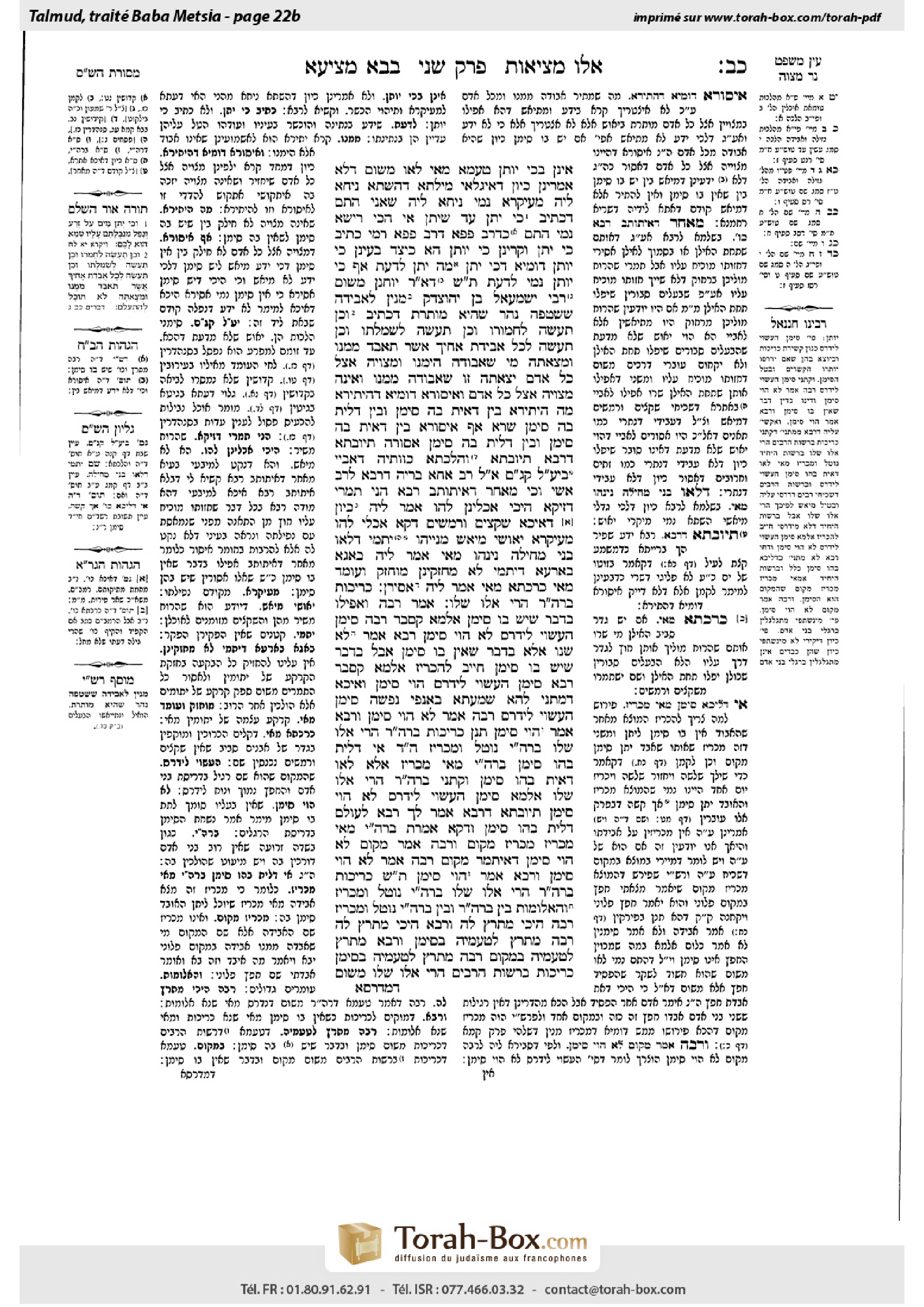
Bava Metzia 22b: Talmud study for Daf Yomi
Study the Talmud for Daf Yomi with scanned pages, Hebrew text, English translations from Sefaria and AI-generated French translations.
Passage selection and English or AI-generated French translation are available where the scan has annotations. Daf Study is independent of Torah-Box and Sefaria.
Browse Bava Metzia · בבא מציעא · All tractatesBava Metzia 22b text and translations
This page of Bava Metzia includes the Aramaic text, an English translation and an AI-generated French translation, alongside the scan above.
בבא מציעא כ״ב ב · Aramaic and Hebrew text
אֵינָן בְּכִי יוּתַּן.
טַעְמָא מַאי? לָאו מִשּׁוּם דְּלָא אָמְרִינַן כֵּיוָן דְּאִיגַּלַּאי מִילְּתָא דְּהַשְׁתָּא נִיחָא לֵיהּ, מֵעִיקָּרָא נָמֵי נִיחָא לֵיהּ? שָׁאנֵי הָתָם, דִּכְתִיב ״כִּי יִתֵּן״. עַד שֶׁיִּתֵּן.
אִי הָכִי, רֵישָׁא נָמֵי: הָתָם כִּדְרַב פָּפָּא. דְּרַב פָּפָּא רָמֵי, כְּתִיב ״כִּי יִתֵּן״, וְקָרֵינַן כִּי יוּתַּן! הָא כֵּיצַד?
בָּעֵינַן ״כִּי יוּתַּן״ דֻּומְיָא ״דְּכִי יִתֵּן״. מָה ״יִתֵּן״ לְדַעַת, אַף ״כִּי יוּתַּן״ נָמֵי לְדַעַת.
תָּא שְׁמַע דְּאָמַר רַבִּי יוֹחָנָן מִשּׁוּם רַבִּי יִשְׁמָעֵאל בֶּן יְהוֹצָדָק: מִנַּיִן לַאֲבֵידָה שֶׁשְּׁטָפָהּ נָהָר שֶׁהִיא מוּתֶּרֶת? דִּכְתִיב: ״וְכֵן תַּעֲשֶׂה לַחֲמוֹרוֹ וְכֵן תַּעֲשֶׂה לְשִׂמְלָתוֹ וְכֵן תַּעֲשֶׂה לְכׇל אֲבֵידַת אָחִיךָ אֲשֶׁר תֹּאבַד מִמֶּנּוּ וּמְצָאתָהּ״. מִי שֶׁאֲבוּדָה הֵימֶנּוּ וּמְצוּיָה אֵצֶל כׇּל אָדָם, יָצָאתָה זוֹ שֶׁאֲבוּדָה מִמֶּנּוּ וְאֵינָהּ מְצוּיָה אֵצֶל כׇּל אָדָם.
וְאִיסּוּרָא דּוּמְיָא דְּהֶיתֵּירָא, מָה הֶיתֵּירָא בֵּין דְּאִית בַּהּ סִימָן וּבֵין דְּלֵית בַּהּ סִימָן – שַׁרְיָא, אַף אִיסּוּרָא בֵּין דְּאִית בַּהּ סִימַן וּבֵין דְּלֵית בַּהּ סִימָן – אֲסִירָא. תְּיוּבְתָּא דְרָבָא, תְּיוּבְתָּא!
וְהִלְכְתָא כְּווֹתֵיהּ דְּאַבָּיֵי בְּיַעַל קַגַּם.
אֲמַר לֵיהּ רַב אַחָא בְּרֵיהּ דְּרָבָא לְרַב אָשֵׁי: וְכִי מֵאַחַר דְּאִיתּוֹתַב רָבָא – הָנֵי תַּמְרֵי דְזִיקָא הֵיכִי אָכְלִינַן לְהוּ? אֲמַר לֵיהּ: כֵּיוָן דְּאִיכָּא שְׁקָצִים וּרְמָשִׂים דְּקָא אָכְלִי לְהוּ, מֵעִיקָּרָא יָאוֹשֵׁי מְיָאַשׁ מִנַּיְיהוּ.
יַתְמֵי דְּלָאו בְּנֵי מְחִילָה נִינְהוּ, מַאי? אֲמַר לֵיהּ: בָּאגָא בְּאַרְעָא דְיַתְמֵי לָא מַחְזְקִינַן.
מוּחְזָק וְעוֹמֵד, מַאי? כְּרַכְתָּא, מַאי? אֲמַר לֵיהּ: אֲסִירָן.
כְּרִיכוֹת בִּרְשׁוּת הָרַבִּים – הֲרֵי אֵלּוּ שֶׁלּוֹ. אָמַר רַבָּה: וַאֲפִילּוּ בְּדָבָר שֶׁיֵּשׁ בּוֹ סִימָן. אַלְמָא קָסָבַר רַבָּה: סִימָן הֶעָשׂוּי לִידָּרֵס לָא הָוֵי סִימָן. רָבָא אָמַר: לֹא שָׁנוּ אֶלָּא בְּדָבָר שֶׁאֵין בּוֹ סִימָן, אֲבָל בְּדָבָר שֶׁיֵּשׁ בּוֹ סִימָן חַיָּיב לְהַכְרִיז. אַלְמָא קָסָבַר רָבָא: סִימָן הֶעָשׂוּי לִידָּרֵס הָוֵי סִימָן.
וְאִיכָּא דְּמַתְנֵי לְהָא שְׁמַעְתָּא בְּאַנְפֵּי נַפְשַׁהּ: סִימָן הֶעָשׂוּי לִידָּרֵס, רַבָּה אָמַר: לָא הָוֵי סִימָן, וְרָבָא אָמַר: הָוֵי סִימָן.
תְּנַן: כְּרִיכוֹת בִּרְשׁוּת הָרַבִּים – הֲרֵי אֵלּוּ שֶׁלּוֹ, בִּרְשׁוּת הַיָּחִיד – נוֹטֵל וּמַכְרִיז. הֵיכִי דָּמֵי? אִי דְּלֵית בְּהוּ סִימָן, בִּרְשׁוּת הַיָּחִיד מַאי מַכְרֵיז? אֶלָּא לָאו דְּאִית בְּהוּ סִימָן, וְקָתָנֵי: בִּרְשׁוּת הָרַבִּים – הֲרֵי אֵלּוּ שֶׁלּוֹ. אַלְמָא סִימָן הֶעָשׂוּי לִידָּרֵס לָא הָוֵי סִימָן, תְּיוּבְתָּא דְּרָבָא!
אָמַר לָךְ רָבָא: לְעוֹלָם דְּלֵית בְּהוּ סִימָן, וּדְקָא אָמְרַתְּ בִּרְשׁוּת הַיָּחִיד מַאי מַכְרֵיז? מַכְרֵיז מָקוֹם. וְרַבָּה אָמַר: מָקוֹם לָא הָוֵי סִימָן. דְּאִיתְּמַר: מָקוֹם, רַבָּה אָמַר: לָא הָוֵי סִימָן, וְרָבָא אָמַר: הָוֵי סִימָן.
תָּא שְׁמַע: כְּרִיכוֹת בִּרְשׁוּת הָרַבִּים – הֲרֵי אֵלּוּ שֶׁלּוֹ, בִּרְשׁוּת הַיָּחִיד – נוֹטֵל וּמַכְרִיז. וְהָאֲלוּמּוֹת, בֵּין בִּרְשׁוּת הָרַבִּים בֵּין בִּרְשׁוּת הַיָּחִיד – נוֹטֵל וּמַכְרִיז. רַבָּה הֵיכִי מְתָרֵץ לַהּ, וְרָבָא הֵיכִי מְתָרֵץ לַהּ? רַבָּה מְתָרֵץ לְטַעְמֵיהּ, בְּסִימָן. וְרָבָא מְתָרֵץ לְטַעְמֵיהּ, בְּמָקוֹם.
רַבָּה מְתָרֵץ לְטַעְמֵיהּ בְּסִימָן: כְּרִיכוֹת בִּרְשׁוּת הָרַבִּים – הֲרֵי אֵלּוּ שֶׁלּוֹ, מִשּׁוּם
Bava Metzia 22b · English translation
the produce is not in the category of: “But when water is placed [khi yuttan] upon the seed,” and the produce is not susceptible to contracting ritual impurity.
What is the reason that if the produce dried, the fact that the owner is glad does not render it susceptible to ritual impurity? Is it not due to the fact that we do not say: Since the matter was revealed that he is amenable to the moisture now, he was also amenable from the outset? The same should be true with regard to despair that is not conscious. The fact that when he becomes aware of his loss he despairs of its recovery does not indicate that he despaired from the outset, contrary to the opinion of Rava. The Gemara rejects the proof: It is different there, as although the phrase is vocalized to mean: “When it is placed,” it is written: When one places [ki yitten], from which it is derived that the produce is rendered susceptible to ritual impurity only if the owner places the liquid on the produce.
The Gemara asks: If so, in the first clause of the baraita, too, the produce should not be rendered susceptible to contracting impurity, because the dew fell on the produce and was not placed there by the owner. The Gemara answers: There, the explanation is in accordance with the opinion of Rav Pappa, as Rav Pappa raised a contradiction: The verse states: “But when water is placed [vekhi yuttan] upon the seed, and any part of a carcass falls thereon, it is ritually impure unto you” (Leviticus 11:38). The word “yuttan” is written in the defective form, as if it says “ki yitten.” Accordingly, this would mean that one must actively place the water on the produce. Yet, we read it, based on the tradition as to its correct pronunciation, as if it is written “ki yuttan,” which includes any situation where the produce becomes wet. How so? How can the way the verse is written and the way it is read be reconciled?
Rav Pappa explains that we require that the situation described by the words “when water is placed [ki yuttan]” be similar to the situation described by the words: When one places [dekhi yitten]: Just as the term places [yitten] indicates that it is with the knowledge of the owner that the produce becomes wet, as he himself is placing the water, so too, the term “is placed [yuttan]” means that it is with his knowledge that the produce becomes wet, despite the fact that he did not place the water himself. Therefore, no proof may be cited with regard to the matter of despair, where there is no Torah derivation requiring awareness from the outset.
The Gemara suggests: Come and hear a proof from that which Rabbi Yoḥanan says in the name of Rabbi Yishmael ben Yehotzadak: From where is it derived with regard to a lost item that the river swept away that it is permitted for its finder to keep it? It is derived from this verse, as it is written: “And so shall you do with his donkey; and so shall you do with his garment; and so shall you do with every lost item of your brother, which shall be lost from him, and you have found it” (Deuteronomy 22:3). The verse states that one must return that which is lost from him, the owner, but is available to be found by any person. Excluded from that obligation is that which is lost from him and is not available to be found by any person; it is ownerless property and anyone who finds it may keep it.
And the prohibition written in the verse against keeping an item that is lost only to its owner is similar to the allowance to keep an item lost to all people that is inferred from the verse; just as in the case of the allowance, whether there is a distinguishing mark and whether there is no distinguishing mark, it is permitted for the finder to keep it, so too in the case of the prohibition, whether there is a distinguishing mark and whether there is no distinguishing mark, it is prohibited for the finder to keep it, until there is proof that the owner despaired of its recovery. The Gemara concludes: The refutation of the opinion of Rava is indeed a conclusive refutation.
And although in disputes between Abaye and Rava, the halakha is typically ruled in accordance with the opinion of Rava, the halakha is in accordance with the opinion of Abaye in the disputes represented by the mnemonic: Yod, ayin, lamed; kuf, gimmel, mem.
Rav Aḥa, son of Rava, said to Rav Ashi: And now that the opinion of Rava was conclusively refuted, and the halakha is that despair that is not conscious is not considered despair, if those dates are blown off the tree by the wind, how do we eat them? Perhaps their owner did not despair of their recovery. Rav Ashi said to him: Since there are repugnant creatures and creeping animals that eat the dates after they fall, the owner despairs of their recovery from the outset. Therefore, one who finds the dates may keep them.
Rav Aḥa asked: Perhaps the tree belonged to minor orphans who, because they are not capable of relinquishing property, cannot despair of recovering the dates from the outset. Accordingly, what is the justification for eating found dates? Rav Ashi said to him: We do not presume a valley to be land belonging to orphans, and therefore that is not a concern.
Rav Aḥa asked: If the presumptive status of the trees was previously established as belonging to orphans, what is the halakha? If the trees are surrounded by fences that prevent repugnant creatures and creeping animals from gaining access, what is the halakha? Rav Ashi said to him: The dates are forbidden in those cases.
§ The mishna teaches that if one found bundles of grain in a public area, these belong to him. Rabba says with regard to this ruling: And this is the halakha even with regard to an item on which there is a distinguishing mark. The Gemara comments: Apparently, Rabba holds that the legal status of a distinguishing mark that is prone to be trampled is not that of a distinguishing mark. Since the owner of the lost item knows that the mark is prone to be trampled, he does not rely on it and he despairs of recovering the item. Rava said: The Sages taught this halakha only with regard to an item on which there is no distinguishing mark, but with regard to an item on which there is a distinguishing mark, the one who finds it is obligated to proclaim his find. The Gemara comments: Apparently, Rava holds that the legal status of a distinguishing mark that is prone to be trampled is that of a distinguishing mark.
And there are those who teach the dispute with regard to this halakha independent of the mishna. With regard to the legal status of a distinguishing mark that is prone to be trampled, Rabba says: It is not a distinguishing mark. And Rava says: It is a distinguishing mark.
The Gemara cites proof from that which we learned in a baraita: If one finds bundles of grain in a public area, these belong to him; if he finds them in a secluded area, the finder takes them and proclaims his find. What are the circumstances? If it is a case where there is no distinguishing mark on the bundles, when one finds them in a secluded area, what does he proclaim? Rather, is it not a case where there is a distinguishing mark on the bundles, and there is then a reason for him to proclaim his find. And yet, it is taught in the baraita that if he finds the bundles in a public area those bundles belong to him. Apparently, a distinguishing mark that is prone to be trampled is not a distinguishing mark. This is a conclusive refutation of the opinion of Rava.
Rava could have said to you: Actually, it is a case where there is no distinguishing mark on the bundles. And with regard to that which you said: When one finds them in a secluded area, what does he proclaim? He proclaims that the owner should provide the location where he lost the bundles and thereby recover his bundles. And Rabba said: The location, provided by the owner, is not a distinguishing mark that would enable the return of an item to its owner. As it was stated that the amora’im disputed this matter: With regard to location, Rabba says: It is not a distinguishing mark, and Rava says: It is a distinguishing mark.
The Gemara suggests: Come and hear a proof from a baraita: If one finds bundles of grain in a public area, these belong to him; if he finds them in a secluded area, the finder takes them and proclaims his find. And with regard to the sheaves, i.e., large bundles, whether he finds them in a public area or whether he finds them in a secluded area, the finder takes them and proclaims his find. How does Rabba explain the baraita, and how does Rava explain the baraita? Rabba explains, according to his line of reasoning, that the baraita is referring to bundles with a distinguishing mark. And Rava explains, according to his line of reasoning, that the baraita is referring to bundles whose location is their distinguishing mark.
The Gemara elaborates. Rabba explains, according to his line of reasoning, that the baraita is referring to bundles with a distinguishing mark: If one finds bundles of grain in a public area, these belong to him due to the fact
Bava Metzia 22b · Traduction française (IA)
le produit n'appartient pas à la catégorie : « Mais quand on verse [khi yuttan] sur la semence », et le produit n'est pas susceptible de contracter une impureté rituelle.
Pourquoi, dans le cas où le produit est sec, le fait que l'propriétaire soit content ne rend pas le produit susceptible d'impureté rituelle ? N'est-ce pas parce que nous ne disons pas : puisque la chose a été révélée qu'il est ouvert à la moiteur maintenant, il l'était aussi dès le début ? De même, c'est vrai concernant l'espoir non conscient. Le fait que lorsqu'il devient conscient de sa perte, il désespère de le récupérer ne montre pas qu'il avait désespéré dès le début, contrairement à l'opinion de Rava. La Guemara rejette cette preuve : c'est différent là, car bien que la phrase soit prononcée pour signifier : « Quand on le place », elle est écrite : « Quand on place [ki yitten] », d'où il est déduit que le produit est rendu susceptible d'impureté rituelle seulement si l'propriétaire verse le liquide sur le produit.
La Guemara pose la question : Si c'est ainsi, dans la première clause de la baraïta également, le produit ne devrait pas être rendu susceptible de contracter une impureté, puisque la rosée est tombée sur le produit et n'a pas été placée là par l'propriétaire. La Guemara répond : là, l'explication est selon l'opinion de Rav Pappa, car Rav Pappa a soulevé un problème : le verset dit : « Mais quand on verse [vekhi yuttan] sur la semence, et qu'une partie d'un cadavre tombe là-dessus, il est impur pour vous » (Lévitique 11:38). Le mot « yuttan » est écrit dans la forme défectueuse, comme si on disait « ki yitten ». Ainsi, cela signifierait qu'on doit activer le versement de l'eau sur le produit. Cependant, on le lit, selon la tradition de sa prononciation correcte, comme si on disait « ki yuttan », ce qui inclut toute situation où le produit devient humide. Comment cela est-il possible ? Comment peut-on concilier la manière dont le verset est écrit et la manière dont il est lu ?
Rav Pappa explique que nous exigeons que la situation décrite par les mots « quand on verse [ki yuttan] » soit semblable à celle décrite par les mots : « quand on place [dekhi yitten] » : Tout comme le terme « place [yitten] » indique que le produit devient humide avec la connaissance du propriétaire, car c'est lui qui verse l'eau, de même, le terme « est placé [yuttan] » signifie que le produit devient humide avec sa connaissance, même si le propriétaire n'a pas lui-même versé l'eau. Ainsi, aucune preuve ne peut être citée concernant la question de la désespérance, où il n'y a pas de dérivation talmudique exigeant la connaissance dès le début.
La Guemara suggère : Viens écouter une preuve à partir de ce que Rabbi Yoḥanan dit au nom de Rabbi Yishmael ben Yehotzadak : D'où est tiré le fait concernant un objet perdu que le fleuve a emporté qu'il est permis au trouvère de le garder ? C'est tiré de ce verset, car il est écrit : « Et ainsi tu feras avec son âne ; et ainsi tu feras avec sa robe ; et ainsi tu feras avec tout objet perdu de ton frère, qui lui a été perdu, et que tu as trouvé » (Dn 22:3). Le verset dit qu'on doit rendre à l'propriétaire l'objet perdu, mais qui est disponible à trouver par n'importe qui. Ce qui est exclu de cette obligation est ce qui est perdu par lui et n'est pas disponible à trouver par n'importe qui ; c'est un objet sans propriétaire et quiconque le trouve peut le garder.
Et la prohibition écrite dans le verset contre garder un objet perdu uniquement à son propriétaire est semblable à l'autorisation de garder un objet perdu à tous les gens, déduite du verset ; tout comme dans le cas de l'autorisation, qu'il y ait un signe distinctif ou non, il est permis au trouvère de le garder, de même dans le cas de la prohibition, qu'il y ait un signe distinctif ou non, il est interdit au trouvère de le garder, jusqu'à ce qu'il y ait une preuve que l'owner a désespéré de le récupérer. La Guemara conclut : La réfutation de l'opinion de Rava est effectivement une réfutation concluante.
Et bien que dans les débats entre Abaye et Rava, la halakha soit généralement décidée selon l'opinion de Rava, la halakha suit l'opinion d'Abaye dans les débats représentés par le mnémotechnique : Yod, Ayin, Lamed ; Kuf, Gimmel, Mem.
Rav Aḥa, fils de Rava, dit à Rav Ashi : Et maintenant que l'opinion de Rava a été concluamment réfutée, et que la halakha est que l'espoir non conscient n'est pas considéré comme un désespoir, si ces figues sont soufflées par le vent, comment les mangeons-nous ? Peut-être que leur propriétaire n'a pas désespéré de leur récupération. Rav Ashi dit à lui : Puisque des créatures repoussantes et des animaux rampants mangent les figues après qu'elles tombent, l'owner désespère de leur récupération dès le début. Ainsi, celui qui trouve les figues peut les garder.
Rav Aḥa demanda : Peut-être que l'arbre appartenait à des orphelins mineurs, qui, parce qu'ils ne peuvent pas renoncer à la propriété, ne peuvent pas désespérer de récupérer les figues dès le début. Ainsi, quelle est la justification de manger les figues trouvées ? Rav Ashi répondit à lui : Nous ne supposons pas une vallée être la propriété d'orphelins, et donc cela n'est pas un problème.
Rav Aḥa demanda : Si le statut présomptif des arbres était précédemment établi comme appartenant aux orphelins, quelle est la halakha ? Si les arbres sont entourés de clôtures qui empêchent les créatures repoussantes et les animaux rampants d'accéder, quelle est la halakha ? Rav Ashi répondit à lui : Les figues sont interdites dans ces cas.
§ La Michna enseigne que si l'on trouve des fagots de blé dans un lieu public, ceux-ci appartiennent à celui qui les a trouvés. Rabba dit concernant cette décision : Et cela est la halakha même concernant un objet sur lequel il y a un signe distinctif. La Guemara commente : Apparemment, Rabba considère que le statut juridique d'un signe distinctif qui est sujet à être foulé n'est pas celui d'un signe distinctif. Puisque le propriétaire de l'objet perdu sait que ce signe est sujet à être foulé, il ne peut pas s'y fier et il désespère de récupérer l'objet. Rava dit : Les Sages ont enseigné cette halakha uniquement concernant un objet sur lequel il n'y a pas de signe distinctif, mais concernant un objet sur lequel il y a un signe distinctif, celui qui le trouve est tenu de proclamer sa découverte. La Guemara commente : Apparemment, Rava considère que le statut juridique d'un signe distinctif qui est sujet à être foulé est celui d'un signe distinctif.
Et il y a ceux qui enseignent le débat concernant cette halakha indépendamment de la Michna. Concernant le statut juridique d'un signe distinctif qui est sujet à être foulé, Rabba dit : Ce n'est pas un signe distinctif. Et Rava dit : C'est un signe distinctif.
La Guemara cite une preuve tirée de ce que nous avons appris dans une baraïta : Si l'on trouve des fagots de blé dans un lieu public, ceux-ci appartiennent à celui qui les a trouvés ; si l'on les trouve dans un lieu isolé, celui qui les trouve les prend et proclame sa découverte. Quelles sont les circonstances ? Si c'est un cas où il n'y a pas de signe distinctif sur les fagots, quand l'on les trouve dans un lieu isolé, que proclame-t-il ? Plutôt, n'est-ce pas un cas où il y a un signe distinctif sur les fagots, et il y a alors une raison pour qu'il proclame sa découverte. Et pourtant, il est enseigné dans la baraïta que si l'on trouve les fagots dans un lieu public, ceux-ci appartiennent à celui qui les a trouvés. Apparemment, un signe distinctif qui est sujet à être foulé n'est pas un signe distinctif. Cela constitue une réfutation concluante de l'opinion de Rava.
Rava pourrait avoir dit à vous : En réalité, c'est un cas où il n'y a pas de signe distinctif sur les fagots. Et concernant ce que vous avez dit : Quand l'on les trouve dans un lieu isolé, que proclame-t-il ? Il proclame que le propriétaire doit indiquer la localisation où il a perdu les fagots et ainsi récupérer ses fagots. Et Rabba dit : La localisation, fournie par le propriétaire, n'est pas un signe distinctif qui permettrait de retrouver un objet à son propriétaire. Comme il a été dit que les amoraïm disputaient cette question : Concernant la localisation, Rabba dit : Ce n'est pas un signe distinctif, et Rava dit : C'est un signe distinctif.
La Guemara suggère : Venez entendre une preuve tirée d'une baraïta : Si l'on trouve des fagots de blé dans un lieu public, ceux-ci appartiennent à celui qui les a trouvés ; si l'on les trouve dans un lieu isolé, celui qui les trouve les prend et proclame sa découverte. Et concernant les gerbes, c'est-à-dire les grandes bouquets, qu'il les trouve dans un lieu public ou qu'il les trouve dans un lieu isolé, celui qui les trouve les prend et proclame sa découverte. Comment Rabba explique-t-il la baraïta, et comment Rava l'explique-t-il ? Rabba explique, selon sa ligne de raisonnement, que la baraïta fait référence à des fagots avec un signe distinctif. Et Rava explique, selon sa ligne de raisonnement, que la baraïta fait référence à des fagots dont la localisation est leur signe distinctif.
La Guemara développe. Rabba explique, selon sa ligne de raisonnement, que la baraïta fait référence à des fagots avec un signe distinctif : Si l'on trouve des fagots de blé dans un lieu public, ceux-ci appartiennent à celui qui les a trouvés en raison du fait que
Traduction française générée par IA à partir de l’édition anglaise de Sefaria. Vérifie toujours un passage avec le texte source.
Text from Sefaria: William Davidson Edition - Vocalized Aramaic (CC BY NC); William Davidson Edition - English (CC BY NC).