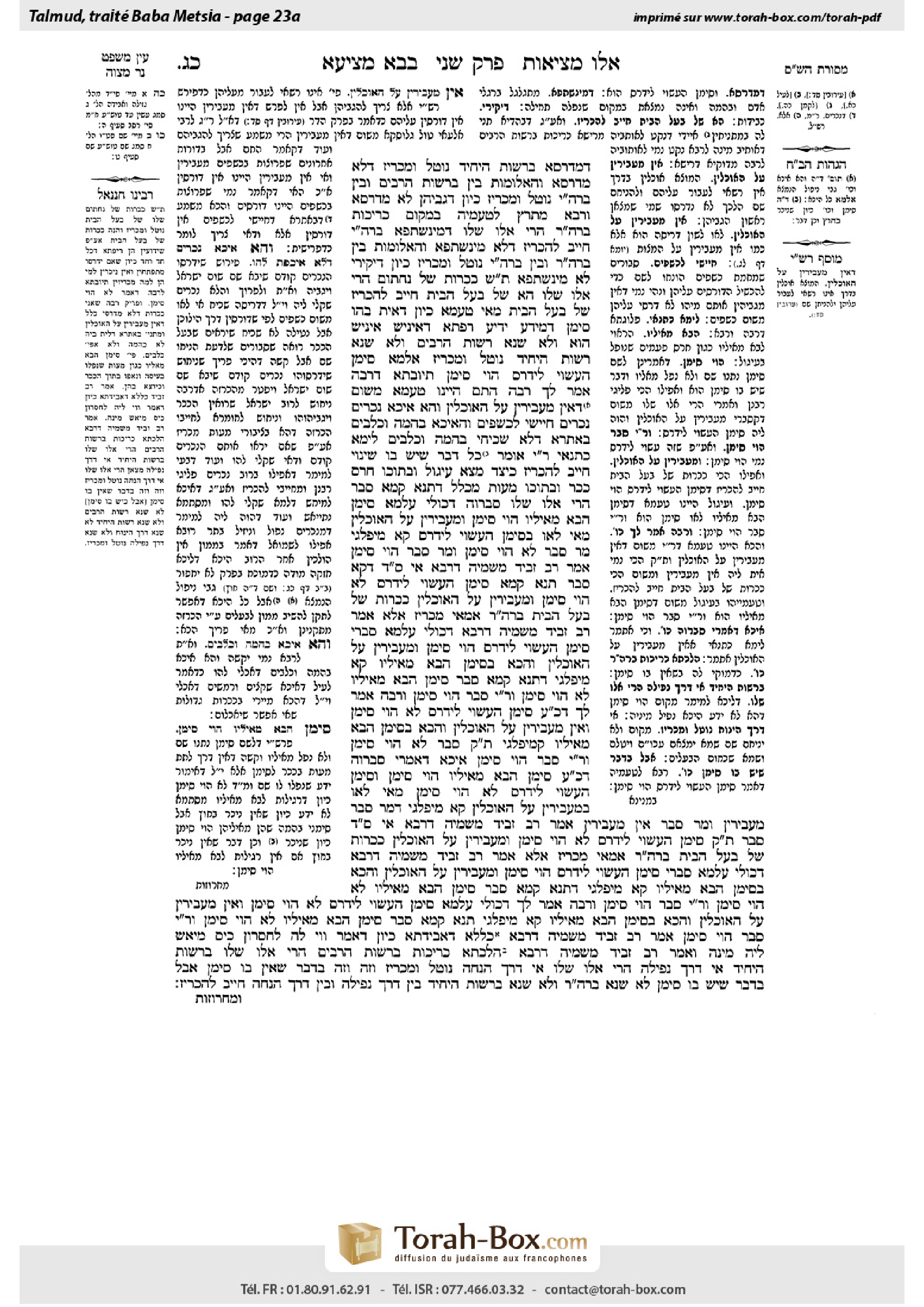
Bava Metzia 23a: Talmud study for Daf Yomi
Study the Talmud for Daf Yomi with scanned pages, Hebrew text, English translations from Sefaria and AI-generated French translations.
Passage selection and English or AI-generated French translation are available where the scan has annotations. Daf Study is independent of Torah-Box and Sefaria.
Browse Bava Metzia · בבא מציעא · All tractatesBava Metzia 23a text and translations
This page of Bava Metzia includes the Aramaic text, an English translation and an AI-generated French translation, alongside the scan above.
בבא מציעא כ״ג א · Aramaic and Hebrew text
דְּמִדַּרְסָא. בִּרְשׁוּת הַיָּחִיד – נוֹטֵל וּמַכְרִיז, דְּלָא מִדַּרְסָא. וְהָאֲלוּמּוֹת, בֵּין בִּרְשׁוּת הָרַבִּים וּבֵין בִּרְשׁוּת הַיָּחִיד – נוֹטֵל וּמַכְרִיז, כֵּיוָן דִּגְבִיהָן לָא מִדַּרְסָא.
וְרָבָא מְתָרֵץ לְטַעְמֵיהּ בְּמָקוֹם: כְּרִיכוֹת בִּרְשׁוּת הָרַבִּים הֲרֵי אֵלּוּ שֶׁלּוֹ – דְּמִינַּשְׁתְּפָא. בִּרְשׁוּת הַיָּחִיד חַיָּיב לְהַכְרִיז – דְּלָא מִינַּשְׁתְּפָא. וְהָאֲלוּמּוֹת, בֵּין בִּרְשׁוּת הָרַבִּים, וּבֵין בִּרְשׁוּת הַיָּחִיד – נוֹטֵל וּמַכְרִיז, כֵּיוָן דְּיַקִּירֵי לָא מִינַּשְׁתְּפָא.
תָּא שְׁמַע: כִּכָּרוֹת שֶׁל נַחְתּוֹם – הֲרֵי אֵלּוּ שֶׁלּוֹ. הָא שֶׁל בַּעַל הַבַּיִת חַיָּיב לְהַכְרִיז. שֶׁל בַּעַל הַבַּיִת מַאי טַעְמָא? כֵּיוָן דְּאִית בְּהוּ סִימָן, דְּמִידָּע יְדִיעַ רִפְתָּא דְאִינִישׁ אִינִישׁ הוּא. וְלָא שְׁנָא רְשׁוּת הָרַבִּים וְלָא שְׁנָא רְשׁוּת הַיָּחִיד – נוֹטֵל וּמַכְרִיז, אַלְמָא סִימָן הֶעָשׂוּי לִידָּרֵס הָוֵי סִימָן, תְּיוּבְתָּא דְּרַבָּה!
אָמַר לָךְ רַבָּה: הָתָם הַיְינוּ טַעְמָא – מִשּׁוּם דְּאֵין מַעֲבִירִין עַל הָאוֹכָלִין. וְהָא אִיכָּא גּוֹיִם! גּוֹיִם חָיְישִׁי לִכְשָׁפִים. וְהָאִיכָּא בְּהֵמָה וּכְלָבִים! בְּאַתְרָא דְּלָא שְׁכִיחִי בְּהֵמָה וּכְלָבִים.
לֵימָא כְּתַנָּאֵי: רַבִּי יְהוּדָה אוֹמֵר: כׇּל דָּבָר שֶׁיֵּשׁ בּוֹ שִׁינּוּי, חַיָּיב לְהַכְרִיז. כֵּיצַד? מָצָא עִיגּוּל וּבְתוֹכוֹ חֶרֶס, כִּכָּר וּבְתוֹכוֹ מָעוֹת. מִכְּלָל דְּתַנָּא קַמָּא סָבַר הֲרֵי אֵלּוּ שֶׁלּוֹ.
סַבְרוּהָ: דְּכוּלֵּי עָלְמָא סִימָן הַבָּא מֵאֵילָיו הָוֵי סִימָן, וּמַעֲבִירִין עַל הָאוֹכָלִין. מַאי לָאו: בְּסִימָן הֶעָשׂוּי לִידָּרֵס קָא מִיפַּלְגִי, מָר סָבַר: לָא הָוֵי סִימָן, וּמָר סָבַר: הָוֵי סִימָן?
אָמַר רַב זְבִיד מִשְּׁמֵיהּ דְּרָבָא: אִי סָלְקָא דַעְתָּךְ דְּקָא סָבַר תַּנָּא קַמָּא סִימָן הֶעָשׂוּי לִידָּרֵס לָא הָוֵי סִימָן, וּמַעֲבִירִין עַל הָאוֹכָלִין, כִּכָּרוֹת שֶׁל בַּעַל הַבַּיִת בִּרְשׁוּת הָרַבִּים אַמַּאי מַכְרִיז?
אֶלָּא, אָמַר רַב זְבִיד מִשְּׁמֵיהּ דְּרָבָא: דְּכוּלֵּי עָלְמָא סָבְרִי סִימָן הֶעָשׂוּי לִידָּרֵס הָוֵי סִימָן, וּמַעֲבִירִין עַל הָאוֹכָלִין. וְהָכָא בְּסִימָן הַבָּא מֵאֵילָיו קָא מִיפַּלְגִי, דְּתַנָּא קַמָּא סָבַר: סִימָן הַבָּא מֵאֵילָיו לָא הָוֵי סִימָן, וְרַבִּי יְהוּדָה סָבַר: הָוֵי סִימָן.
וְרַבָּה אָמַר לָךְ: דְּכוּלֵּי עָלְמָא סִימָן הֶעָשׂוּי לִידָּרֵס – לָא הָוֵי סִימָן וְאֵין מַעֲבִירִין עַל הָאוֹכָלִין. וְהָכָא בְּסִימָן הַבָּא מֵאֵילָיו קָמִיפַּלְגִי תַּנָּא קַמָּא סָבַר: לָא הָוֵי סִימָן, וְרַבִּי יְהוּדָה סָבַר: הָוֵי סִימָן.
אִיכָּא דְּאָמְרִי, סַבְרוּהָ: דְּכוּלֵּי עָלְמָא סִימָן הַבָּא מֵאֵילָיו הָוֵי סִימָן, וְסִימָן הֶעָשׂוּי לִידָּרֵס לָא הָוֵי סִימָן. מַאי לָאו: בְּמַעֲבִירִין עַל הָאוֹכָלִין קָא מִיפַּלְגִי, דְּמָר סָבַר: מַעֲבִירִין, וּמַר סָבַר: אֵין מַעֲבִירִין?
אָמַר רַב זְבִיד מִשְּׁמֵיהּ דְּרָבָא: אִי סָלְקָא דַעְתָּךְ סָבַר תַּנָּא קַמָּא סִימָן הֶעָשׂוּי לִידָּרֵס לָא הָוֵי סִימָן, וּמַעֲבִירִין עַל הָאוֹכָלִין – כִּכָּרוֹת שֶׁל בַּעַל הַבַּיִת בִּרְשׁוּת הָרַבִּים אַמַּאי מַכְרִיז?
אֶלָּא אָמַר רַב זְבִיד מִשְּׁמֵיהּ דְּרָבָא: דְּכוּלֵּי עָלְמָא סָבְרִי סִימָן הֶעָשׂוּי לִידָּרֵס – הָוֵי סִימָן, וּמַעֲבִירִין עַל הָאוֹכָלִין. וְהָכָא בְּסִימָן הַבָּא מֵאֵילָיו קָא מִיפַּלְגִי, דְּתַנָּא קַמָּא סָבַר: סִימָן הַבָּא מֵאֵילָיו – לָא הָוֵי סִימָן, וְרַבִּי יְהוּדָה סָבַר: הָוֵי סִימָן.
וְרַבָּה אָמַר לָךְ: דְּכוּלֵּי עָלְמָא סִימָן הֶעָשׂוּי לִידָּרֵס – לָא הָוֵי סִימָן, וְאֵין מַעֲבִירִין עַל הָאוֹכָלִין. וְהָכָא בְּסִימָן הַבָּא מֵאֵילָיו קָא מִיפַּלְגִי, תַּנָּא קַמָּא סָבַר: סִימָן הַבָּא מֵאֵילָיו – לָא הָוֵי סִימָן, וְרַבִּי יְהוּדָה סָבַר: הָוֵי סִימָן.
אָמַר רַב זְבִיד מִשְּׁמֵיהּ דְּרָבָא: כְּלָלָא דַּאֲבֵידְתָּא כֵּיוָן דְּאָמַר ״וַוי לֵהּ לְחֶסְרוֹן כִּיס״ – מִיָּאַשׁ לֵיהּ מִינַּהּ.
וְאָמַר רַב זְבִיד מִשְּׁמֵיהּ דְּרָבָא: הִלְכְתָא, כְּרִיכוֹת בִּרְשׁוּת הָרַבִּים – הֲרֵי אֵלּוּ שֶׁלּוֹ. בִּרְשׁוּת הַיָּחִיד, אִי דֶּרֶךְ נְפִילָה – הֲרֵי אֵלּוּ שֶׁלּוֹ, אִי דֶּרֶךְ הַנָּחָה – נוֹטֵל וּמַכְרִיז. וְזֶה וָזֶה בְּדָבָר שֶׁאֵין בּוֹ סִימָן, אֲבָל בְּדָבָר שֶׁיֵּשׁ בּוֹ סִימָן – לָא שְׁנָא בִּרְשׁוּת הָרַבִּים וְלָא שְׁנָא בִּרְשׁוּת הַיָּחִיד, בֵּין דֶּרֶךְ נְפִילָה וּבֵין דֶּרֶךְ הַנָּחָה – חַיָּיב לְהַכְרִיז.
Bava Metzia 23a · English translation
that they are trampled. Even if there had been a distinguishing mark on the bundles it would have been destroyed when it was trampled. If he finds them in a secluded area, the finder takes the sheaves and proclaims his find, as due to the absence of pedestrian traffic they are not trampled and the distinguishing mark remains intact. And with regard to the sheaves, whether he finds them in a public area or whether he finds them in a secluded area, the finder takes them and proclaims his find. Since they protrude high above the ground, they are not trampled.
And Rava explains, according to his line of reasoning, that the baraita is referring to bundles whose location is their distinguishing mark: If one finds bundles of grain in a public area, these belong to him due to the fact that they are kicked and they consequently roll to a different location than where they were placed. If he finds them in a secluded area, he is obligated to proclaim his find. Due to the absence of pedestrian traffic they are not kicked and do not roll, and they therefore remain in the location where they were placed. And with regard to the sheaves, whether he finds them in a public area or whether he finds them in a secluded area, the finder takes them and proclaims his find. Since they are heavy, they do not roll when kicked.
The Gemara suggests: Come and hear a proof from the mishna: If one found baker’s loaves, these belong to him. The Gemara infers: But if one finds loaves of a homeowner, he is obligated to proclaim his find. What is the reason? When one finds loaves of a homeowner he is obligated to proclaim his find because there is a distinguishing mark on the loaves. As each person shapes his loaves in a unique manner, it is known that the loaves of a person belong to that person. And there is no difference if the loaves were found in a public area, and there is no difference if the loaves were found in a secluded area; the finder takes the item and proclaims his find. Apparently, the legal status of a distinguishing mark that is prone to be trampled is that of a distinguishing mark. This is a conclusive refutation of the opinion of Rabba.
Rabba could have said to you: There, this is the reason that one must return the loaves of a homeowner found in a public area. It is due to the fact that one does not pass by food without picking it up. Therefore, it can be assumed that it will not be trampled. The Gemara asks: But aren’t there gentiles who do not treat food with deference and who will trample the loaves? The Gemara answers: Gentiles are concerned that the loaves were placed in a public area for reasons of sorcery. The Gemara asks: But aren’t there beasts and dogs that will trample the loaves? The Gemara answers: The mishna is referring to a place where beasts and dogs are not commonly found.
The Gemara suggests: Let us say that this dispute between Rabba and Rava is parallel to a dispute between tanna’im in the mishna. Rabbi Yehuda says: If one finds any lost item in which there is an alteration, he is obligated to proclaim his find. How so? If he found a round cake of pressed figs with an earthenware shard inside it, or a loaf of bread with coins inside it, he must proclaim his find. One may conclude by inference that the first tanna of the mishna holds that even in that case those items belong to him.
In explaining the tannaitic dispute, the Sages assumed that everyone agrees that the legal status of a distinguishing mark that could come to mark an item on its own without having been placed there intentionally is that of a distinguishing mark, and everyone agrees that one passes by food without picking it up. Accordingly, what is the basis of their dispute? Is it not with regard to the matter of a distinguishing mark that is prone to be trampled that they disagree? As one Sage, the first tanna, holds that its legal status is not that of a distinguishing mark, and one Sage, Rabbi Yehuda, holds that its legal status is that of a distinguishing mark.
Rav Zevid said in the name of Rava: If it enters your mind that the first tanna holds that the legal status of a distinguishing mark that is prone to be trampled is not that of a distinguishing mark and that one passes by food without picking it up, then in the case of loaves of a homeowner that were found in a public area, where the loaves would be trampled and their distinguishing mark destroyed, why does he proclaim his find?
Rather, Rav Zevid said in the name of Rava that everyone holds that the legal status of a distinguishing mark that is prone to be trampled is that of a distinguishing mark and that one passes by food without picking it up. And here, it is with regard to the legal status of a distinguishing mark that could come to mark an item on its own that they disagree. The first tanna holds that the legal status of a distinguishing mark that could come to mark an item on its own is not that of a distinguishing mark, and Rabbi Yehuda holds that the legal status of a distinguishing mark that could come to mark an item on its own is that of a distinguishing mark.
And Rabba could have said to you that everyone agrees that the legal status of a distinguishing mark that is prone to be trampled is not that of a distinguishing mark and that one does not pass by food without picking it up. And here, it is with regard to the legal status of a distinguishing mark that could come to mark an item on its own that they disagree. The first tanna holds that the legal status of a distinguishing mark that could come to mark an item on its own is not that of a distinguishing mark, and Rabbi Yehuda holds that the legal status of a distinguishing mark that could come to mark an item on its own is that of a distinguishing mark.
There are those who say, in explaining the tannaitic dispute, that the Sages assumed that everyone agrees that the legal status of a distinguishing mark that could come to mark an item on its own without having been placed there intentionally is that of a distinguishing mark, and everyone agrees that the legal status of a distinguishing mark that is prone to be trampled is not that of a distinguishing mark. What, then, is the basis of their dispute? Is it not with regard to the matter of whether one passes by food without picking it up that they disagree. As one Sage, the first tanna, holds that one passes by food without picking it up, and one Sage, Rabbi Yehuda, holds that one does not pass by food without picking it up.
Rav Zevid said in the name of Rava: If it enters your mind that the first tanna holds that the legal status of a distinguishing mark that is prone to be trampled is not that of a distinguishing mark and that one passes by food without picking it up, then in the case of loaves of a homeowner that were found in a public area, where the loaves would be trampled and their distinguishing mark destroyed, why does he proclaim his find?
Rather, Rav Zevid said in the name of Rava that everyone holds that the legal status of a distinguishing mark that is prone to be trampled is that of a distinguishing mark and that one passes by food without picking it up. And here, it is with regard to the legal status of a distinguishing mark that could come to mark an item on its own that they disagree. The first tanna holds that the legal status of a distinguishing mark that could come to mark an item on its own is not that of a distinguishing mark, and Rabbi Yehuda holds that the legal status of a distinguishing mark that could come to mark an item on its own is that of a distinguishing mark.
And Rabba could have said to you that everyone agrees that the legal status of a distinguishing mark that is prone to be trampled is not that of a distinguishing mark and that one does not pass by food without picking it up. And here, it is with regard to the legal status of a distinguishing mark that could come to mark an item on its own that they disagree. The first tanna holds that the legal status of a distinguishing mark that could come to mark an item on its own is not that of a distinguishing mark, and Rabbi Yehuda holds that the legal status of a distinguishing mark that could come to mark an item on its own is that of a distinguishing mark.
§ Rav Zevid said in the name of Rava that this is the principle of a lost item: Once the owner of a lost item says: Woe is me for the monetary loss, this indicates that he has despaired of its recovery.
And Rav Zevid said in the name of Rava: The halakha is that if one finds bundles of grain in a public area, those bundles belong to him. If he finds the bundles in a secluded area in a manner indicating that they had fallen, those bundles belong to him. If he finds the bundles in a manner indicating that they had been placed there, the finder takes them and proclaims his find. And both this ruling and that ruling are in the case of an item in which there is no distinguishing mark. But in the case of an item on which there is a distinguishing mark, it is no different if the bundles were found in a public area and it is no different if the bundles were found in a secluded area; whether the bundles were found in a manner indicating that they had fallen or whether they were found in a manner indicating that they had been placed there, he is obligated to proclaim his find.
Bava Metzia 23a · Traduction française (IA)
qu'ils soient écrasés. Même s'il y avait un signe distinctif sur les ballots, celui-ci aurait été détruit lorsqu'ils furent écrasés. Si l'on les trouve dans un lieu isolé, le trouvère prend les gerbes et proclame sa découverte, car, en l'absence de passage piéton, elles ne sont pas écrasées et le signe distinctif reste intact. Et concernant les gerbes, qu'elles soient trouvées dans un lieu public ou dans un lieu isolé, le trouvère les prend et proclame sa découverte. Étant donné qu'elles dépassent haut au-dessus du sol, elles ne sont pas écrasées.
Et Rava explique, selon sa ligne de raisonnement, que la baraïta fait référence à des ballots dont la localisation est leur signe distinctif : Si l'on trouve des ballots de céréales dans un lieu public, ceux-ci appartiennent à celui qui les a trouvés, car ils sont foulés et se déplacent vers un autre endroit que celui où ils étaient placés. Si l'on les trouve dans un lieu isolé, il est tenu de proclamer sa découverte. En l'absence de passage piéton, ils ne sont pas foulés et ne se déplacent pas, et restent donc à l'endroit où ils étaient placés. Et concernant les gerbes, qu'elles soient trouvées dans un lieu public ou dans un lieu isolé, le trouvère les prend et proclame sa découverte. Étant donné qu'elles sont lourdes, elles ne se déplacent pas lorsqu'elles sont foulées.
La Guemara suggère : Venez entendre une preuve tirée de la mitsva : Si l'on trouve des pains de boulanger, ceux-ci appartiennent à celui qui les a trouvés. La Guemara déduit : Mais si l'on trouve des pains d'un propriétaire, il est tenu de proclamer sa découverte. Pourquoi ? Lorsqu'on trouve des pains d'un propriétaire, il est tenu de proclamer sa découverte, car il y a un signe distinctif sur les pains. Comme chaque personne façonne ses pains de manière unique, on sait que les pains d'une personne appartiennent à cette personne. Il n'y a pas de différence si les pains ont été trouvés dans un lieu public, et il n'y a pas de différence si les pains ont été trouvés dans un lieu isolé ; le trouvère prend l'objet et proclame sa découverte. Apparemment, le statut juridique d'un signe distinctif sujet à être écrasé est celui d'un signe distinctif. C'est une réfutation concluante de l'opinion de Rabba.
Rabba aurait pu dire à vous : Là, c'est la raison pour laquelle on doit rendre les pains d'un propriétaire trouvés dans un lieu public. C'est en raison du fait que l'on ne passe pas devant les aliments sans les ramasser. On peut donc supposer qu'ils ne seront pas écrasés. La Guemara demande : Mais ne sont-il pas des non-Juifs qui ne traitent pas les aliments avec respect et qui écraseront les pains ? La Guemara répond : Les non-Juifs craignent que les pains aient été placés dans un lieu public à cause de la sorcellerie. La Guemara demande : Mais ne sont-il pas des bêtes et des chiens qui écraseront les pains ? La Guemara répond : La mitsva fait référence à un lieu où les bêtes et les chiens ne sont pas fréquents.
La Guemara suggère : Disons que ce débat entre Rabba et Rava est parallèle à un débat entre tannaïm dans la Michna. Rabbi Yehuda dit : Si l'on trouve un objet perdu dans lequel il y a une modification, il est tenu de proclamer sa découverte. Comment cela ? Si l'on trouve un gâteau rond de figues pressées avec une pièce de terre à l'intérieur, ou un pain de blé avec des pièces à l'intérieur, il doit proclamer sa découverte. On peut conclure par l'inférence que le premier tanna de la Michna considère que même dans ce cas, ces objets appartiennent à celui qui les a trouvés.
En expliquant le débat tannaïque, les Sages ont supposé que tout le monde est d'accord sur le statut juridique d'un signe distinctif qui pourrait marquer un objet sans avoir été placé là intentionnellement, et que tout le monde est d'accord sur le fait que l'on passe devant les aliments sans les ramasser. Ainsi, quelle est la base de leur débat ? N'est-ce pas concernant le statut juridique d'un signe distinctif sujet à être écrasé qu'ils divergent ? Comme un sage, le premier tanna, considère que son statut juridique n'est pas celui d'un signe distinctif, et un autre sage, Rabbi Yehuda, considère que son statut juridique est celui d'un signe distinctif.
Rav Zevid a dit en nom de Rava : Si cela entre dans votre esprit que le premier tanna considère que le statut juridique d'un signe distinctif sujet à être écrasé n'est pas celui d'un signe distinctif et que l'on passe devant les aliments sans les ramasser, alors, dans le cas de pains d'un propriétaire trouvés dans un lieu public, où les pains seraient écrasés et leur signe distinctif détruit, pourquoi proclame-t-on sa découverte ?
Plutôt, Rav Zevid a dit en nom de Rava que tout le monde considère que le statut juridique d'un signe distinctif sujet à être foulé est celui d'un signe distinctif et que l'on passe devant les aliments sans les ramasser. Et ici, il s'agit du statut juridique d'un signe distinctif qui pourrait marquer un objet tout seul. Le premier tanna considère que le statut juridique d'un signe distinctif qui pourrait marquer un objet tout seul n'est pas celui d'un signe distinctif, et Rabbi Yehuda considère que le statut juridique d'un signe distinctif qui pourrait marquer un objet tout seul est celui d'un signe distinctif.
Et Rabba aurait pu dire à vous que tout le monde est d'accord sur le fait que le statut juridique d'un signe distinctif sujet à être foulé n'est pas celui d'un signe distinctif et que l'on ne passe pas devant les aliments sans les ramasser. Et ici, il s'agit du statut juridique d'un signe distinctif qui pourrait marquer un objet tout seul. Le premier tanna considère que le statut juridique d'un signe distinctif qui pourrait marquer un objet tout seul n'est pas celui d'un signe distinctif, et Rabbi Yehuda considère que le statut juridique d'un signe distinctif qui pourrait marquer un objet tout seul est celui d'un signe distinctif.
Il y a ceux qui disent, en expliquant le débat tannaitique, que les Sages supposaient que tout le monde est d'accord sur le statut juridique d'une marque distinctive qui pourrait marquer un objet tout seul, sans avoir été placée là intentionnellement, et que ce statut est celui d'une marque distinctive. Tout le monde est d'accord également sur le statut juridique d'une marque distinctive qui est sujette à être foulée, et ce statut n'est pas celui d'une marque distinctive. Quel est donc le fondement de leur débat ? N'est-ce pas concernant la question de savoir si l'on passe devant de la nourriture sans la ramasser ? Un Sage, le premier tanna, affirme que l'on passe devant de la nourriture sans la ramasser, et un autre Sage, Rabbi Yehuda, affirme que l'on ne passe pas devant de la nourriture sans la ramasser.
Rav Zevid a dit en nom de Rava : Si vous pensez que le premier tanna considère que le statut juridique d'une marque distinctive qui est sujette à être foulée n'est pas celui d'une marque distinctive et que l'on passe devant de la nourriture sans la ramasser, alors dans le cas de des baguettes appartenant à un propriétaire trouvées dans un lieu public, où les baguettes pourraient être foulées et leur marque distinctive détruite, pourquoi l'homme déclare-t-il avoir trouvé ses baguettes ?
Plutôt, Rav Zevid a dit en nom de Rava que tout le monde considère que le statut juridique d'une marque distinctive qui est sujette à être foulée est celui d'une marque distinctive et que l'on passe devant de la nourriture sans la ramasser. Et ici, c'est concernant le statut juridique d'une marque distinctive qui pourrait marquer un objet tout seul que les parties s'opposent. Le premier tanna considère que le statut juridique d'une marque distinctive qui pourrait marquer un objet tout seul n'est pas celui d'une marque distinctive, et Rabbi Yehuda considère que le statut juridique d'une marque distinctive qui pourrait marquer un objet tout seul est celui d'une marque distinctive.
Et Rabba aurait pu dire que tout le monde est d'accord sur le fait que le statut juridique d'une marque distinctive qui est sujette à être foulée n'est pas celui d'une marque distinctive et que l'on ne passe pas devant de la nourriture sans la ramasser. Et ici, il s'agit du statut juridique d'une marque distinctive qui pourrait marquer un objet tout seul, sur lequel ils s'opposent. Le premier tanna considère que le statut juridique d'une marque distinctive qui pourrait marquer un objet tout seul n'est pas celui d'une marque distinctive, et Rabbi Yehuda considère que le statut juridique d'une marque distinctive qui pourrait marquer un objet tout seul est celui d'une marque distinctive.
§ Rav Zevid a dit en nom de Rava que c'est le principe d'un objet perdu : une fois que le propriétaire d'un objet perdu dit : que la perte monétaire me déchire, cela indique qu'il a désespéré de le récupérer.
Et Rav Zevid a dit en nom de Rava : la halakha est que si l'on trouve des ballots de céréales dans un lieu public, ceux-ci appartiennent à lui. Si l'on trouve les ballots dans un lieu isolé, de manière à indiquer qu'ils avaient été tombés, ceux-ci appartiennent à lui. Si l'on trouve les ballots de manière à indiquer qu'ils avaient été placés là, le trouver prend possession d'eux et déclare avoir trouvé. Et ces deux décisions sont dans le cas d'un objet sans marque distinctive. Mais dans le cas d'un objet avec une marque distinctive, il n'y a pas de différence si les ballots ont été trouvés dans un lieu public ou dans un lieu isolé ; que les ballots aient été trouvés de manière à indiquer qu'ils avaient été tombés ou qu'ils avaient été placés là, il est tenu de déclarer avoir trouvé.
Traduction française générée par IA à partir de l’édition anglaise de Sefaria. Vérifie toujours un passage avec le texte source.
Text from Sefaria: William Davidson Edition - Vocalized Aramaic (CC BY NC); William Davidson Edition - English (CC BY NC).