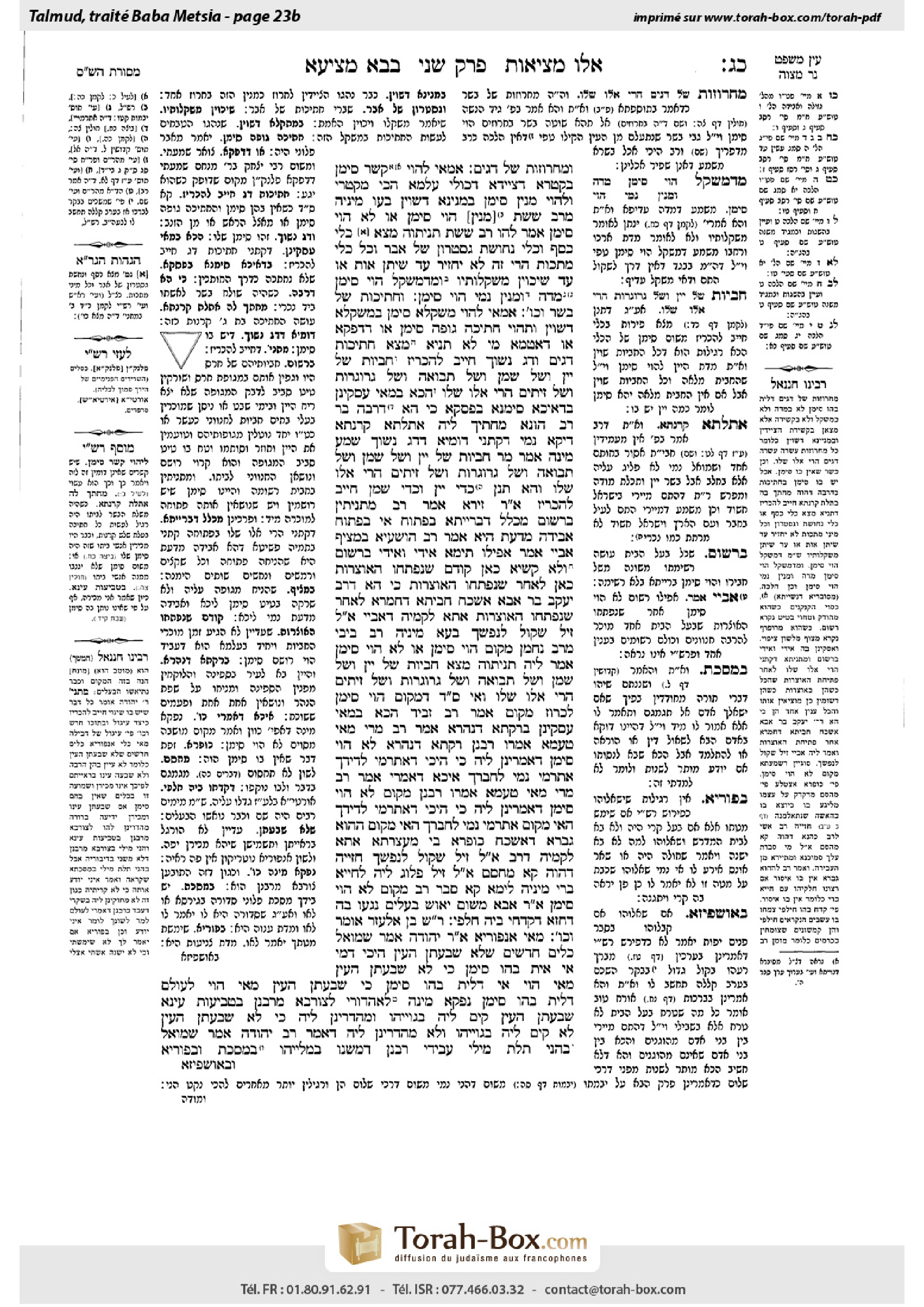
Bava Metzia 23b: Talmud study for Daf Yomi
Study the Talmud for Daf Yomi with scanned pages, Hebrew text, English translations from Sefaria and AI-generated French translations.
Passage selection and English or AI-generated French translation are available where the scan has annotations. Daf Study is independent of Torah-Box and Sefaria.
Browse Bava Metzia · בבא מציעא · All tractatesBava Metzia 23b text and translations
This page of Bava Metzia includes the Aramaic text, an English translation and an AI-generated French translation, alongside the scan above.
בבא מציעא כ״ג ב · Aramaic and Hebrew text
וּמַחְרוֹזוֹת שֶׁל דָּגִים. אַמַּאי? לֶהֱוֵי קֶשֶׁר סִימָן! בְּקִטְרָא דְּצַיָּידֵא, דְּכוּלֵּי עָלְמָא הָכִי מְקַטְּרִי. וְלֶהֱוֵי מִנְיָן סִימָן! בְּמִנְיָנָא דְּשָׁוִין.
בְּעוֹ מִינֵּיהּ מֵרַב שֵׁשֶׁת: [מִנְיָן] הָוֵי סִימָן אוֹ לָא הָוֵי סִימָן? אֲמַר לְהוּ רַב שֵׁשֶׁת: תְּנֵיתוּהָ, מָצָא כְּלֵי כֶסֶף וּכְלֵי נְחוֹשֶׁת, גִּסְטְרוֹן שֶׁל אֲבָר, וְכׇל כְּלֵי מַתָּכוֹת – הֲרֵי זֶה לֹא יַחֲזִיר עַד שֶׁיִּתֵּן אוֹת, אוֹ עַד שֶׁיְּכַוֵּין מִשְׁקְלוֹתָיו. וּמִדְּמִשְׁקָל הָוֵי סִימָן, מִדָּה וּמִנְיָן נָמֵי הָוֵי סִימָן.
וַחֲתִיכוֹת שֶׁל בָּשָׂר וְכוּ׳. אַמַּאי? לֶהֱוֵי מַשְׁקְלָא סִימָן! בְּמַשְׁקְלָא דְּשָׁוִין. וְתֶהֱוֵי חֲתִיכָה גּוּפַהּ סִימָן, אוֹ דְּדָפְקָא אוֹ דְּאַטְמָא! מִי לָא תַּנְיָא: מָצָא חֲתִיכוֹת דָּגִים וְדָג נָשׁוּךְ – חַיָּיב לְהַכְרִיז. חָבִיּוֹת שֶׁל יַיִן וְשֶׁל שֶׁמֶן וְשֶׁל תְּבוּאָה וְשֶׁל גְּרוֹגְרוֹת וְשֶׁל זֵיתִים – הֲרֵי אֵלּוּ שֶׁלּוֹ.
הָכָא בְּמַאי עָסְקִינַן? בִּדְאִיכָּא סִימָנָא בִּפְסָקָא, כִּי הָא דְּרַבָּה בַּר רַב הוּנָא מְחַתֵּיךְ לֵיהּ אַתְּלָת קַרְנָתָא. דַּיְקָא נָמֵי דְּקָתָנֵי דּוּמְיָא דְּדָג נָשׁוּךְ, שְׁמַע מִינַּהּ.
אָמַר מָר: חָבִיּוֹת שֶׁל יַיִן וְשֶׁל שֶׁמֶן וְשֶׁל תְּבוּאָה וְשֶׁל גְּרוֹגְרוֹת וְשֶׁל זֵיתִים – הֲרֵי אֵלּוּ שֶׁלּוֹ. וְהָא תְּנַן: כַּדֵּי יַיִן וְכַדֵּי שֶׁמֶן חַיָּיב לְהַכְרִיז! אָמַר רַבִּי זֵירָא אָמַר רַב: מַתְנִיתִין בְּרָשׁוּם. מִכְּלָל דְּבָרַיְיתָא בְּפָתוּחַ, אִי בְּפָתוּחַ – אֲבֵידָה מִדַּעַת הִיא. אָמַר רַב הוֹשַׁעְיָא: בְּמֵצִיף.
אַבָּיֵי אָמַר: אֲפִילּוּ תֵּימָא אִידֵּי וְאִידֵּי בְּרָשׁוּם, וְלָא קַשְׁיָא: כָּאן – קוֹדֶם שֶׁנִּפְתְּחוּ הָאוֹצָרוֹת, כָּאן – לְאַחַר שֶׁנִּפְתְּחוּ הָאוֹצָרוֹת. כִּי הָא דְּרַב יַעֲקֹב בַּר אַבָּא אַשְׁכַּח חָבִיתָא דְחַמְרָא לְאַחַר שֶׁנִּפְתְּחוּ הָאוֹצָרוֹת, אֲתָא לְקַמֵּיהּ דְּאַבָּיֵי, אֲמַר לֵיהּ: זִיל שְׁקוֹל לְנַפְשָׁךְ.
בְּעָא מִינֵּיהּ רַב בִּיבִי מֵרַב נַחְמָן: מָקוֹם הָוֵי סִימָן, אוֹ לָא הָוֵי סִימָן? אֲמַר לֵיהּ: תְּנֵיתוּהָ, מָצָא חָבִיּוֹת שֶׁל יַיִן וְשֶׁל שֶׁמֶן וְשֶׁל תְּבוּאָה וְשֶׁל גְּרוֹגְרוֹת וְשֶׁל זֵיתִים – הֲרֵי אֵלּוּ שֶׁלּוֹ. וְאִי סָלְקָא דַעְתָּךְ דְּמָקוֹם הָוֵי סִימָן, לִכְרוֹז מָקוֹם! אָמַר רַב זְבִיד, הָכָא בְּמַאי עָסְקִינַן? בְּרַקְּתָא דְנַהֲרָא.
אָמַר רַב מָרִי: מַאי טַעְמָא אֲמַרוּ רַבָּנַן רַקְּתָא דְנַהֲרָא לָא הָוֵי סִימָן? דְּאָמְרִינַן לֵיהּ: כִּי הֵיכִי דְּאִתְרְמִי לְדִידָךְ אִתְרְמִי נָמֵי לְחַבְרָךְ. אִיכָּא דְּאָמְרִי, אָמַר רַב מָרִי: מַאי טַעְמָא אֲמַרוּ רַבָּנַן מָקוֹם לָא הָוֵי סִימָן? דְּאָמְרִינַן לֵיהּ: כִּי הֵיכִי דְּאִתְרְמִי לְדִידָךְ הַאי מְקוֹם, אִתְרְמִי נָמֵי לְחַבְרָךְ הַאי מָקוֹם.
הָהוּא גַּבְרָא דְּאַשְׁכַּח כּוּפְרָא בֵּי מַעֲצַרְתָּא, אֲתָא לְקַמֵּיהּ דְּרַב, אֲמַר לֵיהּ: זִיל שְׁקוֹל לְנַפְשָׁךְ. חַזְיֵיהּ דַּהֲוָה קָא מְחַסֵּם, אֲמַר לֵיהּ: זִיל פְּלוֹג לֵיהּ לְחִיָּיא בְּרִי מִינֵּיהּ. לֵימָא קָא סָבַר רַב מָקוֹם לָא הָוֵי סִימָן? אָמַר רַבִּי אַבָּא: מִשּׁוּם יֵאוּשׁ בְּעָלִים נָגְעוּ בָּהּ, דַּחֲזָא דְּקָדְחִי בֵּיהּ חִלְפֵי.
רַבִּי שִׁמְעוֹן בֶּן אֶלְעָזָר אוֹמֵר וְכוּ׳. מַאי אַנְפּוּרְיָא? אָמַר רַב יְהוּדָה אָמַר שְׁמוּאֵל: כֵּלִים חֲדָשִׁים שֶׁלֹּא שְׂבָעָתַן הָעַיִן. הֵיכִי דָמֵי? אִי אִית בְּהוּ סִימָן – כִּי לֹא שְׂבָעָתַן הָעַיִן מַאי הָוֵי? אִי דְּלֵית בְּהוּ סִימָן – כִּי שְׂבָעָתַן הָעַיִן מַאי הָוֵי?
לְעוֹלָם דְּלֵית בְּהוּ סִימָן – נָפְקָא מִינַּהּ לְאַהְדּוֹרֵי לְצוּרְבָּא מֵרַבָּנַן בִּטְבִיעוּת עֵינָא. שְׂבָעָתַן הָעַיִן – קִים לֵיהּ בְּגַוַּיְיהוּ וּמַהְדְּרִינַן לֵיהּ. כִּי לֹא שְׂבָעָתַן הָעַיִן – לָא קִים לֵיהּ בְּגַוַּיְיהוּ, וְלָא מַהְדְּרִינַן לֵיהּ, דְּאָמַר רַב יְהוּדָה אָמַר שְׁמוּאֵל: בְּהָנֵי תְּלָת מִילֵּי עֲבִידִי רַבָּנַן דִּמְשַׁנּוּ בְּמִלַּיְיהוּ – בְּמַסֶּכֶת, וּבְפוּרְיָא
Bava Metzia 23b · English translation
§ The mishna teaches that strings of fish are among the list of found items that one may keep. The Gemara asks: Why not let the knot with which the fish are tied serve as a distinguishing mark? The Gemara answers: The mishna is referring to the fisherman’s knot with which everyone ties his fish, which is not distinctive. The Gemara asks: But why not let the number of fish tied on the string serve as a distinguishing mark? The Gemara answers: The mishna is referring to a number of fish that is equal to that on all strings of fish in that area.
The Sages raised a dilemma before Rav Sheshet: In items that have no other distinguishing mark, is their number a distinguishing mark or is it not a distinguishing mark? Rav Sheshet said to them: You learned it in a baraita: If one found silver vessels, copper vessels, fragments of lead, and any metal vessels, that person who found them shall not return the item to its owner until the owner provides a distinguishing sign or until the owner accurately provides its weight. And from the fact that weight serves as a distinguishing mark, measure and number also serve as a distinguishing mark.
The mishna teaches that cuts of meat are among the list of found items that one may keep. The Gemara asks: Why not let the weight of the cut serve as a distinguishing mark? The Gemara answers: The mishna is referring to a weight that is equal, i.e., all cuts of meat in that area are of that weight. The Gemara asks: But why not let the cut of meat itself serve as a distinguishing mark, as it came, for example, either from the neck or from the thigh of the animal? Isn’t it taught in a baraita: If one found cuts of fish, or a fish that was bitten, he is obligated to proclaim his find, and if he found barrels of wine, or of oil, or of grain, or of dried figs, or of olives, these belong to him? Apparently, the distinguishing mark in the cuts of fish is the part of the fish from which they were cut.
The Gemara answers: With what are we dealing here in the baraita? It is in a case where there is a distinguishing mark in the shape of the cut, as in that case of Rabba bar Rav Huna who would cut the meat with three corners, forming a triangle. The distinguishing mark is not the part of the fish from where it had been cut. The language of the baraita is also precise, as the case of cuts of fish is taught juxtaposed to and similar to a fish that was bitten, in which case the bite is a distinguishing mark. The Gemara concludes: Learn from it that it is the shape of the cut that is a distinguishing mark, not the place from where it was cut.
The Master said in the baraita: If one found barrels of wine, or of oil, or of grain, or of dried figs, or of olives, these belong to him. The Gemara asks: But didn’t we learn in a mishna (25a): With regard to jugs of wine or jugs of oil, if one finds any of these he is obligated to proclaim his finding. Rabbi Zeira said that Rav said: The mishna is referring to a case of sealed jugs. Each person seals his jugs and barrels in a unique manner. Therefore, the seal constitutes a distinguishing mark. The Gemara asks: One may conclude by inference that the baraita is referring to a case of open barrels, and if it is referring to a case of open barrels, it is a deliberate loss. Since the wine in open barrels will spoil, it is obvious that one need not return it to the owner. Rav Hoshaya says: The baraita is referring to a case where one covers the barrel with the lid but does not seal it.
Abaye said: You can even say that both this mishna and that baraita are referring to jugs and barrels that are sealed, and it is not difficult. Here, in the mishna, where one is required to return the jugs, it is referring to a case where one found the jugs before the storehouses of wine were opened. At that point, the distinguishing mark of the seal proves that the jug belongs to its owner. There, in the baraita, where one is not required to return the barrels, it is referring to a case where one found the barrels after the storehouses of wine were opened. Since the storekeepers sold their barrels to the public, the seal would no longer serve as an indicator of the identity of the owner. This is just as in that case where Rav Ya’akov bar Abba found a barrel of wine after the storehouses were opened. He came before Abaye to ascertain what he should do with the barrel. Abaye said to him: Go take the barrel for yourself.
§ Rav Beivai raised a dilemma before Rav Naḥman: Is the location where the lost item was found a distinguishing mark, or is it not a distinguishing mark? Rav Naḥman said to him that you learned it in the baraita: If one found barrels of wine, or of oil, or of grain, or of dried figs, or of olives, these belong to him. And if it enters your mind that location is a distinguishing mark, let the finder proclaim what he found, and have the location serve as a distinguishing mark. Rav Zevid said: With what are we dealing here? We are dealing with the case of a barrel that was found on the bank of the river. Since it is the place where ships dock and merchandise belonging to many people is loaded and unloaded, the bank of a river cannot serve as a distinguishing mark.
Rav Mari said: What is the reason that the Sages said that in the case of a lost item, the location of the bank of a river is not a distinguishing mark? It is because we say to one seeking to reclaim his item by providing its location on the bank of a river: Just as it happened that you lost an item there, it also happened that another person lost an item there. Some say a slightly different version of that which Rav Mari said: What is the reason that the Sages said that location is not a distinguishing mark? It is because we say to one seeking to reclaim his item by providing its location: Just as it happened that you placed an item in that place, it also happened that another placed an item in that place.
The Gemara relates: There was a certain man who found pitch near the winepress. He came before Rav to ascertain what he should do with the pitch. Rav said to him: Go take the pitch for yourself. Rav saw that the man was hesitating, uncertain that he was entitled to the pitch. Rav, in an attempt to allay his qualms, said to him: Go divide it with Ḥiyya my son, as Rav would certainly not want his son to take a share of a stolen item. The Gemara suggests: Let us say that Rav holds that location is not a distinguishing mark. Rabbi Abba said: That is not Rav’s reasoning. Rather, it is due to the despair of its owner that the Sages touched upon this matter and permitted the finder to keep such a found item. As, Rav saw that grass was growing through the pitch, indicating that it had been there for an extended period.
§ The mishna teaches: Rabbi Shimon ben Elazar says: If one finds any anpurya vessels he is not obligated to proclaim his find. The Gemara asks: What are anpurya vessels? Rav Yehuda says that Shmuel says: They are new vessels, as the eye of its purchaser has not yet sufficiently seen them to be able to recognize them. The Gemara asks: What are the circumstances? If there is a distinguishing mark on the vessels, when the eye of its purchaser has not yet sufficiently seen them, what of it? He can describe the mark after even a short glance and claim his item. If there is no distinguishing mark on the vessels, then when the eye of the one who purchases them has sufficiently seen them, what of it?
The Gemara answers: Actually, it is a vessel in which there is no distinguishing mark, and the practical difference is with regard to returning the vessel to a Torah scholar on the basis of visual recognition. When the eye of a Torah scholar has sufficiently seen them he is certain about them, and we return a lost item to him on the basis of his description of the vessel. When the eye of a Torah scholar has not sufficiently seen them, he is not certain about them, and we do not return a lost item to him, as Rav Yehuda says that Shmuel says: With regard to these three matters alone, it is normal for Sages to amend their statements and deviate from the truth: With regard to a tractate, if he is asked whether he studied a particular tractate, he may humbly say that he did not, even if he did. And with regard to a bed, if he is asked whether he slept in a particular bed, he may say that he did not, to avoid shame in case some unseemly residue is found on the bed.
Bava Metzia 23b · Traduction française (IA)
§ La Michna enseigne que les fils de poisson sont parmi les objets trouvés que l'on peut garder. La Guemara demande : Pourquoi ne pas laisser le nœud avec lequel les poissons sont liés servir de marque distinctive ? La Guemara répond : La Michna fait référence au nœud de pêcheur avec lequel tout le monde lie ses poissons, qui n'est pas distinctif. La Guemara demande : Mais pourquoi ne pas laisser le nombre de poissons liés sur la corde servir de marque distinctive ? La Guemara répond : La Michna fait référence à un nombre de poissons égal à celui de toutes les cordes de poissons dans cette région.
Les Sages ont soulevé un dilemme devant Rav Sheshet : Dans les objets qui n'ont pas d'autre marque distinctive, le nombre est-il une marque distinctive ou non ? Rav Sheshet a dit à ceux-ci : Vous l'avez appris dans une baraïta : Si l'on trouve des vases d'argent, des vases de cuivre, des fragments de plomb et tout autre vase métallique, la personne qui les a trouvés ne doit pas rendre l'objet à son propriétaire jusqu'à ce que le propriétaire fournisse une marque distinctive ou jusqu'à ce que le propriétaire fournisse précisément son poids. Et du fait que le poids sert de marque distinctive, la mesure et le nombre servent également de marque distinctive.
La Michna enseigne que les morceaux de viande sont parmi les objets trouvés que l'on peut garder. La Guemara demande : Pourquoi ne pas laisser le poids du morceau servir de marque distinctive ? La Guemara répond : La Michna fait référence à un poids égal, c'est-à-dire que tous les morceaux de viande de cette région sont de ce poids. La Guemara demande : Mais pourquoi ne pas laisser le morceau de viande lui-même servir de marque distinctive, puisqu'il vient, par exemple, du cou ou de la cuisse de l'animal ? N'est-il pas enseigné dans une baraïta : Si l'on trouve des morceaux de poisson ou un poisson mordu, il est tenu de proclamer sa découverte, et si l'on trouve des tonneaux de vin, d'huile, de céréales, de figues sèches, d'olives, ceux-ci lui appartiennent ? Apparemment, la marque distinctive des morceaux de poisson est la partie du poisson d'où ils ont été coupés.
La Guemara répond : Avec quels objets sommes-nous en train de traiter dans la baraïta ? Il s'agit d'un cas où il y a une marque distinctive dans la forme de la découpe, comme dans le cas de Rabba bar Rav Huna qui coupait la viande avec trois angles, formant un triangle. La marque distinctive n'est pas la partie du poisson d'où il avait été coupé. La langue de la baraïta est aussi précise, car le cas des morceaux de poisson est enseigné côte à côte et semblable à un poisson mordu, dans lequel cas la morsure est une marque distinctive. La Guemara conclut : Apprenez-en que c'est la forme de la découpe qui est une marque distinctive, pas la partie d'où il a été coupé.
Le Maître a dit dans la baraïta : Si l'on trouve des tonneaux de vin, d'huile, de céréales, de figues sèches, d'olives, ceux-ci lui appartiennent. La Guemara demande : Mais n'avons-nous pas appris dans une Michna (25a) : En ce qui concerne des tonneaux de vin ou d'huile, si l'on trouve l'un d'eux, il est tenu de proclamer sa découverte ? Rabbi Zeira a dit que Rav a dit : La Michna fait référence à un cas de tonneaux scellés. Chacun scelle ses tonneaux et ses barils d'une manière unique. Ainsi, le sceau constitue une marque distinctive. La Guemara demande : On peut conclure par analogie que la baraïta fait référence à un cas de barils ouverts, et si elle fait référence à un cas de barils ouverts, c'est une perte volontaire. Puisque le vin dans les barils ouverts se gâte, il est évident que l'on n'a pas besoin de le rendre à l'propriétaire. Rav Hoshaya dit : La baraïta fait référence à un cas où l'on couvre le baril avec le couvercle mais ne le scelle pas.
Abaye a dit : On peut même dire que cette Michna et cette baraïta font référence à des tonneaux et barils scellés, et ce n'est pas difficile. Ici, dans la Michna, où l'on est tenu de rendre les tonneaux, il s'agit d'un cas où l'on a trouvé les tonneaux avant que les entrepôts de vin ne soient ouverts. À ce moment-là, la marque distinctive du sceau prouve que le tonneau appartient à son propriétaire. Là, dans la baraïta, où l'on n'est pas tenu de rendre les barils, il s'agit d'un cas où l'on a trouvé les barils après que les entrepôts de vin aient été ouverts. Puisque les dépositaires ont vendu leurs barils au public, le sceau ne sert plus d'indicateur de l'identité du propriétaire. C'est exactement le cas où Rav Ya'akov bar Abba a trouvé un baril de vin après que les entrepôts aient été ouverts. Il est venu devant Abaye pour savoir ce qu'il devait faire avec le baril. Abaye a dit à lui : Allez prendre le baril pour vous.
§ Rav Beivai a soulevé un dilemme devant Rav Naḥman : La localisation où l'objet perdu a été trouvé est-elle une marque distinctive ou non ? Rav Naḥman a dit à lui que vous l'avez appris dans la baraïta : Si l'on trouve des tonneaux de vin, d'huile, de céréales, de figues sèches, d'olives, ceux-ci lui appartiennent. Et si vous pensez que la localisation est une marque distinctive, faites proclamer ce que l'on a trouvé et faites que la localisation serve de marque distinctive. Rav Zevid a dit : Avec quels objets sommes-nous en train de traiter ? Nous traitons le cas d'un baril trouvé sur la berge du fleuve. Puisque c'est la place où les bateaux mouillent et où les marchandises appartenant à beaucoup de personnes sont chargées et déchargées, la berge d'un fleuve ne peut pas servir de marque distinctive.
Rav Mari a dit : Quel est le motif pour lequel les Sages ont dit que la localisation de la berge d'un fleuve n'est pas une marque distinctive ? C'est parce que nous disons à celui qui cherche à récupérer son objet en indiquant la localisation sur la berge du fleuve : Comme il est arrivé que vous avez perdu un objet là, il est arrivé aussi que quelqu'un d'autre ait perdu un objet là. Certains disent une version légèrement différente de ce que Rav Mari a dit : Quel est le motif pour lequel les Sages ont dit que la localisation n'est pas une marque distinctive ? C'est parce que nous disons à celui qui cherche à récupérer son objet en indiquant sa localisation : Comme il est arrivé que vous avez mis un objet là, il est arrivé aussi que quelqu'un d'autre ait mis un objet là.
La Guemara rapporte : Il y avait un homme qui trouva du goudron près de la vigne. Il vint devant Rav pour savoir ce qu'il devait faire avec le goudron. Rav lui dit : Va-t'en prendre le goudron pour toi-même. Rav vit que l'homme hésitait, incertain qu'il était propriétaire du goudron. Pour apaiser ses craintes, Rav lui dit : Va le partager avec Ḥiyya mon fils, car Rav ne voulait certainement pas que son fils prenne une part d'objet volé. La Guemara suggère : Disons que Rav considère que la localisation n'est pas un signe distinctif. Rabbi Abba dit : Ce n'est pas la raison de Rav. En réalité, c'est à cause de l'espoir du propriétaire que les Sages ont abordé cette question et permis au trouvère de garder un tel objet. En effet, Rav vit que de l'herbe poussait à travers le goudron, indiquant qu'il était là depuis un long temps.
§ La mitsna enseigne : Rabbi Shimon ben Elazar dit : Si l'on trouve des objets anpurya, on n'est pas tenu de proclamer sa découverte. La Guemara demande : Quels sont ces objets anpurya ? Rav Yehuda dit que Shmuel dit : Ce sont des objets nouveaux, car les yeux de leur acheteur n'ont pas encore suffisamment vu pour pouvoir les reconnaître. La Guemara demande : Quelles sont les circonstances ? Si les objets ont un signe distinctif, et que les yeux de leur acheteur n'ont pas encore suffisamment vu, qu'en est-il ? Il peut décrire le signe même après un regard bref et revendiquer son objet. Si les objets n'ont pas de signe distinctif, alors, lorsque les yeux de celui qui les achète ont suffisamment vu, qu'en est-il ?
La Guemara répond : En réalité, il s'agit d'un objet sans signe distinctif, et la différence pratique concerne le retour de l'objet à un savant sur la base de la reconnaissance visuelle. Lorsque les yeux d'un savant ont suffisamment vu, il est certain, et nous rendons un objet perdu à lui sur la base de sa description de l'objet. Lorsque les yeux d'un savant n'ont pas suffisamment vu, il n'est pas certain, et nous ne rendons pas un objet perdu à lui, car Rav Yehuda dit que Shmuel dit : Concernant ces trois choses seulement, il est normal que les Sages modifient leurs déclarations et s'écartent de la vérité : Concernant un traité, si on lui demande s'il a étudié un traité particulier, il peut modestement dire qu'il n'a pas fait, même s'il l'a fait. Et concernant un lit, si on lui demande s'il a dormi dans un lit particulier, il peut dire qu'il n'a pas fait, pour éviter la honte en cas de résidu inapproprié trouvé sur le lit.
Traduction française générée par IA à partir de l’édition anglaise de Sefaria. Vérifie toujours un passage avec le texte source.
Text from Sefaria: William Davidson Edition - Vocalized Aramaic (CC BY NC); William Davidson Edition - English (CC BY NC).