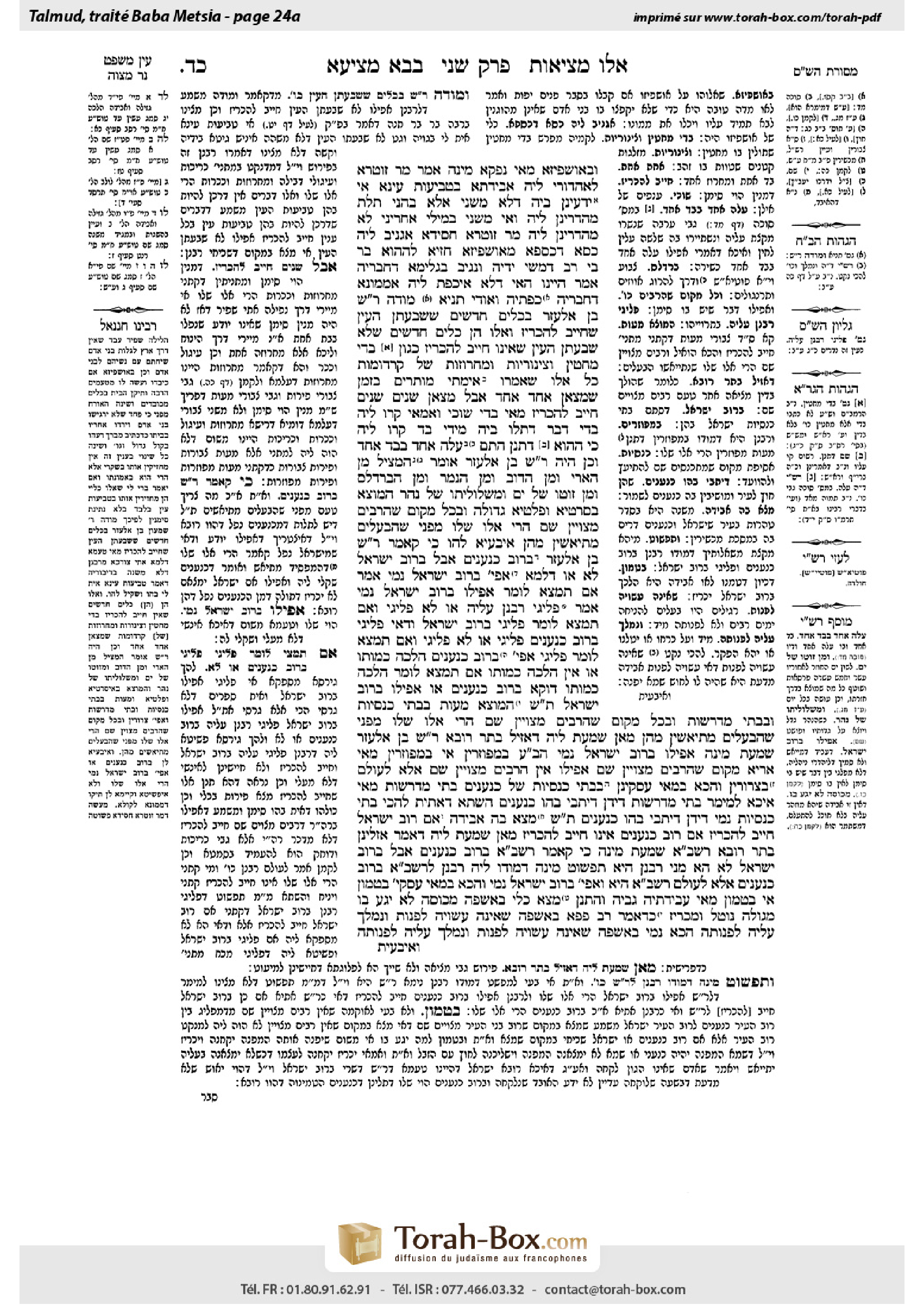
Bava Metzia 24a: Talmud study for Daf Yomi
Study the Talmud for Daf Yomi with scanned pages, Hebrew text, English translations from Sefaria and AI-generated French translations.
Passage selection and English or AI-generated French translation are available where the scan has annotations. Daf Study is independent of Torah-Box and Sefaria.
Browse Bava Metzia · בבא מציעא · All tractatesBava Metzia 24a text and translations
This page of Bava Metzia includes the Aramaic text, an English translation and an AI-generated French translation, alongside the scan above.
בבא מציעא כ״ד א · Aramaic and Hebrew text
וּבְאוּשְׁפִּיזָא. מַאי נָפְקָא מִינַּהּ? אָמַר מָר זוּטְרָא: לְאַהְדּוֹרֵי לֵיהּ אֲבֵידְתָּא בִּטְבִיעוּת עֵינָא. אִי יָדְעִינַן בֵּיהּ דְּלָא מְשַׁנֵּי אֶלָּא בְּהָנֵי תְּלָת – מַהְדְּרִינַן לֵיהּ, וְאִי מְשַׁנֵּי בְּמִילֵּי אַחֲרִינֵי – לָא מַהְדְּרִינַן לֵיהּ.
מָר זוּטְרָא חֲסִידָא אִגְּנִיב לֵיהּ כָּסָא דְכַסְפָּא מֵאוּשְׁפִּיזָא. חַזְיֵאּ לְהָהוּא בַּר בֵּי רַב דְּמָשֵׁי יְדֵיהּ וְנָגֵיב בִּגְלִימָא דְחַבְרֵיהּ. אֲמַר: הַיְינוּ הַאי דְּלָא אִיכְפַּת לֵיהּ אַמָּמוֹנָא דְחַבְרֵיהּ. כַּפְתֵיהּ וְאוֹדִי.
תַּנְיָא: מוֹדֶה רַבִּי שִׁמְעוֹן בֶּן אֶלְעָזָר בְּכֵלִים חֲדָשִׁים שֶׁשְּׂבָעָתַן הָעַיִן שֶׁחַיָּיב לְהַכְרִיז. וְאֵלּוּ הֵן כֵּלִים חֲדָשִׁים שֶׁלֹּא שְׂבָעָתַן הָעַיִן שֶׁאֵינוֹ חַיָּיב לְהַכְרִיז, כְּגוֹן בַּדֵּי מְחָטִין, וְצִינּוֹרִיּוֹת, וּמַחְרוֹזוֹת שֶׁל קַרְדּוּמּוֹת. כׇּל אֵלּוּ שֶׁאָמְרוּ, אֵימָתַי מוּתָּרִים? בִּזְמַן שֶׁמְּצָאָן אֶחָד אֶחָד, אֲבָל מְצָאָן שְׁנַיִם שְׁנַיִם – חַיָּיב לְהַכְרִיז.
מַאי ״בַּדֵּי״? שׂוֹכֵי. וְאַמַּאי קָרוּ לֵיהּ ״בַּדֵּי״? דָּבָר דְּתָלוּ בֵּיהּ מִידֵּי, ״בַּד״ קָרוּ לֵיהּ. כִּי הַהוּא דִּתְנַן הָתָם: עָלֶה אֶחָד בְּבַד אֶחָד.
וְכֵן הָיָה רַבִּי שִׁמְעוֹן בֶּן אֶלְעָזָר אוֹמֵר: הַמַּצִּיל מִן הָאֲרִי וּמִן הַדּוֹב וּמִן הַנָּמֵר וּמִן הַבַּרְדְּלָס וּמִן זוֹטוֹ שֶׁל יָם וּמִשְּׁלוּלִיתוֹ שֶׁל נָהָר, הַמּוֹצֵא בִּסְרַטְיָא וּפְלַטְיָא גְּדוֹלָה, וּבְכׇל מָקוֹם שֶׁהָרַבִּים מְצוּיִין שָׁם – הֲרֵי אֵלּוּ שֶׁלּוֹ, מִפְּנֵי שֶׁהַבְּעָלִים מִתְיָאֲשִׁין מֵהֶן.
אִיבַּעְיָא לְהוּ: כִּי קָאָמַר רַבִּי שִׁמְעוֹן בֶּן אֶלְעָזָר – בְּרוֹב גּוֹיִם אֲבָל בְּרוֹב יִשְׂרָאֵל – לָא, אוֹ דִלְמָא אֲפִילּוּ בְּרוֹב יִשְׂרָאֵל נָמֵי אָמַר?
אִם תִּמְצָא לוֹמַר אֲפִילּוּ בְּרוֹב יִשְׂרָאֵל נָמֵי אָמַר, פְּלִיגִי רַבָּנַן עֲלֵיהּ, אוֹ לָא פְּלִיגִי?
וְאִם תִּמְצָא לוֹמַר פְּלִיגִי, בְּרוֹב יִשְׂרָאֵל וַדַּאי פְּלִיגִי, בְּרוֹב גּוֹיִם פְּלִיגִי אוֹ לָא פְּלִיגִי?
וְאִם תִּמְצָא לוֹמַר פְּלִיגִי אֲפִילּוּ בְּרוֹב גּוֹיִם הֲלָכָה כְּמוֹתוֹ אוֹ אֵין הֲלָכָה כְּמוֹתוֹ?
אִם תִּמְצָא לוֹמַר הֲלָכָה כְּמוֹתוֹ, דַּוְקָא בְּרוֹב גּוֹיִם אוֹ אֲפִילּוּ בְּרוֹב יִשְׂרָאֵל?
תָּא שְׁמַע: הַמּוֹצֵא מָעוֹת בְּבָתֵּי כְנֵסִיּוֹת וּבְבָתֵּי מִדְרָשׁוֹת, וּבְכׇל מָקוֹם שֶׁהָרַבִּים מְצוּיִין שָׁם – הֲרֵי אֵלּוּ שֶׁלּוֹ, מִפְּנֵי שֶׁהַבְּעָלִים מִתְיָאֲשִׁין מֵהֶן. מַאן שָׁמְעַתְּ לֵיהּ דְּאָזֵיל בָּתַר רוּבָּא? רַבִּי שִׁמְעוֹן בֶּן אֶלְעָזָר, שָׁמְעַתְּ מִינַּהּ אֲפִילּוּ בְּרוֹב יִשְׂרָאֵל נָמֵי.
הָכָא בְּמַאי עָסְקִינַן? בִּמְפוּזָּרִין. אִי בִּמְפוּזָּרִין מַאי אִרְיָא מָקוֹם שֶׁהָרַבִּים מְצוּיִין שָׁם? אֲפִילּוּ אֵין הָרַבִּים מְצוּיִין שָׁם!
אֶלָּא לְעוֹלָם בִּצְרוּרִין, וְהָכָא בְּמַאי עָסְקִינַן – בְּבָתֵּי כְנֵסִיּוֹת שֶׁל גּוֹיִם, בָּתֵּי מִדְרָשׁוֹת מַאי אִיכָּא לְמֵימַר? בָּתֵּי מִדְרָשׁוֹת דִּידַן דְּיָתְבִי בְּהוּ גּוֹיִם. הַשְׁתָּא דְּאָתֵית לְהָכִי, בָּתֵּי כְנֵסִיּוֹת נָמֵי דִּידַן דְּיָתְבִי בְּהוּ נָכְרִים.
תָּא שְׁמַע: מָצָא בָּהּ אֲבֵידָה, אִם רוֹב יִשְׂרָאֵל – חַיָּיב לְהַכְרִיז, אִם רוֹב גּוֹיִם – אֵינוֹ חַיָּיב לְהַכְרִיז. מַאן שָׁמְעַתְּ לֵיהּ דְּאָמַר אָזְלִינַן בָּתַר רוּבָּא? רַבִּי שִׁמְעוֹן בֶּן אֶלְעָזָר, שָׁמְעַתְּ מִינַּהּ: כִּי קָאָמַר רַבִּי שִׁמְעוֹן בֶּן אֶלְעָזָר בְּרוֹב גּוֹיִם, אֲבָל בְּרוֹב יִשְׂרָאֵל – לָא!
מַנִּי? רַבָּנַן הִיא, תִּפְשׁוֹט מִינַּהּ דְּמוֹדוּ לֵיהּ רַבָּנַן לְרַבִּי שִׁמְעוֹן בֶּן אֶלְעָזָר בְּרוֹב גּוֹיִם.
אֶלָּא לְעוֹלָם רַבִּי שִׁמְעוֹן בֶּן אֶלְעָזָר הִיא, וַאֲפִילּוּ בְּרוֹב יִשְׂרָאֵל נָמֵי. וְהָכָא בְּמַאי עָסְקִינַן? בְּטָמוּן. אִי בְּטָמוּן, מַאי עֲבִידְתֵּיהּ גַּבֵּיהּ?! וְהָתְנַן: מָצָא כְּלִי בָּאַשְׁפָּה, מְכוּסֶּה – לֹא יִגַּע בּוֹ, מְגוּלֶּה – נוֹטֵל וּמַכְרִיז.
כִּדְאָמַר רַב פָּפָּא, בְּאַשְׁפָּה שֶׁאֵינָהּ עֲשׂוּיָה לְפַנּוֹת, וְנִמְלַךְ עָלֶיהָ לְפַנּוֹתָהּ. הָכָא נָמֵי בְּאַשְׁפָּה שֶׁאֵינָהּ עֲשׂוּיָה לְפַנּוֹת, וְנִמְלַךְ עָלֶיהָ לְפַנּוֹתָהּ.
Bava Metzia 24a · English translation
And he can lie with regard to a host [ushpiza], as one may say that he was not well received by a certain host to prevent everyone from taking advantage of the host’s hospitality. What is the practical difference that emerges from this statement with regard to matters in which Torah scholars deviate from the truth? Mar Zutra says: The practical difference is with regard to returning a lost item on the basis of visual recognition. If we know about him that he alters his statements only with regard to these three matters, we return the lost item to him, but if he alters his statements with regard to other matters, we do not return the lost item to him.
The Gemara relates: A silver goblet was stolen from the host of Mar Zutra Ḥasida. Mar Zutra saw a certain student of Torah who washed his hands and dried them on the cloak of another. Mar Zutra said: This is the one who does not care about the property of another. He bound that student, and the student then confessed that he stole the goblet.
It is taught in a baraita: Although Rabbi Shimon ben Elazar holds that one does not need to proclaim his finding of anpurya vessels, he concedes that the finder is obligated to proclaim his find of new vessels that the eye of its purchaser has sufficiently seen. And these are new vessels that the eye of its purchaser has not yet sufficiently seen and concerning which the finder is not obligated to proclaim his find: for example, branches [badei] upon which needles or utensils for spinning are hanging, or strings of axes. When is it permitted for the one who finds all those items that the tanna mentioned in the baraita to keep them? It is when he found them one at a time. But if he found them two at a time, the finder is obligated to proclaim his find.
The Gemara clarifies: What is the meaning of the term badei? It means branches. And why did the tanna call them branches? It is because the item upon which one hangs another item [davar detalu bei midei], he calls it a branch, like that which we learned there (Sukka 44b): One leaf on one branch.
§ The baraita continues: And likewise, Rabbi Shimon ben Elazar would say: In the case of one who rescues a lost item from a lion, or from a bear, or from a leopard, or from a cheetah [bardelas], or from the tide of the sea, or from the flooding of a river; and in the case of one who finds a lost item in a main thoroughfare [seratya] or a large plaza [pelatya], or in any place where the multitudes are found, these items belong to him due to the fact that the owner despairs of their recovery.
A dilemma was raised before the Sages: When Rabbi Shimon ben Elazar says that if one finds a lost item in any place where multitudes are found, the item belongs to him, did he refer only to a place where there is a majority of gentiles; but in a place where there is a majority of Jews, the owner does not despair of recovering the item, because he relies on the Jews to return his item? Or perhaps, even in a place where there is a majority of Jews, he also says that the item belongs to the one who found it.
And if you say that even in a place where there is a majority of Jews, he also said that the item belongs to the one who found it, do the Rabbis disagree with him or do they not disagree?
And if you say that the Rabbis disagree with him, in a place where there is a majority of Jews, they certainly disagree. In a place where there is a majority of gentiles, do the Rabbis disagree, or do they not disagree?
And if you say that the Rabbis disagree with him even in a place where there is a majority of gentiles, is the halakha in accordance with the opinion of Rabbi Shimon ben Elazar, or is the halakha not in accordance with his opinion?
And if you say that the halakha is in accordance with the opinion of Rabbi Shimon ben Elazar, does this halakha apply specifically in a place where there is a majority of gentiles, or is the halakha in accordance with his opinion even in a place where there is a majority of Jews?
The Gemara suggests: Come and hear a proof from a baraita: In the case of one who finds coins in synagogues [bevatei khenesiyyot] and study halls or in any place where the multitudes are found, these coins belong to him, due to the fact that the owner despairs of their recovery. Who is the one about whom you heard that he follows the multitudes, i.e., that he attaches significance to the loss of an item in a place where the multitudes are present? It is Rabbi Shimon ben Elazar. Conclude from the baraita that Rabbi Shimon ben Elazar holds that a lost item belongs to the finder even in a place where there is a majority of Jews, as synagogues and study halls are places frequented exclusively by Jews.
The Gemara rejects the proof. With what are we dealing here? We are dealing with a case where the coins are scattered and there is no distinguishing mark on them. The Gemara asks: If it is a case where the coins are scattered, why did the baraita establish the case specifically in a place where the multitudes are found? Even in a place where the multitudes are not found, the coins belong to the finder.
Rather, actually the baraita is referring to a case where the coins are bound, and with what are we dealing here? This is a case where the coins were found in the houses of assembly [bevatei khenesiyyot] of gentiles, not in synagogues. That resolves the matter of synagogues; but with regard to study halls, which are exclusive to Jews, what can be said? The Gemara answers: The baraita is referring to our study halls in which gentile guards or custodians are sitting. The Gemara notes: Now that you have arrived at this explanation, the batei khenesiyyot in the baraita can be explained as referring to our synagogues, in which gentiles are sitting.
Come and hear a proof from a mishna (Makhshirin 2:8): In a case when one found a lost item in a city where both Jews and gentiles reside, if the city has a majority of Jews he is obligated to proclaim his find. If there is a majority of gentiles he is not obligated to proclaim his find. Who is the one about whom you heard that he follows the multitudes, i.e., that he attaches significance to the loss of an item in a place where the multitudes are present? It is Rabbi Shimon ben Elazar. Resolve from this mishna that when Rabbi Shimon ben Elazar says that the item belongs to the finder, it is referring specifically to a place where there is a majority of gentiles, but in a place where there is a majority of Jews, no, it does not belong to the finder.
The Gemara rejects this proof: In accordance with whose opinion is this mishna? It is in accordance with the opinion of the Rabbis. The Gemara suggests: In any case, resolve the dilemma from the mishna that the Rabbis concede to Rabbi Shimon ben Elazar in a place where there is a majority of gentiles.
The Gemara rejects this explanation: Rather, actually the mishna is in accordance with the opinion of Rabbi Shimon ben Elazar, and he stated his opinion even in a place where there is a majority of Jews. And with what are we dealing here? This is a case where the found item is concealed. The Gemara asks: If the item is concealed, what is the reason the item is with the finder? Clearly it was placed there and the owner will return to retrieve it. And didn’t we learn in a mishna (25b): In a case where one found a vessel in a garbage dump, if the vessel is concealed he may not touch it, but if it is exposed, the finder takes the item and proclaims his find.
The Gemara answers: It can be explained as Rav Pappa says elsewhere, that it is referring to a garbage dump that is not designed to be cleared, and the owner of the land reconsidered and decided to clear it. If one finds concealed vessels he should proclaim his find, because otherwise the vessels will be cleared with the rest of the garbage dump. Here too, the mishna is referring to a garbage dump that is not designed to be cleared, and the owner of the land reconsidered and decided to clear it. If one finds concealed items, his course of action is determined by the identity of the majority of the residents of the city. If they are Jews, he must proclaim his find, and if not, he need not proclaim his find. No proof can be cited to resolve the dilemma.
Bava Metzia 24a · Traduction française (IA)
Et il peut mentir concernant un hôte [ushpiza], comme on peut dire qu'il n'a pas été bien reçu par un certain hôte afin d'empêcher tout le monde de profiter de l'hospitalité de l'hôte. Quelle est la différence pratique qui découle de cette déclaration concernant les affaires où les savants de la Torah s'écartent de la vérité ? Mar Zutra dit : La différence pratique concerne le retour d'un objet perdu sur la base de la reconnaissance visuelle. Si nous savons qu'il modifie ses déclarations uniquement concernant ces trois matières, nous rendons l'objet perdu à lui, mais si il modifie ses déclarations concernant d'autres matières, nous ne rendons pas l'objet perdu à lui.
Le Guemara rapporte : Un gobelet d'argent avait été volé par l'hôte de Mar Zutra Ḥasida. Mar Zutra vit un certain étudiant de la Torah qui se lavait les mains et sèchait ses mains sur la cape d'un autre. Mar Zutra dit : C'est celui qui n'a pas d'égard pour la propriété d'autrui. Il lia cet étudiant, et l'étudiant avoua avoir volé le gobelet.
Il est enseigné dans une baraïta : Bien que Rabbi Shimon ben Elazar considère que l'on n'a pas besoin d'annoncer la découverte d'un objet [anpurya], il reconnaît que le trouver est tenu de proclamer la découverte d'objets nouveaux que l'œil de leur acheteur a suffisamment vu. Et ces sont des objets nouveaux que l'œil de leur acheteur n'a pas encore suffisamment vu et concernant lesquels le trouver n'est pas tenu de proclamer sa découverte : par exemple, des branches [badei] sur lesquelles des aiguilles ou des ustensiles pour tisser sont suspendus, ou des cordes de haches. Quand est-il permis à celui qui trouve tous ces objets mentionnés par le tanna dans la baraïta de les garder ? C'est quand il les a trouvés un à un. Mais si il les a trouvés deux à la fois, le trouver est tenu de proclamer sa découverte.
Le Guemara clarifie : Quelle est la signification du terme badei ? Cela signifie des branches. Et pourquoi le tanna les appelle-t-il des branches ? C'est parce que l'objet sur lequel l'on suspend un autre objet [davar detalu bei midei], il l'appelle une branche, comme celui que nous avons appris là (Sukka 44b) : Une feuille sur une branche.
§ La baraïta continue : Et de même, Rabbi Shimon ben Elazar disait : Dans le cas d'une personne qui récupère un objet perdu d'un lion, ou d'un ours, ou d'un léopard, ou d'un guépard [bardelas], ou de la marée de la mer, ou de l'inondation d'un fleuve ; et dans le cas d'une personne qui trouve un objet perdu dans une grande rue [seratya] ou dans une grande place [pelatya], ou dans n'importe quel lieu où les multitudes sont présentes, ces objets lui appartiennent en raison du fait que l'owner désespère de les récupérer.
Un dilemme a été soulevé devant les Sages : Lorsque Rabbi Shimon ben Elazar dit que si l'on trouve un objet perdu dans un lieu où les multitudes sont présentes, l'objet appartient à celui qui l'a trouvé, faisait-il référence uniquement à un lieu où il y a une majorité de non-Juifs ; mais dans un lieu où il y a une majorité de Juifs, l'propriétaire ne désespère pas de récupérer l'objet, car il compte sur les Juifs pour lui rendre son objet ? Ou peut-être, même dans un lieu où il y a une majorité de Juifs, il dit aussi que l'objet appartient à celui qui l'a trouvé.
Et si vous dites que même dans un lieu où il y a une majorité de Juifs, il dit aussi que l'objet appartient à celui qui l'a trouvé, les Rabbins s'opposent-ils à lui ou ne s'opposent-ils pas ?
Et si vous dites que les Rabbins s'opposent à lui, dans un lieu où il y a une majorité de Juifs, ils s'opposent certainement. Dans un lieu où il y a une majorité de non-Juifs, les Rabbins s'opposent-ils, ou ne s'opposent-ils pas ?
Et si vous dites que les Rabbins s'opposent à lui même dans un lieu où il y a une majorité de non-Juifs, la halakha suit-elle l'opinion de Rabbi Shimon ben Elazar, ou la halakha ne suit-elle pas son opinion ?
Et si vous affirmez que la halakha suit l'opinion de Rabbi Shimon ben Elazar, cette halakha s'applique-t-elle spécifiquement dans un lieu où il y a une majorité de non-Juifs, ou la halakha suit-elle son opinion même dans un lieu où il y a une majorité de Juifs ?
Le Guemara suggère : Venez entendre une preuve tirée d'une baraïta : Dans le cas d'une personne qui trouve des monnaies dans des synagogues [bevatei khenesiyyot] et des salles de étude ou dans n'importe quel lieu où les multitudes sont présentes, ces monnaies lui appartiennent, en raison du fait que l'owner désespère de les récupérer. Qui est celui dont vous avez entendu qu'il suit les multitudes, c'est-à-dire qu'il accorde de l'importance à la perte d'un objet dans un lieu où les multitudes sont présentes ? C'est Rabbi Shimon ben Elazar. Concluez de la baraïta que Rabbi Shimon ben Elazar considère que l'objet perdu appartient à celui qui l'a trouvé même dans un lieu où il y a une majorité de Juifs, car les synagogues et les salles de étude sont des lieux fréquentés exclusivement par les Juifs.
Le Guemara rejette cette preuve. Avec quoi sommes-nous en train de nous occuper ici ? Nous sommes en train de nous occuper d'un cas où les monnaies sont dispersées et n'ont pas de marque distinctive. Le Guemara demande : Si c'est un cas où les monnaies sont dispersées, pourquoi la baraïta a-t-elle établi le cas spécifiquement dans un lieu où les multitudes sont présentes ? Même dans un lieu où les multitudes ne sont pas présentes, les monnaies appartiennent à celui qui les a trouvées.
En réalité, la baraïta fait référence à un cas où les monnaies sont liées, et avec quoi sommes-nous donc en train de nous occuper ? C'est un cas où les monnaies ont été trouvées dans les maisons de réunion [bevatei khenesiyyot] des non-Juifs, pas dans des synagogues. Cela résout la question des synagogues ; mais concernant les salles de study, qui sont exclusives aux Juifs, que peut-on dire ? Le Guemara répond : La baraïta fait référence à nos salles de study où des gardiens ou des administrateurs païens sont assis. Le Guemara note : Maintenant que vous avez atteint cette explication, les batei khenesiyyot de la baraïta peuvent être expliqués comme faisant référence à nos synagogues, où des païens sont assis.
Venez écouter une preuve tirée d'une mitsva (Makhshirin 2:8) : Dans un cas où l'on trouve un objet perdu dans une ville où habitent à la fois des Juifs et des non-Juifs, si la ville a une majorité de Juifs, il est tenu de proclamer sa découverte. Si la majorité est composée de non-Juifs, il n'est pas tenu de proclamer sa découverte. De qui avez-vous entendu qu'il suit la multitude, c'est-à-dire qu'il accorde de l'importance à la perte d'un objet dans un lieu où la multitude est présente ? C'est Rabbi Shim'on ben Elazar. Résolvez à partir de cette mitsva que lorsque Rabbi Shim'on ben Elazar dit que l'objet appartient à celui qui l'a trouvé, il s'agit spécifiquement d'un lieu où il y a une majorité de non-Juifs, mais dans un lieu où il y a une majorité de Juifs, non, il n'appartient pas à celui qui l'a trouvé.
La Guemara rejette cette preuve : Selon l'opinion de qui est cette mitsva ? C'est selon l'opinion des Rabbins. La Guemara suggère : En tout cas, résolvez ce dilemme à partir de la mitsva que les Rabbins reconnaissent à Rabbi Shim'on ben Elazar dans un lieu où il y a une majorité de non-Juifs.
La Guemara rejette cette explication : En réalité, la mitsva est selon l'opinion de Rabbi Shim'on ben Elazar, et il a exprimé son opinion même dans un lieu où il y a une majorité de Juifs. Et à propos de quoi sommes-nous en train de parler ? C'est le cas où l'objet trouvé est caché. La Guemara demande : Si l'objet est caché, pourquoi l'objet est-il avec le trouver ? Évidemment, il a été placé là et l'propriétaire reviendra le récupérer. Et n'avons-nous pas appris dans une mitsva (25b) : Dans le cas où l'on trouve un récipient dans un tas de détritus, si le récipient est caché, il ne doit pas le toucher, mais si il est exposé, le trouver prend l'objet et proclame sa découverte.
La Guemara répond : On peut l'expliquer comme dit Rav Pappa ailleurs, que cela fait référence à un tas de détritus qui n'est pas conçu pour être nettoyé, et que le propriétaire du terrain a réfléchi et a décidé de le nettoyer. Si l'on trouve des récipients cachés, il doit proclamer sa découverte, car autrement les récipients seront nettoyés avec le reste du tas de détritus. Ici aussi, la mitsva fait référence à un tas de détritus qui n'est pas conçu pour être nettoyé, et que le propriétaire du terrain a réfléchi et a décidé de le nettoyer. Si l'on trouve des objets cachés, son action dépend de l'identité de la majorité des habitants de la ville. Si ce sont des Juifs, il doit proclamer sa découverte, et si ce sont des non-Juifs, il n'a pas besoin de proclamer sa découverte. Aucune preuve ne peut être citée pour résoudre ce dilemme.
Traduction française générée par IA à partir de l’édition anglaise de Sefaria. Vérifie toujours un passage avec le texte source.
Text from Sefaria: William Davidson Edition - Vocalized Aramaic (CC BY NC); William Davidson Edition - English (CC BY NC).