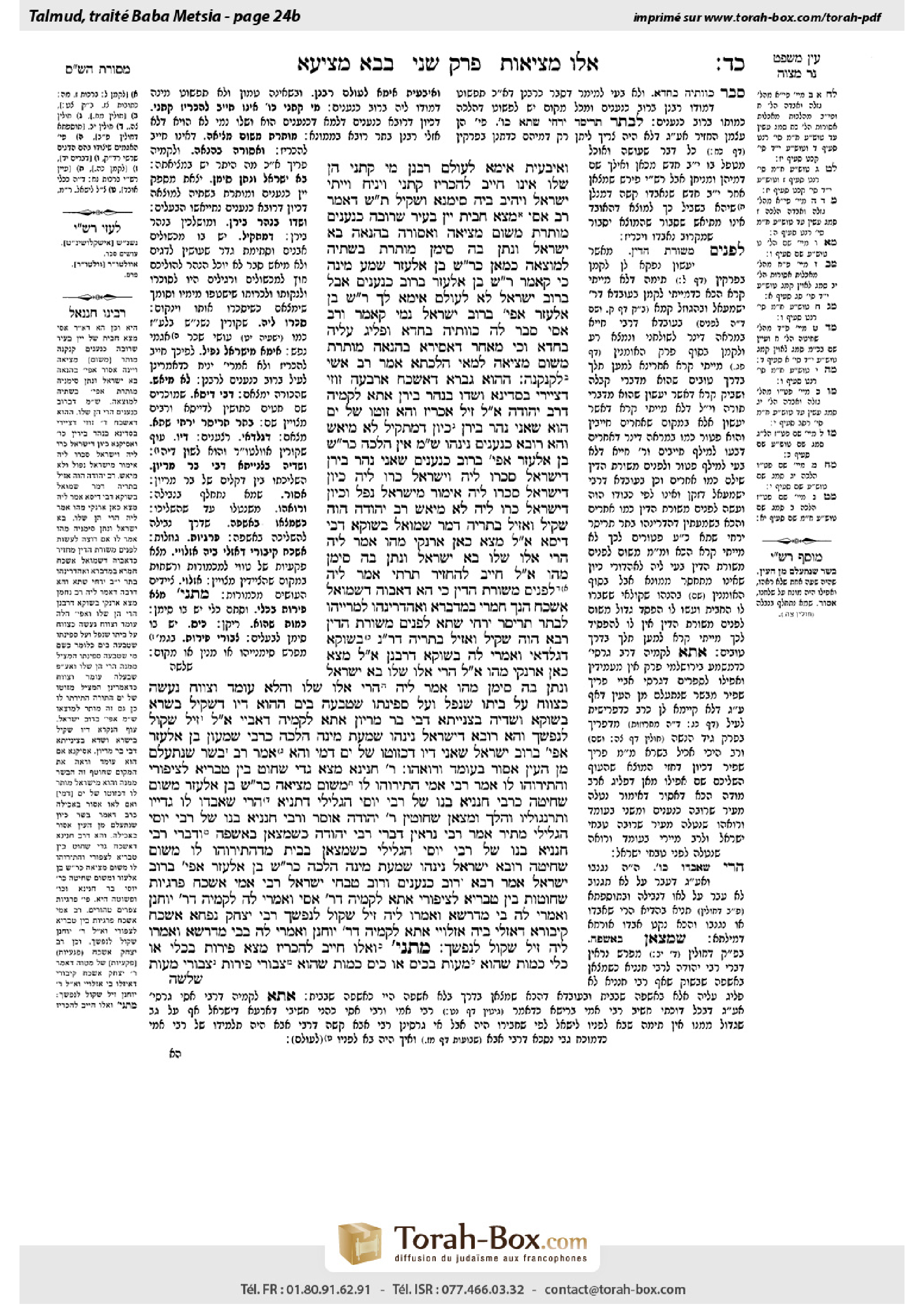
Bava Metzia 24b: Talmud study for Daf Yomi
Study the Talmud for Daf Yomi with scanned pages, Hebrew text, English translations from Sefaria and AI-generated French translations.
Passage selection and English or AI-generated French translation are available where the scan has annotations. Daf Study is independent of Torah-Box and Sefaria.
Browse Bava Metzia · בבא מציעא · All tractatesBava Metzia 24b text and translations
This page of Bava Metzia includes the Aramaic text, an English translation and an AI-generated French translation, alongside the scan above.
בבא מציעא כ״ד ב · Aramaic and Hebrew text
וְאִיבָּעֵית אֵימָא: לְעוֹלָם רַבָּנַן, מִי קָתָנֵי ״הֵן שֶׁלּוֹ״? ״אֵינוֹ חַיָּיב לְהַכְרִיז״ קָתָנֵי. וְיַנִּיחַ, וְיֵיתֵי יִשְׂרָאֵל וְיָהֵיב בֵּיהּ סִימָנָא וְשָׁקֵיל.
תָּא שְׁמַע, דְּאָמַר רַב אַסִּי: מָצָא חָבִית יַיִן בְּעִיר שֶׁרוּבָּהּ גּוֹיִם – מוּתֶּרֶת מִשּׁוּם מְצִיאָה וַאֲסוּרָה בַּהֲנָאָה. בָּא יִשְׂרָאֵל וְנָתַן בָּהּ סִימָן – מוּתֶּרֶת בִּשְׁתִיָּה, לְמוֹצְאָהּ.
כְּמַאן? כְּרַבִּי שִׁמְעוֹן בֶּן אֶלְעָזָר. שְׁמַע מִינַּהּ כִּי קָאָמַר רַבִּי שִׁמְעוֹן בֶּן אֶלְעָזָר – בְּרוֹב גּוֹיִם אֲבָל בְּרוֹב יִשְׂרָאֵל לָא. לְעוֹלָם אֵימָא לָךְ רַבִּי שִׁמְעוֹן בֶּן אֶלְעָזָר אֲפִילּוּ בְּרוֹב יִשְׂרָאֵל נָמֵי קָאָמַר, וְרַב אַסִּי סָבַר לַהּ כְּווֹתֵיהּ בַּחֲדָא, וּפְלִיג עֲלֵיהּ בַּחֲדָא.
וְכִי מֵאַחַר דַּאֲסִירָא בַּהֲנָאָה מוּתֶּרֶת מִשּׁוּם מְצִיאָה, לְמַאי הִלְכְתָא? אָמַר רַב אָשֵׁי: לְקַנְקַנָּהּ.
הָהוּא גַּבְרָא דְּאַשְׁכַּח אַרְבָּעָה זוּזֵי דְּצַיְירִי בִּסְדִינָא וּשְׁדוּ בִּנְהַר בֵּירָן, אֲתָא לְקַמֵּיהּ דְּרַב יְהוּדָה. אֲמַר לֵיהּ: זִיל אַכְרֵיז. וְהָא זוֹטוֹ שֶׁל יָם הוּא! שָׁאנֵי נְהַר בֵּירָן, כֵּיוָן דְּמִתְּקִיל לָא מִיָּאַשׁ. וְהָא רוּבָּא גּוֹיִם נִינְהוּ, שְׁמַע מִינַּהּ אֵין הֲלָכָה כְּרַבִּי שִׁמְעוֹן בֶּן אֶלְעָזָר אֲפִילּוּ בְּרוֹב גּוֹיִם! שָׁאנֵי נְהַר בֵּירָן, דְּיִשְׂרָאֵל סָכְרוּ לֵיהּ וְיִשְׂרָאֵל כָּרוּ לֵיהּ. כֵּיוָן דְּיִשְׂרָאֵל סָכְרוּ לֵיהּ – אֵימוֹר מִיִּשְׂרָאֵל נְפַל, וְכֵיוָן דְּיִשְׂרָאֵל כָּרוּ לֵיהּ – לָא מִיָּאַשׁ.
רַב יְהוּדָה הֲוָה שָׁקֵיל וְאָזֵיל בָּתְרֵיהּ דְּמָר שְׁמוּאֵל בְּשׁוּקָא דְּבֵי דַיְסָא, אֲמַר לֵיהּ: מָצָא כָּאן אַרְנָקִי, מַהוּ? אֲמַר לֵיהּ: הֲרֵי אֵלּוּ שֶׁלּוֹ. בָּא יִשְׂרָאֵל וְנָתַן בָּהּ סִימָן, מַהוּ? אֲמַר לֵיהּ: חַיָּיב לְהַחְזִיר. תַּרְתֵּי! אֲמַר לֵיהּ: לִפְנִים מִשּׁוּרַת הַדִּין. כִּי הָא דַּאֲבוּהּ דִּשְׁמוּאֵל אַשְׁכַּח הָנָךְ חֲמָרֵי בְּמַדְבְּרָא וְאַהְדְּרִינְהוּ לְמָרַיְיהוּ לְבָתַר תְּרֵיסַר יַרְחֵי שַׁתָּא, לִפְנִים מִשּׁוּרַת הַדִּין.
רָבָא הֲוָה שָׁקֵיל וְאָזֵיל בָּתְרֵיהּ דְּרַב נַחְמָן בְּשׁוּקָא דְגִלְדָּאֵי, וְאָמְרִי לַהּ בְּשׁוּקָא דְרַבָּנַן, אֲמַר לֵיהּ: מָצָא כָּאן אַרְנָקִי, מַהוּ? אֲמַר לֵיהּ: הֲרֵי אֵלּוּ שֶׁלּוֹ. בָּא יִשְׂרָאֵל וְנָתַן בָּהּ סִימָן, מַהוּ? אֲמַר לֵיהּ: הֲרֵי אֵלּוּ שֶׁלּוֹ. וַהֲלֹא עוֹמֵד וְצוֹוֵחַ! נַעֲשָׂה כְּצוֹוֵחַ עַל בֵּיתוֹ שֶׁנָּפַל וְעַל סְפִינָתוֹ שֶׁטָּבְעָה בַּיָּם.
הָהוּא דַּיּוֹ דְּשָׁקֵיל בִּשְׂרָא בְּשׁוּקָא וְשַׁדְיֵהּ בְּצִנְיָיתָא דְּבֵי בַּר מָרִיּוֹן. אֲתָא לְקַמֵּיהּ דְּאַבָּיֵי, אֲמַר לֵיהּ: זִיל שְׁקוֹל לְנַפְשָׁךְ. וְהָא רוּבָּא דְּיִשְׂרָאֵל נִינְהוּ, שָׁמְעַתְּ מִינַּהּ הֲלָכָה כְּרַבִּי שִׁמְעוֹן בֶּן אֶלְעָזָר אֲפִילּוּ בְּרוֹב יִשְׂרָאֵל! שָׁאנֵי דַּיּוֹ, דִּכְזוֹטוֹ שֶׁל יָם דָּמֵי. וְהָא אָמַר רַב: בָּשָׂר שֶׁנִּתְעַלֵּם מִן הָעַיִן – אָסוּר! בְּעוֹמֵד וְרוֹאֵהוּ.
רַבִּי חֲנִינָא מָצָא גְּדִי שָׁחוּט בֵּין טְבֶרְיָא לְצִיפּוֹרִי וְהִתִּירוּהוּ לוֹ. אָמַר רַבִּי אַמֵּי: הִתִּירוּהוּ לוֹ מִשּׁוּם מְצִיאָה כְּרַבִּי שִׁמְעוֹן בֶּן אֶלְעָזָר, מִשּׁוּם שְׁחִיטָה כְּרַבִּי חֲנַנְיָא בְּנוֹ שֶׁל רַבִּי יוֹסֵי הַגְּלִילִי. דְּתַנְיָא: הֲרֵי שֶׁאָבְדוּ לוֹ גְּדָיָיו וְתַרְנְגוֹלָיו, הָלַךְ וּמְצָאָן שְׁחוּטִין, רַבִּי יְהוּדָה אוֹסֵר, וְרַבִּי חֲנַנְיָא בְּנוֹ שֶׁל רַבִּי יוֹסֵי הַגְּלִילִי מַתִּיר.
אָמַר רַבִּי: נִרְאִין דִּבְרֵי רַבִּי יְהוּדָה כְּשֶׁמְּצָאָן בְּאַשְׁפָּה, וְדִבְרֵי רַבִּי חֲנַנְיָא בְּנוֹ שֶׁל רַבִּי יוֹסֵי הַגְּלִילִי כְּשֶׁמְּצָאָן בַּבַּיִת. מִדְּהִתִּירוּהוּ לוֹ מִשּׁוּם שְׁחִיטָה, רוּבָּא יִשְׂרָאֵל נִינְהוּ, שָׁמְעַתְּ מִינַּהּ הֲלָכָה כְּרַבִּי שִׁמְעוֹן בֶּן אֶלְעָזָר אֲפִילּוּ בְּרוֹב יִשְׂרָאֵל! אָמַר רָבָא: רוֹב גּוֹיִם וְרוֹב טַבָּחֵי יִשְׂרָאֵל.
רַבִּי אַמֵּי אַשְׁכַּח פַּרְגִּיּוֹת שְׁחוּטוֹת בֵּין טְבֶרְיָא לְצִיפּוֹרִי, אֲתָא לְקַמֵּיהּ דְּרַבִּי אַסִּי, וְאָמְרִי לַהּ לְקַמֵּיהּ דְּרַבִּי יוֹחָנָן, וְאָמְרִי לַהּ בֵּי מִדְרְשָׁא. וַאֲמַרוּ לֵיהּ: זִיל שְׁקוֹל לְנַפְשָׁךְ. רַבִּי יִצְחָק נַפָּחָא אַשְׁכַּח קִיבּוּרָא דְאִזְלֵי בֵּי אָזְלוֹיֵי, אֲתָא לְקַמֵּיהּ דְּרַבִּי יוֹחָנָן, וְאָמְרִי לַהּ בְּבֵי מִדְרְשָׁא, וַאֲמַרוּ לֵיהּ: זִיל שְׁקוֹל לְנַפְשָׁךְ.
מַתְנִי׳ וְאֵלּוּ חַיָּיב לְהַכְרִיז: מָצָא פֵּירוֹת בִּכְלִי, אוֹ כְּלִי כְּמוֹת שֶׁהוּא. מָעוֹת בְּכִיס, אוֹ כִּיס כְּמוֹת שֶׁהוּא. צִבּוּרֵי פֵירוֹת, צִבּוּרֵי מָעוֹת,
Bava Metzia 24b · English translation
And if you wish, say instead that actually the mishna is in accordance with the opinion of the Rabbis. Is it taught in the mishna that the items are his? It is taught that he is not obligated to proclaim his find. He may not keep them, but he shall place the items in his possession and a Jew will come and provide a distinguishing mark to describe the items and take them.
Come and hear a proof from that which Rav Asi says: If one found a barrel of wine in a city whose population has a majority of gentiles, keeping the barrel is permitted in terms of the halakhot of finding lost items because it presumably belonged to a gentile, and deriving benefit from the wine is prohibited, as it is presumed to be wine of a gentile. If a Jew came and provided a distinguishing mark to describe it, drinking the wine is permitted for its finder, as it proved to be the wine of a Jew. Nevertheless, it belongs to the finder, because the owner despaired of recovering a barrel misplaced in a public area.
The Gemara explains the proof: In accordance with whose opinion is this statement of Rav Asi? It is in accordance with the opinion of Rabbi Shimon ben Elazar. Conclude from it that when Rabbi Shimon ben Elazar stated his opinion, it was only with regard to a place where there is a majority of gentiles; but in a place where there is a majority of Jews, the owner does not despair of recovering his lost item. The Gemara rejects the proof: Actually, I will say to you that even with regard to a place where there is a majority of Jews, Rabbi Shimon ben Elazar also stated his opinion, and Rav Asi holds in accordance with the opinion of Rabbi Shimon ben Elazar in one case, that of a place where there is a majority of gentiles, and disagrees with him in one case, that of a place where there is a majority of Jews.
The Gemara clarifies: And once it was established that deriving benefit from the wine is prohibited, then with regard to the fact that it is permitted in terms of the halakhot of finding lost items, for what matter is that halakha relevant? Rav Ashi said: It is relevant with regard to deriving benefit from its container, which is permitted.
The Gemara relates: There was a certain man who found four dinars that were bound in a cloth and cast into the Biran River. He came before Rav Yehuda and asked how to proceed. Rav Yehuda said: Go proclaim your finding. The Gemara asks: But isn’t it a case of an item lost in the tide of the sea that should therefore belong to the finder? The Gemara answers: The Biran River is different. Since it contains obstacles, the owner does not despair of recovering the lost item. The Gemara asks: But isn’t it a place where the majority of the population is gentiles? Conclude from it that the halakha is not in accordance with the opinion of Rabbi Shimon ben Elazar even in a place where there is a majority of gentiles. The Gemara answers: The Biran River is different, as Jews dammed it and Jews dredge it. Since Jews dammed it, say that the coins fell from a Jew, and since Jews dredge it, the owner of the coins does not despair of recovering them.
The Gemara relates: Rav Yehuda was moving along behind Mar Shmuel in the market where pounded grain was sold. Rav Yehuda said to Shmuel: If one found a purse [arnakei] here, what is the halakha? Shmuel said to him that the halakha is as the mishna states: These belong to him. Rav Yehuda asked him: If a Jew came and provided a distinguishing mark to describe it, what is the halakha? Shmuel said to him: The finder is obligated to return it. Rav Yehuda asked: These are two contradictory rulings. Shmuel said to him: By law, it belongs to him. When I said the finder is obligated to return it if he learns the identity of the owner, that was beyond the letter of the law. This is like that incident where Shmuel’s father found these donkeys in the desert and returned them to their owner after the passage of twelve months of the year, as he acted beyond the letter of the law.
The Gemara relates: Rava was moving along behind Rav Naḥman in the tanner’s market, and some say in the marketplace frequented by the Sages. Rava said to Rav Naḥman: If one found a purse here, what is the halakha? Rav Naḥman said to him that the halakha is as the mishna states: These belong to him. Rava asked him: If a Jew came and provided a distinguishing mark to describe it, what is the halakha? Rav Naḥman said to him that in this case as well, the halakha is as the mishna states: These belong to him. Rava asked: But isn’t the owner justifiably standing and screaming that the purse belongs to him? Rav Naḥman said to him: He becomes as one who screams to no avail about his house that collapsed or about his ship that sank in the sea.
The Gemara relates: There was a certain kite that took meat in the marketplace and cast it among the palm trees of the house of bar Maryon. The one who found the meat came before Abaye to ask how to proceed. Abaye said to him: Go take it for yourself. The Gemara asks: But isn’t the marketplace of kosher meat a place where there is a majority of Jews? Conclude from it that the halakha is in accordance with the opinion of Rabbi Shimon ben Elazar even in a place where there is a majority of Jews. The Gemara answers: A kite is different, as an item taken by a kite is similar to a lost item swept away in the tide of the sea. The Gemara raises another issue: But doesn’t Rav say: Meat that was obscured from sight and unsupervised for a period of time is forbidden, as its source is unknown? The Gemara answers: This is a case where the finder stands and sees the meat from the moment that it was taken by the kite until it was cast among the trees.
The Gemara relates: Rabbi Ḥanina found a slaughtered young goat between Tiberias and Tzippori and the Sages permitted it to him. Rabbi Ami said: The Sages permitted it to him in terms of the halakhot of finding lost items in accordance with the opinion of Rabbi Shimon ben Elazar, and they permitted it to him in terms of the halakhot of the slaughter of kosher animals, in accordance with the opinion of Rabbi Ḥananya, son of Rabbi Yosei HaGelili. As it is taught in a baraita: In a case where one’s young goats and roosters were lost, and the owner went and found them slaughtered, Rabbi Yehuda deems the meat forbidden, and Rabbi Ḥananya, son of Rabbi Yosei HaGelili, deems it permitted.
Rabbi Yehuda HaNasi says: The statement of Rabbi Yehuda appears to be correct in a case where he found the slaughtered animals in a garbage dump, as the concern is that they were thrown away because the slaughter was unfit. And the statement of Rabbi Ḥananya, son of Rabbi Yosei HaGelili, appears correct in a case where he found them in the house. The Gemara infers: From the fact that the Sages permitted the meat to him in terms of the halakhot of slaughter, apparently, this place is one where there is a majority of Jews. Conclude from it that the halakha is in accordance with the opinion of Rabbi Shimon ben Elazar even in a place where there is a majority of Jews. Rava said: It is a place where there is a majority of gentiles but the majority of slaughterers are Jews.
The Gemara relates: Rabbi Ami found slaughtered fledglings between Tiberias and Tzippori. He came before Rabbi Asi to ask how to proceed, and some say he came before Rabbi Yoḥanan, and some say he came to the study hall. And they said to him: Go take it for yourself. Rabbi Yitzḥak Nappaḥa found a skein of thread from which a net was woven. He came before Rabbi Yoḥanan to ask how to proceed, and some say he came to the study hall. And they said to him: Go take it for yourself, because he found it in a place frequented by the multitudes.
MISHNA: And for these found items, one is obligated to proclaim his find: If one found produce inside a vessel, or a vessel by itself; coins inside a pouch, or a pouch by itself; piles of produce; piles of coins,
Bava Metzia 24b · Traduction française (IA)
Et si tu veux, dis plutôt que la Michna est selon l'opinion des Sages. Est-ce que la Michna enseigne que les objets appartiennent à l'individu ? Elle enseigne que l'individu n'est pas tenu de proclamer sa découverte. Il ne peut pas les garder, mais il doit placer les objets en son possession et un Juif viendra et donner un signe distinctif pour décrire les objets et les prendre.
Viens écouter une preuve à partir de ce que Rav Asi dit : Si l'on trouve un tonneau de vin dans une ville dont la population est majoritairement païenne, il est permis de garder le tonneau selon les halakhot de la découverte d'objets perdus, car on suppose qu'il appartenait à un païen, et il est interdit d'en tirer un bénéfice, car on suppose que le vin est celui d'un païen. Si un Juif vient et donne un signe distinctif pour décrire le vin, boire le vin est permis pour celui qui l'a trouvé, car il a prouvé que le vin appartenait à un Juif. Cependant, il appartient à celui qui l'a trouvé, car l'owner a désespéré de récupérer un tonneau perdu dans un lieu public.
La Guemara explique la preuve : Selon l'opinion de qui est cette déclaration de Rav Asi ? C'est selon l'opinion de Rabbi Shimon ben Elazar. Conclure en cela que lorsque Rabbi Shimon ben Elazar a exprimé son opinion, c'était uniquement concernant un lieu où il y a une majorité de païens ; mais dans un lieu où il y a une majorité de Juifs, l'owner ne désespère pas de récupérer son objet perdu. La Guemara rejette la preuve : En réalité, je te dis que même concernant un lieu où il y a une majorité de Juifs, Rabbi Shimon ben Elazar a exprimé son opinion, et Rav Asi suit l'opinion de Rabbi Shimon ben Elazar dans un cas, celui d'un lieu où il y a une majorité de païens, et s'y oppose dans un autre cas, celui d'un lieu où il y a une majorité de Juifs.
La Guemara clarifie : Et une fois établi que tirer un bénéfice du vin est interdit, alors concernant le fait que c'est permis selon les halakhot de la découverte d'objets perdus, à quel sujet cette halakha est-elle pertinente ? Rav Ashi dit : Elle est pertinente concernant le bénéfice tiré de son contenant, qui est permis.
La Guemara rapporte : Il y avait un certain homme qui a trouvé quatre dinars liés dans un tissu et jetés dans le fleuve Biran. Il est venu devant Rav Yehuda et a demandé comment agir. Rav Yehuda a dit : Proclame ta découverte. La Guemara pose la question : Mais n'est-ce pas un cas d'objet perdu dans la marée de la mer, qui devrait donc appartenir à celui qui le trouve ? La Guemara répond : Le fleuve Biran est différent. Comme il contient des obstacles, l'propriétaire ne désespère pas de récupérer son objet perdu. La Guemara pose la question : Mais n'est-ce pas un lieu où la majorité de la population est païenne ? Conclure en cela que la halakha ne suit pas l'opinion de Rabbi Shimon ben Elazar même dans un lieu où il y a une majorité de païens. La Guemara répond : Le fleuve Biran est différent, car les Juifs l'ont construit et les Juifs le dégagent. Comme les Juifs l'ont construit, dis que les pièces sont tombées d'un Juif, et comme les Juifs le dégagent, l'propriétaire des pièces ne désespère pas de les récupérer.
La Guemara rapporte : Rav Yehuda marchait derrière Mar Shmuel dans le marché où le grain broyé était vendu. Rav Yehuda a dit à Shmuel : Si l'on trouve un sac [arnakei] ici, quelle est la halakha ? Shmuel a dit à lui que la halakha est comme la Michna dit : Ces objets appartiennent à lui. Rav Yehuda a demandé : Si un Juif vient et donne un signe distinctif pour décrire l'objet, quelle est la halakha ? Shmuel a dit à lui : Le trouver est tenu de le rendre. Rav Yehuda a demandé : Ces sont deux décisions contradictoires. Shmuel a dit à lui : Par la loi, il appartient à lui. Quand j'ai dit que le trouver est tenu de le rendre s'il apprend l'identité du propriétaire, c'était au-delà de la lettre de la loi. C'est comme l'incident où le père de Shmuel a trouvé ces ânes dans le désert et les a rendus à leur propriétaire après un an, car il a agi au-delà de la lettre de la loi.
La Guemara rapporte : Rava marchait derrière Rav Naḥman dans le marché des tanneries, et certains disent dans le marché fréquenté par les Sages. Rava a dit à Rav Naḥman : Si l'on trouve un sac ici, quelle est la halakha ? Rav Naḥman a dit à lui que la halakha est comme la Michna dit : Ces objets appartiennent à lui. Rava a demandé : Si un Juif vient et donne un signe distinctif pour décrire l'objet, quelle est la halakha ? Rav Naḥman a dit à lui que dans ce cas également, la halakha est comme la Michna dit : Ces objets appartiennent à lui. Rava a demandé : Mais n'est-ce pas que l'propriétaire est juste en train de crier que le sac lui appartient ? Rav Naḥman a dit à lui : Il devient comme celui qui crie à l'égard de sa maison effondrée ou de son bateau coulé en mer.
La Guemara rapporte : Il y avait un certain milan qui a pris de la viande dans le marché et l'a jetée parmi les palmiers de la maison de bar Maryon. Celui qui a trouvé la viande est venu devant Abaye pour demander comment agir. Abaye a dit à lui : Va la prendre pour toi-même. La Guemara pose la question : Mais n'est-ce pas un marché de viande kasher, un lieu où il y a une majorité de Juifs ? Conclure en cela que la halakha suit l'opinion de Rabbi Shimon ben Elazar même dans un lieu où il y a une majorité de Juifs. La Guemara répond : Le milan est différent, car un objet pris par un milan est semblable à un objet perdu emporté par la marée de la mer. La Guemara soulève une autre question : Mais n'est-ce pas que Rav dit : La viande qui a été cachée et non surveillée pendant un certain temps est interdite, car sa source est inconnue ? La Guemara répond : C'est un cas où le trouver voit la viande du moment qu'elle a été prise par le milan jusqu'à ce qu'elle ait été jetée parmi les arbres.
La Guemara rapporte : Rabbi Ḥanina trouva un petit bouc égorgé entre Tibériade et Zippori, et les Sages lui permirent de le prendre. Rabbi Ami dit : Les Sages lui permirent de le prendre selon les halakhot de la recherche d'objets perdus selon l'opinion de Rabbi Šim'on ben Elazar, et selon les halakhot de l'égorgement des animaux kasher selon l'opinion de Rabbi Ḥananya, fils de Rabbi Yosei HaGelili. Comme il est enseigné dans une baraïta : Dans un cas où les jeunes boucs et les poulets de quelqu'un ont été perdus, et que l'owner les trouva égorgés, Rabbi Yéhouda considère la viande comme interdite, et Rabbi Ḥananya, fils de Rabbi Yosei HaGelili, considère qu'elle est permise.
Rabbi Yéhouda HaNasi dit : La déclaration de Rabbi Yéhouda semble correcte dans un cas où il trouva les animaux égorgés dans un lieu de décharge, car la préoccupation est qu'ils ont été jetés parce que l'égorgement était inapproprié. Et la déclaration de Rabbi Ḥananya, fils de Rabbi Yosei HaGelili, semble correcte dans un cas où il les trouva à la maison. La Guemara déduit : Du fait que les Sages permirent la viande à lui selon les halakhot de l'égorgement, apparemment, ce lieu est un lieu où il y a une majorité de Juifs. Concluez-en que la halakha suit l'opinion de Rabbi Šim'on ben Elazar même dans un lieu où il y a une majorité de Juifs. Rava dit : C'est un lieu où il y a une majorité de non-Juifs mais la majorité des bouchers sont des Juifs.
La Guemara rapporte : Rabbi Ami trouva des petits oiseaux égorgés entre Tibériade et Zippori. Il vint devant Rabbi Asi pour demander comment agir, et certains disent qu'il vint devant Rabbi Yoḥanan, et d'autres disent qu'il vint dans la salle de study. Et ils dirent à lui : Va le prendre pour toi-même. Rabbi Yitzḥak Nappaḥa trouva un fil de tissage d'un filet. Il vint devant Rabbi Yoḥanan pour demander comment agir, et certains disent qu'il vint dans la salle de study. Et ils dirent à lui : Va le prendre pour toi-même, car il l'a trouvé dans un lieu fréquenté par la foule.
MICHNA : Et pour ces objets trouvés, on est tenu de proclamer sa découverte : Si l'on trouva des produits dans un récipient, ou un récipient seul ; des pièces dans un sac, ou un sac seul ; des tas de produits ; des tas de pièces,
Traduction française générée par IA à partir de l’édition anglaise de Sefaria. Vérifie toujours un passage avec le texte source.
Text from Sefaria: William Davidson Edition - Vocalized Aramaic (CC BY NC); William Davidson Edition - English (CC BY NC).