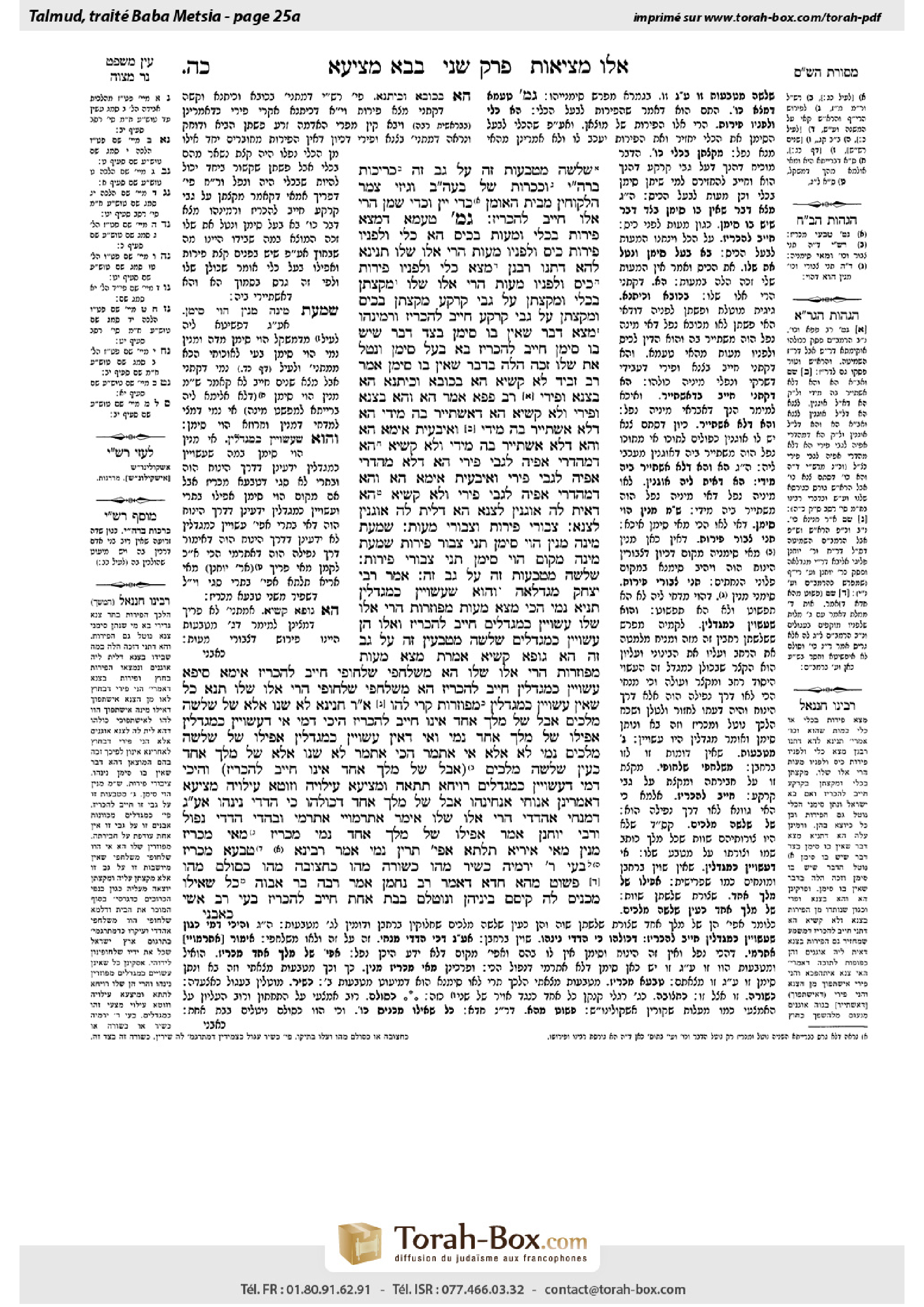
Bava Metzia 25a: Talmud study for Daf Yomi
Study the Talmud for Daf Yomi with scanned pages, Hebrew text, English translations from Sefaria and AI-generated French translations.
Passage selection and English or AI-generated French translation are available where the scan has annotations. Daf Study is independent of Torah-Box and Sefaria.
Browse Bava Metzia · בבא מציעא · All tractatesBava Metzia 25a text and translations
This page of Bava Metzia includes the Aramaic text, an English translation and an AI-generated French translation, alongside the scan above.
בבא מציעא כ״ה א · Aramaic and Hebrew text
שְׁלֹשָׁה מַטְבְּעוֹת זֶה עַל גַּב זֶה, כְּרִיכוֹת בִּרְשׁוּת הַיָּחִיד, וְכִכָּרוֹת שֶׁל בַּעַל הַבַּיִת, וְגִיזֵּי צֶמֶר הַלְּקוּחִין מִבֵּית הָאוּמָּן, כַּדֵּי יַיִן וְכַדֵּי שֶׁמֶן – הֲרֵי אֵלּוּ חַיָּיב לְהַכְרִיז.
גְּמָ׳ טַעְמָא דְּמָצָא פֵּירוֹת בִּכְלִי וּמָעוֹת בְּכִיס. הָא כְּלִי וּלְפָנָיו פֵּירוֹת, כִּיס וּלְפָנָיו מָעוֹת – הֲרֵי אֵלּוּ שֶׁלּוֹ. תְּנֵינָא לְהָא, דְּתָנוּ רַבָּנַן: מָצָא כְּלִי וּלְפָנָיו פֵּירוֹת, כִּיס וּלְפָנָיו מָעוֹת – הֲרֵי אֵלּוּ שֶׁלּוֹ. מִקְצָתָן בַּכְּלִי וּמִקְצָתָן עַל גַּבֵּי קַרְקַע, מִקְצָתָן בַּכִּיס וּמִקְצָתָן עַל גַּבֵּי קַרְקַע – חַיָּיב לְהַכְרִיז.
וּרְמִינְהוּ: מָצָא דָּבָר שֶׁאֵין בּוֹ סִימָן בְּצַד דָּבָר שֶׁיֵּשׁ בּוֹ סִימָן – חַיָּיב לְהַכְרִיז. בָּא בַּעַל סִימָן וְנָטַל אֶת שֶׁלּוֹ – זָכָה הַלָּה בְּדָבָר שֶׁאֵין בּוֹ סִימָן.
אָמַר רַב זְבִיד, לָא קַשְׁיָא: הָא בְּכוּבָּא וְכִיתָּנָא, הָא בְּצַנָּא וּפֵירֵי.
רַב פָּפָּא אָמַר: הָא וְהָא בְּצַנָּא וּפֵירֵי, וְלָא קַשְׁיָא: הָא דְּאִשְׁתְּיַיר בַּהּ מִידֵּי, הָא דְּלָא אִשְׁתְּיַיר בַּהּ מִידֵּי.
וְאִיבָּעֵית אֵימָא: הָא וְהָא דְּלָא אִשְׁתְּיַיר בַּהּ מִידֵּי, וְלָא קַשְׁיָא: הָא דִּמְהַדְּרִי אַפֵּיהּ לְגַבֵּי פֵּירֵי, הָא דְּלָא מְהַדְּרִי אַפֵּיהּ לְגַבֵּי פֵּירֵי.
וְאִיבָּעֵית אֵימָא: הָא וְהָא דִּמְהַדְּרִי אַפֵּיהּ לְגַבֵּי פֵּירֵי, וְלָא קַשְׁיָא: הָא דְּאִית לֵהּ אוּגְנִין לְצַנָּא, הָא דְּלֵית לֵהּ אוּגְנִין לְצַנָּא.
צִבּוּרֵי פֵירוֹת וְצִבּוּרֵי מָעוֹת. שָׁמְעַתְּ מִינַּהּ מִנְיָן הָוֵי סִימָן, תְּנִי: ״צִבּוּר פֵּירוֹת״. שָׁמְעַתְּ מִינַּהּ מָקוֹם הָוֵי סִימָן, תְּנִי: ״צִבּוּרֵי פֵּירוֹת״.
שְׁלֹשָׁה מַטְבְּעוֹת זֶה עַל גַּב זֶה. אָמַר רַבִּי יִצְחָק מַגְדְּלָאָה: וְהוּא שֶׁעֲשׂוּיִין כְּמִגְדָּלִין. תַּנְיָא נָמֵי הָכִי: מָצָא מָעוֹת מְפוּזָּרוֹת – הֲרֵי אֵלּוּ שֶׁלּוֹ, עֲשׂוּיִין כְּמִגְדָּלִים – חַיָּיב לְהַכְרִיז. וְאֵלּוּ הֵן עֲשׂוּיִין כְּמִגְדָּלִים? שְׁלֹשָׁה מַטְבְּעִין זֶה עַל גַּב זֶה.
הָא גּוּפַהּ קַשְׁיָא: אָמְרַתְּ מָצָא מָעוֹת מְפוּזָּרוֹת הֲרֵי אֵלּוּ שֶׁלּוֹ, הָא מְשַׁלְחֲפִי שַׁלְחוֹפֵי חַיָּיב לְהַכְרִיז! אֵימָא סֵיפָא: עֲשׂוּיִין כְּמִגְדָּלִין חַיָּיב לְהַכְרִיז, הָא מְשַׁלְחֲפִי שַׁלְחוֹפֵי הֲרֵי אֵלּוּ שֶׁלּוֹ! תָּנָא כֹּל שֶׁאֵין עֲשׂוּיִין כְּמִגְדָּלִין – מְפוּזָּרוֹת קָרֵי לְהוּ.
אָמַר רַבִּי חֲנִינָא: לֹא שָׁנוּ אֶלָּא שֶׁל שְׁלֹשָׁה מְלָכִים, אֲבָל שֶׁל מֶלֶךְ אֶחָד אֵינוֹ חַיָּיב לְהַכְרִיז. הֵיכִי דָמֵי? אִי דַּעֲשׂוּיִין כְּמִגְדָּלִין – אֲפִילּוּ שֶׁל מֶלֶךְ אֶחָד נָמֵי, וְאִי דְּאֵין עֲשׂוּיִין כְּמִגְדָּלִין – אֲפִילּוּ שֶׁל שְׁלֹשָׁה מְלָכִים נָמֵי לָא!
אֶלָּא אִי אִתְּמַר, הָכִי אִתְּמַר: לֹא שָׁנוּ אֶלָּא שֶׁל מֶלֶךְ אֶחָד כְּעֵין שְׁלֹשָׁה מְלָכִים, אֲבָל שֶׁל מֶלֶךְ אֶחָד אֵינוֹ חַיָּיב לְהַכְרִיז. וְהֵיכִי דָּמֵי דַּעֲשׂוּיִין כְּמִגְדָּלִים? רְוִיחָא תַּתָּאָה וּמְצִיעָא עִילָּוֵיהּ וְזוּטָא עִילָּוֵיהּ מְצִיעָא. דְּאָמְרִינַן: אַנּוֹחֵי אַנְחִינְהוּ. אֲבָל שֶׁל מֶלֶךְ אֶחָד, דְּכוּלְּהוּ כִּי הֲדָדֵי נִינְהוּ אַף עַל גַּב דְּמַנְּחִי אַהֲדָדֵי – הֲרֵי אֵלּוּ שֶׁלּוֹ, אֵימַר: אִתְרְמוֹיֵי אִתְרְמִי וּבַהֲדֵי הֲדָדֵי נְפוּל.
וְרַבִּי יוֹחָנָן אָמַר: אֲפִילּוּ שֶׁל מֶלֶךְ אֶחָד נָמֵי מַכְרֵיז. מַאי מַכְרֵיז? מִנְיָן. מַאי אִירְיָא תְּלָתָא? אֲפִילּוּ תְּרֵין נָמֵי. אָמַר רָבִינָא: טִבְעָא מַכְרֵיז.
בָּעֵי רַבִּי יִרְמְיָה: כְּשֵׁיר, מַהוּ? כְּשׁוּרָה, מַהוּ? כַּחֲצוּבָה, מַהוּ? כְּסוּלָּם, מַהוּ?
פְּשׁוֹט מֵהָא חֲדָא, דְּאָמַר רַב נַחְמָן אָמַר רַבָּה בַּר אֲבוּהּ: כֹּל שֶׁאִילּוּ מַכְנִיס לָהֶ[ן] קֵיסָם בֵּינֵיהֶן וְנוֹטְלָם בְּבַת אַחַת, חַיָּיב לְהַכְרִיז.
בָּעֵי רַב אָשֵׁי:
Bava Metzia 25a · English translation
three coins stacked one atop another; bundles of grain in a secluded area; loaves of a homeowner, as each shapes his loaves in his own unique manner; wool fleeces that are taken from the house of a craftsman, as each craftsman processes the wool in his own unique manner; jugs of wine; or jugs of oil. If one finds any of these, he is obligated to proclaim his find.
GEMARA: The Gemara infers from the mishna: The reason one is obligated to proclaim his find is that he found produce inside the vessel or coins inside the pouch; but if he found a vessel and produce was before it, or if he found a pouch and coins were before it, those, the produce and coins, belong to him. The Gemara comments: We learn from this mishna by inference that which the Sages taught explicitly in a baraita: If one found a vessel and produce was before it, or if he found a pouch and coins were before it, those, the produce and coins, belong to him. If some of the produce is in the vessel and some of the produce is on the ground, or if some of the coins are inside the pouch and some of them are on the ground, one is obligated to proclaim his find.
And the Gemara raises a contradiction from another baraita: If one found an item on which there is no distinguishing mark alongside an item on which there is a distinguishing mark, he is obligated to proclaim that he found both. If the owner of the item with the distinguishing mark came and took his item but did not claim ownership of the other item, the other person, who found the items, acquires the item on which there is no distinguishing mark. This halakha should also apply when one finds a vessel on which there is a distinguishing mark and produce on which there is no distinguishing mark.
The Gemara cites several possible resolutions to this contradiction. Rav Zevid said that this is not difficult: This baraita, where the finder is obligated to proclaim his finding of both the vessel and the produce, is referring to a container and flax. Since the flax fibers are intertwined, when part of the flax falls out of the container, all of the flax would fall out. Therefore, the fact that the flax is completely outside the container is not an indication that it was never in the container. That mishna, from which it is inferred that produce found outside the vessel belongs to the finder, is referring to a basket and produce. Had the produce fallen out of the basket, presumably some produce would remain in the basket, because the individual units of produce are not connected. Therefore, the fact that no produce was found in the basket indicates that the produce did not fall out of the basket.
Rav Pappa said: Both this ruling and that ruling are referring to a basket and produce, and nevertheless it is not difficult: This baraita, where the finder is obligated to proclaim his finding of the produce found outside the vessel, is referring to a case where some produce remains in the basket. That mishna, from which it is inferred that produce found outside the vessel belongs to the finder, is referring to a case where no produce remains in the basket.
And if you wish, say instead: Both this ruling and that ruling are referring to a case where no produce remains in the basket, and nevertheless it is not difficult: This baraita, where the finder is obligated to proclaim his finding of the produce found outside the empty vessel, is referring to a case where the mouth of the basket is facing the produce, indicating that the produce fell from it. That mishna, from which it is inferred that produce found outside the vessel belongs to the finder, is referring to a case where the mouth of the basket is not facing the produce.
And if you wish, say instead: Both this ruling and that ruling are referring to a case where the mouth of the basket is facing the produce, and nevertheless, it is not difficult: That mishna, from which it is inferred that produce found outside the vessel belongs to the finder, is referring to a case where the empty basket has a rim. Had the produce fallen out of the basket, the rim would have prevented some of the produce from falling. This baraita, where the finder is obligated to proclaim the produce found outside the empty vessel, is referring to a case where the basket has no rim and therefore the produce in its entirety could have fallen from the basket.
§ The mishna teaches: And for these found items, one is obligated to proclaim his find: Piles of produce and piles of coins. Conclude from it that number is a distinguishing mark, and one reclaims his produce or coins by correctly declaring the number of piles. The Gemara rejects that proof. Perhaps one should teach the mishna as stating: A pile of produce. It is not the number of piles but their location that serves as a determining mark. Based on that emendation, conclude from it that location is a distinguishing mark. The Gemara rejects that proof as well. Perhaps one should teach the mishna as stating: Piles of produce. Since the authoritative version of the mishna is unclear, no proof can be cited from it.
§ The mishna teaches: And for these found items, one is obligated to proclaim his find: Three coins stacked one atop another. Rabbi Yitzḥak from Migdal says: And one is obligated to proclaim the find in a case where the coins are arranged in well-ordered towers. This is also taught in a baraita: If one found scattered coins, these belong to him. If the coins are arranged in well-ordered towers, he is obligated to proclaim his find. The baraita elaborates: And these coins are arranged in towers: Three coins stacked one atop another.
The Gemara notes an apparent contradiction in the baraita. This baraita itself is difficult. In the first clause of the baraita, you said: If one found scattered coins, these belong to him, from which it can be inferred that if the coins partially overlap [meshalḥefei shalḥufei], he is obligated to proclaim his find. Say the latter clause of the baraita: If the coins are arranged in well-ordered towers, he is obligated to proclaim his find, from which it can be inferred that if the coins partially overlap, those coins belong to him. The Gemara answers: The tanna of the baraita calls any pile of coins that is not arranged in well-ordered towers: Scattered.
Rabbi Ḥanina says: The Sages taught that one must proclaim his find only when he finds coins minted by three different kings, but if all the coins were minted by one king, one is not obligated to proclaim his find. The Gemara asks: What are the circumstances? If the coins are arranged in well-ordered towers, then even if all the coins were minted by one king, the finder should also be obligated to proclaim his find. And if the coins are not arranged in well-ordered towers, then even if the coins were minted by three kings, the finder should also not be obligated to proclaim his find.
Rather, if Rabbi Ḥanina’s ruling was stated, this is how it was stated: The Sages taught that one must proclaim his find only when he finds coins of different sizes minted by one king, which are similar to coins minted by three kings. But if they are coins of the same size minted by one king, he is not obligated to proclaim his find. The Gemara elaborates: According to this interpretation, what are the circumstances of coins that are arranged in well-ordered towers and which one must proclaim? It is when the bottom coin is broadest, and the intermediate-sized coin is atop it and the smallest coin is atop the intermediate one, as we say: They were placed there and are not lost at all. But if one finds coins minted by one king, each of them sized like the other, even if each is placed upon the other, those coins belong to the finder. The reason is that it is possible to say that it is happenstance and they fell together, so their arrangement is not a distinguishing mark.
And Rabbi Yoḥanan says: Even if the coins were minted by one king, one is also obligated to proclaim his find. The Gemara asks: What does one proclaim in order to invite the owner to describe his item? The Gemara answers: He proclaims that he found coins and the owner specifies the number of coins. The Gemara asks: If so, why does the mishna specifically teach a case where one found three coins when even if one found two coins they could be identified by their number? Ravina said: Since the finder proclaims that he found coins, using the plural term, indicating that there were at least two coins, if the owner claims that he lost two coins, the default of the plural term, he is not providing a distinguishing mark. Therefore, the mishna teaches a case of three coins.
Rabbi Yirmeya raises a dilemma: If one found coins configured like a round bracelet, what is the halakha? If they were configured like a straight line, what is the halakha? If they were configured like a triangle, what is the halakha? If they were configured like a ladder, one partially upon the other and partially protruding, what is the halakha?
The Gemara suggests: Resolve at least one of these dilemmas, as Rav Naḥman says that Rabba bar Avuh says: For any arrangement of coins such that if one were to introduce a wood chip between the coins he could thereby lift them all at once with that wood chip, he is obligated to proclaim his find. Based on that criterion, one can conclude that if one finds coins configured like a ladder, he is obligated to proclaim his find.
Rav Ashi raises a dilemma:
Bava Metzia 25a · Traduction française (IA)
trois monnaies empilées les unes sur les autres ; des ballots de céréales dans un lieu isolé ; des pains de la maison d’un propriétaire, car chacun façonne ses pains selon sa propre manière ; des touffes de laine provenant de la maison d’un artisan, car chaque artisan traite la laine selon sa propre manière ; des jarres de vin ; ou des jarres d’huile. Si l’on trouve l’un de ces objets, on est tenu de proclamer sa découverte.
GUEMARA : La Guemara déduit de la mitsna que l’on est tenu de proclamer sa découverte, car l’on a trouvé des produits à l’intérieur du récipient ou des monnaies à l’intérieur de la poche ; mais si l’on a trouvé un récipient et que les produits étaient avant lui, ou si l’on a trouvé une poche et que les monnaies étaient avant elle, ceux-ci, les produits et les monnaies, appartiennent à l’individu. La Guemara commente : Nous apprenons par déduction de cette mitsna ce que les Sages ont enseigné explicitement dans une baraïta : Si l’on a trouvé un récipient et que les produits étaient avant lui, ou si l’on a trouvé une poche et que les monnaies étaient avant elle, ceux-ci, les produits et les monnaies, appartiennent à l’individu. Si une partie des produits est dans le récipient et une autre partie est sur le sol, ou si une partie des monnaies est à l’intérieur de la poche et une autre partie est sur le sol, l’individu est tenu de proclamer sa découverte.
Et la Guemara soulève une contradiction avec une autre baraïta : Si l’on a trouvé un objet dont il n’y a pas de marque distinctive à côté d’un objet dont il y a une marque distinctive, l’individu est tenu de proclamer qu’il a trouvé les deux. Si l’propriétaire de l’objet avec la marque distinctive est venu et a récupéré son objet mais n’a pas réclamé la propriété de l’autre objet, la personne qui a trouvé les objets acquiert l’objet dont il n’y a pas de marque distinctive. Cette halakha devrait également s’appliquer lorsque l’on trouve un récipient dont il y a une marque distinctive et des produits dont il n’y a pas de marque distinctive.
La Guemara cite plusieurs solutions possibles à cette contradiction. Rav Zevid dit : cela n’est pas difficile : cette baraïta, où le trouvère est tenu de proclamer sa découverte des deux objets, le récipient et les produits, fait référence à un contenant et à de la lin. Puisque les fibres de lin sont entrelacées, lorsque partie du lin tombe du contenant, tout le lin tomberait. Par conséquent, le fait que le lin soit entièrement en dehors du contenant ne signifie pas qu’il n’y était jamais. Cette mitsva, d’où l’on déduit que les produits trouvés en dehors du récipient appartiennent au trouvère, fait référence à une corbeille et des produits. Si les produits étaient tombés de la corbeille, on pourrait supposer que certains produits resteraient dans la corbeille, car les unités individuelles de produits ne sont pas connectées. Par conséquent, le fait que aucun produit ne soit trouvé dans la corbeille indique que les produits n’ont pas tombé de la corbeille.
Rav Pappa dit : ces deux décisions font référence à une corbeille et des produits, et pourtant cela n’est pas difficile : cette baraïta, où le trouvère est tenu de proclamer sa découverte des produits trouvés en dehors du récipient, fait référence à un cas où certains produits restent dans la corbeille. Cette mitsva, d’où l’on déduit que les produits trouvés en dehors du récipient appartiennent au trouvère, fait référence à un cas où aucun produit ne reste dans la corbeille.
Et si l’on veut, on peut dire plutôt : ces deux décisions font référence à un cas où aucun produit ne reste dans la corbeille, et pourtant cela n’est pas difficile : cette baraïta, où le trouvère est tenu de proclamer sa découverte des produits trouvés en dehors du récipient vide, fait référence à un cas où la bouche de la corbeille fait face aux produits, indiquant qu’ils sont tombés d’elle. Cette mitsva, d’où l’on déduit que les produits trouvés en dehors du récipient appartiennent au trouvère, fait référence à un cas où la bouche de la corbeille ne fait pas face aux produits.
Et si l’on veut, on peut dire plutôt : ces deux décrets font référence à un cas où l’ouverture de la corbeille fait face aux produits, et pourtant cela n’est pas difficile : cette mitsva, d’où l’on déduit que les produits trouvés en dehors du récipient appartiennent à l’individu, fait référence à un cas où la corbeille a un rebord. Si les produits avaient tombé de la corbeille, le rebord aurait empêché que certains produits tombent. Cette baraïta, où l’individu est tenu de proclamer la découverte des produits en dehors du récipient vide, fait référence à un cas où la corbeille n’a pas de rebord et donc les produits pourraient tous avoir tombé de la corbeille.
§ La mitsva enseigne : Et pour ces objets trouvés, l’individu est tenu de proclamer sa découverte : des tas de produits et des tas de monnaies. Concluez-en que le nombre est une marque distinctive, et l’individu récupère ses produits ou ses monnaies en déclarant correctement le nombre de tas. La Guemara rejette cette preuve. Peut-être devrait-on enseigner la mitsva comme disant : un tas de produits. Ce n’est pas le nombre de tas mais leur emplacement qui sert de marque distinctive. Sur cette édition, concluez que l’emplacement est une marque distinctive. La Guemara rejette cette preuve également. Peut-être devrait-on enseigner la mitsva comme disant : des tas de produits. Puisque la version autoritaire de la mitsva est ambiguë, aucune preuve ne peut être tirée d’elle.
§ La mitsva enseigne : Et pour ces objets trouvés, l’individu est tenu de proclamer sa découverte : trois monnaies empilées les unes sur les autres. Rabbi Yitzḥak de Migdal dit : et l’individu est tenu de proclamer sa découverte dans le cas où les monnaies sont disposées en tours bien ordonnées. Cela est également enseigné dans une baraïta : si l’on a trouvé des monnaies éparses, celles-ci appartiennent à l’individu. Si les monnaies sont disposées en tours bien ordonnées, l’individu est tenu de proclamer sa découverte. La baraïta précise : et ces monnaies sont disposées en tours : trois monnaies empilées les unes sur les autres.
La Guemara souligne une contradiction apparente dans la baraïta. Cette baraïta elle-même est difficile. Dans la première clause de la baraïta, on lit : Si l'on trouve des pièces éparses, celles-ci appartiennent à lui, d'où l'on peut déduire que si les pièces se chevauchent partiellement [meshalḥefei shalḥufei], il est tenu de proclamer sa découverte. La seconde clause de la baraïta dit : Si les pièces sont disposées en tours bien ordonnées, il est tenu de proclamer sa découverte, d'où l'on peut déduire que si les pièces se chevauchent partiellement, celles-ci appartiennent à lui. La Guemara répond : Le tanna de la baraïta appelle toute pile de pièces qui n'est pas disposée en tours bien ordonnées : Éparses.
Rabbi Ḥanina dit : Les Sages ont enseigné que l'on doit proclamer sa découverte uniquement lorsqu'on trouve des pièces frappées par trois rois différents, mais si toutes les pièces sont frappées par un seul roi, on n'est pas tenu de proclamer sa découverte. La Guemara pose la question : Quelles sont les circonstances ? Si les pièces sont disposées en tours bien ordonnées, même si toutes les pièces sont frappées par un seul roi, le trouver devrait également être tenu de proclamer sa découverte. Et si les pièces ne sont pas disposées en tours bien ordonnées, même si les pièces sont frappées par trois rois, le trouver devrait également ne pas être tenu de proclamer sa découverte.
En réalité, si la décision de Rabbi Ḥanina a été émise, c'est ainsi qu'elle a été émise : Les Sages ont enseigné que l'on doit proclamer sa découverte uniquement lorsqu'on trouve des pièces de tailles différentes frappées par un seul roi, ce qui est semblable à des pièces frappées par trois rois. Mais si ce sont des pièces de même taille frappées par un seul roi, on n'est pas tenu de proclamer sa découverte. La Guemara développe : Selon cette interprétation, quels sont les circonstances des pièces disposées en tours bien ordonnées et dont l'on doit proclamer la découverte ? C'est lorsque la pièce du bas est la plus large, la pièce intermédiaire est au-dessus d'elle et la pièce la plus petite est au-dessus de la pièce intermédiaire, comme nous disons : Elles ont été placées là et ne sont pas perdues du tout. Mais si l'on trouve des pièces frappées par un seul roi, chacune de la même taille, même si chacune est placée sur l'autre, ces pièces appartiennent au trouver. La raison est que l'on peut dire qu'il s'agit d'une coïncidence et qu'elles sont tombées ensemble, donc leur disposition n'est pas un signe distinctif.
Et Rabbi Yoḥanan dit : Même si les pièces sont frappées par un seul roi, l'on est également tenu de proclamer sa découverte. La Guemara pose la question : Qu'est-ce que l'on proclame afin d'inviter l'propriétaire à décrire son objet ? La Guemara répond : Il proclame qu'il a trouvé des pièces et l'propriétaire précise le nombre de pièces. La Guemara pose la question : Si c'est ainsi, pourquoi la mishna enseigne spécifiquement un cas où l'on a trouvé trois pièces, alors que même si l'on a trouvé deux pièces, on pourrait les identifier par leur nombre ? Ravina dit : Puisque le trouver proclame qu'il a trouvé des pièces, en utilisant le terme pluriel, indiquant qu'il y avait au moins deux pièces, si l'propriétaire affirme qu'il a perdu deux pièces, le pluriel par défaut ne lui fournit pas un signe distinctif. Par conséquent, la mishna enseigne un cas de trois pièces.
Rabbi Yirmeya soulève un dilemme : Si l'on trouve des pièces disposées comme un bracelet rond, quelle est la halakha ? Si elles sont disposées comme une ligne droite, quelle est la halakha ? Si elles sont disposées comme un triangle, quelle est la halakha ? Si elles sont disposées comme une échelle, partiellement l'une sur l'autre et partiellement dépassant, quelle est la halakha ?
La Guemara suggère : Résolvez au moins l'un de ces dilemmes, car Rav Naḥman dit que Rabba bar Avuh dit : Pour toute disposition des pièces telle que si l'on introduisait une lame de bois entre les pièces, on pourrait ainsi lever toutes les pièces d'un seul coup avec cette lame de bois, il est tenu de proclamer sa découverte. Selon ce critère, on peut conclure que si l'on trouve des pièces disposées comme une échelle, il est tenu de proclamer sa découverte.
Rav Ashi soulève un dilemme :
Traduction française générée par IA à partir de l’édition anglaise de Sefaria. Vérifie toujours un passage avec le texte source.
Text from Sefaria: William Davidson Edition - Vocalized Aramaic (CC BY NC); William Davidson Edition - English (CC BY NC).