Bava Metzia 25b: Talmud study for Daf Yomi
Study the Talmud for Daf Yomi with scanned pages, Hebrew text, English translations from Sefaria and AI-generated French translations.
Passage selection and English or AI-generated French translation are available where the scan has annotations. Daf Study is independent of Torah-Box and Sefaria.
Browse Bava Metzia · בבא מציעא · All tractatesBava Metzia 25b text and translations
This page of Bava Metzia includes the Aramaic text, an English translation and an AI-generated French translation, alongside the scan above.
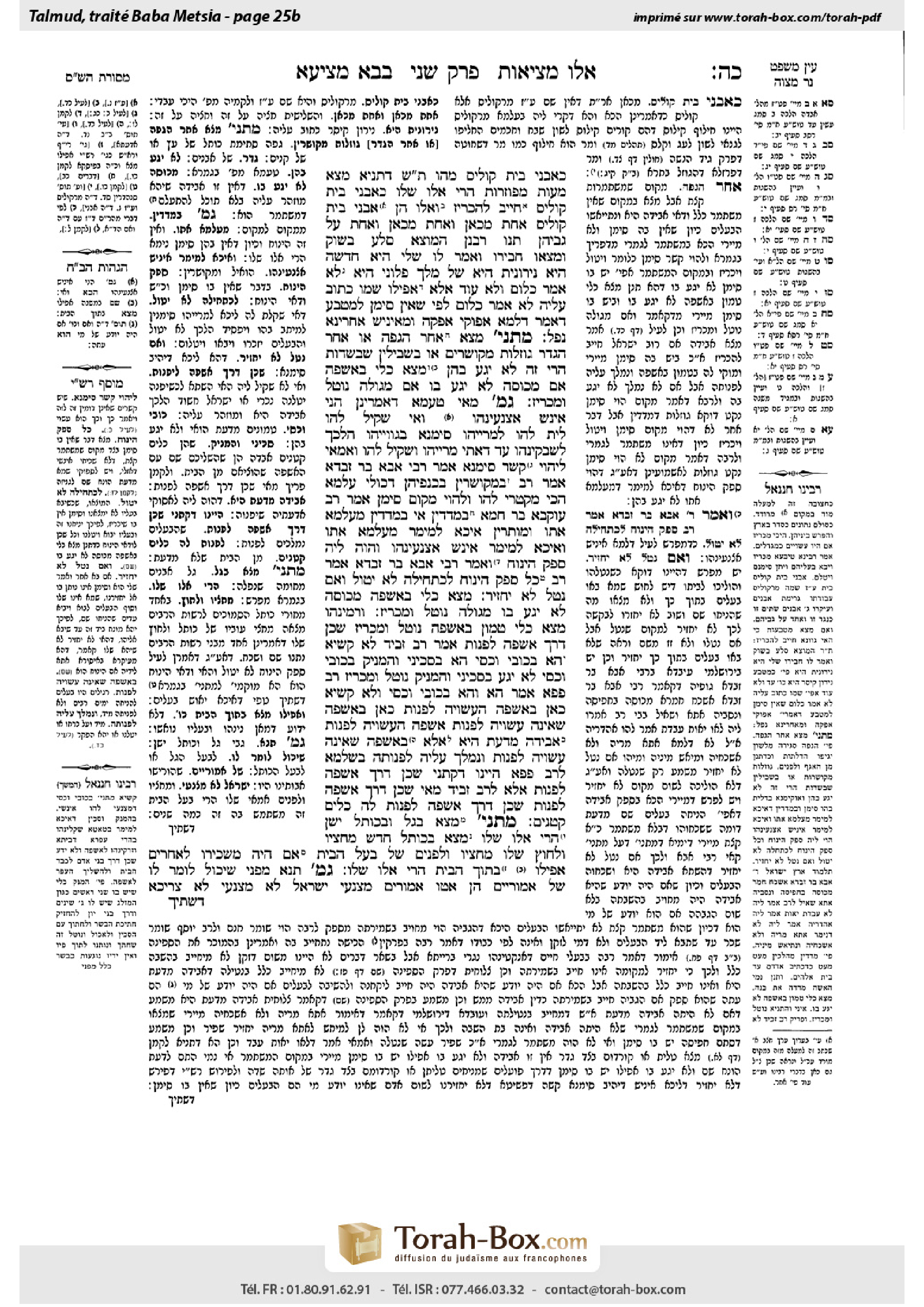
בבא מציעא כ״ה ב · Aramaic and Hebrew text
כְּאַבְנֵי בֵּית קוּלִיס, מַהוּ?
תָּא שְׁמַע, דְּתַנְיָא: מָצָא מָעוֹת מְפוּזָּרוֹת – הֲרֵי אֵלּוּ שֶׁלּוֹ, כְּאַבְנֵי בֵּית קוּלִיס – חַיָּיב לְהַכְרִיז. וְאֵלּוּ הֵן אַבְנֵי בֵּית קוּלִיס: אַחַת מִכָּאן וְאַחַת מִכָּאן וְאַחַת עַל גַּבֵּיהֶן.
תָּנוּ רַבָּנַן: הַמּוֹצֵא סֶלַע בְּשׁוּק, וּמְצָאוֹ חֲבֵירוֹ וְאָמַר: שֶׁלִּי הִיא, חֲדָשָׁה הִיא, נִירוֹנִית הִיא, שֶׁל מֶלֶךְ פְּלוֹנִי הִיא – לֹא אָמַר כְּלוּם. וְלֹא עוֹד, אֶלָּא אֲפִילּוּ שְׁמוֹ כָּתוּב עָלֶיהָ – לֹא אָמַר כְּלוּם. לְפִי שֶׁאֵין סִימָן לְמַטְבֵּעַ. דְּאָמַר: דִּלְמָא אַפּוֹקֵי אַפְּקַהּ וּמֵאִינִישׁ אַחֲרִינָא נְפַל.
מַתְנִי׳ מָצָא אַחַר הַגָּפָה אוֹ אַחַר הַגָּדֵר גּוֹזָלוֹת מְקוּשָּׁרִים, אוֹ בִּשְׁבִילִין שֶׁבַּשָּׂדוֹת – הֲרֵי זֶה לֹא יִגַּע בָּהֶן. מָצָא כְּלִי בָּאַשְׁפָּה, אִם מְכוּסֶּה – לֹא יִגַּע בּוֹ, אִם מְגוּלֶּה – נוֹטֵל וּמַכְרִיז.
גְּמָ׳ מַאי טַעְמָא? דְּאָמְרִינַן: הָנֵי, אִינָשׁ אַצְנְעִינְהוּ, וְאִי שָׁקֵיל לְהוּ – לֵית לְהוּ לְמָרַיְיהוּ סִימָנָא בְּגַוַּויְיהוּ, הִלְכָּךְ לִשְׁבְּקִינְהוּ עַד דְּאָתֵי מָרַיְיהוּ וְשָׁקֵיל לְהוּ.
וְאַמַּאי לֶיהֱוֵי קֶשֶׁר סִימָנָא! אָמַר רַבִּי אַבָּא בַּר זַבְדָּא אָמַר רַב: בִּמְקוּשָּׁרִין בְּכַנְפֵיהֶן, דְּכוּלֵּי עָלְמָא הָכִי מְקַטְּרִי לְהוּ.
וְלֶהֱוֵי מָקוֹם סִימָן! אָמַר רַב עוּקְבָא בַּר חָמָא: בְּמִדַּדִּין. אִי בְּמִדַּדִּין – מֵעָלְמָא אָתוּ וּמוּתָּרִין!
אִיכָּא לְמֵימַר מֵעָלְמָא אֲתוֹ, וְאִיכָּא לְמֵימַר אִינָשׁ אַצְנְעִינְהוּ, וְהָוֵה לֵיהּ סְפֵק הִינּוּחַ, וְאָמַר רַבִּי אַבָּא בַּר זַבְדָּא אָמַר רַב: כֹּל סְפֵק הִינּוּחַ – לְכַתְּחִילָּה לֹא יִטּוֹל, וְאִם נָטַל לֹא יַחֲזִיר.
מָצָא כְּלִי בָּאַשְׁפָּה, מְכוּסֶּה – לֹא יִגַּע בּוֹ, מְגוּלֶּה – נוֹטֵל וּמַכְרִיז. וּרְמִינְהוּ: מָצָא כְּלִי טָמוּן בָּאַשְׁפָּה – נוֹטֵל וּמַכְרִיז, שֶׁכֵּן דֶּרֶךְ אַשְׁפָּה לִפַּנּוֹת.
אָמַר רַב זְבִיד, לָא קַשְׁיָא: הָא בְּכוּבֵּי וְכָסֵי, הָא בְּסַכִּינֵי וְהֶמְנֵיק. בְּכוּבֵּי וְכָסֵי – לֹא יִגַּע, בְּסַכִּינֵי וְהֶמְנֵיק – נוֹטֵל וּמַכְרִיז.
רַב פָּפָּא אָמַר: הָא וְהָא בְּכוּבֵּי וְכָסֵי, וְלָא קַשְׁיָא: כָּאן בְּאַשְׁפָּה הָעֲשׂוּיָה לִפַּנּוֹת, כָּאן בְּאַשְׁפָּה שֶׁאֵינָהּ עֲשׂוּיָה לִפַּנּוֹת.
אַשְׁפָּה הָעֲשׂוּיָה לִפַּנּוֹת אֲבֵידָה מִדַּעַת הִיא! אֶלָּא בְּאַשְׁפָּה שֶׁאֵינָהּ עֲשׂוּיָה לִפַּנּוֹת, וְנִמְלַךְ עָלֶיהָ לְפַנּוֹתָהּ.
בִּשְׁלָמָא לְרַב פָּפָּא – הַיְינוּ דְּקָתָנֵי: שֶׁכֵּן דֶּרֶךְ אַשְׁפָּה לִפַּנּוֹת. אֶלָּא לְרַב זְבִיד, מַאי שֶׁכֵּן דֶּרֶךְ אַשְׁפָּה לִפַּנּוֹת? שֶׁכֵּן דֶּרֶךְ אַשְׁפָּה לְפַנּוֹת לָהּ כֵּלִים קְטַנִּים.
מַתְנִי׳ מָצָא בְּגַל וּבְכוֹתֶל יָשָׁן – הֲרֵי אֵלּוּ שֶׁלּוֹ. מָצָא בְּכוֹתֶל חָדָשׁ, מֵחֶצְיוֹ וְלַחוּץ – שֶׁלּוֹ, מֵחֶצְיוֹ וְלִפְנִים – שֶׁל בַּעַל הַבַּיִת. אִם הָיָה מַשְׂכִּירוֹ לַאֲחֵרִים – אֲפִילּוּ בְּתוֹךְ הַבַּיִת, הֲרֵי אֵלּוּ שֶׁלּוֹ.
גְּמָ׳ תָּנָא: מִפְּנֵי שֶׁיָּכוֹל לוֹמַר לוֹ שֶׁל אֲמוֹרִיִּים הֵן. אַטּוּ אֱמוֹרִים מַצְנְעִי, יִשְׂרָאֵל לָא מַצְנְעִי? לָא צְרִיכָא
Bava Metzia 25b · English translation
If they were configured like the stones of the house of worship dedicated to the Roman deity Mercury, what is the halakha?
The Gemara suggests: Come and hear a resolution of the dilemma. As it is taught in a baraita: If one found scattered coins, these belong to him. If they were configured like the stones of the house of worship dedicated to Mercury, he is obligated to proclaim his find. The Gemara explains: And these are coins that were configured like the stones of the house of worship dedicated to Mercury: One was situated here on one side, and one was situated there alongside it, and one was situated atop the two of them.
§ The Sages taught in a baraita: In the case of one who finds a sela coin in the marketplace and another person finds him and says: It is mine, and the distinguishing mark is that it is new, or that it is a coin minted by the emperor Nero, or that it is minted by king so-and-so, he has not said anything and the finder need not give him the sela. Moreover, even if his name is written on the sela he has not said anything, due to the fact that there is no distinguishing mark for a coin that is effective in its recovery, as the finder says: Perhaps he spent the coin and it fell from another person.
MISHNA: If one found, behind a wooden fence or behind a stone fence, bound fledglings, or if he found them in the paths that run through fields, he may not touch them, as they were certainly placed there intentionally. In a case where one found a vessel in a garbage dump, if it is concealed, he may not touch it, as a person certainly concealed it there. If it is exposed, the finder takes the item and proclaims his find.
GEMARA: What is the reason that one may not touch the fledglings? The Gemara answers: The reason is that we say with regard to these birds: A person concealed them, and if one takes them, their owner has no distinguishing mark on them that would enable him to reclaim them. Therefore, let the finder leave the birds in place until their owner comes and takes them.
The Gemara asks: But why? Let the knot binding them serve as their distinguishing mark. Rabbi Abba bar Zavda said that Rav said: This is a case where the birds were bound at their wings. Since everyone binds them in that manner, the knot binding the birds is not a distinguishing mark.
The Gemara asks: And let their location serve as their distinguishing mark. Rav Ukva bar Ḥama said: This is a case where the birds hop and do not remain in place. The Gemara asks: If it is a case where the birds hop, perhaps the birds came to that location from elsewhere and it is permitted for the finder to keep them.
The Gemara answers: It can be said that the birds came from elsewhere and it can be said that a person concealed them, and the result is uncertainty with regard to whether the placement of the birds was deliberate, i.e., whether or not they are lost items. And Rabbi Abba bar Zavda says that Rav says: In any case of uncertainty as to whether the placement of an item was deliberate, one may not take it ab initio. And if he took it, he need not return it.
§ The mishna teaches: In a case where one found a vessel in a garbage dump, if it is concealed, he may not touch it, as a person certainly concealed it there. If it is exposed, the finder takes the item and proclaims his find. The Gemara raises a contradiction from a baraita: If one found a vessel concealed in a garbage dump, the finder takes the item and proclaims his find, because it is routine for a garbage dump to be cleared. Therefore, presumably it was not placed there; rather, it is a lost item and one is obligated to proclaim his find.
Rav Zevid said that this is not difficult: This mishna is referring to containers or cups. That baraita is referring to knives or a fork [vehamnik]. The Gemara elaborates: In the case of containers or cups, which are large, it is inconceivable that they fell there inadvertently, so he may not touch them. In the case of knives or forks, which are small, there is room for uncertainty as to whether it was placed there or whether it fell, so the finder takes the item and proclaims his find.
Rav Pappa said: Both this baraita and that mishna are referring to containers and cups, and nevertheless, it is not difficult: Here, the baraita is referring to a garbage dump that is designed to be cleared; therefore, he must take the vessel and proclaim his find to prevent it from being cleared with the garbage. There, the mishna is referring to a garbage dump that is not designed to be cleared; as it is possible that the owner placed it there, the finder may not touch it.
The Gemara asks: How could one be obligated to proclaim his find of a vessel in a garbage dump that is designed to be cleared? Even if the owner of the vessel concealed it there, it is a deliberate loss and the owner renounced ownership of the vessel. The Gemara answers: Rather, the baraita is referring to a garbage dump that is not designed to be cleared, and the owner of the land reconsidered and decided to clear it.
The Gemara asks: Granted, according to Rav Pappa, this is the reason that the tanna teaches in the baraita: He takes it and proclaims his find, because it is routine for a garbage dump to be cleared, as the ruling is dependent on whether the dump is ultimately cleared. But according to Rav Zevid, the reason for the ruling in the baraita is that the utensils found were knives and forks. What is the relevance of the statement in the baraita: Because it is routine for a garbage dump to be cleared? The Gemara answers that according to Rav Zevid, it means: Because it is routine for a garbage dump to inadvertently have small utensils cleared, i.e., discarded, into it.
MISHNA: If one found lost items in a heap of stone rubble or in an old wall, these belong to him. If one found lost items in a new wall from its midpoint and outward, they belong to him. If he found the items from its midpoint and inward, they belong to the homeowner. If the homeowner would rent the house to others on a regular basis and there was a steady turnover of residents, even if one found lost items inside the house, these belong to him. Since the owner of the lost items cannot be identified based on location, he will certainly despair of recovering his lost items.
GEMARA: The mishna teaches that if one found a lost item in a heap of rubble or in an old wall it belongs to him. The Sages taught in a baraita: It is his due to the fact that when the owner of the heap or wall claims the property, the finder can say to him: They belong to the Amorites, who lived in Eretz Yisrael before it was conquered by the Jews. The Gemara asks: Is that to say that Amorites conceal items but Jews do not conceal items? Perhaps it was the homeowner who placed the item in the wall or the heap. The Gemara answers: No, the baraita is necessary only in the specific case
Bava Metzia 25b · Traduction française (IA)
Si elles étaient disposées comme les pierres du temple dédié au dieu romain Mercure, quelle est la halakha ?
La Guemara suggère : Viens écouter une résolution de ce dilemme. Comme il est enseigné dans une baraïta : Si l'on trouve des pièces éparses, elles appartiennent à celui qui les trouve. Si elles étaient disposées comme les pierres du temple dédié à Mercure, il est tenu de proclamer sa découverte. La Guemara explique : Et ces pièces sont disposées comme les pierres du temple dédié à Mercure : l'une était située ici d'un côté, l'autre était située là à côté, et l'autre était située au-dessus des deux.
§ Les Sages enseignent dans une baraïta : Dans le cas où l'on trouve une pièce de sela dans le marché et qu'un autre homme le trouve et dit : C'est à moi, et la marque distinctive est qu'elle est neuve, ou qu'elle est une pièce frappée par l'empereur Néron, ou qu'elle est frappée par le roi tel et tel, il n'a pas dit quelque chose et le trouveur n'a pas besoin de lui donner la sela. De plus, même si son nom est écrit sur la sela, il n'a pas dit quelque chose, en raison du fait qu'il n'y a pas de marque distinctive pour une pièce qui permette son récupération, car le trouveur dit : Peut-être qu'il a dépensé la pièce et qu'elle est tombée d'une autre personne.
MICHNA : Si l'on trouve, derrière un mur de bois ou derrière un mur de pierre, des oisillons, ou si l'on les trouve sur les chemins qui traversent les champs, on ne doit pas les toucher, car ils ont certainement été placés là intentionnellement. Dans le cas où l'on trouve un objet dans un tas de détritus, si l'objet est caché, on ne doit pas le toucher, car une personne a certainement caché là. Si l'objet est exposé, le trouveur prend l'objet et proclame sa découverte.
GUEMARA : Quelle est la raison pour laquelle on ne doit pas toucher les oisillons ? La Guemara répond : La raison est que nous disons concernant ces oiseaux : une personne les a cachés, et si l'on les prend, leur propriétaire n'a pas de marque distinctive sur eux qui permette à lui de les récupérer. Par conséquent, laissez le trouveur laisser les oiseaux en place jusqu'à ce que leur propriétaire vienne les prendre.
La Guemara pose la question : Mais pourquoi ? Que le nœud qui les tient ensemble serve de marque distinctive. Rabbi Abba bar Zavda dit que Rav dit : C'est un cas où les oiseaux sont ligotés aux ailes. Puisque tout le monde les ligote ainsi, le nœud qui tient les oiseaux n'est pas une marque distinctive.
La Guemara pose la question : Et que leur emplacement serve de marque distinctive. Rav Ukva bar Ḥama dit : C'est un cas où les oiseaux sautent et ne restent pas en place. La Guemara pose la question : Si c'est un cas où les oiseaux sautent, peut-être les oiseaux sont venus de quelque part d'autre et il est permis au trouveur de les garder.
La Guemara répond : On peut dire qu'ils sont venus d'ailleurs et on peut dire qu'une personne les a cachés, et le résultat est l'incertitude concernant si la mise en place des oiseaux était délibérée, c'est-à-dire si ce sont des objets perdus. Et Rabbi Abba bar Zavda dit que Rav dit : Dans tout cas d'incertitude concernant si la mise en place d'un objet était délibérée, on ne doit pas le prendre d'abord. Et si l'on l'a pris, il n'a pas besoin de le rendre.
§ La mishna enseigne : Dans le cas où l'on trouve un objet dans un tas de détritus, si il est caché, on ne doit pas le toucher, car une personne a certainement caché là. Si il est exposé, le trouveur prend l'objet et proclame sa découverte. La Guemara soulève une contradiction à partir d'une baraïta : Si l'on trouve un objet caché dans un tas de détritus, le trouveur prend l'objet et proclame sa découverte, car c'est habituel de vider un tas de détritus. Par conséquent, on peut supposer qu'il n'a pas été placé là ; plutôt, c'est un objet perdu et l'on est tenu de proclamer sa découverte.
Rav Zevid dit que cela n'est pas difficile : cette Michna fait référence à des conteneurs ou des coupes. Cette Baraïta fait référence à des couteaux ou une fourchette [vehamnik]. La Guemara explique : dans le cas des conteneurs ou des coupes, qui sont grands, il est inconcevable qu'ils aient pu tomber là accidentellement, donc on ne doit pas les toucher. dans le cas des couteaux ou des fourchettes, qui sont petits, il y a de la place pour l'incertitude quant à savoir si l'objet a été placé là ou s'il est tombé, donc le trouveur prend l'objet et proclame sa découverte.
Rav Pappa dit : à la fois cette Baraïta et cette Michna font référence à des conteneurs et des coupes, et néanmoins, cela n'est pas difficile : ici, la Baraïta fait référence à un tas de détritus conçu pour être vidé ; donc il doit prendre l'objet et proclamer sa découverte afin de l'empêcher d'être vidé avec les détritus. là, la Michna fait référence à un tas de détritus non conçu pour être vidé ; car il est possible que le propriétaire l'ait placé là, donc le trouveur ne doit pas le toucher.
La Guemara pose la question : comment peut-on être tenu de proclamer sa découverte d'un objet dans un tas de détritus conçu pour être vidé ? même si le propriétaire de l'objet l'a caché là, c'est une perte délibérée et le propriétaire a renoncé à la propriété de l'objet. la Guemara répond : plutôt, la Baraïta fait référence à un tas de détritus non conçu pour être vidé, et le propriétaire du terrain a réfléchi et a décidé de le vider.
La Guemara pose la question : D'accord, selon Rav Pappa, c'est la raison pour laquelle le tanna enseigne dans la baraïta : il le prend et proclame sa découverte, car c'est habituel de vider un tas de détritus, car la décision dépend du fait que le tas de détritus soit finalement vidé. Mais selon Rav Zevid, la raison de la décision dans la baraïta est que les ustensiles trouvés étaient des couteaux et des fourchettes. Quel est le lien avec l'affirmation dans la baraïta : car c'est habituel de vider un tas de détritus ? La Guemara répond que selon Rav Zevid, cela signifie : car c'est habituel qu'un tas de détritus ait accidentellement des ustensiles petits éliminés, c'est-à-dire jetés, dedans.
MICHNA : Si l'on trouve des objets perdus dans un tas de décombres ou dans un mur ancien, ceux-ci lui appartiennent. Si l'on trouve des objets perdus dans un mur nouveau à partir du milieu et vers l'extérieur, ceux-ci lui appartiennent. Si l'on trouve les objets à partir du milieu et vers l'intérieur, ceux-ci appartiennent au propriétaire du mur. Si le propriétaire loue la maison à d'autres personnes de manière régulière et qu'il y a un turnover régulier d'habitants, même si l'on trouve des objets perdus à l'intérieur de la maison, ceux-ci lui appartiennent. Puisque le propriétaire des objets perdus ne peut être identifié en fonction de la localisation, il se désespère certainement de récupérer ses objets perdus.
GUEMARA : La mishna enseigne que si l'on trouve un objet perdu dans un tas de décombres ou dans un mur ancien, celui-ci lui appartient. Les Sages ont enseigné dans une baraïta : C'est à lui qu'appartient la récompense, car lorsque le propriétaire du tas ou du mur réclame la propriété, le trouver peut lui dire : Ils appartiennent aux Amorites, qui habitaient en Terre d'Israël avant qu'elle ne soit conquise par les Juifs. La Guemara demande : Est-ce que cela signifie que les Amorites cachent des objets mais que les Juifs ne les cachent pas ? Peut-être que c'était le propriétaire lui-même qui a placé l'objet dans le mur ou dans le tas. La Guemara répond : Non, la baraïta est nécessaire uniquement dans le cas spécifique
Traduction française générée par IA à partir de l’édition anglaise de Sefaria. Vérifie toujours un passage avec le texte source.
Text from Sefaria: William Davidson Edition - Vocalized Aramaic (CC BY NC); William Davidson Edition - English (CC BY NC).