Bava Metzia 26b: Talmud study for Daf Yomi
Study the Talmud for Daf Yomi with scanned pages, Hebrew text, English translations from Sefaria and AI-generated French translations.
Passage selection and English or AI-generated French translation are available where the scan has annotations. Daf Study is independent of Torah-Box and Sefaria.
Browse Bava Metzia · בבא מציעא · All tractatesBava Metzia 26b text and translations
This page of Bava Metzia includes the Aramaic text, an English translation and an AI-generated French translation, alongside the scan above.
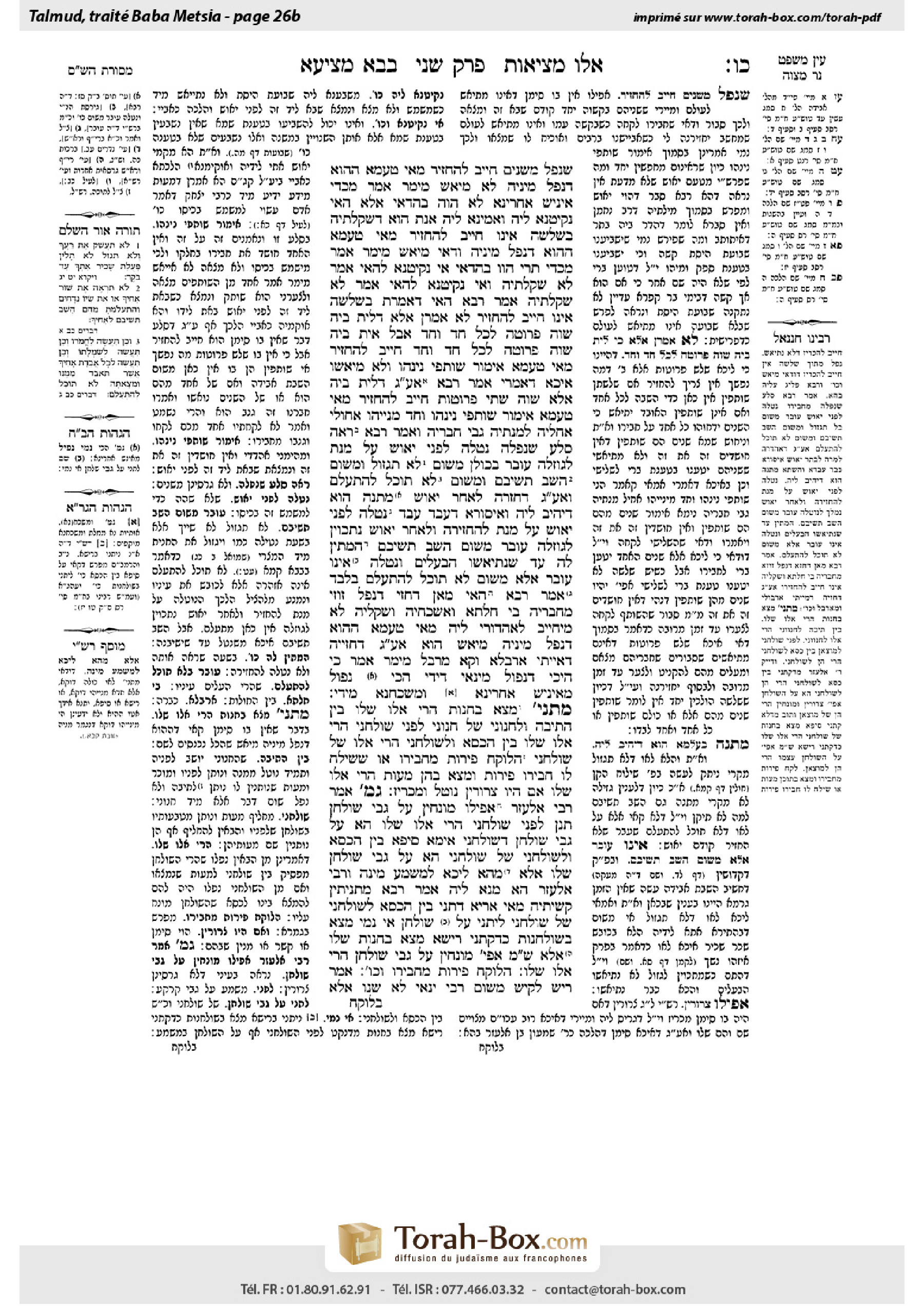
בבא מציעא כ״ו ב · Aramaic and Hebrew text
שֶׁנָּפַל מִשְּׁנַיִם חַיָּיב לְהַחְזִיר. מַאי טַעְמָא? הָהוּא דִּנְפַל מִינֵּיהּ לָא מִיָּאַשׁ, מֵימָר אָמַר: מִכְּדֵי אִינִישׁ אַחֲרִינָא לָא הֲוָה בַּהֲדַאי אֶלָּא הַאי, נָקֵיטְנָא לֵיהּ וְאָמֵינָא לֵיהּ: אַנְתְּ הוּא דִּשְׁקַלְתֵּיהּ.
בִּשְׁלֹשָׁה אֵינוֹ חַיָּיב לְהַחְזִיר. מַאי טַעְמָא? הָהוּא דִּנְפַל מִינֵּיהּ וַדַּאי מִיָּאַשׁ, מֵימָר אָמַר: מִכְּדֵי תְּרֵי הֲווֹ בַּהֲדַאי, אִי נָקֵיטְנָא לְהַאי אָמַר: ״לָא שְׁקַלְתֵּיהּ״, וְאִי נָקֵיטְנָא לְהַאי אָמַר: ״לָא שְׁקַלְתֵּיהּ״.
אָמַר רָבָא: הַאי דְּאָמְרַתְּ בִּשְׁלֹשָׁה אֵינוֹ חַיָּיב לְהַחְזִיר – לָא אֲמַרַן אֶלָּא דְּלֵית בֵּיהּ שָׁוֶה פְּרוּטָה לְכׇל חַד וְחַד, אֲבָל אִית בֵּיהּ שָׁוֶה פְּרוּטָה לְכׇל חַד וְחַד – חַיָּיב לְהַחְזִיר. מַאי טַעְמָא? אֵימוֹר שׁוּתָּפֵי נִינְהוּ וְלָא מִיָּאֲשׁוּ.
אִיכָּא דְּאָמְרִי, אָמַר רָבָא: אַף עַל גַּב דְּלֵית בֵּיהּ אֶלָּא שָׁוֶה שְׁתֵּי פְרוּטוֹת – חַיָּיב לְהַחְזִיר, מַאי טַעְמָא? אֵימוֹר שׁוּתָּפֵי נִינְהוּ וְחַד מִנַּיְיהוּ אַחוֹלֵי אַחֲלֵיהּ לִמְנָתֵיהּ גַּבֵּי חַבְרֵיהּ.
וְאָמַר רָבָא: רָאָה סֶלַע שֶׁנָּפְלָה, נְטָלָהּ לִפְנֵי יֵאוּשׁ עַל מְנָת לְגוֹזְלָהּ – עוֹבֵר בְּכוּלָּן: מִשּׁוּם ״לֹא תִגְזוֹל״, וּמִשּׁוּם ״הָשֵׁב תְּשִׁיבֵם״, וּמִשּׁוּם ״לֹא תוּכַל לְהִתְעַלֵּם״. וְאַף עַל גַּב (דַּחֲזָרָה) [דְּאַהְדְּרַהּ] לְאַחַר יֵאוּשׁ, מַתָּנָה הוּא דְּיָהֵיב לֵיהּ, וְאִיסּוּרָא דַּעֲבַד – עֲבַד.
נְטָלָהּ לִפְנֵי יֵאוּשׁ עַל מְנָת לְהַחְזִירָהּ, וּלְאַחַר יֵאוּשׁ נִתְכַּוֵּין לְגוֹזְלָהּ – עוֹבֵר מִשּׁוּם ״הָשֵׁב תְּשִׁיבֵם״.
הִמְתִּין לָהּ עַד שֶׁנִּתְיָאֲשׁוּ הַבְּעָלִים וּנְטָלָהּ, אֵינוֹ עוֹבֵר אֶלָּא מִשּׁוּם ״לֹא תוּכַל לְהִתְעַלֵּם״ בִּלְבָד.
אָמַר רָבָא: הַאי מַאן דְּחָזֵי דִּנְפוּל זוּזֵי מֵחַבְרֵיהּ בֵּי חָלָתָא וְאַשְׁכְּחֵיהּ וְשַׁקְלֵיהּ – לָא מִיחַיַּיב לְאַהְדּוֹרֵי לֵיהּ, מַאי טַעְמָא? הָהוּא דִּנְפַל מִינֵּיהּ מִיָּאַשׁ הוּא. אַף עַל גַּב דְּחַזְיֵיהּ דְּאַיְיתִי אַרְבְּלָא וְקָא מְרַבֵּל, מֵימָר אָמַר: כִּי הֵיכִי דִּנְפוּל מִינַּאי דִּידִי הָכִי נְפוּל מֵאִינִישׁ אַחֲרִינָא וּמַשְׁכַּחְנָא מִידֵּי.
מַתְנִי׳ מָצָא בַּחֲנוּת – הֲרֵי אֵלּוּ שֶׁלּוֹ. בֵּין הַתֵּיבָה וְלַחֶנְוָנִי – שֶׁל חֶנְוָנִי. לִפְנֵי שׁוּלְחָנִי – הֲרֵי אֵלּוּ שֶׁלּוֹ. בֵּין הַכִּסֵּא וְלַשּׁוּלְחָנִי – הֲרֵי אֵלּוּ שֶׁל שׁוּלְחָנִי.
הַלּוֹקֵחַ פֵּירוֹת מֵחֲבֵירוֹ, אוֹ שֶׁשִּׁילַּח לוֹ חֲבֵירוֹ פֵּירוֹת, וּמָצָא בָּהֶן מָעוֹת – הֲרֵי אֵלּוּ שֶׁלּוֹ. אִם הָיוּ צְרוּרִין – נוֹטֵל וּמַכְרִיז.
גְּמָ׳ אָמַר רַבִּי אֶלְעָזָר: אֲפִילּוּ מוּנָּחִין עַל גַּבֵּי שׁוּלְחָן.
תְּנַן: לִפְנֵי שׁוּלְחָנִי – הֲרֵי אֵלּוּ שֶׁלּוֹ. הָא, עַל גַּבֵּי שׁוּלְחָן – דְּשׁוּלְחָנִי! אֵימָא סֵיפָא: בֵּין הַכִּסֵּא וְלַשּׁוּלְחָנִי – שֶׁל שׁוּלְחָנִי! הָא, עַל גַּבֵּי שׁוּלְחָן שֶׁלּוֹ. אֶלָּא מֵהָא לֵיכָּא לְמִשְׁמַע מִינַּהּ.
וְרַבִּי אֶלְעָזָר, הָא מְנָא לֵיהּ? אָמַר רָבָא: מַתְנִיתִין קְשִׁיתֵיהּ. מַאי אִרְיָא דְּתָנֵי ״בֵּין הַכִּסֵּא לַשּׁוּלְחָנִי שֶׁל שׁוּלְחָנִי״? לִיתְנֵי ״עַל שׁוּלְחָן״, אִי נָמֵי: ״מָצָא בַּשּׁוּלְחָנוּת״ כִּדְקָתָנֵי רֵישָׁא ״מָצָא בַּחֲנוּת שֶׁלּוֹ״. אֶלָּא שְׁמַע מִינַּהּ: אֲפִילּוּ מוּנָּחִין עַל גַּבֵּי שׁוּלְחָן – הֲרֵי אֵלּוּ שֶׁלּוֹ.
הַלּוֹקֵחַ פֵּירוֹת מֵחֲבֵירוֹ וְכוּ׳. אָמַר רֵישׁ לָקִישׁ מִשּׁוּם רַבִּי יַנַּאי: לֹא שָׁנוּ אֶלָּא
Bava Metzia 26b · English translation
that fell from one of two people, he is obligated to return it. What is the reason? The person from whom the sela fell does not despair of recovering it. He says: After all, no other person was with me, only this one who was with me, as he is unaware that the sela was found by a third party. He therefore thinks: I will seize him and say to him: It is you who took it.
In a case where the coin fell from one of three people, the finder is not obligated to return it. What is the reason? The person from whom the sela fell certainly despairs of recovering it. He says: After all, two other people were with me. If I seize this one, he will say: I did not take it. And if I seize that one, he will say: I did not take it. Since he cannot make a definitive claim, he despairs of recovering his coin.
Based on the fact that by Torah law, one must return a lost item to its owner only if it is worth one peruta, Rava said: With regard to that which you said, that in a case where the coin fell from one of three people the finder is not obligated to return it, we said this only in a case where the total value of the lost coin, when divided by three, does not amount to the value of one peruta for each and every one of them; but if it amounts to the value of one peruta for each and every one of them, he is obligated to return it. What is the reason? Say that perhaps they are partners, i.e., they own the coin jointly; consequently, they do not despair, as each assumes that one of the other two found it and is holding it for the three of them.
There are those who say that Rava said: Even if its total value is only two perutot, which is insufficient to provide each of the three partners with one peruta, one is obligated to return it. What is the reason? Say that perhaps they are partners and one relinquishes his share to another. In that case, the remaining two partners each have a one peruta share, rendering the finder liable to return it.
§ And Rava says: In a case where one saw a sela coin that fell from another, if he took the coin in order to steal it, before the despair of the owner, he violates all of the following mitzvot: He is liable due to the prohibition: “You shall not…rob” (Leviticus 19:13); and due to the positive mitzva, stated with regard to found items, of: “You shall return them to your brother” (Deuteronomy 22:1), and due to the prohibition, stated with regard to one who finds an item: “You may not disregard” (Deuteronomy 22:3). And even if he returned it after the despair of the owner, it is merely a gift that he gave him; and the transgression that he performed, he performed, and he remains in violation of these mitzvot.
Rava continues: If he took the coin in order to return it, before the despair of the owner, and then, after the despair of the owner, he intended to steal it; he violates a commandment, due to his failure to fulfill the positive mitzva of: “You shall return them to your brother.” He does not violate the prohibition: “You shall not…rob,” because at the time he took the coin he did not intend to keep it. And he does not violate the prohibition: “You may not disregard,” because he did not disregard the lost item. He took it with the intention of returning it.
If he waited until the owner despaired of recovering the lost item and only then took it, he violates a commandment, but only due to his failure to fulfill the positive mitzva of: “You may not disregard,” as he took no action to return the lost item to its owner.
Rava says: In the case of this person who saw that a dinar coin fell from another into the sand, and then he found it and took it, he is not obligated to return it to its owner. What is the reason? The reason is that the one from whom the money fell despairs of finding it. Even if the finder sees that the owner brought a sifter and is sifting through the sand, ostensibly indicating that he did not despair of finding his coin, perhaps the owner is saying: Just as a coin fell from me in the sand, so too, a coin fell from another person and I will find some item to offset my loss.
MISHNA: If one found items without a distinguishing mark in a store, those items belong to him, as, since the store is frequented by the multitudes, the owner despairs of its recovery. If the items were found between the storekeeper’s counter and the storekeeper, the items belong to the storekeeper; since his customers do not typically have access to that area, presumably the items are his. If one found coins before a money changer, those coins belong to him. If the coins were found between the money changer’s chair and the money changer, those coins belong to the money changer, because his clients do not typically have access to that area.
In the case of one who purchases produce from another or in a case where another sent him produce as a gift, and he found coins intermingled with the produce, those coins belong to him. If the coins were bundled, this serves as a distinguishing mark and the finder takes the coins and proclaims his find.
GEMARA: The mishna teaches that if one found coins before a money changer, those coins belong to him. Rabbi Elazar says: Even if the coins were found placed upon the table itself they belong to the finder.
The Gemara challenges: We learned in the mishna: If one found coins before a money changer, those coins belong to him; this indicates by inference that if they were found upon the table, the coins belong to the money changer. The Gemara responds: Say the latter clause of the mishna: If the coins were found between the money changer’s chair and the money changer, those coins belong to the money changer; this indicates by inference that if they were found upon the table, the coins belong to the finder. The Gemara concludes: Rather, due to the contradictory inferences from the first and the latter clauses, no inference is to be learned from this mishna.
The Gemara asks: And Rabbi Elazar himself, from where does he derive this halakha that coins found on the table belong to the finder, given that apparently one cannot infer this ruling from the mishna? Rava said: The mishna is difficult for him: Why did the tanna teach specifically that when the coins are found between the money changer’s chair and the money changer, those coins belong to the money changer? Let the tanna teach instead: If the coins were found on the table, or: If the coins were found in the money-changing establishment, as it is taught in the first clause of the mishna: If one found items without a distinguishing mark in a store, those items belong to him. Rather, learn from it that since the money changer typically places his money in his drawer, even if the coins were found placed upon the table itself these coins belong to him.
§ The mishna teaches: In the case of one who purchases produce from another, and he found coins intermingled with the produce, those coins belong to him. Reish Lakish says in the name of Rabbi Yannai: The Sages taught this only
Bava Metzia 26b · Traduction française (IA)
Celui qui a trouvé une monnaie tombée d'une des deux personnes est tenu de la rendre. Pourquoi ? Celui d'où la monnaie est tombée ne désespère pas de la récupérer. Il dit : Après tout, il n'y avait pas d'autre personne avec moi, seulement celui qui était avec moi, car il ne sait pas que la monnaie a été trouvée par un tiers. Il pense donc : Je vais saisir celui-ci et lui dire : C'est toi qui l'as prise.
Dans le cas où la monnaie est tombée d'une des trois personnes, le trouver ne doit pas la rendre. Pourquoi ? Celui d'où la monnaie est tombée désespère certainement de la récupérer. Il dit : Après tout, deux autres personnes étaient avec moi. Si je saisie celui-ci, il dira : Je n'ai pas pris cela. Et si je saisie celui-là, il dira : Je n'ai pas pris cela. Puisqu'il ne peut pas faire une déclaration définitive, il désespère de récupérer sa monnaie.
D'après le fait que selon la loi du Torah, on doit rendre un objet perdu à son propriétaire uniquement s'il vaut un peruta, Rava dit : En ce qui concerne ce que vous avez dit, que dans le cas où la monnaie est tombée d'une des trois personnes, le trouver n'est pas tenu de la rendre, nous avons dit cela uniquement dans le cas où la valeur totale de la monnaie perdue, divisée par trois, ne représente pas la valeur d'un peruta pour chacun d'eux ; mais si elle représente la valeur d'un peruta pour chacun d'eux, il est tenu de la rendre. Pourquoi ? Disons que peut-être ils sont associés, c'est-à-dire qu'ils possèdent la monnaie ensemble ; par conséquent, ils ne désespèrent pas, car chacun suppose que l'un des autres deux l'a trouvée et la tient pour les trois.
Certains disent que Rava a dit : Même si sa valeur totale est seulement deux perutot, ce qui est insuffisant pour que chaque des trois associés ait un peruta, on est tenu de la rendre. Pourquoi ? Disons que peut-être ils sont associés et qu'un d'entre eux renonce à sa part à un autre. Dans ce cas, les deux associés restants ont chacun une part d'un peruta, ce qui rend le trouver tenu de la rendre.
§ Rava dit : Dans le cas où l'on a vu une monnaie tombée d'une autre personne, et s'il a pris la monnaie pour la voler avant que le propriétaire ne désespère, il viole toutes les suivantes commandements : Il est tenu responsable de l'interdiction : « Vous ne devriez pas... voler » (Lévitique 19:13) ; et de la commandement positif, concernant les objets trouvés, de : « Vous devez les rendre à votre frère » (Dn 22:1), et de l'interdiction, concernant celui qui trouve un objet : « Vous ne devriez pas négliger » (Dn 22:3). Et même s'il a rendu la monnaie après que le propriétaire ait désespéré, c'est simplement un cadeau qu'il lui a donné ; et la transgression qu'il a commise, il l'a commise, et il reste en violation de ces commandements.
Rava continue : S'il a pris la monnaie pour la rendre avant que le propriétaire ne désespère, et ensuite, après que le propriétaire ait désespéré, il a l'intention de la voler ; il viole un commandement, en raison de son échec à remplir le commandement positif de : « Vous devez les rendre à votre frère. » Il ne viole pas l'interdiction : « Vous ne devriez pas... voler », car à l'époque où il a pris la monnaie, il n'avait pas l'intention de la garder. Et il ne viole pas l'interdiction : « Vous ne devriez pas négliger », car il n'a pas négligé l'objet perdu. Il l'a pris avec l'intention de le rendre.
Si l'on attend jusqu'au désespoir du propriétaire pour prendre l'objet, on viole un commandement, mais uniquement en raison de l'échec à remplir le commandement positif de : « Vous ne devriez pas négliger », car on n'a pas pris d'initiative pour rendre l'objet perdu à son propriétaire.
Rava dit : Dans le cas de cette personne qui a vu qu'une monnaie de dinar était tombée d'une autre dans le sable, et ensuite l'a trouvée et l'a prise, il n'est pas tenu de la rendre à son propriétaire. Pourquoi ? La raison est que celui d'où la monnaie est tombée désespère de la trouver. Même si le trouver voit que le propriétaire a apporté un tamis et le fait passer dans le sable, ce qui semble indiquer qu'il n'a pas désespéré de trouver sa monnaie, peut-être le propriétaire dit : Comme une monnaie est tombée de moi dans le sable, ainsi une monnaie est tombée d'une autre personne et je trouverai quelque chose pour compenser ma perte.
MICHNA : Si l'on a trouvé des objets sans marque distinctive dans un magasin, ceux-ci appartiennent à celui qui les a trouvés, car, puisque le magasin est fréquenté par la foule, le propriétaire désespère de les récupérer. Si les objets ont été trouvés entre le comptoir du marchand et le marchand lui-même, les objets appartiennent au marchand ; puisque ses clients n'ont généralement pas accès à cette zone, on suppose que les objets sont à lui. Si l'on a trouvé des monnaies devant un changeur, celles-ci appartiennent à celui qui les a trouvés. Si les monnaies ont été trouvées entre la chaise du changeur et le changeur lui-même, celles-ci appartiennent au changeur, car ses clients n'ont généralement pas accès à cette zone.
Dans le cas où l'on achète des produits d'une autre personne ou où une autre personne lui a envoyé des produits en cadeau, et l'on a trouvé des monnaies mêlées aux produits, celles-ci appartiennent à celui qui les a trouvés. Si les monnaies étaient emballées, cela sert de marque distinctive et le trouver prend les monnaies et proclame sa découverte.
GUEMARA : La mishna enseigne que si l'on a trouvé des monnaies devant un changeur, celles-ci appartiennent à celui qui les a trouvés. Rabbi Elazar dit : Même si les monnaies ont été trouvées placées sur la table elle-même, elles appartiennent au trouver.
La Guemara conteste : Nous avons appris dans la mishna : Si l'on a trouvé des monnaies devant un changeur, celles-ci appartiennent à celui qui les a trouvés ; cela indique par inférence que si elles ont été trouvées sur la table, les monnaies appartiennent au changeur. La Guemara répond : Disons la dernière partie de la mishna : Si les monnaies ont été trouvées entre la chaise du changeur et le changeur lui-même, celles-ci appartiennent au changeur ; cela indique par inférence que si elles ont été trouvées sur la table, les monnaies appartiennent au trouver. La Guemara conclut : Plutôt, en raison de la contradiction entre les inférences de la première et de la dernière partie, aucune inférence ne doit être tirée de cette mishna.
Le Guemara demande : Et Rabbi Elazar lui-même, d'où tire-t-il cette halakha selon laquelle les monnaies trouvées sur la table appartiennent à celui qui les a trouvées, sachant que visiblement on ne peut pas déduire cette décision de la mitsna ? Rava dit : la mitsna est difficile pour lui : pourquoi le tanna a-t-il enseigné spécifiquement que lorsque les monnaies sont trouvées entre la chaise du changeur de monnaie et le changeur de monnaie, ces monnaies appartiennent au changeur de monnaie ? Que le tanna ait plutôt enseigné : si les monnaies ont été trouvées sur la table, ou : si les monnaies ont été trouvées dans l'établissement de change, comme il est enseigné dans la première partie de la mitsna : si l'on trouve des objets sans marque distinctive dans un magasin, ces objets appartiennent à celui qui les a trouvés. Apprends plutôt de cela que puisque le changeur de monnaie place généralement ses monnaies dans son tiroir, même si les monnaies ont été trouvées placées sur la table elle-même, ces monnaies lui appartiennent.
§ La mitsna enseigne : dans le cas d'une personne qui achète des produits d'une autre personne, et qu'il a trouvé des monnaies mêlées aux produits, ces monnaies lui appartiennent. Reish Lakish dit en nom de Rabbi Yannai : les Sages ont enseigné cela uniquement
Traduction française générée par IA à partir de l’édition anglaise de Sefaria. Vérifie toujours un passage avec le texte source.
Text from Sefaria: William Davidson Edition - Vocalized Aramaic (CC BY NC); William Davidson Edition - English (CC BY NC).