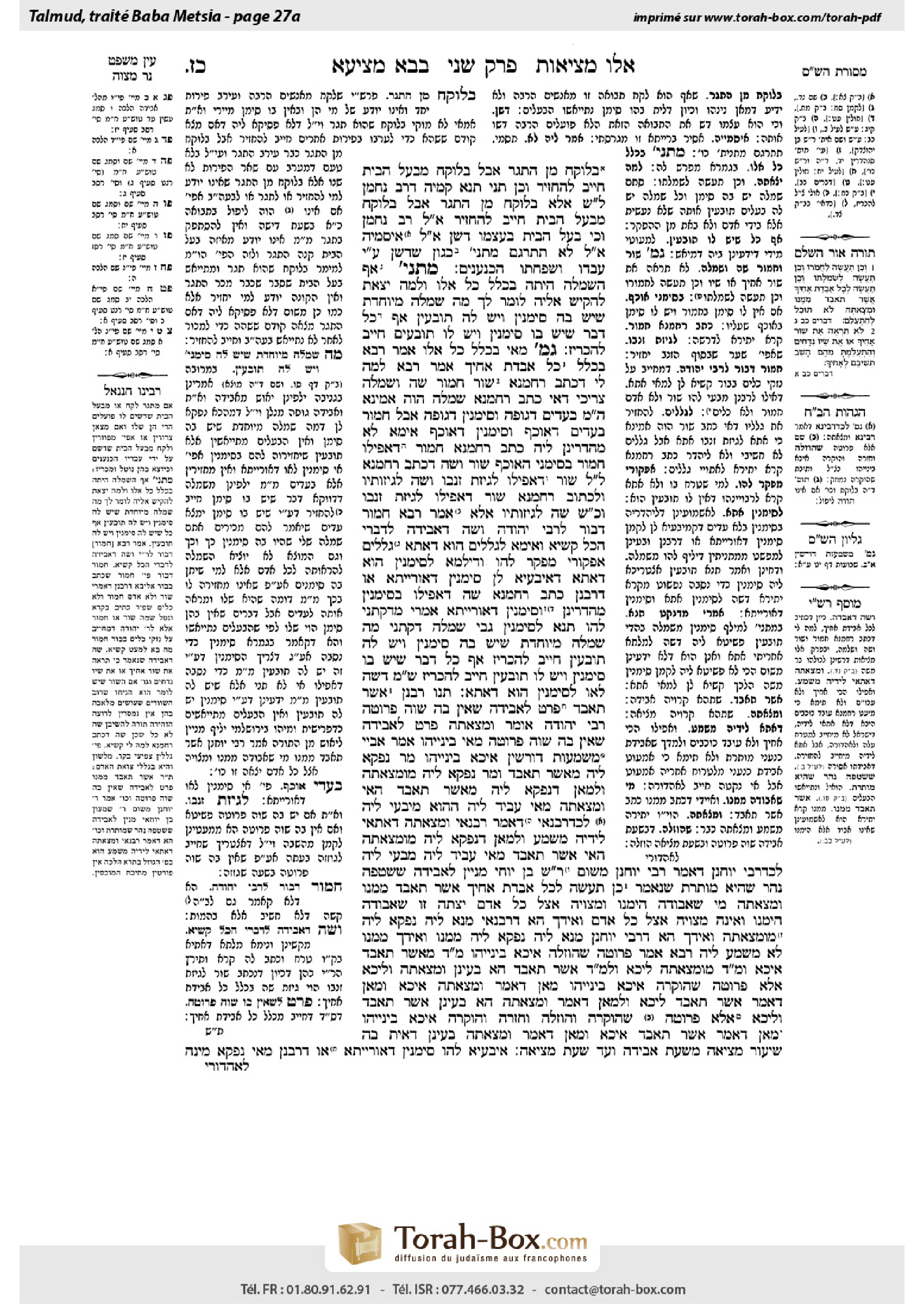
Bava Metzia 27a: Talmud study for Daf Yomi
Study the Talmud for Daf Yomi with scanned pages, Hebrew text, English translations from Sefaria and AI-generated French translations.
Passage selection and English or AI-generated French translation are available where the scan has annotations. Daf Study is independent of Torah-Box and Sefaria.
Browse Bava Metzia · בבא מציעא · All tractatesBava Metzia 27a text and translations
This page of Bava Metzia includes the Aramaic text, an English translation and an AI-generated French translation, alongside the scan above.
בבא מציעא כ״ז א · Aramaic and Hebrew text
בְּלוֹקֵחַ מִן הַתַּגָּר, אֲבָל בְּלוֹקֵחַ מִבַּעַל הַבַּיִת – חַיָּיב לְהַחְזִיר. וְכֵן תָּנֵי תַּנָּא קַמֵּיהּ דְּרַב נַחְמָן: לֹא שָׁנוּ אֶלָּא בְּלוֹקֵחַ מִן הַתַּגָּר, אֲבָל בְּלוֹקֵחַ מִבַּעַל הַבַּיִת – חַיָּיב לְהַחְזִיר.
אֲמַר לֵיהּ רַב נַחְמָן: וְכִי בַּעַל הַבַּיִת בְּעַצְמוֹ דָּשָׁן? אֲמַר לֵיהּ: אֶיסְמְיַהּ? אֲמַר לֵיהּ: לָא, תִּתַּרְגַּם מַתְנִיתִין כְּגוֹן שֶׁדָּשָׁן עַל יְדֵי עַבְדּוֹ וְשִׁפְחָתוֹ הַכְּנַעֲנִים.
מַתְנִי׳ אַף הַשִּׂמְלָה הָיְתָה בִּכְלַל כׇּל אֵלּוּ, וְלָמָּה יָצָאת? לְהַקִּישׁ אֵלֶיהָ, לוֹמַר לְךָ: מָה שִׂמְלָה מְיוּחֶדֶת, שֶׁיֵּשׁ בָּהּ סִימָנִין וְיֵשׁ לָהּ תּוֹבְעִין, אַף כׇּל דָּבָר שֶׁיֵּשׁ בּוֹ סִימָנִין וְיֵשׁ לוֹ תּוֹבְעִים חַיָּיב לְהַכְרִיז.
גְּמָ׳ מַאי ״בִּכְלַל כׇּל אֵלּוּ״? אָמַר רָבָא: בִּכְלַל ״כׇּל אֲבֵדַת אָחִיךָ״.
אָמַר רָבָא: לְמָה לִי דִּכְתַב רַחֲמָנָא ״שׁוֹר״, ״חֲמוֹר״, ״שֶׂה״ וְ״שִׂמְלָה״?
צְרִיכִי, דְּאִי כְּתַב רַחֲמָנָא שִׂמְלָה, הֲוָה אָמֵינָא: הָנֵי מִילֵּי בְּעֵדִים דְּגוּפַהּ וְסִימָנִין דְּגוּפַהּ. אֲבָל חֲמוֹר בְּעֵדִים דְּאוּכָּף וְסִימָנִין דְּאוּכָּף, אֵימָא לָא מַהְדְּרִינַן לֵיהּ, כְּתַב רַחֲמָנָא ״חֲמוֹר״ דַּאֲפִילּוּ חֲמוֹר בְּסִימָנֵי הָאוּכָּף.
״שׁוֹר״ וָ״שֶׂה״, דִּכְתַב רַחֲמָנָא לְמָה לִי? ״שׁוֹר״ – דַּאֲפִילּוּ לְגִיזַּת זְנָבוֹ, וְ״שֶׂה״ – לְגִיזּוֹתָיו. וְלִכְתּוֹב רַחֲמָנָא ״שׁוֹר״, דַּאֲפִילּוּ לְגִיזַּת זְנָבוֹ, וְכׇל שֶׁכֵּן ״שֶׂה״ לְגִיזּוֹתָיו!
אֶלָּא אָמַר רָבָא: ״חֲמוֹר״ דְּבוֹר לְרַבִּי יְהוּדָה, וְ״שֶׂה״ דַאֲבֵידָה – לְדִבְרֵי הַכֹּל קַשְׁיָא.
וְאֵימָא לִגְלָלִים הוּא דַּאֲתָא? גְּלָלִים – אַפְקוֹרֵי מַפְקַר לְהוּ. וְדִילְמָא לְסִימָנִין הוּא דַּאֲתָא, דְּאִיבַּעְיָא לַן: סִימָנִין דְּאוֹרָיְיתָא אוֹ דְרַבָּנַן. כְּתַב רַחֲמָנָא ״שֶׂה״, דַּאֲפִילּוּ בְּסִימָנִין מַהְדְּרִינַן, וְסִימָנִין דְּאוֹרָיְיתָא.
אָמְרִי: מִדְּקָתָנֵי לְהוּ תַּנָּא, לְסִימָנִין גַּבֵּי שִׂמְלָה, דְּקָתָנֵי: מָה שִׂמְלָה מְיוּחֶדֶת שֶׁיֵּשׁ בָּהּ סִימָנִין וְיֵשׁ לָהּ תּוֹבְעִין – חַיָּיב לְהַכְרִיז, אַף כׇּל דָּבָר שֶׁיֵּשׁ בּוֹ סִימָנִין וְיֵשׁ לוֹ תּוֹבְעִין – חַיָּיב לְהַכְרִיז. שְׁמַע מִינַּהּ דְּ״שֶׂה״ לָאו לְסִימָנִין הוּא דַּאֲתָא.
תָּנוּ רַבָּנַן: ״אֲשֶׁר תֹּאבַד״ – פְּרָט לַאֲבֵידָה שֶׁאֵין בָּהּ שָׁוֶה פְּרוּטָה. רַבִּי יְהוּדָה אוֹמֵר: ״וּמְצָאתָהּ״ – פְּרָט לַאֲבֵידָה שֶׁאֵין בָּהּ שָׁוֶה פְּרוּטָה.
מַאי בֵּינַיְיהוּ? אָמַר אַבָּיֵי: מַשְׁמָעוּת דּוֹרְשִׁין אִיכָּא בֵּינַיְיהוּ. מָר נָפְקָא לֵיהּ מֵ״אֲשֶׁר תֹּאבַד״ וּמָר נָפְקָא לֵיהּ מִ״וּמְצָאתָהּ״.
וּלְמַאן דְּנָפְקָא לֵיהּ מֵ״אֲשֶׁר תֹּאבַד״ הַאי ״וּמְצָאתָהּ״ מַאי עָבֵיד לֵיהּ?
הַהוּא מִיבְּעֵי לֵיהּ לְכִדְרַבְנַאי, דְּאָמַר רַבְנַאי: ״וּמְצָאתָהּ״ – דַּאֲתַאי לִידֵיהּ מַשְׁמַע.
וּלְמַאן דְּנָפְקָא לֵיהּ מִ״וּמְצָאתָהּ״, הַאי ״אֲשֶׁר תֹּאבַד״ מַאי עָבֵיד לֵיהּ?
מִבְּעֵי לֵיהּ לְכִדְרַבִּי יוֹחָנָן. דְּאָמַר רַבִּי יוֹחָנָן מִשּׁוּם רַבִּי שִׁמְעוֹן בֶּן יוֹחַאי: מִנַּיִין לַאֲבֵידָה שֶׁשְּׁטָפָהּ נָהָר שֶׁהִיא מוּתֶּרֶת? שֶׁנֶּאֱמַר: ״כֵּן תַּעֲשֶׂה לְכׇל אֲבֵדַת אָחִיךָ אֲשֶׁר תֹּאבַד מִמֶּנּוּ וּמְצָאתָהּ״ – מִי שֶׁאֲבוּדָה הֵימֶנּוּ וּמְצוּיָה אֵצֶל כׇּל אָדָם, יָצְתָה זוֹ שֶׁאֲבוּדָה הֵימֶנּוּ וְאֵינָהּ מְצוּיָה אֵצֶל כׇּל אָדָם.
וְאִידַּךְ, הָא דְּרַבְנַאי מְנָא לֵיהּ? נָפְקָא לֵיהּ מִ״וּמְצָאתָהּ״.
וְאִידַּךְ, הָא דְּרַבִּי יוֹחָנָן מְנָא לֵיהּ? נָפְקָא לֵיהּ ״מִמֶּנּוּ״. וְאִידָּךְ? ״מִמֶּנּוּ״ לָא מַשְׁמַע לֵיהּ.
רָבָא אָמַר: פְּרוּטָה שֶׁהוּזְלָה אִיכָּא בֵּינַיְיהוּ, מַאן דְּאָמַר מֵ״אֲשֶׁר תֹּאבַד״ – אִיכָּא, וּמַאן דְּאָמַר מִ״וּמְצָאתָהּ״ – לֵיכָּא.
וּלְמַאן דְּאָמַר ״אֲשֶׁר תֹּאבַד״ – הָא בָּעֵינַן ״וּמְצָאתָהּ״, וְלֵיכָּא!
אֶלָּא: פְּרוּטָה שֶׁהוּקְרָה אִיכָּא בֵּינַיְיהוּ, מַאן דְּאָמַר ״וּמְצָאתָהּ״ – אִיכָּא, וּמַאן דְּאָמַר ״אֲשֶׁר תֹּאבַד״ – לֵיכָּא.
וּלְמַאן דְּאָמַר ״וּמְצָאתָהּ״, הָא בָּעֵינַן ״אֲשֶׁר תֹּאבַד״ וְלֵיכָּא!
אֶלָּא פְּרוּטָה שֶׁהוּקְרָה וְהוּזְלָה וְחָזְרָה וְהוּקְרָה אִיכָּא בֵּינַיְיהוּ. מַאן דְּאָמַר ״אֲשֶׁר תֹּאבַד״ – אִיכָּא. וּמַאן דְּאָמַר ״וּמְצָאתָהּ״ – בָּעֵינַן דְּאִית בַּהּ שִׁיעוּר מְצִיאָה מִשְּׁעַת אֲבֵידָה וְעַד שְׁעַת מְצִיאָה.
אִיבַּעְיָא לְהוּ: סִימָנִין דְּאוֹרָיְיתָא אוֹ דְרַבָּנַן? מַאי נָפְקָא מִינַּהּ?
Bava Metzia 27a · English translation
in the case of one who purchases produce from a merchant, who acquired the produce from several suppliers and is unable to determine the source of the coins. But in the case of one who purchases produce from a single owner, he is obligated to return the coins to the seller. And likewise, the tanna who recited mishnayot and baraitot in the study hall of Rav Naḥman taught a baraita before Rav Naḥman: The Sages taught that the coins belong to the buyer only in the case of one who purchases produce from a merchant, but in the case of one who purchases produce from a single owner, he is obligated to return the coins to the seller.
Rav Naḥman said to the tanna: But does the owner thresh the grain himself? His workers thresh the grain, and the coins could belong to one of them. The tanna said to Rav Naḥman: Based on the difficulty you raise, should I delete it from the collection of authoritative baraitot? Rav Naḥman said to the tanna: No. Interpret the baraita as referring to a case where the grain was threshed by his Canaanite slave or maidservant, and therefore any coins found intermingled with the produce belong to the owner.
MISHNA: This mishna is an excerpt from a halakhic midrash concerning lost items, based on the verse: “You shall not see your brother’s ox or his sheep wandering, and disregard them; you shall return them to your brother…And so shall you do with his donkey; and so shall you do with his garment; and so shall you do with every lost item of your brother, which shall be lost from him, and you have found it; you may not disregard it” (Deuteronomy 22:1, 3). The garment was also included in the generalization that one must return all of these items. And why did it emerge from the generalization that it should be specified? To draw an analogy to it and to say to you: What is notable about a garment? It is notable in that there are distinguishing marks concerning it and it has claimants asserting ownership, and its finder is obligated to proclaim his find. So too with regard to any item concerning which there are distinguishing marks and it has claimants asserting ownership, its finder is obligated to proclaim his find.
GEMARA: When the mishna says that the garment was included in the generalization that one must return all of these items, in what generalization is it included? Rava said: It is included in the generalization: “And so shall you do with his donkey; and so shall you do with his garment; and so shall you do with every lost item of your brother, which shall be lost from him, and you have found it; you may not disregard it” (Deuteronomy 22:3).
Rava says: Why do I need all the specific items that the Merciful One writes that one must return: An ox, a donkey, a sheep, and a garment? One of them would seem to suffice.
Rava answers: They are all necessary, as a unique halakha is derived from each example. As, if the Merciful One had written only “garment,” I would say: This matter, i.e., the mitzva to return a lost item, applies only in a case where the owner brings witnesses capable of testifying about the item itself or he describes distinguishing marks concerning the item itself; but with regard to returning a donkey to its owner in a case where he brings witnesses with regard to the saddle or describes distinguishing marks concerning the saddle and not on the donkey, say that we do not return the donkey to the owner. To counter this, the Merciful One writes: “Donkey,” from which it is derived that a donkey is returned to its owner even in a case where he describes distinguishing marks on the saddle.
Rava continues: With regard to the specific mentions of “ox” and “sheep” that the Merciful One writes, why do I need them? Rava answers: From “ox” it is derived that one must return even the sheared wool of its tail; and from “sheep” it is derived that one must return even its sheared wool. The Gemara challenges: And let the Merciful One write only “ox,” from which it is derived that one must return even the sheared wool of its tail, and derive all the more so that one must return the more substantial sheared wool of a sheep.
Rather, Rava said: The term “donkey” stated with regard to damage in the category of Pit, according to the opinion of Rabbi Yehuda (see Exodus 21:33 and Bava Kamma 54a), and the term “sheep” stated with regard to a lost item, according to the opinion of everyone, are difficult. There is no explanation for why they are stated.
The Gemara suggests: And say that the term “sheep” comes to teach the obligation to return the animal’s dung? The Gemara answers: One need not return dung, because the owner has renounced its ownership. The Gemara suggests: And perhaps the term “sheep” comes to teach the obligation to return an item based on its owner providing distinguishing marks, as we raised a dilemma: Is the halakha that an item can be identified using distinguishing marks by Torah law or is it by rabbinic law? Therefore, the Merciful One writes: “Sheep” in order to teach that it is not only through the testimony of witnesses, but even based on distinguishing marks that we return lost items to their owner. Resolve the dilemma and conclude that the halakha that an item can be identified using distinguishing marks is by Torah law.
The Gemara rejects this proof. The Sages say: One can understand the matter from the fact that the tanna teaches the concept of distinguishing marks together with the term garment. As it is taught in the mishna: What is notable about a garment? It is notable in that there are distinguishing marks concerning it and it has claimants asserting ownership, and its finder is obligated to proclaim his find. So too with regard to any item concerning which there are distinguishing marks and it has claimants asserting ownership, its finder is obligated to proclaim his find. Conclude from it that the term “sheep” does not come to teach the obligation to return an item based on its owner providing distinguishing marks.
The Sages taught in a baraita: The verse states: “And so shall you do with his donkey; and so shall you do with his garment; and so shall you do with every lost item of your brother, which shall be lost from him, and you have found it” (Deuteronomy 22:3). The Rabbis derive that this phrase serves to exclude a lost item in which there is not the value of one peruta, which due to its negligible value is not considered lost. Rabbi Yehuda says that this halakha is derived from the conclusion of that verse: “Which shall be lost from him, and you have found it.” The term “and you have found it” serves to exclude a lost item in which there is not the value of one peruta.
The Gemara asks: What is the practical difference between the two opinions? Ostensibly, the Rabbis and Rabbi Yehuda both state the same halakha. Abaye said: There is no practical difference. Rather, the interpretation of the meaning of the verse is the difference between them. One Sage, the Rabbis, derives it from the phrase: “Which shall be lost from him”; and one Sage, Rabbi Yehuda, derives it from the term: “And you have found it.”
The Gemara asks: And according to the first Sage, the Rabbis, who derives the halakha that one need not return a lost item worth less than one peruta from the phrase “which shall be lost from him,” what does he do with the term: “And you have found it”?
The Gemara answers: According to the Rabbis, that term is necessary for the derivation of the halakha in accordance with the opinion of Rabbenai. As Rabbenai says in interpreting the verse: “And so shall you do with every lost item of your brother’s, which he has lost, and you have found it” (Deuteronomy 22:3), that the term “and you have found it” means that it assumes the status of a found item only when it actually enters his possession.
The Gemara asks: And according to Rabbi Yehuda, who derives the halakha that one need not return a lost item worth less than one peruta from the term: “And you have found it,” what does he do with the phrase: “Which has been lost from him”?
The Gemara answers: According to Rabbi Yehuda, that phrase is necessary for the derivation of the halakha in accordance with the opinion of Rabbi Yoḥanan. As Rabbi Yoḥanan says in the name of Rabbi Shimon ben Yoḥai: From where is it derived with regard to a lost item that the river swept away that it is permitted for its finder to keep it? It is derived from this verse, as it is written: “And so shall you do with his donkey; and so shall you do with his garment; and so shall you do with every lost item of your brother, which shall be lost from him, and you have found it” (Deuteronomy 22:3). The verse states that one must return that which is lost from him, the owner, but is available to be found by any person. Excluded from that obligation is that which is lost from him and is not available to be found by any person; it is ownerless property and anyone who finds it may keep it.
The Gemara asks: And the other tanna, Rabbi Yehuda, who derived from the term: “And you have found it,” that one need not return a lost item worth less than one peruta, from where does he derive the halakha of Rabbenai that the item assumes the status of a found item only when it actually comes into his possession? The Gemara answers: Rabbi Yehuda derives it from the superfluous conjunction “and” in the term “and you have found it.”
The Gemara asks further: And the other tanna, the first tanna, who derives from the phrase “which shall be lost from him” that one need not return a lost item worth less than one peruta, from where do they derive the halakha of Rabbi Yoḥanan that one need not return an item that is lost from him and is not available to be found by every person? The Gemara answers: He derives it from the superfluous term “from him,” in the phrase “which shall be lost from him.” And as for the other tanna, Rabbi Yehuda, he does not learn anything from the term “from him.”
Abaye explained that there is no practical difference between the opinion of the first tanna and Rabbi Yehuda. By contrast, Rava said: The practical difference between them is with regard to an item that was worth one peruta when it was lost but that was then devalued and was worth less than one peruta when it was found. According to the one who says that the halakha that one need not return a lost item worth less than one peruta is derived from the phrase “which shall be lost from him,” there is an obligation to return the item, as that verse is referring to the value of the item when it was lost. And according to the one who says that the halakha that one need not return a lost item worth less than one peruta is derived from the phrase: “And you have found it,” there is no obligation to return the item, as that verse is referring to the value of the item when it is found.
The Gemara asks: But even according to the one who says that the halakha is derived from the phrase “which shall be lost from him,” do we not require the item to be worth one peruta when it is found, based on the term “and you have found it”? And in this case, it is not worth one peruta when it is found, so he should agree that it need not be returned.
Rather, the practical difference between them is with regard to an item worth less than one peruta when it was lost that appreciated in value and is worth one peruta when it is found. According to the one who says that the halakha that one need not return a lost item worth less than one peruta is derived from the term: “And you have found it,” there is an obligation to return the item, as that verse is referring to its value when it is found. And according to the one who says that the halakha that one need not return a lost item worth less than one peruta is derived from the phrase: “Which shall be lost from him,” there is no obligation to return the item, as that verse is referring to the value of the item when it was lost.
The Gemara asks: But even according to the one who says that the halakha is derived from the term “and you have found it,” do we not require the item to be worth one peruta when it is lost, based on the phrase “which shall be lost from him”? And in this case, it is not worth one peruta when it was lost, so he should agree that it need not be returned.
Rather, the practical difference between them is with regard to the case of an item worth one peruta when it was lost that appreciated in value and was devalued in the interim and was worth less than one peruta, and then appreciated in value and is worth one peruta when it is found. According to the one who says that the halakha that one need not return a lost item worth less than one peruta is derived from the phrase: “Which shall be lost from him,” there is an obligation to return the item, as the verse is referring to its value only when it was lost and when it is found. And according to the one who says that the halakha that one need not return a lost item worth less than one peruta is derived from: “And you have found it,” there is no obligation to return the item, as we require that there will be the value of one peruta, the requisite measure of a lost item, from the time of its loss and until the time of its finding, as the conjunction “and” connects the time of the finding to the time of the loss.
§ A dilemma was raised before the Sages: Is identification of an item on the basis of distinguishing marks by Torah law or is it by rabbinic law? The Gemara asks: What difference is there whether it is by Torah law or by rabbinic law?
Bava Metzia 27a · Traduction française (IA)
Dans le cas d'une personne qui achète des produits auprès d'un marchand, qui a acquis ces produits auprès de plusieurs fournisseurs et ne peut déterminer la provenance des pièces monétaires. Mais dans le cas d'une personne qui achète des produits auprès d'un seul propriétaire, il est tenu de rendre les pièces monétaires au vendeur. De même, le tanna qui a récité des mishnayot et des baraitot dans la salle d'étude de Rav Naḥman a enseigné une baraïta devant Rav Naḥman : Les Sages ont enseigné que les pièces appartiennent à l'acheteur uniquement dans le cas d'une personne qui achète des produits auprès d'un marchand, mais dans le cas d'une personne qui achète des produits auprès d'un seul propriétaire, il est tenu de rendre les pièces monétaires au vendeur.
Rav Naḥman a dit au tanna : Mais le propriétaire mele la céréale lui-même ? Ses ouvriers mele la céréale, et les pièces monétaires pourraient appartenir à l'un d'entre eux. Le tanna a répondu à Rav Naḥman : Sur la difficulté que vous soulévez, devrais-je supprimer cela de la collection des baraitot autoritaires ? Rav Naḥman a dit au tanna : Non. Interprétez la baraïta comme se référant à un cas où la céréale a été melée par son esclave cananite ou sa servante, et donc toute pièce monétaire trouvée mêlée aux produits appartient au propriétaire.
MICHNA : Cette mishna est un extrait d'un midrash halakhique concernant les objets perdus, basé sur la parole : « Tu ne regarderas pas l'ox de ton frère ou son mouton errant, et tu ne l'ignoreras pas ; tu le rendras à ton frère… Et ainsi tu feras avec son âne ; et ainsi tu feras avec son vêtement ; et ainsi tu feras avec tout objet perdu de ton frère, qui lui a échappé, et que tu as trouvé ; tu ne l'ignoreras pas » (Deutéronome 22:1, 3). Le vêtement était également inclus dans la généralisation selon laquelle on doit rendre tous ces objets. Et pourquoi est-il sorti de cette généralisation pour être spécifié ? Pour t'annoncer une analogie avec cela et dire : Qu'est-ce qui est notable dans un vêtement ? C'est notable par le fait qu'il y a des marques distinctives concernant lui et qu'il a des prétendants affirmant la propriété, et celui qui le trouve est tenu de proclamer sa découverte. De même, concernant tout objet dont il y a des marques distinctives et qui a des prétendants affirmant la propriété, celui qui le trouve est tenu de proclamer sa découverte.
GUEMARA : Lorsque la mishna dit que le vêtement était inclus dans la généralisation selon laquelle on doit rendre tous ces objets, dans quelle généralisation est-il inclus ? Rava a dit : Il est inclus dans la généralisation : « Et ainsi tu feras avec son âne ; et ainsi tu feras avec son vêtement ; et ainsi tu feras avec tout objet perdu de ton frère, qui lui a échappé, et que tu as trouvé ; tu ne l'ignoreras pas » (Deutéronome 22:3).
Rava dit : Pourquoi ai-je besoin de tous les objets spécifiques que l'Éternel a écrit que l'on doit rendre : un bœuf, un âne, un mouton et un vêtement ? L'un d'entre eux suffirait.
Rava répond : Ils sont tous nécessaires, car une halakha unique est dérivée de chaque exemple. Ainsi, si l'Éternel avait écrit seulement « vêtement », je dirais : Cette mitsva, c'est-à-dire l'obligation de rendre un objet perdu, s'applique uniquement dans un cas où le propriétaire apporte des témoins capables de témoigner sur l'objet lui-même ou il décrit des marques distinctives concernant l'objet lui-même ; mais concernant le retour d'un âne à son propriétaire dans un cas où il apporte des témoins concernant la selle ou décrit des marques distinctives concernant la selle et non sur l'âne, disons que nous ne rendons pas l'âne à son propriétaire. Pour contrecarrer cela, l'Éternel écrit : « âne », d'où il est dérivé que l'âne est rendu à son propriétaire même dans un cas où il décrit des marques distinctives sur la selle.
Rava continue : Concernant les mentions spécifiques de « bœuf » et « mouton » que l'Éternel a écrit, pourquoi ai-je besoin d'eux ? Rava répond : De « bœuf », il est dérivé que l'on doit rendre même la laine de la queue de ce bœuf ; et de « mouton », il est dérivé que l'on doit rendre même sa laine. La Guemara conteste : Et que l'Éternel écrive seulement « bœuf », d'où il est dérivé que l'on doit rendre même la laine de la queue de ce bœuf, et dérive encore davantage que l'on doit rendre la laine plus substantielle d'un mouton.
Plutôt, Rava a dit : Le terme « âne » mentionné concernant les dommages dans la catégorie du trou, selon l'opinion de Rabbi Yehuda (voir Exode 21:33 et Bava Kamma 54a), et le terme « mouton » mentionné concernant un objet perdu, selon l'opinion de tous, sont difficiles. Il n'y a pas d'explication pour pourquoi ils sont mentionnés.
La Guemara suggère : Et dire que le terme « mouton » vient enseigner l'obligation de rendre les crottins ? La Guemara répond : On n'a pas besoin de rendre les crottins, car le propriétaire a renoncé à sa propriété. La Guemara suggère : Et peut-être le terme « mouton » vient enseigner l'obligation de rendre un objet en fonction des marques distinctives fournies par son propriétaire, comme nous avons soulevé un dilemme : L'halakha est-elle que l'objet peut être identifié par des marques distinctives selon la loi divine ou selon la loi rabbinique ? Ainsi, l'Éternel écrit : « Mouton » afin d'enseigner que ce n'est pas seulement par le témoignage des témoins, mais même sur la base des marques distinctives que nous rendons les objets perdus à leur propriétaire. Résolvez ce dilemme et concluez que l'halakha selon laquelle un objet peut être identifié par des marques distinctives est selon la loi divine.
La Guemara rejette cette preuve. Les Sages disent : On peut comprendre la question à partir du fait que le tanna enseigne la notion de marques distinctives ensemble avec le terme « vêtement ». Comme il est enseigné dans la mishna : Qu'est-ce qui est notable dans un vêtement ? C'est notable par le fait qu'il y a des marques distinctives concernant lui et qu'il a des prétendants affirmant la propriété, et celui qui le trouve est tenu de proclamer sa découverte. De même, concernant tout objet dont il y a des marques distinctives et qui a des prétendants affirmant la propriété, celui qui le trouve est tenu de proclamer sa découverte. Concluez-en qu'il ne vient pas du terme « mouton » enseigner l'obligation de rendre un objet en fonction des marques distinctives fournies par son propriétaire.
Les Sages ont enseigné dans une baraïta : La Parashah dit : « Et ainsi tu feras avec son âne ; et ainsi tu feras avec sa robe ; et ainsi tu feras avec toute chose perdue de ton frère, qui lui a échappé, et que tu as trouvée » (Deutéronome 22:3). Les Rabbins déduisent que cette expression sert à exclure une chose perdue dont la valeur ne dépasse pas celle d’un peruta, car, à cause de sa valeur négligeable, elle n’est pas considérée comme perdue. Rabbi Yéhuda dit que cette halakha est déduite de la conclusion de cette Parashah : « Qui lui a échappé, et que tu as trouvée ». L’expression « et que tu as trouvée » sert à exclure une chose perdue dont la valeur ne dépasse pas celle d’un peruta.
Le Guemara demande : Quelle est la différence pratique entre ces deux opinions ? Apparemment, les Rabbins et Rabbi Yéhuda disent tous deux la même halakha. Abaye dit : Il n’y a pas de différence pratique. Plutôt, la différence entre eux réside dans l’interprétation de la signification de la Parashah. Un Sage, les Rabbins, en déduit cela à partir de l’expression : « Qui lui a échappé » ; et un autre Sage, Rabbi Yéhuda, en déduit cela à partir du terme : « Et que tu as trouvée ».
Le Guemara demande : Et selon le premier Sage, les Rabbins, qui déduisent la halakha selon laquelle on n’a pas l’obligation de rendre une chose perdue dont la valeur est inférieure à celle d’un peruta à partir de l’expression « qui lui a échappé », que fait-il avec le terme : « et que tu as trouvée » ?
Le Guemara répond : Selon les Rabbins, ce terme est nécessaire pour la déduction de la halakha selon l’opinion des Rabbanim. Comme les Rabbanim disent, en interprétant la Parashah : « Et ainsi tu feras avec toute chose perdue de ton frère, qui lui a échappé, et que tu as trouvée » (Deutéronome 22:3), que l’expression « et que tu as trouvée » signifie que la chose ne prend le statut d’une chose trouvée qu’une fois qu’elle entre effectivement en possession de quelqu’un.
Le Guemara demande : Et selon Rabbi Yéhuda, qui déduit la halakha selon laquelle on n’a pas l’obligation de rendre une chose perdue dont la valeur est inférieure à celle d’un peruta à partir du terme : « et que tu as trouvée », que fait-il avec l’expression : « qui lui a échappé » ?
Le Guemara répond : Selon Rabbi Yéhuda, cette expression est nécessaire pour la déduction de la halakha selon l’opinion de Rabbi Yoḥanan. Comme Rabbi Yoḥanan dit, en nom de Rabbi Shimon ben Yoḥai : D’où est-t-elle déduite la halakha concernant une chose perdue que le fleuve a emportée, qui permet à celui qui la trouve de la garder ? Elle est déduite de cette Parashah, comme il est écrit : « Et ainsi tu feras avec son âne ; et ainsi tu feras avec sa robe ; et ainsi tu feras avec toute chose perdue de ton frère, qui lui a échappé, et que tu as trouvée » (Deutéronome 22:3). La Parashah dit qu’on doit rendre ce qui est perdu de lui, le propriétaire, mais qui est disponible à être trouvé par toute personne. Exclue de cette obligation est la chose perdue de lui et non disponible à être trouvée par toute personne ; c’est une chose sans propriétaire et toute personne qui la trouve peut la garder.
Le Guemara demande : Et l’autre tanna, Rabbi Yéhuda, qui déduit la halakha selon laquelle on n’a pas l’obligation de rendre une chose perdue dont la valeur est inférieure à celle d’un peruta à partir du terme : « et que tu as trouvée », d’où déduit-il la halakha des Rabbanim selon laquelle la chose ne prend le statut d’une chose trouvée qu’une fois qu’elle entre effectivement en possession de quelqu’un ? Le Guemara répond : Rabbi Yéhuda en déduit cela à partir du conjonction superflu « et » dans l’expression « et que tu as trouvée ».
Le Guemara demande encore : Et l’autre tanna, le premier tanna, qui déduit la halakha selon laquelle on n’a pas l’obligation de rendre une chose perdue dont la valeur est inférieure à celle d’un peruta à partir de l’expression « qui lui a échappé », d’où déduit-il la halakha de Rabbi Yoḥanan selon laquelle on n’a pas l’obligation de rendre une chose perdue de lui et non disponible à être trouvée par toute personne ? Le Guemara répond : Il en déduit cela à partir du terme superflu « de lui » dans l’expression « qui lui a échappé ». Et quant à l’autre tanna, Rabbi Yéhuda, il ne tire rien de l’expression « de lui ».
Abaye explique que la différence pratique entre l’opinion du premier tanna et celle de Rabbi Yéhuda n’existe pas. En revanche, Rava dit : La différence pratique entre eux concerne une chose qui valait un peruta lorsqu’elle a été perdue, mais qui a ensuite perdu de sa valeur et valait moins qu’un peruta lorsqu’elle a été trouvée. Selon celui qui dit que la halakha selon laquelle on n’a pas l’obligation de rendre une chose perdue dont la valeur est inférieure à celle d’un peruta est déduite à partir de l’expression « qui lui a échappé », il y a une obligation de rendre la chose, car cette Parashah fait référence à la valeur de la chose lorsqu’elle a été perdue. Et selon celui qui dit que la halakha selon laquelle on n’a pas l’obligation de rendre une chose perdue dont la valeur est inférieure à celle d’un peruta est déduite à partir de l’expression « et que tu as trouvée », il n’y a pas d’obligation de rendre la chose, car cette Parashah fait référence à la valeur de la chose lorsqu’elle est trouvée.
Le Guemara demande : Mais même selon celui qui dit que la halakha est déduite à partir de l’expression « qui lui a échappé », ne devons-nous pas exiger que la chose vaille un peruta lorsqu’elle est trouvée, à partir du terme « et que tu as trouvée » ? Et dans ce cas, elle ne vaut pas un peruta lorsqu’elle est trouvée, donc il devrait accepter qu’elle ne doive pas être rendue.
Plutôt, la différence pratique entre eux concerne une chose qui valait moins qu’un peruta lorsqu’elle a été perdue, mais qui a augmenté en valeur et vaut un peruta lorsqu’elle est trouvée. Selon celui qui dit que la halakha selon laquelle on n’a pas l’obligation de rendre une chose perdue dont la valeur est inférieure à celle d’un peruta est déduite à partir du terme « et que tu as trouvée », il y a une obligation de rendre la chose, car cette expression fait référence à sa valeur lorsqu’elle est trouvée. Et selon celui qui dit que la halakha selon laquelle on n’a pas l’obligation de rendre une chose perdue dont la valeur est inférieure à celle d’un peruta est déduite à partir de l’expression « qui lui a échappé », il n’y a pas d’obligation de rendre la chose, car cette expression fait référence à la valeur de la chose lorsqu’elle a été perdue.
Le Guemara pose la question : Mais même selon celui qui affirme que la halakha est dérivée du terme « et tu l'as trouvé », ne devons-nous pas exiger que l'objet soit valant un peruta lorsqu'il est perdu, en vertu de la phrase « qui sera perdu de lui » ? Et dans ce cas, il n'était pas valant un peruta lorsqu'il a été perdu, donc il devrait convenir qu'il n'est pas nécessaire de le rendre.
En réalité, la différence pratique entre eux concerne le cas d'un objet valant un peruta lorsqu'il a été perdu, qui a augmenté en valeur, puis a diminué temporairement et était alors moins valant qu'un peruta, et ensuite a augmenté à nouveau pour être valant un peruta lorsqu'il est trouvé. Selon celui qui affirme que la halakha selon laquelle il n'est pas nécessaire de rendre un objet perdu valant moins qu'un peruta est dérivée de la phrase : « Qui sera perdu de lui », il y a une obligation de rendre l'objet, car la parole fait référence à sa valeur uniquement lorsqu'il a été perdu et lorsqu'il est trouvé. Et selon celui qui affirme que la halakha selon laquelle il n'est pas nécessaire de rendre un objet perdu valant moins qu'un peruta est dérivée de : « Et tu l'as trouvé », il n'y a pas d'obligation de rendre l'objet, car nous exigeons que la valeur d'un peruta, la mesure requise d'un objet perdu, soit présente du moment de sa perte jusqu'au moment de sa découverte, car la conjonction « et » relie le moment de la découverte à celui de la perte.
§ Un dilemme a été soulevé devant les Sages : L'identification d'un objet sur la base de ses caractéristiques distinctives est-elle réglementée par la Torah ou par la loi rabbinique ? Le Guemara demande : Quelle différence y a-t-il que ce soit réglementé par la Torah ou par la loi rabbinique ?
Traduction française générée par IA à partir de l’édition anglaise de Sefaria. Vérifie toujours un passage avec le texte source.
Text from Sefaria: William Davidson Edition - Vocalized Aramaic (CC BY NC); William Davidson Edition - English (CC BY NC).