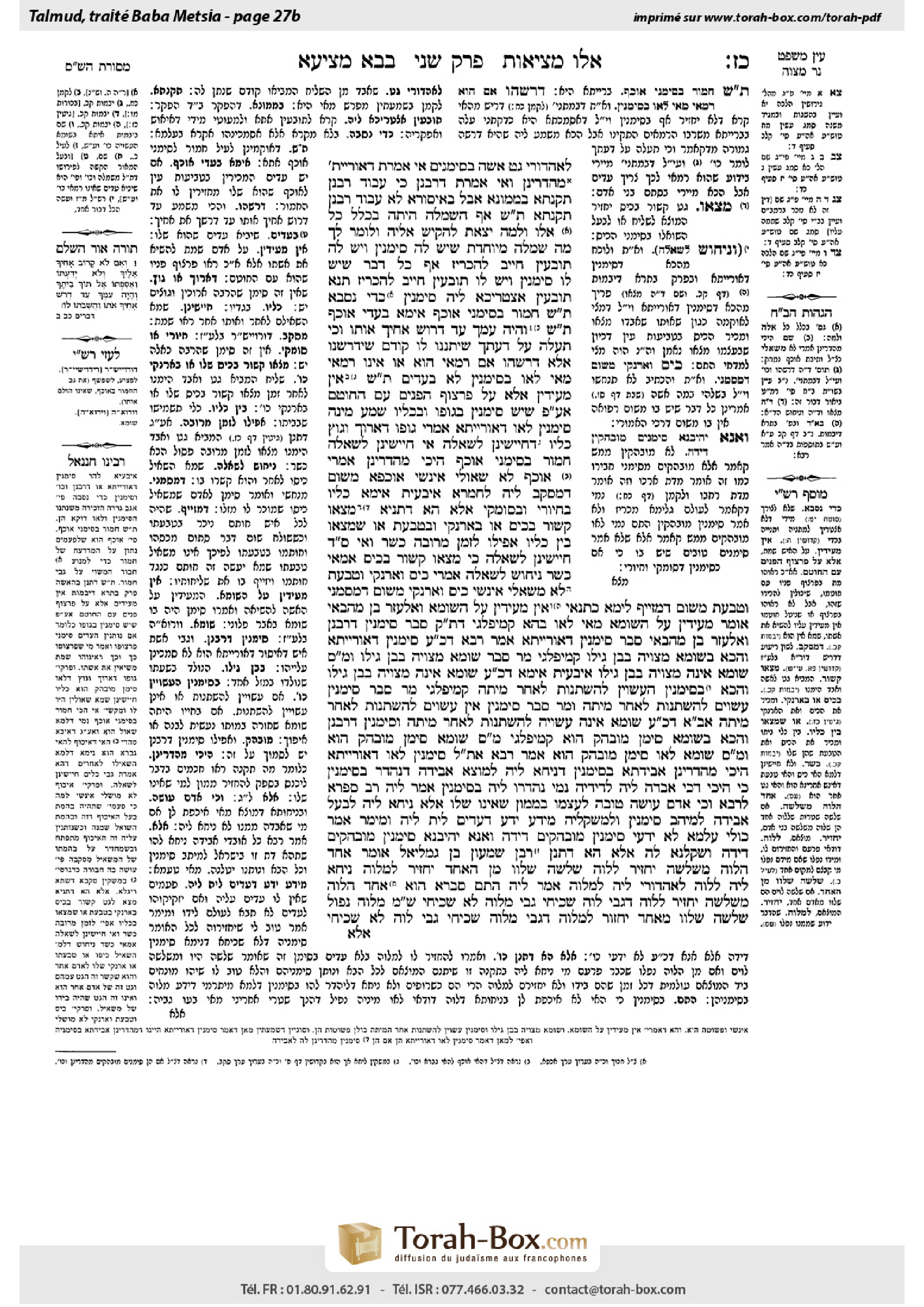
Bava Metzia 27b: Talmud study for Daf Yomi
Study the Talmud for Daf Yomi with scanned pages, Hebrew text, English translations from Sefaria and AI-generated French translations.
Passage selection and English or AI-generated French translation are available where the scan has annotations. Daf Study is independent of Torah-Box and Sefaria.
Browse Bava Metzia · בבא מציעא · All tractatesBava Metzia 27b text and translations
This page of Bava Metzia includes the Aramaic text, an English translation and an AI-generated French translation, alongside the scan above.
בבא מציעא כ״ז ב · Aramaic and Hebrew text
לְאַהְדּוֹרֵי גֵּט אִשָּׁה בְּסִימָנִים. אִי אָמְרַתְּ דְּאוֹרָיְיתָא – מַהְדְּרִינַן, וְאִי אָמְרַתְּ דְּרַבָּנַן – כִּי עֲבוּד רַבָּנַן תַּקַּנְתָּא בְּמָמוֹנָא, אֲבָל בְּאִיסּוּרָא – לָא עֲבוּד רַבָּנַן תַּקַּנְתָּא.
תָּא שְׁמַע: אַף הַשִּׂמְלָה הָיְתָה בִּכְלַל כׇּל אֵלּוּ, וְלָמָּה יָצָאת לְהַקִּישׁ אֵלֶיהָ? וְלוֹמַר לְךָ: מָה שִׂמְלָה מְיוּחֶדֶת שֶׁיֵּשׁ לָהּ סִימָנִין וְיֵשׁ לָהּ תּוֹבְעִין חַיָּיב לְהַכְרִיז, אַף כׇּל דָּבָר שֶׁיֵּשׁ לוֹ סִימָנִין וְיֵשׁ לוֹ תּוֹבְעִין חַיָּיב לְהַכְרִיז. תַּנָּא: תּוֹבְעִין אִצְטְרִיכָא לֵיהּ, סִימָנִין כְּדִי נַסְבַהּ.
תָּא שְׁמַע: חֲמוֹר בְּסִימָנֵי אוּכָּף. אֵימָא ״בְּעֵדֵי אוּכָּף״.
תָּא שְׁמַע: ״וְהָיָה עִמְּךָ עַד דְּרֹשׁ אָחִיךָ אֹתוֹ״. וְכִי תַּעֲלֶה עַל דַּעְתְּךָ שֶׁיִּתְּנֶנּוּ לוֹ קוֹדֶם שֶׁיִּדְרְשֶׁנּוּ?! אֶלָּא דׇּרְשֵׁהוּ אִם רַמַּאי הוּא אוֹ אֵינוֹ רַמַּאי.
מַאי לָאו בְּסִימָנִין? לֹא, בְּעֵדִים.
תָּא שְׁמַע: אֵין מְעִידִין אֶלָּא עַל פַּרְצוּף הַפָּנִים עִם הַחוֹטֶם, אַף עַל פִּי שֶׁיֵּשׁ סִימָנִין בְּגוּפוֹ וּבְכֵלָיו.
שְׁמַע מִינַּהּ סִימָנִין לָאו דְּאוֹרָיְיתָא! אָמְרִי: גּוּפוֹ – דְּאָרוֹךְ וְגוּץ. כֵּלָיו – דְּחָיְישִׁינַן לִשְׁאֵלָה.
אִי חָיְישִׁינַן לִשְׁאֵלָה, חֲמוֹר בְּסִימָנֵי אוּכָּף הֵיכִי מַהְדְּרִינַן? אָמְרִי: אוּכָּף, לָא שָׁאיְלִי אִינָשֵׁי אוּכָּפָא, מִשּׁוּם דִּמְסַקֵּב לֵיהּ לַחֲמָרָא.
אִיבָּעֵית אֵימָא: כֵּלָיו בְּחִיוָּרֵי וּבְסוּמְקִי.
אֶלָּא הָא דְּתַנְיָא: מְצָאוֹ קָשׁוּר בְּכִיס אוֹ בְּאַרְנָקִי וּבְטַבַּעַת, אוֹ שֶׁמְּצָאוֹ בֵּין כֵּלָיו, אֲפִילּוּ לִזְמַן מְרוּבֶּה – כָּשֵׁר. וְאִי סָלְקָא דַעְתָּךְ חָיְישִׁינַן לִשְׁאֵלָה, כִּי מְצָאוֹ קָשׁוּר בְּכִיס אַמַּאי כָּשֵׁר? נֵיחוּשׁ לִשְׁאֵלָה!
אָמְרִי: כִּיס וְאַרְנָקִי וְטַבַּעַת לָא מַשְׁאֲלִי אִינָשֵׁי. כִּיס וְאַרְנָקִי – מִשּׁוּם דִּמְסַמְּנִי, וְטַבַּעַת – מִשּׁוּם דִּמְזַיֵּיף.
לֵימָא כְתַנָּאֵי: אֵין מְעִידִין עַל הַשּׁוּמָא, וְאֶלְעָזָר בֶּן מַהֲבַאי אוֹמֵר: מְעִידִין עַל הַשּׁוּמָא. מַאי לָאו בְּהָא קָמִיפַּלְגִי? דְּתַנָּא קַמָּא סָבַר: סִימָנִין דְּרַבָּנַן, וְאֶלְעָזָר בֶּן מַהֲבַאי סָבַר: סִימָנִין דְּאוֹרָיְיתָא.
אָמַר רָבָא: דְּכוּלֵּי עָלְמָא סִימָנִין דְּאוֹרָיְיתָא, וְהָכָא בְּשׁוּמָא מְצוּיָה בְּבֶן גִּילוֹ קָמִיפַּלְגִי. מָר סָבַר: שׁוּמָא מְצוּיָה בְּבֶן גִּילוֹ, וּמָר סָבַר: שׁוּמָא אֵינָהּ מְצוּיָה בְּבֶן גִּילוֹ.
אִיבָּעֵית אֵימָא: דְּכוּלֵּי עָלְמָא שׁוּמָא אֵינָהּ מְצוּיָה בְּבֶן גִּילוֹ, וְהָכָא בְּסִימָנִין הָעֲשׂוּיִן לְהִשְׁתַּנּוֹת לְאַחַר מִיתָה קָמִיפַּלְגִי. מָר סָבַר: סִימָנִין עֲשׂוּיִם לְהִשְׁתַּנּוֹת לְאַחַר מִיתָה. וּמָר סָבַר: סִימָנִין אֵין עֲשׂוּיִם לְהִשְׁתַּנּוֹת לְאַחַר מִיתָה.
אִיבָּעֵית אֵימָא: דְּכוּלֵּי עָלְמָא שׁוּמָא אֵינָהּ עֲשׂוּיָה לְהִשְׁתַּנּוֹת לְאַחַר מִיתָה, וְסִימָנִין דְּרַבָּנַן, וְהָכָא בְּשׁוּמָא סִימָן מוּבְהָק הוּא קָמִיפַּלְגִי. מָר סָבַר: שׁוּמָא סִימָן מוּבְהָק הוּא, וּמָר סָבַר: שׁוּמָא לָאו סִימָן מוּבְהָק הוּא.
אָמַר רָבָא: אִם תִּמְצֵי לוֹמַר סִימָנִין לָאו דְּאוֹרָיְיתָא, הֵיכִי מַהְדְּרִינַן אֲבֵידְתָּא בְּסִימָנִין? דְּנִיחָא לֵיהּ לְמוֹצֵא אֲבֵידָה דְּנַהְדַּר בְּסִימָנִין, כִּי הֵיכִי דְּכִי אָבְדָה לֵיהּ לְדִידֵהּ נָמֵי נַהְדְּרוּ לֵיהּ בְּסִימָנִין.
אֲמַר לֵיהּ רַב סָפְרָא לְרָבָא: וְכִי אָדָם עוֹשֶׂה טוֹבָה לְעַצְמוֹ בְּמָמוֹן שֶׁאֵינוֹ שֶׁלּוֹ?
אֶלָּא נִיחָא לֵיהּ לְבַעַל אֲבֵידָה לְמֵיהַב סִימָנִין וּלְמִשְׁקְלֵיהּ. מִידָּע יָדַע דְּעֵדִים לֵית לֵיהּ, וּמֵימָר אָמַר: כּוּלֵּי עָלְמָא לָא יָדְעִי סִימָנִין מוּבְהָקִים דִּידַהּ, וַאֲנָא יָהֵיבְנָא סִימָנִין מוּבְהָקִים דִּידַהּ וְשָׁקֵלְנָא לַהּ.
אֶלָּא הָא דִּתְנַן, רַבָּן שִׁמְעוֹן בֶּן גַּמְלִיאֵל אוֹמֵר: אֶחָד הַלֹּוֶה מִשְּׁלֹשָׁה – יַחְזִיר לַלֹּוֶה, שְׁלֹשָׁה שֶׁלָּווּ מִן הָאֶחָד – יַחְזִיר לַמַּלְוֶה. נִיחָא לֵיהּ לְלֹוֶה לְאַהְדּוֹרֵי לֵיהּ לְמַלְוֶה?
אֲמַר לֵיהּ: הָתָם סְבָרָא הוּא, אֶחָד הַלֹּוֶה מִשְּׁלֹשָׁה יַחְזִיר לַלֹּוֶה – דְּגַבֵּי לֹוֶה שְׁכִיחִי, גַּבֵּי מַלְוֶה לָא שְׁכִיחִי. שְׁמַע מִינַּהּ מִלֹּוֶה נְפוּל. שְׁלֹשָׁה שֶׁלָּווּ מֵאֶחָד יַחְזִיר לַמַּלְוֶה – דְּגַבֵּי מַלְוֶה שְׁכִיחִי, גַּבֵּי לֹוֶה לָא שְׁכִיחִי.
Bava Metzia 27b · English translation
The Gemara answers: The practical difference is with regard to returning the bill of divorce of a woman that was lost by an agent before its delivery, on the basis of distinguishing marks. If you say that the identification of an item on the basis of distinguishing marks is by Torah law, we return the document and allow the agent to transmit it to the woman. But if you say that it is by rabbinic law, we do not return the document, because when the Sages institute an ordinance, it is only with regard to monetary matters they have the authority to declare property ownerless; but with regard to ritual matters, the Sages do not institute an ordinance. They lack the authority to abrogate the prohibitions by Torah law that are associated with a woman’s marital status.
The Gemara suggests: Come and hear proof from the mishna: The garment was also included in the generalization that one must return all of these items. And why did it emerge from the generalization that is should be specified? To draw an analogy to it and to say to you: What is notable about a garment? It is notable in that there are distinguishing marks concerning it and it has claimants asserting ownership, and its finder is obligated to proclaim his find. So too with regard to any item concerning which there are distinguishing marks and it has claimants asserting ownership, its finder is obligated to proclaim his find. Clearly, the identification of an item on the basis of distinguishing marks is by Torah law. The Gemara rejects the proof: Perhaps it was necessary for the tanna to mention only the criterion of claimants, and the tanna cited the criterion of distinguishing marks for no reason, as by Torah law distinguishing marks are not a relevant factor.
The Gemara suggests: Come and hear proof from the aforementioned statement: The obligation to return a donkey to its owner on the basis of the distinguishing marks of the saddle is derived based on the mention of the word “donkey” in the verse from Deuteronomy. Clearly, the identification of an item on the basis of distinguishing marks is by Torah law. The Gemara rejects this proof: Emend the baraita and say: There is an obligation to return the donkey only on the basis of witnesses who testify with regard to the identity of the owner based on the fact that the saddle belongs to him, and not on the basis of distinguishing marks.
The Gemara suggests: Come and hear proof from a mishna (28b): “And if your brother be not near you, and you know him not, then you shall bring it into your house, and it shall be with you until your brother claims [derosh] it, and you shall return it to him” (Deuteronomy 22:2). Would it enter your mind that he would give the lost item to him before he claims it? How can the finder return it if he does not know the identity of the owner? Rather, the verb derosh is not referring to the claim of the owner; it is referring to the scrutiny performed by the finder. Scrutinize him [darshehu] to determine whether the claimant is a swindler or whether he is not a swindler. Only then may you return the lost item to him.
The Gemara states its suggested proof: What, is it not that the one who claims the lost item proves that he is not a swindler on the basis of distinguishing marks that he provides? Apparently, the identification of an item on the basis of distinguishing marks is by Torah law. The Gemara rejects this proof: No, the determination of whether he is a swindler is on the basis of scrutinizing his witnesses.
The Gemara suggests: Come and hear proof from a mishna (Yevamot 120a): One testifies that a man died, thereby permitting his wife to remarry, only if he can testify about seeing the countenance [partzuf ] of the face with the nose, as this allows one to identify the individual with certainty. Although there are distinguishing marks on his body and on his garments, which appear to indicate his identity, they cannot be used to identify the person.
The Gemara states its suggested proof: Conclude from it that the identification of an item on the basis of distinguishing marks is not by Torah law. The Sages say in rejecting that proof: The distinguishing marks on his body mentioned in the mishna are non-specific distinguishing marks, e.g., that he was tall or short, and that is the reason that the distinguishing marks are ineffective in determining his identity. The distinguishing marks on his garments mentioned in the mishna are ineffective in determining his identity, as we are concerned about the possibility of a loan, e.g., perhaps the husband loaned his clothes to the deceased.
The Gemara asks: If we are concerned about the possibility of a loan, how do we return a donkey to its owner on the basis of the distinguishing marks of the saddle; perhaps it was borrowed? The Sages say in response: People do not typically borrow a saddle because saddles that are not custom fit wound the donkey.
If you wish, say instead: The distinguishing marks on his garments mentioned in the mishna are non-specific distinguishing marks, e.g., where the witness said that they were white or red, and that is the reason that the distinguishing marks are ineffective in determining his identity.
The Gemara questions the previous answer with regard to the concern about the possibility of a loan. But there is that which is taught in a baraita: If the agent found the bill of divorce that he lost bound to his pouch, or his purse, or his signet ring, or if he found it among his garments, even if he found it a long time after he lost it, the distinguishing marks on those items are sufficient in order to identify the bill of divorce as the one that he lost, and it is valid. And if it enters your mind that we are concerned about the possibility of a loan, when he found the bill of divorce bound to his pouch, why is it valid? Let us be concerned about the possibility of a loan and that perhaps the pouch and the bill of divorce belong to someone else.
The Sages say in response: There is no concern in this case, as people do not loan a pouch, a purse, or a signet ring to another person. One does not loan his pouch and his purse to others due to the fact that it portends the loss of his good fortune. And one does not loan his signet ring to others due to the fact that it could be used to forge documents.
The Gemara suggests: Let us say that the dilemma whether the identification of an item on the basis of distinguishing marks is by Torah law or by rabbinic law is the subject of a dispute between tanna’im, as it is taught in a baraita: One does not testify on the basis of a mole on the body of the deceased to determine the identity of a man who died and permit his wife to remarry. And Elazar ben Mahavai says: One testifies to identify the corpse on the basis of a mole. What, is it not with regard to this matter that they disagree; as the first tanna holds that identification of an item on the basis of distinguishing marks is by rabbinic law and therefore, testimony concerning those marks cannot dissolve a marriage by Torah law; and Elazar ben Mahavai holds that identification of an item on the basis of distinguishing marks is by Torah law.
Rava said: That is not necessarily the crux of their dispute, as perhaps everyone agrees that identification of an item on the basis of distinguishing marks is by Torah law, and here, it is with regard to whether one needs to be concerned that a mole is often found on one’s contemporary, i.e., one born under the same constellation, rendering it useless as a means of identification, that they disagree. One Sage, the first tanna, holds that a mole is often found on one’s contemporary and therefore it is insufficient as a means of identification; and one Sage, Elazar ben Mahavai, holds that a mole is not often found on one’s contemporary, and therefore it is sufficient as a means of identification.
If you wish, say instead that everyone agrees that a mole is not often found on one’s contemporary, and here it is with regard to whether the appearance of distinguishing marks on the body is apt to change after death that they disagree. One Sage, the first tanna, holds that the appearance of distinguishing marks is apt to change after death, and that consequently they are insufficient as a means of identification; and one Sage, Elazar ben Mahavai, holds that the appearance of distinguishing marks is not apt to change after death, and therefore, they are sufficient as a means of identification.
If you wish, say instead that everyone agrees that a mole is not apt to change after death, and that the identification of an item on the basis of distinguishing marks is by rabbinic law, and here it is with regard to whether a mole is a clear-cut distinguishing mark that they disagree. One Sage, Elazar ben Mahavai, holds that a mole is a clear-cut distinguishing mark that can be relied upon without hesitation even in matters of Torah law, e.g., dissolving a marriage; and one Sage, the first tanna, holds that a mole is not a clear-cut distinguishing mark. Since standard distinguishing marks are sufficient by rabbinic law, a marriage, which is in effect by Torah law, cannot be dissolved on the basis of a mole.
Rava says: If you say that the identification of an item on the basis of distinguishing marks is not by Torah law, how do we return a lost item to the presumed owner on the basis of distinguishing marks; perhaps it will result in the return of property to one who was in fact not the owner? Rava answers: We return the lost item, as it is satisfactory to the finder of a lost item to return it on the basis of distinguishing marks, rather than exercise his right by Torah law to retain it, so that when an item is lost from him in the future, the finder will return it to him on the basis of distinguishing marks as well.
Rav Safra said to Rava: But can a person perform an act that results in benefit for himself with property that is not his? The lost item belongs not to the finder but to the one who lost it. How can the finder waive the right of the true owner to the lost item so that he may recover his own lost item in the future?
Rather, we return the lost item, as it is satisfactory to the owner of the lost item to be able to provide a description using distinguishing marks and on that basis take possession of the item. He knows that he has no witnesses to testify to his ownership, and he says: No one else knows the clear-cut distinguishing marks that are on the item. And I will provide a description using the clear-cut distinguishing marks, and based on that information I will take possession of the item. Each owner gives his tacit agreement to the return of lost items on the basis of distinguishing marks, based on the belief that he is best able to identify them.
The Gemara asks: But there is that which we learned in a mishna (20a), that Rabban Shimon ben Gamliel says: If one found three promissory notes relating to the loan of one debtor who borrowed money from three creditors, he must return the documents to the debtor. If one found three promissory notes relating to the loans of three debtors who borrowed money from one creditor, he must return the documents to the creditor. If one returns lost items on the basis of distinguishing marks due to the tacit agreement of the owners, is it satisfactory to the debtor to have the documents returned to the creditor, as doing so would enable the creditor to collect payment of the loan?
Rava said to Rav Safra: There, the obligation to return the promissory notes to the creditor is not on the basis of distinguishing marks; rather, it is based on logical reasoning. If one found three promissory notes relating to the loan of one debtor who borrowed money from three creditors, he shall return the documents to the debtor, because a group of several documents indicating that one debtor borrowed money from several creditors is typically found with the debtor and is not typically found with a creditor, as the only element common to all the documents is the debtor. Conclude from it that the group of documents fell from the debtor while they were in his possession. If one found three promissory notes relating to the loans of three debtors who borrowed money from one creditor, he shall return the documents to the creditor, because a group of several documents indicating that multiple debtors borrowed money from a single creditor is typically found with the creditor and is not typically found with a debtor, as the only element common to all the documents is the creditor.
Bava Metzia 27b · Traduction française (IA)
Le Guemara répond : La différence pratique concerne la restitution du document de divorce d'une femme perdu par un agent avant sa livraison, sur la base de marques distinctives. Si vous dites que l'identification d'un objet sur la base de marques distinctives est une loi divine, nous restituerons le document et permettrons à l'agent de le transmettre à la femme. Mais si vous dites que c'est une loi rabbinique, nous ne restituerons pas le document, car lorsque les Sages instituent une ordonnance, c'est uniquement concernant les affaires monétaires qu'ils ont la compétence de déclarer une propriété sans propriétaire. Concernant les affaires rituelles, les Sages n'ont pas le pouvoir d'instituer une ordonnance. Ils n'ont pas la compétence d'abroger les interdits de droit divin associés au statut marital d'une femme.
Le Guemara suggère : Venez entendre la preuve à partir de la mitsva : La robe était également incluse dans la généralisation selon laquelle il faut restituer tous ces objets. Et pourquoi est-elle sortie de cette généralisation pour être spécifiée ? Pour en faire une analogie et vous dire : Qu'est-ce qui est notable à propos d'une robe ? C'est qu'il y a des marques distinctives concernant elle et qu'elle a des propriétaires qui réclament sa possession, et celui qui la trouve est tenu de proclamer sa découverte. De même, concernant tout objet dont il y a des marques distinctives et qui a des propriétaires qui réclament sa possession, celui qui le trouve est tenu de proclamer sa découverte. Évidemment, l'identification d'un objet sur la base de marques distinctives est une loi divine. Le Guemara rejette cette preuve : Peut-être que le tanna a eu besoin de mentionner uniquement le critère des propriétaires, et qu'il a cité le critère des marques distinctives sans raison, car, selon la loi divine, les marques distinctives ne sont pas un facteur pertinent.
Le Guemara suggère : Venez entendre la preuve à partir de l'affirmation précédente : L'obligation de restituer un âne à son propriétaire sur la base des marques distinctives de la selle est dérivée de la mention du mot « âne » dans la parabole du Deutéronome. Évidemment, l'identification d'un objet sur la base de marques distinctives est une loi divine. Le Guemara rejette cette preuve : Modifiez la baraïta et dites : Il y a une obligation de restituer l'âne uniquement sur la base des témoins qui témoignent de l'identité du propriétaire en raison du fait que la selle appartient à lui, et non sur la base des marques distinctives.
Le Guemara suggère : Venez entendre la preuve à partir d'une mitsva (28b) : « Et si ton frère n'est pas près de toi, et que tu ne le connais pas, alors tu le ramèneras chez toi, et il sera avec toi jusqu'à ce que ton frère réclame [derosh] cela, et tu le lui rendras » (Deutéronome 22:2). Est-ce que cela t'entre en tête qu'il lui donnerait l'objet perdu avant qu'il ne le réclame ? Comment le trouver peut-il le rendre s'il ne connaît pas l'identité du propriétaire ? Plutôt, le verbe derosh ne fait pas référence à la réclamation du propriétaire ; il fait référence à l'inspection effectuée par le trouver. Inspecte-le [darshehu] pour déterminer si le réclamant est un escroc ou s'il ne l'est pas. Seulement alors peux-tu rendre l'objet perdu à lui.
Le Guemara énonce sa preuve suggérée : Qu'est-ce que cela signifie, que ce n'est pas que celui qui réclame l'objet perdu prouve qu'il n'est pas un escroc sur la base des marques distinctives qu'il fournit ? Apparemment, l'identification d'un objet sur la base de marques distinctives est une loi divine. Le Guemara rejette cette preuve : Non, la détermination de savoir s'il est un escroc est basée sur l'inspection de ses témoins.
Le Guemara suggère : Venez entendre la preuve à partir d'une mitsva (Yevamot 120a) : Un témoin affirme que l'homme est mort, permettant ainsi à sa femme de se remarier, uniquement s'il peut témoigner avoir vu le visage [partzuf] avec le nez, car cela permet d'identifier l'individu avec certitude. Bien qu'il y ait des marques distinctives sur son corps et sur ses vêtements, qui semblent indiquer son identité, elles ne peuvent pas être utilisées pour identifier la personne.
Le Guemara énonce sa preuve suggérée : Concluez-en qu'identifier une personne sur la base de marques distinctives n'est pas une loi divine. Les Sages disent en rejetant cette preuve : Les marques distinctives sur son corps mentionnées dans la mitsva sont des marques non spécifiques, par exemple, qu'il était grand ou petit, et c'est la raison pour laquelle les marques distinctives sont inefficaces pour déterminer son identité. Les marques distinctives sur ses vêtements mentionnées dans la mitsva sont inefficaces pour déterminer son identité, car nous craignons la possibilité d'un prêt, par exemple, peut-être que le mari a prêté ses vêtements à l'homme décédé.
Le Guemara pose une question : Si nous craignons la possibilité d'un prêt, comment pouvons-nous restituer un âne à son propriétaire sur la base des marques distinctives de la selle ; peut-être qu'il a été emprunté ? Les Sages répondent en disant : Les gens ne prêtent généralement pas une selle, car les selles non sur mesure blessent l'âne.
Si vous le souhaitez, dites plutôt : Les marques distinctives sur ses vêtements mentionnées dans la Michna sont des marques non spécifiques, par exemple, lorsque le témoin a dit qu'ils étaient blancs ou rouges, et c'est la raison pour laquelle les marques distinctives sont inefficaces pour déterminer son identité.
Le Guemara questionne la réponse précédente concernant la crainte de la possibilité d'un prêt. Mais il y a ce qui est enseigné dans une baraïta : Si l'agent a trouvé le document de divorce qu'il avait perdu attaché à sa poche, ou à son sac, ou à son anneau, ou s'il l'a trouvé parmi ses vêtements, même s'il l'a trouvé longtemps après qu'il l'avait perdu, les marques distinctives sur ces objets sont suffisantes pour identifier le document de divorce comme celui qu'il a perdu, et il est valide. Et si cela entre en votre tête que nous craignons la possibilité d'un prêt, quand il a trouvé le document de divorce attaché à sa poche, pourquoi est-il valide ? Laissons-nous craindre la possibilité d'un prêt et que peut-être la poche et le document de divorce appartiennent à quelqu'un d'autre.
Les Sages disent en réponse : Il n'y a pas de souci dans ce cas, car les gens ne prêtent pas un sac, un portefeuille ou une bague à un autre. On ne prête pas son sac et son portefeuille à autrui en raison du fait qu'ils portent malheur. Et on ne prête pas sa bague à autrui en raison du fait qu'elle pourrait être utilisée pour falsifier des documents.
Le Guemara suggère : Disons que la question de savoir si l'identification d'un objet sur la base de marques distinctives est une loi divine ou une loi rabbinique est l'objet d'un désaccord entre les tannaïm, comme il est enseigné dans une baraïta : On ne peut témoigner sur la base d'une tache sur le corps du défunt pour déterminer l'identité d'un homme décédé et permettre à sa femme de se remarier. Et Elazar ben Mahavai dit : On témoigne pour identifier le corps sur la base d'une tache. Qu'est-ce que cela n'a pas à voir avec cette affaire qu'ils discutent ; car le premier tanna considère que l'identification d'un objet sur la base de marques distinctives est une loi rabbinique et donc, le témoignage concernant ces marques ne peut pas dissoudre un mariage selon la loi divine ; et Elazar ben Mahavai considère que l'identification d'un objet sur la base de marques distinctives est une loi divine.
Rava dit : Ce n'est pas nécessairement le point principal de leur désaccord, car peut-être tout le monde convient que l'identification d'un objet sur la base de marques distinctives est une loi divine, et ici, il s'agit de savoir si l'on doit craindre que la tache soit souvent trouvée sur un contemporain, c'est-à-dire une personne née sous la même constellation, ce qui rendrait cette méthode d'identification inutile. Un sage, le premier tanna, considère que la tache est souvent trouvée sur un contemporain et donc insuffisante comme méthode d'identification ; et un autre sage, Elazar ben Mahavai, considère que la tache n'est pas souvent trouvée sur un contemporain, et donc suffisante comme méthode d'identification.
Si tu veux, dis plutôt que tout le monde convient que la tache n'est pas souvent trouvée sur un contemporain, et ici il s'agit de savoir si l'apparition des marques distinctives sur le corps est susceptible de changer après la mort, ce qu'ils discutent. Un sage, le premier tanna, considère que l'apparition des marques distinctives est susceptible de changer après la mort, et donc insuffisante comme méthode d'identification ; et un autre sage, Elazar ben Mahavai, considère que l'apparition des marques distinctives n'est pas susceptible de changer après la mort, et donc suffisante comme méthode d'identification.
Si tu veux, dis plutôt que tout le monde convient que la tache n'est pas susceptible de changer après la mort, et que l'identification d'un objet sur la base de marques distinctives est une loi rabbinique, et ici il s'agit de savoir si la tache est une marque distinctive claire. Un sage, Elazar ben Mahavai, considère que la tache est une marque distinctive claire qui peut être retenue sans hésitation même dans les affaires de loi divine, par exemple, dissoudre un mariage ; et un autre sage, le premier tanna, considère que la tache n'est pas une marque distinctive claire. Puisque les marques distinctives standard sont suffisantes selon la loi rabbinique, un mariage, qui est en vigueur selon la loi divine, ne peut pas être dissous sur la base d'une tache.
Rava dit : Si tu dis que l'identification d'un objet sur la base de marques distinctives n'est pas une loi divine, comment pouvons-nous rendre un objet perdu à son propriétaire supposé sur la base de marques distinctives ; peut-être cela entraînera la restitution d'un objet à une personne qui n'était pas en réalité son propriétaire ? Rava répond : Nous rendons l'objet perdu, car il est satisfaisant au trouver pour le rendre sur la base de marques distinctives, plutôt que d'exercer son droit selon la loi divine de le conserver, de sorte que lorsqu'un objet lui sera perdu à l'avenir, le trouver le rendra sur la base de marques distinctives à nouveau.
Rav Safra dit à Rava : Mais peut-on faire une action qui procure un bénéfice à soi-même avec un objet qui n'est pas à soi ? L'objet perdu n'appartient pas au trouver, mais à celui qui l'a perdu. Comment le trouver peut-il renoncer au droit du propriétaire réel à l'objet perdu afin de pouvoir récupérer son propre objet perdu à l'avenir ?
Plutôt, nous rendons l'objet perdu, car il est satisfaisant au propriétaire de l'objet perdu de pouvoir fournir une description utilisant des marques distinctives et, sur cette base, prendre possession de l'objet. Il sait qu'il n'a pas de témoins pour témoigner de son droit d'ownership, et il dit : Personne d'autre ne connaît les marques distinctives claires qui sont sur l'objet. Et je fournirai une description utilisant les marques distinctives claires, et, sur cette information, je prendrai possession de l'objet. Chaque propriétaire donne son accord tacite à la restitution des objets perdus sur la base de marques distinctives, en se basant sur la croyance qu'il est le mieux à même d'identifier ces objets.
Le Guemara pose la question : Mais il y a ce que nous avons appris dans une mitsna (20a), que Rabban Shimon ben Gamliel dit : Si l'on a trouvé trois notes de promesse concernant le prêt d'un débiteur qui a emprunté de l'argent à trois créanciers, il doit rendre les documents au débiteur. Si l'on a trouvé trois notes de promesse concernant les prêts de trois débiteurs qui ont emprunté de l'argent à un créancier, il doit rendre les documents au créancier. Si la restitution des objets perdus sur la base de marques distinctives est satisfaisante grâce à l'accord tacite des propriétaires, est-ce satisfaisant au débiteur de voir les documents restitués au créancier, car cela permettrait au créancier de récupérer le prêt ?
Rava dit à Rav Safra : Là, l'obligation de rendre les billets de créance au créancier ne repose pas sur des marques distinctives ; elle repose plutôt sur la raison logique. Si l'on trouve trois billets de créance relatifs à un prêt d'un seul débiteur qui a emprunté de l'argent à trois créanciers, on doit rendre les documents au débiteur, car un groupe de plusieurs documents indiquant qu'un seul débiteur a emprunté de l'argent à plusieurs créanciers est généralement trouvé avec le débiteur et non avec le créancier, car l'élément commun à tous les documents est le débiteur. Concluez-en que le groupe de documents est tombé du débiteur alors qu'ils étaient en son possession. Si l'on trouve trois billets de créance relatifs aux prêts de trois débiteurs qui ont emprunté de l'argent à un seul créancier, on doit rendre les documents au créancier, car un groupe de plusieurs documents indiquant que plusieurs débiteurs ont emprunté de l'argent à un seul créancier est généralement trouvé avec le créancier et non avec le débiteur, car l'élément commun à tous les documents est le créancier.
Traduction française générée par IA à partir de l’édition anglaise de Sefaria. Vérifie toujours un passage avec le texte source.
Text from Sefaria: William Davidson Edition - Vocalized Aramaic (CC BY NC); William Davidson Edition - English (CC BY NC).