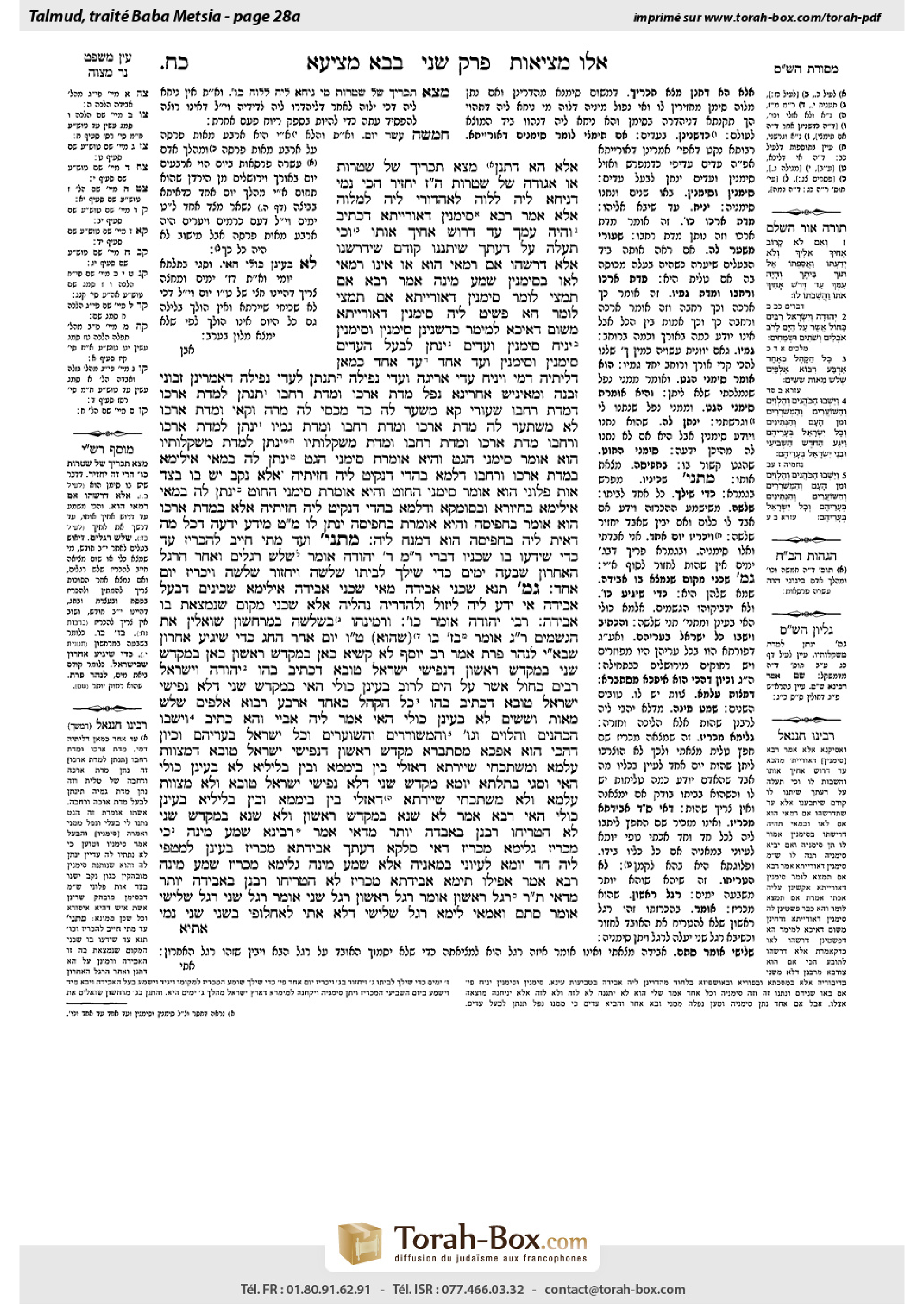
Bava Metzia 28a: Talmud study for Daf Yomi
Study the Talmud for Daf Yomi with scanned pages, Hebrew text, English translations from Sefaria and AI-generated French translations.
Passage selection and English or AI-generated French translation are available where the scan has annotations. Daf Study is independent of Torah-Box and Sefaria.
Browse Bava Metzia · בבא מציעא · All tractatesBava Metzia 28a text and translations
This page of Bava Metzia includes the Aramaic text, an English translation and an AI-generated French translation, alongside the scan above.
בבא מציעא כ״ח א · Aramaic and Hebrew text
אֶלָּא הָא דִּתְנַן: מָצָא תַּכְרִיךְ שֶׁל שְׁטָרוֹת אוֹ אֲגוּדָּה שֶׁל שְׁטָרוֹת – הֲרֵי זֶה יַחְזִיר, הָכִי נָמֵי דְּנִיחָא לֵיהּ לְלֹוֶה לְאַהְדּוֹרֵי לֵיהּ לְמַלְוֶה?
אֶלָּא אָמַר רָבָא: סִימָנִין דְּאוֹרָיְיתָא, דִּכְתִיב: ״וְהָיָה עִמְּךָ עַד דְּרֹשׁ אָחִיךָ אֹתוֹ״, וְכִי תַּעֲלֶה עַל דַּעְתְּךָ שֶׁיִּתְּנֶנּוּ קוֹדֶם שֶׁיִּדְרְשֶׁנּוּ?! אֶלָּא דׇּרְשֵׁהוּ אִם רַמַּאי הוּא אוֹ אֵינוֹ רַמַּאי. לָאו בְּסִימָנִין? שְׁמַע מִינַּהּ.
אָמַר רָבָא: אִם תִּמְצֵי לוֹמַר סִימָנִין דְּאוֹרָיְיתָא. ״אִם תִּמְצֵי לוֹמַר״?! הָא פְּשִׁיט לֵיהּ סִימָנִין דְּאוֹרָיְיתָא! מִשּׁוּם דְּאִיכָּא לְמֵימַר כִּדְשַׁנִּינַן.
סִימָנִין וְסִימָנִין – יַנִּיחַ. סִימָנִין וְעֵדִים – יִנָּתֵן לְבַעַל הָעֵדִים. סִימָנִין וְסִימָנִין וְעֵד אֶחָד – עֵד אֶחָד כְּמַאן דְּלֵיתֵיהּ דָּמֵי, וְיַנִּיחַ.
עֵדֵי אֲרִיגָה וְעֵדֵי נְפִילָה – תִּנָּתֵן לְעֵדֵי נְפִילָה, דְּאָמְרִינַן זַבּוֹנֵי זַבְּנַהּ וּמֵאִינִישׁ אַחֲרִינָא נְפַל.
מִדַּת אׇרְכּוֹ וּמִדַּת רׇחְבּוֹ – תִּנָּתֵן לְמִדַּת אׇרְכּוֹ, דְּמִדַּת רׇחְבּוֹ שַׁעוֹרֵי קָא מְשַׁעַר לַהּ כַּד מִכַּסֵּי לַהּ מָרַהּ וְקָאֵי, וּמִדַּת אׇרְכּוֹ לָא מִשְׁתַּעַר לֵהּ.
מִדַּת אׇרְכּוֹ וּמִדַּת רׇחְבּוֹ וּמִדַּת גַּמָּיו – יִנָּתֵן לְמִדַּת אׇרְכּוֹ וְרׇחְבּוֹ.
מִדַּת אׇרְכּוֹ וּמִדַּת רׇחְבּוֹ וּמִדַּת מִשְׁקְלוֹתָיו – יִנָּתֵן לְמִדַּת מִשְׁקְלוֹתָיו.
הוּא אוֹמֵר סִימָנֵי הַגֵּט וְהִיא אוֹמֶרֶת סִימָנֵי הַגֵּט – יִנָּתֵן לָהּ. בְּמַאי? אִילֵימָא בְּמִדַּת אׇרְכּוֹ וְרׇחְבּוֹ, דִּלְמָא בַּהֲדֵי דְּנָקֵיט לֵיהּ חֲזַיְתֵיהּ. אֶלָּא – נֶקֶב יֵשׁ בּוֹ בְּצַד אוֹת פְּלוֹנִי.
הוּא אוֹמֵר סִימָנֵי הַחוּט, וְהִיא אוֹמֶרֶת סִימָנֵי הַחוּט – יִנָּתֵן לָהּ. בְּמַאי? אִילֵימָא בְּחִיוָּרָא וּבְסוּמָּקָא, וְדִלְמָא בַּהֲדֵי דְּנָקֵיט לֵיהּ חֲזַיְתֵיהּ? אֶלָּא בְּמִדַּת אׇרְכּוֹ.
הוּא אוֹמֵר בַּחֲפִיסָה וְהִיא אוֹמֶרֶת בַּחֲפִיסָה – יִנָּתֵן לוֹ. מַאי טַעְמָא? מִידָּע יָדְעָה דְּכֹל מָה דְּאִית לֵיהּ בַּחֲפִיסָה הוּא דְּמַנַּח לֵיהּ.
מַתְנִי׳ וְעַד מָתַי חַיָּיב לְהַכְרִיז? עַד כְּדֵי שֶׁיֵּדְעוּ בּוֹ שְׁכֵנָיו, דִּבְרֵי רַבִּי מֵאִיר. רַבִּי יְהוּדָה אוֹמֵר: שָׁלֹשׁ רְגָלִים, וְאַחַר הָרֶגֶל הָאַחֲרוֹן שִׁבְעָה יָמִים, כְּדֵי שֶׁיֵּלֵךְ לְבֵיתוֹ שְׁלֹשָׁה, וְיַחְזוֹר שְׁלֹשָׁה, וְיַכְרִיז יוֹם אֶחָד.
גְּמָ׳ תָּנָא: שְׁכֵנֵי אֲבֵידָה. מַאי שְׁכֵנֵי אֲבֵידָה? אִילֵימָא שְׁכֵינִים דְּבַעַל אֲבֵידָה? אִי יָדַע לֵיהּ לֵיזוֹל וְלַהְדְּרַיהּ נִהֲלֵיהּ! אֶלָּא שְׁכֵנֵי מָקוֹם שֶׁנִּמְצֵאת בּוֹ אֲבֵידָה.
רַבִּי יְהוּדָה אוֹמֵר: כּוּ׳.
וּרְמִינְהוּ: בִּשְׁלֹשָׁה בִּמְרַחְשְׁוָן שׁוֹאֲלִין אֶת הַגְּשָׁמִים. רַבָּן גַּמְלִיאֵל אוֹמֵר: בְּשִׁבְעָה בּוֹ, שֶׁהוּא חֲמִישָּׁה עָשָׂר יוֹם אַחַר הֶחָג, כְּדֵי שֶׁיַּגִּיעַ אַחֲרוֹן שֶׁבְּאֶרֶץ יִשְׂרָאֵל לִנְהַר פְּרָת!
אָמַר רַב יוֹסֵף: לָא קַשְׁיָא, כָּאן – בְּמִקְדָּשׁ רִאשׁוֹן, כָּאן – בְּמִקְדָּשׁ שֵׁנִי.
בְּמִקְדָּשׁ רִאשׁוֹן, דִּנְפִישִׁי יִשְׂרָאֵל טוּבָא, דִּכְתִיב בְּהוּ: ״יְהוּדָה וְיִשְׂרָאֵל רַבִּים כַּחוֹל אֲשֶׁר עַל הַיָּם לְרַב״ – בָּעֵינַן כּוּלֵּי הַאי. בְּמִקְדָּשׁ שֵׁנִי, דְּלָא נְפִישִׁי יִשְׂרָאֵל טוּבָא, דִּכְתִיב בְּהוּ: ״כׇּל הַקָּהָל כְּאֶחָד אַרְבַּע רִבּוֹא אַלְפַּיִם שְׁלֹשׁ מֵאוֹת שִׁשִּׁים״ – לָא בָּעֵינַן כּוּלֵּי הַאי.
אֲמַר לֵיהּ אַבָּיֵי: וְהָא כְּתִיב ״וַיֵּשְׁבוּ הַכֹּהֲנִים וְהַלְוִיִּם וְגוֹ׳ וְהַמְשֹׁרְרִים וְהַשּׁוֹעֲרִים וְכׇל יִשְׂרָאֵל בְּעָרֵיהֶם״.
וְכֵיוָן דְּהָכִי הוּא, אִפְּכָא מִסְתַּבְּרָא: מִקְדָּשׁ רִאשׁוֹן, דִּנְפִישִׁי יִשְׂרָאֵל טוּבָא, דִּמְצַוַּות עָלְמָא, וּמִשְׁתַּכְחִי שְׁיָירָתָא דְּאָזְלִי בֵּין בִּימָמָא וּבֵין בְּלֵילְיָא – לָא בָּעֵינַן כּוּלֵּי הַאי, וְסַגִּי בִּתְלָתָא יוֹמָא. מִקְדָּשׁ שֵׁנִי, דְּלָא נְפִישִׁי יִשְׂרָאֵל טוּבָא, וְלָא מְצַוַּות עָלְמָא, וְלָא מִשְׁתַּכְחִי שְׁיָירָתָא דְּאָזְלִי בֵּין בִּימָמָא וּבֵין בְּלֵילְיָא – בָּעֵינַן כּוּלֵּי הַאי.
רָבָא אֲמַר: לָא שְׁנָא בְּמִקְדָּשׁ רִאשׁוֹן וְלָא שְׁנָא בְּמִקְדָּשׁ שֵׁנִי, לֹא הִטְרִיחוּ רַבָּנַן בַּאֲבֵדָה יוֹתֵר מִדַּאי.
אָמַר רָבִינָא: שְׁמַע מִינַּהּ כִּי מַכְרֵיז, גְּלִימָא מַכְרֵיז. דְּאִי סָלְקָא דַעְתָּךְ ״אֲבֵידְתָּא״ מַכְרֵיז, בָּעֵינַן לְמִטְפֵּי לֵיהּ חֲדָא יוֹמָא לְעַיּוֹנֵי בְּמָאנֵיהּ. אֶלָּא שְׁמַע מִינַּהּ: גְּלִימָא מַכְרֵיז. שְׁמַע מִינַּהּ.
רָבָא אָמַר: אֲפִילּוּ תֵּימָא ״אֲבֵידְתָּא״ מַכְרֵיז, לֹא הִטְרִיחוּ רַבָּנַן בַּאֲבֵידָה יוֹתֵר מִדַּאי.
תָּנוּ רַבָּנַן: רֶגֶל רִאשׁוֹן אוֹמֵר רֶגֶל רִאשׁוֹן, רֶגֶל שֵׁנִי אוֹמֵר רֶגֶל שֵׁנִי, רֶגֶל שְׁלִישִׁי אוֹמֵר סְתָם.
וְאַמַּאי? לֵימָא רֶגֶל שְׁלִישִׁי! דְּלָא אָתֵי לְאִחַלּוֹפֵי בְּשֵׁנִי. שֵׁנִי נָמֵי
Bava Metzia 28a · English translation
The Gemara asks: But there is that which we learned in that mishna (20a): If one found a roll of documents or a bundle of documents, he shall return the documents to whomever describes the roll and the bundle, which serve as distinguishing marks. Would one say that so too, if one returns lost items on the basis of distinguishing marks due to the tacit agreement of the owners, it is satisfactory to the debtor to have the documents returned to the creditor?
Rather, Rava said: Identification of an item on the basis of distinguishing marks is by Torah law, as it is written: “And if your brother be not near you, and you know him not, then you shall bring it into your house, and it shall be with you until your brother claims [derosh] it, and you shall return it to him” (Deuteronomy 22:2). Would it enter your mind that he would give the lost item to him before he claims it? How can the finder return it if he does not know the identity of the owner? Rather, the verb derosh is not referring to the claim of the owner; it is referring to the scrutiny performed by the finder. Scrutinize him [darshehu] to determine whether the claimant is a swindler or whether he is not a swindler. Only then may you return the lost item to him. What, is it not that the one who claims the lost item proves that he is not a swindler on the basis of distinguishing marks that he provides? Rava affirms: Conclude from it that identification of an item on the basis of distinguishing marks is by Torah law.
Rava begins his statement and says: If you say that identification of an item on the basis of distinguishing marks is by Torah law. The Gemara interjects: If you say? Didn’t he already resolve the dilemma and conclude that identification of an item on the basis of distinguishing marks is by Torah law? The Gemara answers: Rava phrased his statement conditionally due to the fact that although he holds that identification of an item on the basis of distinguishing marks is by Torah law, one could reject his conclusion and say as we explained previously (27b), that when the mishna states that the finder scrutinizes whether he is a swindler, he does so on the basis of witnesses and not on the basis of distinguishing marks.
The Gemara resumes Rava’s interrupted statement: If you say that identification of an item on the basis of distinguishing marks is by Torah law, then in a case where an item is found and two people claim it as theirs, and one describes distinguishing marks on the item and the other describes distinguishing marks on the item, the finder shall leave it in his possession and not give it to either claimant. In a case where one person describes distinguishing marks on the item and the other brings two witnesses to support his claim of ownership, the item shall be given to the claimant with witnesses. In a case where one person describes distinguishing marks on the item and the other describes distinguishing marks on the item and brings one witness to support his claim of ownership, the one witness is as one who is not there, and the finder shall leave it in his possession. The testimony of a single witness has no legal standing in this case.
In a case where one claimant to a found garment brings witnesses who testify that the garment was woven for him, and the other claimant brings witnesses who testify that the garment had fallen from him, the garment shall be given to the claimant whose witnesses testified that the garment had fallen from him, as we say that perhaps the one for whom it was woven sold the garment and it fell from another person, who is the current owner.
If one claimant provides the measure of length of a lost garment and the other provides the measure of its width, the garment shall be given to the claimant who provided the measure of its length, as one can approximate the measure of its width when its owner dons the garment and stands, but the measure of its length cannot be approximated in that manner. Therefore, it is a more clear-cut distinguishing characteristic.
If one claimant provides the measure of its length and the measure of its width and the other provides the measure of its gamma, its combined length and width, which together form the Greek letter gamma, but does not provide each measure individually, the item shall be given to the claimant who provided the measure of its length and the measure of its width separately.
If one claimant provides the measure of its length and the measure of its width and the other provides the measure of its weight, the item shall be given to the claimant who provided the measure of its weight, which, because it is more difficult to approximate, is a more clear-cut distinguishing characteristic.
Rava continues: In a case where a bill of divorce is found and it is unclear whether it had been delivered to the wife, and the husband, who reconsidered, states the distinguishing marks of the bill of divorce and claims that he did not yet give it to his wife, and the wife, who wants to be divorced, states the distinguishing marks of the bill of divorce and claims that she already received it, the document shall be given to the wife. The Gemara asks: With what distinguishing mark did she describe the bill of divorce? If we say that she described it with the measure of its height and its width, that is not a clear-cut distinguishing mark; perhaps while her husband was holding the bill of divorce, she saw it, although he had not yet given it to her. Rather, it must be that she says that there is a perforation alongside such and such letter in the document, which she could know only if the bill of divorce had been in her hand.
In a case where the husband states the distinguishing marks of the string with which the bill of divorce is bound, and she states the distinguishing marks of the string, the document shall be given to the wife. The Gemara asks: With what distinguishing mark did she describe the string? If we say that she described it by saying that the string is white or by saying that it is red, this cannot be the mark based on which she proves her ownership, as perhaps while her husband was holding the bill of divorce, she saw the string. Rather, it must be that she stated the measure of its length. As the string was wrapped around the document, she would know its length only if the bill of divorce had been in her hand.
In a case where the husband claims that the bill of divorce was not given to the wife and states that it was stored in a case, and the wife claims that she received the bill of divorce and states that it was stored in a case, the document shall be given to the husband. What is the reason? Identification of the document based on its storage cannot prove her ownership, as she knows that he places any valuable item that he has in his possession in the case.
MISHNA: And until when is one who finds a lost item obligated to proclaim his find? He is obligated to do so until the moment that the neighbors will know of its existence; this is the statement of Rabbi Meir. Rabbi Yehuda says: He is obligated to proclaim his find for three pilgrimage Festivals and for seven days after the last of the three pilgrimage Festivals, so that its owner will have time to go to his home, a trip lasting up to three days, and ascertain that he in fact lost the item, and he will return to Jerusalem, a trip lasting up to three days, and proclaim his loss for one day.
GEMARA: The mishna teaches that one must proclaim his find until his neighbors will know of its existence. A tanna taught: One must proclaim his find until the neighbors of the lost item will know of its existence. The Gemara asks: What is the meaning of the expression: Neighbors of the lost item? If we say that the reference is to neighbors of the owner of the lost item, he need not proclaim his find, as if the finder knows who lost the item, let him go and return it to him. The Gemara answers: Rather, the reference is to the neighbors of the place where the lost item was found.
§ The mishna teaches that Rabbi Yehuda says: He is obligated to proclaim his find for three pilgrimage Festivals and for seven days after the last of the three pilgrimage Festivals, so that its owner will go to his home, a trip lasting up to three days, will ascertain that he in fact lost the item, and will return to Jerusalem, a trip lasting up to three days, and proclaim his loss for one day.
Apropos Rabbi Yehuda’s calculation of three days as the duration of a pilgrim’s travel from Jerusalem to his home, the Gemara raises a contradiction from a mishna (Ta’anit 10a): On the third of the month of Marḥeshvan one starts to request rain by inserting the phrase: And grant dew and rain, in the blessing of the years, the ninth blessing of the Amida prayer. Rabban Gamliel says: One starts to request rain on the seventh of Marḥeshvan, which is fifteen days after the conclusion of the festival of Sukkot, so that the last of those who are in Eretz Yisrael on the pilgrimage to Jerusalem can reach their homes beyond the Euphrates River before the onset of rain, which would make crossing the river more hazardous. Apparently, it takes fifteen days for those who came for the pilgrimage Festivals to return home, not three days.
Rav Yosef says: This is not difficult. Here, in the mishna in tractate Ta’anit, Rabban Gamliel’s statement is referring to the duration of the journey during the First Temple period, which took fifteen days; whereas there, Rabbi Yehuda’s statement is referring to the duration of the journey during the Second Temple period, which took three days.
The Gemara explains the answer: During the First Temple period, when the Jewish people were very numerous, as it is written with regard to them: “Judea and Israel were many, as the sand that is by the sea in multitude, eating and drinking and rejoicing” (I Kings 4:20), we need that much time for them to travel from Jerusalem to the farthest reaches of Eretz Yisrael, due to the wide distribution of the large population. During the Second Temple period, when the Jewish people were not very numerous, as it is written: “The whole congregation together was forty and two thousand three hundred and sixty” (Ezra 2:64), we do not need that much time for them to travel from Jerusalem to the farthest reaches of Eretz Yisrael, due to the limited distribution of the small population.
Abaye said to Rav Yosef: But isn’t it written: “So the priests, and the Levites, and some of the people, and the singers, and the porters, and the Gibeonites, dwelt in their cities, and all Israel in their cities” (Ezra 2:70). The verse indicates that despite their limited numbers, the Jewish people dwelt in all the cities that they inhabited previously, and the distance to the far reaches of Eretz Yisrael was no shorter during the Second Temple period.
Abaye continued: And since that is the reality, the opposite is reasonable. During the First Temple period, when the Jewish people were very numerous and when everyone was structured in groups, and caravans could be found that traveled both during the day and during the night, we do not need that much time to travel from Jerusalem to the farthest reaches of Eretz Yisrael, and three days suffice. By contrast, during the Second Temple period, when the Jewish people were not very numerous and when everyone was not structured in groups, and therefore, caravans could not be found that traveled both during the day and during the night, we need that much time, i.e., fifteen days, to travel from Jerusalem to the farthest reaches of Eretz Yisrael.
Rava said: It is no different during the First Temple period and it is no different during the Second Temple period; the requisite travel time to the border was fifteen days, as the opinion of Rabban Gamliel indicates. Nevertheless, Rabbi Yehuda calculated three days of travel to the border because the Sages did not wish to trouble the finder excessively in returning a lost item by requiring him to wait an extended amount of time.
Ravina says: Learn from the calculation of Rabbi Yehuda in the mishna that when a finder proclaims his find he specifies the nature of the item, e.g., he proclaims that he found a cloak. As, if it enters your mind that the finder proclaims that he found a lost item without specifying its nature, we need to increase the period of time afforded the owner to ascertain that he lost an item, and add one day for him to examine all his vessels. Rather, learn from it that the finder proclaims that he found a cloak. The Gemara affirms: Learn from it that the finder specifies the nature of the item.
Rava said: Even if you say that the finder proclaims that he found an unspecified lost item, nevertheless, Rabbi Yehuda does not require extending the period afforded the owner, because the Sages did not wish to trouble the finder excessively in returning a lost item by requiring him to wait an extended amount of time.
The Sages taught in a baraita: On the first pilgrimage Festival after finding the lost item, the finder proclaims his find and says: This is the first pilgrimage Festival that I am proclaiming this find. On the second pilgrimage Festival after finding the lost item, the finder proclaims his find and says: This is the second pilgrimage Festival that I am proclaiming this find. On the third pilgrimage Festival, the finder proclaims his find and says his proclamation without specification of the number of the Festival.
The Gemara asks: And why does he not specify the number of the Festival? Just as he specified the previous two Festivals, let him say that it is the third pilgrimage Festival. The Gemara answers: He does not specify that it is the third pilgrimage Festival, so that one who hears him will not come to confuse it with the second pilgrimage Festival. If the finder were to proclaim that it is the third [shelishi] Festival, it is possible that the owner would mistakenly hear the word second [sheni] and believe that there is time remaining to reclaim his lost item. Since on the second Festival he mentions the number and on the third Festival he does not mention a number, there is no potential for confusion. The Gemara asks: Based on that reasoning, on the second pilgrimage Festival too, the finder should not mention the number of the Festival,
Bava Metzia 28a · Traduction française (IA)
Le Guemara pose la question : Mais nous avons appris dans cette mitsva (20a) : Si l'on trouve un rouleau de documents ou un paquet de documents, on doit rendre les documents à celui qui décrit le rouleau et le paquet, qui servent de signes distinctifs. Dirait-on que de même, si l'on rend des objets perdus sur la base de signes distinctifs en raison de l'accord tacite des propriétaires, cela suffit au débiteur pour que les documents soient rendus au créancier ?
Plutôt, Rava dit : L'identification d'un objet sur la base de signes distinctifs est réglementaire, car il est écrit : « Et si ton frère n'est pas près de toi, et que tu ne le connaisses pas, alors tu le ramèneras chez toi, et il restera avec toi jusqu'à ce que ton frère réclame [derosh] cela, et tu le rendras à lui » (Deutéronome 22:2). Est-ce que cela t'effleurerait de lui donner l'objet avant qu'il ne le réclame ? Comment le trouver peut-il le rendre s'il ne connaît pas l'identité du propriétaire ? Plutôt, le verbe derosh ne fait pas référence à la réclamation du propriétaire ; il fait référence à l'inspection effectuée par le trouver. Inspecte-le [darshehu] afin de déterminer si le réclamant est un escroc ou s'il ne l'est pas. Seulement alors peut-on rendre l'objet perdu à lui. Qu'est-ce que cela n'est pas que celui qui réclame l'objet prouve qu'il n'est pas un escroc sur la base des signes distinctifs qu'il fournit ? Rava affirme : Concluez-en qu'identifier un objet sur la base de signes distinctifs est réglementaire.
Rava commence son discours et dit : Si vous dites que l'identification d'un objet sur la base de signes distinctifs est une loi divine. Le Guemara interrompt : Si vous dites ? N'a-t-il pas déjà résolu le dilemme et conclu que l'identification d'un objet sur la base de signes distinctifs est une loi divine ? Le Guemara répond : Rava a formulé son discours conditionnellement en raison du fait que bien qu'il considère que l'identification d'un objet sur la base de signes distinctifs est une loi divine, on pourrait rejeter sa conclusion et dire comme nous l'avons expliqué précédemment (27b), que lorsque la mitsva dit que le trouver examine si l'individu est un escroc, il le fait sur la base de témoins et non sur la base de signes distinctifs.
Le Guemara reprend la déclaration interrompue de Rava : Si vous dites que l'identification d'un objet sur la base de signes distinctifs est une loi divine, alors dans un cas où un objet est trouvé et deux personnes le réclament comme étant leur propriété, et l'une décrit des signes distinctifs sur l'objet et l'autre décrit des signes distinctifs sur l'objet, le trouver doit laisser l'objet chez lui et ne pas le donner à l'un des réclamants. Dans un cas où une personne décrit des signes distinctifs sur l'objet et l'autre apporte deux témoins pour soutenir sa réclamation de propriété, l'objet doit être donné au réclamant avec les témoins. Dans un cas où une personne décrit des signes distinctifs sur l'objet et l'autre décrit des signes distinctifs sur l'objet et apporte un seul témoin pour soutenir sa réclamation de propriété, le témoin unique est comme celui qui n'est pas présent, et le trouver doit laisser l'objet chez lui. Le témoignage d'un seul témoin n'a pas de valeur légale dans ce cas.
Dans un cas où un réclamant à un vêtement trouvé apporte des témoins qui témoignent que le vêtement a été tissé pour lui, et l'autre réclamant apporte des témoins qui témoignent que le vêtement est tombé de lui, le vêtement doit être donné au réclamant dont les témoins ont témoigné que le vêtement était tombé de lui, car nous disons que peut-être celui pour qui il a été tissé l'a vendu et il est tombé d'une autre personne, qui est le propriétaire actuel.
Si un réclamant fournit la mesure de la longueur d'un vêtement perdu et l'autre fournit la mesure de sa largeur, le vêtement doit être donné au réclamant qui a fourni la mesure de sa longueur, car on peut approximer la mesure de sa largeur lorsque son propriétaire porte le vêtement et se tient debout, mais la mesure de sa longueur ne peut pas être approximée ainsi. Par conséquent, c'est un caractère distinctif plus clair.
Si un réclamant fournit la mesure de sa longueur et la mesure de sa largeur et l'autre fournit la mesure de son gamma, c'est-à-dire la longueur et la largeur combinées, qui forment la lettre grecque gamma, mais ne fournit pas chaque mesure individuellement, l'objet doit être donné au réclamant qui a fourni la mesure de sa longueur et la mesure de sa largeur séparément.
Si un réclamant fournit la mesure de sa longueur et la mesure de sa largeur et l'autre fournit la mesure de son poids, l'objet doit être donné au réclamant qui a fourni la mesure de son poids, car celle-ci, étant plus difficile à approximer, est une caractéristique distincte plus claire.
Rava continue : Dans un cas où un acte de divorce est trouvé et il est incertain s'il a été remis à la femme, et le mari, qui a réfléchi, déclare les caractéristiques distinctives de l'acte de divorce et affirme qu'il n'a pas encore donné l'acte à sa femme, et la femme, qui veut être divorcée, déclare les caractéristiques distinctives de l'acte de divorce et affirme qu'elle l'a déjà reçu, le document doit être donné à la femme. Le Guemara pose la question : Avec quelle caractéristique distinctive a-t-elle décrit l'acte de divorce ? Si nous disons qu'elle l'a décrit par la mesure de sa hauteur et de sa largeur, ce n'est pas une caractéristique distinctive claire ; peut-être qu'en tenant l'acte de divorce, elle l'a vu, bien qu'il n'ait pas encore été donné à elle. Plutôt, il doit être qu'elle dit qu'il y a une perforation à côté d'une telle et telle lettre dans le document, qu'elle ne pourrait connaître que si l'acte de divorce avait été entre ses mains.
Dans un cas où le mari indique les caractéristiques distinctives du fil avec lequel le document de divorce est lié, et elle indique les caractéristiques distinctives du fil, le document sera donné à la femme. La Guemara pose la question : Quelle caractéristique distinctive a-t-elle décrite du fil ? Si nous disons qu'elle l'a décrite en disant qu'il est blanc ou en disant qu'il est rouge, cela ne peut pas être la caractéristique sur laquelle elle prouve sa propriété, car peut-être qu'entretemps, pendant que son mari tenait le document de divorce, elle a vu le fil. Il faut plutôt dire qu'elle a indiqué la mesure de sa longueur. Comme le fil était enroulé autour du document, elle ne connaîtrait sa longueur que si le document de divorce était entre ses mains.
Dans un cas où le mari affirme que le document de divorce n'a pas été donné à la femme et indique qu'il est conservé dans un coffre, et la femme affirme qu'elle a reçu le document de divorce et indique qu'il est conservé dans un coffre, le document sera donné au mari. Quelle est la raison ? L'identification du document en fonction de son emplacement ne peut prouver sa propriété, car elle sait qu'il place tout objet précieux qu'il possède dans le coffre.
MICHNA : Jusqu'à quel moment est-on tenu de proclamer la découverte d'un objet perdu ? Il est tenu de le faire jusqu'au moment où les voisins connaîtront son existence ; c'est la déclaration de Rabbi Meir. Rabbi Yéhuda dit : Il est tenu de proclamer la découverte pendant trois fêtes de pèlerinage et pendant sept jours après la dernière de ces trois fêtes de pèlerinage, afin que son propriétaire ait le temps de se rendre chez lui, un trajet pouvant durer jusqu'à trois jours, de vérifier qu'il a effectivement perdu l'objet, et de revenir à Jérusalem, un trajet pouvant durer jusqu'à trois jours, et de proclamer sa perte pendant un jour.
GUEMARA : La Michna enseigne que l'on doit proclamer la découverte jusqu'au moment où les voisins connaîtront son existence. Un tanna a enseigné : On doit proclamer la découverte jusqu'au moment où les voisins du lieu où l'objet perdu a été trouvé connaîtront son existence. La Guemara pose la question : Quelle est la signification de l'expression : voisins de l'objet perdu ? Si nous disons que cela fait référence aux voisins du propriétaire de l'objet perdu, il n'est pas tenu de proclamer sa découverte, car si le trouver sait qui a perdu l'objet, il peut aller le lui rendre. La Guemara répond : Au contraire, cela fait référence aux voisins du lieu où l'objet perdu a été trouvé.
§ La Michna enseigne que Rabbi Yéhuda dit : Il est tenu de proclamer la découverte pendant trois fêtes de pèlerinage et pendant sept jours après la dernière de ces trois fêtes de pèlerinage, afin que son propriétaire ait le temps de se rendre chez lui, un trajet pouvant durer jusqu'à trois jours, de vérifier qu'il a effectivement perdu l'objet, et de revenir à Jérusalem, un trajet pouvant durer jusqu'à trois jours, et de proclamer sa perte pendant un jour.
A propos du calcul de Rabbi Yéhuda selon lequel trois jours étaient la durée du trajet d'un pèlerin de Jérusalem à son domicile, la Guemara soulève une contradiction à partir d'une Michna (Ta'anit 10a) : Le troisième du mois de Marḥeshvan, on commence à demander la pluie en insérant la phrase : « Et donne la rosée et la pluie », dans la prière de la durée des années, la neuvième bénédiction de l'Amida. Rabban Gamliel dit : On commence à demander la pluie le septième de Marḥeshvan, ce qui est quinze jours après la fin de la fête de Sucot, afin que les derniers qui sont en Eretz Yisrael pour le pèlerinage à Jérusalem puissent atteindre leurs maisons au-delà du fleuve Eufrate avant l'arrivée de la pluie, ce qui rendrait la traversée du fleuve plus dangereuse. Apparemment, il faut quinze jours pour que ceux qui sont venus pour les fêtes de pèlerinage retournent chez eux, pas trois jours.
Rav Yosef dit : Ce n'est pas difficile. Ici, dans la Michna du traité Ta'anit, la déclaration de Rabban Gamliel fait référence à la durée du trajet pendant la Première Maison, qui durait quinze jours ; tandis que là, la déclaration de Rabbi Yéhuda fait référence à la durée du trajet pendant la Deuxième Maison, qui durait trois jours.
La Guemara explique la réponse : Pendant la Première Maison, lorsque le peuple juif était très nombreux, comme il est écrit à leur sujet : « Juda et Israël étaient nombreux, comme la poussière par la mer en multitude, mangeant et buvant et se réjouissant » (I Rois 4:20), nous avions besoin de ce temps pour qu'ils voyagent de Jérusalem jusqu'aux extrémités d'Eretz Yisrael, en raison de la large distribution de la grande population. Pendant la Deuxième Maison, lorsque le peuple juif n'était pas très nombreux, comme il est écrit : « La congrégation entière était quarante et deux mille trois cents soixante » (Ezra 2:64), nous n'avions pas besoin de ce temps pour qu'ils voyagent de Jérusalem jusqu'aux extrémités d'Eretz Yisrael, en raison de la limite de la petite population.
Abaye dit à Rav Yosef : Mais n'est-il pas écrit : « Ainsi les prêtres, les Lévites, et certains du peuple, et les chanteurs, les portiers, et les Gibeonites, demeurèrent dans leurs villes, et tout Israël dans ses villes » (Ezra 2:70). La parole indique que malgré leur nombre limité, le peuple juif demeurait dans toutes les villes qu'ils habitaient auparavant, et la distance aux extrémités d'Eretz Yisrael n'était pas plus courte pendant la Deuxième Maison.
Abaye continua : Et puisque c'est la réalité, l'inverse est raisonnable. Pendant la Première Maison, lorsque le peuple juif était très nombreux et que tout le monde était structuré en groupes, et que l'on pouvait trouver des caravanes voyageant la journée et la nuit, nous n'avions pas besoin de ce temps pour voyager de Jérusalem jusqu'aux extrémités d'Eretz Yisrael, et trois jours suffisaient. À l'inverse, pendant la Deuxième Maison, lorsque le peuple juif n'était pas très nombreux et que tout le monde n'était pas structuré en groupes, et donc, qu'il n'y avait pas de caravanes voyageant la journée et la nuit, nous avions besoin de ce temps, c'est-à-dire quinze jours, pour voyager de Jérusalem jusqu'aux extrémités d'Eretz Yisrael.
Rava a dit : Ce n'est pas différent durant la Première Maison et ce n'est pas différent durant la Deuxième Maison ; le temps de trajet requis jusqu'à la frontière était de quinze jours, selon l'opinion de Rabban Gamliel. Cependant, Rabbi Yehuda a calculé trois jours de trajet jusqu'à la frontière, car les Sages ne souhaitaient pas trop embêter le trouvér en exigeant qu'il attende une longue période pour rendre un objet perdu.
Ravina dit : Apprenez de la calculation de Rabbi Yehuda dans la mitsva que lorsqu'un trouvér proclame son trouvaille, il spécifie la nature de l'objet, par exemple, il proclame qu'il a trouvé une couverture. En effet, si l'idée vous vient que le trouvér proclame qu'il a trouvé un objet perdu sans spécifier sa nature, nous devons augmenter la période accordée au propriétaire pour vérifier qu'il a perdu un objet, et ajouter un jour pour qu'il examine tous ses objets. En revanche, apprenez-en que le trouvér proclame qu'il a trouvé une couverture. La Guemara affirme : Apprenez-en que le trouvér spécifie la nature de l'objet.
Rava a dit : Même si vous dites que le trouvér proclame qu'il a trouvé un objet perdu non spécifié, néanmoins, Rabbi Yehuda ne requiert pas d'étendre la période accordée au propriétaire, car les Sages ne souhaitaient pas trop embêter le trouvér en exigeant qu'il attende une longue période pour rendre un objet perdu.
Les Sages ont enseigné dans une baraïta : Lors du premier festival de pèlerinage, après avoir trouvé l'objet perdu, le trouvér proclame sa trouvaille et dit : C'est le premier festival de pèlerinage que je proclame cette trouvaille. Lors du deuxième festival de pèlerinage, après avoir trouvé l'objet perdu, le trouvér proclame sa trouvaille et dit : C'est le deuxième festival de pèlerinage que je proclame cette trouvaille. Lors du troisième festival de pèlerinage, le trouvér proclame sa trouvaille et dit sa proclamation sans spécifier le nombre du festival.
La Guemara pose la question : Et pourquoi ne spécifie-t-il pas le nombre du festival ? Comme il a spécifié les deux festivals précédents, qu'il dise qu'il s'agit du troisième festival de pèlerinage. La Guemara répond : Il ne spécifie pas qu'il s'agit du troisième festival de pèlerinage, afin que celui qui l'entend ne vienne pas le confondre avec le deuxième festival de pèlerinage. Si le trouvér proclamait qu'il s'agit du troisième [shelishi] festival, il est possible que le propriétaire entende par erreur le mot deuxième [sheni] et croie qu'il reste du temps pour récupérer son objet perdu. Puisque lors du deuxième festival il mentionne le nombre et lors du troisième festival il ne mentionne pas de nombre, il n'y a pas de risque de confusion. La Guemara pose la question : Selon ce raisonnement, lors du deuxième festival de pèlerinage également, le trouvér ne devrait pas mentionner le nombre du festival,
Traduction française générée par IA à partir de l’édition anglaise de Sefaria. Vérifie toujours un passage avec le texte source.
Text from Sefaria: William Davidson Edition - Vocalized Aramaic (CC BY NC); William Davidson Edition - English (CC BY NC).