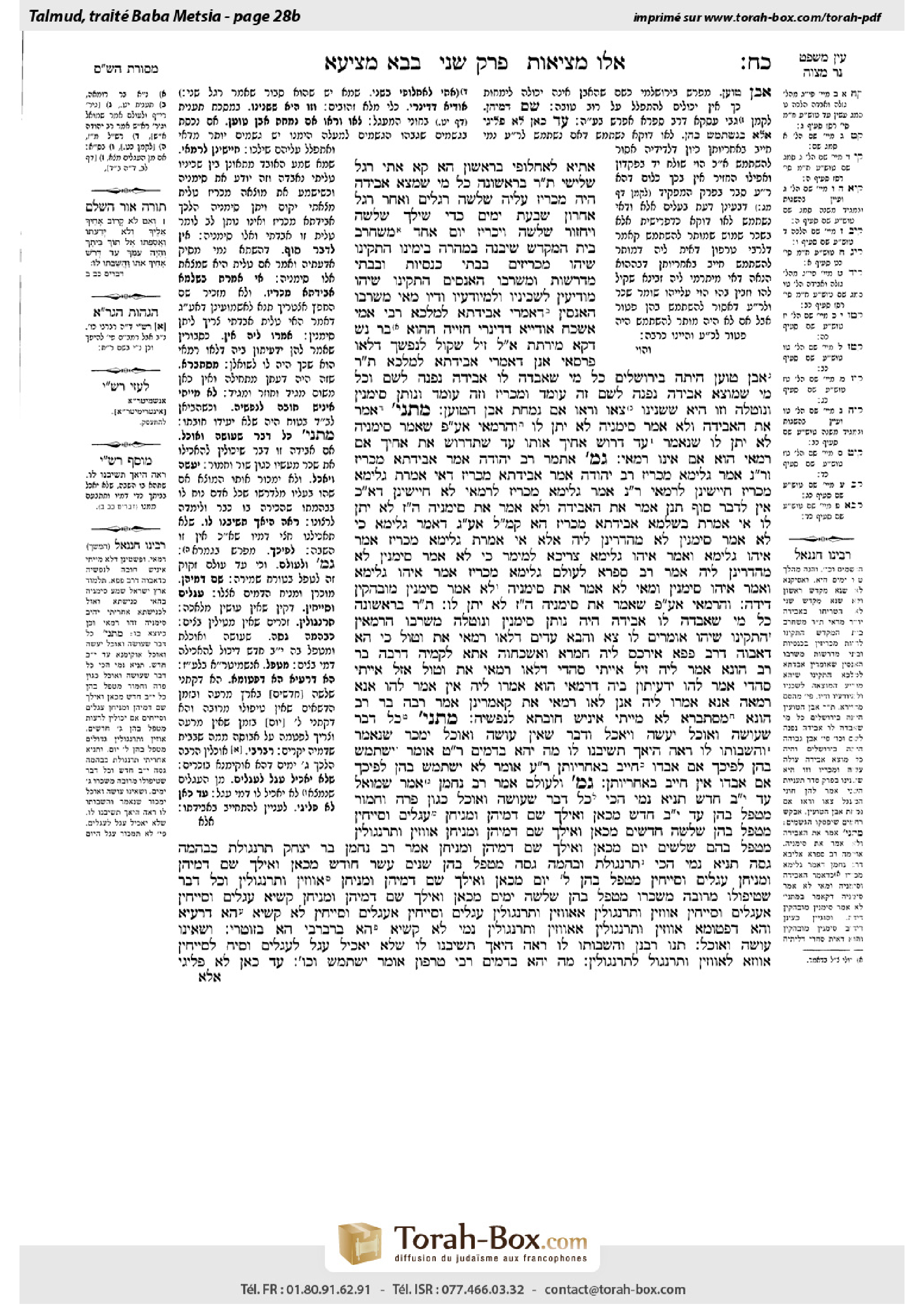
Bava Metzia 28b: Talmud study for Daf Yomi
Study the Talmud for Daf Yomi with scanned pages, Hebrew text, English translations from Sefaria and AI-generated French translations.
Passage selection and English or AI-generated French translation are available where the scan has annotations. Daf Study is independent of Torah-Box and Sefaria.
Browse Bava Metzia · בבא מציעא · All tractatesBava Metzia 28b text and translations
This page of Bava Metzia includes the Aramaic text, an English translation and an AI-generated French translation, alongside the scan above.
בבא מציעא כ״ח ב · Aramaic and Hebrew text
אַתְיָא לְאִחַלּוֹפֵי בְּרִאשׁוֹן! הָא קָא אָתֵי רֶגֶל שְׁלִישִׁי.
תָּנוּ רַבָּנַן: בָּרִאשׁוֹנָה, כׇּל מִי שֶׁמָּצָא אֲבֵידָה הָיָה מַכְרִיז עָלֶיהָ שְׁלֹשָׁה רְגָלִים, וְאַחַר רֶגֶל אַחֲרוֹן שִׁבְעַת יָמִים, כְּדֵי שֶׁיֵּלֵךְ שְׁלֹשָׁה וְיַחְזוֹר שְׁלֹשָׁה וְיַכְרִיז יוֹם אֶחָד. מִשֶּׁחָרַב בֵּית הַמִּקְדָּשׁ, שֶׁיִּבָּנֶה בִּמְהֵרָה בְּיָמֵינוּ, הִתְקִינוּ שֶׁיְּהוּ מַכְרִיזִים בְּבָתֵּי כְנֵסִיּוֹת וּבְבָתֵּי מִדְרָשׁוֹת. וּמִשֶּׁרַבּוּ הָאַנָּסִים הִתְקִינוּ שֶׁיְּהוּ מוֹדִיעִין לִשְׁכֵינָיו וְלִמְיוּדָּעָיו וְדַיּוֹ.
מַאי מִשֶּׁרַבּוּ הָאַנָּסִין? דְּאָמְרִי אֲבֵידְתָּא לְמַלְכָּא. רַבִּי אַמֵּי אַשְׁכַּח אוּדְיָיא דְּדִינָרֵי, חַזְיֵיהּ הָהוּא רוֹמָאָה דְּקָא מִירְתַת. אֲמַר לֵיהּ: זִיל שְׁקוֹל לְנַפְשָׁךְ, דְּלָאו פָּרְסָאֵי אֲנַן דְּאָמְרִי אֲבֵידְתָּא לְמַלְכָּא.
תָּנוּ רַבָּנַן: אֶבֶן טוֹעִ[י]ן הָיְתָה בִּירוּשָׁלַיִם. כׇּל מִי שֶׁאָבְדָה לוֹ אֲבֵידָה נִפְנֶה לְשָׁם, וְכׇל מִי שֶׁמּוֹצֵא אֲבֵידָה נִפְנֶה לְשָׁם. זֶה עוֹמֵד וּמַכְרִיז, וְזֶה עוֹמֵד וְנוֹתֵן סִימָנִין וְנוֹטְלָהּ. וְזוֹ הִיא שֶׁשָּׁנִינוּ: צְאוּ וּרְאוּ אִם נִמְחֵת אֶבֶן הַטּוֹעִ[י]ן.
מַתְנִי׳ אָמַר אֶת הָאֲבֵידָה, וְלֹא אָמַר סִימָנֶיהָ – לֹא יִתֵּן לוֹ. וְהָרַמַּאי, אַף עַל פִּי שֶׁאָמַר סִימָנֶיהָ – לֹא יִתֵּן לוֹ, שֶׁנֶּאֱמַר: ״עַד דְּרֹשׁ אָחִיךָ אֹתוֹ״, עַד שֶׁתִּדְרוֹשׁ אֶת אָחִיךָ אִם רַמַּאי הוּא אִם אֵינוֹ רַמַּאי.
גְּמָ׳ אִתְּמַר, רַב יְהוּדָה אָמַר: ״אֲבֵידְתָּא״ מַכְרֵיז, וְרַב נַחְמָן אָמַר: ״גְּלִימָא״ מַכְרֵיז.
רַב יְהוּדָה אָמַר: ״אֲבֵידְתָּא״ מַכְרֵיז, דְּאִי אָמְרַתְּ ״גְּלִימָא״ מַכְרֵיז – חָיְישִׁינַן לְרַמַּאי.
רַב נַחְמָן אָמַר: ״גְּלִימָא״ מַכְרֵיז, לְרַמַּאי לָא חָיְישִׁינַן, דְּאִם כֵּן אֵין לַדָּבָר סוֹף.
תְּנַן: אָמַר אֶת הָאֲבֵידָה וְלֹא אָמַר אֶת סִימָנֶיהָ – הֲרֵי זֶה לֹא יִתֵּן לוֹ. אִי אָמְרַתְּ בִּשְׁלָמָא ״אֲבֵידְתָּא״ מַכְרֵיז, הָא קָא מַשְׁמַע לַן אַף עַל גַּב דְּאָמַר ״גְּלִימָא״, כִּי לָא אָמַר סִימָנִין לָא מַהְדְּרִינַן לֵיהּ. אֶלָּא אִי אָמְרַתְּ ״גְּלִימָא״ מַכְרֵיז, אָמַר אִיהוּ גְּלִימָא, וְאָמַר אִיהוּ גְּלִימָא, צְרִיכָא לְמֵימַר כִּי לָא אָמַר סִימָנִין לָא מַהְדְּרִינַן לֵיהּ?
אָמַר רַב סָפְרָא, לְעוֹלָם ״גְּלִימָא״ מַכְרֵיז, אָמַר אִיהוּ גְּלִימָא, וְאָמַר אִיהוּ סִימָנִין. וּמַאי לֹא אָמַר אֶת סִימָנֶיהָ? לָא אֲמַר סִימָנִין מוּבְהָקִין דִּידַהּ.
וְהָרַמַּאי אַף עַל פִּי שֶׁאָמַר אֶת סִימָנֶיהָ – הֲרֵי זֶה לֹא יִתֵּן לוֹ. תָּנוּ רַבָּנַן: בָּרִאשׁוֹנָה, כׇּל מִי שֶׁאָבְדָה לוֹ אֲבֵידָה – הָיָה נוֹתֵן סִימָנִין וְנוֹטְלָהּ. מִשֶּׁרַבּוּ הָרַמָּאִין, הִתְקִינוּ שֶׁיְּהוּ אוֹמְרִים לוֹ: צֵא וְהָבֵא עֵדִים דְּלָאו רַמַּאי אַתְּ, וְטוֹל.
כִּי הָא דַּאֲבוּהּ דְּרַב פָּפָּא אִירְכַס לֵיהּ חַמְרָא וְאַשְׁכְּחוּהּ. אֲתָא לְקַמֵּיהּ דְּרַבָּה בַּר רַב הוּנָא, אֲמַר לֵיהּ: זִיל אַיְיתִי סָהֲדִי דְּלָאו רַמַּאי אַתְּ, וְטוֹל. אֲזַל אַיְיתִי סָהֲדֵי, אֲמַר לְהוּ: יָדְעִיתוּן בֵּיהּ דְּרַמַּאי הוּא? אֲמַרוּ לֵיהּ: אִין. אֲמַר לְהוּ: אֲנָא רַמָּאָה אֲנָא?! אֲמַרוּ לֵיהּ: אֲנַן ״לָאו רַמַּאי אַתְּ״ קָאָמְרִינַן. אָמַר רַבָּה בַּר רַב הוּנָא: מִסְתַּבְּרָא, לָא מַיְיתֵי אִינִישׁ חוֹבְתָּא לְנַפְשֵׁיהּ.
מַתְנִי׳ כׇּל דָּבָר שֶׁעוֹשֶׂה וְאוֹכֵל – יַעֲשֶׂה וְיֹאכַל, וְדָבָר שֶׁאֵין עוֹשֶׂה וְאוֹכֵל – יִמָּכֵר, שֶׁנֶּאֱמַר: ״וַהֲשֵׁבוֹתוֹ לוֹ״, רְאֵה הֵיאַךְ תְּשִׁיבֶנּוּ לוֹ.
מָה יְהֵא בַּדָּמִים? רַבִּי טַרְפוֹן אוֹמֵר: יִשְׁתַּמֵּשׁ בָּהֶן, לְפִיכָךְ אִם אָבְדוּ – חַיָּיב בְּאַחְרָיוּתָן. רַבִּי עֲקִיבָא אוֹמֵר: לֹא יִשְׁתַּמֵּשׁ בָּהֶן, לְפִיכָךְ אִם אָבְדוּ – אֵין חַיָּיב בְּאַחְרָיוּתָן.
גְּמָ׳ וּלְעוֹלָם? אָמַר רַב נַחְמָן אָמַר שְׁמוּאֵל: עַד שְׁנֵים עָשָׂר חֹדֶשׁ. תַּנְיָא נָמֵי הָכִי: כׇּל דָּבָר שֶׁעוֹשֶׂה וְאוֹכֵל כְּגוֹן פָּרָה וַחֲמוֹר – מִטַּפֵּל בָּהֶן עַד שְׁנֵים עָשָׂר חֹדֶשׁ, מִכָּאן וְאֵילָךְ – שָׁם דְּמֵיהֶן וּמַנִּיחָן.
עֲגָלִים וּסְיָיחִין – מִטַּפֵּל בָּהֶן שְׁלֹשָׁה חֳדָשִׁים, מִכָּאן וְאֵילָךְ – שָׁם דְּמֵיהֶן וּמַנִּיחָן. אֲווֹזִין וְתַרְנְגוֹלִין – מִטַּפֵּל בָּהֶם שְׁלֹשִׁים יוֹם, מִכָּאן וְאֵילָךְ – שָׁם דְּמֵיהֶן וּמַנִּיחָן.
אָמַר רַב נַחְמָן בַּר יִצְחָק: תַּרְנְגוֹלֶת כִּבְהֵמָה גַּסָּה. תַּנְיָא נָמֵי הָכִי: תַּרְנְגוֹלֶת וּבְהֵמָה גַּסָּה – מִטַּפֵּל בָּהֶן שְׁנֵים עָשָׂר חוֹדֶשׁ, מִכָּאן וְאֵילָךְ – שָׁם דְּמֵיהֶן וּמַנִּיחָן. עֲגָלִים וּסְיָיחִין – מִטַּפֵּל בָּהֶן שְׁלֹשִׁים יוֹם, מִכָּאן וְאֵילָךְ – שָׁם דְּמֵיהֶן וּמַנִּיחָן. אֲווֹזִין וְתַרְנְגוֹלִין וְכׇל דָּבָר שֶׁטִּיפּוּלוֹ מְרוּבֶּה מִשְּׂכָרוֹ – מִטַּפֵּל בָּהֶן שְׁלֹשָׁה יָמִים, מִכָּאן וְאֵילָךְ – שָׁם דְּמֵיהֶן וּמַנִּיחָן.
קַשְׁיָא עֲגָלִים וּסְיָיחִין אַעֲגָלִים וּסְיָיחִין, אֲווֹזִין וְתַרְנְגוֹלִין אַאֲווֹזִין וְתַרְנְגוֹלִין!
עֲגָלִים וּסְיָיחִין אַעֲגָלִים וּסְיָיחִין לָא קַשְׁיָא: הָא דְּרִעְיָא, וְהָא דְּפִטּוּמָא.
אֲווֹזִין וְתַרְנְגוֹלִין אַאֲווֹזִין וְתַרְנְגוֹלִין נָמֵי לָא קַשְׁיָא: הָא בְּרַבְרְבֵי, הָא בְּזוּטְרֵי.
וְשֶׁאֵינוֹ עוֹשֶׂה וְאוֹכֵל. תָּנוּ רַבָּנַן: ״וַהֲשֵׁבוֹתוֹ לוֹ״ – רְאֵה הֵיאַךְ תְּשִׁיבֶנּוּ לוֹ, שֶׁלֹּא יַאֲכִיל עֵגֶל לַעֲגָלִים, וּסְיָח לִסְיָיחִין, אֲווֹזָא לַאֲווֹזִין, וְתַרְנְגוֹל לְתַרְנְגוֹלִין.
מָה יְהֵא בַּדָּמִים? רַבִּי טַרְפוֹן אוֹמֵר יִשְׁתַּמֵּשׁ וְכוּ׳. עַד כָּאן לָא פְּלִיגִי
Bava Metzia 28b · English translation
because perhaps one who hears him will come to confuse it with the first pilgrimage Festival? The Gemara answers: Confusing the second Festival with the first is not a problem, as in any case, won’t the finder come on the third pilgrimage Festival, thereby giving the owner another opportunity to recover his lost item?
§ The Sages taught: Initially, anyone who found a lost item would proclaim his find for three pilgrimage Festivals and for seven days after the last of the three pilgrimage Festivals, so that its owner will go to his home, a trip lasting up to three days, and will return to Jerusalem, a trip lasting up to three days, and proclaim his loss for one day. But from the time that the Temple was destroyed, may it be rebuilt speedily in our days, the Sages instituted that those who find lost items shall proclaim their finds in synagogues and study halls. And from the time that the oppressors proliferated, the Sages instituted an ordinance that one who finds a lost item shall inform his neighbors and acquaintances, and that will suffice for him.
The Gemara asks: What is the meaning of: From the time that the oppressors proliferated? The Gemara answers: It is from the time that they say: A lost item belongs to the king. The Sages were concerned that any public proclamation would result in confiscation of the lost item. The Gemara relates: Rabbi Ami found a vessel full of dinars. A certain Roman saw that he was wary and hesitant to take it. The Roman said to him: Go, take it for yourself; as we are not Persians, who say that a lost item belongs to the king.
The Sages taught in a baraita: There was a Claimant’s Stone in Jerusalem, and anyone who lost an item would be directed there and anyone who found a lost item would be directed there. This finder would stand and proclaim his find and that owner would stand and provide its distinguishing marks and take the item. And that is the place about which we learned in a mishna (Ta’anit 19a): Go and see if the Claimant’s Stone has been obscured by the rising water.
MISHNA: If a claimant accurately stated what type of item the lost item that was found by another is, but did not state, i.e., describe, its distinguishing marks, the finder shall not give it to him. And in the case of a swindler, even though he stated its distinguishing marks, the finder shall not give the lost item to him, as it is stated: “And if your brother be not near you, and you know him not, then you shall bring it into your house, and it shall be with you until your brother claims [derosh] it [oto], and you shall return it to him” (Deuteronomy 22:2). Would it enter your mind that the finder would give it to him before he claims it? How can the finder return it if he does not know the identity of the owner? Rather, the verb derosh is not referring to the claim of the owner; it is referring to the scrutiny performed by the finder. You shall not return the lost item until you scrutinize [shetidrosh] your brother to determine whether he, the claimant, is a swindler or whether he is not a swindler.
GEMARA: It was stated that Rav Yehuda said: One who finds an item proclaims that he found a lost item without specifying its nature. And Rav Naḥman said: He specifies the nature of the item, e.g., he proclaims that he found a cloak.
Rav Yehuda said: One who finds an item proclaims that he found a lost item, as if you say that he proclaims that he found a cloak, we are concerned about the possibility that a swindler may attempt to claim the item. Perhaps the swindler learned that another person lost that item, and he will ascertain its distinguishing marks, provide those distinguishing marks, and claim the item.
Rav Naḥman said: The finder proclaims that he found a cloak, and we are not concerned about the possibility that a swindler may attempt to claim the item, as if so, there is no end to the matter. Even if the finder does not specify the nature of the item, perhaps a swindler would be able to guess its nature.
The Gemara cites proof from that which we learned in the mishna: If a claimant accurately states what type of item the lost item that was found by another is, but did not state its distinguishing marks, the finder shall not give it to him. Granted, if you say the finder proclaims that he found an unspecified lost item, this mishna teaches us that even though the claimant indeed stated that the lost item is a cloak, as long as he did not state its distinguishing marks, we do not return it to him. But if you say that the finder proclaims that he found a cloak, if the finder stated that he found a cloak and the claimant stated that he lost a cloak, does it need to be said that when he did not state its distinguishing marks, we do not return it to him?
Rav Safra said: Actually, one could say that the finder proclaims that he found a cloak, and the mishna is referring to a case where the finder stated that he found a cloak, and the claimant stated its distinguishing marks. And what is the meaning of the phrase in the mishna: If he did not state its distinguishing marks? It means: If he did not state its clear-cut distinguishing marks but rather stated distinguishing marks that are not exclusive to the item. Therefore, he does not prove his ownership.
§ The mishna teaches: And in the case of a swindler, even though he stated its distinguishing marks, the finder shall not give the lost item to him. The Sages taught: Initially, anyone who lost an item would provide its distinguishing marks and take it. But when the swindlers proliferated, the Sages instituted an ordinance that the finders will say to him: Go and bring witnesses who can testify that you are not a swindler, and take your item.
The Gemara relates: This is as in that incident involving the father of Rav Pappa, who lost a donkey and others found it. He came before Rabba bar Rav Huna to reclaim his donkey. Rabba bar Rav Huna said to the father of Rav Pappa: Go and bring witnesses who can testify that you are not a swindler, and you may take your donkey. The father of Rav Pappa went and brought witnesses. Rabba bar Rav Huna said to the witnesses: Do you know about him that he is a swindler? The witnesses said: Yes. Rav Pappa’s father said, incredulously, to the witnesses: I am a swindler? The witnesses said to him: We were saying that you are not a swindler. They had thought the question was if he was not a swindler, and therefore responded in the affirmative. Rabba bar Rav Huna said: It is reasonable to conclude that the witnesses actually intended to support Rav Pappa’s father, because presumably, a person does not bring condemnation upon himself; Rav Pappa’s father would not have volunteered to provide witnesses who would testify against him.
MISHNA: If one finds any living being that works and generates enough revenue to cover the costs of the food that it eats, it shall work and eat while in the finder’s possession. And any living being that does not work but it does eat shall be sold, as it is stated: “Then you shall bring it into your house, and it shall be with you until your brother claims it, and you shall return it to him” (Deuteronomy 22:2), indicating that the finder must see how best to return it to him. Since the owner must repay the finder for his expenditures, if feeding the animal costs more than its value, the finder’s keeping the animal in his possession will prevent the owner from recovering it.
What shall be done with the money received from the sale of the animal? Rabbi Tarfon says: The finder may use it; therefore, if the money is lost, he is liable to pay restitution for it. Rabbi Akiva says: He may not use the money; therefore, if it is lost, he is not liable to pay restitution for it.
GEMARA: The mishna teaches that an animal that generates enough revenue to cover the costs of the food that it eats shall work and eat while in the finder’s possession. The Gemara asks: And must he care for the animal forever? Rav Naḥman says that Shmuel says: He cares for the animal until twelve months pass. This is also taught in a baraita: If one finds any living being that works and generates enough revenue to cover the costs of the food that it eats, e.g., a cow or a donkey, he tends to them until twelve months pass. From that point forward, one assesses their value, sells them, and places the money aside for the owner.
If one finds calves and foals, which are young and unfit for labor, he tends to them for three months, as they do not earn their keep. From that point forward, one assesses their value, sells them, and places the money aside for the owner. If one finds geese and roosters, he tends to them for thirty days. From that point forward, one assesses their value, sells them, and places the money aside for the owner.
Rav Naḥman bar Yitzḥak says: The legal status of a chicken is like that of a large domesticated animal in that the eggs it lays suffice to cover the cost of its food, and therefore the finder keeps it for twelve months. This is also taught in a baraita: If one finds a chicken and a large domesticated animal, he tends to them for twelve months. From that point forward, one assesses their value, sells them, and places the money aside for the owner. If one finds calves and foals, he tends to them for thirty days. From that point forward, one assesses their value, sells them, and places the money aside for the owner. If one finds geese and roosters and anything that costs more to tend to than the revenue generated by it, he tends to them for three days. From that point forward, one assesses their value, sells them, and places the money aside for the owner.
The Gemara asks: It is difficult, as there is a contradiction between the ruling in the first baraita that the finder keeps calves and foals for three months and the ruling in the second baraita that the finder keeps calves and foals for thirty days; and there is another contradiction between the ruling in the first baraita that the finder keeps geese and roosters for thirty days, and the ruling in the second baraita that the finder keeps geese and roosters for three days.
The Gemara answers: The contradiction between the ruling in the first baraita with regard to calves and foals and the ruling in the second baraita with regard to calves and foals is not difficult. This ruling in the first baraita that the finder keeps them for three months is referring to calves and foals that graze in the pasture, and that ruling in the second baraita that the finder keeps them for thirty days is referring to calves and foals that need to be fattened and therefore require greater exertion on the part of the one who finds them.
The contradiction between the ruling in the first baraita with regard to geese and roosters and the ruling in the second baraita with regard to geese and roosters is also not difficult. This ruling in the first baraita that the finder keeps them for thirty days is referring to large geese and roosters, which do not require great exertion, and that ruling in the second baraita that the finder keeps them for three days is referring to small geese and roosters, which require great exertion.
The mishna teaches: And any living being that does not work but it does eat shall be sold. The Sages taught in a baraita: The verse states: “And you shall return it to him” (Deuteronomy 22:2), indicating that the finder must see how best to return it to him, meaning that one shall not feed the value of a calf to the lost calves that he is tending, nor the value of a foal to the lost foals that he is tending, nor the value of a goose to the geese that he is tending, nor the value of a rooster to the roosters that he is tending. Were the finder to do so, ultimately, the owner would receive nothing.
§ The mishna teaches: What shall be done with the money received from the sale of the animal? Rabbi Tarfon says: The finder may use it; therefore, if the money is lost, he is liable to pay restitution for its loss. Rabbi Akiva says: He may not use the money. Therefore, if it is lost, he is not liable to pay restitution. The Gemara analyzes the tannaitic dispute: Rabbi Tarfon and Rabbi Akiva disagree
Bava Metzia 28b · Traduction française (IA)
car peut-être celui qui l'entendra confondra ce festival avec le premier festival de pèlerinage ? La Guemara répond : Confondre le deuxième festival avec le premier n'est pas un problème, car, en tout cas, ne viendra-t-il pas le propriétaire chercher son objet au troisième festival de pèlerinage, ce qui lui donnera une autre opportunité de récupérer son objet perdu ?
§ Les Sages enseignèrent : D'abord, celui qui trouvait un objet perdu proclamait sa découverte pendant trois festivals de pèlerinage et pendant sept jours après le dernier de ces trois festivals de pèlerinage, afin que son propriétaire vienne chez lui, un trajet pouvant durer jusqu'à trois jours, et revienne à Jérusalem, un trajet pouvant durer jusqu'à trois jours, et proclame sa perte pendant un jour. Mais depuis que le Temple a été détruit, qu'il soit reconstruit rapidement dans nos jours, les Sages ont institué que ceux qui trouvent des objets perdu doivent proclamer leur découverte dans les synagogues et les salles de study. Et depuis que les oppresseurs se sont multipliés, les Sages ont institué un règlement selon lequel celui qui trouve un objet perdu doit informer ses voisins et connaissances, et cela suffira à lui.
La Guemara demande : Quelle est la signification de : Depuis que les oppresseurs se sont multipliés ? La Guemara répond : C'est depuis que l'on dit : Un objet perdu appartient au roi. Les Sages craignaient que toute proclamation publique entraîne la confiscation de l'objet perdu. La Guemara rapporte : Rabbi Ami trouva un récipient rempli de dinars. Un certain romain vit qu'il était méfiant et hésitant à le prendre. Le romain lui dit : Allez, prenez-le pour vous ; car nous ne sommes pas des Perses, qui disent qu'un objet perdu appartient au roi.
Les Sages enseignèrent dans une baraïta : Il y avait une Pierre du Justicier à Jérusalem, et celui qui perdait un objet était dirigé vers là, et celui qui trouvait un objet perdu était également dirigé vers là. Ce dernier se levait et proclamait sa découverte, et le propriétaire se levait et donnait les caractéristiques distinctives de l'objet et le prenait. Et c'est là le lieu dont nous avons appris dans une mitsva (Ta'anit 19a) : Allez voir si la Pierre du Justicier a été recouverte par l'eau montante.
MITSVA : Si un justicier a correctement déclaré le type d'objet perdu trouvé par un autre, mais n'a pas déclaré ses caractéristiques distinctives, le trouver ne doit pas lui donner l'objet. Et dans le cas d'un escroc, même s'il a déclaré ses caractéristiques distinctives, le trouver ne doit pas lui donner l'objet perdu, car il est dit : « Et si ton frère n'est pas près de toi, et que tu ne le connais pas, alors tu le ramèneras chez toi, et il sera avec toi jusqu'à ce que ton frère déclare [derosh] [l'objet] [oto], et tu le lui rendras » (Deutéronome 22:2). Est-ce que cela t'entre en tête que le trouver lui donnerait l'objet avant qu'il ne le déclare ? Comment le trouver pourrait-il le rendre s'il ne connaît pas l'identité du propriétaire ? Plutôt, le verbe derosh ne fait pas référence à la revendication du propriétaire ; il fait référence à l'inspection effectuée par le trouver. Tu ne dois pas rendre l'objet perdu jusqu'à ce que tu inspectes [shetidrosh] ton frère pour déterminer s'il, le déclarant, est un escroc ou s'il ne l'est pas.
GUEMARA : Il a été dit que Rav Yehuda dit : Celui qui trouve un objet proclame qu'il a trouvé un objet perdu sans préciser sa nature. Et Rav Naḥman dit : Il précise la nature de l'objet, par exemple, il proclame qu'il a trouvé une cape.
Rav Yehuda dit : Celui qui trouve un objet proclame qu'il a trouvé un objet perdu, comme si on disait qu'il proclame qu'il a trouvé une cape, nous craignons la possibilité qu'un escroc tente de revendiquer l'objet. Peut-être que l'escroc a appris que quelqu'un a perdu cet objet, et il cherchera ses caractéristiques distinctives, fournira ces caractéristiques distinctives et revendiquera l'objet.
Rav Naḥman dit : Le trouver proclame qu'il a trouvé une cape, et nous ne craignons pas la possibilité qu'un escroc tente de revendiquer l'objet, car si tel est le cas, la question n'aurait pas de fin. Même si le trouver ne précise pas la nature de l'objet, peut-être un escroc pourrait deviner sa nature.
La Guemara cite une preuve à partir de ce que nous avons appris dans la Michna : Si un déclarant déclare correctement le type d'objet que l'objet perdu trouvé par un autre est, mais n'a pas déclaré ses caractéristiques distinctives, le trouver ne doit pas lui donner l'objet. Admettons que vous disiez que le trouver proclame qu'il a trouvé un objet perdu non spécifié, cette Michna nous apprend que même si le déclarant a effectivement déclaré que l'objet perdu est une cape, tant qu'il n'a pas déclaré ses caractéristiques distinctives, nous ne lui rendons pas l'objet. Mais si vous dites que le trouver proclame qu'il a trouvé une cape, si le trouver a déclaré qu'il a trouvé une cape et que le déclarant a déclaré qu'il a perdu une cape, est-ce que cela doit être dit que lorsque celui-ci n'a pas déclaré ses caractéristiques distinctives, nous ne lui rendons pas l'objet ?
Rav Safra dit : En réalité, on pourrait dire que le trouver proclame avoir trouvé une cape, et la mitsna fait référence à un cas où le trouver a déclaré avoir trouvé une cape, et le déclarant a déclaré ses caractéristiques distinctives. Et quelle est la signification de la phrase dans la mitsna : Si on n'a pas déclaré ses caractéristiques distinctives ? Cela signifie : Si on n'a pas déclaré ses caractéristiques distinctives claires, mais plutôt des caractéristiques distinctives non exclusives à l'objet. Ainsi, il ne prouve pas sa propriété.
§ La mitsna enseigne : Et dans le cas d'un escroc, même s'il a déclaré ses caractéristiques distinctives, le trouver ne doit pas lui donner l'objet perdu. Les Sages enseignèrent : D'abord, celui qui perdait un objet déclarait ses caractéristiques distinctives et le récupérait. Mais lorsque les escrocs se sont multipliés, les Sages ont institué un règlement selon lequel les trouver diront à lui : Allez et apportez des témoins qui puissent témoigner que vous n'êtes pas un escroc, et prenez votre objet.
La Guemara rapporte : Cela est semblable à l'incident concernant le père de Rav Pappa, qui avait perdu un âne et d'autres l'avaient trouvé. Il s'est présenté devant Rabba bar Rav Huna pour récupérer son âne. Rabba bar Rav Huna a dit au père de Rav Pappa : Va chercher des témoins qui puissent témoigner que tu n'es pas un escroc, et tu pourras récupérer ton âne. Le père de Rav Pappa est allé chercher des témoins. Rabba bar Rav Huna a dit aux témoins : Savez-vous qu'il est un escroc ? Les témoins ont répondu : Oui. Le père de Rav Pappa a dit, incrédulement, aux témoins : Je suis un escroc ? Les témoins ont répondu : Nous disions que tu n'étais pas un escroc. Ils pensaient que la question était si tu n'étais pas un escroc, et donc ont répondu affirmativement. Rabba bar Rav Huna a dit : Il est raisonnable de conclure que les témoins avaient réellement l'intention de soutenir le père de Rav Pappa, car on suppose qu'une personne ne se met pas volontairement en situation de condamnation ; le père de Rav Pappa n'aurait pas volontairement fourni des témoins qui témoigneraient contre lui.
MICHNA : Si l'on trouve un être vivant qui travaille et génère suffisamment de revenus pour couvrir les coûts de la nourriture qu'il consomme, il doit travailler et manger pendant qu'il est en possession de celui qui l'a trouvé. Et tout être vivant qui ne travaille pas mais qui mange doit être vendu, car il est dit : « Puis tu le ramèneras chez toi, et il restera avec toi jusqu'à ce que ton frère le réclame, et tu le lui rendras » (Deutéronome 22:2), indiquant que celui qui a trouvé doit voir comment mieux rendre l'animal à son propriétaire. Puisque le propriétaire doit réparer les dépenses du trouver, si l'alimentation de l'animal coûte plus que sa valeur, la possession de l'animal par le trouver empêchera le propriétaire de le récupérer.
Que faire avec l'argent reçu de la vente de l'animal ? Rabbi Tarfon dit : Le trouver peut l'utiliser ; donc, si l'argent est perdu, il est tenu responsable de le remplacer. Rabbi Akiva dit : Il ne peut pas utiliser l'argent ; donc, si l'argent est perdu, il n'est pas tenu responsable de le remplacer.
GUEMARA : La Michna enseigne que l'animal qui génère suffisamment de revenus pour couvrir les coûts de la nourriture qu'il consomme doit travailler et manger pendant qu'il est en possession de celui qui l'a trouvé. La Guemara pose la question : Et doit-il s'occuper de l'animal à jamais ? Rav Naḥman dit que Shmuel dit : Il s'occupe de l'animal jusqu'à ce que douze mois passent. Cela est également enseigné dans une baraïta : Si l'on trouve un être vivant qui travaille et génère suffisamment de revenus pour couvrir les coûts de la nourriture qu'il consomme, par exemple un bœuf ou un âne, il s'occupe de lui jusqu'à ce que douze mois passent. À partir de ce moment, on évalue sa valeur, on le vend et on met l'argent de côté pour le propriétaire.
Si l'on trouve des veaux et des poulains, qui sont jeunes et inaptes au travail, on s'occupe d'eux pendant trois mois, car ils ne gagnent pas leur vie. À partir de ce moment, on évalue leur valeur, on les vend et on met l'argent de côté pour le propriétaire. Si l'on trouve des canards et des poulets, on s'occupe d'eux pendant trente jours. À partir de ce moment, on évalue leur valeur, on les vend et on met l'argent de côté pour le propriétaire.
Rav Naḥman bar Yitzḥak dit : Le statut juridique d'un poulet est comme celui d'un grand animal domestique, car les œufs qu'il pond suffisent à couvrir les coûts de sa nourriture, et donc celui qui le trouve le garde pendant douze mois. Cela est également enseigné dans une baraïta : Si l'on trouve un poulet et un grand animal domestique, on s'occupe d'eux pendant douze mois. À partir de ce moment, on évalue leur valeur, on les vend et on met l'argent de côté pour le propriétaire. Si l'on trouve des veaux et des poulains, on s'occupe d'eux pendant trente jours. À partir de ce moment, on évalue leur valeur, on les vend et on met l'argent de côté pour le propriétaire. Si l'on trouve des canards et des roosters et tout ce qui coûte plus cher à s'occuper que les revenus qu'il génère, on s'occupe d'eux pendant trois jours. À partir de ce moment, on évalue leur valeur, on les vend et on met l'argent de côté pour le propriétaire.
La Guemara pose la question : C'est difficile, car il y a une contradiction entre la décision de la première baraïta selon laquelle celui qui trouve garde les veaux et les poulains pendant trois mois et la décision de la deuxième baraïta selon laquelle celui qui trouve garde les veaux et les poulains pendant trente jours ; et il y a une autre contradiction entre la décision de la première baraïta concernant les canards et les roosters et la décision de la deuxième baraïta concernant les canards et les roosters.
La Guemara répond : La contradiction entre la décision de la première baraïta concernant les veaux et les poulains et la décision de la deuxième baraïta concernant les veaux et les poulains n'est pas difficile. Cette décision de la première baraïta selon laquelle celui qui trouve les garde pendant trois mois fait référence aux veaux et poulains qui paissent dans les prairies, et cette décision de la deuxième baraïta selon laquelle celui qui trouve les garde pendant trente jours fait référence aux veaux et poulains qui doivent être épaissis et nécessitent donc un plus grand effort de la part de celui qui les a trouvés.
La contradiction entre la décision de la première baraïta concernant les canards et les poulets et la décision de la deuxième baraïta concernant les canards et les poulets n'est pas non plus difficile. Cette décision de la première baraïta selon laquelle le trouver les garde pendant trente jours fait référence aux grands canards et poulets, qui n'exigent pas un grand effort, et cette décision de la deuxième baraïta selon laquelle le trouver les garde pendant trois jours fait référence aux petits canards et poulets, qui exigent un grand effort.
La Michna enseigne : Et tout être vivant qui ne travaille pas mais qui mange doit être vendu. Les Sages ont enseigné dans une baraïta : Le verset dit : « Et tu le lui rendras » (Deutéronome 22:2), indiquant que le trouver doit voir comment mieux rendre l'animal à son propriétaire, c'est-à-dire qu'on ne doit pas nourrir la valeur d'un veau aux veaux perdus que l'on tient, ni la valeur d'un poulain aux poulains perdus que l'on tient, ni la valeur d'un canard aux canards que l'on tient, ni la valeur d'un poulet aux poulets que l'on tient. Si le trouver le faisait, finalement, le propriétaire recevrait rien.
§ La Michna enseigne : Que faire du prix de la vente de l'animal ? Rabbi Tarfon dit : Le trouvart peut l'utiliser ; donc, si l'argent est perdu, il est tenu responsable de la restitution de sa perte. Rabbi Akiva dit : Il ne peut pas utiliser l'argent. Donc, si celui-ci est perdu, il n'est pas tenu responsable de la restitution. La Guemara analyse le désaccord tannaitique : Rabbi Tarfon et Rabbi Akiva sont en désaccord
Traduction française générée par IA à partir de l’édition anglaise de Sefaria. Vérifie toujours un passage avec le texte source.
Text from Sefaria: William Davidson Edition - Vocalized Aramaic (CC BY NC); William Davidson Edition - English (CC BY NC).