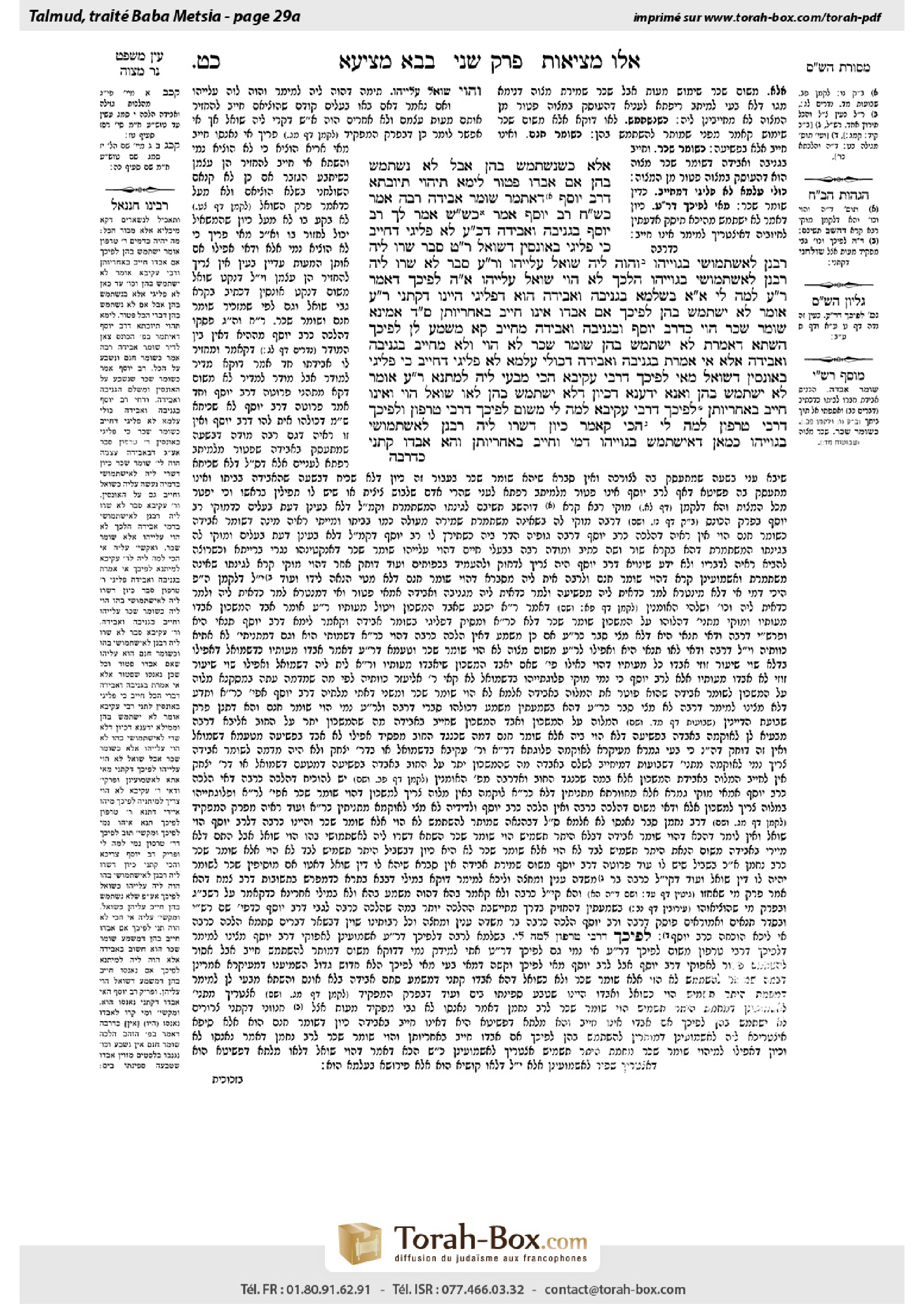
Bava Metzia 29a: Talmud study for Daf Yomi
Study the Talmud for Daf Yomi with scanned pages, Hebrew text, English translations from Sefaria and AI-generated French translations.
Passage selection and English or AI-generated French translation are available where the scan has annotations. Daf Study is independent of Torah-Box and Sefaria.
Browse Bava Metzia · בבא מציעא · All tractatesBava Metzia 29a text and translations
This page of Bava Metzia includes the Aramaic text, an English translation and an AI-generated French translation, alongside the scan above.
בבא מציעא כ״ט א · Aramaic and Hebrew text
אֶלָּא כְּשֶׁנִּשְׁתַּמֵּשׁ בָּהֶן. אֲבָל לֹא נִשְׁתַּמֵּשׁ בָּהֶן, אִם אָבְדוּ – פָּטוּר.
לֵימָא תֶּיהְוֵי תְּיוּבְתָּא דְּרַב יוֹסֵף? דְּאִתְּמַר: שׁוֹמֵר אֲבֵידָה, רַבָּה אָמַר: כְּשׁוֹמֵר חִנָּם, רַב יוֹסֵף אָמַר: כְּשׁוֹמֵר שָׂכָר.
אָמַר לְךָ רַב יוֹסֵף: בִּגְנֵיבָה וַאֲבֵידָה – דְּכוּלֵּי עָלְמָא לָא פְּלִיגִי דְּחַיָּיב, כִּי פְּלִיגִי בְּאוּנְסִין דְּשׁוֹאֵל, רַבִּי טַרְפוֹן סָבַר: שָׁרוּ לֵיהּ רַבָּנַן לְאִשְׁתַּמּוֹשֵׁי בְּגַוַּיְיהוּ, וְהָוֵה לֵיהּ שׁוֹאֵל עֲלַיְיהוּ. וְרַבִּי עֲקִיבָא סָבַר: לָא שָׁרוּ לֵיהּ רַבָּנַן לְאִשְׁתַּמּוֹשֵׁי בְּגַוַּיְיהוּ, הִלְכָּךְ לָא הָוֵי שׁוֹאֵל עֲלַיְיהוּ.
אִי הָכִי, ״לְפִיכָךְ״ דְּאָמַר רַבִּי עֲקִיבָא, לְמָה לִי? אִי אָמְרַתְּ בִּשְׁלָמָא בִּגְנֵיבָה וַאֲבֵידָה הוּא דִּפְלִיגִי, הַיְינוּ דְּקָתָנֵי ״רַבִּי עֲקִיבָא אוֹמֵר לֹא יִשְׁתַּמֵּשׁ בָּהֶן, לְפִיכָךְ אִם אָבְדוּ – אֵינוֹ חַיָּיב בְּאַחְרָיוּתָן״. סָלְקָא דַּעְתָּךְ אָמֵינָא שׁוֹמֵר שָׂכָר הָוֵי כִּדְרַב יוֹסֵף, וּבִגְנֵיבָה וַאֲבֵידָה מְחַיֵּיב, קָא מַשְׁמַע לַן ״לְפִיכָךְ״. הַשְׁתָּא דְּאָמְרַתְּ לֹא יִשְׁתַּמֵּשׁ בָּהֶן, שׁוֹמֵר שָׂכָר לָא הָוֵי וְלָא מְחַיֵּיב בִּגְנֵיבָה וַאֲבֵידָה.
אֶלָּא אִי אָמְרַתְּ בִּגְנֵיבָה וַאֲבֵידָה דְּכוּלֵּי עָלְמָא לָא פְּלִיגִי דְּחַיָּיב, כִּי פְּלִיגִי בְּאוּנְסִין דְּשׁוֹאֵל, מַאי ״לְפִיכָךְ״ דְּרַבִּי עֲקִיבָא? הָכִי מִבְּעֵי לֵיהּ לְמִתְנֵא: ״רַבִּי עֲקִיבָא אוֹמֵר לֹא יִשְׁתַּמֵּשׁ בָּהֶן״, וַאֲנָא יָדַעְנָא דְּכֵיוָן דְּלֹא יִשְׁתַּמֵּשׁ בָּהֶן – לָאו שׁוֹאֵל הָוֵי וְאֵינוֹ חַיָּיב בְּאַחְרָיוּתָן, ״לְפִיכָךְ״ דְּרַבִּי עֲקִיבָא לְמָה לִי?
מִשּׁוּם ״לְפִיכָךְ״ דְּרַבִּי טַרְפוֹן.
וּלְפִיכָךְ דְּרַבִּי טַרְפוֹן לְמָה לִי? הָכִי קָאָמַר: כֵּיוָן דְּשָׁרוּ לֵיהּ רַבָּנַן לְאִשְׁתַּמּוֹשֵׁי בְּגַוַּיְיהוּ כְּמַאן דְּאִישְׁתַּמַּשׁ בְּגַוַּיְיהוּ דָּמֵי וְחַיָּיב בְּאַחְרָיוּתָן.
וְהָא ״אָבְדוּ״ קָתָנֵי!
Bava Metzia 29a · English translation
only in a case where the finder used the money. But in a case where the finder did not use the money, everyone agrees that if the money is lost, the finder is exempt from paying restitution for its loss.
The Gemara suggests: Let us say that this shall be a conclusive refutation of the statement of Rav Yosef, as it was stated that there is an amoraic dispute with regard to the legal status of a bailee charged with safeguarding a lost item. Rabba said: His legal status is like that of an unpaid bailee, who is liable to compensate the owner of the deposited item only in cases of negligence. Rav Yosef said: His legal status is like that of a paid bailee, who is liable to compensate the owner of the deposited item even in cases of theft or loss. When the mishna teaches that if the finder did not use the money everyone agrees that he is exempt from paying restitution for its loss, it apparently contradicts the statement of Rav Yosef.
The Gemara answers that Rav Yosef could have said to you: In cases of theft or loss, everyone agrees that a bailee charged with safeguarding a lost item is liable to pay restitution for it. When they disagree is in a case of damage caused by circumstances beyond his control, for which it is the obligation of a borrower to pay compensation. The Gemara elaborates: Rabbi Tarfon holds: The Sages permitted him to use the money, and he is therefore a borrower with regard to it, and is liable to compensate the owner even in the event of circumstances beyond his control. And Rabbi Akiva holds: The Sages did not permit him to use the money, and he is therefore not a borrower with regard to it.
The Gemara asks: If so, why do I need the statement that Rabbi Akiva said: He may not use the money; therefore, if it is lost, he is not liable to pay restitution for it? Granted, if you say that it is in cases of theft or loss that they disagree, I understand that is the reason that the tanna teaches in the mishna that Rabbi Akiva says: He may not use the money; therefore, if it is lost, he is not liable to pay restitution for it. The Gemara explains: Since it enters your mind to say that the legal status of the finder is like that of a paid bailee, in accordance with the opinion of Rav Yosef, and that in cases of theft and loss the finder is liable to pay restitution, Rabbi Akiva teaches us: Therefore, if it is lost, he is not liable to pay restitution. Now that you said that he may not use the money, he is not a paid bailee and is not liable to pay restitution in cases of theft and loss.
But if you say that in cases of theft or loss, everyone agrees that a bailee charged with safeguarding a lost item is liable to pay restitution for it, and when they disagree it is in cases of damage caused by circumstances beyond his control for which it is the obligation of a borrower to pay compensation, what is the meaning of the statement of Rabbi Akiva: Therefore, if it is lost, he is not liable to pay restitution for it? Rather, this is what the mishna should have taught: Rabbi Akiva says: He may not use the money; and I would know that since he may not use the money, he is not considered a borrower, and consequently bears no financial responsibility. Why do I need the statement that Rabbi Akiva said: Therefore, if it is lost, he is not liable to pay restitution for it?
The Gemara answers: The explanation appended to the statement of Rabbi Akiva is indeed extraneous. It was added in order to create a parallel between the formulation of the statement of Rabbi Akiva and the formulation of the statement of Rabbi Tarfon. The phrase: Therefore, if the money is lost, he is not liable to pay restitution for it, was appended to the statement of Rabbi Akiva due to the explanation: Therefore, if the money is lost, he is liable to pay restitution for it, stated by Rabbi Tarfon.
The Gemara asks: And why do I need the statement that Rabbi Tarfon said: Therefore, if the money is lost, he is liable to pay restitution for it? The Gemara answers: This is what the mishna is saying: Since the Sages permitted him to use the money, his legal status is like that of one who actually used it and therefore, he is liable to pay restitution for it.
The Gemara asks: How can Rav Yosef explain that the dispute in the mishna is with regard to damage caused by circumstances beyond his control? But doesn’t the mishna teach: Therefore, if the money is lost? The disagreement between Rabbi Tarfon and Rabbi Akiva is with regard to a case of damage due to loss, and not with regard to a case of damage caused by circumstances beyond one’s control.
Bava Metzia 29a · Traduction française (IA)
seulement dans le cas où le trouvereur a utilisé l'argent. Mais dans le cas où le trouvereur n'a pas utilisé l'argent, tout le monde convient que si l'argent est perdu, le trouvereur est exempt de payer la restitution de sa perte.
La Guemara suggère : Disons que cela constituerait une réfutation définitive de la déclaration de Rav Yosef, car il a été dit qu'il y a un débat entre les amoraïm concernant le statut juridique d'un dépositaire chargé de garder un objet perdu. Rabba a dit : Son statut juridique est celui d'un dépositaire non rémunéré, qui est tenu de compenser le propriétaire de l'objet déposé uniquement dans les cas de négligence. Rav Yosef a dit : Son statut juridique est celui d'un dépositaire rémunéré, qui est tenu de compenser le propriétaire de l'objet déposé même en cas de vol ou de perte. Lorsque la Michna enseigne que si le trouvereur n'a pas utilisé l'argent, tout le monde convient qu'il est exempt de payer la restitution de sa perte, cela semble contradictoire avec la déclaration de Rav Yosef.
La Guemara répond que Rav Yosef aurait pu dire à vous : Dans les cas de vol ou de perte, tout le monde convient que le dépositaire chargé de garder un objet perdu est tenu de payer la restitution. Le désaccord est dans le cas de dommages causés par des circonstances hors de son contrôle, pour lesquels il incombe à un prêteur de payer une compensation. La Guemara développe : Rabbi Tarfon affirme que les Sages ont permis d'utiliser l'argent, et il est donc considéré comme un prêteur à l'égard de celui-ci, et est tenu de compenser le propriétaire même en cas de circonstances hors de son contrôle. Et Rabbi Akiva affirme que les Sages n'ont pas permis d'utiliser l'argent, et il n'est donc pas considéré comme un prêteur à l'égard de celui-ci.
La Guemara pose la question : Si c'est ainsi, pourquoi ai-je besoin de la déclaration selon laquelle Rabbi Akiva a dit : Il ne peut pas utiliser l'argent ; donc, si l'argent est perdu, il n'est pas tenu de payer la restitution ? Admettons que vous disiez que c'est dans les cas de vol ou de perte que les parties s'opposent, je comprends alors que c'est la raison pour laquelle le tanna enseigne dans la Michna que Rabbi Akiva dit : Il ne peut pas utiliser l'argent ; donc, si l'argent est perdu, il n'est pas tenu de payer la restitution. La Guemara explique : Puisque vous pensez à l'idée que le statut juridique du trouvereur est celui d'un dépositaire rémunéré, conformément à l'opinion de Rav Yosef, et que dans les cas de vol et de perte le trouvereur est tenu de payer la restitution, Rabbi Akiva nous enseigne : donc, si l'argent est perdu, il n'est pas tenu de payer la restitution. Maintenant que vous dites qu'il ne peut pas utiliser l'argent, il n'est pas un dépositaire rémunéré et n'est pas tenu de payer la restitution en cas de vol et de perte.
Mais si vous dites que dans les cas de vol ou de perte, tout le monde convient que le dépositaire chargé de garder un objet perdu est tenu de payer la restitution, et que le désaccord est dans le cas de dommages causés par des circonstances hors de son contrôle pour lesquels il incombe à un prêteur de payer une compensation, quelle est la signification de la déclaration de Rabbi Akiva : donc, si l'argent est perdu, il n'est pas tenu de payer la restitution ? Plutôt, c'est ce que la Michna aurait dû enseigner : Rabbi Akiva dit : Il ne peut pas utiliser l'argent ; et je saurais que puisque il ne peut pas utiliser l'argent, il n'est pas considéré comme un prêteur, et par conséquent n'assume aucune responsabilité financière. Pourquoi ai-je besoin de la déclaration selon laquelle Rabbi Akiva a dit : donc, si l'argent est perdu, il n'est pas tenu de payer la restitution ?
La Guemara répond : L'explication ajoutée à la déclaration de Rabbi Akiva est effectivement superflue. Elle a été ajoutée afin de créer un parallèle entre la formulation de la déclaration de Rabbi Akiva et celle de Rabbi Tarfon. La phrase : donc, si l'argent est perdu, il est tenu de payer la restitution, a été ajoutée à la déclaration de Rabbi Akiva en raison de l'explication : donc, si l'argent est perdu, il n'est pas tenu de payer la restitution, déclarée par Rabbi Tarfon.
La Guemara pose la question : Et pourquoi ai-je besoin de la déclaration selon laquelle Rabbi Tarfon a dit : donc, si l'argent est perdu, il est tenu de payer la restitution ? La Guemara répond : C'est ce que la Michna affirme : puisque les Sages ont permis d'utiliser l'argent, son statut juridique est celui d'une personne qui l'a effectivement utilisé et par conséquent, il est tenu de payer la restitution.
La Guemara pose la question : Comment Rav Yosef peut-il expliquer que le désaccord dans la Michna est concernant les dommages causés par des circonstances hors de son contrôle ? Mais ne dit pas la Michna : donc, si l'argent est perdu ? Le désaccord entre Rabbi Tarfon et Rabbi Akiva est concernant un cas de dommage dû à la perte, et non concernant un cas de dommage causé par des circonstances hors de son contrôle.
Traduction française générée par IA à partir de l’édition anglaise de Sefaria. Vérifie toujours un passage avec le texte source.
Text from Sefaria: William Davidson Edition - Vocalized Aramaic (CC BY NC); William Davidson Edition - English (CC BY NC).