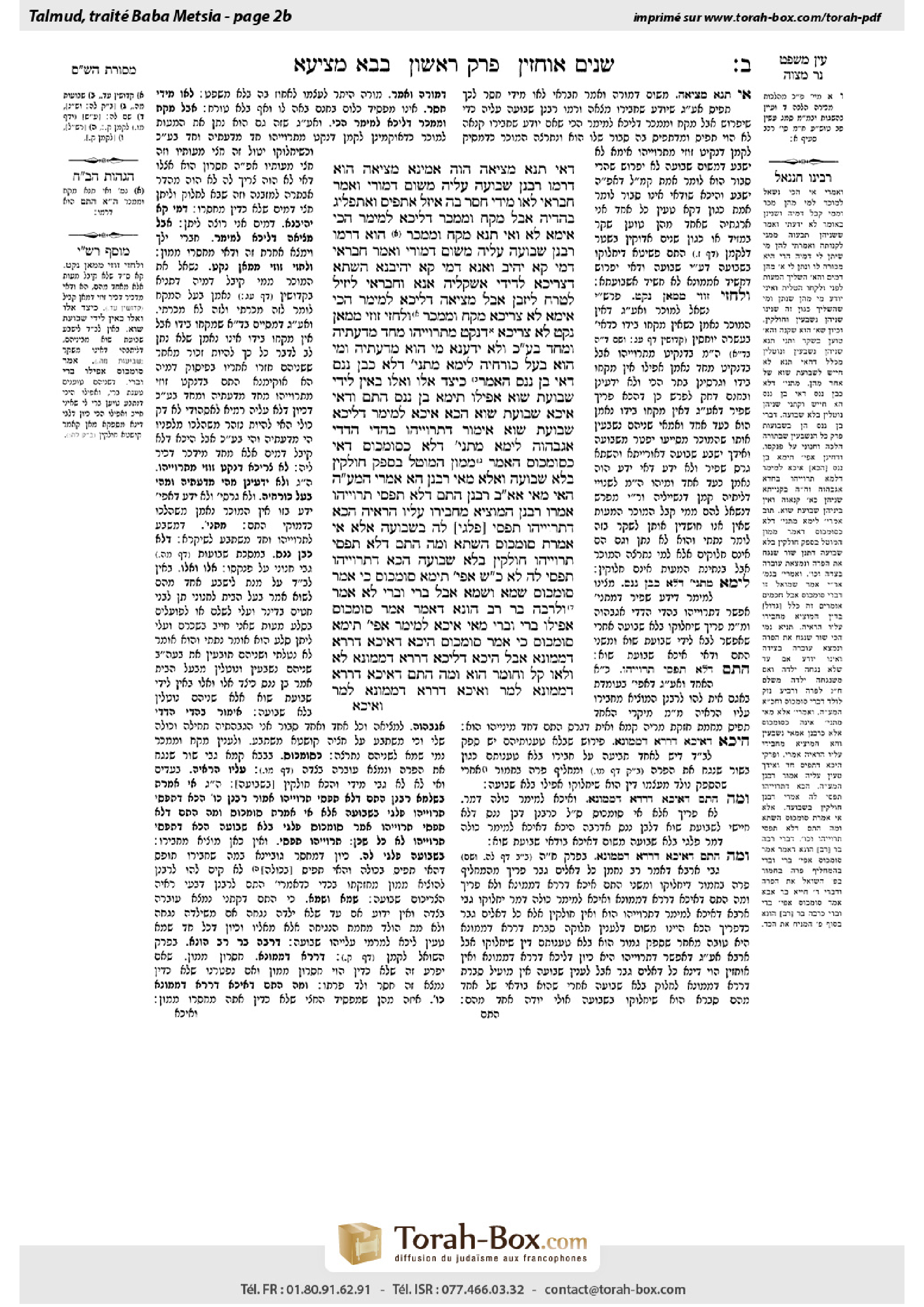
Bava Metzia 2b: Talmud study for Daf Yomi
Study the Talmud for Daf Yomi with scanned pages, Hebrew text, English translations from Sefaria and AI-generated French translations.
Passage selection and English or AI-generated French translation are available where the scan has annotations. Daf Study is independent of Torah-Box and Sefaria.
Browse Bava Metzia · בבא מציעא · All tractatesBava Metzia 2b text and translations
This page of Bava Metzia includes the Aramaic text, an English translation and an AI-generated French translation, alongside the scan above.
בבא מציעא ב׳ ב · Aramaic and Hebrew text
דְּאִי תְּנָא מְצִיאָה הֲוָה אָמֵינָא: מְצִיאָה הוּא דִּרְמוֹ רַבָּנַן שְׁבוּעָה עֲלֵיהּ מִשּׁוּם דְּמוֹרֵי וְאָמַר, חַבְרַאי לָאו מִידֵּי חָסַר בָּהּ, אֵיזִל אֶתְפִּיס וְאִתְפְּלֵיג בַּהֲדֵיהּ! אֲבָל מִקָּח וּמִמְכָּר, דְּלֵיכָּא לְמֵימַר הָכִי – אֵימָא לָא.
וְאִי תְּנָא מִקָּח וּמִמְכָּר, הוּא דִּרְמוֹ רַבָּנַן שְׁבוּעָה עֲלֵיהּ מִשּׁוּם דְּמוֹרֵי וְאָמַר: חַבְרַאי דְּמֵי קָא יָהֵיב וַאֲנָא דְּמֵי קָא יָהֵיבְנָא, הַשְׁתָּא דִּצְרִיכָא לְדִידִי אֶשְׁקְלֵיהּ אֲנָא, וְחַבְרַאי לֵיזִיל לִטְרַח לִיזְבַּן, אֲבָל מְצִיאָה, דְּלֵיכָּא לְמֵימַר הָכִי – אֵימָא לָא. צְרִיכָא.
מִקָּח וּמִמְכָּר, וְלִחְזֵי זוּזֵי מִמַּאן נָקֵט? לָא צְרִיכָא דְּנָקֵט מִתַּרְוַיְיהוּ, מֵחַד מִדַּעְתֵּיהּ וּמֵחַד בְּעַל כָּרְחֵיהּ, וְלָא יָדַעְנָא מִי הוּא מִדַּעְתֵּיהּ, וּמִי הוּא בְּעַל כָּרְחֵיהּ.
לֵימָא מַתְנִיתִין דְּלָא כְּבֶן נַנָּס, דְּאִי בֶּן נַנָּס, הָאָמַר:
כֵּיצַד אֵלּוּ וָאֵלּוּ בָּאִין לִידֵי שְׁבוּעַת שָׁוְא?
אֲפִילּוּ תֵּימָא בֶּן נַנָּס, הָתָם וַדַּאי אִיכָּא שְׁבוּעַת שָׁוְא. הָכָא אִיכָּא לְמֵימַר דְּלֵיכָּא שְׁבוּעַת שָׁוְא, אֵימוֹר דְּתַרְוַיְיהוּ בַּהֲדֵי הֲדָדֵי אַגְבְּהוּהָ.
לֵימָא מַתְנִיתִין דְּלָא כְּסוֹמְכוֹס, דְּאִי כְּסוֹמְכוֹס, הָאָמַר: מָמוֹן הַמּוּטָּל בְּסָפֵק – חוֹלְקִין בְּלֹא שְׁבוּעָה.
וְאֶלָּא מַאי, רַבָּנַן? הָא אָמְרִי הַמּוֹצִיא מֵחֲבֵרוֹ עָלָיו הָרְאָיָה!
הַאי מַאי, אִי אָמְרַתְּ בִּשְׁלָמָא רַבָּנַן: הָתָם דְּלָא תָּפְסִי תַּרְוַיְיהוּ אֲמַרוּ רַבָּנַן הַמּוֹצִיא מֵחֲבֵירוֹ עָלָיו הָרְאָיָה, הָכָא דְּתַרְוַיְיהוּ תָּפְסִי [פָּלְגִי] לַהּ בִּשְׁבוּעָה.
אֶלָּא אִי אָמְרַתְּ סוֹמְכוֹס, הַשְׁתָּא וּמָה הָתָם דְּלָא תָּפְסִי תַּרְוַיְיהוּ – חוֹלְקִין בְּלֹא שְׁבוּעָה, הָכָא דְּתַרְוַיְיהוּ תָּפְסִי לַהּ – לֹא כׇּל שֶׁכֵּן!
אֲפִילּוּ תֵּימָא סוֹמְכוֹס: כִּי אָמַר סוֹמְכוֹס שֶׁמָּא וְשֶׁמָּא, אֲבָל בָּרִי וּבָרִי – לָא אָמַר.
וּלְרַבָּה בַּר רַב הוּנָא, דְּאָמַר: אָמַר סוֹמְכוֹס אֲפִילּוּ בָּרִי וּבָרִי, מַאי אִיכָּא לְמֵימַר?
אֲפִילּוּ תֵּימָא סוֹמְכוֹס, כִּי אָמַר סוֹמְכוֹס – הֵיכָא דְּאִיכָּא דְּרָרָא דְמָמוֹנָא, אֲבָל הֵיכָא דְּלֵיכָּא דְּרָרָא דְמָמוֹנָא – לָא.
וְלָאו קַל וָחוֹמֶר הוּא? וּמָה הָתָם דְּאִיכָּא דְּרָרָא דְמָמוֹנָא לְמָר, וְאִיכָּא דְּרָרָא דְמָמוֹנָא לְמָר,
Bava Metzia 2b · English translation
As had the tanna taught the case of a found item alone, I would say that it is only in the case of a found item that the Sages imposed an oath upon him, as in that case one can rationalize his actions and say: The other party, the one who in fact found the item, is not losing anything by not keeping all of it, as it was not his to begin with. I will go seize it from him and divide it with him. But in the case of buying and selling, where that cannot be said, say that the Sages did not impose an oath upon him.
And had the tanna taught the case of buying and selling alone, one might say that it is specifically in this case that the Sages imposed an oath upon him, because he could rationalize his actions, saying to himself: The other party gave money to the seller and I gave money to the seller; now that I need it for myself, I will take it and let the other one go to the trouble to buy another item like the first item. But in the case of a found item, where that cannot be said, say that the Sages did not suspect that he seized an item that did not belong to him, and therefore there is no need to impose an oath upon him. Therefore, both cases are necessary.
The Gemara asks: How can the mishna be referring to a case of buying and selling? But let us see from whom the seller took the money. Obviously, the one who gave him the money is the one who bought it. The Gemara answers: No, it is necessary in a case where he took money from both of them. He accepted the money willingly from the one to whom he wanted to sell the item, and he received the money against his will from the one to whom he did not want to sell the item, and I do not know who is the one from whom he took it willingly, and who is the one from whom he received it against his will. Consequently, the matter is clarified by means of an oath.
§ The Gemara suggests: Let us say that the mishna is not in accordance with the opinion of ben Nannas, as, if it were in accordance with the opinion of ben Nannas, doesn’t he say that an oath is not administered to two parties in court when one of them is certainly lying?
As it is stated in a mishna (Shevuot 45a): With regard to a case where a man said to his laborer: Go to the storekeeper and he will give you food in lieu of your salary, and sometime later the laborer claimed that the storekeeper did not give him anything while the storekeeper claimed that he did, the Rabbis say: The storekeeper and the laborer must each take an oath to support their claims, and the employer must pay them both. Ben Nannas says in response: How can you allow these people, i.e., the laborer, and those people, i.e., the storekeeper, to come to take an oath in vain? Since one of them is definitely lying, the Sages would not impose the taking of an oath that by definition must be false. Similarly, in the case of the mishna here, since the found item is divided between the parties in any case, according to the opinion of ben Nannas they should receive their portions without taking an oath.
The Gemara rejects this suggestion: It is even possible for you to say that the mishna is in accordance with the opinion of ben Nannas. There, in the case of the laborer and the storekeeper, an oath is certainly taken in vain, as it is clear that one of them is lying. Here, there is room to say that there is no oath taken in vain. Say that they are both taking an oath truthfully, as they lifted the item together, and therefore each of them owns half of it. In this case, ben Nannas would agree that they both take an oath.
The Gemara suggests further: Let us say that the mishna is not in accordance with the opinion of Sumakhos, as, if it were in accordance with the opinion of Sumakhos, doesn’t he say the following principle: In a case of property of uncertain ownership, the parties divide it without taking an oath.
The Gemara rejects this suggestion: Rather, what opinion does the mishna follow? Does the mishna follow the opinion of the Rabbis, who disagree with Sumakhos? Don’t they say that in a case of property of uncertain ownership the burden of proof rests upon the claimant? In the case of the mishna neither side offers proof.
The Gemara answers: What is this comparison? Granted, if you say that the mishna is in accordance with the opinion of the Rabbis, there is room to distinguish between two cases: There, in the case of property of uncertain ownership, where both parties are not grasping the property, the Rabbis say that the burden of proof rests upon the claimant since the one with possession of the property ostensibly has the right to that property. Here, in the case of the mishna, where both are grasping the property and neither has exclusive possession of the item, they divide it with the proviso that they take an oath.
The Gemara continues to state its proof that the mishna is not in accordance with the opinion of Sumakhos: But if you say that the mishna is in accordance with the opinion of Sumakhos, how do you resolve the following contradiction: Now, if there, in a case where they are not both grasping the property, they nevertheless divide it without taking an oath, here, where they are both grasping the property, is it not all the more so that they should divide it without taking an oath?
The Gemara rejects this suggestion: You may even say that the mishna is in accordance with the opinion of Sumakhos. When Sumakhos states that in a case of property of uncertain ownership, the parties divide it without taking an oath, that is in the case of an uncertain claim and an uncertain claim, i.e., when the circumstances are such that neither party can state definitively that he is entitled to the property. But in a case of a certain claim and a certain claim, where each party states definitively that he is entitled to the property, Sumakhos does not say that they divide the property without taking an oath.
The Gemara asks: And according to the opinion of Rabba bar Rav Huna, who said that Sumakhos says that even in a case of a certain claim and a certain claim the parties divide the property without an oath, what is there to say to establish the mishna in accordance with the opinion of Sumakhos?
The Gemara answers: You may even say that the mishna is in accordance with the opinion of Sumakhos. When Sumakhos says that property of uncertain ownership is divided, he is referring to a case where the litigants have a financial association with the item independent of their claims to it. But where the litigants do not have a financial association with the item beyond their claims, they do not divide it without taking an oath.
The Gemara asks: But is it not an a fortiori inference? If there, in a case where this Master has a financial association with the item, and that Master has a financial association with the item,
Bava Metzia 2b · Traduction française (IA)
Comme le tanna avait enseigné le cas d'un objet trouvé seul, je dirais que c'est uniquement dans le cas d'un objet trouvé que les Sages ont imposé un serment à l'individu, car dans ce cas on peut justifier ses actions en disant : L'autre partie, celle qui a effectivement trouvé l'objet, ne perd rien en ne conservant pas tout, car il ne lui appartenait pas initialement. Je vais le lui prendre et le partager avec lui. Mais dans le cas d'une vente ou d'un achat, où cela ne peut pas être dit, on dira que les Sages n'ont pas imposé de serment à l'individu.
Et si le tanna avait enseigné le cas d'une vente ou d'un achat seul, on pourrait dire que c'est précisément dans ce cas que les Sages ont imposé un serment à l'individu, car il pouvait justifier ses actions en disant à lui-même : L'autre partie a donné de l'argent au vendeur et j'ai donné de l'argent au vendeur ; maintenant que j'en ai besoin pour moi-même, je vais le prendre et laisser l'autre partie s'employer à acheter un autre objet semblable au premier. Mais dans le cas d'un objet trouvé, où cela ne peut pas être dit, on dira que les Sages n'ont pas soupçonné qu'il avait pris un objet qui ne lui appartenait pas, et par conséquent il n'y a pas besoin d'imposer un serment à l'individu. Ainsi, les deux cas sont nécessaires.
La Guemara pose la question : Comment la Michna peut-elle parler du cas d'une vente ou d'un achat ? Mais voyons d'abord de qui le vendeur a reçu l'argent. Évidemment, celui qui lui a donné l'argent est celui qui l'a acheté. La Guemara répond : Non, il est nécessaire dans un cas où il a reçu de l'argent des deux parties. Il a accepté l'argent volontairement de celui à qui il voulait vendre l'objet, et il a reçu l'argent contre son gré de celui à qui il ne voulait pas vendre l'objet, et je ne sais pas qui est celui d'où il a reçu l'argent volontairement, et qui est celui d'où il a reçu l'argent contre son gré. Par conséquent, la question est clarifiée grâce à un serment.
§ La Guemara suggère : Disons que la Michna ne suit pas l'opinion de Ben Nannas, car, si elle suivait son opinion, ne dit-il pas qu'un serment n'est pas administré à deux parties en cour lorsque l'une d'entre elles ment certainement ?
Comme il est dit dans une Michna (Shevuot 45a) : Concernant un cas où un homme a dit à son ouvrier : Va chez le marchand et il te donnera de la nourriture à la place de ton salaire, et plus tard l'ouvrier a affirmé que le marchand ne lui avait donné rien tandis que le marchand affirmait qu'il avait fait cela, les Rabbins disent : Le marchand et l'ouvrier doivent chacun prendre un serment pour soutenir leurs allégations, et le patron doit payer les deux. Ben Nannas répond en disant : Comment pouvez-vous permettre à ces gens, c'est-à-dire l'ouvrier, et à ces gens, c'est-à-dire le marchand, de venir prendre un serment en vain ? Puisque l'un d'eux ment certainement, les Sages ne mettraient pas en place un serment qui, par définition, est faux. De même, dans le cas de la Michna ici, puisque l'objet trouvé est divisé entre les parties dans tous les cas, selon l'opinion de Ben Nannas, ils devraient recevoir leurs parts sans prendre de serment.
La Guemara rejette cette suggestion : Il est même possible de dire que la Michna suit l'opinion de Ben Nannas. Là, dans le cas de l'ouvrier et du marchand, un serment est certainement pris en vain, car il est clair que l'un d'eux ment. Ici, il y a de la place pour dire qu'il n'y a pas de serment pris en vain. Disons qu'ils prennent tous deux un serment de manière sincère, car ils ont levé l'objet ensemble, et par conséquent chacun possède la moitié. Dans ce cas, Ben Nannas serait d'accord qu'ils prennent tous deux un serment.
La Guemara suggère davantage : Disons que la Michna ne suit pas l'opinion de Sumakhos, car, si elle suivait son opinion, ne dit-il pas ce principe : Dans un cas de propriété incertaine, les parties divisent la propriété sans prendre de serment.
La Guemara rejette cette suggestion : Plutôt, quelle opinion suit la Michna ? Suit-elle l'opinion des Rabbins, qui s'opposent à Sumakhos ? Ne disent-ils pas que dans un cas de propriété incertaine, la charge de la preuve incombe au plaignant ? Dans le cas de la Michna, ni l'une ni l'autre ne présentent de preuve.
La Guemara répond : Quel est ce parallèle ? Bien sûr, si vous dites que la Michna suit l'opinion des Rabbins, il y a de la place pour distinguer entre deux cas : Là, dans le cas de propriété incertaine, où les deux parties ne s'emparent pas de la propriété, les Rabbins disent que la charge de la preuve incombe au plaignant, car celui qui possède la propriété semble avoir le droit à cette propriété. Ici, dans le cas de la Michna, où les deux s'emparent de la propriété et aucun ne possède exclusivement l'objet, ils le divisent avec la condition qu'ils prennent un serment.
La Guemara continue à établir sa preuve que la Michna ne suit pas l'opinion de Sumakhos : Mais si vous dites que la Michna suit l'opinion de Sumakhos, comment résolvez-vous cette contradiction : Maintenant, si là, dans un cas où ils ne s'emparent pas tous les deux de la propriété, ils divisent tout de même sans prendre de serment, ici, où ils s'emparent tous les deux de la propriété, n'est-ce pas encore plus que cela qu'ils devraient diviser sans prendre de serment ?
La Guemara rejette cette suggestion : Vous pouvez même dire que la Michna suit l'opinion de Sumakhos. Lorsque Sumakhos dit que dans un cas de propriété incertaine, les parties divisent la propriété sans prendre de serment, c'est dans le cas d'une revendication incertaine et d'une revendication incertaine, c'est-à-dire lorsque les circonstances sont telles que ni l'une ni l'autre partie ne peut affirmer de manière définitive qu'elle est propriétaire de la propriété. Mais dans un cas de revendication certaine et de revendication certaine, où chaque partie affirme de manière définitive qu'elle est propriétaire de la propriété, Sumakhos ne dit pas qu'ils divisent la propriété sans prendre de serment.
Le Guemara pose la question : Et selon l'opinion de Rabba bar Rav Huna, qui disait que Sumakhos affirmait que même dans un cas de revendication et de revendication, les parties divisent la propriété sans serment, que dire pour établir la mitsna selon l'opinion de Sumakhos ?
Le Guemara répond : On peut même dire que la mitsna est selon l'opinion de Sumakhos. Lorsque Sumakhos dit que la propriété incertaine est divisée, il fait référence à un cas où les parties ont une association financière avec l'objet indépendamment de leurs revendications. Mais là où les parties n'ont pas d'association financière avec l'objet au-delà de leurs revendications, elles ne le divisent pas sans prendre un serment.
Le Guemara pose la question : Mais n'est-ce pas une déduction a fortiori ? Si là, dans un cas où ce maître a une association financière avec l'objet, et que ce maître a une association financière avec l'objet,
Traduction française générée par IA à partir de l’édition anglaise de Sefaria. Vérifie toujours un passage avec le texte source.
Text from Sefaria: William Davidson Edition - Vocalized Aramaic (CC BY NC); William Davidson Edition - English (CC BY NC).