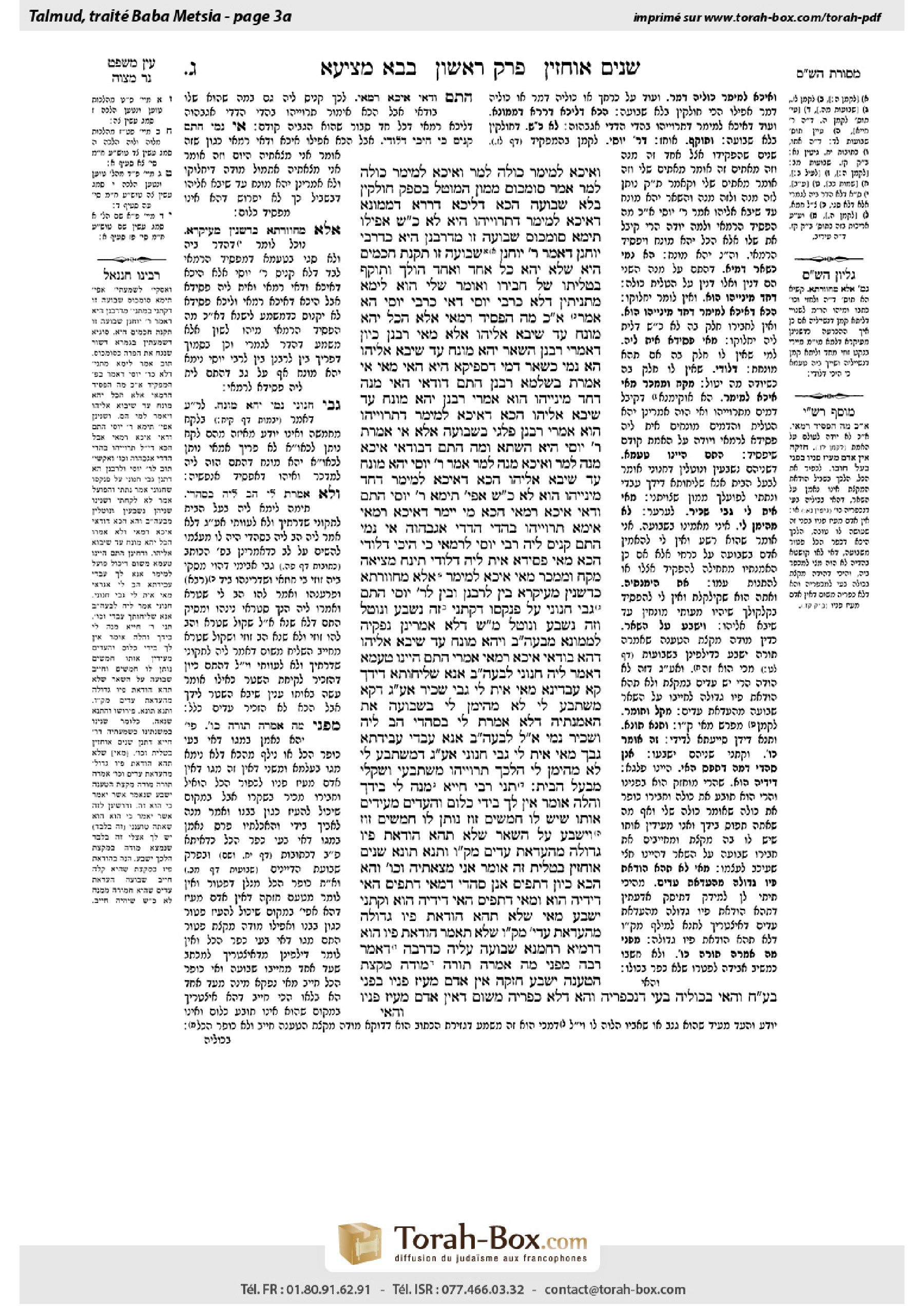
Bava Metzia 3a: Talmud study for Daf Yomi
Study the Talmud for Daf Yomi with scanned pages, Hebrew text, English translations from Sefaria and AI-generated French translations.
Passage selection and English or AI-generated French translation are available where the scan has annotations. Daf Study is independent of Torah-Box and Sefaria.
Browse Bava Metzia · בבא מציעא · All tractatesBava Metzia 3a text and translations
This page of Bava Metzia includes the Aramaic text, an English translation and an AI-generated French translation, alongside the scan above.
בבא מציעא ג׳ א · Aramaic and Hebrew text
וְאִיכָּא לְמֵימַר כּוּלָּהּ לְמָר, וְאִיכָּא לְמֵימַר כּוּלָּהּ לְמָר, אָמַר סוֹמְכוֹס: מָמוֹן הַמּוּטָּל בְּסָפֵק חוֹלְקִין בְּלֹא שְׁבוּעָה, הָכָא, דְּלֵיכָּא דְּרָרָא דְמָמוֹנָא, דְּאִיכָּא לְמֵימַר דְּתַרְוַיְיהוּ הִיא, לֹא כׇּל שֶׁכֵּן!
אֲפִילּוּ תֵּימָא סוֹמְכוֹס, שְׁבוּעָה זוֹ מִדְּרַבָּנַן הִיא כִּדְרַבִּי יוֹחָנָן. דְּאָמַר רַבִּי יוֹחָנָן: שְׁבוּעָה זוֹ תַּקָּנַת חֲכָמִים הִיא, שֶׁלֹּא יְהֵא כׇּל אֶחָד וְאֶחָד הוֹלֵךְ וְתוֹקֵף בְּטַלִּיתוֹ שֶׁל חֲבֵירוֹ וְאוֹמֵר: שֶׁלִּי הוּא.
לֵימָא מַתְנִיתִין דְּלָא כְּרַבִּי יוֹסֵי, דְּאִי כְּרַבִּי יוֹסֵי – הָא אָמַר: אִם כֵּן מָה הִפְסִיד רַמַּאי? אֶלָּא הַכֹּל יְהֵא מוּנָּח עַד שֶׁיָּבֹא אֵלִיָּהוּ.
אֶלָּא מַאי רַבָּנַן – כֵּיוָן דְּאָמְרִי רַבָּנַן: ״הַשְּׁאָר יְהֵא מוּנָּח עַד שֶׁיָּבֹא אֵלִיָּהוּ״, הָא נָמֵי כִּשְׁאָר דָּמֵי, דִּסְפֵיקָא הִיא!
הַאי מַאי? אִי אָמְרַתְּ בִּשְׁלָמָא רַבָּנַן, הָתָם דְּוַדַּאי הַאי מָנֶה דְּחַד מִינַּיְיהוּ הוּא אָמְרִי רַבָּנַן: יְהֵא מוּנָּח עַד שֶׁיָּבֹא אֵלִיָּהוּ. הָכָא דְּאִיכָּא לְמֵימַר דְּתַרְוַיְיהוּ הוּא, אָמְרִי רַבָּנַן: פָּלְגִי בִּשְׁבוּעָה.
אֶלָּא אִי אָמְרַתְּ רַבִּי יוֹסֵי הִיא, הַשְׁתָּא וּמָה הָתָם דִּבְוַדַּאי אִיכָּא מָנֶה לְמָר וְאִיכָּא מָנֶה לְמָר, אֲמַר רַבִּי יוֹסֵי יְהֵא מוּנָּח עַד שֶׁיָּבֹא אֵלִיָּהוּ, הָכָא דְּאִיכָּא לְמֵימַר דְּחַד מִינַּיְיהוּ הוּא – לֹא כׇּל שֶׁכֵּן!
אֲפִילּוּ תֵּימָא רַבִּי יוֹסֵי, הָתָם – וַדַּאי אִיכָּא רַמַּאי, הָכָא מִי יֵימַר דְּאִיכָּא רַמַּאי? אֵימָא תַּרְוַיְיהוּ בַּהֲדֵי הֲדָדֵי אַגְבְּהוּהָ.
אִי נָמֵי: הָתָם קָנֵיס לֵיהּ רַבִּי יוֹסֵי לְרַמַּאי כִּי הֵיכִי דְּלוֹדֵי, הָכָא מַאי פְּסֵידָא אִית לֵיהּ דְּלוֹדֵי.
תִּינַח מְצִיאָה, מִקָּח וּמִמְכָּר מַאי אִיכָּא לְמֵימַר? אֶלָּא מְחַוַּורְתָּא כִּדְשַׁנִּין מֵעִיקָּרָא.
בֵּין לְרַבָּנַן וּבֵין לְרַבִּי יוֹסֵי, הָתָם גַּבֵּי חֶנְוָנִי עַל פִּנְקָסוֹ דְּקָתָנֵי: זֶה נִשְׁבָּע וְנוֹטֵל, וְזֶה נִשְׁבָּע וְנוֹטֵל.
מַאי שְׁנָא דְּלָא אָמְרִינַן נַפְּקֵיהּ לְמָמוֹנָא מִבַּעַל הַבַּיִת, וִיהֵא מוּנָּח עַד שֶׁיָּבֹא אֵלִיָּהוּ, דְּהָא בְּוַדַּאי אִיכָּא רַמַּאי!
אָמְרִי הָתָם, הַיְינוּ טַעְמָא דְּאָמַר לֵיהּ חֶנְוָנִי לְבַעַל הַבַּיִת: אֲנָא שְׁלִיחוּתָא דִידָךְ קָא עָבְדִינָא, מַאי אִית לִי גַּבֵּי שָׂכִיר, אַף עַל גַּב דְּקָא מִשְׁתְּבַע לִי, לָא מְהֵימַן לִי בִּשְׁבוּעָה, אַתְּ הֶאֱמַנְתֵּיהּ, דְּלָא אֲמַרְתְּ לִי בְּסָהֲדֵי הַב לֵיהּ.
וְשָׂכִיר נָמֵי אָמַר לֵיהּ לְבַעַל הַבַּיִת: אֲנָא עֲבַדִי עֲבִידְתָּא גַּבָּךְ, מַאי אִית לִי גַּבֵּי חֶנְוָנִי, אַף עַל גַּב דְּמִשְׁתְּבַע לִי לָא מְהֵימָן לִי. הִלְכָּךְ, תַּרְוַיְיהוּ מִשְׁתַּבְעִי וְשָׁקְלִי מִבַּעַל הַבַּיִת.
תָּנֵי רַבִּי חִיָּיא: מָנֶה לִי בְּיָדְךָ, וְהַלָּה אוֹמֵר: אֵין לְךָ בְּיָדִי כְּלוּם, וְהָעֵדִים מְעִידִים אוֹתוֹ שֶׁיֵּשׁ לוֹ חֲמִשִּׁים זוּז – נוֹתֵן לוֹ חֲמִשִּׁים זוּז, וְיִשָּׁבַע עַל הַשְּׁאָר.
שֶׁלֹּא תְּהֵא הוֹדָאַת פִּיו גְּדוֹלָה מֵהַעֲדָאַת עֵדִים, מִקַּל וָחוֹמֶר.
וְתַנָּא תּוּנָא: שְׁנַיִם אוֹחֲזִין בְּטַלִּית זֶה אוֹמֵר אֲנִי מְצָאתִיהָ וְכוּ׳. וְהָא הָכָא כֵּיוָן דְּתָפֵיס, אֲנַן סָהֲדִי דְּמַאי דְּתָפֵיס הַאי דִּידֵיהּ הוּא, וּמַאי דְּתָפֵיס הַאי דִּידֵיהּ הוּא, וְקָתָנֵי: יִשָּׁבַע!
מַאי ״שֶׁלֹּא תְּהֵא הוֹדָאַת פִּיו גְּדוֹלָה מֵהַעֲדָאַת עֵדִים מִקַּל וָחוֹמֶר״? שֶׁלֹּא תֹּאמַר הוֹדָאַת פִּיו הוּא דְּרַמְיָא רַחֲמָנָא שְׁבוּעָה עֲלֵיהּ כִּדְרַבָּה.
דְּאָמַר רַבָּה: מִפְּנֵי מָה אָמְרָה תּוֹרָה מוֹדֶה מִקְצָת הַטַּעֲנָה יִשָּׁבַע? חֲזָקָה אֵין אָדָם מֵעִיז פָּנָיו בִּפְנֵי בַּעַל חוֹבוֹ, וְהַאי בְּכוּלֵּיהּ בָּעֵי דְּנִכְפְּרֵיהּ, וְהָא דְּלָא כַּפְרֵיהּ – מִשּׁוּם דְּאֵין אָדָם מֵעִיז פָּנָיו
Bava Metzia 3a · English translation
and there is room to say that it belongs entirely to one of them, and there is also room to say that it belongs entirely to the other one, and nevertheless Sumakhos says that since it is property of uncertain ownership they divide it without taking an oath, then here, where the litigants have no financial association with the item, as there is room to say that it belongs to both of them, all the more so is it not clear that they should divide it without taking an oath?
The Gemara answers: You may even say that the mishna is in accordance with the opinion of Sumakhos: This oath is instituted by rabbinic law in accordance with the statement of Rabbi Yoḥanan. As Rabbi Yoḥanan says: This oath, administered in the case of two people holding a garment, is an ordinance instituted by the Sages so that everyone will not go and seize the garment of another and say: It is mine.
§ The Gemara suggests: Let us say that the mishna is not in accordance with the opinion of Rabbi Yosei. As, if you say that the ruling is in accordance with the opinion of Rabbi Yosei, doesn’t he say that a case cannot be decided in a manner in which there is no deterrent for one taking a false claim to court (37a)? He says this with regard to a case where two people deposited money with the same person. One deposited one hundred dinars and one deposited two hundred, and the bailee forgot which of them deposited the larger sum. Subsequently, each claimed ownership of the larger sum and was prepared to take an oath to that effect. The Rabbis say that each should receive the smaller sum and the remainder should be held until Elijah the prophet prophetically resolves the uncertainty. Rabbi Yosei says: If so, what did the swindler lose? Rather, the entire deposit will be placed in a safe place until Elijah comes.
The Gemara counters: Rather, what is suggested? Is it suggested that the mishna is in accordance with the opinion of the Rabbis, who disagree with Rabbi Yosei? Since the Rabbis say there: The remainder is placed in a safe place until Elijah comes, this case of the mishna concerning the garment is also comparable to the remainder in the case of the deposit, as it is uncertain to whom the entire garment belongs. It should therefore be placed in a safe place until the matter is resolved.
The Gemara answers: What is this comparison? Granted, if you say that the mishna is in accordance with the opinion of the Rabbis there, in the case of the depositors, where these one hundred dinars certainly belong to only one of them and the Rabbis say that it is placed in a safe place until Elijah comes, here, in the case of this mishna, where there is room to say that it belongs to both of them, the Rabbis say that they divide it with the proviso that they take an oath.
But if you say that the mishna is in accordance with the opinion of Rabbi Yosei, there is a difficulty. Now consider, if there, in a case where it is certain that there are one hundred dinars that belong to one of the litigants and there are one hundred dinars that belong to the other one, nevertheless, Rabbi Yosei says that the entire sum is placed in a safe place until Elijah comes, here, where there is room to say that it all belongs to only one of them, all the more so is it not clear that it should be placed in a safe place until Elijah comes, as one of the claims may be entirely fraudulent?
The Gemara rejects this suggestion: You may even say that the mishna is in accordance with the opinion of Rabbi Yosei: There, in the case of the deposit, there is certainly a swindler between the two depositors. By contrast, here, in the case of the mishna, who is to say that there is a swindler? Say that both of them lifted the garment at the same time, and therefore there is no reason to penalize them by placing the garment in a safe place.
Alternatively, there is room to distinguish between the cases: There, Rabbi Yosei penalizes the swindler by confiscating his deposit so that he will admit that he lied in order to receive his original deposit of one hundred dinars from the bailee. Here, in the case of the garment, what loss would a swindler incur that would prompt him to admit that he is lying? If the item is placed in a safe place, he loses nothing.
The Gemara rejects this alternative explanation: This distinction works out well in the case of a found item where he did not pay anything for it. Consequently, he has no incentive to admit that he lied. But in a case of buying and selling, what is there to say? Both parties paid for the item and prefer to receive the item. Rather, the distinction is clearly as we explained initially. The difference between the cases is that in the mishna, there is no certainty that one of them is lying.
The Gemara asks: Both according to the opinion of the Rabbis and according to the opinion of Rabbi Yosei, there, with regard to the case of a storekeeper relying on his ledger, it is unclear why the money is not held until the matter is clarified. This is referring to a case where an employer tells a storekeeper to give food to his laborer in lieu of his salary, and later the storekeeper claims that he gave it to him but the laborer claims that he did not receive it. Both parties therefore claim payment from the employer. As the mishna (Shevuot 45a) teaches that this one, the storekeeper, takes an oath that he gave the food to the laborer and receives payment from the employer, and that one, the laborer, takes an oath that he was not given the food and takes his salary from the employer.
What is different in that case, that we do not say: Appropriate the money from the employer, and it is placed in a safe place until Elijah comes? Apparently, we should say this because there is certainly a swindler among the litigants, since it is impossible that both the storekeeper and the laborer are telling the truth.
The Sages say in response: There, this is the reason that the money is not set aside: Because the storekeeper can say to the employer: I carried out your agency to give the food to the laborer, and I have dealings only with you. What business do I have with the hired laborer? Even if he takes an oath to me that he did not receive the food, he is not trustworthy to me by virtue of his oath. You are the one who trusted him, as you did not say to me: Give him the food in the presence of witnesses. Therefore, you are obligated to pay me. If you have a grievance, settle it with your employee.
And the hired laborer can also say to the employer: I worked for you. What relationship do I have with the storekeeper? Even if he takes an oath to me that he gave me the change, he is not trustworthy to me by virtue of his oath. Therefore, both parties take an oath and take payment from the employer.
§ Rabbi Ḥiyya taught a baraita: If one says to another: I have one hundred dinars [maneh] in your possession that you borrowed from me and did not repay, and the other party says: Nothing of yours is in my possession, and the witnesses testify that he has fifty dinars that he owes the claimant, he gives him fifty dinars and takes an oath about the remainder, i.e., that he did not borrow the fifty remaining dinars from him.
This ruling is derived via an a fortiori inference from the halakha that one who admits to part of a claim that is brought against him is obligated to take an oath that he owes no more than the amount that he admits to have borrowed. The inference is: As the admission of one’s own mouth should not carry greater weight than the testimony of witnesses. Since in this case witnesses testify that he owes an amount equal to part of the claim, he is all the more so obligated to take an oath with regard to the rest of the sum.
The Gemara comments: And the tanna of the mishna also taught a similar halakha: In a case of two people who came to court holding a garment, where this one says: I found it, and the other one says: I found it, each litigant takes an oath and they divide the garment. And here, in the case of a found item, since each litigant is holding part of the garment, it is clear to us that what is in this one’s grasp is his, and what is in that one’s grasp is his. This is tantamount to witnesses testifying that part of the claim of each litigant is legitimate. And the mishna teaches that each of them takes an oath.
The Gemara clarifies: For what reason is it necessary to have the a fortiori inference: As the admission of one’s own mouth should not carry greater weight than the testimony of witnesses? Isn’t the comparison to the case of an admission to part of a claim self-evident? The Gemara answers: It is necessary so that you will not say that it is only in a case of the admission of one’s own mouth that the Merciful One imposes an oath upon him, in accordance with the explanation of Rabba.
As Rabba says: For what reason did the Torah say that one who admits to part of the claim must take an oath? It is because there is a presumption that a person does not exhibit insolence by lying in the presence of his creditor, who had done him a favor by lending money to him. And this person who denies part of the claim actually wants to deny all of the debt, so as to be exempt, and this fact that he does not deny all of it is because a person does not exhibit insolence.
Bava Metzia 3a · Traduction française (IA)
et il y a place pour dire qu'il appartient entièrement à l'un d'eux, et il y a aussi place pour dire qu'il appartient entièrement à l'autre, et pourtant Sumakhos dit que puisque c'est une propriété de propriété incertaine, ils la divisent sans prendre d'œuvres, alors ici, où les parties n'ont pas de lien financier avec l'objet, comme il y a place pour dire qu'il appartient aux deux, encore davantage n'est-il pas clair qu'ils devraient le diviser sans prendre d'œuvres ?
Le Guemara répond : On peut même dire que la mitsva est selon l'opinion de Sumakhos : cet serment est institué par la loi rabbinique selon la déclaration de Rabbi Yoḥanan. Comme Rabbi Yoḥanan dit : Ce serment, administré dans le cas de deux personnes tenant une robe, est un ordonnance instituée par les Sages afin que personne ne va pas aller saisir la robe d'un autre et dire : C'est à moi.
§ Le Guemara suggère : Disons que la mitsva n'est pas selon l'opinion de Rabbi Yosei. Comme, si vous dites que la décision est selon l'opinion de Rabbi Yosei, n'est-ce pas que il dit qu'un cas ne peut être décidé d'une manière où il n'y a pas de dissuasion pour que l'un prétende à tort devant le tribunal (37a) ? Il dit cela concernant un cas où deux personnes ont déposé de l'argent avec la même personne. L'une a déposé cent dinars et l'autre deux cents, et le dépositaire a oublié laquelle des deux avait déposé la somme plus grande. Par la suite, chacun a revendiqué la possession de la somme plus grande et était prêt à prendre un serment à cet effet. Les Rabbins disent que chacun devrait recevoir la somme plus petite et le reste devrait être conservé jusqu'à ce que l'ange Eliézer résolve l'incertitude. Rabbi Yosei dit : Si c'est ainsi, que le voleur a-t-il perdu ? Plutôt, toute la dépôt devrait être placé en lieu sûr jusqu'à ce que Eliézer vienne.
Le Guemara réfute : Plutôt, de quoi s'agit-il ? Est-ce que cela suggère que la mitsva est selon l'opinion des Rabbins, qui s'opposent à Rabbi Yosei ? Puisque les Rabbins disent là : Le reste est placé en lieu sûr jusqu'à ce que le Messie vienne, ce cas de la mitsva concernant la robe est également comparable au reste dans le cas du dépôt, puisqu'il est incertain à qui appartient toute la robe. Il devrait donc être placé en lieu sûr jusqu'à ce que la question soit résolue.
Le Guemara répond : De quelle comparaison s'agit-il ? Bien sûr, si vous dites que la mitsva est selon l'opinion des Rabbins là, dans le cas des dépositaires, où ces cent dinars appartiennent certainement à l'un d'eux et les Rabbins disent qu'il est placé en lieu sûr jusqu'à ce que le Messie vienne, ici, dans le cas de cette mitsva, où il y a place pour dire qu'il appartient aux deux, les Rabbins disent qu'ils le divisent avec la condition qu'ils prennent un serment.
Mais si vous dites que la mitsva est selon l'opinion de Rabbi Yosei, il y a un problème. Maintenant considérez, si là, dans un cas où il est certain qu'il y a cent dinars qui appartiennent à l'un des litigants et cent dinars qui appartiennent à l'autre, néanmoins, Rabbi Yosei dit que toute la somme est placée en lieu sûr jusqu'à ce que le Messie vienne, ici, où il y a place pour dire qu'il appartient uniquement à l'un d'eux, encore davantage n'est-il pas clair qu'il devrait être placé en lieu sûr jusqu'à ce que le Messie vienne, puisqu'une des revendications pourrait être entièrement frauduleuse ?
Le Guemara rejette cette suggestion : On peut même dire que la mitsna suit l'opinion de Rabbi Yosei : Là, dans le cas des dépositaires, il y a certainement un voleur entre les deux dépositaires. À l'inverse, ici, dans le cas de la mitsna, qui est-ce qui dit qu'il y a un voleur ? Dites qu'ils ont tous deux levé la robe en même temps, et donc il n'y a pas de raison de les pénaliser en plaçant la robe en lieu sûr.
Une autre alternative, il y a place pour distinguer entre les cas : Là, Rabbi Yosei pénalise le voleur en confisquant son dépôt afin qu'il admette qu'il a menti afin de recevoir son dépôt initial de cent dinars du dépositaire. Ici, dans le cas de la robe, qu'est-ce que le voleur perd qui le pousserait à admettre qu'il ment ? Si l'objet est placé en lieu sûr, il ne perd rien.
Le Guemara rejette cette autre explication : Cette distinction fonctionne bien dans le cas d'un objet trouvé où il n'a pas payé pour cela. Par conséquent, il n'a pas d'incentif à admettre qu'il ment. Mais dans un cas d'achat et de vente, qu'est-ce qu'on peut dire ? Les deux parties ont payé pour l'objet et préfèrent recevoir l'objet. Plutôt, la distinction est clairement comme nous l'avons expliqué initialement. La différence entre les cas est que dans la mitsna, il n'y a pas de certitude que l'un d'eux ment.
Le Guemara pose la question : Selon l'opinion des Rabbins et selon celle de Rabbi Yosei, dans le cas du dépositaire qui se base sur son livre de comptes, pourquoi la somme n'est-elle pas conservée jusqu'à ce que la question soit clarifiée ? Cela fait référence à un cas où un employeur dit à un dépositaire de donner de la nourriture à son ouvrier à la place de son salaire, et plus tard le dépositaire affirme avoir donné la nourriture à l'ouvrier mais l'ouvrier affirme n'avoir pas reçu la nourriture. Les deux parties revendiquent donc le paiement de l'employeur. Comme la mitsva (Shevuot 45a) enseigne que celui-ci, le dépositaire, prend un serment qu'il a donné la nourriture à l'ouvrier et reçoit le paiement de l'employeur, et celui-ci, l'ouvrier, prend un serment qu'il n'a pas reçu la nourriture et reçoit son salaire de l'employeur.
Qu'est-ce qui diffère dans ce cas, que nous ne disons pas : Approprier l'argent de l'employeur et le placer en lieu sûr jusqu'à ce que Elijah vienne ? Apparemment, nous devons dire cela parce qu'il y a certainement un voleur parmi les litigants, puisque c'est impossible que les deux, le dépositaire et l'ouvrier, disent la vérité.
Les Sages disent en réponse : Là, c'est la raison pour laquelle l'argent n'est pas mis de côté : parce que le commis peut dire à l'employeur : J'ai exécuté votre mandat pour donner la nourriture au travailleur, et je n'ai affaire qu'à vous. Quel intérêt ai-je avec le travailleur engagé ? Même s'il jure devant moi qu'il n'a pas reçu la nourriture, il ne me paraît pas digne de confiance à cause de son serment. Vous êtes celui qui l'avait confiance, car vous n'avez pas dit à moi : Donnez-lui la nourriture en présence de témoins. Ainsi, vous êtes tenu de me payer. Si vous avez un grief, résolvez-le avec votre employé.
Et le travailleur engagé peut aussi dire à l'employeur : J'ai travaillé pour vous. Quel lien ai-je avec le commis ? Même s'il jure devant moi qu'il m'a donné le reste, il ne me paraît pas digne de confiance à cause de son serment. Ainsi, les deux parties prennent un serment et reçoivent le paiement de l'employeur.
§ Rabbi Ḥiyya enseignait une baraïta : Si l'un dit à l'autre : J'ai un hundred dinars [maneh] chez toi que tu as emprunté de moi et que tu n'as pas remboursé, et l'autre dit : Rien de tien n'est chez moi, et les témoins témoignent qu'il a cinquante dinars qu'il doit au prétendant, il lui donne cinquante dinars et prend un serment concernant le reste, c'est-à-dire qu'il n'a pas emprunté les cinquante dinars restants à lui.
Cette décision est dérivée par une inférence a fortiori à partir de la halakha selon laquelle celui qui admet une partie d'une réclamation portée contre lui est tenu de prendre un serment qu'il ne doit pas plus que l'amount qu'il admet avoir emprunté. L'inférence est : Comme l'admission de sa propre bouche ne doit pas avoir plus de poids que le témoignage des témoins. Puisque dans ce cas les témoins témoignent qu'il doit une somme égale à une partie de la réclamation, il est d'autant plus tenu de prendre un serment concernant le reste de la somme.
Le Guemara commente : Et le tanna de la mishna a également enseigné une halakha similaire : Dans un cas de deux personnes qui sont venues devant le tribunal avec une robe, où l'un dit : Je l'ai trouvée, et l'autre dit : Je l'ai trouvée, chaque partie prenante prend un serment et ils divisent la robe. Et ici, dans le cas d'un objet trouvé, puisque chaque partie prenante tient une partie de la robe, il est clair pour nous que ce qui est dans la main de l'un est sien, et ce qui est dans la main de l'autre est sien. Cela équivaut à ce que les témoins témoignent que la part de la réclamation de chaque partie prenante est légitime. Et la mishna enseigne que chacun d'eux prend un serment.
Le Guemara clarifie : Pour quelle raison est-il nécessaire d'avoir cette inférence a fortiori : Comme l'admission de sa propre bouche ne doit pas avoir plus de poids que le témoignage des témoins ? N'est-ce pas la comparaison au cas d'une admission à une partie d'une réclamation évidente ? Le Guemara répond : Il est nécessaire afin que vous ne disiez pas que c'est seulement dans le cas d'une admission de sa propre bouche que l'Éternel impose un serment à l'individu, conformément à l'explication de Rabba.
Comme Rabba le dit : Pour quelle raison la Torah indique-t-elle que celui qui admet une partie de la réclamation doit prendre un serment ? C'est parce qu'il y a une présomption selon laquelle une personne ne montre pas d'arrogance en mentant en présence de son créancier, qui lui a fait un bien en lui prêtant de l'argent. Et cette personne qui nie une partie de la réclamation veut en réalité nier toute la dette afin d'être exempt, et ce fait qu'il ne nie pas toute la dette est dû au fait qu'une personne ne montre pas d'arrogance.
Traduction française générée par IA à partir de l’édition anglaise de Sefaria. Vérifie toujours un passage avec le texte source.
Text from Sefaria: William Davidson Edition - Vocalized Aramaic (CC BY NC); William Davidson Edition - English (CC BY NC).