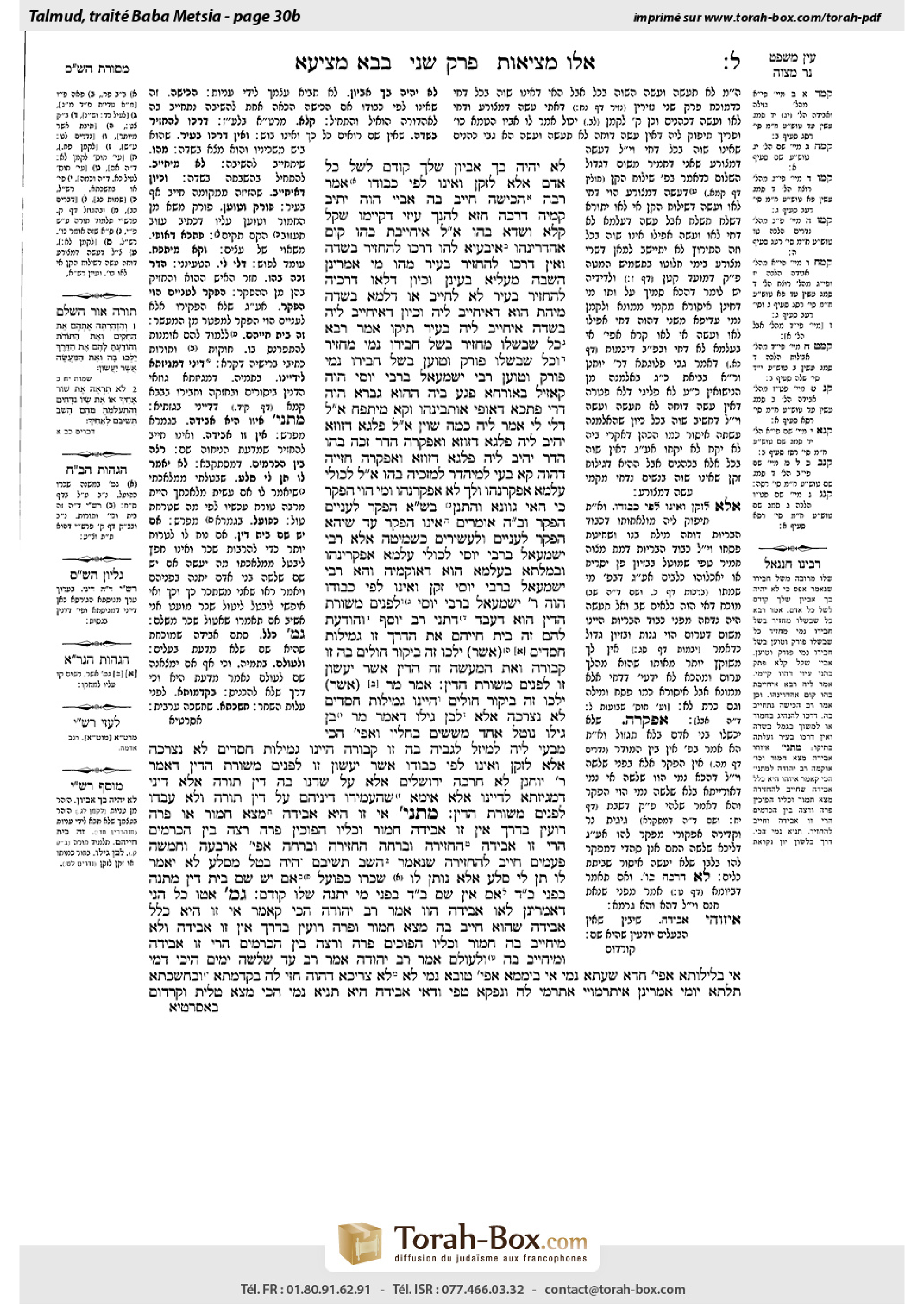
Bava Metzia 30b: Talmud study for Daf Yomi
Study the Talmud for Daf Yomi with scanned pages, Hebrew text, English translations from Sefaria and AI-generated French translations.
Passage selection and English or AI-generated French translation are available where the scan has annotations. Daf Study is independent of Torah-Box and Sefaria.
Browse Bava Metzia · בבא מציעא · All tractatesBava Metzia 30b text and translations
This page of Bava Metzia includes the Aramaic text, an English translation and an AI-generated French translation, alongside the scan above.
בבא מציעא ל׳ ב · Aramaic and Hebrew text
לֹא יִהְיֶה בְּךָ אֶבְיוֹן״ – שֶׁלְּךָ קוֹדֵם לְשֶׁל כׇּל אָדָם,
אֶלָּא לְזָקֵן וְאֵינָהּ לְפִי כְּבוֹדוֹ.
אָמַר רַבָּה: הִכִּישָׁהּ – חַיָּיב בָּהּ. אַבָּיֵי הֲוָה יָתֵיב קַמֵּיהּ דְּרַבָּה, חֲזָא לְהָנָךְ עִיזֵּי דְּקָיְימוּ, שְׁקַל קָלָא וּשְׁדָא בְּהוּ. אֲמַר לֵיהּ: אִיחַיַּיבְתְּ בְּהוּ, קוּם אַהְדְּרִינְהוּ.
אִיבַּעְיָא לְהוּ: דַּרְכּוֹ לְהַחְזִיר בַּשָּׂדֶה, וְאֵין דַּרְכּוֹ לְהַחְזִיר בָּעִיר, מַהוּ? מִי אָמְרִינַן הֲשָׁבָה מְעַלְּיָא בָּעֵינַן, וְכֵיוָן דְּלָאו דַּרְכֵּיהּ לְהַחְזִיר בָּעִיר – לָא לִחַיַּיב? אוֹ דִלְמָא בַּשָּׂדֶה מִיהַת הוּא דְּאִיחַיַּיב לֵיהּ, וְכֵיוָן דְּאִיחַיַּיב עֲלֵיהּ בַּשָּׂדֶה – אִיחַיַּיב לֵיהּ בָּעִיר? תֵּיקוּ.
אָמַר רָבָא: כֹּל שֶׁבְּשֶׁלּוֹ מַחְזִיר, בְּשֶׁל חֲבֵירוֹ נָמֵי מַחְזִיר. וְכֹל שֶׁבְּשֶׁלּוֹ פּוֹרֵק וְטוֹעֵן, בְּשֶׁל חֲבֵירוֹ נָמֵי פּוֹרֵק וְטוֹעֵן.
רַבִּי יִשְׁמָעֵאל בְּרַבִּי יוֹסֵי הֲוָה קָאָזֵיל בְּאוֹרְחָא, פְּגַע בֵּיהּ הָהוּא גַּבְרָא, הֲוָה דָּרֵי פִּתְכָּא דְאוֹפֵי, אוֹתְבִינְהוּ וְקָא מִיתְּפַח, אֲמַר לֵיהּ: דְּלִי לִי, אֲמַר לֵיהּ: כַּמָּה שָׁוִין? אֲמַר לֵיהּ: פַּלְגָא דְזוּזָא, יְהַיב לֵיהּ פַּלְגָא דְזוּזָא וְאַפְקְרֵהּ.
הֲדַר זְכָה בְּהוּ, הֲדַר יְהַיב לֵיהּ פַּלְגָא דְזוּזָא וְאַפְקְרֵהּ. חַזְיֵיהּ דַּהֲוָה קָא בָּעֵי לְמֶיהְדַּר לְמִזְכֵּיה בְּהוּ, אֲמַר לֵיהּ: לְכוּלֵּי עָלְמָא אַפְקַרְ[תִּי]נְהוּ וְלָךְ לָא אַפְקַרְ[תִּי]נְהוּ.
וּמִי הָוֵי הֶפְקֵר כִּי הַאי גַוְונָא? וְהָתְנַן, בֵּית שַׁמַּאי אוֹמְרִים: הֶפְקֵר לַעֲנִיִּים – הֶפְקֵר. וּבֵית הִלֵּל אוֹמְרִים: אֵינוֹ הֶפְקֵר עַד שֶׁיְּהֵא הֶפְקֵר לַעֲנִיִּים וְלַעֲשִׁירִים, כִּשְׁמִיטָּה.
אֶלָּא רַבִּי יִשְׁמָעֵאל בְּרַבִּי יוֹסֵי לְכוּלֵּי עָלְמָא אַפְקְרִינְהוּ, וּבְמִלְּתָא בְּעָלְמָא הוּא דְּאוֹקְמֵיהּ.
וְהָא רַבִּי יִשְׁמָעֵאל בְּרַבִּי יוֹסֵי זָקֵן וְאֵינָהּ לְפִי כְבוֹדוֹ הֲוָה! רַבִּי יִשְׁמָעֵאל בְּרַבִּי יוֹסֵי לִפְנִים מִשּׁוּרַת הַדִּין הוּא דַּעֲבַד.
דְּתָנֵי רַב יוֹסֵף: ״וְהוֹדַעְתָּ לָהֶם״ – זֶה בֵּית חַיֵּיהֶם, ״אֶת הַדֶּרֶךְ״ – זוֹ גְּמִילוּת חֲסָדִים, ״אֲשֶׁר יֵלְכוּ״ – זֶה בִּיקּוּר חוֹלִים, ״בָּהּ״ – זוֹ קְבוּרָה, ״וְאֶת הַמַּעֲשֶׂה״ – זֶה הַדִּין, ״אֲשֶׁר יַעֲשׂוּן״ – זוֹ לִפְנִים מִשּׁוּרַת הַדִּין.
אָמַר מָר: ״אֲשֶׁר יֵלְכוּ״ – זֶה בִּיקּוּר חוֹלִים, הַיְינוּ גְּמִילוּת חֲסָדִים! לֹא נִצְרְכָה אֶלָּא לְבֶן גִּילוֹ, דְּאָמַר מָר: בֶּן גִּילוֹ נוֹטֵל אֶחָד מִשִּׁשִּׁים בְּחׇלְיוֹ, וַאֲפִילּוּ הָכִי מִבְּעֵי לֵיהּ לְמֵיזַל לְגַבֵּיהּ.
״בָּהּ״ – זוֹ קְבוּרָה. הַיְינוּ גְּמִילוּת חֲסָדִים! לֹא נִצְרְכָה אֶלָּא לְזָקֵן וְאֵינָהּ לְפִי כְּבוֹדוֹ.
אֲשֶׁר יַעֲשׂוּן זוֹ לִפְנִים מִשּׁוּרַת הַדִּין. דְּאָמַר רַבִּי יוֹחָנָן: לֹא חָרְבָה יְרוּשָׁלַיִם אֶלָּא עַל שֶׁדָּנוּ בָּהּ דִּין תּוֹרָה. אֶלָּא דִּינֵי דְּמָגִיזְתָּא לְדַיְּינוּ?! אֶלָּא אֵימָא: שֶׁהֶעֱמִידוּ דִּינֵיהֶם עַל דִּין תּוֹרָה וְלָא עֲבַדוּ לִפְנִים מִשּׁוּרַת הַדִּין.
מַתְנִי׳ אֵי זוֹ הִיא אֲבֵידָה? מָצָא חֲמוֹר אוֹ פָּרָה רוֹעִין בַּדֶּרֶךְ – אֵין זוֹ אֲבֵידָה. חֲמוֹר וְכֵלָיו הֲפוּכִין, פָּרָה רָצָה בֵּין הַכְּרָמִים – הֲרֵי זוֹ אֲבֵידָה. הֶחְזִירָהּ וּבָרְחָה, הֶחְזִירָהּ וּבָרְחָה, אֲפִילּוּ אַרְבָּעָה וַחֲמִישָׁה פְּעָמִים – חַיָּיב לְהַחְזִירָהּ, שֶׁנֶּאֱמַר: ״הָשֵׁב תְּשִׁיבֵם״.
הָיָה בָּטֵל מִסֶּלַע, לֹא יֹאמַר לוֹ: תֵּן לִי סֶלַע, אֶלָּא נוֹתֵן לוֹ שְׂכָרוֹ כְּפוֹעֵל. אִם יֵשׁ שָׁם בֵּית דִּין – מַתְנֶה בִּפְנֵי בֵּית דִּין, אִם אֵין שָׁם בֵּית דִּין – בִּפְנֵי מִי יַתְנֶה? שֶׁלּוֹ קוֹדֵם.
גְּמָ׳ אַטּוּ כֹּל הָנֵי דְּאָמְרִינַן, לָאו אֲבֵידָה הָווּ? אָמַר רַב יְהוּדָה: הָכִי קָאָמַר, אֵי זוֹ הִיא כְּלַל אֲבֵידָה שֶׁהוּא חַיָּיב בָּהּ? מָצָא חֲמוֹר וּפָרָה רוֹעִין בַּדֶּרֶךְ – אֵין זוֹ אֲבֵידָה וְלָא מִיחַיַּיב בַּהּ. חֲמוֹר וְכֵלָיו הֲפוּכִים, פָּרָה וְרָצָה בֵּין הַכְּרָמִים – הֲרֵי זוֹ אֲבֵידָה וּמִיחַיַּיב בַּהּ.
וּלְעוֹלָם?! אָמַר רַב יְהוּדָה אָמַר רַב: עַד שְׁלֹשָׁה יָמִים. הֵיכִי דָמֵי? אִי בְּלֵילָוָתָא – אֲפִילּוּ חֲדָא שַׁעְתָּא נָמֵי, אִי בִּימָמָא – אֲפִילּוּ טוּבָא נָמֵי לָא!
לָא צְרִיכָא, דַּהֲוָה חָזֵי לַהּ בְּקַדְמְתָא וּבַחֲשֶׁכְתָּא, תְּלָתָא יוֹמֵי אָמְרִינַן: אִיתְרְמוֹיֵי אִתְרְמִי לַהּ וְנָפְקָא, טְפֵי וַדַּאי אֲבֵידָה הִיא.
תַּנְיָא נָמֵי הָכִי: מָצָא טַלִּית וְקַרְדּוֹם
Bava Metzia 30b · English translation
there shall be no needy among you” (Deuteronomy 15:4). This verse can be understood as a command, indicating that it is incumbent upon each individual to ensure that he will not become needy. Therefore, your assets take precedence over the assets of any other person.
The Gemara concludes: Rather, the verse is necessary to derive the exemption from returning the lost item in the case where he was an elderly person and it is not in keeping with his dignity to tend to the item.
Rabba says: If there was a lost animal and the elderly person began the process of returning it, e.g., if he struck it even once to guide it in a certain direction, he is obligated to tend to it and return it. The Gemara relates: Abaye was sitting before Rabba and saw these goats standing nearby. He picked up a clod of dirt and threw it at them, causing them to move. Rabba said to him: You have thereby obligated yourself to return them. Arise and return them to their owner.
A dilemma was raised before the Sages: In a case of a person for whom it is his typical manner to return an item of that type in the field, where there are fewer onlookers, but it is not his typical manner to return an item of that type in the city, what is the halakha? Do we say that for one to be obligated to return a lost item we need an unequivocal obligation to return it that applies in all cases, and since it is not his typical manner to return an item of that sort in the city, let him not be obligated to return such an item at all? Or perhaps, he is obligated in any event to return the item in the field, and once he is obligated to return it in the field, he is also obligated in the city. The Gemara concludes: The dilemma shall stand unresolved.
Rava says: In any case where he would recover his own item and would consider it to be in keeping with his dignity, he is also obligated to return another’s item. And any case where he unloads and loads his own animal’s burden, he is also obligated to unload and load the burden of another’s animal.
The Gemara relates: Rabbi Yishmael, son of Rabbi Yosei, was walking on the road. A certain man encountered him, and that man was carrying a burden that consisted of sticks of wood. He set down the wood and was resting. The man said to him: Lift them for me and place them upon me. Since it was not in keeping with the dignity of Rabbi Yishmael, son of Rabbi Yosei, to lift the wood, Rabbi Yishmael said to him: How much are they worth? The man said to him: A half-dinar. Rabbi Yishmael, son of Rabbi Yosei, gave him a half-dinar, took possession of the wood, and declared the wood ownerless.
The man then reacquired the wood and again requested that Rabbi Yishmael, son of Rabbi Yosei, lift the wood for him. Rabbi Yishmael, son of Rabbi Yosei, again gave him a half-dinar, again took possession of the wood, and again declared the wood ownerless. He then saw that the man desired to reacquire the sticks of wood. Rabbi Yishmael, son of Rabbi Yosei, said to him: I declared the sticks of wood ownerless with regard to everyone else, but I did not declare them ownerless with regard to you.
The Gemara asks: But is property rendered ownerless in a case like this? But didn’t we learn in a mishna (Pe’a 6:1) that Beit Shammai say: Property declared ownerless for the poor is thereby rendered ownerless. And Beit Hillel say: It is not ownerless, until the property will be ownerless for the poor and for the rich, like produce during the Sabbatical Year, which is available for all. As the halakha is in accordance with the opinion of Beit Hillel, how could Rabbi Yishmael, son of Rabbi Yosei, declare the wood ownerless selectively, excluding the prior owner of the wood?
Rather, Rabbi Yishmael, son of Rabbi Yosei, actually declared the wood ownerless to everyone without exception, and it was with a mere statement that he prevented him from reacquiring the wood, i.e., he told the man not to reacquire the wood even though there was no legal impediment to that reacquisition.
The Gemara asks: But wasn’t Rabbi Yishmael, son of Rabbi Yosei, an elderly person and it was not in keeping with his dignity to tend to the item? Why did he purchase the wood and render it ownerless in order to absolve himself of the obligation to lift the burden if he had no obligation to do so in the first place? The Gemara answers: In the case of Rabbi Yishmael, son of Rabbi Yosei, he conducted himself beyond the letter of the law, and he could have simply refused the request for help.
The Gemara cites a source for going beyond the letter of the law in the performance of mitzvot. As Rav Yosef taught in a baraita with regard to the verse: “And you shall teach them the statutes and the laws, and shall show them the path wherein they shall walk and the action that they must perform” (Exodus 18:20). The baraita parses the various directives in the verse. “And you shall teach them,” that is referring to the structure of their livelihood, i.e., teach the Jewish people trades so that they may earn a living; “the path,” that is referring to acts of kindness; “they shall walk,” that is referring to visiting the ill; “wherein,” that is referring to burial; “and the action,” that is referring to acting in accordance with the letter of the law; “that they must perform,” that is referring to acting beyond the letter of the law.
The Gemara analyzes the baraita. The Master said: With regard to the phrase “they shall walk,” that is referring to visiting the ill. The Gemara asks: That is a detail of acts of kindness; why does the baraita list it separately? The Gemara answers: The reference to visiting the ill is necessary only for the contemporary of the ill person, as the Master said: When one who is a contemporary of an ill person visits him, he takes one-sixtieth of his illness. Since visiting an ill contemporary involves contracting a bit of his illness, a special derivation is necessary to teach that even so, he is required to go and visit him.
It was taught in the baraita: With regard to the phrase “wherein,” that is referring to burial. The Gemara asks: That is a detail of acts of kindness; why does the baraita list it separately? The Gemara answers: The reference to burial is necessary only to teach the halakha of an elderly person, and it is in a circumstance where it is not in keeping with his dignity to bury the dead. Therefore, a special derivation is necessary to teach that even so, he is required to participate in the burial.
It was taught in the baraita: “That they must perform”; that is referring to acting beyond the letter of the law, as Rabbi Yoḥanan says: Jerusalem was destroyed only for the fact that they adjudicated cases on the basis of Torah law in the city. The Gemara asks: Rather, what else should they have done? Should they rather have adjudicated cases on the basis of arbitrary decisions [demagizeta]? Rather, say: That they established their rulings on the basis of Torah law and did not go beyond the letter of the law.
MISHNA: Which is the item that is considered lost property? If one found a donkey or a cow grazing on the path, that is not lost property, as presumably the owners are nearby and are aware of the animals’ whereabouts. If one found a donkey with its accoutrements overturned, or a cow that ran through the vineyards, that is lost property. In a case where one returned the lost animal and it fled, and he again returned it and it fled, even if this scenario repeats itself four or five times, he is obligated to return it each time, as it is stated: “You shall not see your brother’s ox or his sheep wandering and disregard them; you shall return them to your brother” (Deuteronomy 22:1).
If in the course of tending to and returning the lost item, the finder was idle from labor that would have earned him a sela, he shall not say to the owner of the item: Give me a sela to compensate me for my lost income. Rather, the owner gives him his wage as if he were a laborer, a payment that is considerably smaller. If there are three men there who can convene as a court, he may stipulate before the court that he will undertake to return the item provided that he receives full compensation for lost income. If there is no court there before whom he can stipulate his condition, his financial interests take precedence and he need not return the lost item.
GEMARA: With regard to the question in the mishna: Which is the item that is considered lost property, the Gemara asks: Is that to say that all those other cases that we stated in this chapter are not lost property? Rav Yehuda said that this is what the tanna is saying: What is the principle employed in defining a lost item that one is obligated to return? The mishna cites examples to illustrate the principle: If one found a donkey or a cow grazing on the path, that is not lost property, and he is not obligated to return it. But if one found a donkey with its accoutrements overturned, or a cow that was running through the vineyards, that is lost property, and he is obligated to return it.
With regard to the ruling in the mishna that a donkey and cow grazing on the path are not considered lost property, the Gemara asks: And is that the case even if they graze there untended forever? Rav Yehuda said that Rav said: Until three days pass they are not lost. Thereafter, they are considered lost. The Gemara asks: What are the circumstances? If the animal is found grazing at night, even if it is untended for even one hour it can be presumed to be lost, as an owner never grazes his animals untended at night. If the animal is found grazing during the day, even if it is untended for more than three days, it is also not presumed to be lost.
The Gemara answers: No, the measure of three days is necessary only in a case where one saw the animal grazing in the early hours in the morning and in the dark of nightfall. For the first three days, we say: It happened that the animal went out a bit earlier or a bit later than usual, but nevertheless, it was with the owner’s knowledge. Once this is observed for more than three days, it is certainly a lost item.
This is also taught in a baraita: If one found a cloak or an ax
Bava Metzia 30b · Traduction française (IA)
« Il n'y aura point de pauvre parmi vous » (Deutéronome 15:4). Cette versette peut être comprise comme un commandement, indiquant que chacun est tenu de s'assurer qu'il ne deviendra pas pauvre. Ainsi, vos biens prennent precedence sur les biens de toute autre personne.
La Guemara conclut : Plutôt, cette versette est nécessaire pour déduire l'exemption de rendre un objet perdu dans le cas où il s'agit d'une personne âgée et que ce n'est pas conforme à son honneur de s'occuper de l'objet.
Rabba dit : Si un animal a été perdu et que la personne âgée a commencé le processus de le rendre, par exemple, s'il a frappé l'animal même une fois pour le guider dans une certaine direction, il est tenu de s'occuper de lui et de le rendre. La Guemara rapporte : Abaye était assis devant Rabba et a vu ces boucs près de lui. Il a ramassé un morceau de terre et l'a lancé contre eux, les faisant bouger. Rabba a dit à lui : Vous avez ainsi engagé votre responsabilité de les rendre. Levez-vous et rendez-les à leur propriétaire.
Un dilemme a été soulevé devant les Sages : Dans le cas d'une personne dont la manière habituelle est de rendre un objet de ce type dans le champ, où il y a moins de témoins, mais dont la manière habituelle n'est pas de rendre un objet de ce type en ville, quelle est la halakha ? Disons-nous que pour qu'une personne soit tenue de rendre un objet perdu, nous avons besoin d'une obligation claire de le rendre qui s'applique à tous les cas, et puisque ce n'est pas sa manière habituelle de rendre un objet de ce genre en ville, qu'il ne soit pas tenu de le rendre du tout ? Ou bien, disons-nous qu'il est tenu de le rendre en tout cas dans le champ, et que s'il est tenu de le rendre dans le champ, il est également tenu en ville. La Guemara conclut : Ce dilemme restera sans solution.
Rava dit : Dans tout cas où il récupérerait son propre objet et considérerait cela comme conforme à son honneur, il est également tenu de rendre un objet d'autrui. Et dans tout cas où il décharge et charge la charge de son propre animal, il est également tenu de décharger et de charger la charge d'un autre animal.
La Guemara rapporte : Rabbi Yishmael, fils de Rabbi Yosei, marchait sur la route. Un certain homme l'a rencontré, et cet homme portait une charge composée de bâtons. Il a posé la bois et s'est reposé. L'homme a dit à lui : Lève-les pour moi et place-les sur moi. Puisque ce n'était pas conforme à l'honneur de Rabbi Yishmael, fils de Rabbi Yosei, de lever les bâtons, Rabbi Yishmael a dit à lui : Combien valent-ils ? L'homme a dit à lui : Un demi-dinar. Rabbi Yishmael, fils de Rabbi Yosei, lui a donné un demi-dinar, a pris possession des bâtons et a déclaré les bâtons sans propriétaire.
L'homme a ensuite réacquis les bâtons et a à nouveau demandé à Rabbi Yishmael, fils de Rabbi Yosei, de les lever pour lui. Rabbi Yishmael, fils de Rabbi Yosei, a à nouveau donné un demi-dinar, a à nouveau pris possession des bâtons et a à nouveau déclaré les bâtons sans propriétaire. Il a ensuite vu que l'homme souhaitait réacquérir les bâtons. Rabbi Yishmael, fils de Rabbi Yosei, a dit à lui : J'ai déclaré les bâtons sans propriétaire par rapport à tout le monde, mais je n'ai pas déclaré qu'ils étaient sans propriétaire par rapport à vous.
La Guemara pose la question : Mais est-ce que la propriété est rendue sans propriétaire dans un cas comme celui-ci ? Mais n'avons-nous pas appris dans une mitsva (Pe’a 6:1) que Beit Shammai disent : La propriété déclarée sans propriétaire pour les pauvres est ainsi rendue sans propriétaire. Et Beit Hillel disent : Ce n'est pas sans propriétaire, jusqu'à ce que la propriété soit sans propriétaire pour les pauvres et pour les riches, comme les produits pendant l'année sabbatique, qui sont disponibles pour tous. Comme la halakha suit l'opinion de Beit Hillel, comment Rabbi Yishmael, fils de Rabbi Yosei, a-t-il pu déclarer la bois sans propriétaire de manière sélective, excluant l'ancien propriétaire de la bois ?
Plutôt, Rabbi Yishmael, fils de Rabbi Yosei, a en réalité déclaré la bois sans propriétaire pour tout le monde sans exception, et c'était simplement avec une déclaration qu'il l'a empêché de réacquérir la bois, c'est-à-dire qu'il a dit à l'homme de ne pas réacquérir la bois même s'il n'y avait pas d'obstacle juridique à cela.
La Guemara pose la question : Mais n'était-ce pas Rabbi Yishmael, fils de Rabbi Yosei, une personne âgée, et ce n'était pas conforme à son honneur de s'occuper de l'objet ? Pourquoi a-t-il acheté le bois et l'a-t-il rendu sans propriétaire afin de s'absoudre de l'obligation de lever la charge, s'il n'avait pas d'obligation à le faire en premier lieu ? La Guemara répond : Dans le cas de Rabbi Yishmael, fils de Rabbi Yosei, il s'est comporté au-delà de la lettre de la loi, et il aurait pu simplement refuser la demande d'aide.
La Guemara cite une source concernant l'excès au-delà de la lettre de la loi dans l'accomplissement des mitsvot. Comme Rav Yosef a enseigné dans une baraïta concernant la versette : « Et tu apprendras à eux les statuts et les lois, et tu montreras leur chemin où ils marcheront et l'acte qu'ils doivent accomplir » (Exode 18:20). La baraïta interprète les diverses directives de la versette. « Et tu apprendras à eux », c'est ce qui fait référence à la structure de leur subsistance, c'est-à-dire enseigner au peuple juif des métiers afin qu'ils puissent gagner leur vie ; « le chemin », c'est ce qui fait référence aux actes de bonté ; « ils marcheront », c'est ce qui fait référence à la visite des malades ; « où », c'est ce qui fait référence à l'enterrement ; « et l'acte », c'est ce qui fait référence à agir selon la lettre de la loi ; « qu'ils doivent accomplir », c'est ce qui fait référence à agir au-delà de la lettre de la loi.
La Guemara analyse la baraïta. Le Maître a dit : Concernant la phrase « ils marcheront », cela fait référence à la visite des malades. La Guemara pose la question : C'est un détail des actes de bonté ; pourquoi la baraïta l'énumère séparément ? La Guemara répond : La référence à la visite des malades est nécessaire uniquement pour le contemporain du malade, car le Maître a dit : Lorsqu'une personne contemporaine d'une personne malade le visite, elle contracte un sixième de sa maladie. Puisque la visite d'un contemporain malade implique la contraction d'une partie de sa maladie, une dérivation spéciale est nécessaire pour enseigner que même ainsi, il est requis de se rendre chez lui.
Il fut enseigné dans une baraïta : Concernant la phrase « où », cela fait référence à l'enterrement. La Guemara demande : C'est un détail des actes de bonté ; pourquoi la baraïta l'énumère-t-elle séparément ? La Guemara répond : La mention de l'enterrement est nécessaire uniquement pour enseigner la halakha concernant un vieillard, et cela dans un cas où il n'est pas convenable pour lui d'enterrer les morts. Par conséquent, une dérivation spéciale est nécessaire pour enseigner que même ainsi, il est tenu de participer à l'enterrement.
Il fut enseigné dans une baraïta : « Qu'ils doivent accomplir » ; cela fait référence à agir au-delà de la lettre de la loi, comme le dit Rabbi Yoḥanan : Jérusalem fut détruite uniquement pour le fait qu'ils jugeaient les cas sur la base de la loi divine dans la ville. La Guemara demande : Plutôt, que devaient-ils faire d'autre ? Devaient-ils plutôt juger les cas sur la base de décisions arbitraires [demagizeta] ? Plutôt, disons : Qu'ils ont établi leurs décisions sur la base de la loi divine et n'ont pas dépassé la lettre de la loi.
MICHNA : Quel est l'objet qui est considéré comme un objet perdu ? Si l'on trouva un âne ou une vache paissant sur la route, cela n'est pas un objet perdu, car on suppose que les propriétaires sont proches et savent où se trouvent les animaux. Si l'on trouva un âne avec ses accessoires renversés, ou une vache qui a traversé les vignobles, cela est un objet perdu. Dans le cas où l'on rendit l'animal perdu et il s'échappa, et l'on le rendit à nouveau et il s'échappa, même si cette situation se répète quatre ou cinq fois, il est tenu de le rendre chaque fois, car il est dit : « Tu ne devras pas voir l'âne ou la vache de ton frère errant et l'ignorer ; tu dois le rendre à ton frère » (Deutéronome 22:1).
Si, au cours de l'entretien et du retour de l'objet perdu, le trouvère était inactif dans un travail qui aurait pu lui rapporter un sela, il ne doit pas dire au propriétaire de l'objet : Donne-moi un sela pour compenser ma perte de revenu. Plutôt, le propriétaire lui donne son salaire comme s'il était un ouvrier, une rémunération considérablement plus faible. Si trois hommes sont présents qui peuvent former un tribunal, il peut stipuler devant le tribunal qu'il s'engage à rendre l'objet à condition qu'il reçoive une rémunération complète pour sa perte de revenu. Si aucun tribunal n'est présent devant lequel il puisse stipuler ses conditions, ses intérêts financiers prennent precedence et il n'a pas besoin de rendre l'objet perdu.
GUEMARA : Concernant la question de la michna : Quel est l'objet qui est considéré comme un objet perdu, la Guemara demande : Est-ce que cela signifie que tous les autres cas que nous avons évoqués dans ce chapitre ne sont pas des objets perdus ? Rav Yehuda dit que c'est ce que le tanna dit : Quel est le principe utilisé pour définir un objet perdu que l'on est tenu de rendre ? La michna cite des exemples pour illustrer ce principe : Si l'on trouva un âne ou une vache paissant sur la route, cela n'est pas un objet perdu, et l'on n'est pas tenu de le rendre. Mais si l'on trouva un âne avec ses accessoires renversés, ou une vache qui traversait les vignobles, cela est un objet perdu, et l'on est tenu de le rendre.
Concernant la décision de la Michna que les ânes et les vaches paissant sur la route ne sont pas considérés comme des objets perdus, la Guemara demande : Et cela est-il vrai même s'ils paissent ainsi sans surveillance pendant toujours ? Rav Yehuda dit que Rav dit : Jusqu'à ce que trois jours passent, ils ne sont pas considérés comme perdus. Après cela, ils sont considérés comme perdus. La Guemara demande : Quelles sont les circonstances ? Si l'animal est trouvé paissant la nuit, même s'il est sans surveillance pendant une heure, il peut être considéré comme perdu, car un propriétaire ne laisse jamais ses animaux paître sans surveillance la nuit. Si l'animal est trouvé paissant pendant la journée, même s'il est sans surveillance pendant plus de trois jours, il n'est pas considéré comme perdu.
La Guemara répond : Non, la mesure de trois jours est nécessaire uniquement dans le cas où l'on a vu l'animal paître tôt le matin ou en pleine nuit. Pour les trois premiers jours, on dit : Il est possible que l'animal soit sorti un peu plus tôt ou un peu plus tard que d'habitude, mais néanmoins, cela était avec la connaissance du propriétaire. Une fois que cela est observé pendant plus de trois jours, il est certainement un objet perdu.
Cela est également enseigné dans une baraïta : Si l'on trouve une cape ou un hachoir
Traduction française générée par IA à partir de l’édition anglaise de Sefaria. Vérifie toujours un passage avec le texte source.
Text from Sefaria: William Davidson Edition - Vocalized Aramaic (CC BY NC); William Davidson Edition - English (CC BY NC).