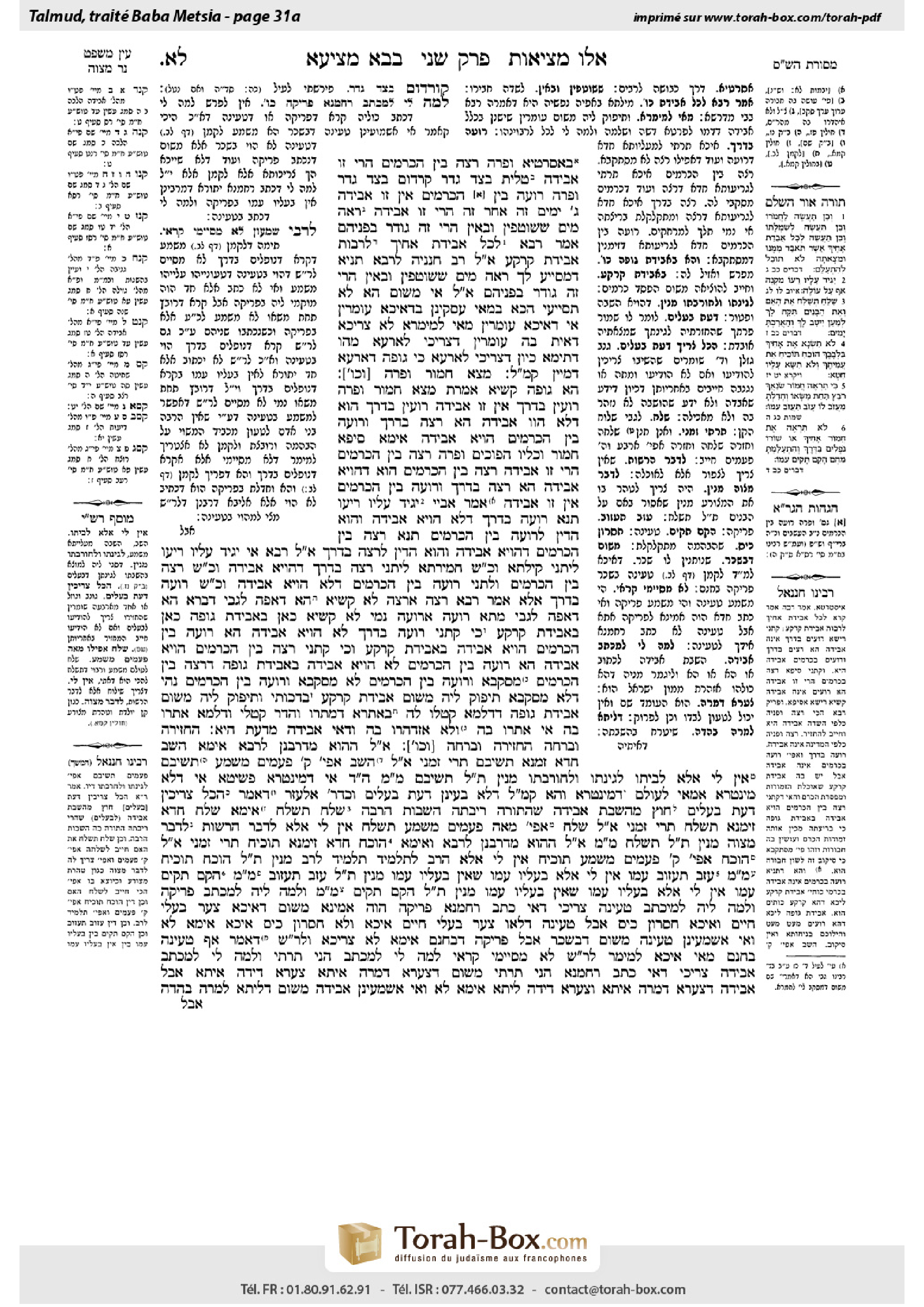
Bava Metzia 31a: Talmud study for Daf Yomi
Study the Talmud for Daf Yomi with scanned pages, Hebrew text, English translations from Sefaria and AI-generated French translations.
Passage selection and English or AI-generated French translation are available where the scan has annotations. Daf Study is independent of Torah-Box and Sefaria.
Browse Bava Metzia · בבא מציעא · All tractatesBava Metzia 31a text and translations
This page of Bava Metzia includes the Aramaic text, an English translation and an AI-generated French translation, alongside the scan above.
בבא מציעא ל״א א · Aramaic and Hebrew text
בְּאִסְרַטְיָא וּפָרָה רָצָה בֵּין הַכְּרָמִים – הֲרֵי זוֹ אֲבֵידָה. טַלִּית בְּצַד גָּדֵר, קַרְדּוֹם בְּצַד גָּדֵר, וּפָרָה רוֹעָה בֵּין הַכְּרָמִים – אֵין זוֹ אֲבֵידָה. שְׁלֹשָׁה יָמִים זֶה אַחַר זֶה – הֲרֵי זוֹ אֲבֵידָה. רָאָה מַיִם שֶׁשּׁוֹטְפִין וּבָאִין – הֲרֵי זֶה גּוֹדֵר בִּפְנֵיהֶם.
אָמַר רָבָא: ״לְכׇל אֲבֵידַת אָחִיךָ״ – לְרַבּוֹת אֲבֵידַת קַרְקַע. אֲמַר לֵיהּ רַב חֲנַנְיָא לְרָבָא: תַּנְיָא דִּמְסַיַּיע לָךְ, רָאָה מַיִם שֶׁשּׁוֹטְפִין וּבָאִין הֲרֵי זֶה גּוֹדֵר בִּפְנֵיהֶם.
אֲמַר לֵיהּ: אִי מִשּׁוּם הָא לָא (תְּסַיְּיעַי) [תְּסַיְּיעַן], הָכָא בְּמַאי עָסְקִינַן? בִּדְאִיכָּא עוּמְרִין. אִי דְּאִיכָּא עוּמְרִין, מַאי לְמֵימְרָא – לָא צְרִיכָא, דְּאִית בַּהּ עוּמְרִין דִּצְרִיכִי לְאַרְעָא, מַהוּ דְּתֵימָא: כֵּיוָן דִּצְרִיכִי לְאַרְעָא, כִּי גּוּפַהּ דְּאַרְעָא דָּמַיִין, קָא מַשְׁמַע לַן.
מָצָא חֲמוֹר וּפָרָה [וְכוּ׳]. הָא גּוּפַהּ קַשְׁיָא! אָמְרַתְּ: מָצָא חֲמוֹר וּפָרָה רוֹעִין בַּדֶּרֶךְ – אֵין זוֹ אֲבֵידָה, רוֹעִין בַּדֶּרֶךְ הוּא דְּלָא הָווּ אֲבֵידָה, הָא רָצָה בַּדֶּרֶךְ וְרוֹעָה בֵּין הַכְּרָמִים הָוְיָא אֲבֵידָה. אֵימָא סֵיפָא: חֲמוֹר וְכֵלָיו הֲפוּכִים וּפָרָה רָצָה בֵּין הַכְּרָמִים – הֲרֵי זוֹ אֲבֵידָה. רָצָה בֵּין הַכְּרָמִים הוּא דְּהָוְיָא אֲבֵידָה, הָא רָצָה בַּדֶּרֶךְ וְרוֹעָה בֵּין הַכְּרָמִים – אֵין זוֹ אֲבֵידָה!
אָמַר אַבָּיֵי: ״יַגִּיד עָלָיו רֵעוֹ״; תְּנָא רוֹעָה בַּדֶּרֶךְ דְּלָא הָוְיָא אֲבֵידָה, וְהוּא הַדִּין לְרוֹעָה בֵּין הַכְּרָמִים. תְּנָא רָצָה בֵּין הַכְּרָמִים דְּהָוְיָא אֲבֵידָה, וְהוּא הַדִּין לְרָצָה בַּדֶּרֶךְ.
אֲמַר לֵיהּ רָבָא: אִי ״יַגִּיד עָלָיו רֵעוֹ״ – לִיתְנֵי קִילְּתָא, וְכׇל שֶׁכֵּן חֲמִירְתָּא. לִיתְנֵי רָצָה בַּדֶּרֶךְ דְּהָוְיָא אֲבֵידָה, וְכׇל שֶׁכֵּן רָצָה בֵּין הַכְּרָמִים. וְלִתְנֵי רוֹעָה בֵּין הַכְּרָמִים, דְּלָא הָוְיָא אֲבֵידָה, וְכׇל שֶׁכֵּן רוֹעָה בַּדֶּרֶךְ.
אֶלָּא אָמַר רָבָא: רָצָה אַרָצָה לָא קַשְׁיָא, הָא דְּאַפַּהּ לְגַבֵּי דַּבְרָא, הָא דְּאַפַּהּ לְגַבֵּי מָתָא.
רוֹעָה אַרוֹעָה נָמֵי לָא קַשְׁיָא: כָּאן בַּאֲבֵידַת גּוּפָהּ, כָּאן בַּאֲבֵידַת קַרְקַע.
כִּי קָתָנֵי רוֹעָה בַּדֶּרֶךְ לָא הָוְיָא אֲבֵידָה, הָא רוֹעָה בֵּין הַכְּרָמִים הָוְיָא אֲבֵידָה בַּאֲבֵידַת קַרְקַע. וְכִי קָתָנֵי רָצָה בֵּין הַכְּרָמִים הָוְיָא אֲבֵידָה, הָא רוֹעָה בֵּין הַכְּרָמִים לָא הָוְיָא אֲבֵידָה בַּאֲבֵידַת גּוּפָהּ, דְּרָצָה בֵּין הַכְּרָמִים מִסְ[תַּ]קְּבָא, וְרוֹעָה בֵּין הַכְּרָמִים לָא מִסְ[תַּ]קְּבָא.
וְרוֹעָה בֵּין הַכְּרָמִים, נְהִי דְּלָא מִסְ[תַּ]קְּבָא תִּיפּוֹק לֵיהּ מִשּׁוּם אֲבֵידַת קַרְקַע! בִּדְגוֹי.
וְתִיפּוֹק לֵיהּ מִשּׁוּם אֲבֵידַת גּוּפָהּ, דְּדִלְמָא קָטְלוּ לַהּ! בְּאַתְרָא דְּמַתְרוּ וַהֲדַר קָטְלִי. וְדִלְמָא אַתְרוֹ בָּהּ! אִי אַתְרוֹ בַּהּ וְלָא אִזְדְּהַרוּ בַּהּ, וַדַּאי אֲבֵידָה מִדַּעַת הִיא.
הֶחְזִירָהּ וּבָרְחָה הֶחְזִירָהּ וּבָרְחָה [וְכוּ׳]. אֲמַר לֵיהּ הָהוּא מִדְּרַבָּנַן לְרָבָא, אֵימָא: ״הָשֵׁב״ חֲדָא זִמְנָא, ״תְּשִׁיבֵם״ תְּרֵי זִמְנֵי!
אֲמַר לֵיהּ: ״הָשֵׁב״ אֲפִילּוּ מֵאָה פְּעָמִים מַשְׁמַע, ״תְּשִׁיבֵם״ אֵין לִי אֶלָּא לְבֵיתוֹ, לְגִינָּתוֹ וּלְחוּרְבָּתוֹ מִנַּיִן? תַּלְמוּד לוֹמַר: ״תְּשִׁיבֵם״, מִכׇּל מָקוֹם. הֵיכִי דָמֵי? אִי דְּמִינַּטְרָא, פְּשִׁיטָא. אִי דְּלָא מִינַּטְרָא, אַמַּאי?
לְעוֹלָם דְּמִינַּטְרָא, וְהָא קָא מַשְׁמַע לַן: דְּלָא בָּעֵינַן דַּעַת בְּעָלִים. וְכִדְרַבִּי אֶלְעָזָר דְּאָמַר: הַכֹּל צְרִיכִין דַּעַת בְּעָלִים, חוּץ מֵהֲשָׁבַת אֲבֵידָה, שֶׁהַתּוֹרָה רִיבְּתָה הֲשָׁבוֹת הַרְבֵּה.
״שַׁלֵּחַ תְּשַׁלַּח״, אֵימָא: ״שַׁלֵּחַ״ חֲדָא זִימְנָא, ״תְּשַׁלַּח״ תְּרֵי זִמְנֵי!
אֲמַר לֵיהּ: ״שַׁלֵּחַ״ – אֲפִילּוּ מֵאָה פְּעָמִים מַשְׁמַע. ״תְּשַׁלַּח״ אֵין לִי אֶלָּא לִדְבַר הָרְשׁוּת, לִדְבַר מִצְוָה מִנַּיִן? תַּלְמוּד לוֹמַר: ״תְּשַׁלַּח״, מִכׇּל מָקוֹם.
אֲמַר לֵיהּ הָהוּא מִדְּרַבָּנַן לְרָבָא: וְאֵימָא ״הוֹכֵחַ״ חֲדָא זִימְנָא, ״תּוֹכִיחַ״ תְּרֵי זִמְנֵי?
אֲמַר לֵיהּ: ״הוֹכֵחַ״ – אֲפִילּוּ מֵאָה פְּעָמִים מַשְׁמַע. ״תּוֹכִיחַ״ – אֵין לִי אֶלָּא הָרַב לְתַלְמִיד. תַּלְמִיד לְרַב מִנַּיִן? תַּלְמוּד לוֹמַר: ״הוֹכֵחַ תּוֹכִיחַ״, מִכׇּל מָקוֹם.
״עָזֹב תַּעֲזֹב עִמּוֹ״, אֵין לִי אֶלָּא בְּעָלָיו עִמּוֹ. שֶׁאֵין בְּעָלָיו עִמּוֹ, מִנַּיִן? תַּלְמוּד לוֹמַר ״עָזֹב תַּעֲזֹב״, מִכׇּל מָקוֹם.
״הָקֵם תָּקִים עִמּוֹ״, אֵין לִי אֶלָּא בְּעָלָיו עִמּוֹ. שֶׁאֵין בְּעָלָיו עִמּוֹ, מִנַּיִן? תַּלְמוּד לוֹמַר ״הָקֵם תָּקִים״, מִכׇּל מָקוֹם.
וּלְמָה לֵיהּ לְמִכְתַּב פְּרִיקָה, וּלְמָה לֵיהּ לְמִכְתַּב טְעִינָה? צְרִיכִי, דְּאִי כְּתַב רַחֲמָנָא פְּרִיקָה – הֲוָה אָמֵינָא מִשּׁוּם דְּאִיכָּא צַעַר בַּעֲלֵי חַיִּים וְאִיכָּא חֶסְרוֹן כִּיס, אֲבָל טְעִינָה, דְּלָאו צַעַר בַּעֲלֵי חַיִּים אִיכָּא וְלָא חֶסְרוֹן כִּיס אִיכָּא, אֵימָא לָא.
וְאִי אַשְׁמְעִינַן טְעִינָה מִשּׁוּם דִּבְשָׂכָר, אֲבָל פְּרִיקָה דִּבְחִנָּם, אֵימָא לָא. צְרִיכָא.
וּלְרַבִּי שִׁמְעוֹן דְּאָמַר: אַף טְעִינָה בְּחִנָּם, מַאי אִיכָּא לְמֵימַר? לְרַבִּי שִׁמְעוֹן לָא מְסַיְּימִי קְרָאֵי.
לְמָה לִי לְמִכְתַּב הָנֵי תַּרְתֵּי, וּלְמָה לִי לְמִכְתַּב אֲבֵידָה? צְרִיכִי, דְּאִי כְּתַב רַחֲמָנָא הָנֵי תַּרְתֵּי – מִשּׁוּם דְּצַעֲרָא דְּמָרַהּ אִיתָא, צַעֲרָא דִּידַהּ אִיתָא. אֲבָל אֲבֵידָה, דְּצַעֲרָא דְּמָרַהּ אִיתָא וְצַעֲרָא דִּידַהּ לֵיתָא, אֵימָא לָא. וְאִי אַשְׁמְעִינַן אֲבֵידָה – מִשּׁוּם דְּלֵיתֵאּ לְמָרַהּ בַּהֲדַהּ,
Bava Metzia 31a · English translation
on a main thoroughfare [be’isratiyya], or a cow running through the vineyards, that is lost property. If one found a cloak alongside a fence, an ax alongside a fence, or a cow grazing among the vineyards, that is not lost property. If one sees these items for three consecutive days, that is lost property. If one saw water that is flowing and coming to inundate another’s field, he must establish a barrier before the water in order to preserve the field.
Rava says that the verse: “And so shall you do with every lost item of your brother” (Deuteronomy 22:3), serves to include an obligation to protect your brother from the loss of his land. Rav Ḥananya said to Rava: There is a baraita that is taught that supports your opinion. If one saw water that is flowing and coming to inundate another’s field, he must establish a barrier before the water in order to preserve the field.
Rava said to Rav Ḥananya: If you are attempting to bring support for my ruling due to that baraita, do not support my ruling. With what are we dealing here in the baraita? We are dealing with a field in which there are sheaves of grain on the land. The tanna of the baraita is referring to preservation of the sheaves, not of the land itself. The Gemara asks: If the baraita is referring to a field in which there are sheaves of grain, what is the purpose of stating it? Isn’t it obvious that one is obligated to preserve the sheaves as he would any other item? No, it is necessary to state the halakha only in a case where there are sheaves that need the land in order to dry. Lest you say: Since they still need the land, their legal status is like that of the land itself and he is not obligated to return them, the baraita teaches us that the sheaves are independent of the land and must be preserved.
§ The mishna teaches: If one found a donkey or a cow grazing on the path, that is not deemed lost property. The Gemara asks: This itself is difficult. On the one hand you said: If one found a donkey or a cow grazing on the path, that is not lost property, from which it may be inferred that only if it is grazing on the path it is not lost property, but if it was running on the path or grazing among the vineyards, it is a lost item. On the other hand, say the latter clause of the mishna: If one found a donkey with its accoutrements overturned, or a cow that ran through the vineyards, that is lost property. From this wording it may be inferred that only if the animal is running through the vineyards is it lost property, but if it is running on the path or grazing among the vineyards, it is not lost property.
Abaye said that the tanna employs the style of: Its counterpart tells about it (see Job 36:33), and the mishna distinguishes between grazing and running. The tanna taught a case of grazing on the path, where the animal is not considered lost property, and the same is true of a case where the animal is grazing among the vineyards. And the tanna taught a case of running through the vineyards, where the animal is considered lost property, and the same is true of a case where the animal is running on the path.
Rava said to him: If the tanna employs the style of: Its counterpart tells about it, let him teach the lenient case and all the more so it would apply to the stringent case. The Gemara elaborates: Let the tanna teach that when the animal is running on the path it is lost property and all the more so it is lost property when it is running through the vineyards. And let the tanna teach that when the animal is grazing among the vineyards it is not lost property, and all the more so it is not lost property when it is grazing on the path.
Rather, Rava said: The apparent contradiction between the inference from the first clause with regard to running on the path and the inference from the latter clause with regard to running on the path is not difficult. This inference from the first clause that an animal running on the path is lost property is referring to a case where its face is directed toward the field, and it is running away from the city. That inference from the latter clause that an animal running on the path is not lost property is referring to a case where its face is directed toward the city.
Rava continues: The apparent contradiction between the inference from the first clause with regard to grazing among the vineyards and the inference from the latter clause with regard to grazing among the vineyards is also not difficult. Here, the inference from the latter clause that an animal grazing among the vineyards is not lost property is with regard to loss of the animal itself. There, the inference from the first clause that the halakhot of lost property apply in the case of an animal grazing among the vineyards is referring to loss in the sense of damage to the land.
The Gemara elaborates: When the tanna teaches that in the case of an animal grazing on the path, the halakhot of lost property do not apply, from which it is inferred: But in the case of an animal grazing among the vineyards the halakhot of lost property do apply, it is referring to preventing loss in the sense of damage to the land caused by the animal. And when the tanna teaches that in the case of an animal running among the vineyards the halakhot of lost property do apply, from which it is inferred: But in the case of an animal grazing among the vineyards the halakhot of lost property do not apply, it is referring to loss of the animal itself, as an animal running among the vineyards is typically wounded with lacerations from the vines, but an animal grazing among the vineyards is not typically wounded.
The Gemara asks: And with regard to the inference from the latter clause that in the case of an animal grazing among the vineyards the halakhot of lost property do not apply, although it is not wounded, why not derive that the halakhot of lost property do apply due to loss in the sense of damage to the land caused by the animal? The Gemara answers: It is stated with regard to the land of a gentile, which one is not obligated to return or preserve.
The Gemara questions this explanation: But why not derive that one is obligated to return it due to loss of the animal itself, as perhaps the gentiles will kill it? The Gemara answers: It is stated with regard to a place where they forewarn the owner and only then kill the animal. The Gemara challenges: And perhaps they already forewarned the owner with regard to the animal. The Gemara explains: If they already forewarned the owner with regard to the animal and the owner did not heed the warning, this is certainly a case of deliberate loss, where there is no obligation to return it.
§ The mishna teaches: In a case where one returned the lost animal and it fled, and he again returned it and it fled, even if this scenario repeats itself four or five times, he is obligated to return it each time, as it is stated: “You shall not see your brother’s ox or his sheep wandering and disregard them; you shall return them [hashev teshivem] to your brother” (Deuteronomy 22:1). The Gemara understands that from the use of the compound form of the verb, “hashev teshivem,” the mishna derives that one must return the lost animal multiple times if it flees. The Gemara asks: A certain one of the Sages said to Rava: Say that from “hashev” one derives the obligation to return the animal once, and from “teshivem” one derives the obligation to return the animal twice, and beyond that there is no obligation.
Rava said to him: “Hashev” indicates that there is an absolute obligation to return the animal, even if it flees one hundred times. “Teshivem” teaches another matter: I have derived only that one may return the animal to the owner’s house. From where is the halakha derived that one may return the animal to his garden or to his building in ruins? The verse states: “Teshivem,” to teach that in any case, wherever one returns the lost animal, he fulfills the mitzva of returning it. The Gemara asks: What are the circumstances? If those areas are protected, it is obvious that one who returns the animal there fulfills his obligation. If they are not protected, why is he considered to have returned the lost animal? It will just flee again.
The Gemara answers: Actually, it is a case where the property is protected. And this teaches us that we do not require the owner’s knowledge in order to return the lost item to him. And this ruling is in accordance with the opinion of Rabbi Elazar, who says: Every instance involving return of an item to its owner, e.g., by a bailee or by a thief, requires the owner’s knowledge that it is being returned, except for the return of a lost item, as the Torah amplified the halakha to permit multiple forms of return by means of the compound verb “hashev teshivem,” among them return without the owner’s knowledge.
The Gemara cites additional mitzvot where the Torah employs the compound verb form, and the Sages derived additional halakhot from the phrasing of the verse. With regard to the mitzva of dispatch of the mother bird from the nest before taking its eggs or fledglings, the verse states: “You shall dispatch [shalle’aḥ teshallaḥ] the mother, but the young take for yourself; that it may be well with you, and that you may prolong your days” (Deuteronomy 22:7). The Gemara understands that from the use of the compound form of the verb, “shalle’aḥ teshallaḥ,” the Sages derive that one must dispatch the mother bird multiple times if it returns. The Gemara asks: Say that from “shalle’aḥ” one derives the obligation to dispatch the mother once, and from “teshallaḥ” one derives the obligation to dispatch the mother twice, and beyond that there is no obligation.
Rava said to him: “Shalle’aḥ” indicates that one must dispatch the mother even one hundred times. “Teshallaḥ” teaches another matter: I have derived only the obligation to dispatch the mother bird in a case where one takes the eggs or the fledglings and wants to take the mother bird for a non-compulsory matter, e.g., to eat it. In a case where one takes the eggs or the fledglings and needs the mother bird for a matter involving a mitzva, e.g., the purification of a leper, from where is the halakha that he must dispatch the mother derived? The verse states: “Teshallaḥ,” to teach that in any case one must dispatch the mother bird.
With regard to the mitzva of rebuke, the verse states: “You shall not hate your brother in your heart; you shall rebuke [hokhe’aḥ tokhiaḥ] your neighbor, and not bear sin because of him” (Leviticus 19:17). The Gemara understands that from the use of the compound form of the verb, “hokhe’aḥ tokhiaḥ,” the Sages derive that one must rebuke another multiple times if necessary. A certain one of the Sages said to Rava: Say that from “hokhe’aḥ” one derives the obligation to rebuke another once, and from “tokhiaḥ” one derives the obligation to rebuke another twice, and beyond that there is no obligation.
Rava said to him: “Hokhe’aḥ” indicates that one must rebuke another even one hundred times. “Tokhiaḥ” teaches another matter: I have derived only the obligation of a teacher to rebuke a student. With regard to the obligation for a student to rebuke a teacher, from where is it derived? The verse states: “Hokhe’aḥ tokhiaḥ” to teach that one is obligated to rebuke another in any case that warrants rebuke.
§ The Gemara cites additional derivations from compound verb forms. “If you see the donkey of him that hates you collapsed under its burden, you shall forgo passing him by; you shall release it [azov ta’azov] with him” (Exodus 23:5). I have derived only that one is obligated to help unload the fallen animal in a case where its owner is with it. From where is the obligation to unload it in a case where its owner is not with it derived? The verse states: “Azov ta’azov,” indicating that there is an obligation to unload it in any case.
The verse states: “You shall not see your brother’s donkey or his ox fallen by the wayside, and hide yourself from them; you shall lift them [hakem takim] with him” (Deuteronomy 22:4). I have derived only that one is obligated to help load the animal in a case where its owner is with it. From where is the obligation to load it in a case where its owner is not with it derived? The verse states: “Hakem takim,” to teach that there is an obligation to load it in any case.
The Gemara asks: And why does the Torah need to write the compound verb form to teach the obligation in the owner’s absence with regard to unloading and why does the Torah need to write the compound verb form to teach the obligation in the owner’s absence with regard to loading the animal? The Gemara answers: They are both necessary, as had the Merciful One written this halakha only with regard to unloading, I would say that one is obligated to unload the animal even when the owner is not present, due to the fact that in the failure to unload the animal there is potential suffering of animals and there is potential monetary loss, as the burden might be damaged or the animal might die. But in the case of loading, where there is no potential suffering of animals and there is no potential monetary loss, I would say no, there is no obligation to load the animal when the owner is not present.
The Gemara continues its answer: And had the Torah taught us the obligation in the owner’s absence with regard to loading, I would say that it is due to the fact that his action is rewarded with remuneration, as one is paid for loading an animal. But with regard to unloading, which is performed for free, I would say no, there is no obligation to unload the animal when the owner is not present. Due to the unique element in each, both are necessary.
The Gemara asks: And according to Rabbi Shimon, who says that even loading must be performed for free, what is there to say to explain why it was necessary to repeat the obligation with regard to unloading? The Gemara answers: According to Rabbi Shimon, it is not clearly defined which of the verses is referring to loading and which is referring to unloading. Had the Torah written one verse, it would have been interpreted to be referring to unloading and one might assume that he need not load an animal in the absence of the owner.
The Gemara asks: Why do I need the Torah to write these two mitzvot of unloading and loading, and why do I need the Torah to write the obligation to return a lost item? Write one of them, and derive the other from it, as they are all mitzvot to preserve another’s property. The Gemara answers: Both are necessary, as had the Merciful One written only these two mitzvot of unloading and loading, one would say that it is due to the fact that in those cases there is the suffering of its owner and there is the suffering of the animal itself. But in the case of a lost item, where there is the suffering of its owner but there is no suffering of the lost item, I might say no, there is no obligation to return the lost item. And had the Torah taught us only the obligation to return a lost item, one would say that is due to the fact that its owner is not with it to care for it;
Bava Metzia 31a · Traduction française (IA)
Un bétail errant sur une route principale [be’isratiyya], ou un bœuf errant dans les vignes, est considéré comme un objet perdu. Si l'on trouve une couverture à côté d'un mur, une hache à côté d'un mur, ou un bœuf paissant dans les vignes, ce n'est pas un objet perdu. Si l'on voit ces objets pendant trois jours consécutifs, alors c'est un objet perdu. Si l'on voit de l'eau qui coule et qui menace d'inonder un champ d'autrui, il faut ériger un barrage avant que l'eau ne s'écoule afin de préserver le champ.
Rava dit que la parole : « Et ainsi tu feras avec tout objet perdu de ton frère » (Deutéronome 22:3), sert à inclure une obligation de protéger ton frère contre la perte de son champ. Rav Ḥananya dit à Rava : Il existe une baraïta qui est enseignée et qui soutient ton opinion. Si l'on voit de l'eau qui coule et qui menace d'inonder un champ d'autrui, il faut ériger un barrage avant que l'eau ne s'écoule afin de préserver le champ.
Rava dit à Rav Ḥananya : Si tu essaies de trouver un soutien pour mon opinion en raison de cette baraïta, ne soutiens pas mon opinion. De quoi s'agit-il dans cette baraïta ? Il s'agit d'un champ où il y a des gerbes de céréales. Le tanna de la baraïta fait référence à la préservation des gerbes, pas du champ lui-même. La Guemara pose la question : Si la baraïta fait référence à un champ où il y a des gerbes de céréales, à quoi sert-elle d'être mentionnée ? N'est-ce pas évident que l'on est tenu de préserver les gerbes comme on le ferait avec tout autre objet ? Non, il est nécessaire de mentionner cette halakha uniquement dans un cas où les gerbes ont besoin du champ pour sécher. De peur que l'on dise : Puisque elles ont encore besoin du champ, leur statut juridique est celui du champ lui-même et l'on n'est pas tenu de les rendre, la baraïta nous apprend que les gerbes sont indépendantes du champ et doivent être préservées.
§ La mitsna enseigne : Si l'on trouve un âne ou un bœuf paissant sur la route, ce n'est pas considéré comme un objet perdu. La Guemara pose la question : Cela même est difficile. D'une part, vous dites : Si l'on trouve un âne ou un bœuf paissant sur la route, ce n'est pas un objet perdu, d'où l'on peut en déduire que seul le cas où il paît sur la route n'est pas un objet perdu, mais si l'animal court sur la route ou paît dans les vignes, c'est un objet perdu. D'autre part, la dernière clause de la mitsna dit : Si l'on trouve un âne avec ses accessoires renversés, ou un bœuf qui court dans les vignes, c'est un objet perdu. D'après cette formulation, on peut en déduire que seul le cas où l'animal court dans les vignes est un objet perdu, mais si l'animal court sur la route ou paît dans les vignes, ce n'est pas un objet perdu.
Abaye dit que le tanna utilise le style : Son homologue en parle (voir Job 36:33), et la mitsna distingue entre le pâturage et la course. Le tanna a enseigné le cas d'un animal pâturant sur la route, où l'animal n'est pas considéré comme un objet perdu, et c'est pareil pour le cas d'un animal pâturant dans les vignes. Et le tanna a enseigné le cas d'un animal courant dans les vignes, où l'animal est considéré comme un objet perdu, et c'est pareil pour le cas d'un animal courant sur la route.
Rava dit à lui : Si le tanna utilise le style : Son homologue en parle, qu'il enseigne le cas favorable et encore plus encore il s'appliquerait au cas strict. La Guemara développe : Qu'il enseigne que lorsque l'animal court sur la route, c'est un objet perdu et encore plus encore c'est un objet perdu lorsque l'animal court dans les vignes. Et qu'il enseigne que lorsque l'animal pâture dans les vignes, ce n'est pas un objet perdu, et encore plus encore ce n'est pas un objet perdu lorsque l'animal pâture sur la route.
Plutôt, Rava dit : La contradiction apparente entre l'inférence tirée de la première clause concernant la course sur la route et l'inférence tirée de la dernière clause concernant la course sur la route n'est pas difficile. Cette inférence tirée de la première clause selon laquelle un animal courant sur la route est un objet perdu fait référence à un cas où son visage est tourné vers le champ et il s'éloigne de la ville. Cette inférence tirée de la dernière clause selon laquelle un animal courant sur la route n'est pas un objet perdu fait référence à un cas où son visage est tourné vers la ville.
Rava continue : La contradiction apparente entre l'inférence tirée de la première clause concernant le pâturage dans les vignes et l'inférence tirée de la dernière clause concernant le pâturage dans les vignes n'est pas difficile. Ici, l'inférence tirée de la dernière clause selon laquelle un animal pâturant dans les vignes n'est pas un objet perdu fait référence à la perte de l'animal lui-même. Là, l'inférence tirée de la première clause selon laquelle les halakhot des objets perdus s'appliquent dans le cas d'un animal pâturant dans les vignes fait référence à la perte au sens de dommage au champ.
La Guemara développe : Lorsque le tanna enseigne que dans le cas d'un animal pâturant sur la route, les halakhot des objets perdus ne s'appliquent pas, d'où l'on en déduit : Mais dans le cas d'un animal pâturant dans les vignes, les halakhot des objets perdus s'appliquent, il fait référence à la prévention de la perte au sens de dommage au champ causé par l'animal. Et lorsque le tanna enseigne que dans le cas d'un animal courant dans les vignes, les halakhot des objets perdus s'appliquent, d'où l'on en déduit : Mais dans le cas d'un animal pâturant dans les vignes, les halakhot des objets perdus ne s'appliquent pas, il fait référence à la perte de l'animal lui-même, car un animal courant dans les vignes est généralement blessé par des écorchures des vignes, mais un animal pâturant dans les vignes n'est généralement pas blessé.
La Guemara pose la question : Et concernant l'inférence de la dernière clause que dans le cas d'un animal pâturant dans les vignes, les halakhot des objets perdus ne s'appliquent pas, même s'il n'est pas blessé, pourquoi ne pas en déduire que les halakhot des objets perdus s'appliquent en raison de la perte au sens de dommage au champ causé par l'animal ? La Guemara répond : Il est dit concernant la terre d'un non-Juif, dont l'on n'est pas tenu de rendre ou de préserver.
La Guemara questionne cette explication : Mais pourquoi ne pas déduire qu'on est tenu de le rendre en raison de la perte de l'animal lui-même, en cas où les Gentils pourraient le tuer ? La Guemara répond : Il est dit concernant un lieu où l'on prévient d'abord l'propriétaire avant de tuer l'animal. La Guemara conteste : Et peut-être qu'ils ont déjà prévenu l'propriétaire concernant l'animal. La Guemara explique : Si on a déjà prévenu l'propriétaire concernant l'animal et qu'il n'a pas écouté l'avertissement, c'est certainement un cas de perte volontaire, où il n'y a pas d'obligation de le rendre.
§ La Michna enseigne : Dans un cas où l'on a rendu un animal perdu et qu'il s'est enfui, et qu'on l'a à nouveau rendu et qu'il s'est enfui, même si cette situation se répète quatre ou cinq fois, on est tenu de le rendre chaque fois, car il est dit : « Tu ne regarderas pas l'âne de ton frère ou son bœuf errant et tu ne les négligeras pas ; tu les rendras [hashev teshivem] à ton frère » (Deutéronome 22:1). La Guemara comprend que, grâce à l'emploi de la forme composée du verbe « hashev teshivem », la Michna déduit que l'on doit rendre l'animal perdu plusieurs fois s'il s'enfuit. La Guemara pose la question : Un certain Sage a dit à Rava : Dis que « hashev » déduit l'obligation de rendre l'animal une fois, et que « teshivem » déduit l'obligation de le rendre deux fois, et au-delà il n'y a pas d'obligation.
Rava répondit à lui : « Hashev » indique qu'il y a une obligation absolue de rendre l'animal, même s'il s'enfuit cent fois. « Teshivem » enseigne une autre chose : j'ai déduit seulement que l'on peut rendre l'animal à la maison de l'owner. D'où déduit-on la halakha selon laquelle l'on peut rendre l'animal dans son jardin ou dans son bâtiment en ruine ? La Sainte Écriture dit : « Teshivem », pour enseigner que dans tous les cas, où qu'on rend l'animal perdu, on accomplît la mitsva de le rendre. La Guemara pose la question : Quelles sont les circonstances ? Si ces lieux sont protégés, il est évident que celui qui rend l'animal y accomplît son obligation. Si ce n'est pas le cas, pourquoi est-on considéré comme ayant rendu l'animal perdu ? Il s'enfuirait à nouveau.
La Guemara répond : En réalité, il s'agit d'un cas où la propriété est protégée. Et cela nous enseigne que l'on n'exige pas la connaissance de l'owner pour rendre l'objet perdu à lui. Et cette décision est conforme à l'opinion de Rabbi Eléazar, qui dit : Toute instance concernant le retour d'un objet à son propriétaire, par exemple par un dépositaire ou un voleur, exige la connaissance du propriétaire qu'il est rendu, sauf pour le retour d'un objet perdu, car la Torah a amplifié la halakha pour permettre plusieurs formes de retour par l'intermédiaire du verbe composé « hashev teshivem », dont le retour sans la connaissance du propriétaire.
La Guemara cite d'autres mitsvot où la Torah emploie la forme composée du verbe, et les Sages ont déduit d'autres halakhot à partir de la formulation du verset. Concernant la mitsva de lâcher la mère oiseau du nid avant de prendre ses œufs ou ses petits, le verset dit : « Tu lâcheras [shalle’aḥ teshallaḥ] la mère, mais tu prendras les petits ; afin que cela soit bien avec toi, et que tu prolonges tes jours » (Deutéronome 22:7). La Guemara comprend que, grâce à l'emploi de la forme composée du verbe « shalléaḥ teshallaḥ », les Sages déduisent que l'on doit lâcher la mère oiseau plusieurs fois si elle revient. La Guemara pose la question : Dis que « shalléaḥ » déduit l'obligation de lâcher la mère une fois, et que « teshallaḥ » déduit l'obligation de lâcher la mère deux fois, et au-delà il n'y a pas d'obligation.
Rava répondit à lui : « Shalléaḥ » indique qu'il faut lâcher la mère même cent fois. « Teshallaḥ » enseigne une autre chose : J'ai déduit seulement l'obligation de lâcher la mère oiseau dans le cas où l'on prend les œufs ou les petits et qu'on veut prendre la mère oiseau pour une affaire non obligatoire, par exemple pour la manger. Dans le cas où l'on prend les œufs ou les petits et qu'on a besoin de la mère oiseau pour une affaire liée à une mitsva, par exemple la purification d'un lépreux, d'où déduit-on la halakha qu'il faut lâcher la mère ? Le verset dit : « Teshallaḥ », pour enseigner que dans tous les cas, on doit lâcher la mère oiseau.
Concernant la mitsva de réprimande, le verset dit : « Tu ne haïras pas ton frère dans ton cœur ; tu réprimanderas [hokhe’aḥ tokhiaḥ] ton voisin, et tu ne porteras pas le péché à cause de lui » (Lévitique 19:17). La Guemara comprend que, grâce à l'emploi de la forme composée du verbe « hokhe’aḥ tokhiaḥ », les Sages déduisent que l'on doit réprimander une autre personne plusieurs fois si nécessaire. Un certain Sage a dit à Rava : Dis que « hokhe’aḥ » déduit l'obligation de réprimander une autre personne une fois, et que « tokhiaḥ » déduit l'obligation de réprimander une autre personne deux fois, et au-delà il n'y a pas d'obligation.
Rava répondit à lui : « Hokhe’aḥ » indique qu'il faut réprimander une autre personne même cent fois. « Tokhiaḥ » enseigne une autre chose : J'ai déduit seulement l'obligation d'un maître de réprimander un élève. Concernant l'obligation d'un élève de réprimander un maître, d'où déduit-on cela ? Le verset dit : « Hokhe’aḥ tokhiaḥ », pour enseigner qu'on est tenu de réprimander une autre personne dans tous les cas où la réprimande est nécessaire.
§ La Guemara cite d'autres déductions à partir des formes composées des verbes. « Si tu vois l'âne de celui qui t'aime ou qui t'haït qui s'est effondré sous son fardeau, tu laisseras passer ; tu libéreras l'âne [azov ta’azov] avec lui » (Exode 23:5). J'ai déduit seulement que l'on est tenu d'aider à décharger l'animal tombé dans le cas où son propriétaire est avec lui. D'où déduit-on l'obligation de décharger l'animal dans le cas où son propriétaire n'est pas avec lui ? Le verset dit : « Azov ta’azov », indiquant qu'il y a une obligation de décharger l'animal dans tous les cas.
La parabole dit : « Tu ne regarderas pas l'âne ou la bête de ton frère tombant sur le chemin, et tu ne t'en éloigneras pas ; tu le leveras avec lui » (Deutéronome 22:4). J'ai tiré seulement que l'on est tenu de l'aider à charger l'animal dans le cas où son propriétaire est présent. D'où tire-t-on l'obligation de le charger dans le cas où son propriétaire n'est pas présent ? La parabole dit : « Hakem takim », pour enseigner qu'il y a une obligation de le charger dans tous les cas.
Le Guemara demande : Et pourquoi la Torah a-t-elle besoin d'écrire le verbe composé pour enseigner l'obligation en l'absence du propriétaire concernant le déchargement et pourquoi la Torah a-t-elle besoin d'écrire le verbe composé pour enseigner l'obligation en l'absence du propriétaire concernant le chargement de l'animal ? Le Guemara répond : Les deux sont nécessaires, car si le Très Miséricordieux avait écrit cette halakha seulement concernant le déchargement, je dirais que l'on est tenu de décharger l'animal même en l'absence du propriétaire, en raison du fait que l'absence de déchargement peut entraîner un malheur pour l'animal et une perte financière, car la charge pourrait être endommagée ou l'animal pourrait mourir. Mais dans le cas du chargement, où il n'y a pas de malheur pour l'animal et pas de perte financière, je dirais que non, il n'y a pas d'obligation de charger l'animal en l'absence du propriétaire.
Le Guemara continue sa réponse : Et si la Torah nous avait appris l'obligation en l'absence du propriétaire concernant le chargement, je dirais que c'est en raison du fait que son action est récompensée par une rémunération, car on est payé pour charger un animal. Mais concernant le déchargement, qui est fait gratuitement, je dirais que non, il n'y a pas d'obligation de décharger l'animal en l'absence du propriétaire. En raison de l'élément unique dans chaque cas, les deux sont nécessaires.
Le Guemara demande : Et selon Rabbi Shimon, qui affirme que même le chargement doit être accompli gratuitement, qu'est-ce qui justifie de répéter l'obligation concernant le déchargement ? Le Guemara répond : Selon Rabbi Shimon, il n'est pas clair quel verset fait référence au chargement et quel verset fait référence au déchargement. Si la Torah avait écrit un seul verset, on l'interpréterait comme faisant référence au déchargement et on pourrait penser que l'on n'a pas besoin de charger l'animal en l'absence du propriétaire.
Le Guemara demande : Pourquoi ai-je besoin de la Torah pour écrire ces deux mitsvot de déchargement et de chargement, et pourquoi ai-je besoin de la Torah pour écrire l'obligation de rendre un objet perdu ? Écris-en un seul, et déduis-en l'autre, car ils sont tous des mitsvot pour préserver la propriété d'autrui. Le Guemara répond : Les deux sont nécessaires, car si le Très Miséricordieux avait écrit seulement ces deux mitsvot de déchargement et de chargement, on dirait que c'est en raison du fait que dans ces cas-là il y a le malheur du propriétaire et le malheur de l'animal lui-même. Mais dans le cas d'un objet perdu, où il y a le malheur du propriétaire mais pas de malheur de l'objet perdu, on pourrait dire que non, il n'y a pas d'obligation de rendre l'objet perdu. Et si la Torah nous avait appris seulement l'obligation de rendre un objet perdu, on dirait que c'est en raison du fait que son propriétaire n'est pas présent pour s'en occuper ;
Traduction française générée par IA à partir de l’édition anglaise de Sefaria. Vérifie toujours un passage avec le texte source.
Text from Sefaria: William Davidson Edition - Vocalized Aramaic (CC BY NC); William Davidson Edition - English (CC BY NC).