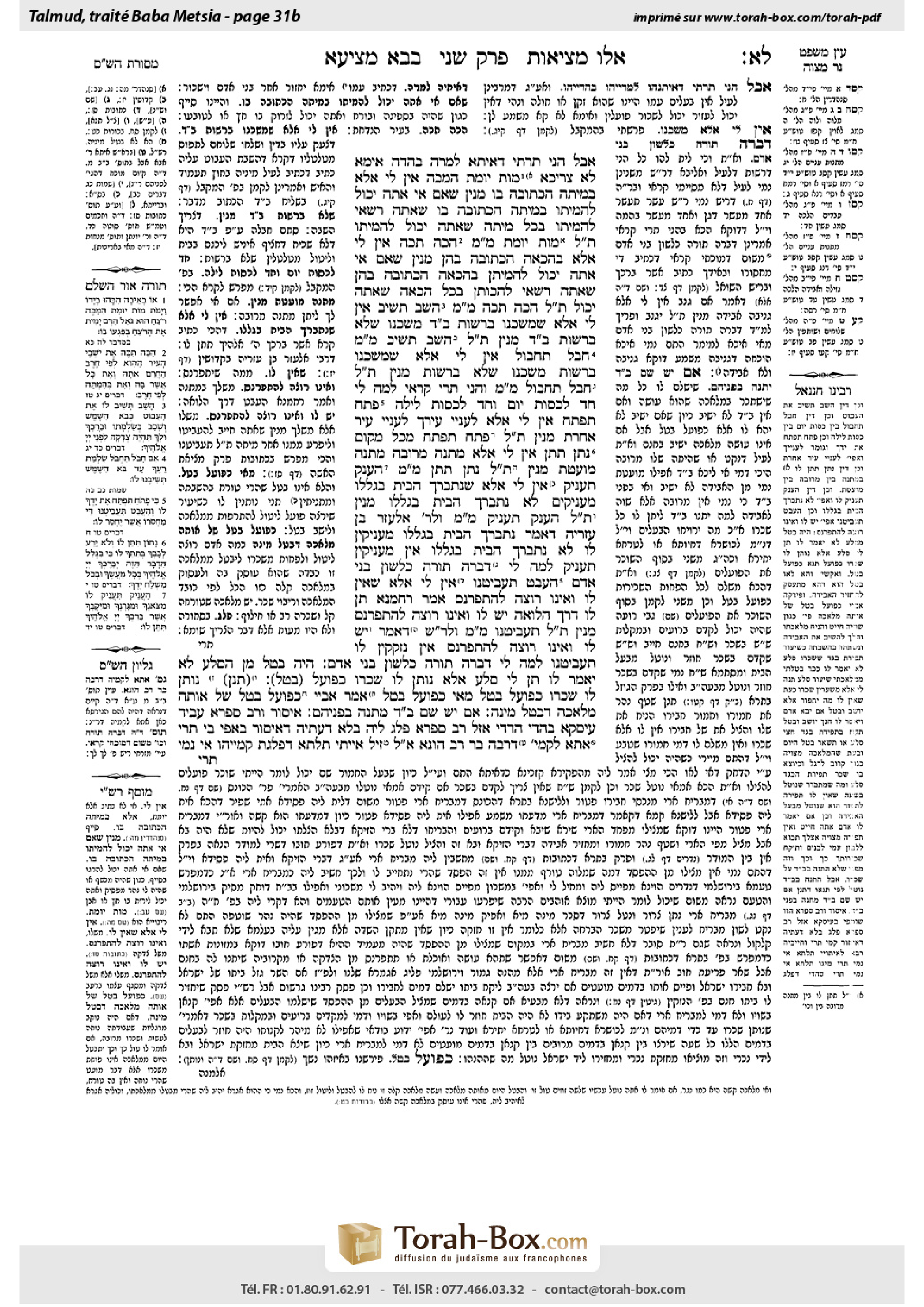
Bava Metzia 31b: Talmud study for Daf Yomi
Study the Talmud for Daf Yomi with scanned pages, Hebrew text, English translations from Sefaria and AI-generated French translations.
Passage selection and English or AI-generated French translation are available where the scan has annotations. Daf Study is independent of Torah-Box and Sefaria.
Browse Bava Metzia · בבא מציעא · All tractatesBava Metzia 31b text and translations
This page of Bava Metzia includes the Aramaic text, an English translation and an AI-generated French translation, alongside the scan above.
בבא מציעא ל״א ב · Aramaic and Hebrew text
אֲבָל הָנֵי תַּרְתֵּי דְּאִיתֵאּ לְמָרַהּ בַּהֲדַהּ, אֵימָא לָא. צְרִיכָא.
״מוֹת יוּמַת הַמַּכֶּה״, אֵין לִי אֶלָּא בְּמִיתָה הַכְּתוּבָה בּוֹ. מִנַּיִן שֶׁאִם אִי אַתָּה יָכוֹל לַהֲמִיתוֹ בְּמִיתָה הַכְּתוּבָה בּוֹ שֶׁאַתָּה רַשַּׁאי לַהֲמִיתוֹ בְּכׇל מִיתָה שֶׁאַתָּה יָכוֹל לַהֲמִיתוֹ? תַּלְמוּד לוֹמַר: ״מוֹת יוּמַת״, מִכׇּל מָקוֹם.
״הַכֵּה תַכֶּה״, אֵין לִי אֶלָּא בְּהַכָּאָה הַכְּתוּבָה בָּהֶן, מִנַּיִן שֶׁאִם אִי אַתָּה יָכוֹל לַהֲמִיתָן בְּהַכָּאָה הַכְּתוּבָה בָּהֶן שֶׁאַתָּה רַשַּׁאי לְהַכּוֹתָן בְּכׇל הַכָּאָה שֶׁאַתָּה יָכוֹל? תַּלְמוּד לוֹמַר ״הַכֵּה תַכֶּה״, מִכׇּל מָקוֹם.
״הָשֵׁב תָּשִׁיב״, אֵין לִי אֶלָּא שֶׁמִּשְׁכְּנוֹ בִּרְשׁוּת בֵּית דִּין. מִשְׁכְּנוֹ שֶׁלֹּא בִּרְשׁוּת בֵּית דִּין, מִנַּיִן? תַּלְמוּד לוֹמַר: ״הָשֵׁב תָּשִׁיב״, מִכׇּל מָקוֹם.
״חָבֹל תַּחְבֹּל״, אֵין לִי אֶלָּא שֶׁמִּשְׁכְּנוֹ בִּרְשׁוּת. מִשְׁכְּנוֹ שֶׁלֹּא בִּרְשׁוּת, מִנַּיִן? תַּלְמוּד לוֹמַר: ״חָבֹל תַּחְבֹּל״, מִכׇּל מָקוֹם.
וְהָנֵי תְּרֵי קְרָאֵי לְמָה לִי? חַד לִכְסוּת יוֹם, וְחַד לִכְסוּת לַיְלָה.
״פָּתֹחַ תִּפְתַּח״, אֵין לִי אֶלָּא לַעֲנִיֵּי עִירֶךָ. לַעֲנִיֵּי עִיר אַחֶרֶת, מִנַּיִן? תַּלְמוּד לוֹמַר: ״פָּתֹחַ תִּפְתַּח״, מִכׇּל מָקוֹם.
״נָתֹן תִּתֵּן״, אֵין לִי אֶלָּא מַתָּנָה מְרוּבָּה. מַתָּנָה מוּעֶטֶת, מִנַּיִן? תַּלְמוּד לוֹמַר: ״נָתֹן תִּתֵּן״, מִכׇּל מָקוֹם.
״הַעֲנֵיק תַּעֲנִיק״, אֵין לִי אֶלָּא שֶׁנִּתְבָּרֵךְ הַבַּיִת בִּגְלָלוֹ מַעֲנִיקִין. לֹא נִתְבָּרֵךְ הַבַּיִת בִּגְלָלוֹ, מִנַּיִן? תַּלְמוּד לוֹמַר ״הַעֲנֵיק תַּעֲנִיק״, מִכׇּל מָקוֹם.
וּלְרַבִּי אֶלְעָזָר בֶּן עֲזַרְיָה, דְּאָמַר: נִתְבָּרֵךְ הַבַּיִת בִּגְלָלוֹ – מַעֲנִיקִין לוֹ, לֹא נִתְבָּרֵךְ הַבַּיִת בִּגְלָלוֹ – אֵין מַעֲנִיקִין, ״תַּעֲנִיק״ לְמָה לִי? דִּבְּרָה תוֹרָה כִּלְשׁוֹן בְּנֵי אָדָם.
״הַעֲבֵט תַּעֲבִיטֶנּוּ״, אֵין לִי אֶלָּא שֶׁאֵין לוֹ וְאֵינוֹ רוֹצֶה לְהִתְפַּרְנֵס, אָמַר רַחֲמָנָא: תֵּן לוֹ דֶּרֶךְ הַלְוָאָה. יֵשׁ לוֹ וְאֵינוֹ רוֹצֶה לְהִתְפַּרְנֵס, מִנַּיִן? תַּלְמוּד לוֹמַר: ״תַּעֲבִיטֶנּוּ״, מִכׇּל מָקוֹם.
וּלְרַבִּי שִׁמְעוֹן דְּאָמַר: יֵשׁ לוֹ וְאֵינוֹ רוֹצֶה לְהִתְפַּרְנֵס אֵין נִזְקָקִין לוֹ, ״תַּעֲבִיטֶנּוּ״ לְמָה לִי? דִּבְּרָה תוֹרָה כִּלְשׁוֹן בְּנֵי אָדָם.
הָיָה בָּטֵל מִן הַסֶּלַע, לֹא יֹאמַר לוֹ ״תֵּן לִי סֶלַע״, אֶלָּא נוֹתֵן לוֹ שְׂכָרוֹ כְּפוֹעֵל (בָּטֵל). תְּנַן: נוֹתֵן לוֹ שְׂכָרוֹ כְּפוֹעֵל בָּטֵל.
מַאי כְּפוֹעֵל בָּטֵל? אָמַר אַבָּיֵי: כְּפוֹעֵל בָּטֵל שֶׁל אוֹתָהּ מְלָאכָה, דִּבְטַל מִינַּהּ.
אִם יֵשׁ שָׁם בֵּית דִּין – מַתְנֶה בִּפְנֵיהֶם. אִיסּוּר וְרַב סָפְרָא עֲבֻיד עִיסְקָא בַּהֲדֵי הֲדָדֵי. אֲזַל רַב סָפְרָא פְּלַג לֵיהּ בְּלָא דַּעְתֵּיהּ דְּאִיסּוּר בְּאַפֵּי בֵּי תְרֵי. אֲתָא לְקַמֵּיהּ דְּרַבָּה בַּר רַב הוּנָא, אֲמַר לֵיהּ: זִיל אַיְיתִי תְּלָתָא דִּפְלַגְתְּ קַמַּיְיהוּ, אִי נָמֵי
Bava Metzia 31b · English translation
but in the case of these two mitzvot of unloading and loading, where its owner is with it, I might say no, there is no need to assist him. Therefore, it was necessary for the Torah to write both.
§ The Gemara cites additional derivations from compound verb forms. “Or in enmity struck him with his hand, that he died; he that struck him shall be put to death [mot yumat]” (Numbers 35:21). I have derived only that the murderer is executed with the form of death written with regard to him, i.e., decapitation. From where is it derived that if you are unable to execute him with the form of death written with regard to him, it is permitted for you to execute him with any death with which you are able to execute him? The verse states: “Mot yumat,” to teach that you must execute him in any case.
With regard to an idolatrous city, it is written: “You shall strike [hakeh takeh] the inhabitants of that city by sword, destroying it utterly” (Deuteronomy 13:16). I have derived only that the residents of the idolatrous city are executed with the form of death written with regard to them, i.e., decapitation. From where is it derived that if you are unable to execute them with the form of death written with regard to them, it is permitted for you to execute them with any death with which you are able to execute them? The verse states: “Hakeh takeh,” to teach that you must execute him in any case.
With regard to an item that a poor person needs, e.g., a blanket, that a lender took as collateral when lending him money, it is written: “You shall restore [hashev tashiv] to him the pledge when the sun goes down, that he may sleep in his garment, and bless you; and it shall be righteousness for you before the Lord your God” (Deuteronomy 24:13). I have derived only the obligation to return his garment each night in a case where the lender took collateral with the sanction of the court. From where do I derive the obligation to return his garment each night even in a case where the lender took collateral without the sanction of the court? The verse states: “Hashev tashiv,” to teach that he must return it in any case.
The Gemara brings another derivation from a compound verb written with regard to returning collateral: “If you take as collateral [ḥavol taḥbol] your neighbor’s garment, you shall restore it to him until the sun sets” (Exodus 22:25). I have derived only the obligation to return his garment before sunset in a case where the lender took collateral with the sanction of the court. From where do I derive the obligation to return his garment each night even in a case where the lender took collateral without the sanction of the court? The verse states: “Ḥavol taḥbol,” to teach that he must return it in any case.
The Gemara asks: And with regard to these two verses, why do I need both of them to teach the same halakha, that one must return to the debtor any garment that he needs? The Gemara answers: One is referring to a garment worn during the day, and one is referring to a garment worn during the night (see 114b).
With regard to the mitzva of giving charity and granting loans, it is written: “For the poor shall never cease out of the land; therefore I command you, saying: You shall open [patoaḥ tiftaḥ] your hand to your poor and needy brother in your land” (Deuteronomy 15:11). I have derived only the obligation to give charity to the poor residents of your city. From where is the obligation to give charity to the poor residents of another city derived? The verse states: “Patoaḥ tiftaḥ,” to teach that you must give charity to the poor in any case.
With regard to the mitzva of giving charity it is written: “Beware…and your eye is stingy against your needy brother…You shall give [naton titten] him, and your heart shall not be grieved when you give unto him” (Deuteronomy 15:9–10). I have derived only the obligation to give a large gift. From where is the obligation to give even a small gift derived? The verse states: “Naton titten,” to teach that one must give gifts in any case, whether a large gift or a small one.
With regard to the release of a Hebrew slave it is written: “You shall furnish [ha’aneik ta’anik] him liberally from your flock, and from your threshing floor, and from your winepress; of that which the Lord your God has blessed you, you shall give unto him” (Deuteronomy 15:14). Based on the conclusion of the verse, I have derived only that when the house is blessed because of him, one furnishes the slave with gifts. From where have I derived the obligation to furnish him with gifts even when the house is not blessed because of him? The verse states: “Ha’aneik ta’anik,” to teach that one must furnish him with gifts in any case.
The Gemara asks: And according to Rabbi Elazar ben Azarya, who says: If the house is blessed because of him, one furnishes him with gifts, and if the house is not blessed because of him, one need not furnish him with gifts, why do I need a compound verb, “ha’aneik ta’anik”? The Gemara answers: The Torah speaks in the language of people. The compound verb is a common conversational style, and the Torah employs the same style. Rabbi Elazar ben Azarya holds there is nothing extraordinary about it and therefore, nothing may be derived from it.
With regard to the mitzva of lending money to the poor it is written: “But you shall open your hand to him, and you shall lend [ha’avet ta’avitennu] him sufficient for his need that he is lacking” (Deuteronomy 15:8). I have derived only that in a case where one does not have resources and does not want to be supported with charity, the Merciful One states: Provide for him by means of a loan. In a case where he has resources and he does not want to support himself with his resources, from where is the obligation to lend him money derived? The verse states: “Ta’avitennu,” to teach that you must grant him a loan in any case.
The Gemara asks: And according to Rabbi Shimon, who says that in a case where he has resources and does not want to support himself with his resources one is not obligated to attend to his needs, why do I need a doubled verb: “Ha’avet ta’avitennu”? The Gemara answers: The Torah speaks in the language of people and nothing may be derived from it.
§ The mishna teaches: If in the course of tending to and returning the lost item, the finder was idle from labor that would have earned him a sela, he shall not say to the owner of the item: Give me a sela to compensate me for my lost income. Rather, the owner gives him his wage as if he were a laborer. The Gemara cites that we learned in a baraita (Tosefta 4:11): The owner gives him his wage as if he were an idle laborer.
The Gemara asks: What is the meaning of: As if he were an idle laborer? In fact, he is not idle, but engaged in return of a lost item. Abaye said: It means that he is paid as a laborer who is idle from that typical labor of his from which he is kept idle. In other words, he must receive the amount of money a person would be willing to accept to refrain from his current occupation and engage in returning a lost item. This calculation accounts for both the degree of difficulty of his steady employment and the amount of his remuneration.
§ The mishna teaches: If there are three men there who can convene as a court, he may stipulate before the court that he will undertake to return the item provided that he receives full compensation for lost income. The Gemara relates: Issur and Rav Safra formed a joint venture with each other. Rav Safra went and dissolved their partnership without Issur’s knowledge in the presence of two witnesses. Rav Safra came before Rabba bar Rav Huna in order to ratify the dissolution of the partnership. Rabba bar Rav Huna said to him: Go and bring me the court of three before whom you dissolved your partnership. Alternatively, you may bring
Bava Metzia 31b · Traduction française (IA)
mais dans le cas de ces deux mitsvot de déchargement et de chargement, où son propriétaire est présent, je pourrais dire non, il n'y a pas besoin d'assister. Il fallait donc que la Torah ait écrit les deux.
§ La Guemara cite d'autres dérivation d'expressions verbales composées. « Ou en haine il le frappa avec sa main, qu'il mourut ; celui qui le frappa sera mis à mort [mot yumat] » (Nombres 35:21). J'ai dérivé seulement que le meurtrier est exécuté selon la forme de mort écrite à son égard, c'est-à-dire la décapitation. D'où est dérivé que si vous ne pouvez pas l'exécuter selon la forme de mort écrite à son égard, il est permis de l'exécuter selon toute forme de mort que vous pouvez utiliser ? La versette dit : « Mot yumat », pour enseigner que vous devez l'exécuter en tout cas.
Concernant une ville idolâtre, il est écrit : « Vous frapperez [hakeh takeh] les habitants de cette ville avec l'épée, la détruisant entièrement » (Deutéronome 13:16). J'ai dérivé seulement que les habitants de la ville idolâtre sont exécutés selon la forme de mort écrite à leur égard, c'est-à-dire la décapitation. D'où est dérivé que si vous ne pouvez pas les exécuter selon la forme de mort écrite à leur égard, il est permis de les exécuter selon toute forme de mort que vous pouvez utiliser ? La versette dit : « Hakeh takeh », pour enseigner que vous devez les exécuter en tout cas.
Concernant un objet dont un pauvre a besoin, par exemple un manteau, que le prêteur a pris comme caution lorsqu'il lui a prêté de l'argent, il est écrit : « Vous rendrez [hashev tashiv] à lui la caution quand le soleil se couchera, afin qu'il dorme dans son vêtement, et qu'il bénisse le Seigneur ; et cela sera droit pour toi devant l'Éternel votre Dieu » (Deutéronome 24:13). J'ai dérivé seulement l'obligation de rendre son manteau chaque soir dans le cas où le prêteur a pris la caution avec l'autorisation du tribunal. D'où dérive-t-on l'obligation de rendre son manteau chaque soir même dans le cas où le prêteur a pris la caution sans l'autorisation du tribunal ? La versette dit : « Hashev tashiv », pour enseigner qu'il doit le rendre en tout cas.
La Guemara rapporte une autre dérivation d'une expression verbale composée concernant le retour de la caution : « Si tu prends comme caution [ḥavol taḥbol] le manteau de ton voisin, tu rendras à lui ce manteau jusqu'au coucher du soleil » (Exode 22:25). J'ai dérivé seulement l'obligation de rendre son manteau avant le coucher du soleil dans le cas où le prêteur a pris la caution avec l'autorisation du tribunal. D'où dérive-t-on l'obligation de rendre son manteau chaque soir même dans le cas où le prêteur a pris la caution sans l'autorisation du tribunal ? La versette dit : « Ḥavol taḥbol », pour enseigner qu'il doit le rendre en tout cas.
La Guemara pose la question : Et concernant ces deux versets, pourquoi ai-je besoin des deux pour enseigner la même halakha, à savoir qu'on doit rendre à l'emprunteur tout vêtement dont il a besoin ? La Guemara répond : l'un parle d'un vêtement porté pendant la journée, et l'autre d'un vêtement porté pendant la nuit (voir 114b).
Concernant la mitsva de donner des aumônes et de prêter de l'argent, il est écrit : « Car le pauvre ne cessera jamais de la terre ; donc je commande que tu dises : Ouvre [patoaḥ tiftaḥ] ta main à ton frère pauvre et nécessiteux dans ta terre » (Deutéronome 15:11). J'ai dérivé seulement l'obligation de donner des aumônes aux pauvres habitants de ta ville. D'où dérive-t-on l'obligation de donner des aumônes aux pauvres habitants d'une autre ville ? La versette dit : « Patoaḥ tiftaḥ », pour enseigner que tu dois donner des aumônes aux pauvres en tout cas.
Concernant la mitsva de donner des aumônes, il est écrit : « Garde-toi… et ton œil est jaloux envers ton frère pauvre… Donne [naton Tunisia] lui, et ton cœur ne sera pas triste quand tu donnes à lui » (Deutéronome 15:9–10). J'ai dérivé seulement l'obligation de donner un don important. D'où dérive-t-on l'obligation de donner même un petit don ? La versette dit : « Naton Tunisia », pour enseigner qu'on doit donner des dons en tout cas, qu'il s'agisse d'un don important ou d'un petit don.
Concernant la mitsva de libérer un serviteur israélite, il est écrit : « Tu fourniras [ha’aneik ta’anik] à lui généreusement de ton troupeau, et de ton moulin, et de ton vin ; de ce que l'Éternel ton Dieu a béni toi, tu donneras à lui » (Deutéronome 15:14). Selon la conclusion de la versette, j'ai dérivé seulement que lorsque la maison est bénie à cause de lui, on fournit au serviteur des dons. D'où ai-je dérivé l'obligation de fournir des dons même lorsque la maison n'est pas bénie à cause de lui ? La versette dit : « Ha’aneik ta’anik », pour enseigner qu'on doit fournir des dons en tout cas.
La Guemara pose la question : Et selon Rabbi Elazar ben Azarya, qui dit : Si la maison est bénie à cause de lui, on lui offre des dons, et si la maison n'est pas bénie à cause de lui, on n'a pas besoin de lui offrir des dons, pourquoi ai-je besoin d'une expression verbale composée, « ha’aneik ta’anik » ? La Guemara répond : La Torah parle dans la langue des gens. L'expression verbale composée est un style de conversation courant, et la Torah l'utilise ainsi. Rabbi Elazar ben Azarya considère qu'il n'y a rien d'exceptionnel à cela et donc, rien ne peut en être dérivé.
Concernant la mitsva de prêter de l'argent au pauvre, il est écrit : « Mais tu ouvriras ta main à lui, et tu prêteras [ha’avet ta’avitennu] à lui suffisamment pour sa nécessité qu'il manque » (Deutéronome 15:8). J'ai dérivé seulement que dans le cas où l'on n'a pas de ressources et qu'on ne veut pas être soutenu par des aumônes, l'Éternel Miséricordieux dit : Fournis-lui par un prêt. Dans le cas où il a des ressources et qu'il ne veut pas se soutenir avec ses ressources, d'où dérive-t-on l'obligation de lui prêter de l'argent ? La versette dit : « Ta’avitennu », pour enseigner qu'on doit lui prêter en tout cas.
Le Guemara pose la question : Et selon Rabbi Shimon, qui dit que dans un cas où l'on a des ressources et qu'on ne veut pas se maintenir grâce à ses ressources, on n'est pas tenu de s'occuper de ses besoins, pourquoi a-t-on besoin d'un verbe double : « Ha’avet ta’avitennu » ? Le Guemara répond : La Torah parle dans la langue des gens et rien ne peut en être déduit.
§ La mitsna enseigne : Si, pendant l'entretien et le retour d'un objet perdu, le trouvère a perdu un sela de revenu en raison d'un travail qu'il aurait pu faire, il ne doit pas dire au propriétaire de l'objet : Donnez-moi un sela pour compenser ma perte. Au contraire, le propriétaire lui donne son salaire comme s'il était un ouvrier. Le Guemara cite que nous avons appris dans une baraïta (Tosefta 4:11) : Le propriétaire lui donne son salaire comme s'il était un ouvrier inactif.
Le Guemara pose la question : Quelle est la signification de : Comme s'il était un ouvrier inactif ? En réalité, il n'est pas inactif, mais engagé dans le retour d'un objet perdu. Abaye dit : Cela signifie qu'il est payé comme un ouvrier inactif de son travail habituel, duquel il est maintenu inactif. En d'autres termes, il doit recevoir la somme d'argent que quelqu'un accepterait pour renoncer à son occupation actuelle et s'engager dans le retour d'un objet perdu. Ce calcul tient compte à la fois de la difficulté de son emploi habituel et de son salaire.
§ La mitsna enseigne : Si trois hommes sont présents qui peuvent former un tribunal, il peut stipuler devant le tribunal qu'il s'engage à rendre l'objet à condition qu'il reçoive une compensation complète pour sa perte de revenu. Le Guemara rapporte : Issur et Rav Safra ont formé une association commune entre eux. Rav Safra est allé dissoudre leur partenariat sans la connaissance d'Issur devant deux témoins. Rav Safra est venu devant Rabba bar Rav Huna afin de valider la dissolution du partenariat. Rabba bar Rav Huna a dit à lui : Allez chercher le tribunal de trois devant qui vous avez dissous votre partenariat. Ou bien, vous pouvez apporter
Traduction française générée par IA à partir de l’édition anglaise de Sefaria. Vérifie toujours un passage avec le texte source.
Text from Sefaria: William Davidson Edition - Vocalized Aramaic (CC BY NC); William Davidson Edition - English (CC BY NC).