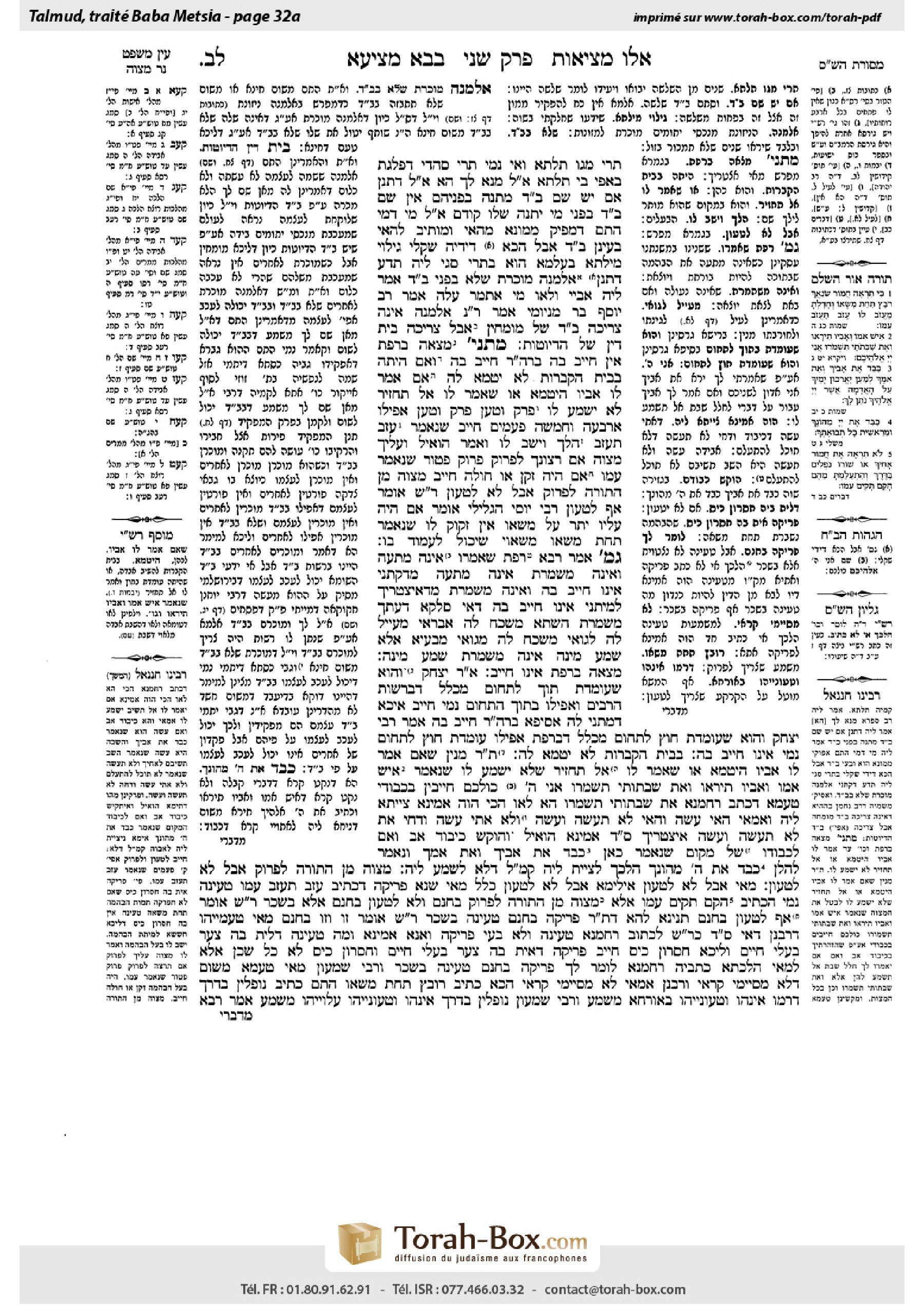
Bava Metzia 32a: Talmud study for Daf Yomi
Study the Talmud for Daf Yomi with scanned pages, Hebrew text, English translations from Sefaria and AI-generated French translations.
Passage selection and English or AI-generated French translation are available where the scan has annotations. Daf Study is independent of Torah-Box and Sefaria.
Browse Bava Metzia · בבא מציעא · All tractatesBava Metzia 32a text and translations
This page of Bava Metzia includes the Aramaic text, an English translation and an AI-generated French translation, alongside the scan above.
בבא מציעא ל״ב א · Aramaic and Hebrew text
תְּרֵי מִגּוֹ תְּלָתָא, וְאִי נָמֵי תְּרֵי סָהֲדִי דִּפְלַגְתְּ בְּאַפֵּי בֵּי תְלָתָא.
אֲמַר לֵיהּ: מְנָא לָךְ הָא? אֲמַר לֵיהּ, דִּתְנַן: אִם יֵשׁ שָׁם בֵּית דִּין – מַתְנֶה בִּפְנֵיהֶם, אֵין שָׁם בֵּית דִּין – בִּפְנֵי מִי יַתְנֶה? שֶׁלּוֹ קוֹדֵם.
אֲמַר לֵיהּ: מִי דָּמֵי?! הָתָם דְּמַפֵּיק מָמוֹנָא מֵהַאי וּמוֹתֵיב לְהַאי בָּעֵינַן בֵּית דִּין, אֲבָל הָכָא דִּידִיה שְׁקַלִי גִּילּוּי מִילְּתָא בְּעָלְמָא הוּא בִּתְרֵי סַגִּי לֵיהּ. תִּדַּע, דִּתְנַן: אַלְמָנָה מוֹכֶרֶת שֶׁלֹּא בִּפְנֵי בֵּית דִּין!
אֲמַר לֵיהּ אַבָּיֵי: וְלָאו מִי אִתְּמַר עֲלַהּ ״אָמַר רַב יוֹסֵף בַּר מִנְיוֹמֵי אָמַר רַב נַחְמָן: אַלְמָנָה אֵינָהּ צְרִיכָה בֵּית דִּין שֶׁל מוּמְחִין, אֲבָל צְרִיכָה בֵּית דִּין שֶׁל הֶדְיוֹטוֹת״?
מַתְנִי׳ מְצָאָהּ בָּרֶפֶת – אֵין חַיָּיב בָּהּ. בִּרְשׁוּת הָרַבִּים – חַיָּיב בָּהּ. וְאִם הָיְתָה בְּבֵית הַקְּבָרוֹת – לֹא יִטַּמֵּא לָהּ. אִם אָמַר לוֹ אָבִיו ״הִיטַּמֵּא״, אוֹ שֶׁאָמַר לוֹ ״אַל תַּחְזִיר״ – לֹא יִשְׁמַע לוֹ.
פָּרַק וְטָעַן, פָּרַק וְטָעַן, אֲפִילּוּ אַרְבָּעָה וַחֲמִישָׁה פְּעָמִים – חַיָּיב, שֶׁנֶּאֱמַר ״עָזֹב תַּעֲזֹב״.
הָלַךְ וְיָשַׁב לוֹ, וְאָמַר: ״הוֹאִיל וְעָלֶיךָ מִצְוָה, אִם רְצוֹנְךָ לִפְרוֹק – פְּרוֹק״ – פָּטוּר, שֶׁנֶּאֱמַר: ״עִמּוֹ״. אִם הָיָה זָקֵן אוֹ חוֹלֶה – חַיָּיב.
מִצְוָה מִן הַתּוֹרָה לִפְרוֹק אֲבָל לֹא לִטְעוֹן. רַבִּי שִׁמְעוֹן אוֹמֵר: אַף לִטְעוֹן.
רַבִּי יוֹסֵי הַגְּלִילִי אוֹמֵר: אִם הָיָה עָלָיו יָתֵר עַל מַשָּׂאוֹ – אֵין זָקוּק לוֹ, שֶׁנֶּאֱמַר ״תַּחַת מַשָּׂאוֹ״, מַשּׂאוֹי שֶׁיָּכוֹל לַעֲמוֹד בּוֹ.
גְּמָ׳ אָמַר רָבָא: רֶפֶת שֶׁאָמְרוּ אֵינָהּ מַתְעָה וְאֵינָהּ מְשַׁמֶּרֶת. אֵינָהּ מַתְעָה, מִדְּקָתָנֵי ״אֵינוֹ חַיָּיב בָּהּ״. וְאֵינָהּ מְשַׁמֶּרֶת, מִדְּאִיצְטְרִיךְ לְמִיתְנֵי ״אֵינוֹ חַיָּיב בָּהּ״.
דְּאִי סָלְקָא דַעְתָּךְ מְשַׁמֶּרֶת, הַשְׁתָּא מַשְׁכַּח לָהּ אַבָּרַאי מְעַיֵּיל לַהּ לְגַוַּאי, מַשְׁכַּח לַהּ מִגַּוַּאי מִבַּעְיָא? אֶלָּא שְׁמַע מִינַּהּ: אֵינָהּ מְשַׁמֶּרֶת, שְׁמַע מִינַּהּ.
מְצָאָהּ בָּרֶפֶת אֵינוֹ חַיָּיב. אָמַר רַבִּי יִצְחָק: וְהוּא שֶׁעוֹמֶדֶת תּוֹךְ לַתְּחוּם. מִכְּלָל, דְּבִרְשׁוּת הָרַבִּים וַאֲפִילּוּ בְּתוֹךְ הַתְּחוּם – נָמֵי חַיָּיב.
אִיכָּא דְּמַתְנֵי לַהּ אַסֵּיפָא: בִּרְשׁוּת הָרַבִּים חַיָּיב בָּהּ. אָמַר רַבִּי יִצְחָק: וְהוּא שֶׁעוֹמֶדֶת חוּץ לַתְּחוּם. מִכְּלַל, דְּבָרֶפֶת אֲפִילּוּ עוֹמֶדֶת חוּץ לַתְּחוּם – נָמֵי אֵינוֹ חַיָּיב בָּהּ.
בְּבֵית הַקְּבָרוֹת לֹא יִטַּמֵּא לָהּ. תָּנוּ רַבָּנַן: מִנַּיִן שֶׁאִם אָמַר לוֹ אָבִיו ״הִיטַּמֵּא״, אוֹ שֶׁאָמַר לוֹ ״אַל תַּחְזִיר״ שֶׁלֹּא יִשְׁמַע לוֹ? שֶׁנֶּאֱמַר: ״אִישׁ אִמּוֹ וְאָבִיו תִּירָאוּ וְאֶת שַׁבְּתוֹתַי תִּשְׁמֹרוּ אֲנִי ה׳״, כּוּלְּכֶם חַיָּיבִין בִּכְבוֹדִי.
טַעְמָא דִּכְתַב רַחֲמָנָא ״אֶת שַׁבְּתוֹתַי תִּשְׁמֹרוּ״ הָא לָאו הָכִי הֲוָה אָמֵינָא (צָיְיתָא) [נֵיצִית] לֵיהּ? וְאַמַּאי? הַאי עֲשֵׂה, וְהַאי לֹא תַעֲשֶׂה וַעֲשֵׂה – וְלָא אָתֵי עֲשֵׂה וְדָחֵי אֶת לֹא תַעֲשֶׂה וַעֲשֵׂה!
אִיצְטְרִיךְ. סָלְקָא דַּעְתָּךְ אָמֵינָא: הוֹאִיל וְהוּקַּשׁ כִּיבּוּד אָב וָאֵם לִכְבוֹדוֹ שֶׁל מָקוֹם, שֶׁנֶּאֱמַר כָּאן ״כַּבֵּד אֶת אָבִיךָ וְאֶת אִמֶּךָ״, וְנֶאֱמַר לְהַלָּן ״כַּבֵּד אֶת ה׳ מֵהוֹנֶךָ״, הִלְכָּךְ לֵצִיית לֵיהּ, קָא מַשְׁמַע לַן דְּלָא לִשְׁמַע לֵיהּ.
מִצְוָה מִן הַתּוֹרָה לִפְרוֹק אֲבָל לֹא לִטְעוֹן. מַאי אֲבָל לֹא לִטְעוֹן? אִילֵימָא אֲבָל לֹא לִטְעוֹן כְּלָל, מַאי שְׁנָא פְּרִיקָה, דִּכְתִיב ״עָזֹב תַּעֲזֹב עִמּוֹ״, טְעִינָה נָמֵי הָכְתִיב ״הָקֵם תָּקִים עִמּוֹ״!
אֶלָּא: מִצְוָה מִן הַתּוֹרָה לִפְרוֹק בְּחִנָּם, וְלֹא לִטְעוֹן בְּחִנָּם אֶלָּא בְּשָׂכָר. רַבִּי שִׁמְעוֹן אוֹמֵר: אַף לִטְעוֹן בְּחִנָּם. תְּנֵינָא לְהָא דְּתָנוּ רַבָּנַן: פְּרִיקָה בְּחִנָּם, טְעִינָה בְּשָׂכָר. רַבִּי שִׁמְעוֹן אוֹמֵר: זוֹ וָזוֹ בְּחִנָּם.
מַאי טַעְמַיְיהוּ דְּרַבָּנַן? דְּאִי סָלְקָא דַעְתָּךְ כְּרַבִּי שִׁמְעוֹן, לִכְתּוֹב רַחֲמָנָא טְעִינָה וְלָא בָּעֵי פְּרִיקָה. וַאֲנָא אָמֵינָא: וּמָה טְעִינָה דְּלֵית בַּהּ צַעַר בַּעֲלֵי חַיִּים וְלֵיכָּא חֶסְרוֹן כִּיס – חַיָּיב, פְּרִיקָה דְּאִית בָּהּ צַעַר בַּעֲלֵי חַיִּים וְחֶסְרוֹן כִּיס, לֹא כׇּל שֶׁכֵּן?! אֶלָּא לְמַאי הִלְכְתָא כַּתְבֵיהּ רַחֲמָנָא? לוֹמַר לָךְ: פְּרִיקָה בְּחִנָּם, טְעִינָה בְּשָׂכָר.
וְרַבִּי שִׁמְעוֹן מַאי טַעְמָא? מִשּׁוּם דְּלָא מְסַיְּימִי קְרָאֵי.
וְרַבָּנַן אַמַּאי לָא מְסַיְּימִי קְרָאֵי? הָכָא כְּתִיב ״רוֹבֵץ תַּחַת מַשָּׂאוֹ״, הָתָם כְּתִיב ״נוֹפְלִין בַּדֶּרֶךְ״, דִּרְמוּ אִינְהוּ וּטְעוּנַיְיהוּ בְּאוֹרְחָא מַשְׁמַע. וְרַבִּי שִׁמְעוֹן: ״נוֹפְלִין בַּדֶּרֶךְ״ אִינְהוּ וּטְעוּנַיְיהוּ עִלָּוַיְיהוּ מַשְׁמַע.
אָמַר רָבָא:
Bava Metzia 32a · English translation
two of the three of them to testify that you dissolved the partnership before them. Or alternatively, bring two witnesses to testify that you dissolved the partnership before a court of three.
Rav Safra said to Rabba bar Rav Huna: From where do you know this halakha, that dissolution of the partnership may be accomplished only before a court? Rabba bar Rav Huna said to him: It is as we learned in the mishna: If there are three men there who can convene as a court, he may stipulate before the court that he will undertake to return the item provided that he receives full compensation for lost income. But if there is no court there, before whom can he stipulate his condition? Rather, in that case, his financial interests take precedence, and he need not return the lost item. Apparently, one stipulates binding conditions with regard to another’s property only before a court.
Rav Safra said to Rabba bar Rav Huna: Is that case in the mishna comparable to this case? There, where he is removing property from the possession of this person and giving it to that person, we require a court. But here, referring to himself in the third person, he is merely taking his own property, and not the property of any other person. There is no transaction effected here. It is mere disclosure of the matter that he divided the joint property equitably, and two witnesses are sufficient for him to disclose that fact. Rav Safra cites proof. Know that this is so, as we learned in a mishna (Ketubot 97a) that a widow owed sustenance from her husband’s estate sells the property of the estate when not before a court. Apparently, one need not involve the court when reclaiming property that belongs to him.
Abaye said to him: But wasn’t it stated with regard to that mishna that Rav Yosef bar Minyumi says that Rav Naḥman says: The court before which a widow sells the property of the estate need not be a court of experts, but is required to be at least a court of laymen. Therefore, as in the parallel case of the widow, even when disclosing that one took property belonging to him, two witnesses are not sufficient and a court is required.
MISHNA: If one found an animal in a stable belonging to its owner, he is not obligated to return it to its owner. If he found it in a public area, he is obligated to return it. And if the animal was lost in a graveyard and a priest found it, he may not become impure to return it. If his father said to him: Become impure; or in a case where one was obligated to return the animal and his father said to him: Do not return it, he may not listen to his father, as one may not violate Torah law to honor his father.
If one unloaded a burden from an animal collapsing under its weight and then later loaded it onto the animal, and later unloaded and loaded it again, even if this scenario repeats itself four or five times, he is obligated to continue unloading and loading, as it is stated: “If you see the donkey of him that hates you collapsed under its burden, you shall forgo passing him by; you shall release it [azov ta’azov] with him” (Exodus 23:5). It is derived from the verse that one is obligated to perform the action as needed, even several times.
If the owner went, and sat, and said to a passerby: Since there is a mitzva incumbent upon you to unload the burden, if it is your wish to unload the burden, unload it, in such a case the passerby is exempt, as it is stated: “You shall release it with him,” with the owner of the animal. If the failure of the owner to participate in unloading the burden was due to the fact he was old or infirm, the passerby is obligated to unload the burden alone.
There is a mitzva by Torah law to unload a burden, but there is no mitzva to load it. Rabbi Shimon says: There is even a mitzva to load the burden.
Rabbi Yosei HaGelili says: If there was a burden upon the animal greater than its typical burden, one need not attend to it, as it is stated: “Under its burden,” i.e., the obligation is with regard to a burden that the animal can bear.
GEMARA: The mishna teaches that if one found an animal in a stable, he need not return it to its owner. Rava said: The stable that the Sages mentioned in the mishna is one that neither encourages the animal to stray nor secures the animal so it will not flee. The Gemara explains Rava’s statement. That it does not encourage the animal to stray is learned from the fact that the tanna teaches: He is not obligated in its return. The fact that it does not secure the animal is learned from the fact that it was necessary for the tanna to teach: He is not obligated in its return.
The Gemara continues its explanation of Rava’s statement: As, if it enters your mind to say that it is a stable that secures the animal, that ruling would be extraneous. Now that in a case where one found the animal outside a stable he brings it inside a stable of that type and thereby returns the animal to its owner, in a case where he found the animal inside the stable is it necessary to teach that he is not obligated to return it to its owner? Rather, learn from it that the stable mentioned in the mishna does not secure the animal and therefore there is a possibility that one must return it. The Gemara affirms: Indeed, learn from it that it is a stable that neither encourages the animal to stray nor secures the animal.
§ The mishna teaches: If one found an animal in a stable belonging to its owner, he is not obligated to return it. Rabbi Yitzḥak says: And that is the halakha only in a case where the animal is standing within the city limits. The Gemara concludes by inference that if the animal was found in a public area he is obligated to return it, and even if it was within the city limits, he is also obligated to return it.
There are those who teach this statement with regard to the latter clause of the mishna: If he found it in a public area, he is obligated to return it. Rabbi Yitzḥak says: And that is the halakha only in a case where the animal is standing beyond the city limits. The Gemara concludes by inference that in a case where the animal was found in the stable, even if the animal is standing beyond the city limits, he is also not obligated in its return.
§ The mishna teaches: And if the animal was lost in a graveyard and was found by a priest, he may not become impure to return it. In a case where a priest’s father said to him: Become impure, or in a case where one was obligated to return the animal and his father said to him: Do not return it, he may not listen to his father. The Gemara cites a baraita in which the Sages taught: From where is it derived that if a priest’s father said to him: Become impure, or that if one’s father said to him: Do not return a lost item that you found; he should not listen to him? It is derived from the verse, as it is stated: “Every man shall fear his mother and his father, and you shall observe My Shabbatot; I am the Lord” (Leviticus 19:3). From the fact that the verse concludes: “I am the Lord,” it is derived that: You are all, parent and child alike, obligated in My honor. Therefore, if a parent commands his child to refrain from observing a mitzva, he must not obey the command.
The Gemara infers: The reason that a priest must not obey his father’s command to become impure is because the Merciful One writes: “You shall observe My Shabbatot; I am the Lord”; but if it were not so, I would say that the child must obey him. The Gemara asks: But why? This obligation to obey a parent is a positive mitzva, as it is written: “Honor your father and your mother” (Exodus 20:12), and that obligation of a priest to refrain from becoming impure is both a prohibition: “To the dead among his people he shall not defile himself” (Leviticus 21:1), and a positive mitzva: “You shall be holy” (Leviticus 19:2); and the principle is that a positive mitzva does not come and override a prohibition and a positive mitzva.
The Gemara answers that the derivation from “You shall observe My Shabbatot; I am the Lord” was necessary, as it might enter your mind to say: Since honoring one’s father and mother is equated to the honor of the Omnipresent, as it is stated here: “Honor your father and your mother” (Exodus 20:12), and it is stated elsewhere: “Honor the Lord with your wealth” (Proverbs 3:9), therefore, one might have thought that the priest must obey his father’s command to become impure. Therefore the Torah teaches us that the priest is commanded not to listen to him.
§ The mishna teaches: There is a mitzva by Torah law to unload a burden, but there is no mitzva to load it. The Gemara asks: What is the meaning of the phrase: But there is no mitzva to load it? If we say that it means: But there is no mitzva to load it at all; what is different about unloading, with regard to which it is written: “You shall release it with him” (Exodus 23:5)? With regard to loading as well, isn’t it written: “You shall lift them with him” (Deuteronomy 22:4)?
The Gemara answers: Rather, there is a mitzva by Torah law to unload the burden for free, but there is no mitzva to load it for free; rather, the mitzva is performed with remuneration. Rabbi Shimon says: There is also a mitzva to load it for free. The Gemara states: We learn by inference from the mishna that which the Sages taught explicitly in a baraita: Unloading is performed for free, and loading is performed with remuneration. Rabbi Shimon said: Both this and that are performed for free.
The Gemara asks: What is the reason for the opinion of the Rabbis that there is a distinction between unloading and loading with regard to remuneration? The reason is that if it enters your mind that the halakha is in accordance with the opinion of Rabbi Shimon, let the Merciful One write only the mitzva of loading, and then He would need not write the mitzva of unloading, and I would say: Just as with regard to loading, where there is no potential suffering of animals and there is no potential monetary loss for the owner, one is obligated to load the burden, with regard to unloading, where there is potential suffering of animals and there is potential monetary loss for the owner, is it not all the more so clear that one is required to unload the burden? Rather, with regard to what halakha did the Merciful One write the mitzva of unloading? It is to tell you: The mitzva of unloading the burden is performed for free, but the mitzva of loading is performed with remuneration.
The Gemara asks: And according to Rabbi Shimon, who holds that even loading is performed for free, what is the reason that the Torah writes the mitzva of unloading? The Gemara answers: It is because the verses are not clearly defined, and it is unclear which of the verses refers to loading and which refers to unloading. Had the Torah written one verse, it would have been interpreted with regard to unloading, and there would be no source that one needs to load an animal.
And the Rabbis could ask: Why does Rabbi Shimon say that the verses are not clearly defined? Here it is written: “Collapsed under its burden” (Exodus 23:5), clearly referring to the case of a burden that needs unloading, and there it is written: “Fallen down by the way” (Deuteronomy 22:4), indicating that both the animals and their burdens are lying on the way and are in need of loading. And Rabbi Shimon explains that the verses are not defined because the phrase “fallen down by the way” could be understood as indicating that the animals are fallen with their burdens upon them, and referring to unloading.
Rava says:
Bava Metzia 32a · Traduction française (IA)
Deux des trois d'entre eux doivent témoigner que vous avez dissous la part de propriété avant eux. Ou bien, apporter deux témoins pour témoigner que vous avez dissous la part de propriété devant un tribunal de trois.
Rav Safra dit à Rabba bar Rav Huna : D'où savez-vous cette halakha, que la dissolution de la part de propriété peut être accomplie uniquement devant un tribunal ? Rabba bar Rav Huna répondit à lui : C'est comme nous avons appris dans la mitsna : Si trois hommes y sont présents qui peuvent former un tribunal, il peut stipuler devant le tribunal qu'il s'engage à rendre l'objet à condition qu'il reçoive une compensation pleine pour les pertes de revenus. Mais s'il n'y a pas de tribunal là, devant qui peut-il stipuler sa condition ? Plutôt, dans ce cas, ses intérêts financiers prennent precedence, et il n'a pas besoin de rendre l'objet perdu. Apparemment, on stipule des conditions engageantes concernant la propriété d'autrui uniquement devant un tribunal.
Rav Safra dit à Rabba bar Rav Huna : Ce cas dans la mitsna est-il comparable à ce cas ? Là, où il retire une propriété de la possession de cette personne et la donne à celle-ci, nous exigeons un tribunal. Mais ici, faisant référence à lui-même au troisième personne, il n'agit qu'en prenant sa propre propriété, et non la propriété d'une autre personne. Il n'y a pas de transaction ici. C'est simplement la divulgation de la division équitable de la propriété commune, et deux témoins suffisent pour lui divulguer ce fait. Rav Safra cite une preuve. Savez-vous que c'est ainsi, comme nous avons appris dans une mitsna (Ketubot 97a) qu'une veuve doit subvenir à ses besoins à partir de l'État de son époux vend la propriété de l'État sans être devant un tribunal. Apparemment, il n'est pas nécessaire d'impliquer le tribunal lors de la récupération d'une propriété qui lui appartient.
Abaye dit à lui : N'était-ce pas dit concernant cette mitsna que Rav Yosef bar Minyumi dit que Rav Naḥman dit : Le tribunal devant lequel une veuve vend la propriété de l'État n'a pas besoin d'être un tribunal d'experts, mais doit être au moins un tribunal de laïcs. Ainsi, comme dans le cas parallèle de la veuve, même lorsqu'on divulgue qu'on a pris une propriété qui lui appartient, deux témoins ne suffisent pas et un tribunal est requis.
MITSNA : Si l'on trouva un animal dans un étable appartenant à son propriétaire, il n'est pas tenu de le rendre à son propriétaire. Si l'on trouva cet animal dans un lieu public, il est tenu de le rendre. Et si l'animal était perdu dans un cimetière et un prêtre le trouva, il ne peut pas devenir impur pour le rendre. Si son père lui dit : Devenez impur ; ou dans un cas où l'on était tenu de rendre l'animal et son père lui dit : Ne le rendez pas, il ne doit pas écouter son père, car on ne peut pas enfreindre la loi divine pour honorer son père.
Si l'on décharge un fardeau d'un animal qui s'effondre sous son poids et ensuite charge à nouveau l'animal, et ensuite décharge et charge à nouveau, même si cette situation se répète quatre ou cinq fois, il est tenu de continuer à décharger et à charger, car il est dit : « Si tu vois le chameau de celui qui t'aime qui s'effondre sous son fardeau, tu devras passer outre ; tu devras le libérer avec lui [azov ta'azov] avec lui » (Exode 23:5). Cela est tiré de la parole, et l'on est tenu d'accomplir l'action autant de fois que nécessaire.
Si l'propriétaire est venu, s'est assis, et a dit à un passant : Puisque il y a une mitsva qui incombe à toi de décharger le fardeau, si c'est ton souhait de décharger le fardeau, décharge-le, dans ce cas le passant est exempt, car il est dit : « Tu devras le libérer avec lui », avec l'propriétaire de l'animal. Si l'échec de l'propriétaire à participer à la décharge du fardeau était dû au fait qu'il était âgé ou infirme, le passant est tenu de décharger le fardeau seul.
Il y a une mitsva selon la loi divine de décharger un fardeau, mais il n'y a pas de mitsva de le charger. Rabbi Shimon dit : Il y a même une mitsva de charger le fardeau.
Rabbi Yosei HaGelili dit : Si le fardeau sur l'animal était plus lourd que son fardeau habituel, on n'a pas besoin de s'en occuper, car il est dit : « Sous son fardeau », c'est-à-dire l'obligation est concernant un fardeau que l'animal peut porter.
GUEMARA : La mitsva enseigne que si l'on trouva un animal dans un étable, il n'est pas tenu de le rendre à son propriétaire. Rava dit : L'étable mentionné par les Sages dans la mitsva est celui qui neither encourage l'animal à s'éloigner ni sécurise l'animal afin qu'il ne s'échappe pas. La Guemara explique la déclaration de Rava. Que cela ne encourage pas l'animal à s'éloigner est appris du fait que le tanna enseigne : Il n'est pas tenu de le rendre. Le fait qu'il ne sécurise pas l'animal est appris du fait qu'il était nécessaire pour le tanna d'enseigner : Il n'est pas tenu de le rendre.
La Guemara continue son explication de la déclaration de Rava : Comme, si l'idée te vient de dire que c'est un étable qui sécurise l'animal, cette règle serait superflue. Maintenant, dans un cas où l'on trouva l'animal en dehors d'un étable, on le ramène dans un étable de ce type et ainsi on rend l'animal à son propriétaire, dans un cas où l'on trouva l'animal à l'intérieur de l'étable, est-il nécessaire d'enseigner que l'on n'est pas tenu de le rendre à son propriétaire ? Plutôt, apprends-en que l'étable mentionné dans la mitsva ne sécurise pas l'animal et donc il y a une possibilité qu'il doive être rendu. La Guemara confirme : En effet, apprends-en que c'est un étable qui neither encourage l'animal à s'éloigner ni sécurise l'animal et donc il y a une possibilité qu'il doive être rendu.
§ La mitsva enseigne : Si l'on trouva un animal dans un étable appartenant à son propriétaire, il n'est pas tenu de le rendre. Rabbi Yitzḥak dit : Et c'est la halakha uniquement dans le cas où l'animal est debout dans les limites de la ville. La Guemara conclut par déduction que si l'animal a été trouvé dans un lieu public, il est tenu de le rendre, et même s'il était à l'intérieur des limites de la ville, il est également tenu de le rendre.
Il y a ceux qui enseignent cette déclaration concernant la dernière clause de la mitsna : Si l'on trouve un objet dans un lieu public, on est tenu de le rendre. Rabbi Yitzhak dit : Et c'est la halakha uniquement dans le cas où l'animal est situé au-delà des limites de la ville. La Guemara conclut par déduction que dans le cas où l'animal a été trouvé dans l'étable, même s'il est situé au-delà des limites de la ville, on n'est pas tenu de le rendre.
§ La mitsna enseigne : Et si l'animal a été perdu dans un cimetière et a été trouvé par un prêtre, il ne peut pas devenir impur pour le rendre. Dans le cas où le père d'un prêtre lui dit : Devenez impur, ou dans le cas où l'on est tenu de rendre l'animal et que son père lui dit : Ne le rendez pas, il ne doit pas écouter son père. La Guemara cite une baraïta dans laquelle les Sages enseignent : D'où est tiré le fait que si le père d'un prêtre lui dit : Devenez impur, ou que si l'on dit à quelqu'un : Ne rendez pas un objet perdu que vous avez trouvé, il ne doit pas écouter ? C'est tiré de la parole : « Chacun craignera son père et sa mère, et tu observeras mes sabbats ; je suis le Seigneur » (Lévitique 19:3). Du fait que la parole conclut : « Je suis le Seigneur », on tire que : Vous êtes tous, père et fils, tenus à mon honneur. Ainsi, si un père commande à son fils de ne pas observer une mitsva, il ne doit pas obéir à la commande.
La Guemara infère : La raison pour laquelle un prêtre ne doit pas obéir à la commande de son père est que le Miséricordieux écrit : « Tu observeras mes sabbats ; je suis le Seigneur » ; mais si ce n'était pas le cas, je dirais que l'enfant doit obéir à son père. La Guemara demande : Mais pourquoi ? Cette obligation d'obéir à un père est une mitsva positive, comme il est écrit : « Honore ton père et ta mère » (Ex 20:12), et cette obligation du prêtre de ne pas devenir impur est à la fois une interdiction : « Il ne doit pas se salir parmi les morts de son peuple » (Lévitique 21:1), et une mitsva positive : « Tu seras saint » (Lévitique 19:2) ; et le principe est que une mitsva positive ne vient pas contredire une interdiction et une mitsva positive.
La Guemara répond que la déduction de « Tu observeras mes sabbats ; je suis le Seigneur » était nécessaire, car on pourrait penser que l'honneur du père est équivalent à l'honneur du Tout-Puissant, comme il est dit ici : « Honore ton père et ta mère » (Ex 20:12), et il est dit ailleurs : « Honore le Seigneur avec tes richesses » (Pr 3:9), donc on pourrait penser que le prêtre doit obéir à la commande de son père. Ainsi, la Torah nous enseigne que le prêtre est tenu de ne pas écouter.
§ La mitsna enseigne : Il y a une mitsva selon la Torah à décharger un fardeau, mais il n'y a pas de mitsva à le charger. La Guemara demande : Quelle est la signification de la phrase : Mais il n'y a pas de mitsva à le charger ? Si on dit que cela signifie : Mais il n'y a pas de mitsva à le charger du tout ; qu'est-ce qui diffère dans le cas de la décharge, concernant lequel il est écrit : « Tu le libères avec lui » (Ex 23:5) ? Concernant le chargement, n'est-il pas écrit : « Tu le soulèves avec lui » (Dt 22:4) ?
La Guemara répond : Plutôt, il y a une mitsva selon la Torah à décharger le fardeau gratuitement, mais il n'y a pas de mitsva à le charger gratuitement ; plutôt, la mitsva est accomplie avec rémunération. Rabbi Shimon dit : Il y a aussi une mitsva à le charger gratuitement. La Guemara dit : Nous apprenons par déduction de la mitsna ce que les Sages ont enseigné explicitement dans une baraïta : La décharge est accomplie gratuitement, et le chargement est accompli avec rémunération. Rabbi Shimon dit : Les deux sont accomplis gratuitement.
La Guemara demande : Quelle est la raison de l'opinion des Rabbins selon laquelle il y a une distinction entre la décharge et le chargement concernant la rémunération ? La raison est que si on pense que la halakha suit l'opinion de Rabbi Shimon, que le Miséricordieux écrive seulement la mitsva du chargement, et qu'il n'aurait pas besoin d'écrire la mitsva de la décharge, et je dirais : Tout comme concernant le chargement, où il n'y a pas de souffrance potentielle des animaux et pas de perte monétaire pour l'owner, on est tenu de charger le fardeau, concernant la décharge, où il y a une souffrance potentielle des animaux et une perte monétaire potentielle pour l'owner, n'est-ce pas encore plus clair que l'on est tenu de décharger le fardeau ? Plutôt, concernant quelle halakha le Miséricordieux a-t-il écrit la mitsva de la décharge ? C'est pour te dire : La mitsva de la décharge du fardeau est accomplie gratuitement, mais la mitsva du chargement est accomplie avec rémunération.
La Guemara demande : Et selon Rabbi Shimon, qui affirme que même le chargement est gratuit, quelle est la raison pour laquelle la Torah écrit la mitsva de la décharge ? La Guemara répond : C'est parce que les versets ne sont pas clairs, et il est ambigu de savoir quel verset concerne le chargement et quel verset concerne la décharge. Si la Torah avait écrit un seul verset, il aurait été interprété en référence à la décharge, et il n'y aurait pas eu de source indiquant qu'il faut charger un animal.
Et les Rabbins pourraient demander : Pourquoi Rabbi Shimon affirme-t-il que les versets ne sont pas clairs ? Ici il est écrit : « Écrasé sous son fardeau » (Exode 23:5), clairement faisant référence au cas d'un fardeau qui a besoin d'être déchargé, et là il est écrit : « Tombé par le chemin » (Deutéronome 22:4), indiquant que les animaux et leurs fardeaux sont sur le chemin et ont besoin d'être chargés. Et Rabbi Shimon explique que les versets ne sont pas définis parce que la phrase « Tombé par le chemin » pourrait être interprétée comme indiquant que les animaux sont tombés avec leurs fardeaux sur eux, et faisant référence à la décharge.
Rava dit :
Traduction française générée par IA à partir de l’édition anglaise de Sefaria. Vérifie toujours un passage avec le texte source.
Text from Sefaria: William Davidson Edition - Vocalized Aramaic (CC BY NC); William Davidson Edition - English (CC BY NC).