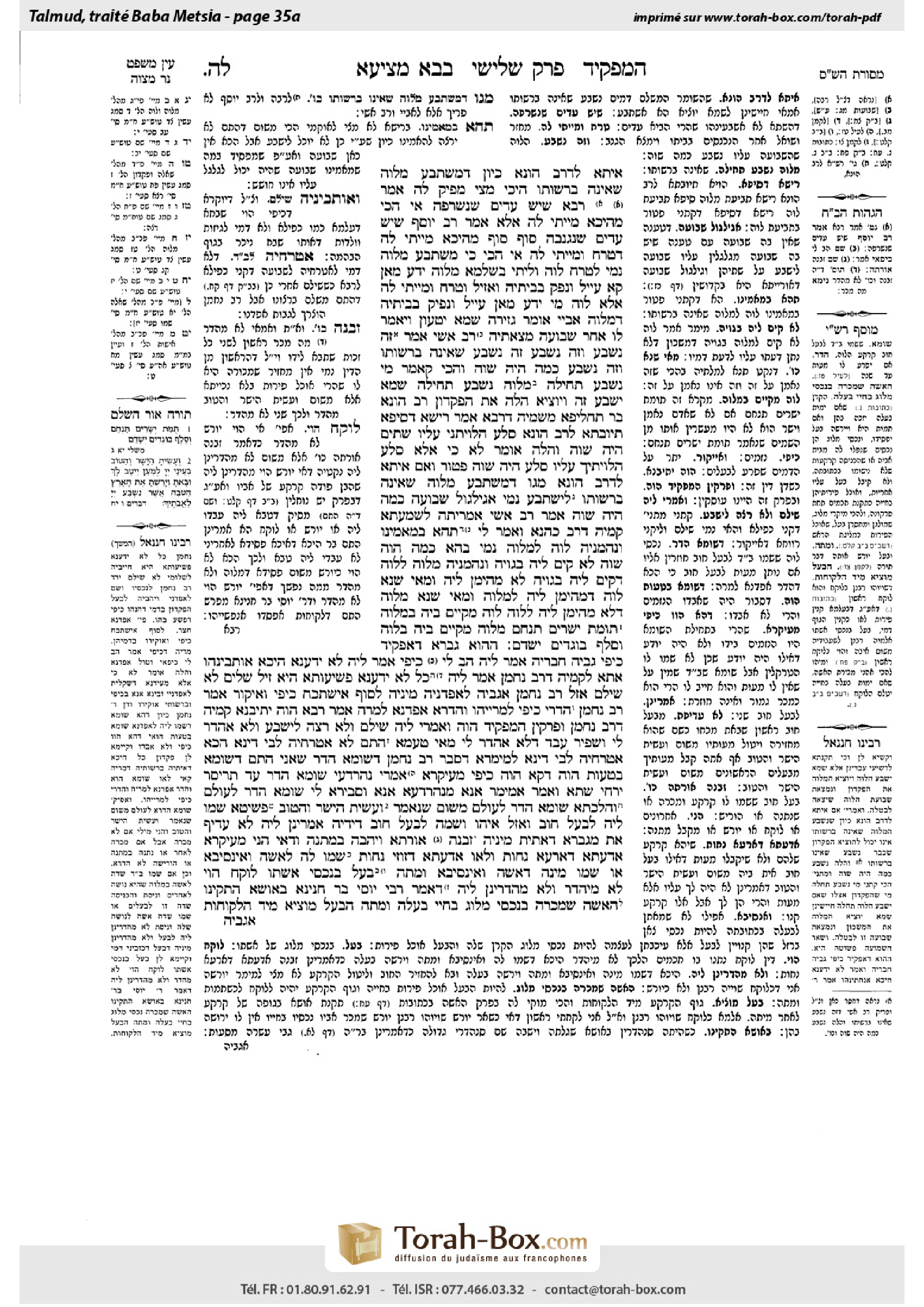
Bava Metzia 35a: Talmud study for Daf Yomi
Study the Talmud for Daf Yomi with scanned pages, Hebrew text, English translations from Sefaria and AI-generated French translations.
Passage selection and English or AI-generated French translation are available where the scan has annotations. Daf Study is independent of Torah-Box and Sefaria.
Browse Bava Metzia · בבא מציעא · All tractatesBava Metzia 35a text and translations
This page of Bava Metzia includes the Aramaic text, an English translation and an AI-generated French translation, alongside the scan above.
בבא מציעא ל״ה א · Aramaic and Hebrew text
אִיתָא לִדְרַב הוּנָא כֵּיוָן דְּמִשְׁתְּבַע מִלְוֶה שֶׁאֵינָהּ בִּרְשׁוּתוֹ, הֵיכִי מָצֵי מַפֵּיק לַהּ? אָמַר רָבָא: שֶׁיֵּשׁ עֵדִים שֶׁנִּשְׂרְפָה.
אִי הָכִי, מֵהֵיכָא מַיְיתֵי לַהּ? אֶלָּא אָמַר רַב יוֹסֵף: שֶׁיֵּשׁ עֵדִים שֶׁנִּגְנְבָה. סוֹף סוֹף מֵהֵיכָא מַיְיתֵי לַהּ? דְּטָרַח וּמַיְיתֵי לַהּ.
אִי הָכִי, כִּי מִשְׁתְּבַע מַלְוֶה נָמֵי, לִטְרַח לֹוֶה וְלַיְתֵי! בִּשְׁלָמָא מַלְוֶה יָדַע מַאן קָא עָיֵיל וְנָפֵק בְּבֵיתֵיהּ, וְאָזֵיל וְטָרַח וּמַיְיתֵי לַהּ. אֶלָּא לֹוֶה, מִי יָדַע מַאן עָיֵיל וְנָפֵיק בְּבֵיתֵיהּ דְּמַלְוֶה?
אַבָּיֵי אוֹמֵר: גְּזֵירָה שֶׁמָּא יִטְעוֹן וְיֹאמַר לוֹ: אַחַר שְׁבוּעָה מְצָאתִיהָ. רַב אָשֵׁי אָמַר: זֶה נִשְׁבָּע וְזֶה נִשְׁבָּע, זֶה נִשְׁבָּע שֶׁאֵינָהּ בִּרְשׁוּתוֹ, וְזֶה נִשְׁבָּע כַּמָּה הָיָה שָׁוֶה. וְהָכִי קָאָמַר: מִי נִשְׁבָּע תְּחִילָּה? מַלְוֶה נִשְׁבָּע תְּחִילָּה, שֶׁמָּא יִשָּׁבַע זֶה וְיוֹצִיא הַלָּה אֶת הַפִּקָּדוֹן.
רַב הוּנָא בַּר תַּחְלִיפָא מִשְּׁמֵיהּ דְּרָבָא אָמַר: רֵישָׁא דְסֵיפָא תְּיוּבְתָּא לְרַב הוּנָא, סֶלַע הִלְוִיתַנִי עָלָיו, שְׁתַּיִם הָיָה שָׁוֶה. וְהַלָּה אוֹמֵר: לֹא כִי, אֶלָּא סֶלַע הִלְוִיתִיךָ עָלָיו, סֶלַע הָיָה שָׁוֶה – פָּטוּר. וְאִם אִיתָא לִדְרַב הוּנָא מִגּוֹ דְּמִשְׁתְּבַע מַלְוֶה שֶׁאֵינָהּ בִּרְשׁוּתוֹ, לִישְׁתְּבַע נָמֵי אַגִּילְגּוּל שְׁבוּעָה כַּמָּה הָיָה שָׁוֶה!
אָמַר רַב אָשֵׁי: אַמְרִיתַהּ לִשְׁמַעְתָּא קַמֵּיהּ דְּרַב כָּהֲנָא וְאָמַר לִי: תְּהֵא בְּמַאֲמִינוֹ. וּנְהֵמְנֵיהּ לֹוֶה לְמַלְוֶה נָמֵי בְּהָא כַּמָּה הֲוָה שָׁוֶה? לָא קִים לֵיהּ בְּגַוֵּיהּ. וּנְהֵמְנֵיהּ מַלְוֶה לְלֹוֶה, דְּקִים לֵיהּ בְּגַוֵּיהּ? לָא מְהֵימַן לֵיהּ.
וּמַאי שְׁנָא לֹוֶה דִּמְהֵימַן לֵיהּ לְמַלְוֶה, וּמַאי שְׁנָא מַלְוֶה דְּלָא מְהֵימַן לֵיהּ לְלֹוֶה? לֹוֶה מְקַיֵּים בֵּיהּ בְּמַלְוֶה ״תֻּמַּת יְשָׁרִים תַּנְחֵם״, מַלְוֶה מְקַיֵּים בֵּיהּ בְּלֹוֶה ״וְסֶלֶף בּוֹגְדִים יְשָׁדֵּם״.
הָהוּא גַּבְרָא דְּאַפְקֵיד כִּיפֵּי גַּבֵּי חַבְרֵיהּ. אֲמַר לֵיהּ: הַב לִי כִּיפַּי, אֲמַר לֵיהּ: לָא יָדַעְנָא הֵיכָא אוֹתְבִי[תִי]נְהוּ. אֲתָא לְקַמֵּיהּ דְּרַב נַחְמָן. אֲמַר לֵיהּ: כֹּל לָא יָדַעְנָא פְּשִׁיעוּתָא הִיא, זִיל שַׁלֵּים! לָא שַׁילֵּם. אֲזַל רַב נַחְמָן אַגַּבְּיֵהּ לְאַפַּדְנֵיהּ מִינֵּיהּ, לְסוֹף אִישְׁתְּכֻח כִּיפֵּי וְאִיַּקּוּר. אָמַר רַב נַחְמָן: הָדְרִי כִּיפֵּי לְמָרַיְיהוּ. וְהָדְרָא אַפַּדְנָא לְמָרַהּ.
אָמַר רָבָא: הֲוָה יָתֵיבְנָא קַמֵּיהּ דְּרַב נַחְמָן, וּפִרְקִין ״הַמַּפְקִיד״ הֲוָה, וַאֲמַרִי לֵיהּ: שִׁילֵּם וְלֹא רָצָה לִישָּׁבַע. וְלָא אַהְדַּר לִי.
וְשַׁפִּיר עֲבַד דְּלָא אַהְדַּר לִי. מַאי טַעְמָא? הָתָם לָא אַטְרְחֵיהּ לְבֵי דִינָא, הָכָא אַטְרְחֵיהּ לְבֵי דִינָא.
לְמֵימְרָא דְּסָבַר רַב נַחְמָן דְּשׁוּמָא הָדַר? שָׁאנֵי הָתָם, דְּשׁוּמָא בְּטָעוּת הֲוָה, (דְּקָא) [דְּהָא] הֲוָה כִּיפֵּי מֵעִיקָּרָא.
אָמְרִי נְהַרְדָּעֵי: שׁוּמָא הָדַר עַד תְּרֵיסַר יַרְחֵי שַׁתָּא. וְאָמַר אַמֵּימָר: אֲנָא מִנְּהַרְדְּעָא אֲנָא, וּסְבִירָא לִי שׁוּמָא הָדַר לְעוֹלָם. וְהִלְכְתָא: שׁוּמָא הָדַר לְעוֹלָם, מִשּׁוּם שֶׁנֶּאֱמַר ״וְעָשִׂיתָ הַיָּשָׁר וְהַטּוֹב״.
פְּשִׁיטָא: שָׁמוּ לֵיהּ לְבַעַל חוֹב, וַאֲזַל אִיהוּ וְשָׁמַהּ לְבַעַל חוֹב דִּידֵיהּ, אָמְרִינַן לֵיהּ: לָא עֲדִיף אַתְּ מִגַּבְרָא דַּאֲתֵית מִינֵּיהּ. זַבְּנַהּ, אוֹרְתַאּ, וְיַהֲבַהּ בְּמַתָּנָה, וַדַּאי הָנֵי מֵעִיקָּרָא אַדַּעְתָּא דְּאַרְעָא נְחוּת וְלָאו אַדַּעְתָּא דְּזוּזֵי נְחוּת.
שָׁמוּ לַהּ לְאִשָּׁה וְאִינְּסִיבָא, אוֹ שָׁמוּ מִינַּהּ דְּאִשָּׁה וְאִינְּסִיבָא וּמֵתָה בַּעַל בְּנִכְסֵי אִשְׁתּוֹ לוֹקֵחַ הָוֵי – לָא מַיהְדַּר וְלָא מַהְדְּרִינַן לֵיהּ.
דְּאָמַר רַבִּי יוֹסֵי בַּר חֲנִינָא: בְּאוּשָׁא הִתְקִינוּ – הָאִשָּׁה שֶׁמָּכְרָה בְּנִכְסֵי מְלוֹג בְּחַיֵּי בַּעְלָהּ וָמֵתָה – הַבַּעַל מוֹצִיא מִיַּד הַלָּקוֹחוֹת.
Bava Metzia 35a · English translation
the statement of Rav Huna is so, once the creditor takes an oath that the collateral is not in his possession, how can he produce it thereafter? Rava said: The mishna is referring to a case where there are witnesses that the collateral was burned. Therefore, the creditor need not take an oath that it is not in his possession.
The Gemara asks: If so, the question remains: Why is the obligation to take the oath transferred from the debtor to the creditor? There is no concern that the creditor will produce the collateral. From where will he bring it if it was burned? Rather, Rav Yosef said: The mishna is referring to a case where there are witnesses that the collateral was stolen. The Gemara asks: Ultimately, in that case too, from where will the creditor bring the collateral if it was stolen? The Gemara answers: Although the collateral had been stolen, it is possible the creditor will exert himself to locate the thief and bring the collateral, thereby proving that the debtor took a false oath.
The Gemara asks: If so, in a case where the creditor takes an oath as well, let the debtor exert himself and bring the collateral, thereby proving that the creditor took a false oath. The Gemara answers: This is unlikely. Granted, there is concern that the creditor will recover the stolen collateral, as he knows who enters and exits his house, so he may have some inkling of the identity of the thief. And therefore, he goes and exerts himself and brings the collateral. But with regard to the debtor, does he know who enters and exits the creditor’s house? He has no inkling who the thief might be.
Abaye says: Although the creditor takes an oath that the collateral is not in his possession, the obligation to take an oath for partial admission is transferred from the debtor to the creditor, as the Sages issued a decree lest the debtor take the oath for his partial admission and the creditor claim and say to him: I found the collateral after you took the oath. Rav Ashi says: This party, the creditor, takes an oath and that party, the debtor, takes an oath. This party, the creditor, takes an oath that the collateral is not in his possession. And that party, the debtor, takes an oath as to how much the collateral was worth. And this is what the mishna is saying: Who takes an oath first? The creditor takes an oath first that the collateral is not in his possession, lest this party, i.e., the debtor, take an oath and the other party, i.e., the creditor, produce the deposit.
Rav Huna bar Taḥlifa said in the name of Rava: The first part of the latter clause of the mishna is a conclusive refutation of the opinion of Rav Huna, who said that the creditor is obligated to take an oath that the collateral is not in his possession. In that clause, the debtor said: You loaned me a sela on the basis of that collateral, and the collateral was worth two sela, so now you owe me a sela. And the other party, i.e., the creditor, said: That is not the case, rather, I loaned you a sela on the basis of that collateral and the collateral was worth a sela. In this case, the creditor is exempt. And if the statement of Rav Huna is so, once the creditor takes an oath that the collateral is not in his possession, let him also take an oath by means of extension of an oath as to how much the collateral was worth, as one obligated to take an oath can be forced to take other oaths as well.
Rav Ashi said: I stated this halakha before Rav Kahana, and he said to me: Let the halakha in the mishna be understood with regard to a case where the debtor trusts the creditor that the collateral is no longer in his possession. The Gemara challenges: But if so, let the debtor trust the creditor with regard to this matter of how much the collateral was worth. The Gemara explains: The creditor is not certain about the value of the collateral, as the item did not belong to him, which is why the debtor does not rely upon him to take an oath concerning its value. The Gemara challenges: But let the creditor trust the debtor, as the debtor is certain about the value of the collateral, as it is his. The Gemara answers: The creditor does not trust the debtor.
The Gemara asks: And what is different so that the debtor trusts the creditor that the collateral is not in his possession, and what is different that the creditor does not trust the debtor to accurately assess the value of the collateral? The Gemara answers: The debtor sees in the creditor fulfillment of the verse: “The integrity of the upright shall guide them” (Proverbs 11:3). He believes that God blesses the creditor with wealth to lend because he is an upright person. The creditor sees in the debtor fulfillment of the end of that verse: “But the perverseness of the faithless shall destroy them” (Proverbs 11:3). The creditor believes that God made the debtor poor because he is a deceitful person.
§ The Gemara relates: A certain man deposited jewels [keifei] with another. When the period of the deposit was complete, the owner of the jewels said to the bailee: Give me the jewels. The bailee said to him in response: I do not know where I placed them. The matter came before Rav Naḥman, who said to the bailee: Every circumstance where a bailee claims: I do not know where I placed them, is in and of itself negligence. Go pay him for the jewels. The bailee did not pay. Rav Naḥman went and gave instructions to repossess his palace and sell it to pay for the jewels. Ultimately, not only were the jewels found, but they had also increased in value. Rav Naḥman said: The jewels return to their initial owner, and the palace returns to its owner, and the bailee does not profit from the increase in the value of the jewels.
Rava said: I was sitting at that time studying before Rav Naḥman, and our chapter of study was this chapter: One who deposits, which is relevant to this case. And I said to Rav Naḥman: Isn’t this the case of a bailee who paid the owner and did not wish to take an oath? And it is the bailee who receives the double payment, ostensibly because once he paid, the owner transfers ownership of the item to him. And Rav Naḥman did not answer me, and he did well that he did not answer me, as the question was not worthy of an answer.
Rava continues: What is the reason he did not answer me? The reason is that the cases cannot be compared. There, in the case of the mishna, the bailee paid at his own initiative. He did not inconvenience the owner by compelling him to go to court. Therefore, the owner transfers ownership of the deposit to the bailee. Here, in the case involving the jewels, the bailee inconvenienced the owner and compelled him to go to court. Consequently, the owner does not transfer ownership of the deposit to the bailee.
The Gemara asks: Is this to say that Rav Naḥman holds that after property is repossessed in order to pay an unpaid debt based on the court’s appraisal of the article’s value, it is returned if the debtor pays the debt? The Gemara rejects that conclusion: In general, the item is not returned. But it is different there, in the case of the jewels, as it was an erroneous appraisal, in that the jewels were in the possession of the bailee from the outset and he was merely unable to locate them.
With regard to the reversal of an appraisal, the Sages of Neharde’a say: After property is repossessed in order to pay an unpaid debt based on the court’s appraisal of the article’s value, it is returned to the debtor, provided he repays the debt from the time of the appraisal until the twelve months of the year have passed. And Ameimar said: I am from Neharde’a, and nevertheless, I hold that repossession based on an appraisal of an article’s value can always be returned. If the debtor pays his debt, he can reclaim his property at any point. The Gemara rules: And the halakha is that repossession based on an appraisal can always be returned, due to the fact that it is stated: “And you shall do that which is right and good” (Deuteronomy 6:18). The owner of property appreciates his property more than another person would. Therefore, once the debtor repays his debt to the creditor, legal formalism should not prevent return of the debtor’s property.
§ The Gemara clarifies related matters. It is obvious that if the court appraised property to repay a debt to a creditor, and this creditor went and had the property appraised and repaid his debt to his creditor, we say to the second creditor: Your rights are not superior to those of the man through whom you came to possess the property. Just as the first debtor can repay the debt and reclaim his property from his creditor, he can also reclaim the property from the creditor of his creditor. If a creditor who received appraised land sold it or bequeathed it to his heirs or gave it as a gift, the debtor cannot reclaim the land from those who acquired their land. It is certain that from the outset, when those people acquired the land, it was with the intent to acquire the land itself that they descended to it, and it was not with the intent to receive money that they descended to the land.
If the court appraised property to repay a debt to a woman and she then married, or if the court appraised property from a woman to repay her debt and she then married and died, since the legal status of a husband with regard to his wife’s property is that of a buyer, he does not return property that was appraised and repossessed to pay his wife’s debt. And we do not return to him property that was repossessed from his wife if he pays her debt.
This is as Rabbi Yosei bar Ḥanina said: In Usha the Sages instituted that in the case of a woman who sold part of her usufruct property during the life of her husband and she died, the husband repossesses the property from the purchasers. The property belongs to the wife, while the profits accrued after marriage belong to the husband. Therefore, the woman does not have the right to sell the property as long as they are married. If she sold the property and died, and her husband is her heir, the Sages instituted that his legal status is that of a buyer and not an heir. His rights to the land precede those of the subsequent buyers. He repossesses the land and reimburses them the sale price of the property.
Bava Metzia 35a · Traduction française (IA)
La déclaration de Rav Huna est ainsi : une fois que le créancier jure qu'il ne possède pas la garantie, comment peut-il produire celle-ci plus tard ? Rava dit : La mitsva fait référence à un cas où des témoins affirment que la garantie a été brûlée. Ainsi, le créancier n'a pas besoin de jurer qu'il ne la possède pas.
Le Guemara demande : Si c'est ainsi, la question reste : pourquoi l'obligation de jurer est-elle transférée du débiteur au créancier ? Il n'y a pas de crainte que le créancier produise la garantie. D'où viendra-t-elle si elle a été brûlée ? Plutôt, Rav Yosef dit : La mitsva fait référence à un cas où des témoins affirment que la garantie a été volée. Le Guemara demande : Finalement, dans ce cas également, d'où viendra-t-il la garantie si elle a été volée ? Le Guemara répond : Bien que la garantie ait été volée, il est possible que le créancier s'efforce de trouver le voleur et de récupérer la garantie, ce qui prouvera que le débiteur a prétendu à un faux serment.
Le Guemara demande : Si c'est ainsi, dans un cas où le créancier jure également, que le débiteur s'efforce de produire la garantie, ce qui prouvera que le créancier a prétendu à un faux serment. Le Guemara répond : Cela est peu probable. Bien que l'on craigne que le créancier récupère la garantie volée, car il connaît qui entre et sort de sa maison, il peut avoir une idée de l'identité du voleur. Et c'est pourquoi il s'efforce de trouver la garantie. Mais concernant le débiteur, sait-il qui entre et sort de la maison du créancier ? Il n'a aucune idée de l'identité du voleur.
Abaye dit : Bien que le créancier jure que la garantie n'est pas en son possession, l'obligation de jurer pour une admission partielle est transférée du débiteur au créancier, car les Sages ont émis un décret afin que le débiteur ne jure pas pour son admission partielle et que le créancier ne puisse affirmer : j'ai trouvé la garantie après que tu as pris le serment. Rav Ashi dit : Ce parti, le créancier, jure et celui-là, le débiteur, jure. Ce parti, le créancier, jure que la garantie n'est pas en son possession. Et celui-là, le débiteur, jure sur la valeur de la garantie. Et c'est ce que la mitsna dit : Qui jure en premier ? Le créancier jure en premier que la garantie n'est pas en son possession, afin que ce parti, c'est-à-dire le débiteur, ne jure pas et que l'autre parti, c'est-à-dire le créancier, produise le dépôt.
Rav Huna bar Taḥlifa a dit en nom de Rava : La première partie de la dernière clause de la mitsna est une refutation définitive de l'opinion de Rav Huna, qui disait que le créancier est tenu de jurer que la garantie n'est pas en son possession. Dans cette clause, le débiteur dit : Tu m'as prêté un sela sur la base de cette garantie, et la garantie valait deux sela, donc maintenant tu me dois un sela. Et l'autre parti, c'est-à-dire le créancier, dit : Ce n'est pas le cas, plutôt, je t'ai prêté un sela sur la base de cette garantie et la garantie valait un sela. Dans ce cas, le créancier est exempt. Et si la déclaration de Rav Huna est ainsi, une fois que le créancier jure que la garantie n'est pas en son possession, il devrait également jurer par extension sur la valeur de la garantie, car celui qui est tenu de jurer peut être contraint de prendre d'autres serments également.
Rav Ashi dit : J'ai énoncé cette halakha devant Rav Kahana, et il m'a dit : Fais comprendre cette halakha en la rapportant à un cas où le débiteur confie au créancier que la garantie n'est plus en son possession. Le Guemara conteste : Mais si c'est ainsi, que le débiteur confie au créancier concernant la valeur de la garantie ? Le Guemara explique : Le créancier n'est pas certain de la valeur de la garantie, car l'objet n'appartenait pas à lui, ce qui est pourquoi le débiteur ne se fie pas à lui pour prendre un serment concernant sa valeur. Le Guemara conteste : Mais que le créancier confie au débiteur, car le débiteur est certain de la valeur de la garantie, car c'est son objet. Le Guemara répond : Le créancier ne confie pas au débiteur.
Le Guemara demande : Et qu'est-ce qui diffère tellement que le débiteur confie au créancier que la garantie n'est plus en son possession, et qu'est-ce qui diffère que le créancier ne confie pas au débiteur pour évaluer correctement la valeur de la garantie ? Le Guemara répond : Le débiteur voit dans le créancier la réalisation de la parole : « La droiture des justes les guidera » (Proverbes 11:3). Il croit que Dieu bénit le créancier de richesse pour prêter car il est un homme droit. Le créancier voit dans le débiteur la réalisation de la fin de cette parole : « Mais la perversité des méchants détruirait eux » (Proverbes 11:3). Le créancier croit que Dieu a rendu le débiteur pauvre car il est un homme menteur.
§ Le Guemara rapporte : Un certain homme avait déposé des bijoux [keifei] chez un autre. Lorsque la période du dépôt était terminée, l'propriétaire des bijoux dit au dépositaire : Donne-moi les bijoux. Le dépositaire répondit : Je ne sais pas où je les ai mis. L'affaire vint devant Rav Naḥman, qui dit au dépositaire : Toute circonstance où un dépositaire affirme : Je ne sais pas où je les ai mis, est en soi négligence. Va lui payer les bijoux. Le dépositaire ne paya pas. Rav Naḥman alla donner des instructions pour saisir sa résidence et la vendre afin de payer les bijoux. Finalement, non seulement les bijoux furent trouvés, mais ils avaient également augmenté en valeur. Rav Naḥman dit : Les bijoux retournent à leur propriétaire initial, et la résidence retournent à son propriétaire, et le dépositaire ne profite pas de l'augmentation de valeur des bijoux.
Rava dit : J'étais assis à ce moment-là en étude devant Rav Naḥman, et notre chapitre d'étude était celui-ci : Celui qui dépose, qui est pertinent pour ce cas. Et je dis à Rav Naḥman : N'est-ce pas le cas d'un dépositaire qui a payé l'propriétaire et ne voulait pas prendre un serment ? Et c'est le dépositaire qui reçoit le double paiement, apparemment car une fois qu'il a payé, l'propriétaire transfère la propriété de l'objet à lui. Et Rav Naḥman ne répondit pas à ma question, et il fit bien de ne pas répondre, car la question n'était pas méritante d'une réponse.
Rava continue : Quel est le motif pour lequel il n'a pas répondu à ma question ? Le motif est que les cas ne peuvent être comparés. Là, dans le cas de la michna, le baalie késouf a payé de son propre chef. Il n'a pas gêné l'propriétaire en le forçant à aller en justice. Par conséquent, l'propriétaire transfère la propriété du dépôt au baalie késouf. Ici, dans le cas des bijoux, le baalie késouf a gêné l'propriétaire et l'a forcé à aller en justice. Par conséquent, l'propriétaire ne transfère pas la propriété du dépôt au baalie késouf.
La Guemara pose la question : Est-ce que cela signifie que Rav Naḥman considère que, après que la propriété ait été saisie afin de payer une dette non remboursée selon l'appréciation du tribunal de la valeur de l'article, elle est rendue si le débiteur rembourse sa dette ? La Guemara rejette cette conclusion : En général, l'article n'est pas rendu. Mais c'est différent là, dans le cas des bijoux, car il s'agissait d'une appréciation erronée, puisque les bijoux étaient en possession du baalie késouf dès le départ et qu'il n'était simplement pas parvenu à les trouver.
En ce qui concerne l'inversion d'une appréciation, les Sages de Neharde’a disent : Après que la propriété ait été saisie afin de payer une dette non remboursée selon l'appréciation du tribunal de la valeur de l'article, elle est rendue au débiteur, à condition qu'il rembourse la dette depuis l'époque de l'appréciation jusqu'à la fin des douze mois de l'année. Et Ameimar dit : Je suis de Neharde’a, et pourtant, je considère que la saisie fondée sur l'appréciation de la valeur d'un article peut toujours être rendue. Si le débiteur rembourse sa dette, il peut récupérer sa propriété à tout moment. La Guemara déclare : Et la halakha est que la saisie fondée sur une appréciation peut toujours être rendue, en raison du fait que cela est dit : « Et tu feras ce qui est droit et bon » (Deutéronome 6:18). L'propriétaire de la propriété apprécie sa propriété plus qu'une autre personne ne le ferait. Par conséquent, une fois que le débiteur rembourse sa dette au créancier, les formalités juridiques ne devraient pas empêcher le retour de la propriété du débiteur.
§ La Guemara clarifie des points connexes. Il est évident que si le tribunal a apprécié une propriété afin de rembourser une dette à un créancier, et que ce créancier est allé apprécier la propriété et a remboursé sa dette à son créancier, nous disons au deuxième créancier : Vos droits ne sont pas supérieurs à ceux de l'homme par lequel vous avez acquis la propriété. Tout comme le premier débiteur peut rembourser sa dette et récupérer sa propriété auprès de son créancier, il peut également récupérer la propriété auprès du créancier de son créancier. Si un créancier qui a reçu une terre apprécisée a vendu cette terre, ou l'a léguée à ses héritiers, ou l'a donnée en cadeau, le débiteur ne peut pas récupérer la terre auprès de ceux qui ont acquis leur terre. Il est certain que dès le départ, lorsqu'ils ont acquis la terre, ils sont descendus là-bas avec l'intention d'acquérir la terre elle-même, et non avec l'intention de recevoir de l'argent.
Si le tribunal a évalué une propriété afin de rembourser une dette à une femme et qu'elle est ensuite devenue mariée, ou si le tribunal a évalué une propriété d'une femme afin de rembourser sa dette et qu'elle est ensuite devenue mariée et est décédée, puisque le statut juridique d'un mari par rapport à la propriété de sa femme est celui d'un acheteur, il ne restitue pas la propriété évaluée et saisie pour payer sa dette à son épouse. Et nous ne restituons pas à lui la propriété saisie de sa femme si il rembourse sa dette.
C'est ce que Rabbi Yosei bar Ḥanina a dit : À Usha, les Sages ont institué que dans le cas d'une femme qui a vendu une partie de sa propriété de usufruit pendant la vie de son mari et qui est décédée, le mari récupère la propriété auprès des acheteurs. La propriété appartient à la femme, tandis que les profits acquis après le mariage appartiennent au mari. Par conséquent, la femme n'a pas le droit de vendre la propriété tant qu'ils sont mariés. Si elle a vendu la propriété et est décédée, et que son mari est son héritier, les Sages ont institué que son statut juridique est celui d'un acheteur et non d'un héritier. Ses droits sur la terre précèdent ceux des acheteurs ultérieurs. Il récupère la terre et indemnisera ceux qui l'ont achetée en leur remettant le prix de vente de la propriété.
Traduction française générée par IA à partir de l’édition anglaise de Sefaria. Vérifie toujours un passage avec le texte source.
Text from Sefaria: William Davidson Edition - Vocalized Aramaic (CC BY NC); William Davidson Edition - English (CC BY NC).