Bava Metzia 36a: Talmud study for Daf Yomi
Study the Talmud for Daf Yomi with scanned pages, Hebrew text, English translations from Sefaria and AI-generated French translations.
Passage selection and English or AI-generated French translation are available where the scan has annotations. Daf Study is independent of Torah-Box and Sefaria.
Browse Bava Metzia · בבא מציעא · All tractatesBava Metzia 36a text and translations
This page of Bava Metzia includes the Aramaic text, an English translation and an AI-generated French translation, alongside the scan above.
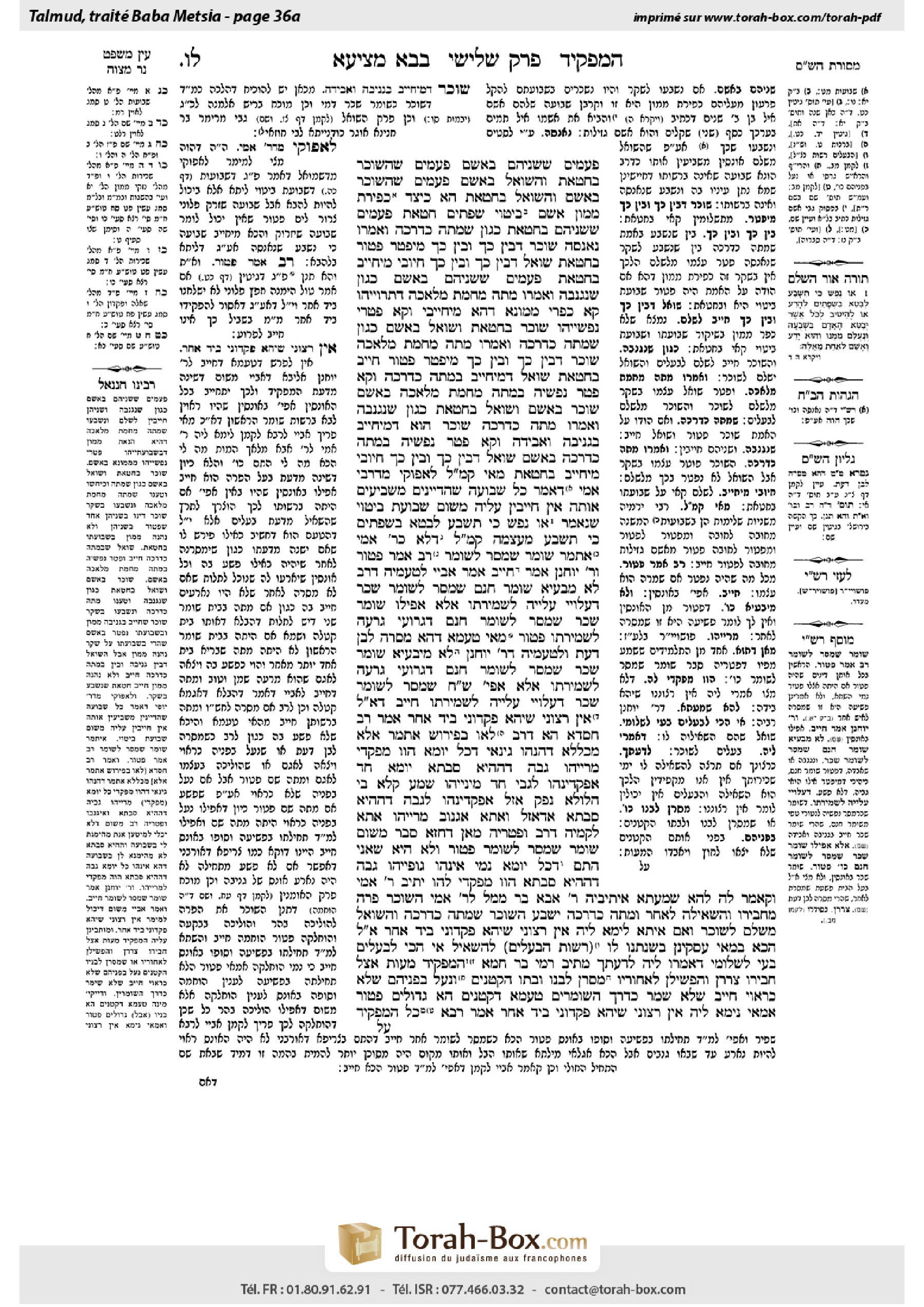
בבא מציעא ל״ו א · Aramaic and Hebrew text
פְּעָמִים שֶׁשְּׁנֵיהֶם בְּאָשָׁם. פְּעָמִים שֶׁהַשּׂוֹכֵר בְּחַטָּאת וְהַשּׁוֹאֵל בְּאָשָׁם, פְּעָמִים שֶׁהַשּׂוֹכֵר בְּאָשָׁם וְהַשּׁוֹאֵל בְּחַטָּאת.
הָא כֵּיצַד? כְּפִירַת מָמוֹן – אָשָׁם. בִּיטּוּי שְׂפָתַיִם – חַטָּאת.
פְּעָמִים שֶׁשְּׁנֵיהֶם בְּחַטָּאת – כְּגוֹן שֶׁמֵּתָה כְּדַרְכָּהּ, וְאָמְרוּ נֶאֶנְסָה. שׂוֹכֵר דְּבֵין כָּךְ וּבֵין כָּךְ מִיפְּטַר פָּטוּר בְּחַטָּאת, שׁוֹאֵל דְּבֵין כָּךְ וּבֵין כָּךְ חַיּוֹבֵי מִיחַיַּיב בְּחַטָּאת.
פְּעָמִים שֶׁשְּׁנֵיהֶם בְּאָשָׁם – כְּגוֹן שֶׁנִּגְנְבָה, וְאָמְרוּ מֵתָה מֵחֲמַת מְלָאכָה, דְּתַרְוַיְיהוּ קָא כָפְרִי מָמוֹנָא, דְּהָא מִיחַיְּיבִי, וְקָא פָטְרִי נַפְשַׁיְיהוּ.
שׂוֹכֵר בְּחַטָּאת וְשׁוֹאֵל בְּאָשָׁם – כְּגוֹן שֶׁמֵּתָה כְּדַרְכָּהּ, וְאָמְרוּ מֵתָה מֵחֲמַת מְלָאכָה. שׂוֹכֵר דְּבֵין כָּךְ וּבֵין כָּךְ מִיפְּטַר פָּטוּר – חַיָּיב בְּחַטָּאת. שׁוֹאֵל דְּמִיחַיַּיב בְּמֵתָה כְּדַרְכָּהּ, וְקָא פָטַר נַפְשֵׁיהּ בְּמֵתָה מֵחֲמַת מְלָאכָה – בְּאָשָׁם.
שׂוֹכֵר בְּאָשָׁם וְשׁוֹאֵל בְּחַטָּאת – כְּגוֹן שֶׁנִּגְנְבָה וְאָמְרוּ מֵתָה כְּדַרְכָּהּ. שׂוֹכֵר הוּא דְּמִיחַיַּיב בִּגְנֵיבָה וַאֲבֵידָה, וְקָא פָטַר נַפְשֵׁיהּ בְּמֵתָה כְּדַרְכָּהּ – בְּאָשָׁם. שׁוֹאֵל דְּבֵין כָּךְ וּבֵין כָּךְ חַיּוֹבֵי מִיחַיַּיב – בְּחַטָּאת.
מַאי קָא מַשְׁמַע לַן? לְאַפּוֹקֵי מִדְּרַבִּי אַמֵּי, דְּאָמַר: כׇּל שְׁבוּעָה שֶׁהַדַּיָּינִים מַשְׁבִּיעִים אוֹתָהּ – אֵין חַיָּיבִין עָלֶיהָ מִשּׁוּם שְׁבוּעַת בִּיטּוּי, שֶׁנֶּאֱמַר: ״אוֹ נֶפֶשׁ כִּי תִשָּׁבַע לְבַטֵּא בִשְׂפָתַיִם״ ״כִּי תִשָּׁבַע״ מֵעַצְמָהּ. קָא מַשְׁמַע לַן דְּלָא כְּרַבִּי אַמֵּי.
אִתְּמַר: שׁוֹמֵר שֶׁמָּסַר לְשׁוֹמֵר, רַב אָמַר: פָּטוּר, וְרַבִּי יוֹחָנָן אָמַר: חַיָּיב.
אָמַר אַבָּיֵי, לְטַעְמֵיהּ דְּרַב, לָא מִבַּעְיָא שׁוֹמֵר חִנָּם שֶׁמָּסַר לְשׁוֹמֵר שָׂכָר דְּעַלּוֹיֵי עַלְּיַיהּ לִשְׁמִירָתוֹ, אֶלָּא אֲפִילּוּ שׁוֹמֵר שָׂכָר שֶׁמָּסַר לְשׁוֹמֵר חִנָּם, דְּגָרוֹעֵי גָּרְעַהּ לִשְׁמִירָתוֹ – פָּטוּר. מַאי טַעְמָא? דְּהָא מְסָרָהּ לְבֶן דַּעַת.
וּלְטַעְמֵיהּ דְּרַבִּי יוֹחָנָן, לָא מִיבַּעְיָא שׁוֹמֵר שָׂכָר שֶׁמָּסַר לְשׁוֹמֵר חִנָּם דְּגָרוֹעֵי גָּרְעַהּ לִשְׁמִירָתוֹ, אֶלָּא אֲפִילּוּ שׁוֹמֵר חִנָּם שֶׁמָּסַר לְשׁוֹמֵר שָׂכָר, דְּעַלּוֹיֵי עַלְּיַיהּ לִשְׁמִירָתוֹ – חַיָּיב. דְּאָמַר לֵיהּ: ״אֵין רְצוֹנִי שֶׁיְּהֵא פִּקְדוֹנִי בְּיַד אַחֵר״.
אָמַר רַב חִסְדָּא: הָא דְּרַב לָאו בְּפֵירוּשׁ אִתְּמַר, אֶלָּא מִכְּלָלָא. דְּהָנְהוּ גִּינָּאֵי, דְּכֹל יוֹמָא הֲווֹ מַפְקְדִי מָרַיְיהוּ גַּבַּהּ דְּהַהִיא סָבְתָּא. יוֹמָא חַד אַפְקְדֻינְהוּ לְגַבֵּי חַד מִינַּיְיהוּ, שְׁמַע קָלָא בֵּי הִלּוּלָא נְפַק אֲזַל. אַפְקְדִינְהוּ לְגַבַּהּ דְּהַהִיא סָבְתָּא, אַדַּאֲזַל וַאֲתָא אִגְּנוּב מָרַיְיהוּ.
אֲתָא לְקַמֵּיהּ דְּרַב וּפַטְרֵיהּ, מַאן דַּחֲזָא סָבַר מִשּׁוּם שׁוֹמֵר שֶׁמָּסַר לְשׁוֹמֵר פָּטוּר. וְלָא הִיא, שָׁאנֵי הָתָם דְּכֹל יוֹמָא נָמֵי אִינְהוּ גּוּפַיְיהוּ גַּבַּהּ דְּהַהִיא סָבְתָּא הֲווֹ מַפְקְדִי לְהוּ.
יָתֵיב רַבִּי אַמֵּי וְקָאָמַר לַהּ לְהָא שְׁמַעְתָּא. אֵיתִיבֵיהּ רַבִּי אַבָּא בַּר מֶמֶל לְרַבִּי אַמֵּי: הַשּׂוֹכֵר פָּרָה מֵחֲבֵירוֹ וְהִשְׁאִילָהּ לְאַחֵר וּמֵתָה כְּדַרְכָּהּ – יִשָּׁבַע הַשּׂוֹכֵר שֶׁמֵּתָה כְּדַרְכָּהּ וְהַשּׁוֹאֵל מְשַׁלֵּם לַשּׂוֹכֵר. וְאִם אִיתָא, לֵימָא לֵיהּ: אֵין רְצוֹנִי שֶׁיְּהֵא פִּקְדוֹנִי בְּיַד אַחֵר! אֲמַר לֵיהּ: הָכָא בְּמַאי עָסְקִינַן? בְּשֶׁנָּתְנוּ לוֹ רְשׁוּת הַבְּעָלִים לְהַשְׁאִיל.
אִי הָכִי לִבְעָלִים בָּעֵי לְשַׁלּוֹמֵי! דַּאֲמַרוּ לֵיהּ: לְדַעְתָּךְ.
מֵתִיב רָמֵי בַּר חָמָא: הַמַּפְקִיד מָעוֹת אֵצֶל חֲבֵירוֹ צְרָרָן וְהִפְשִׁילָן לַאֲחוֹרָיו, מְסָרָן לִבְנוֹ וּבִתּוֹ הַקְּטַנִּים, וְנָעַל בִּפְנֵיהֶם שֶׁלֹּא כָּרָאוּי – חַיָּיב, שֶׁלֹּא שָׁמַר כְּדֶרֶךְ הַשּׁוֹמְרִים.
טַעְמָא דִּקְטַנִּים, הָא גְּדוֹלִים – פָּטוּר. אַמַּאי? נֵימָא לֵיהּ: אֵין רְצוֹנִי שֶׁיְּהֵא פִּקְדוֹנִי בְּיַד אַחֵר!
אָמַר רָבָא: כׇּל הַמַּפְקִיד
Bava Metzia 36a · English translation
there are times that both are liable to bring a guilt-offering; there are times that the renter is liable to bring a sin-offering and the borrower is liable to bring a guilt-offering; there are times that the renter is liable to bring a guilt-offering and the borrower is liable to bring a sin-offering.
The Gemara elaborates: How so? One who takes a false oath that involves the denial of a monetary matter is liable to bring a guilt-offering. One who takes a false oath on an utterance of the lips that involves no denial of a monetary debt is liable to bring a sin-offering.
The Gemara elaborates: There are times that both are liable to bring a sin-offering. This is in a case where the cow died in its typical manner and the renter and the borrower both said that it died due to circumstances beyond his control. A renter, who in any case is exempt from paying whether it died of natural causes or due to circumstances beyond his control, is liable to bring a sin-offering if he took a false oath. A borrower, who in any case is liable to pay regardless of the circumstances of its death, is liable to bring a sin-offering if he took a false oath. In both cases, the oath involved no denial of monetary debt.
There are times that both are liable to bring a guilt-offering. This is in a case where the cow was stolen from a borrower, and the renter and the borrower both said that it died due to ordinary labor. That is a case where both denied a monetary matter, as they are both liable to pay in a case of theft, and both take an oath on a claim with which they seek to exempt themselves.
There are times when a renter is liable to bring a sin-offering and a borrower is liable to bring a guilt-offering. This is in a case where the cow died in its typical manner and the renter and the borrower both said that it died due to ordinary labor. A renter, who in any case is exempt, as he is exempt from paying in cases where the ox was damaged or died due to circumstances beyond his control, is liable to bring a sin-offering, as the false oath involved no denial of monetary debt. A borrower, who is liable to pay when the cow died in its typical manner and attempted to exempt himself with the claim that it died due to ordinary labor, is liable to bring a guilt-offering.
There are times when a renter is liable to bring a guilt-offering and a borrower is liable to bring a sin-offering. This is in a case where the cow was stolen from the borrower, and the renter and the borrower both said that it died in its typical manner. The renter, who is liable to pay in cases of theft and loss and attempted to exempt himself with the claim that it died in its typical manner, is liable to bring a guilt-offering. A borrower, who in any case is liable to pay, is liable to bring a sin-offering.
The Gemara asks: What is Rabbi Yirmeya teaching us with this systematic presentation of these cases? They are merely details based on established halakhic principles. The Gemara answers: His statement serves to exclude the opinion of Rabbi Ami, who says: With regard to any oath that the judges administer, one is not liable to bring a sin-offering for taking a false oath on an utterance, as it is stated in the passage concerning the obligation to bring an offering for taking a false oath: “Or if a soul takes an oath clearly to utter with lips” (Leviticus 5:4). The Gemara infers: The liability to bring an offering for taking a false oath applies only to one who takes an oath on his own initiative, but not when the oath is administered by others. Rabbi Yirmeya teaches us that the halakha is not in accordance with the opinion of Rabbi Ami, as one is liable to bring a sin-offering for taking a false oath on an utterance even if it was administered by another.
It was stated that there is an amoraic dispute with regard to a bailee who conveyed to another bailee the deposit with which he was entrusted. Rav says: He is exempt from payment in the same cases in which he is exempt when the deposit is in his possession. And Rabbi Yoḥanan said: He is liable to pay even in cases of damage due to circumstances beyond his control.
Abaye says: According to Rav’s line of reasoning, it is not necessary to state his ruling in a case where he was initially an unpaid bailee who conveyed the deposit for safeguarding to a paid bailee, as in that case the unpaid bailee enhanced the level of his safeguarding, since a paid bailee is liable to pay in instances where an unpaid bailee is exempt. But even in the case of a paid bailee who conveyed the deposit for safeguarding to an unpaid bailee, where the paid bailee diminished the level of his safeguarding, he is exempt. What is the reason? He is exempt because he conveyed the deposit to a mentally competent person, thereby effectively safeguarded the deposit.
According to Rabbi Yoḥanan’s line of reasoning, it is not necessary to state his ruling in a case where he was initially a paid bailee who conveyed the deposit for safeguarding to an unpaid bailee, as the paid bailee diminished the level of his safeguarding, since an unpaid bailee is exempt in instances where a paid bailee is liable to pay. But even in the case of an unpaid bailee who conveyed the deposit for safeguarding to a paid bailee, where the unpaid bailee enhanced the level of his safeguarding, he is liable to pay. What is the reason? He is liable because the owner of the deposit said to him: It is not my desire that my deposit be in the possession of another bailee.
Rav Ḥisda said: This statement that is attributed to Rav was not stated explicitly. Rather, it was inferred from another statement of his, as it is related: There were these gardeners who each day would deposit their spades with a certain old woman. One day they deposited their spades with one of gardeners. He heard noise from a wedding hall and set out and went there. He deposited the spades with that old woman. In the time that he went and came back from the wedding, their spades were stolen.
The case came before Rav, and Rav exempted the gardener who deposited the spades with the old woman. One who observed Rav’s ruling thought that Rav issued that ruling due to the fact that a bailee who conveyed a deposit to another bailee is exempt. But that is not so. There, in the case of the spades, it is different, as the gardeners themselves would deposit their spades with that old woman. Since the gardeners cannot claim that it is not their desire for their deposit to be in the possession of this old woman, the gardener who did so is exempt.
The Gemara relates: Rabbi Ami sat and stated this halakha. Rabbi Abba bar Memel raised an objection to Rabbi Ami from the mishna: In the case of one who rents a cow from another, and this renter lends it to another person, and the cow dies in its typical manner in the possession of the borrower, the halakha is that the renter takes an oath to the owner of the cow that the cow died in its typical manner, and the borrower pays the renter for the cow that he borrowed. And if the statement of Rabbi Yoḥanan is so, let the owner say to the renter: It is not my desire that my deposit be in the possession of another bailee, and the renter should be liable to pay because he violated the owner’s wishes. Rabbi Ami said to him: With what are we dealing here? It is a case where the owner gave the renter permission to lend the deposit to another.
The Gemara asks: If so, the borrower should be required to pay the owner, as the owner sanctioned the borrowing. Rabbi Abba bar Memel answers: The case in the mishna is one where the owner said to the renter: Lend this deposit to another at your discretion. Therefore, it is not considered as if the owner lent it to the borrower.
Rami bar Ḥama raises an objection from a mishna (42a): In the case of one who deposited coins with another, and that bailee bound it in a cloth and slung it behind him, or conveyed them to his minor son or daughter for safeguarding, or locked the door before the coins in an inappropriate, i.e., insufficient, manner to secure them, the bailee is liable to pay for the coins, as he did not safeguard the coins in the manner typical of bailees.
The Gemara infers: The reason he is liable to pay is that he conveyed the coins to his minor children, but if he conveyed them to his adult son or daughter he is exempt. Why? Let the owner say to him as Rabbi Yoḥanan said: It is not my desire that my deposit be in the possession of another bailee, and therefore even if the children are adults the bailee should be liable to pay.
Rava said: No proof can be cited, as it is clear that in the case of anyone who deposits an item with another,
Bava Metzia 36a · Traduction française (IA)
Il y a des moments où les deux sont tenus de présenter un sacrifice de culpabilité ; il y a des moments où le locataire est tenu de présenter un sacrifice expiatoire et le prêteur est tenu de présenter un sacrifice de culpabilité ; il y a des moments où le locataire est tenu de présenter un sacrifice de culpabilité et le prêteur est tenu de présenter un sacrifice expiatoire.
La Guemara développe : De quelle manière ? Celui qui prend un faux serment concernant la négation d'une affaire monétaire est tenu de présenter un sacrifice de culpabilité. Celui qui prend un faux serment sur une déclaration de la bouche qui ne concerne pas la négation d'une dette monétaire est tenu de présenter un sacrifice expiatoire.
La Guemara développe : Il y a des moments où les deux sont tenu de présenter un sacrifice expiatoire. C'est dans le cas où la vache est morte de manière normale et le locataire et le prêteur ont tous deux dit qu'elle était morte en raison de circonstances hors de leur contrôle. Un locataire, qui est en tout cas exempt de payer qu'elle soit morte de causes naturelles ou en raison de circonstances hors de son contrôle, est tenu de présenter un sacrifice expiatoire s'il a pris un faux serment. Un prêteur, qui est en tout cas tenu de payer indépendamment des circonstances de sa mort, est tenu de présenter un sacrifice expiatoire s'il a pris un faux serment. Dans les deux cas, le serment ne comportait pas la négation d'une dette monétaire.
Il y a des moments où les deux sont tenus de présenter un sacrifice de culpabilité. C'est dans le cas où la vache a été volée par le prêteur, et le locataire et le prêteur ont tous deux dit qu'elle était morte en raison du travail ordinaire. C'est un cas où les deux nient une affaire monétaire, car ils sont tous deux tenus de payer en cas de vol, et les deux prennent un serment sur une revendication avec laquelle ils cherchent à s'écarter de leur responsabilité.
Il y a des moments où le locataire est tenu de présenter un sacrifice expiatoire et le prêteur est tenu de présenter un sacrifice de culpabilité. C'est dans le cas où la vache est morte de manière normale et le locataire et le prêteur ont tous deux dit qu'elle était morte en raison du travail ordinaire. Un locataire, qui est en tout cas exempt, car il est exempt de payer dans les cas où l'animal a été endommagé ou est mort en raison de circonstances hors de son contrôle, est tenu de présenter un sacrifice expiatoire, car le faux serment ne comportait pas la négation d'une dette monétaire. Un prêteur, qui est tenu de payer lorsque la vache est morte de manière normale et a cherché à s'écarter de sa responsabilité en affirmant qu'elle était morte en raison du travail ordinaire, est tenu de présenter un sacrifice de culpabilité.
Il y a des moments où le locataire est tenu de présenter un sacrifice de culpabilité et le prêteur est tenu de présenter un sacrifice expiatoire. C'est dans le cas où la vache a été volée par le prêteur, et le locataire et le prêteur ont tous deux dit qu'elle était morte de manière normale. Le locataire, qui est tenu de payer en cas de vol et de perte et a cherché à s'écarter de sa responsabilité en affirmant qu'elle était morte de manière normale, est tenu de présenter un sacrifice de culpabilité. Un prêteur, qui est en tout cas tenu de payer, est tenu de présenter un sacrifice expiatoire.
La Guemara pose la question : Quelle est la leçon que Rabbi Yirmeya nous transmet avec cette présentation systématique de ces cas ? Ce sont simplement des détails fondés sur des principes halakhiques établis. La Guemara répond : Son propos vise à écarter l'opinion de Rabbi Ami, qui affirme : En ce qui concerne tout serment que les juges administrent, on n'est pas tenu de présenter un sacrifice expiatoire pour avoir pris un faux serment sur une déclaration, car il est dit dans la parole concernant l'obligation de présenter un sacrifice pour avoir pris un faux serment : « Ou si un âme prend un serment clairement pour prononcer avec les lèvres » (Lévitique 5:4). La Guemara déduit : La responsabilité de présenter un sacrifice pour avoir pris un faux serment s'applique uniquement à celui qui prend un serment de sa propre initiative, mais pas lorsqu'il est administré par autrui. Rabbi Yirmeya nous enseigne que la halakha ne suit pas l'opinion de Rabbi Ami, car on est tenu de présenter un sacrifice expiatoire pour avoir pris un faux serment sur une déclaration même s'il a été administré par un autre.
Il a été dit qu'il existe un débat entre les amoraim concernant un dépositaire qui a transmis à un autre dépositaire le dépôt avec lequel il était chargé. Rav dit : Il est exempt de paiement dans les mêmes cas où il est exempt lorsque le dépôt est en son possession. Et Rabbi Yoḥanan dit : Il est tenu de payer même dans les cas de dommages dus à des circonstances hors de son contrôle.
Abaye dit : Selon la ligne de raisonnement de Rav, il n'est pas nécessaire d'énoncer sa décision dans un cas où il était initialement un dépositaire non rémunéré qui a transmis le dépôt à un dépositaire rémunéré pour le garder, car dans ce cas le dépositaire non rémunéré a amélioré le niveau de sa garde, puisque le dépositaire rémunéré est tenu de payer dans les cas où le dépositaire non rémunéré est exempt. Mais même dans le cas d'un dépositaire rémunéré qui a transmis le dépôt à un dépositaire non rémunéré, où le dépositaire rémunéré a diminué le niveau de sa garde, il est exempt. Quelle est la raison ? Il est exempt car il a transmis le dépôt à une personne mentalement compétente, ce qui a effectivement garanti le dépôt.
Selon la ligne de raisonnement de Rabbi Yoḥanan, il n'est pas nécessaire d'énoncer sa décision dans un cas où il était initialement un dépositaire rémunéré qui a transmis le dépôt à un dépositaire non rémunéré, car le dépositaire rémunéré a diminué le niveau de sa garde, puisque le dépositaire non rémunéré est exempt dans les cas où le dépositaire rémunéré est tenu de payer. Mais même dans le cas d'un dépositaire non rémunéré qui a transmis le dépôt à un dépositaire rémunéré, où le dépositaire non rémunéré a amélioré le niveau de sa garde, il est tenu de payer. Quelle est la raison ? Il est tenu de payer car le propriétaire du dépôt a dit à lui : Ce n'est pas mon désir que mon dépôt soit en possession d'un autre dépositaire.
Rav Ḥisda dit : Cette déclaration attribuée à Rav n'a pas été énoncée explicitement. Elle a été inférée d'une autre déclaration de sa part, comme il est rapporté : Il y avait ces jardiniers qui chaque jour déposaient leurs pioches chez une certaine vieille femme. Un jour, ils déposèrent leurs pioches chez l'un des jardiniers. Il entendit du bruit d'un salon de mariage et partit et alla y être. Il déposa les pioches chez cette vieille femme. Pendant le temps qu'il était allé et revenu du mariage, leurs pioches furent volées.
Le cas est venu devant Rav, et Rav a exempté le jardinier qui avait déposé les pioches chez cette vieille femme. Celui qui a observé la décision de Rav a pensé que Rav avait rendu cette décision en raison du fait qu’un dépositaire qui transmet un dépôt à un autre dépositaire est exempt. Mais ce n’est pas le cas. Là, dans le cas des pioches, c’est différent, car les jardiniers eux-mêmes déposaient leurs pioches chez cette vieille femme. Puisque les jardiniers ne peuvent pas affirmer qu’il n’est pas leur désir que leur dépôt soit en possession de cette vieille femme, le jardinier qui a fait cela est exempt.
La Guemara rapporte : Rabbi Ami s’est assis et a énoncé cette halakha. Rabbi Abba bar Memel a soulevé une objection contre Rabbi Ami à partir de la michna : Dans le cas d’un homme qui loue un taureau à un autre, et ce locataire prête ce taureau à une autre personne, et le taureau meurt de manière normale en possession du prêteur, la halakha est que le locataire jure devant le propriétaire du taureau que le taureau est mort de manière normale, et le prêteur paie au locataire pour le taureau qu’il a emprunté. Et si la déclaration de Rabbi Yoḥanan est ainsi, que l’owner dise au locataire : Ce n’est pas mon désir que mon dépôt soit en possession d’un autre dépositaire, et le locataire devrait être tenu responsable de payer car il a violé le souhait de l’owner. Rabbi Ami a dit à lui : Avec quoi sommes-nous en train de traiter ici ? C’est un cas où l’owner a donné au locataire la permission de prêter le dépôt à un autre.
La Guemara pose la question : Si c’est ainsi, le prêteur devrait être tenu de payer l’owner, car l’owner a autorisé le prêts. Rabbi Abba bar Memel répond : Le cas dans la michna est celui où l’owner a dit au locataire : Prête ce dépôt à un autre selon ton bon plaisir. Par conséquent, cela ne s’entend pas comme si l’owner avait prêté à le prêteur.
Rami bar Ḥama soulève une objection tirée d’une michna (42a) : Dans le cas d’un homme qui a déposé des pièces chez un autre, et ce dépositaire les a liées dans un tissu et les a suspendues derrière lui, ou les a données à son fils ou sa fille mineure pour les garder, ou a verrouillé la porte devant les pièces d’une manière inappropriée, c’est-à-dire insuffisante, pour les sécuriser, le dépositaire est tenu de payer pour les pièces, car il n’a pas sécurisé les pièces de la manière typique des dépositaires.
La Guemara déduit : La raison pour laquelle il est tenu de payer est qu’il a transmis les pièces à ses enfants mineurs, mais s’il les a transmis à son fils ou sa fille adulte, il est exempt. Pourquoi ? Que l’owner dise à lui comme Rabbi Yoḥanan l’a dit : Ce n’est pas mon désir que mon dépôt soit en possession d’un autre dépositaire, et par conséquent même si les enfants sont adultes, le dépositaire devrait être tenu de payer.
Rava a dit : Aucune preuve ne peut être citée, car il est clair que dans le cas de toute personne qui dépose un objet chez un autre,
Traduction française générée par IA à partir de l’édition anglaise de Sefaria. Vérifie toujours un passage avec le texte source.
Text from Sefaria: William Davidson Edition - Vocalized Aramaic (CC BY NC); William Davidson Edition - English (CC BY NC).