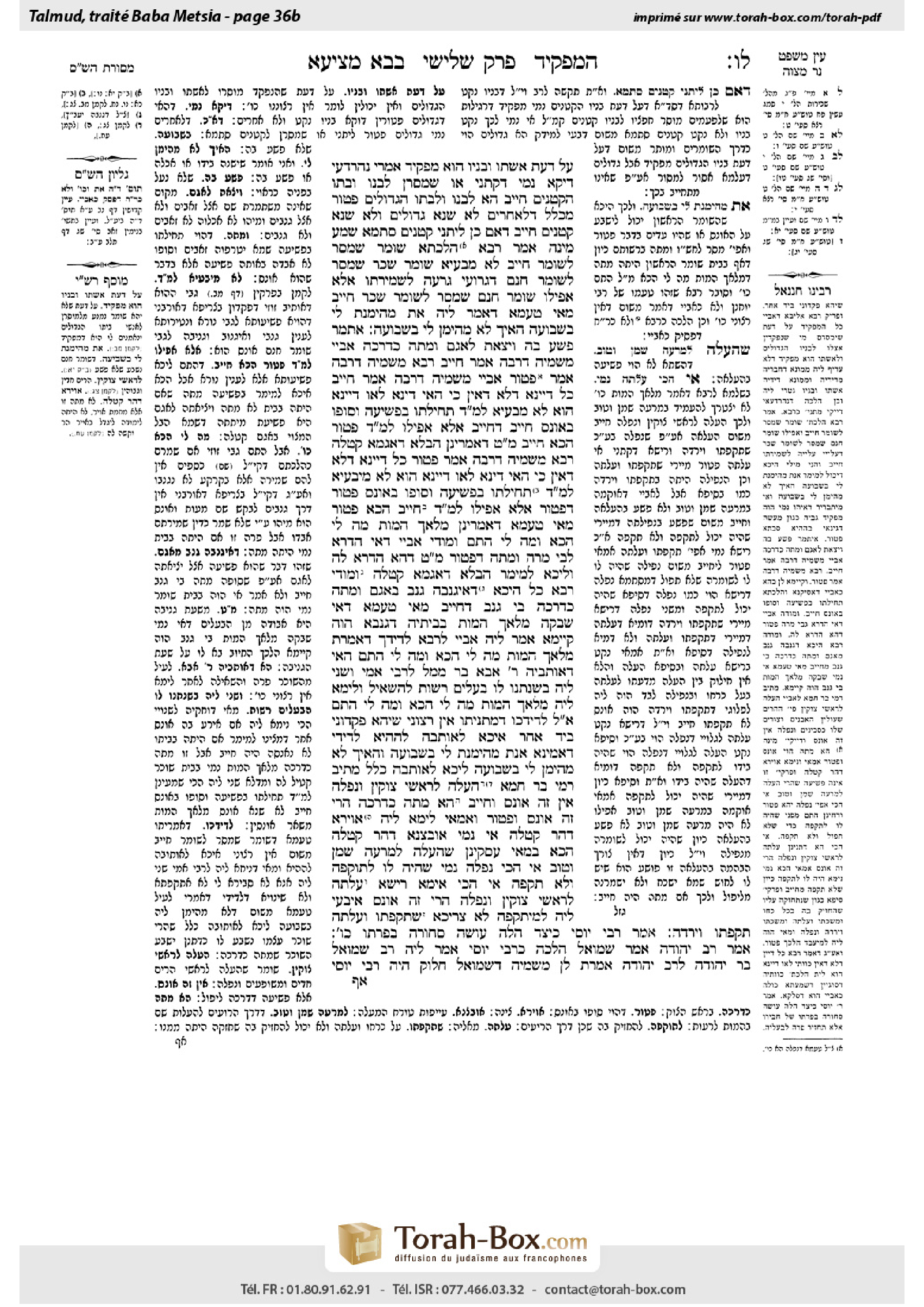
Bava Metzia 36b: Talmud study for Daf Yomi
Study the Talmud for Daf Yomi with scanned pages, Hebrew text, English translations from Sefaria and AI-generated French translations.
Passage selection and English or AI-generated French translation are available where the scan has annotations. Daf Study is independent of Torah-Box and Sefaria.
Browse Bava Metzia · בבא מציעא · All tractatesBava Metzia 36b text and translations
This page of Bava Metzia includes the Aramaic text, an English translation and an AI-generated French translation, alongside the scan above.
בבא מציעא ל״ו ב · Aramaic and Hebrew text
עַל דַּעַת אִשְׁתּוֹ וּבָנָיו הוּא מַפְקִיד.
אָמְרִי נְהַרְדָּעֵי, דַּיְקָא נָמֵי דְּקָתָנֵי: אוֹ שֶׁמְּסָרָן לִבְנוֹ וּבִתּוֹ הַקְּטַנִּים – חַיָּיב. הָא לִבְנוֹ וּלְבִתּוֹ הַגְּדוֹלִים – פָּטוּר. מִכְלָל דְּלַאֲחֵרִים, לָא שְׁנָא גְּדוֹלִים וְלָא שְׁנָא קְטַנִּים – חַיָּיב, דְּאִם כֵּן, לִיתְנֵי קְטַנִּים סְתָמָא. שְׁמַע מִינַּהּ.
אָמַר רָבָא, הִלְכְתָא: שׁוֹמֵר שֶׁמָּסַר לְשׁוֹמֵר – חַיָּיב, לָא מִבַּעְיָא שׁוֹמֵר שָׂכָר שֶׁמָּסַר לְשׁוֹמֵר חִנָּם דְּגָרוֹעֵי גָּרְעַהּ לִשְׁמִירָתוֹ, אֶלָּא אֲפִילּוּ שׁוֹמֵר חִנָּם שֶׁמָּסַר לְשׁוֹמֵר שָׂכָר – חַיָּיב, מַאי טַעְמָא? דַּאֲמַר לֵיהּ: אַתְּ מְהֵימְנַתְּ לִי בִּשְׁבוּעָה, הַאיְךְ לָא מְהֵימַן לִי בִּשְׁבוּעָה.
אִתְּמַר: פָּשַׁע בָּהּ וְיָצָאת לַאֲגַם, וּמֵתָה כְּדַרְכָּהּ. אַבָּיֵי מִשְּׁמֵיהּ דְּרַבָּה אָמַר: חַיָּיב, רָבָא מִשְּׁמֵיהּ דְּרַבָּה אָמַר: פָּטוּר.
אַבָּיֵי מִשְּׁמֵיהּ דְּרַבָּה אָמַר: חַיָּיב, כׇּל דַּיָּינָא דְּלָא דָּאֵין כִּי הַאי דִּינָא לָאו דַּיָּינָא הוּא. לָא מִבַּעְיָא לְמַאן דְּאָמַר תְּחִילָּתוֹ בִּפְשִׁיעָה וְסוֹפוֹ בְּאוֹנֶס חַיָּיב, דְּחַיָּיב. אֶלָּא אֲפִילּוּ לְמַאן דְּאָמַר פָּטוּר, הָכָא חַיָּיב. מַאי טַעְמָא? דְּאָמְרִינַן: הַבְלָא דְאַגְמָא קַטְלַהּ.
רָבָא מִשְּׁמֵיהּ דְּרַבָּה אָמַר: פָּטוּר, כֹּל דַּיָּינָא דְּלָא דָּאֵין כִּי הַאי דִּינָא לָאו דַּיָּינָא הוּא. לָא מִיבַּעְיָא לְמַאן דְּאָמַר תְּחִילָּתוֹ בִּפְשִׁיעָה וְסוֹפוֹ בְּאוֹנֶס פָּטוּר, דְּפָטוּר, אֶלָּא אֲפִילּוּ לְמַאן דְּאָמַר חַיָּיב, הָכָא פָּטוּר. מַאי טַעְמָא? דְּאָמְרִינַן: מַלְאַךְ הַמָּוֶת מָה לִי הָכָא וּמָה לִי הָתָם.
וּמוֹדֵי אַבָּיֵי, דְּאִי הֲדַרָא לְבֵי מָרַהּ וּמִתָה – דְּפָטוּר. מַאי טַעְמָא? דְּהָא הֲדַרָא לַהּ וְלֵיכָּא לְמֵימַר הַבְלָא דְּאַגְמָא קַטְלַהּ. וּמוֹדֵי רָבָא כֹּל הֵיכָא דְּאִי גַּנְבַהּ גַּנָּב בַּאֲגַם וּמֵתָה כְּדַרְכָּהּ בֵּי גַנָּב – דְּחַיָּיב. מַאי טַעְמָא? דְּאִי שַׁבְקַהּ מַלְאַךְ הַמָּוֶת בְּבֵיתֵיהּ דְּגַנָּבָא הֲוָה קָיְימָא.
אֲמַר לֵיהּ אַבָּיֵי לְרָבָא: לְדִידָךְ, דְּאָמְרַתְּ מַלְאַךְ הַמָּוֶת מָה לִי הָכָא וּמָה לִי הָתָם, הַאי דְּאוֹתְבֵיהּ רַבִּי אַבָּא בַּר מֶמֶל לְרַבִּי אַמֵּי וְשַׁנִּי לֵיהּ בְּשֶׁנָּתְנוּ לוֹ בְּעָלִים רְשׁוּת לְהַשְׁאִיל, וְלֵימָא לֵיהּ: מַלְאַךְ הַמָּוֶת מָה לִי הָכָא וּמָה לִי הָתָם!
אֲמַר לֵיהּ: לְדִידְכוּ דְּמַתְנִיתוּ ״אֵין רְצוֹנִי שֶׁיְּהֵא פִּקְדוֹנִי בְּיַד אַחֵר״ – אִיכָּא לְאוֹתֹבַהּ לְהַהִיא, לְדִידִי דְּאָמֵינָא: אַנְתְּ מְהֵימְנַתְּ לִי בִּשְׁבוּעָה וְהַאיְךְ לָא מְהֵימַן לִי – בִּשְׁבוּעָה לֵיכָּא לְאוֹתֹבַהּ כְּלָל.
מֵתִיב רָמֵי בַּר חָמָא: הֶעֱלָהּ לְרָאשֵׁי צוּקִין וְנָפְלָה – אֵין זֶה אוֹנֶס, וְחַיָּיב. הָא מֵתָה כְּדַרְכָּהּ – הֲרֵי זֶה אוֹנֶס וּפָטוּר. וְאַמַּאי? לֵימָא לֵיהּ: אַוֵּירָא דְהַר קַטְלַהּ, אִי נָמֵי אוּבְצָנָא דְהַר קַטְלַהּ!
הָכָא בְּמַאי עָסְקִינַן? שֶׁהֶעֱלָהּ לְמִרְעֶה שָׁמֵן וְטוֹב. אִי הָכִי, נָפְלָה נָמֵי! שֶׁהָיָה לוֹ לְתוֹקְפָּהּ וְלֹא תְּקָפָהּ.
אִי הָכִי, אֵימָא רֵישָׁא: עָלְתָה לְרָאשֵׁי צוּקִין וְנָפְלָה – הֲרֵי זֶה אוֹנֶס, אִיבְּעִי לֵיהּ לְמִיתְקְפַהּ! לָא צְרִיכָא שֶׁתְּקָפַתּוּ וְעָלְתָה, תְּקָפַתּוּ וְיָרְדָה.
אָמַר רַבִּי יוֹסֵי: כֵּיצַד הַלָּה עוֹשֶׂה סְחוֹרָה בְּפָרָתוֹ כּוּ׳. אָמַר רַב יְהוּדָה אָמַר שְׁמוּאֵל: הֲלָכָה כְּרַבִּי יוֹסֵי. אֲמַר לֵיהּ רַב שְׁמוּאֵל בַּר יְהוּדָה לְרַב יְהוּדָה: אֲמַרְתְּ לַן מִשְּׁמֵיהּ דִּשְׁמוּאֵל: חָלוּק הָיָה רַבִּי יוֹסֵי
Bava Metzia 36b · English translation
it is with the awareness that at times the bailee’s wife and his children will safeguard the item that he deposits it, as the bailee cannot be with the deposit at all times.
The Sages of Neharde’a say: The language of the mishna is also precise, as it teaches: Or if he conveyed the coins to his minor son or daughter for safeguarding, he is liable to pay. But if he conveyed them to his adult son and daughter, he is exempt. By inference, one can conclude that with regard to others, it is no different if they are adults and it is no different if they are minors. Either way, the bailee is liable to pay, as, if there were a difference, let the tanna teach: If he conveyed the coins to minors, without qualification. The Gemara concludes: Since the tanna specifically addressed the case of one’s minor children, learn from the wording of the mishna that the difference between minors and adults exists only with regard to one’s children.
Rava says: The halakha is: A bailee who conveyed a deposit to another bailee is liable to pay. It is not necessary to say that this is the halakha if he was a paid bailee who conveyed the deposit to an unpaid bailee, as in that case the first bailee diminished the level of his safeguarding, as an unpaid bailee is exempt from paying in instances where a paid bailee is obligated to do so. But even if it was initially an unpaid bailee who conveyed the deposit for safeguarding to a paid bailee, the first bailee is liable to pay. What is the reason that he is liable in that case? He is liable, as the owner of the deposit can say to him: You are trustworthy to me when you take an oath that the item was stolen or lost. That person is not trustworthy to me when he takes an oath.
It was stated that there is an amoraic dispute: In the case of one who was negligent in safeguarding an animal, and it went into a marsh, where it was susceptible to thieves and predatory animals, but it died in its typical manner despite this negligence, i.e., it was neither stolen nor devoured, Abaye says in the name of Rabba: The bailee is liable to pay. Rava says in the name of Rabba: The bailee is exempt from doing so.
The Gemara elaborates. Abaye said in the name of Rabba: He is liable to pay, and any judge who does not rule in accordance with this halakha is not a judge. It is not necessary to say that the bailee is liable in this case, according to the one who says: In a case where the incident was initially through negligence and ultimately by accident, one is liable to pay. According to this opinion, it is obvious that the bailee is liable to pay. But even according to the one who says: If the incident was initially through negligence and ultimately by accident one is exempt, here the bailee is still liable to pay. What is the reason that he is liable? It is because we say: The air of the marsh killed the animal. The negligence led to the death of the animal, and it was not due to circumstances beyond his control.
Rava says in the name of Rabba: He is exempt, and any judge who does not rule in accordance with this halakha is not a judge. It is not necessary to say that the bailee is exempt in this case, according to the one who says: In a case where the incident was initially through negligence and ultimately by accident, one is exempt from payment. According to this opinion, it is obvious that the bailee is exempt. But even according to the one who says: In a case where the incident was initially through negligence and ultimately by accident, one is liable to pay, here the bailee is still exempt from payment. What is the reason that he is exempt? It is because we say with regard to the Angel of Death, who causes death by natural causes: What difference is there to me if the animal was here, and what difference is there to me if the animal was there? The cause of the animal’s death was natural, and there is no relevance given to the location of the death. Consequently, the bailee is exempt.
The Gemara notes: And Abaye concedes that if the animal returned from the marsh to its owner’s house and died there that the bailee is exempt. What is the reason that he is exempt? He is exempt due to the fact that the animal returned, and since it was able to return there is no justification to say that the air of the marsh killed it. And Rava concedes that anytime the animal was stolen from the marsh and then dies in its typical manner in the house of the thief that the bailee is liable to pay. What is the reason that he is liable to pay? He is liable because even if the Angel of Death spared the life of the animal, it would be standing in the house of the thief due to the negligence of the bailee.
Abaye said to Rava: According to you, who said with regard to the Angel of Death: What difference is there to me if the animal was here and what difference is there to me if the animal was there? How will you explain the exchange between Rabbi Abba bar Memel and Rabbi Ami? As there is that objection that was raised by Rabbi Abba bar Memel to Rabbi Ami from the mishna with regard to one who rents a cow from another, and then lends it to another person, and Rabbi Ami answered him: It is a case where the owner gave the renter permission to lend the deposit. Abaye states his challenge: But according to your explanation, let Rabbi Ami say to him that the bailee is exempt because with regard to the Angel of Death, what difference is there to me if the animal was here, and what difference is there to me if the animal was there. If the death would have happened regardless of the location of the animal, it makes no difference whether it was in the possession of the first renter or in the possession of the one he lent it to.
Rava said to Abaye: According to you, that you teach that a bailee who conveyed a deposit to another bailee is liable to pay because the owner can claim: It is not my desire that my deposit be in the possession of another bailee, there is room to raise that objection. But according to me, as I say that a bailee who conveyed a deposit to another bailee is liable to pay because the owner can claim: You are trustworthy to me when you take an oath that the item was stolen or lost; that person is not trustworthy to me when he takes an oath, there is no room to raise that objection at all.
Rami bar Ḥama raises an objection to the opinion of Abaye from a mishna (93b): If one brought the animal to the edge of a cliff and it fell, that is not considered an accident, and he is liable to pay. One may infer that if he brought it to the edge of the cliff and it died in its typical manner, that is considered an accident and he is exempt. But why? Let the owner of the animal say to the bailee: It is the air of the mountain that killed it, or: The exhaustion from climbing the mountain killed it.
The Gemara rejects this: With what are we dealing here? It is with a case where the bailee took the animal to a bountiful and high-quality pasture. Since shepherds typically herd their flocks there, taking the animal there is not negligent. The Gemara asks: If so, then the bailee should be exempt even if the animal fell. The Gemara answers: He is liable to pay because he should have subdued the animal to prevent it from falling, and he did not subdue it.
The Gemara asks: If so, say the first clause of the mishna: If the animal climbed to the top of a cliff and fell, it is a circumstance beyond his control and he is exempt. Shouldn’t he be liable, since he was required to subdue it and prevent it from falling? The Gemara answers: No, it is necessary for the tanna to say that the bailee is exempt only in a case where the animal overpowered him and ascended and the animal overpowered him and descended. Although he attempted to prevent the animal from falling, it overpowered the bailee and fell.
§ The mishna teaches that Rabbi Yosei said: How does the other party do business with and profit from another’s cow? Rav Yehuda says that Shmuel says: The halakha is in accordance with the opinion of Rabbi Yosei. Rav Shmuel bar Yehuda said to Rav Yehuda: You told us in the name of Shmuel that Rabbi Yosei was in disagreement with the first tanna
Bava Metzia 36b · Traduction française (IA)
Il est conscient que parfois la femme et les enfants du bailee pourront garder l'objet qu'il dépose, car le bailee ne peut être en permanence avec l'objet déposé.
Les Sages de Neharde’a disent : La langue de la michna est aussi précise, car elle enseigne : Ou s'il a transmis les pièces à son fils ou à sa fille mineure afin de les garder, il est tenu de payer. Mais s'il les a transmis à son fils ou à sa fille adulte, il est exempt. Par conséquent, on peut conclure que concernant d'autres personnes, il n'y a pas de différence si elles sont adultes ou mineures. Dans tous les cas, le bailee est tenu de payer, car, s'il y avait une différence, le tanna l'aurait enseignée : S'il a transmis les pièces à des mineurs, sans restriction. La gemara conclut : Puisque le tanna a spécifiquement abordé le cas des enfants mineurs de la personne, on en déduit que la différence entre mineurs et adultes existe uniquement concernant ses enfants.
Rava dit : La halakha est : Un bailee qui a transmis un dépôt à un autre bailee est tenu de payer. Il n'est pas nécessaire de dire que c'est la halakha s'il était un bailee rémunéré qui a transmis le dépôt à un bailee non rémunéré, car dans ce cas, le premier bailee a diminué le niveau de sa garde, car un bailee non rémunéré est exempt de payer dans les cas où un bailee rémunéré est tenu de le faire. Mais même si c'était initialement un bailee non rémunéré qui a transmis le dépôt à un bailee rémunéré, le premier bailee est tenu de payer. Quelle est la raison pour laquelle il est tenu en ce cas ? Il est tenu, car l'propriétaire du dépôt peut lui dire : Tu es digne de confiance pour moi quand tu prends un serment que l'objet a été volé ou perdu. Cette personne n'est pas digne de confiance pour moi quand il prend un serment.
Il a été dit qu'il existe un débat entre les amoraim : Dans le cas d'une personne négligente dans la garde d'un animal, qui l'a laissé entrer dans un marais, où il était susceptible de être volé ou dévoré par des animaux prédateurs, mais qui est mort de manière normale malgré cette négligence, c'est-à-dire qu'il n'a pas été volé ni dévoré, Abaye dit au nom de Rabba : Le bailee est tenu de payer. Rava dit au nom de Rabba : Le bailee est exempt de le faire.
La gemara développe. Abaye dit au nom de Rabba : Il est tenu de payer, et tout juge qui ne rend pas ce jugement n'est pas un juge. Il n'est pas nécessaire de dire que le bailee est tenu en ce cas, selon celui qui dit : Dans un cas où l'incident a été initialement par négligence et finalement par accident, on est tenu de payer. Selon cet avis, il est évident que le bailee est tenu de payer. Mais même selon celui qui dit : Dans un cas où l'incident a été initialement par négligence et finalement par accident, on est exempt, ici le bailee est toujours tenu de payer. Quelle est la raison pour laquelle il est tenu ? C'est parce que nous disons : L'air du marais a tué l'animal. La négligence a conduit à la mort de l'animal, et cela n'était pas dû à des circonstances hors de son contrôle.
Rava dit au nom de Rabba : Il est exempt, et tout juge qui ne rend pas ce jugement n'est pas un juge. Il n'est pas nécessaire de dire que le bailee est exempt en ce cas, selon celui qui dit : Dans un cas où l'incident a été initialement par négligence et finalement par accident, on est exempt de payer. Selon cet avis, il est évident que le bailee est exempt. Mais même selon celui qui dit : Dans un cas où l'incident a été initialement par négligence et finalement par accident, on est tenu de payer, ici le bailee est toujours exempt. Quelle est la raison pour laquelle il est exempt ? C'est parce que nous disons concernant l'Ange de la Mort, qui cause la mort par des causes naturelles : Quelle différence y a-t-il pour moi si l'animal était ici, et quelle différence y a-t-il pour moi si l'animal était là ? La cause de la mort de l'animal était naturelle, et la localisation n'a pas d'importance. Par conséquent, le bailee est exempt.
La gemara note : Et Abaye reconnaît que si l'animal est revenu du marais chez son propriétaire et est mort là, le bailee est exempt. Quelle est la raison pour laquelle il est exempt ? Il est exempt car l'animal est revenu, et puisque cela a été possible, il n'y a pas de justification pour dire que l'air du marais a tué l'animal. Et Rava reconnaît que tout moment où l'animal a été volé du marais et est mort de manière normale chez le voleur, le bailee est tenu de payer. Quelle est la raison pour laquelle il est tenu de payer ? Il est tenu car même si l'Ange de la Mort a préservé la vie de l'animal, il serait resté chez le voleur en raison de la négligence du bailee.
Abaye a dit à Rava : Selon vous, qui dites concernant l'Ange de la Mort : Quelle différence y a-t-il pour moi si l'animal était ici et quelle différence y a-t-il pour moi si l'animal était là ? Comment expliquerez-vous l'échange entre Rabbi Abba bar Memel et Rabbi Ami ? Car il y a une objection soulevée par Rabbi Abba bar Memel contre Rabbi Ami à partir de la michna concernant celui qui loue un boeuf d'un autre, puis le prête à une autre personne, et Rabbi Ami répond à lui : C'est un cas où l'owner a donné au locataire la permission de prêter le dépôt. Abaye formule son défi : Mais selon votre explication, laissez Rabbi Ami dire à lui que le bailee est exempt car concernant l'Ange de la Mort, quelle différence y a-t-il pour moi si l'animal était ici, et quelle différence y a-t-il pour moi si l'animal était là. Si la mort aurait eu lieu indépendamment de la localisation de l'animal, il n'y a pas de différence entre le fait qu'il soit en possession du premier locataire ou en possession de celui à qui il l'a prêté.
Rava a dit à Abaye : Selon vous, que vous enseignez que le gardien qui a transmis un dépôt à un autre gardien est tenu de payer, car l'owner peut réclamer : Ce n'est pas mon désir que mon dépôt soit en possession d'un autre gardien, il y a lieu de soulever cet objection. Mais selon moi, comme je dis que le gardien qui a transmis un dépôt à un autre gardien est tenu de payer, car l'owner peut réclamer : Vous êtes digne de confiance pour moi lorsque vous jurez que l'objet a été volé ou perdu ; cette personne n'est pas digne de confiance pour moi lorsqu'il jure, il n'y a donc aucun lieu de soulever cette objection du tout.
Rami bar Ḥama émet un objection contre l'opinion d'Abaye, en se basant sur une mitsva (93b) : Si l'on amène l'animal au bord d'un précipice et qu'il tombe, cela n'est pas considéré comme un accident, et il est tenu de payer. On peut en déduire que si l'on l'amène au bord du précipice et qu'il meurt de manière typique, cela est considéré comme un accident et il est exempt. Mais pourquoi ? Que l'owner de l'animal dise au gardien : C'est l'air de la montagne qui l'a tué, ou : L'épuisement du montagnard l'a tué.
La Guemara rejette cela : Avec quel cas sommes-nous en train de nous occuper ? C'est avec un cas où le gardien a amené l'animal dans un pâturage abondant et de haute qualité. Puisque les bergers habituellement conduisent leurs troupeaux là, emmener l'animal là n'est pas négligent. La Guemara demande : Si c'est ainsi, alors le gardien devrait être exempt même si l'animal est tombé. La Guemara répond : Il est tenu de payer, car il aurait dû dompter l'animal pour l'empêcher de tomber, et il ne l'a pas dompté.
La Guemara demande : Si c'est ainsi, disons la première partie de la mitsna : Si l'animal monte au sommet d'un précipice et tombe, c'est une circonstance au-delà de son contrôle et il est exempt. Ne devrait-il pas être responsable, puisqu'il était tenu de le dompter et d'empêcher sa chute ? La Guemara répond : Non, il est nécessaire que le tanna indique que le gardien est exempt uniquement dans le cas où l'animal l'a surpassé et est monté, et l'animal l'a surpassé et est descendu. Bien qu'il ait tenté de prévenir l'animal de tomber, il l'a surpassé et est tombé.
§ La mitsna enseigne que Rabbi Yosei a dit : Comment un autre fait affaire avec et profite d'une vache d'un autre ? Rav Yehuda dit que Shmuel dit : La halakha suit l'opinion de Rabbi Yosei. Rav Shmuel bar Yehuda a dit à Rav Yehuda : Vous nous avez dit en nom de Shmuel que Rabbi Yosei était en désaccord avec le premier tanna
Traduction française générée par IA à partir de l’édition anglaise de Sefaria. Vérifie toujours un passage avec le texte source.
Text from Sefaria: William Davidson Edition - Vocalized Aramaic (CC BY NC); William Davidson Edition - English (CC BY NC).