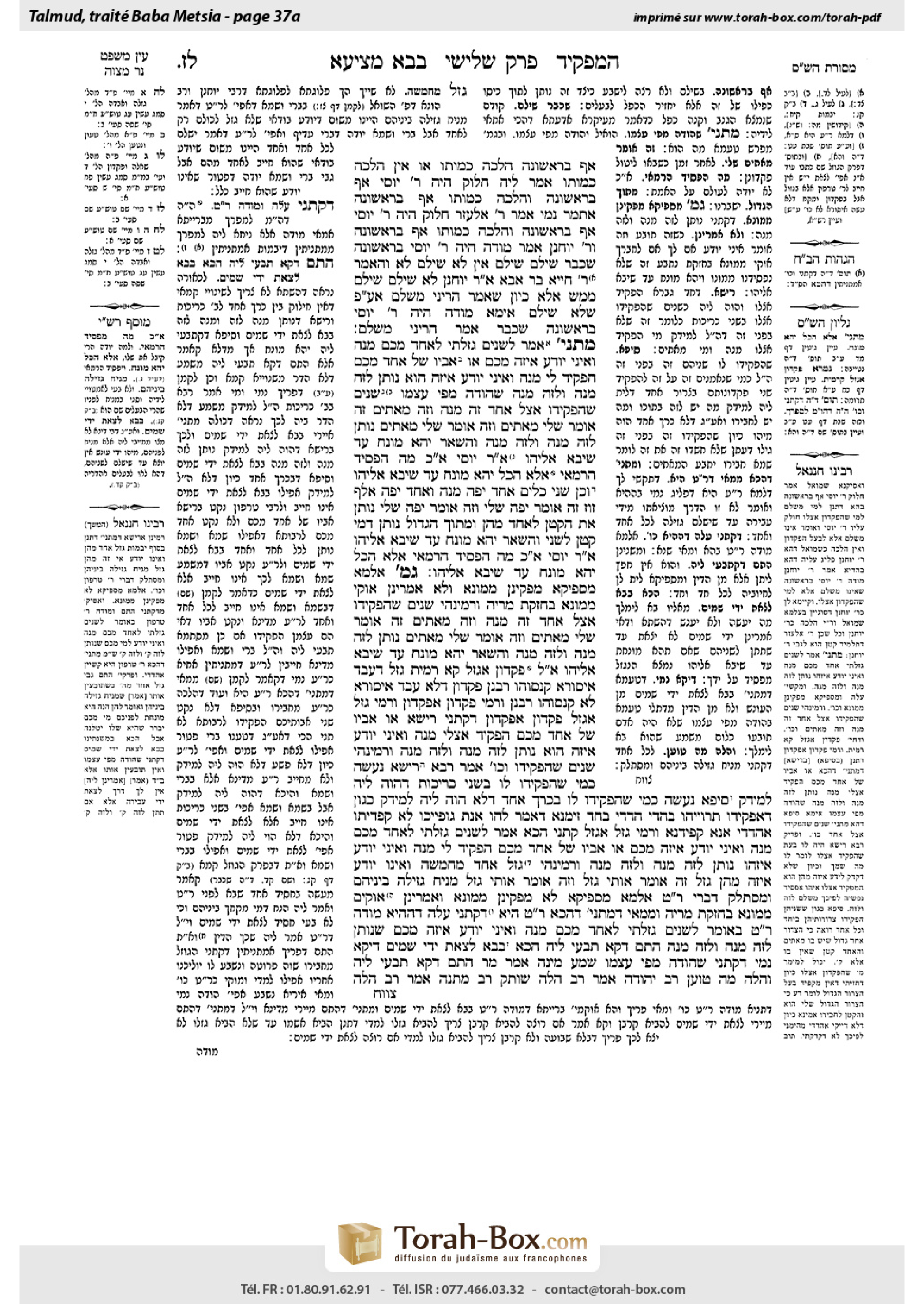
Bava Metzia 37a: Talmud study for Daf Yomi
Study the Talmud for Daf Yomi with scanned pages, Hebrew text, English translations from Sefaria and AI-generated French translations.
Passage selection and English or AI-generated French translation are available where the scan has annotations. Daf Study is independent of Torah-Box and Sefaria.
Browse Bava Metzia · בבא מציעא · All tractatesBava Metzia 37a text and translations
This page of Bava Metzia includes the Aramaic text, an English translation and an AI-generated French translation, alongside the scan above.
בבא מציעא ל״ז א · Aramaic and Hebrew text
אַף בָּרִאשׁוֹנָה, הֲלָכָה כְּמוֹתוֹ אוֹ אֵין הֲלָכָה כְּמוֹתוֹ? אֲמַר לֵיהּ: חָלוּק הָיָה רַבִּי יוֹסֵי אַף בָּרִאשׁוֹנָה, וַהֲלָכָה כְּמוֹתוֹ אַף בָּרִאשׁוֹנָה.
אִתְּמַר נָמֵי. אָמַר רַבִּי אֶלְעָזָר: חָלוּק הָיָה רַבִּי יוֹסֵי אַף בָּרִאשׁוֹנָה, וַהֲלָכָה כְּמוֹתוֹ אַף בָּרִאשׁוֹנָה. וְרַבִּי יוֹחָנָן אָמַר: מוֹדֶה הָיָה רַבִּי יוֹסֵי בָּרִאשׁוֹנָה שֶׁכְּבָר שִׁילֵּם.
שִׁילֵּם – אִין, לֹא שִׁילֵּם – לָא? וְהָאָמַר רַבִּי חִיָּיא בַּר אַבָּא אָמַר רַבִּי יוֹחָנָן: לֹא ״שִׁילֵּם״ שִׁילֵּם מַמָּשׁ, אֶלָּא כֵּיוָן שֶׁאָמַר ״הֲרֵינִי מְשַׁלֵּם״ אַף עַל פִּי שֶׁלֹּא שִׁילֵּם. אֵימָא: מוֹדֶה הָיָה רַבִּי יוֹסֵי בָּרִאשׁוֹנָה שֶׁכְּבָר אָמַר ״הֲרֵינִי מְשַׁלֵּם״.
מַתְנִי׳ אָמַר לִשְׁנַיִם: גָּזַלְתִּי לְאֶחָד מִכֶּם מָנֶה וְאֵינִי יוֹדֵעַ אֵיזֶה מִכֶּם. אוֹ: אָבִיו שֶׁל אֶחָד מִכֶּם הִפְקִיד לִי מָנֶה וְאֵינִי יוֹדֵעַ אֵיזֶה הוּא – נוֹתֵן לָזֶה מָנֶה וְלָזֶה מָנֶה, שֶׁהוֹדָה מִפִּי עַצְמוֹ.
שְׁנַיִם שֶׁהִפְקִידוּ אֵצֶל אֶחָד, זֶה מָנֶה וְזֶה מָאתַיִם. זֶה אוֹמֵר: שֶׁלִּי מָאתַיִם, וְזֶה אוֹמֵר: שֶׁלִּי מָאתַיִם. נוֹתֵן לָזֶה מָנֶה וְלָזֶה מָנֶה, וְהַשְּׁאָר יְהֵא מוּנָּח עַד שֶׁיָּבֹא אֵלִיָּהוּ.
אָמַר רַבִּי יוֹסֵי: אִם כֵּן, מָה הִפְסִיד הָרַמַּאי? אֶלָּא הַכֹּל יְהֵא מוּנָּח עַד שֶׁיָּבֹא אֵלִיָּהוּ.
וְכֵן שְׁנֵי כֵלִים, אֶחָד יָפֶה מָנֶה, וְאֶחָד יָפֶה אֶלֶף זוּז, זֶה אוֹמֵר: יָפֶה שֶׁלִּי, וְזֶה אוֹמֵר: יָפֶה שֶׁלִּי – נוֹתֵן אֶת הַקָּטָן לְאֶחָד מֵהֶן, וּמִתּוֹךְ הַגָּדוֹל נוֹתֵן דְּמֵי קָטָן לַשֵּׁנִי, וְהַשְּׁאָר יְהֵא מוּנָּח עַד שֶׁיָּבֹא אֵלִיָּהוּ. אָמַר רַבִּי יוֹסֵי: אִם כֵּן מָה הִפְסִיד הָרַמַּאי? אֶלָּא, הַכֹּל יְהֵא מוּנָּח עַד שֶׁיָּבֹא אֵלִיָּהוּ.
גְּמָ׳ אַלְמָא מִסְּפֵיקָא מַפְּקִינַן מָמוֹנָא, וְלָא אָמְרִינַן: אוֹקֵי מָמוֹנָא בְּחֶזְקַת מָרֵיהּ.
וּרְמִינְהִי: שְׁנַיִם שֶׁהִפְקִידוּ אֵצֶל אֶחָד, זֶה מָנֶה וְזֶה מָאתַיִם, זֶה אוֹמֵר ״שֶׁלִּי מָאתַיִם״ וְזֶה אוֹמֵר ״שֶׁלִּי מָאתַיִם״ – נוֹתֵן לָזֶה מָנֶה וְלָזֶה מָנֶה, וְהַשְּׁאָר יְהֵא מוּנָּח עַד שֶׁיָּבֹא אֵלִיָּהוּ.
אֲמַר לֵיהּ: פִּקָּדוֹן אַגָּזֵל קָא רָמֵית, גָּזֵל דַּעֲבַד אִיסּוּרָא – קַנְסוּהּ רַבָּנַן, פִּקָּדוֹן דְּלָא עֲבַד אִיסּוּרָא – לָא קַנְסוּהּ רַבָּנַן.
וּרְמִי פִּקָּדוֹן אַפִּקָּדוֹן, וּרְמִי גָּזֵל אַגָּזֵל. פִּקָּדוֹן אַפִּקְדוֹן, דְּקָתָנֵי רֵישָׁא: אוֹ אָבִיו שֶׁל אֶחָד מִכֶּם הִפְקִיד אֶצְלִי מָנֶה, וְאֵינִי יוֹדֵעַ אֵיזֶה הוּא נוֹתֵן לָזֶה מָנֶה וְלָזֶה מָנֶה. וּרְמִינְהִי: שְׁנַיִם שֶׁהִפְקִידוּ וְכוּ׳!
אָמַר רָבָא: רֵישָׁא נַעֲשָׂה כְּמִי שֶׁהִפְקִידוּ לוֹ בִּשְׁנֵי כְרִיכוֹת, דַּהֲוָה לֵיהּ לְמֵידַק. סֵיפָא נַעֲשָׂה כְּמִי שֶׁהִפְקִידוּ לוֹ בְּכֶרֶךְ אֶחָד, דְּלָא הֲוָה לֵיהּ לְמֵידַק, כְּגוֹן דְּאַפְקִידוּ תַּרְוַיְיהוּ בַּהֲדֵי הֲדָדֵי בְּחַד זִימְנָא, דְּאָמַר לְהוּ: אַנְתְּ גּוּפַיְיכוּ לָא קָפְדִיתוּ אַהֲדָדֵי, אֲנָא קָפֵידְנָא?
וּרְמִי גָּזֵל אַגָּזֵל, קָתָנֵי הָכָא: אֲמַר לִשְׁנַיִם גָּזַלְתִּי לְאֶחָד מִכֶּם מָנֶה וְאֵינִי יוֹדֵעַ אֵיזֶה מִכֶּם, אוֹ אָבִיו שֶׁל אֶחָד מִכֶּם הִפְקִיד לִי מָנֶה וְאֵינִי יוֹדֵעַ אֵיזֶה הוּא – נוֹתֵן לָזֶה מָנֶה וְלָזֶה מָנֶה.
וּרְמִינְהִי: גָּזַל אֶחָד מֵחֲמִשָּׁה, וְאֵינוֹ יוֹדֵעַ אֵיזֶה מֵהֶן גָּזַל, זֶה אוֹמֵר: אוֹתִי גָּזַל, וְזֶה אוֹמֵר: אוֹתִי גָּזַל, מַנִּיחַ גְּזֵילָה בֵּינֵיהֶם וּמִסְתַּלֵּק, דִּבְרֵי רַבִּי טַרְפוֹן. אַלְמָא מִסְּפֵקָא לָא מַפְּקִינַן מָמוֹנָא, וְאָמְרִינַן: אוֹקֵים מָמוֹנָא בְּחֶזְקַת מָרֵיהּ.
וּמִמַּאי דְּמַתְנִיתִין דְּהָכָא רַבִּי טַרְפוֹן הִיא? דְּקָתָנֵי עֲלַהּ דְּהַהִיא מוֹדֶה רַבִּי טַרְפוֹן בְּאוֹמֵר לִשְׁנַיִם גָּזַלְתִּי לְאֶחָד מִכֶּם מָנֶה וְאֵינִי יוֹדֵעַ אֵיזֶה מִכֶּם שֶׁנּוֹתֵן לָזֶה מָנֶה וְלָזֶה מָנֶה.
הָתָם דְּקָא תָבְעִי לֵיהּ, הָכָא בְּבָא לָצֵאת יְדֵי שָׁמַיִם. דַּיְקָא נָמֵי דְּקָתָנֵי: שֶׁהוֹדָה מִפִּי עַצְמוֹ. שְׁמַע מִינַּהּ.
אָמַר מָר: הָתָם דְּקָא תָבְעִי לֵיהּ. וְהַלָּה מָה טוֹעֵן? רַב יְהוּדָה אָמַר רַב: הַלָּה שׁוֹתֵק. רַב מַתְנָה אָמַר רַב: הַלָּה
Bava Metzia 37a · English translation
even in the first mishna in this chapter, and Rabbi Yosei holds that even when a bailee pays for the deposit and chooses not to take an oath, the thief pays the double payment to the owner. Is the halakha in accordance with his opinion even in that case, or is the halakha not in accordance with his opinion? Rav Yehuda said to him: Rabbi Yosei was in disagreement even in the first mishna in this chapter, and the halakha is in accordance with his opinion even in the first mishna.
It was also stated that the amora’im in Eretz Yisrael disagreed about this matter. Rabbi Elazar says: Rabbi Yosei was in disagreement even in the first mishna and the halakha is in accordance with his opinion even in the first mishna. And Rabbi Yoḥanan says: Rabbi Yosei conceded in the first mishna because the bailee already paid and acquired the animal.
The Gemara questions the formulation of Rabbi Yoḥanan’s statement: If he paid, yes, the thief pays the double payment to him; if he did not pay, no? But doesn’t Rabbi Ḥiyya bar Abba say that Rabbi Yoḥanan himself says: When the mishna says: If the bailee paid, it does not mean that he actually paid; rather, once the bailee said: I hereby choose to pay, even if he did not yet actually pay, he acquired the double payment? The Gemara answers: Emend the statement of Rabbi Yoḥanan and say: Rabbi Yosei conceded in the first mishna because the bailee already said: I hereby choose to pay.
MISHNA: If one said to two people: I robbed one of you of one hundred dinars, but I do not know from which of you I took the money, or if one said to two people: The father of one of you deposited one hundred dinars with me, but I do not know the father of which of you he is, then he gives one hundred dinars to this person and one hundred dinars to that person. This is because there is no way to determine which of them is entitled to the money, and he admitted his obligation at his own initiative.
In the case of two people who deposited money with one person, and this one deposited one hundred dinars and that one deposited two hundred dinars, and when they come to collect their deposit, this one says: My deposit was two hundred dinars, and that one says: My deposit was two hundred dinars, the bailee gives one hundred dinars to this one and one hundred dinars to that one. And the rest of the money, i.e., the contested one hundred dinars, will be placed in a safe place until Elijah comes and prophetically determines the truth.
Rabbi Yosei said: If so, what did the swindler lose? He lost nothing by claiming the one hundred dinars that belongs to another, and he has no incentive to admit the truth. Rather, the entire deposit will be placed in a safe place until Elijah comes. As his fraud will cause him to lose even the one hundred dinars that he deposited, perhaps he will be discouraged from making a fraudulent claim.
And likewise, if two people deposited two vessels, one worth one hundred dinars and one worth one thousand dinars, and this one says: The expensive vessel is mine, and that one says: The expensive vessel is mine, the bailee gives the small vessel to one of them, and from the proceeds of the sale of the large vessel he gives the value of the small vessel to the other, and the rest of the money is placed in a safe place until Elijah comes. Rabbi Yosei said: If so, what did the swindler lose? Rather, the entire deposit, i.e., both vessels, are placed in a safe place until Elijah comes or one of them admits his deceit.
GEMARA: From the fact that the mishna teaches that if the bailee does not know whom he robbed, he gives one hundred dinars to this one and one hundred dinars to that one, apparently, in cases of uncertainty, we expropriate property and return it to those claiming it. And we do not say: Establish the money in the possession of its owner. In this case, the bailee is currently the owner of the money, but the money is not left in his possession.
And raise a contradiction from the continuation of the mishna: In the case of two people who deposited money with one person, and this one deposited one hundred dinars and that one deposited two hundred dinars, and when they come to collect their deposit, this one says: My deposit was two hundred dinars, and that one says: My deposit was two hundred dinars, the bailee gives one hundred dinars to this one and one hundred dinars to that one. And the rest of the money will be placed in a safe place until Elijah comes and prophetically determines the truth.
The Sages said to the one who raised the contradiction: Are you raising a contradiction between the halakha stated in the case of a deposit and the halakha stated in the case of a robbery? In the case of robbery, where one transgressed a prohibition, the Sages penalized him and ruled that he must pay both possible robbery victims. In the case of a deposit, where he did not transgress a prohibition, the Sages did not penalize him.
And they raised a contradiction between the halakha stated in the case of a deposit and the halakha stated in the case of a deposit, and they raised a contradiction between the halakha stated in the case of a robbery and the halakha stated in the case of a robbery. There is a contradiction between the halakha stated in the case of a deposit and the halakha stated in the case of a deposit, as it is taught in the first clause of the mishna: Or, if one said to two people: The father of one of you deposited one hundred dinars with me, but I do not know the father of which of you he is, he gives one hundred dinars to this person and one hundred dinars to that person. The Gemara raises a contradiction from the continuation of the mishna cited above: In the case of two people who deposited money with one person, the contested sum is placed in a safe place until Elijah comes.
Rava said: In the first clause of the mishna, in the case where the bailee receives money from the father of one person, he becomes like one with whom they deposited sums of money in two separate bundles, as the bailee should have been discerning with regard to who gave him the money. His failure to do so constitutes negligence, and therefore he pays the sum to both claimants. In the latter clause of the mishna, in the case where he receives money from two people, he becomes like one with whom they deposited sums of money in one bundle, as there is no expectation that he should have been discerning. It is a case where they both deposited their money together at one time, as the bailee says to them: If you yourselves were not suspicious of each other, should I be suspicious? Therefore, he is required to pay them only the sum that they can prove is theirs.
And they raised a contradiction between the halakha stated in the case of a robbery and the halakha stated in the case of a robbery. It is taught here: If one said to two people: I robbed one of you of one hundred dinars, but I do not know from which of you I took the money, or if one said to two people: The father of one of you deposited one hundred dinars with me, but I do not know the father of which of you he is, then he gives one hundred dinars to this person and one hundred dinars to that person.
The Gemara raises a contradiction from a mishna (Yevamot 118b): If one robbed one of five people and he does not know which of them he robbed, and this one says: He robbed me, and that one says: He robbed me, the robber places the stolen item between them and withdraws from them; this is the statement of Rabbi Tarfon. Apparently, contrary to the mishna, we do not expropriate property due to an uncertainty and return it to those claiming it, and instead we say: Establish the money in the possession of its owner.
The Gemara asks: And from where is it known that the mishna here is in accordance with the opinion of Rabbi Tarfon? Perhaps the mishna is in accordance with the opinion of Rabbi Akiva, who holds the robber must pay each of the five possible victims, and there is no contradiction at all. The Gemara answers: It is known that the mishna here is in accordance with the opinion of Rabbi Tarfon, as it is taught in a baraita concerning the halakha taught in that mishna, in tractate Yevamot: Rabbi Tarfon concedes that in a case where a robber says to two people: I robbed one of you of one hundred dinars, but I do not know which of you it was, he gives one hundred dinars to this person and one hundred dinars to that person, as he has already admitted his obligation on his own. There is an apparent contradiction between the two statements of Rabbi Tarfon.
The Gemara answers: There, in the mishna where one robbed one of five people of money, it is referring to a case where the claimants demand payment from him. He is required to pay them only one hundred dinars, as the burden of proof rests upon the claimant. By contrast, here, i.e., in this mishna and the statement of Rabbi Tarfon in the baraita, it is referring to a case where the robber comes to fulfill his obligation to Heaven. Only by returning the money to the person he robbed can he atone for his transgression. Therefore, he goes beyond the halakhic requirement and pays both claimants. The Gemara notes: The language of this mishna is also precise, as the tanna teaches: Because he admitted his obligation at his own initiative. The Gemara affirms: Learn from the wording of the mishna that this is the explanation of the mishna.
With regard to returning stolen money, the Master said: There, it is referring to a case where the claimants demand payment from him. The Gemara asks: And the other person, the thief, what does he claim in response? Rav Yehuda says that Rav says: The other person is silent, as he does not know to whom he owes the money. Rav Mattana says that Rav says: The other person
Bava Metzia 37a · Traduction française (IA)
Même dans la première mitsva de ce chapitre, Rabbi Yosei considère que même lorsque le dépositaire paie pour le dépôt et choisit de ne pas prendre d'œuf, le voleur paie double au propriétaire. La halakha suit-elle son opinion même dans ce cas, ou la halakha ne suit-elle pas son opinion ? Rav Yehuda répondit à lui : Rabbi Yosei était en désaccord même dans la première mitsva de ce chapitre, et la halakha suit son opinion même dans la première mitsva.
Il a également été dit que les amoraïm en Terre d'Israël étaient en désaccord sur cette question. Rabbi Elazar dit : Rabbi Yosei était en désaccord même dans la première mitsva et la halakha suit son opinion même dans la première mitsva. Et Rabbi Yoḥanan dit : Rabbi Yosei a cédé dans la première mitsva car le dépositaire avait déjà payé et acquis l'animal.
La Guemara questionne la formulation de l'affirmation de Rabbi Yoḥanan : Si il a payé, oui, le voleur paie double à lui ; si il n'a pas payé, non ? Mais ne dit pas Rabbi Ḥiyya bar Abba que Rabbi Yoḥanan lui-même dit : Lorsque la mitsva dit : Si le dépositaire a payé, cela ne signifie pas qu'il a effectivement payé ; plutôt, une fois que le dépositaire a dit : Je choisis de payer, même s'il n'a pas encore effectivement payé, il a acquis le double paiement ? La Guemara répond : Corrigez l'affirmation de Rabbi Yoḥanan et dites : Rabbi Yosei a cédé dans la première mitsva car le dépositaire a déjà dit : Je choisis de payer.
MICHNA : Si l'on dit à deux personnes : J'ai volé à l'une d'entre vous un cent dinars, mais je ne sais pas à laquelle j'ai pris l'argent, ou si l'on dit à deux personnes : Le père d'une d'entre vous a déposé un cent dinars chez moi, mais je ne surse pas le père de laquelle d'entre vous il est, alors il donne un cent dinars à cette personne et un cent dinars à celle-ci. Cela est ainsi parce qu'il n'y a aucun moyen de déterminer à qui appartient l'argent, et il a admis sa dette de son propre chef.
Dans le cas de deux personnes ayant déposé de l'argent chez une personne, et cette personne ayant déposé un cent dinars et celle-ci ayant déposé deux cents dinars, et lorsqu'elles viennent récupérer leur dépôt, cette personne dit : Mon dépôt était deux cents dinars, et celle-ci dit : Mon dépôt était deux cents dinars, le dépositaire donne un cent dinars à cette personne et un cent dinars à celle-ci. Et le reste de l'argent, c'est-à-dire le cent dinars contesté, sera mis en lieu sûr jusqu'à ce que l'Élie vienne et détermine la vérité prophétiquement.
Rabbi Yosei dit : Si c'est ainsi, que a-t-il perdu le voleur ? Il n'a perdu rien en prétendant que le cent dinars appartient à un autre, et il n'a aucun motif d'admettre la vérité. Plutôt, l'ensemble du dépôt sera mis en lieu sûr jusqu'à ce que l'Élie vienne. Car son fraude pourrait lui faire perdre même le cent dinars qu'il a déposé, peut-être sera-t-il découragé de faire une revendication frauduleuse.
Et de même, si deux personnes ont déposé deux objets, l'un valant un cent dinars et l'autre un millier de dinars, et cette personne dit : L'objet cher est le mien, et celle-ci dit : L'objet cher est le mien, le dépositaire donne l'objet petit à l'un d'eux, et à partir des recettes de la vente de l'objet cher, il donne la valeur de l'objet petit à l'autre, et le reste de l'argent est mis en lieu sûr jusqu'à ce que l'Élie vienne ou que l'un d'eux admette sa tromperie. Rabbi Yosei dit : Si c'est ainsi, que a-t-il perdu le voleur ? Plutôt, l'ensemble du dépôt, c'est-à-dire les deux objets, est mis en lieu sûr jusqu'à ce que l'Élie vienne ou que l'un d'eux admette sa tromperie.
GUEMARA : D'après le fait que la mitsva enseigne que si le dépositaire ne sait pas à qui il a volé, il donne un cent dinars à cette personne et un cent dinars à celle-ci, apparemment, dans les cas d'incertitude, nous exproprions la propriété et la rendons à ceux qui la réclament. Et nous ne disons pas : Établissez l'argent dans la possession de son propriétaire. Dans ce cas, le dépositaire est actuellement le propriétaire de l'argent, mais l'argent n'est pas laissé en sa possession.
Et soulève un paradoxe à partir de la continuation de la mitsva : Dans le cas de deux personnes ayant déposé de l'argent chez une personne, et cette personne ayant déposé un cent dinars et celle-ci ayant déposé deux cents dinars, et lorsqu'elles viennent récupérer leur dépôt, cette personne dit : Mon dépôt était deux cents dinars, et celle-ci dit : Mon dépôt était deux cents dinars, le dépositaire donne un cent dinars à cette personne et un cent dinars à celle-ci. Et le reste de l'argent sera mis en lieu sûr jusqu'à ce que l'Élie vienne et détermine la vérité prophétiquement.
Les Sages dirent à celui qui soulevait le paradoxe : Vous soulevez-vous un paradoxe entre la halakha énoncée dans le cas d'un dépôt et la halakha énoncée dans le cas d'un vol ? Dans le cas d'un vol, où l'on a transgressé une interdiction, les Sages ont sanctionné et ont décidé qu'il doive payer aux deux victimes possibles. Dans le cas d'un dépôt, où l'on n'a pas transgressé une interdiction, les Sages n'ont pas sanctionné.
Et ils ont soulevé un paradoxe entre la halakha énoncée dans le cas d'un dépôt et la halakha énoncée dans le cas d'un dépôt, et ils ont soulevé un paradoxe entre la halakha énoncée dans le cas d'un vol et la halakha énoncée dans le cas d'un vol. Il y a un paradoxe entre la halakha énoncée dans le cas d'un dépôt et la halakha énoncée dans le cas d'un dépôt, comme il est enseigné dans la première clause de la mitsna : Ou, si l'on dit à deux personnes : Le père d'une d'entre vous a déposé cent dinars chez moi, mais je ne sais pas le père de laquelle d'entre vous il est, il donne cent dinars à cette personne et cent dinars à celle-ci. La Guemara soulève un paradoxe à partir de la continuation de la mitsna citée ci-dessus : Dans le cas de deux personnes ayant déposé de l'argent chez une personne, la somme contestée est mise en lieu sûr jusqu'à ce que l'Élie vienne.
Rava a dit : Dans la première clause de la mitsna, dans le cas où le gardien reçoit de l'argent du père d'une personne, il devient comme celui avec qui on a déposé des sommes d'argent en deux paquets séparés, car le gardien aurait dû être discernant quant à celui qui lui donnait de l'argent. Son échec à le faire constitue une négligence, et par conséquent il paie la somme aux deux réclamants. Dans la seconde clause de la mitsna, dans le cas où il reçoit de l'argent de deux personnes, il devient comme celui avec qui on a déposé des sommes d'argent dans un seul paquet, car il n'y a pas d'attente qu'il soit discernant. Il s'agit d'un cas où ils ont tous deux déposé leur argent ensemble à la fois, car le gardien dit à eux : Si vous n'étiez pas suspects les uns des autres, devrais-je l'être ? Par conséquent, il est tenu de payer seulement la somme qu'ils peuvent prouver être à eux.
Et ils ont soulevé une contradiction entre la halakha énoncée dans le cas d'un vol et la halakha énoncée dans le cas d'un vol. Il est enseigné ici : Si l'on dit à deux personnes : J'ai volé l'une d'entre vous d'une centaine de drachmes, mais je ne sais pas laquelle d'entre vous j'ai volée, ou si l'on dit à deux personnes : Le père d'une d'entre vous a déposé une centaine de drachmes avec moi, mais je ne sais pas le père de laquelle d'entre vous il s'agit, alors il donne une centaine de drachmes à cette personne et une centaine de drachmes à celle-ci.
Le Guemara soulève une contradiction à partir d'une mitsna (Yevamot 118b) : Si l'on a volé l'un des cinq personnes et qu'on ne sait pas laquelle d'entre elles on a volée, et que celui-ci dit : Il m'a volé, et celui-ci dit : Il m'a volé, le voleur place l'objet volé entre eux et s'éloigne d'eux ; c'est la déclaration de Rabbi Tarfon. Apparemment, contrairement à la mitsna, nous ne confisquons pas la propriété en raison d'une incertitude et ne la rendons pas à ceux qui réclament, mais au contraire nous disons : Établissez l'argent dans la possession de son propriétaire.
Le Guemara demande : Et d'où sait-on que la mitsva ici est en conformité avec l'opinion de Rabbi Tarfon ? Peut-être que la mitsva est en conformité avec l'opinion de Rabbi Akiva, qui considère que le voleur doit payer chaque un des cinq possibles victimes, et il n'y a pas de contradiction du tout. Le Guemara répond : On sait que la mitsva ici est en conformité avec l'opinion de Rabbi Tarfon, car il est enseigné dans une baraïta concernant la halakha énoncée dans cette mitsva, dans le traité Yevamot : Rabbi Tarfon reconnaît que dans le cas où un voleur dit à deux personnes : J'ai volé l'une d'entre vous d'une centaine de drachmes, mais je ne sais pas laquelle d'entre vous c'était, il donne une centaine de drachmes à cette personne et une centaine de drachmes à celle-ci, car il a déjà admis sa dette de lui-même. Il y a une contradiction apparente entre les deux déclarations de Rabbi Tarfon.
Le Guemara répond : Là, dans la mitsva où l'on a volé l'un des cinq personnes d'argent, il s'agit d'un cas où les réclamants demandent un paiement à lui. Il est tenu de payer seulement une centaine de drachmes, car la charge de la preuve incombe au réclamant. À l'inverse, ici, c'est-à-dire dans cette mitsva et la déclaration de Rabbi Tarfon dans la baraïta, il s'agit d'un cas où le voleur vient remplir son obligation envers Dieu. Seul en rendant l'argent à la personne qu'il a volée peut-il expier son péché. Par conséquent, il dépasse la exigence halakhique et paie les deux réclamants. Le Guemara note : La formulation de cette mitsva est aussi précise, car le tanna enseigne : Parce qu'il a admis sa dette de lui-même. Le Guemara affirme : Apprenez de la formulation de la mitsva que c'est l'explication de la mitsva.
Concernant le retour d'argent volé, le Maître a dit : Là, il s'agit d'un cas où les réclamants demandent un paiement à lui. Le Guemara demande : Et l'autre personne, le voleur, quel argument présente-t-il en réponse ? Rav Yehuda dit que Rav dit : L'autre personne est muette, car il ne sait pas à qui il doit l'argent. Rav Mattana dit que Rav dit : L'autre personne
Traduction française générée par IA à partir de l’édition anglaise de Sefaria. Vérifie toujours un passage avec le texte source.
Text from Sefaria: William Davidson Edition - Vocalized Aramaic (CC BY NC); William Davidson Edition - English (CC BY NC).