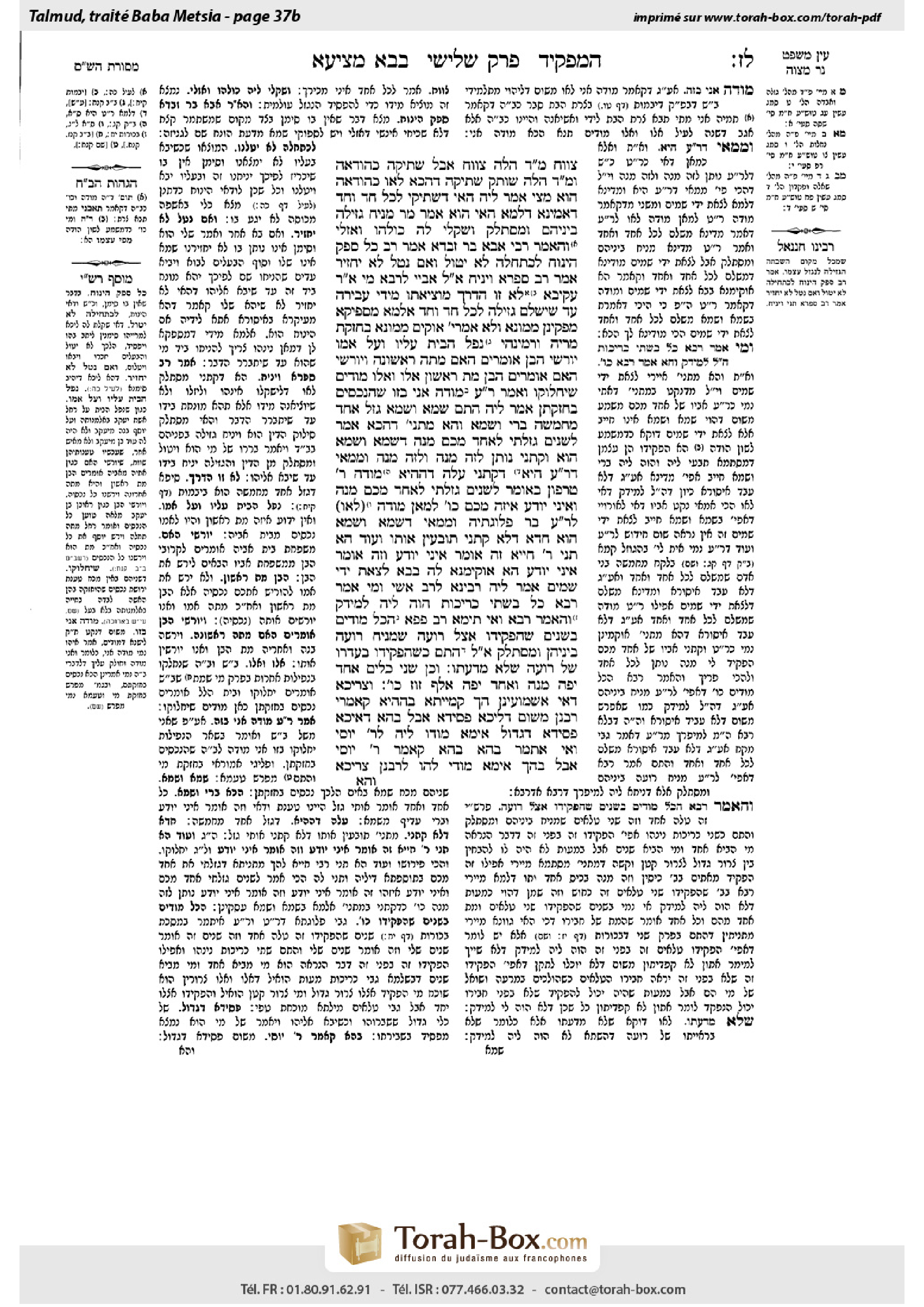
Bava Metzia 37b: Talmud study for Daf Yomi
Study the Talmud for Daf Yomi with scanned pages, Hebrew text, English translations from Sefaria and AI-generated French translations.
Passage selection and English or AI-generated French translation are available where the scan has annotations. Daf Study is independent of Torah-Box and Sefaria.
Browse Bava Metzia · בבא מציעא · All tractatesBava Metzia 37b text and translations
This page of Bava Metzia includes the Aramaic text, an English translation and an AI-generated French translation, alongside the scan above.
בבא מציעא ל״ז ב · Aramaic and Hebrew text
צוֹוֵחַ. מַאן דְּאָמַר הַלָּה צוֹוֵחַ, אֲבָל שְׁתִיקָה – כְּהוֹדָאָה. וּמַאן דְּאָמַר הַלָּה שׁוֹתֵק, שְׁתִיקָה דְּהָכָא לָאו כְּהוֹדָאָה הוּא, מָצֵי אֲמַר לֵיהּ: הַאי דִּשְׁתִיקִי לְכֹל חַד וְחַד, דְּאָמֵינָא דִּלְמָא הַאי הוּא.
אָמַר מָר: מַנִּיחַ גְּזֵילָה בֵּינֵיהֶם וּמִסְתַּלֵּק. וְשָׁקְלִי לַהּ כּוּלְּהוּ וְאָזְלִי? וְהָאָמַר רַבִּי אַבָּא בַּר זַבְדָּא אָמַר רַב: כֹּל סְפֵק הִינּוּחַ לְכַתְּחִילָּה לֹא יִטּוֹל, וְאִם נָטַל – לֹא יַחֲזִיר. אָמַר רַב סָפְרָא: וְיַנִּיחַ.
אֲמַר לֵיהּ אַבָּיֵי לְרָבָא: מִי אָמַר רַבִּי עֲקִיבָא לֹא זוֹ הַדֶּרֶךְ מוֹצִיאָתוֹ מִידֵי עֲבֵירָה עַד שֶׁיְּשַׁלֵּם גְּזֵילָה לְכֹל חַד וְחַד? אַלְמָא מִסְּפֵיקָא מַפְּקִינַן מָמוֹנָא, וְלָא אָמְרִינַן ״אוֹקֵים מָמוֹנָא בְּחֶזְקַת מָרֵיהּ״.
וּרְמִינְהִי: נָפַל הַבַּיִת עָלָיו וְעַל אִמּוֹ, יוֹרְשֵׁי הַבֵּן אוֹמְרִים: הָאֵם מֵתָה רִאשׁוֹנָה. וְיוֹרְשֵׁי הָאֵם אוֹמְרִים: הַבֵּן מֵת רִאשׁוֹן. אֵלּוּ וָאֵלּוּ מוֹדִים שֶׁיַּחְלוֹקוּ. וְאָמַר רַבִּי עֲקִיבָא: מוֹדֶה אֲנִי בָּזוֹ שֶׁהַנְּכָסִים בְּחֶזְקָתָן!
אֲמַר לֵיהּ, הָתָם – שֶׁמָּא וְשֶׁמָּא, גָּזַל אֶחָד מֵחֲמִשָּׁה – בָּרִי וְשֶׁמָּא. וְהָא מַתְנִיתִין דְּהָכָא אָמַר לִשְׁנַיִם: גָּזַלְתִּי לְאֶחָד מִכֶּם מָנֶה, דְּשֶׁמָּא וְשֶׁמָּא הוּא, וְקָתָנֵי: נוֹתֵן לָזֶה מָנֶה וְלָזֶה מָנֶה.
וּמִמַּאי דְּרַבִּי עֲקִיבָא הִיא? דְּקָתָנֵי עֲלַהּ דְּהַהִיא: מוֹדֶה רַבִּי טַרְפוֹן בְּאוֹמֵר לִשְׁנַיִם ״גָּזַלְתִּי לְאֶחָד מִכֶּם מָנֶה וְאֵינִי יוֹדֵעַ אֵיזֶה מִכֶּם כּוּ׳״, לְמַאן מוֹדֶה? לָאו לְרַבִּי עֲקִיבָא בַּר פְּלוּגְתֵּיהּ?
וּמִמַּאי דְּשֶׁמָּא וְשֶׁמָּא הוּא? חֲדָא דְּלָא קָתָנֵי תּוֹבְעִין אוֹתוֹ. וְעוֹד, הָא תָּנֵי רַבִּי חִיָּיא: זֶה אוֹמֵר ״אֵינִי יוֹדֵעַ״ וְזֶה אוֹמֵר ״אֵינִי יוֹדֵעַ״.
הָא אוֹקֵימְנָא לַהּ בְּבָא לָצֵאת יְדֵי שָׁמַיִם.
אֲמַר לֵיהּ רָבִינָא לְרַב אָשֵׁי: וּמִי אָמַר רָבָא כֹּל בִּשְׁתֵּי כְּרִיכוֹת הֲוָה לֵיהּ לְמֵידַק? וְהָאָמַר רָבָא, וְאִי תֵּימָא רַב פָּפָּא: הַכֹּל מוֹדִים בִּשְׁנַיִם שֶׁהִפְקִידוּ אֵצֶל רוֹעֶה, שֶׁמַּנִּיחַ רוֹעֶה בֵּינֵיהֶן וּמִסְתַּלֵּק! אֲמַר לֵיהּ: הָתָם כְּשֶׁהִפְקִידוּ בְּעֶדְרוֹ שֶׁל רוֹעֶה שֶׁלֹּא מִדַּעְתּוֹ.
וְכֵן שְׁנֵי כֵלִים אֶחָד יָפֶה מָנֶה וְאֶחָד יָפֶה אֶלֶף זוּז כּוּ׳. וּצְרִיכָא.
דְּאִי אַשְׁמְועִינַן הָךְ קַמַּיְיתָא: בְּהַהִיא קָאָמְרִי רַבָּנַן מִשּׁוּם דְּלֵיכָּא פְּסֵידָא. אֲבָל בְּהָא, דְּאִיכָּא פְּסֵידָא דְגָדוֹל אֵימָא מוֹדוּ לֵיהּ לְרַבִּי יוֹסֵי. וְאִי אִתְּמַר בְּהָא, בְּהָא קָאָמַר רַבִּי יוֹסֵי. אֲבָל בְּהָךְ אֵימָא מוֹדֵי לְהוּ לְרַבָּנַן. צְרִיכָא.
Bava Metzia 37b · English translation
screams and says to each of the claimants: I do not recognize you and I find no basis for your claim. The Gemara comments: The one who says that the other screams holds that he need not return the money to each of them if he is screaming that he does not accept their claims. But a reaction of silence is tantamount to admission that the demands of the claimants are legitimate. And the one who says that the other is silent holds that the silence here is not tantamount to admission, as the robber could say to him: The fact that I was silent to each and every one of the claimants is because I said: Perhaps this is he, the robbery victim, but I do not admit that I owe money to more than one person.
The Master said: The robber places the stolen item between them and withdraws from them. The Gemara challenges: And all of them take it and go, possibly resulting in the robbery victim losing his property. But doesn’t Rabbi Abba bar Zavda say that Rav says concerning found items: In any case of uncertainty whether the placement of a found item was deliberate, the finder may not take the item ab initio, and if he took it, he should not return it to one who claims ownership without conclusive proof? Here too, the robber should keep the money until one of the claimants provides conclusive proof that the money is his. Rav Safra says: The baraita means: And the robber should place it in his possession or before the court.
Abaye said to Rava: In disputing Rabbi Tarfon’s opinion with regard to one who robbed money from one of five people, did Rabbi Akiva say: This is not the way to spare him from transgression; he is not considered to have returned the stolen item until he pays the value of the stolen item to each and every one of the five? Apparently, in his opinion, in cases of uncertainty, we expropriate property and return it to those claiming it, and we do not say: Establish the money in the possession of its owner.
The Gemara raises a contradiction from a mishna (Bava Batra 158b): A house collapsed on a person and on his mother, and it is unclear which of them died first. The son’s heirs say: The mother died first and her property was inherited by her son, who then died, and therefore the heirs of the son inherit the property of both. And the mother’s heirs say: The son died first, and therefore the mother’s heirs should inherit all of her property. In this case, both these tanna’im, Beit Shammai, and those tanna’im, Beit Hillel, agree that they should divide the disputed property, although they disagree in similar cases. And Rabbi Akiva said: I concede in this case that the property retains its previous ownership status. Apparently, Rabbi Akiva himself holds that property is not removed from one’s possession in cases of uncertainty.
Rava said to Abaye: There, in the case where the house collapsed, it is where there is an uncertain claim and an uncertain claim, as neither party knows what transpired. By contrast, in a case where one robbed money from one of five people, it is a case where there is a certain claim and an uncertain claim, as the robber does not know from whom he robbed the money, but the victims’ claims are based on certainty. The Gemara challenges: But in the mishna here, where one said to two people: I robbed one of you of one hundred dinars, but I do not know from which of you I took the money, it is a case where there is an uncertain claim and an uncertain claim, and it is taught: He gives one hundred dinars to this person and one hundred dinars to that person.
The Gemara asks: And from where is it known that the mishna here is in accordance with the opinion of Rabbi Akiva? The Gemara answers: This is known, as it is taught in a baraita concerning the halakha taught in that mishna: Rabbi Tarfon concedes that in a case where one says to two people: I robbed one of the two of you of one hundred dinars and I do not know from which of you I robbed the money, the robber gives one hundred dinars to each of them. To whom does Rabbi Tarfon concede? Is it not to Rabbi Akiva, who is his usual disputant?
The Gemara asks: And from where is it known that in the mishna it is a case where there is an uncertain claim and an uncertain claim? Perhaps the victims are certain that they were robbed. The Gemara answers: This is unlikely for several reasons. One, it is not taught in the mishna that they demand payment from him. And furthermore, didn’t Rabbi Ḥiyya teach in a baraita that the mishna is referring to a case where this party says: I do not know, and that party says: I do not know, indicating that these are uncertain claims?
The Gemara resolves the contradiction between the statements of Rabbi Akiva: Didn’t we establish the mishna as referring to a case in which the robber is coming to fulfill his obligation to Heaven? Therefore, the robber gives one hundred dinars to each, although he has no legal obligation to do so, as they made uncertain claims.
Ravina said to Rav Ashi: And did Rava say that in every case where the deposits are given in two separate bundles that the bailee should have been discerning with regard to the identity of the ones giving him the deposits? But didn’t Rava say, and some say that it was Rav Pappa who said: Everyone concedes in the case of two people who deposited animals with a shepherd, that if each claims that his deposit included a greater number of animals than that of the other, the shepherd places the animals among them and leaves? Rav Ashi said to Ravina: There, it is referring to a case where the shepherds deposited animals in the shepherd’s flock without his knowledge. Clearly there is no expectation that the shepherd will discern how many animals belong to each party.
The mishna teaches: And likewise, in the case of two people who deposited two vessels, one worth one hundred dinars and one worth one thousand dinars, and each of the claimants claims that the expensive vessel is his, the bailee gives the small vessel to one of them, and from the proceeds of the sale of the large vessel he gives the value of the small vessel to the other, and the rest of the money is placed in a safe place until Elijah comes. The Gemara comments: And it is necessary for the tanna to cite both the case of money and the case of vessels.
The reason is that if the tanna had taught us this first case with regard to money alone, one would conclude that it is in this case that the Rabbis say that each party receives one hundred dinars, and one hundred dinars is kept in a safe place, because in this case there is no loss. But in that case of the vessels, where there is a loss of the large vessel, as it must be broken or sold in order to pay the value of the small vessel to the other party, say that they concede to Rabbi Yosei that both vessels are kept in a safe place. And had the dispute been stated only in that case of vessels, one would conclude that it is in that case that Rabbi Yosei said that both vessels are kept in a safe place. But in this case of money, say that he concedes to the Rabbis. Therefore, it is necessary to cite both cases.
Bava Metzia 37b · Traduction française (IA)
il crie et dit à chacun des prétendants : Je ne vous reconnais pas et je ne trouve aucune base pour votre revendication. La Guemara commente : Celui qui affirme que l’autre crie considère qu’il n’a pas besoin de rendre l’argent à chacun d’eux s’il crie qu’il ne reconnaît pas leurs revendications. Mais une réaction de silence équivaut à une admission que les revendications des prétendants sont légitimes. Et celui qui affirme que l’autre est silencieux considère que le silence ici n’équivaut pas à une admission, car le voleur pourrait lui dire : Le fait que j’ai été silencieux envers chacun des prétendants est parce que j’ai dit : Peut-être c’est lui, la victime, mais je ne reconnais pas d’être dû à plus d’une personne.
Le Maître dit : Le voleur place l’objet volé entre eux et s’éloigne d’eux. La Guemara soulève un problème : Et tous les deux le prennent et s’en vont, ce qui pourrait entraîner la perte de la propriété du victime. Mais n’a-t-il pas dit Rabbi Abba bar Zavda que Rav dit concernant les objets trouvés : Dans tout cas d’incertitude quant à la volonté de laisser un objet trouvé, le trouver ne peut pas prendre l’objet dès le début, et s’il l’a pris, il ne doit pas le rendre à celui qui prétend en être propriétaire sans preuve concluante ? Ici aussi, le voleur devrait garder l’argent jusqu’à ce qu’un des prétendants fournisse une preuve concluante que l’argent est le sien. Rav Safra dit : La baraïta signifie : Et le voleur devrait placer l’objet en son possession ou devant le tribunal.
Abaye dit à Rava : En discutant de l’opinion de Rabbi Tarfon concernant celui qui a volé de l’argent à l’un des cinq personnes, Rabbi Akiva a-t-il dit : Ce n’est pas la bonne manière de le préserver de la transgression ; il n’est pas considéré comme ayant rendu l’objet volé jusqu’à ce qu’il paie la valeur de l’objet volé à chacun des cinq ? Apparemment, selon son avis, dans les cas d’incertitude, nous exproprions la propriété et la rendons à ceux qui la revendiquent, et nous ne disons pas : Établissez l’argent en possession de son propriétaire.
La Guemara soulève une contradiction à partir d’une mitsva (Bava Batra 158b) : Une maison s’est effondrée sur une personne et sur sa mère, et il est incertain qui est mort en premier. Les héritiers du fils disent : La mère est morte en premier et sa propriété a été héritée par son fils, qui est ensuite mort, et donc les héritiers du fils héritent de la propriété des deux. Et les héritiers de la mère disent : Le fils est mort en premier, et donc les héritiers de la mère devraient hériter de toute sa propriété. Dans ce cas, ces deux tannaïm, Beit Shammai, et ceux-ci, Beit Hillel, s’accordent sur le fait qu’ils doivent diviser la propriété contestée, bien qu’ils diffèrent dans des cas similaires. Et Rabbi Akiva a dit : Je reconnais dans ce cas que la propriété conserve son statut d’origine. Apparemment, Rabbi Akiva lui-même considère que la propriété n’est pas retirée de la possession d’une personne dans les cas d’incertitude.
Rava dit à Abaye : Là, dans le cas où la maison s’est effondrée, il s’agit d’un cas de revendication incertaine et de revendication incertaine, car ni l’une ni l’autre ne sait ce qui s’est produit. À l’inverse, dans le cas où l’on a volé de l’argent à l’un des cinq personnes, il s’agit d’un cas de revendication certaine et de revendication incertaine, car le voleur ne sait pas à qui il a volé l’argent, mais les revendications des victimes sont basées sur la certitude. La Guemara soulève un problème : Mais dans la mitsva ici, où l’on a dit à deux personnes : J’ai volé cent drachmes à l’un de vous, mais je ne sais pas à quel d’entre vous j’ai volé l’argent, il s’agit d’un cas de revendication incertaine et de revendication incertaine, et il est enseigné : Il donne cent drachmes à cette personne et cent drachmes à celle-ci.
La Guemara demande : Et d’où sait-on que la mitsva ici est en conformité avec l’opinion de Rabbi Akiva ? La Guemara répond : Cela est connu, car il est enseigné dans une baraïta concernant la halakha enseignée dans cette mitsva : Rabbi Tarfon reconnaît que dans un cas où l’on dit à deux personnes : J’ai volé un hundred de drachmes à l’un des deux d’entre vous et je ne sais pas à quel d’entre vous j’ai volé l’argent, le voleur donne un hundred de drachmes à chacun d’eux. À qui reconnaît Rabbi Tarfon ? N’est-ce pas à Rabbi Akiva, qui est son adversaire habituel ?
La Guemara demande : Et d’où sait-on que dans la mitsva il s’agit d’un cas de revendication incertaine et de revendication incertaine ? Peut-être les victimes sont certaines qu’elles ont été volées. La Guemara répond : Cela est peu probable pour plusieurs raisons. Premièrement, il n’est pas enseigné dans la mitsva qu’ils demandent un paiement à lui. Et de plus, n’a-t-il pas enseigné Rabbi Ḥiyya dans une baraïta que la mitsva fait référence à un cas où cette partie dit : Je ne sais pas, et que l’autre dit : Je ne sais pas, indiquant que ces revendications sont incertaines ?
La Guemara résout la contradiction entre les déclarations de Rabbi Akiva : N’avons-nous pas établi la mitsva comme faisant référence à un cas où le voleur vient remplir son obligation envers le Ciel ? Ainsi, le voleur donne un hundred de drachmes à chacun, même s’il n’a pas d’obligation légale à le faire, car les revendications sont incertaines.
Ravina dit à Rav Ashi : Et Rava a-t-il dit que dans tout cas où les dépôts sont donnés en deux paquets séparés, le dépositaire devrait être discernant concernant l’identité de ceux qui lui donnent les dépôts ? Mais n’a-t-il pas dit Rava, et certains disent que c’était Rav Pappa qui a dit : Tout le monde reconnaît dans le cas de deux personnes qui ont déposé des bêtes avec un berger, que si chacun affirme que son dépôt comprenait un nombre plus élevé d’animaux que celui de l’autre, le berger place les bêtes entre eux et s’en va ? Rav Ashi dit à Ravina : Là, il s’agit d’un cas où les déposants ont déposé des bêtes dans la troupe du berger sans son savoir. Il est clair qu’il n’y a pas d’attente que le berger discernera combien d’animaux appartiennent à chaque partie.
La Michna enseigne : De même, dans le cas de deux personnes ayant déposé deux objets, l'un valant cent dinars et l'autre mille dinars, et chaque prétendant affirmant que l'objet cher est le sien, le gardien donne l'objet petit à l'un d'eux, et à partir des revenus de la vente de l'objet cher, il donne la valeur de l'objet petit à l'autre, et le reste de l'argent est mis en lieu sûr jusqu'à l'arrivée d'Elijah. La Guemara commente : Il est nécessaire que le tanna cite à la fois le cas des monnaies et le cas des objets.
La raison est que si le tanna avait enseigné d'abord ce premier cas uniquement concernant les monnaies, on en conclurait que c'est dans ce cas que les Rabbins disent que chaque partie reçoit cent dinars, et cent dinars sont mis en lieu sûr, car dans ce cas il n'y a pas de perte. Mais dans ce cas des objets, où il y a une perte de l'objet cher, puisqu'il faut le briser ou le vendre pour payer la valeur de l'objet petit à l'autre partie, on dit qu'ils reconnaissent Rabbi Yosei selon lequel les deux objets sont conservés en lieu sûr. Et si la dispute avait été énoncée uniquement dans ce cas des objets, on en conclurait que c'est dans ce cas que Rabbi Yosei a dit que les deux objets sont conservés en lieu sûr. Mais dans ce cas des monnaies, on dit qu'il reconnaît les Rabbins. Ainsi, il est nécessaire de citer les deux cas.
Traduction française générée par IA à partir de l’édition anglaise de Sefaria. Vérifie toujours un passage avec le texte source.
Text from Sefaria: William Davidson Edition - Vocalized Aramaic (CC BY NC); William Davidson Edition - English (CC BY NC).