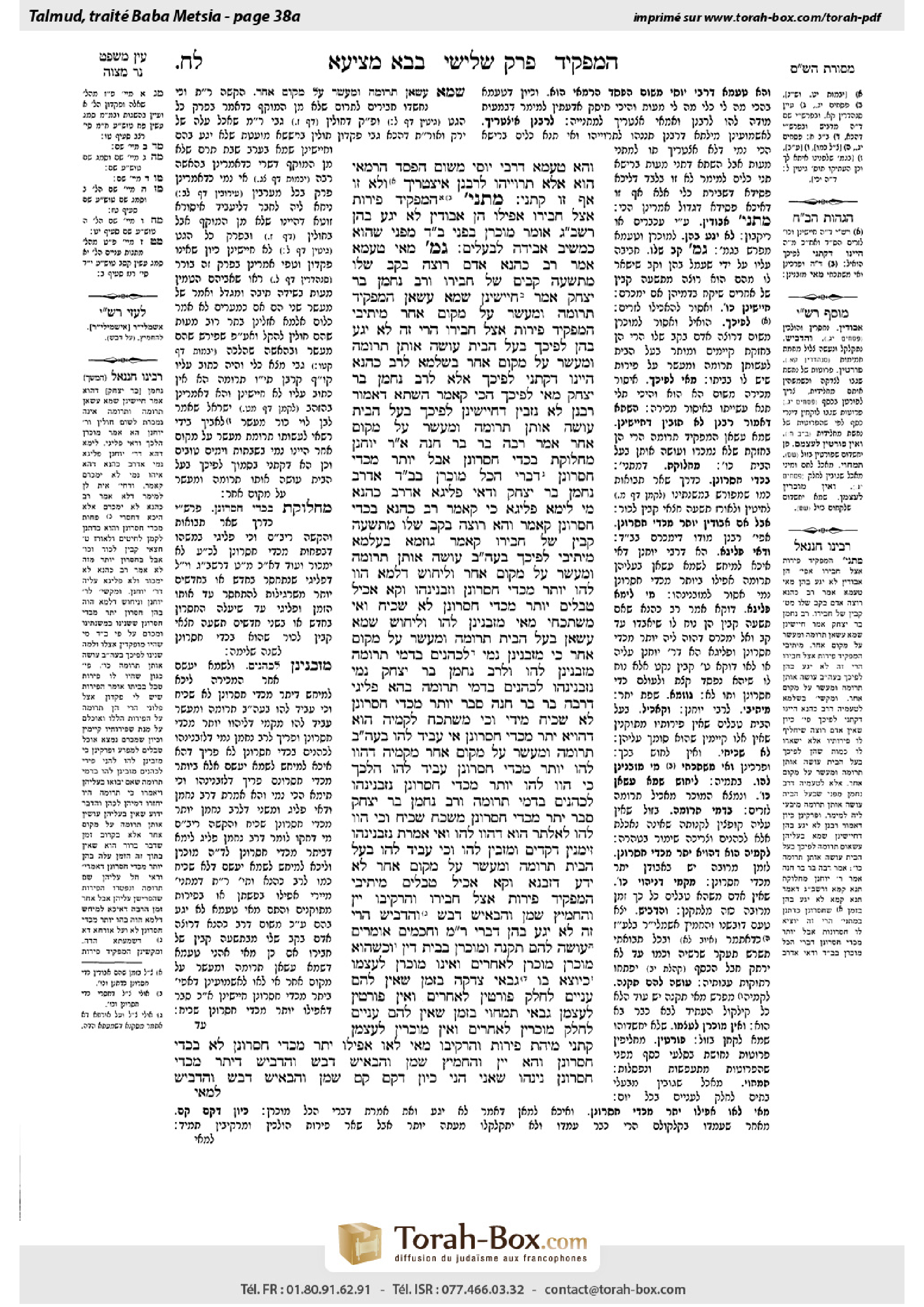
Bava Metzia 38a: Talmud study for Daf Yomi
Study the Talmud for Daf Yomi with scanned pages, Hebrew text, English translations from Sefaria and AI-generated French translations.
Passage selection and English or AI-generated French translation are available where the scan has annotations. Daf Study is independent of Torah-Box and Sefaria.
Browse Bava Metzia · בבא מציעא · All tractatesBava Metzia 38a text and translations
This page of Bava Metzia includes the Aramaic text, an English translation and an AI-generated French translation, alongside the scan above.
בבא מציעא ל״ח א · Aramaic and Hebrew text
וְהָא טַעְמָא דְּרַבִּי יוֹסֵי מִשּׁוּם הֶפְסֵד הָרַמַּאי הוּא. אֶלָּא תַּרְוַיְיהוּ לְרַבָּנַן אִיצְטְרִיךְ, וְלֹא זוֹ אַף זוֹ קָתָנֵי.
מַתְנִי׳ הַמַּפְקִיד פֵּירוֹת אֵצֶל חֲבֵירוֹ, אֲפִילּוּ הֵן אֲבוּדִין – לֹא יִגַּע בָּהֶן. רַבָּן שִׁמְעוֹן בֶּן גַּמְלִיאֵל אוֹמֵר: מוֹכְרָן בִּפְנֵי בֵּית דִּין, מִפְּנֵי שֶׁהוּא כְּמֵשִׁיב אֲבֵידָה לַבְּעָלִים.
גְּמָ׳ מַאי טַעְמָא? אָמַר רַב כָּהֲנָא: אָדָם רוֹצֶה בְּקַב שֶׁלּוֹ מִתִּשְׁעָה קַבִּים שֶׁל חֲבֵירוֹ. וְרַב נַחְמָן בַּר יִצְחָק אָמַר: חָיְישִׁינַן שֶׁמָּא עֲשָׂאָן הַמַּפְקִיד תְּרוּמָה וּמַעֲשֵׂר עַל מָקוֹם אַחֵר.
מֵיתִיבִי: הַמַּפְקִיד פֵּירוֹת אֵצֶל חֲבֵירוֹ, הֲרֵי זֶה לֹא יִגַּע בָּהֶן. לְפִיכָךְ בַּעַל הַבַּיִת עוֹשֶׂה אוֹתָן תְּרוּמָה וּמַעֲשֵׂר עַל מָקוֹם אַחֵר. בִּשְׁלָמָא לְרַב כָּהֲנָא, הַיְינוּ דְּקָתָנֵי ״לְפִיכָךְ״.
אֶלָּא לְרַב נַחְמָן בַּר יִצְחָק מַאי ״לְפִיכָךְ״? הָכִי קָאָמַר: הַשְׁתָּא דַּאֲמוּר רַבָּנַן לָא נְזַבֵּין, דְּחָיְישִׁינַן – לְפִיכָךְ בַּעַל הַבַּיִת עוֹשֶׂה אוֹתָן תְּרוּמָה וּמַעֲשֵׂר עַל מָקוֹם אַחֵר.
אָמַר רַבָּה בַּר בַּר חָנָה אָמַר רַבִּי יוֹחָנָן: מַחֲלוֹקֶת בִּכְדֵי חֶסְרוֹנָן, אֲבָל יוֹתֵר מִכְּדֵי חֶסְרוֹנָן – דִּבְרֵי הַכֹּל מוֹכְרָן בְּבֵית דִּין.
אַדְּרַב נַחְמָן בַּר יִצְחָק – וַדַּאי פְּלִיגָא. אַדְּרַב כָּהֲנָא מִי לֵימָא פְּלִיגָא? כִּי קָאָמַר רַב כָּהֲנָא – בִּכְדֵי חֶסְרוֹנָן קָאָמַר.
וְהָא רוֹצֶה בְּקַב שֶׁלּוֹ מִתִּשְׁעָה קַבִּין שֶׁל חֲבֵירוֹ קָאָמַר! גּוּזְמָא בְּעָלְמָא.
מֵיתִיבִי: לְפִיכָךְ בַּעַל הַבַּיִת עוֹשֶׂה אוֹתָן תְּרוּמָה וּמַעֲשֵׂר עַל מָקוֹם אַחֵר. וְלֵיחוּשׁ דִּלְמָא הֲווֹ לְהוּ יוֹתֵר מִכְּדֵי חֶסְרוֹנָן, וְזַבְּנִינְהוּ – וְקָא אָכֵיל טְבָלִים! יוֹתֵר מִכְּדֵי חֶסְרוֹנָן לָא שְׁכִיחַ.
וְאִי מִשְׁתַּכְחִי מַאי? מְזַבְּנִינַן לְהוּ? וְלֵיחוּשׁ שֶׁמָּא עֲשָׂאָן בַּעַל הַבַּיִת תְּרוּמָה וּמַעֲשֵׂר עַל מָקוֹם אַחֵר! כִּי מְזַבְּנִינַן נָמֵי – לְכֹהֲנִים בִּדְמֵי תְרוּמָה מְזַבְּנִינַן לְהוּ.
וּלְרַב נַחְמָן בַּר יִצְחָק נָמֵי נְזַבְּנִינְהוּ לְכֹהֲנִים בִּדְמֵי תְרוּמָה? בְּהָא פְּלִיגִי, דְּרַבָּה בַּר בַּר חַנָּה סְבַר: יוֹתֵר מִכְּדֵי חֶסְרוֹנָן לָא שְׁכִיחַ מִידֵּי, וְכִי מִשְׁתְּכַח, לְקַמֵּיהּ הוּא דְּהָוְיָא יָתֵיר מִכְּדֵי חֶסְרוֹנָן. אִי עָבֵיד לְהוּ בַּעַל הַבַּיִת תְּרוּמָה וּמַעֲשֵׂר עַל מָקוֹם אַחֵר, מִקַּמֵּיה דְּהָווּ לְהוּ יוֹתֵר מִכְּדֵי חֶסְרוֹנָן עָבֵיד לְהוּ. הִלְכָּךְ, כִּי הָווּ לְהוּ יוֹתֵר מִכְּדֵי חֶסְרוֹנָן – נְזַבְּנִינְהוּ לְכֹהֲנִים בִּדְמֵי תְרוּמָה.
וְרַב נַחְמָן בַּר יִצְחָק סָבַר: יָתֵר מִכְּדֵי חֶסְרוֹנָן מִשְׁכָּח שְׁכִיחַ וְכִי הָווּ לְהוּ – לְאַלְתַּר הוּא דְּהָווּ לְהוּ. וְאִי אָמְרַתְּ נְזַבְּנִינְהוּ – זִימְנִין דְּקָדֵים וּמְזַבֵּין לְהוּ, וְכִי עָבֵיד לְהוּ בַּעַל הַבַּיִת תְּרוּמָה וּמַעֲשֵׂר עַל מְקוֹם אַחֵר – לָא יָדַע דִּ[מְ]זַבְּנָא, וְקָא אָכֵיל טְבָלִים.
מֵיתִיבִי: הַמַּפְקִיד פֵּירוֹת אֵצֶל חֲבֵירוֹ וְהִרְקִיבוּ, יַיִן וְהֶחְמִיץ, שֶׁמֶן וְהִבְאִישׁ, דְּבַשׁ וְהִדְבִּישׁ – הֲרֵי זֶה לֹא יִגַּע בָּהֶן, דִּבְרֵי רַבִּי מֵאִיר. וַחֲכָמִים אוֹמְרִים: עוֹשֶׂה לָהֶם תַּקָּנָה, וּמוֹכְרָן בְּבֵית דִּין. וּכְשֶׁהוּא מוֹכְרָן – מוֹכְרָן לַאֲחֵרִים וְאֵינוֹ מוֹכְרָן לְעַצְמוֹ.
כַּיּוֹצֵא בּוֹ: גַּבָּאֵי צְדָקָה בִּזְמַן שֶׁאֵין לָהֶם עֲנִיִּים לְחַלֵּק – פּוֹרְטִין לַאֲחֵרִים, וְאֵין פּוֹרְטִין לְעַצְמָן. גַּבָּאֵי תַמְחוּי בִּזְמַן שֶׁאֵין לָהֶם עֲנִיִּים לְחַלֵּק – מוֹכְרִין לַאֲחֵרִים, וְאֵין מוֹכְרִים לְעַצְמָן.
קָתָנֵי מִיהַת פֵּירוֹת וְהִרְקִיבוּ, מַאי לָאו אֲפִילּוּ יָתֵר מִכְּדֵי חֶסְרוֹנָן? לֹא, בִּכְדֵי חֶסְרוֹנָן. וְהָא יַיִן וְהֶחְמִיץ, שֶׁמֶן וְהִבְאִישׁ, דְּבַשׁ וְהִדְבִּישׁ – דְּיָתֵר מִכְּדֵי חֶסְרוֹנָן נִינְהוּ! שָׁאנֵי הָנֵי כֵּיוָן דְּקָם – קָם.
שֶׁמֶן וְהִבְאִישׁ, דְּבַשׁ וְהִדְבִּישׁ –
Bava Metzia 38a · English translation
The Gemara asks: But isn’t the reason for the opinion of Rabbi Yosei as he stated in the mishna: Due to the loss of the fraud? It is not due to the fact that the vessel will not remain intact. Consequently, there is no reason to believe that Rabbi Yosei would concede to the Rabbis in the instance where money was deposited. Rather, both of the cases are necessary according to the Rabbis. And although the first case could have been inferred from the second case, the tanna teaches the mishna employing the style of: Not only this but also that, i.e., the mishna began with an obvious example and continued with a more novel one.
MISHNA: In the case of one who deposits produce with another, even if it is lost due to spoilage or vermin, the bailee may not touch it, as it is not his. Rabban Shimon ben Gamliel says: He sells it before the court, as by doing so he is like one returning a lost item to the owner, since through its sale he prevents the owner from losing the value of his produce.
GEMARA: What is the reason that the first tanna said that the bailee should not touch the produce? Rav Kahana says that it is based on the principle: A person prefers a kav of his own produce to nine kav of another’s produce. Consequently, despite the spoilage, the owner prefers that the bailee not touch the produce. Rav Naḥman bar Yitzḥak says: We are concerned that perhaps the one who deposited the produce rendered it teruma and tithe for produce in another place, resulting in the buyer consuming produce that is teruma and tithe inappropriately.
The Gemara raises an objection from a baraita: In the case of one who deposits produce with another, the bailee may not touch it, and therefore the owner may render it teruma or tithe for produce in another place. Granted, according to Rav Kahana, this is the reason that the tanna teaches: And therefore the owner renders them teruma. The concern that the owner may render the produce teruma and tithe is not the reason why the bailee may not sell it, and the halakha that the owner may render the produce teruma and tithe results from the halakha that the bailee may not sell it.
But according to Rav Naḥman bar Yitzḥak, what is the meaning of the term therefore? According to his explanation, the fact that the owner may render the produce teruma and tithe is the very reason why the bailee may not sell the produce. The Gemara explains: This is what the tanna is saying: Now that the Sages said that the bailee may not sell the produce due to the fact that we are concerned that perhaps the owner had rendered it teruma, the owner can be confident that the produce is still in the possession of the bailee. Therefore, the owner may render it teruma and tithe for produce in another place even ab initio.
§ Rabba bar bar Ḥana says that Rabbi Yoḥanan says: The dispute in the mishna is in a case where the produce deteriorates at its standard rate of deterioration. But if the produce deteriorates at a rate greater than its standard rate of deterioration, everyone agrees that the bailee sells it before the court.
The Gemara comments: Rabbi Yoḥanan certainly disagrees with the opinion of Rav Naḥman bar Yitzḥak, as the concern that the owner might have rendered the produce teruma or tithe applies regardless of the rate of deterioration. The Gemara asks: Shall we say that Rabbi Yoḥanan disagrees with the opinion of Rav Kahana? The Gemara answers: When Rav Kahana says that one prefers his own produce, it was in a case where the produce deteriorates at its standard rate of deterioration that he says it. When the rate of deterioration is accelerated, he would agree that the bailee sells the produce.
The Gemara asks: But didn’t Rav Kahana say: A person prefers a kav of his own produce to nine kav of another’s produce? This indicates that even if the rate of deterioration was accelerated, one prefers his own produce, as in the case he describes eight-ninths of the produce is lost. The Gemara answers: This expression is merely an exaggeration, and actually one prefers his own produce only when its rate of deterioration is standard.
The Gemara raises an objection from a baraita: Therefore, the owner renders it teruma or tithe for produce in another place. And let the owner be concerned that perhaps the produce deteriorated at a rate greater than its standard rate of deterioration, and the bailee sold it, in which case the owner would be eating untithed produce. The Gemara answers: Deterioration at a rate greater than its standard rate of deterioration is uncommon, and the Sages do not issue decrees for uncommon cases.
The Gemara asks: And if it is found that more of the produce is missing than would be lost according to the standard rate of deterioration, what should be done? According to the opinion of Rabbi Yoḥanan, do we sell it? But let us be concerned that perhaps the owner already rendered this produce teruma and tithe for produce in another place. The Gemara answers: Even when we sell the produce, it is to priests at the price of teruma that we sell it. Consequently, even if the owner rendered it teruma, it is consumed by priests and therefore there is no concern.
The Gemara asks: And according to Rav Naḥman bar Yitzḥak as well, since the concern is that perhaps the owner rendered the produce teruma, let the bailee sell the produce to priests at the price of teruma. The Gemara answers: It is with regard to this that they disagree, as Rabba bar bar Ḥana holds: Deterioration at a rate greater than its standard rate of deterioration is not common at all. And when it occurs that the produce deteriorates at the greater rate, it is only from now on that it is assumed that it became deteriorated at a rate greater than its standard rate of deterioration. Therefore, if the owner had rendered the produce teruma and tithe for produce in another place, it is assumed that it was before it deteriorated at a rate greater than its standard rate of deterioration that he did it. Therefore, when the produce deteriorated at a rate greater than its standard rate of deterioration, the bailee should sell the produce to priests at the price of teruma, as it may be teruma.
And Rav Naḥman bar Yitzḥak holds: Deterioration at a rate greater than its standard rate of deterioration is common. And when the produce became deteriorated at a rate greater than its standard rate of deterioration, it may be immediately that it became deteriorated to that extent. And if you say: Let us sell it, the concern is that at times the bailee will sell it early. And when the owner renders the produce teruma and tithe for produce in another place, he does not know that the bailee already sold the produce, and the owner eats untithed produce.
The Gemara raises an objection from a baraita: In the case of one who deposits produce with another and it rotted, wine and it fermented, oil and it putrefied, honey and it spoiled, the bailee may not touch them; this is the statement of Rabbi Meir. And the Rabbis say: He effects a remedy for these items and sells them in court. The baraita adds: And when he sells them, he sells them to others and does not sell them to himself, even for the same price, so no one will suspect that he bought it at a discount.
On a similar note, with regard to charity collectors, when they do not have poor people to whom to distribute charity, they change copper perutot that they collected for more valuable silver coins only for other people, but they do not change the coins for themselves, to avoid suspicion. If collectors for the charity plate collected ready-made food for the poor, at a time where there are no poor people to whom to distribute the food, they sell the food only to others but do not sell the food to themselves.
In any event, it is taught: Produce and it rotted. What, is it not referring even to a case where they all rotted at a rate greater than its standard rate of deterioration? The Gemara rejects this: No; it is referring to a case where they deteriorated at their standard rate of deterioration. The Gemara asks: But aren’t the cases of wine and it fermented, oil and it putrefied, and honey and it spoiled cases where these items deteriorated at a rate greater than their standard rate of deterioration, as there is a significant difference in the price of wine before and after fermentation, and in the price of oil before and after putrefaction? The Gemara rejects that proof: Those cases are different. Once they become spoiled, they remain spoiled but do not continue to deteriorate. Therefore, although their deterioration was significant, there is nothing gained by selling it.
On a related note, the Gemara asks: Concerning the cases of oil and it putrefied, honey and it spoiled,
Bava Metzia 38a · Traduction française (IA)
La Guemara pose la question : Mais n’est-ce pas que la raison de l’opinion de Rabbi Yosei, telle qu’il l’a formulée dans la Michna, est due à la perte du fraudeur ? Ce n’est pas en raison du fait que le récipient ne restera pas intact. Ainsi, il n’y a pas de raison de penser que Rabbi Yosei céderait aux Rabbins dans le cas où de l’argent a été déposé. Plutôt, les deux cas sont nécessaires selon les Rabbins. Et bien que le premier cas puisse être déduit du second, le tanna enseigne la Michna en utilisant le style : Non seulement cela, mais aussi cela, c’est-à-dire que la Michna commence par un exemple évident et continue avec un exemple plus nouveau.
MICHA : Dans le cas d’une personne qui dépose des produits avec une autre, même si ceux-ci sont perdus à cause de la pourriture ou des ravages, le baal kessef ne peut pas toucher à ces produits, car ils ne lui appartiennent pas. Rabban Shimon ben Gamliel dit : Il les vend avant le tribunal, car ainsi il est comme celui qui rend un objet perdu à son propriétaire, puisque par sa vente il empêche le propriétaire de perdre la valeur de ses produits.
GUEMARA : Quelle est la raison pour laquelle le premier tanna a dit que le baal kessef ne devrait pas toucher aux produits ? Rav Kahana dit que cela s’appuie sur le principe : Une personne préfère un kav de ses propres produits à neuf kav de ceux d’un autre. Ainsi, malgré la pourriture, le propriétaire préfère que le baal kessef ne touche pas aux produits. Rav Naḥman bar Yitzḥak dit : Nous craignons que celui qui a déposé les produits ait rendu terouma et tithe pour des produits ailleurs, entraînant ainsi la consommation par l’acheteur de produits terouma et tithe de manière inappropriée.
La Guemara soulève un objet à partir d’une baraïta : Dans le cas d’une personne qui dépose des produits avec une autre, le baal kessef ne peut pas toucher à ces produits, et donc le propriétaire peut les rendre terouma ou tithe pour des produits ailleurs. Admettons, selon Rav Kahana, que c’est la raison pour laquelle le tanna enseigne : Et donc le propriétaire rend ces produits terouma. La crainte que le propriétaire puisse rendre les produits terouma et tithe n’est pas la raison pour laquelle le baal kessef ne doit pas les vendre, et la halakha selon laquelle le propriétaire peut rendre les produits terouma et tithe découle de la halakha selon laquelle le baal kessef ne doit pas les vendre.
Mais selon Rav Naḥman bar Yitzḥak, quelle est la signification du terme donc ? Selon son explication, le fait que le propriétaire puisse rendre les produits terouma et tithe est la raison même pour laquelle le baal kessef ne doit pas les vendre. La Guemara explique : C’est ce que le tanna dit : Maintenant que les Sages ont dit que le baal kessef ne doit pas vendre les produits en raison de la crainte que le propriétaire ait rendu terouma, le propriétaire peut être sûr que les produits sont encore en possession du baal kessef. Ainsi, le propriétaire peut rendre les produits terouma et tithe pour des produits ailleurs dès le début.
§ Rabba bar bar Ḥana dit que Rabbi Yoḥanan dit : Le débat dans la mitsna est dans le cas où les produits se détériorent à leur taux normal de détérioration. Mais si les produits se détériorent à un taux supérieur à leur taux normal de détérioration, tout le monde convient que le baal kessef les vend avant le tribunal.
La Guemara commente : Rabbi Yoḥanan ne peut pas être d’accord avec l’opinion de Rav Naḥman bar Yitzḥak, car la crainte que le propriétaire ait rendu les produits terouma ou tithe s’applique indépendamment du taux de détérioration. La Guemara pose la question : Devons-nous dire que Rabbi Yoḥanan est en désaccord avec l’opinion de Rav Kahana ? La Guemara répond : Lorsque Rav Kahana dit qu’une personne préfère un kav de ses propres produits à neuf kav d’un autre, il le dit dans le cas où les produits se détériorent à leur taux normal de détérioration. Lorsque le taux de détérioration est accéléré, il serait d’accord que le baal kessef vende les produits.
La Guemara pose la question : Mais n’a-t-il pas dit Rav Kahana : Une personne préfère un kav de ses propres produits à neuf kav d’un autre ? Cela indique que même si le taux de détérioration est accéléré, on préfère ses propres produits, comme dans le cas qu’il décrit où huit-neuvièmes des produits sont perdus. La Guemara répond : Cette expression est simplement une hyperbole, et en réalité, on préfère ses propres produits uniquement lorsque leur taux de détérioration est normal.
La Guemara soulève une objection à partir d’une baraïta : Donc, le propriétaire rend terouma ou tithe pour des produits ailleurs. Et que le propriétaire soit inquiet que les produits se soient détériorés à un taux supérieur à leur taux normal de détérioration, et que le baal kessef les ait vendus, dans ce cas le propriétaire mangerait des produits non titrés. La Guemara répond : La détérioration à un taux supérieur à leur taux normal de détérioration est rare, et les Sages ne prennent pas en compte les cas rares lorsqu’ils établissent des décrets.
La Guemara pose la question : Et si on découvre que plus de produits sont manquants que ce qui serait perdu selon le taux normal de détérioration, que doit-on faire ? Selon l’opinion de Rabbi Yoḥanan, devons-nous les vendre ? Mais on doit craindre que le propriétaire ait déjà rendu ces produits terouma et tithe pour des produits ailleurs. La Guemara répond : Même lorsqu’on vend les produits, on les vend aux prêtres au prix de terouma. Ainsi, même si le propriétaire les a rendus terouma, ils sont consommés par les prêtres et donc il n’y a pas de crainte.
Le Guemara pose la question : Et selon Rav Naḥman bar Yitzḥak également, puisque la préoccupation est que peut-être l'owner a rendu les produits terouma, faites vendre les produits aux prêtres au prix de terouma. Le Guemara répond : C'est à ce sujet qu'ils divergent, car Rabba bar bar Ḥana affirme : La détérioration à un taux supérieur à son taux standard de détérioration n'est pas commune du tout. Et lorsqu'il arrive que les produits se détériorent à un taux supérieur à leur taux standard de détérioration, c'est seulement à partir de maintenant qu'on suppose qu'ils se sont détériorés à un taux supérieur à leur taux standard de détérioration. Par conséquent, si l'owner avait rendu les produits terouma et a titré les produits ailleurs, on suppose qu'il l'a fait avant qu'ils ne se détériorent à un taux supérieur à leur taux standard de détérioration. Par conséquent, lorsqu'ils se sont détériorés à un taux supérieur à leur taux standard de détérioration, le baal kessef devrait vendre les produits aux prêtres au prix de terouma, car ils peuvent être terouma.
Et Rav Naḥman bar Yitzḥak affirme : La détérioration à un taux supérieur à son taux standard de détérioration est commune. Et lorsqu'ils se sont détériorés à un taux supérieur à leur taux standard de détérioration, on peut immédiatement penser qu'ils se sont détériorés à ce point. Et si l'on dit : Faisons-le vendre, la préoccupation est que parfois le baal kessef vendra tôt. Et lorsqu'il rend les produits terouma et titre les produits ailleurs, il ne sait pas que le baal kessef a déjà vendu les produits, et l'owner mange des produits non titrés.
Le Guemara soulève une objection tirée d'une baraïta : Dans le cas d'une personne qui dépose des produits chez un autre et qu'ils se sont détériorés, vin et qu'ils ont fermenté, huile et qu'ils se sont putréfiés, miel et qu'ils se sont gâtés, le baal kessef ne doit pas toucher à ces produits ; c'est la déclaration de Rabbi Meir. Et les Sages disent : Il applique un remède à ces produits et les vend en cour. La baraïta ajoute : Et lorsqu'il les vend, il les vend à d'autres et ne les vend pas à lui-même, même au même prix, afin qu'on ne soupçonne pas qu'il les a achetés à un rabais.
Sur un point similaire, concernant les collecteurs de charité, lorsqu'ils n'ont pas de pauvres auxquels distribuer la charité, ils échangent les perutot en cuivre qu'ils ont collectés contre des pièces d'argent plus précieuses uniquement pour d'autres personnes, mais ils n'échangent pas les pièces pour eux-mêmes, pour éviter les soupçons. Si les collecteurs de la table de charité ont collecté des aliments prêts à la consommation pour les pauvres, à un moment où il n'y a pas de pauvres auxquels distribuer les aliments, ils vendent les aliments uniquement à d'autres mais ne les vendent pas à eux-mêmes.
En tout cas, il est enseigné : Produits et ils se sont détériorés. Qu'est-ce que cela ne signifie pas même dans le cas où ils se sont tous détériorés à un taux supérieur à leur taux standard de détérioration ? Le Guemara rejette cette interprétation : Non ; il s'agit d'un cas où ils se sont détériorés à leur taux standard de détérioration. Le Guemara pose la question : Mais ne sont-ce pas les cas de vin et il a fermenté, huile et il s'est putréfié, et miel et il s'est gâté des cas où ces produits se sont détériorés à un taux supérieur à leur taux standard de détérioration, car il y a une différence significative dans le prix du vin avant et après la fermentation, et dans le prix de l'huile avant et après la putréfaction ? Le Guemara rejette cette preuve : Ces cas sont différents. Une fois qu'ils sont gâtés, ils restent gâtés mais ne continuent pas à se détériorer. Par conséquent, bien que leur détérioration ait été significative, il n'y a rien à gagner en les vendant.
Sur un point lié, le Guemara pose la question : Concernant les cas d'huile qui s'est putréfié, miel qui s'est gâté,
Traduction française générée par IA à partir de l’édition anglaise de Sefaria. Vérifie toujours un passage avec le texte source.
Text from Sefaria: William Davidson Edition - Vocalized Aramaic (CC BY NC); William Davidson Edition - English (CC BY NC).