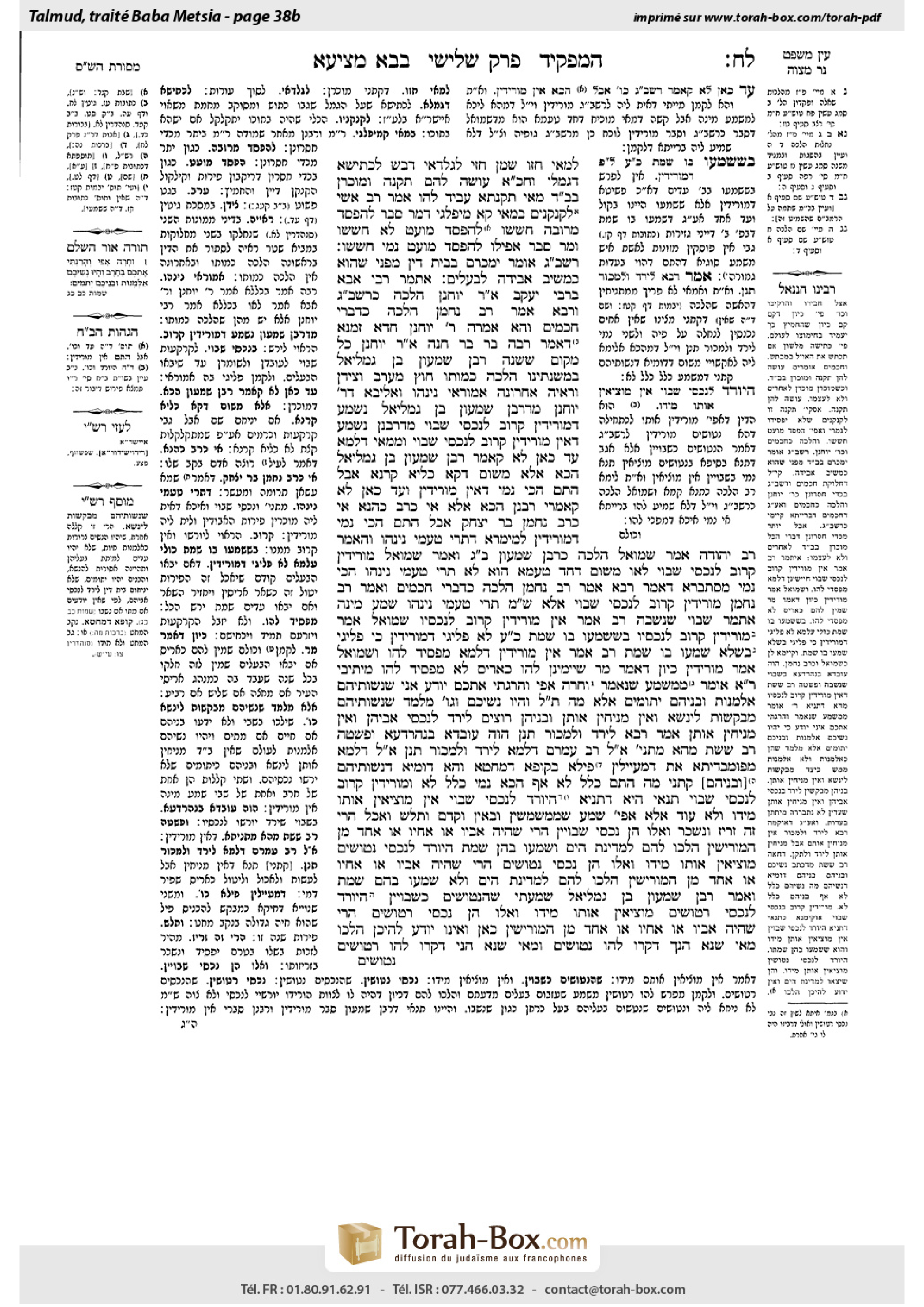
Bava Metzia 38b: Talmud study for Daf Yomi
Study the Talmud for Daf Yomi with scanned pages, Hebrew text, English translations from Sefaria and AI-generated French translations.
Passage selection and English or AI-generated French translation are available where the scan has annotations. Daf Study is independent of Torah-Box and Sefaria.
Browse Bava Metzia · בבא מציעא · All tractatesBava Metzia 38b text and translations
This page of Bava Metzia includes the Aramaic text, an English translation and an AI-generated French translation, alongside the scan above.
בבא מציעא ל״ח ב · Aramaic and Hebrew text
לְמַאי חֲזוּ? שֶׁמֶן חֲזֵי לְגִלְדָּאֵי, דְּבַשׁ לִכְתִישָׁא דְגַמְלֵי.
וַחֲכָמִים אוֹמְרִים: עוֹשֶׂה לָהֶם תַּקָּנָה וּמוֹכְרָן בְּבֵית דִּין. מַאי תַּקַּנְתָּא עָבֵיד לְהוּ? אָמַר רַב אָשֵׁי: לְקַנְקַנִּים.
בְּמַאי קָא מִיפַּלְגִי? דְּמָר סָבַר: לְהֶפְסֵד מְרוּבֶּה – חָשְׁשׁוּ, לְהֶפְסֵד מוּעָט – לֹא חָשְׁשׁוּ. וּמָר סָבַר: אֲפִילּוּ לְהֶפְסֵד מוּעָט נָמֵי חָשְׁשׁוּ.
רַבָּן שִׁמְעוֹן בֶּן גַּמְלִיאֵל אוֹמֵר יִמְכְּרֵם בְּבֵית דִּין, מִפְּנֵי שֶׁהוּא כְּמֵשִׁיב אֲבֵידָה לִבְעָלִים. אִתְּמַר, רַבִּי אַבָּא בְּרַבִּי יַעֲקֹב אָמַר רַבִּי יוֹחָנָן: הֲלָכָה כְּרַבָּן שִׁמְעוֹן בֶּן גַּמְלִיאֵל. וְרָבָא אָמַר רַב נַחְמָן: הֲלָכָה כְּדִבְרֵי חֲכָמִים.
וְהָא אַמְרַהּ רַבִּי יוֹחָנָן חֲדָא זִמְנָא, דְּאָמַר רַבָּה בַּר בַּר חָנָה אָמַר רַבִּי יוֹחָנָן: כׇּל מָקוֹם שֶׁשָּׁנָה רַבָּן שִׁמְעוֹן בֶּן גַּמְלִיאֵל בְּמִשְׁנָתֵינוּ הֲלָכָה כְּמוֹתוֹ, חוּץ מֵעָרֵב, וְצַיְדָן, וּרְאָיָה אַחֲרוֹנָה.
אָמוֹרָאֵי נִינְהוּ וְאַלִּיבָּא דְּרַבִּי יוֹחָנָן.
מִדְּרַבָּן שִׁמְעוֹן בֶּן גַּמְלִיאֵל נִשְׁמָע דְּמוֹרִידִין קָרוֹב לְנִכְסֵי שָׁבוּי. מִדְּרַבָּנַן נִשְׁמַע דְּאֵין מוֹרִידִין קָרוֹב לְנִכְסֵי שָׁבוּי.
וּמִמַּאי? דִּלְמָא עַד כָּאן לָא קָאָמַר רַבָּן שִׁמְעוֹן בֶּן גַּמְלִיאֵל הָכָא, אֶלָּא מִשּׁוּם דְּקָא כָלְיָא קַרְנָא, אֲבָל הָתָם הָכִי נָמֵי דְּאֵין מוֹרִידִין. וְעַד כָּאן לָא קָאָמְרִי רַבָּנַן הָכָא, אֶלָּא אִי כְּרַב כָּהֲנָא, אִי כְּרַב נַחְמָן בַּר יִצְחָק. אֲבָל הָתָם הָכִי נָמֵי דְּמוֹרִידִין.
לְמֵימְרָא דִּתְרֵי טַעְמֵי נִינְהוּ? וְהָאָמַר רַב יְהוּדָה אָמַר שְׁמוּאֵל: הֲלָכָה כְּרַבָּן שִׁמְעוֹן בֶּן גַּמְלִיאֵל, וְאָמַר שְׁמוּאֵל: מוֹרִידִין קָרוֹב לְנִכְסֵי שָׁבוּי. לָאו מִשּׁוּם דְּחַד טַעְמָא הוּא? לָא, תְּרֵי טַעְמֵי נִינְהוּ.
הָכִי נָמֵי מִסְתַּבְּרָא, דְּאָמַר רָבָא אָמַר רַב נַחְמָן: הֲלָכָה כְּדִבְרֵי חֲכָמִים. וְאָמַר רַב נַחְמָן: מוֹרִידִין קָרוֹב לְנִכְסֵי שָׁבוּי. אֶלָּא שְׁמַע מִינַּהּ: תְּרֵי טַעְמֵי נִינְהוּ, שְׁמַע מִינַּהּ.
אִתְּמַר: שָׁבוּי שֶׁנִּשְׁבָּה, רַב אָמַר: אֵין מוֹרִידִין קָרוֹב לִנְכָסָיו, שְׁמוּאֵל אָמַר: מוֹרִידִין קָרוֹב לִנְכָסָיו.
בְּשֶׁשָּׁמְעוּ בּוֹ שֶׁמֵּת – כּוּלֵּי עָלְמָא לָא פְּלִיגִי דְּמוֹרִידִין.
כִּי פְּלִיגִי בְּשֶׁלֹּא שָׁמְעוּ בּוֹ שֶׁמֵּת. רַב אָמַר: אֵין מוֹרִידִין, דִּלְמָא מַפְסִיד לְהוּ. וּשְׁמוּאֵל אָמַר: מוֹרִידִין, כֵּיוָן דְּאָמַר מָר שָׁיְימִינַן לְהוּ כְּאָרִיס, לָא מַפְסֵיד לְהוּ.
מֵיתִיבִי, רַבִּי אֱלִיעֶזֶר אוֹמֵר: מִמַּשְׁמַע שֶׁנֶּאֱמַר ״וְחָרָה אַפִּי וְהָרַגְתִּי אֶתְכֶם״ יוֹדֵעַ אֲנִי שֶׁנְּשׁוֹתֵיהֶם אַלְמָנוֹת וּבְנֵיהֶם יְתוֹמִים, אֶלָּא מָה תַּלְמוּד לוֹמַר ״וְהָיוּ נְשֵׁיכֶם וְגוֹ׳״?
מְלַמֵּד שֶׁנְּשׁוֹתֵיהֶם מְבַקְּשׁוֹת לִינָּשֵׂא וְאֵין מַנִּיחִין אוֹתָן, וּבְנֵיהֶן רוֹצִים לֵירֵד לְנִכְסֵי אֲבִיהֶן וְאֵין מַנִּיחִין אוֹתָן. אָמַר רָבָא: לֵירֵד וְלִמְכּוֹר תְּנַן.
הֲוָה עוֹבָדָא בִּנְהַרְדְּעָא, וּפַשְׁטַהּ רַב שֵׁשֶׁת מֵהָא מַתְנִיתָא. אֲמַר לֵיהּ רַב עַמְרָם: דִּלְמָא לֵירֵד וְלִמְכּוֹר תְּנַן? אֲמַר לֵיהּ: דִּלְמָא מִפּוּמְבְּדִיתָא אַתְּ, דִּמְעַיְּילִין פִּילָא בְּקוֹפָא דְמַחְטָא. וְהָא דּוּמְיָא דִּנְשׁוֹתֵיהֶם [וּבְנֵיהֶם] קָתָנֵי, מָה הָתָם כְּלָל לָא – אַף הָכָא נָמֵי כְּלָל לָא.
וּמוֹרִידִין קָרוֹב לְנִכְסֵי שָׁבוּי תַּנָּאֵי הִיא, דְּתַנְיָא: הַיּוֹרֵד לְנִכְסֵי שָׁבוּי – אֵין מוֹצִיאִין אוֹתוֹ מִיָּדוֹ, וְלֹא עוֹד אֶלָּא אֲפִילּוּ שָׁמַע שֶׁמְּמַשְׁמְשִׁין וּבָאִין, וְקָדַם וְתָלַשׁ וְאָכַל – הֲרֵי זֶה זָרִיז וְנִשְׂכָּר. וְאֵלּוּ הֵן נִכְסֵי שְׁבוּיִין – הֲרֵי שֶׁהָיָה אָבִיו אוֹ אָחִיו אוֹ אֶחָד מִן הַמּוֹרִישִׁין, הָלְכוּ לָהֶם לִמְדִינַת הַיָּם, וְשָׁמְעוּ בָּהֶן שֶׁמֵּת.
הַיּוֹרֵד לְנִכְסֵי נְטוּשִׁים – מוֹצִיאִין אוֹתוֹ מִיָּדוֹ. וְאֵלּוּ הֵן נִכְסֵי נְטוּשִׁים: הֲרֵי שֶׁהָיָה אָבִיו אוֹ אָחִיו אוֹ אֶחָד מִן הַמּוֹרִישִׁין, הָלְכוּ לָהֶם לִמְדִינַת הַיָּם וְלֹא שָׁמְעוּ בָּהֶם שֶׁמֵּת. וְאָמַר רַבָּן שִׁמְעוֹן בֶּן גַּמְלִיאֵל: שָׁמַעְתִּי שֶׁהַנְּטוּשִׁים כִּשְׁבוּיִין.
הַיּוֹרֵד לְנִכְסֵי רְטוּשִׁים – מוֹצִיאִין אוֹתוֹ מִיָּדוֹ. וְאֵלּוּ הֵן נִכְסֵי רְטוּשִׁים – הֲרֵי שֶׁהָיָה אָבִיו אוֹ אָחִיו אוֹ אֶחָד מִן הַמּוֹרִישִׁין כָּאן, וְאֵינוֹ יוֹדֵעַ לְהֵיכָן הָלְכוּ.
מַאי שְׁנָא הָנָךְ דְּקָרוּ לְהוּ ״נְטוּשִׁים״, וּמַאי שְׁנָא הָנֵי דְּקָרוּ לְהוּ ״רְטוּשִׁים״?
Bava Metzia 38b · English translation
for what use are they fit? According to the Rabbis, one sells them in court. Apparently, they must have some value. The Gemara answers: Oil is fit for tanners who would coat the hides with oil even if it had a foul odor. Honey it fit as a salve for a wound on the back of camels.
It is taught in the baraita: And the Rabbis say that the bailee effects a remedy for the spoiled products and sells them in court. The Gemara asks: What remedy does he effect for those products? Rav Ashi said: It is a remedy for the casks. Although the contents of the barrel are irreversibly spoiled, leaving it in the barrels will ruin the barrels.
The Gemara asks: Since Rabbi Meir agrees that when there is deterioration at a rate greater than its standard rate of deterioration, the bailee should sell the deposit, with regard to what issue do Rabbi Meir and the Rabbis disagree? The Gemara answers: The dispute is that one Sage, Rabbi Meir, holds: The Sages were concerned for a significant loss, but the Sages were not concerned for an insignificant loss, like damage to the barrels. And one Sage, the Rabbis, holds: The Sages were concerned even for an insignificant loss.
§ The mishna teaches that Rabban Shimon ben Gamliel says: He sells it before the court, due to the fact that in doing so he is like one returning a lost item to the owner. It was stated that Rabbi Abba, son of Rabbi Ya’akov, says that Rabbi Yoḥanan says: The halakha is in accordance with the opinion of Rabban Shimon ben Gamliel. And Rava says that Rav Naḥman says: The halakha is in accordance with the statement of the Rabbis.
The Gemara asks: But why is it necessary for Rabbi Yoḥanan to issue that ruling specifically in this case? Didn’t Rabbi Yoḥanan already say one other time that in general the halakha is in accordance with the opinion of Rabban Shimon ben Gamliel? As Rabba bar bar Ḥana says that Rabbi Yoḥanan said: Every place where Rabban Shimon ben Gamliel taught a ruling in our mishna, the halakha is in accordance with his opinion, except for the following three cases: The responsibility of the guarantor (Bava Batra 173b), and the incident that occurred in the city of Tzaidan (Gittin 74a), and the dispute with regard to evidence in the final disagreement (Sanhedrin 31a). By inference, in all other cases, Rabbi Yoḥanan holds that the halakha is in accordance with his opinion.
The Gemara answers: Rabbi Abba and Rabba bar bar Ḥana are amora’im and disagree with regard to the opinion of Rabbi Yoḥanan. Rabbi Abba holds that there was no general ruling, and therefore a ruling was necessary in this case. Rabba bar bar Ḥana holds that Rabbi Yoḥanan issued a general ruling.
The Gemara notes: From the statement of Rabban Shimon ben Gamliel, it is learned that the court authorizes a relative, who is the heir apparent, to descend and manage the property of a captive. A bailee who sells rotting produce is like one returning a lost item to the owner; one who manages the property of a captive who is unable to do so himself should have the same status. From the statement of the Rabbis, who say that the bailee may not touch the rotting produce, it is learned that the court does not authorize a relative to descend and manage the property of a captive.
The Gemara rejects this parallel: And from where do you draw that conclusion? Perhaps Rabban Shimon ben Gamliel states his opinion here only due to the fact that the principal, i.e., the rotting produce, is destroyed. But there, indeed, the court does not authorize a relative to descend and manage the property of a captive, because if the land lies fallow, the land will remain intact, even if the captive will not profit. And perhaps the Rabbis state their opinion only here based either on the reason of Rav Kahana, that a person prefers his own produce, or on the reason of Rav Naḥman bar Yitzḥak, that there is concern that perhaps the owner designated the produce as teruma or tithe. But there, with regard to the captive’s property, those reasons do not apply, and indeed the court authorizes the relative to manage it.
The Gemara asks: Is this to say that they are two independent reasons for these two halakhot? But doesn’t Rav Yehuda say that Shmuel says: The halakha is in accordance with the opinion of Rabban Shimon ben Gamliel, and Shmuel says: The court authorizes a relative to descend and manage the property of a captive? Is it not due to the fact that there is one common reason for both halakhot? The Gemara rejects that reasoning: No, they are based upon two unrelated reasons, and Shmuel ruled the halakha in each case independently.
The Gemara comments: So too, it is reasonable to say that the two halakhot are unrelated, as Rava says that Rav Naḥman says: The halakha is in accordance with the opinion of the Rabbis, and Rav Naḥman says: The court authorizes a relative to descend and manage the property of a captive. Rather, learn from it that they are based upon two unrelated reasons. The Gemara affirms: Learn from it that they are unrelated.
The Gemara notes that it was stated that there is an amoraic dispute with regard to one who was taken captive. Rav says: The court does not authorize a relative to descend and manage the property of a captive. Shmuel says: The court authorizes a relative to descend and manage the property of a captive.
The Gemara limits the scope of the dispute: In a case where they heard that the captive died, everyone agrees that the court authorizes a relative to descend and manage the property of a captive. The relative is the prospective heir and will tend to the land as if it were his own. If the captive returns, he will compensate the relative for his expenditures.
When they disagree, it is in a case where they did not hear that the captive died and presumably he will return. Rav says: The court does not authorize a relative to descend and manage the property of a captive, lest he devalue the property. Since presumably the owner of the property is alive, the relative assumes that he will eventually be required to return the property to the owner. Therefore, he does not tend to the land as if it were his own but will farm the land to increase its short-term yield, at the expense of its long-term condition. And Shmuel says: The court authorizes a relative to descend and manage the property of a captive. Since the Master said: In any case where one works a field that is not his, we appraise his work as if he were a sharecropper, the relative will not devalue the property. It is in his best interest to tend to the land to ensure that he will receive his payment.
The Gemara raises an objection from a baraita. Rabbi Eliezer says: By inference, from that which is stated: “My wrath shall wax hot, and I will kill you” (Exodus 22:23), I know that their wives shall be widows and their children orphans. Rather, what is the meaning when the verse states: “And your wives shall be widows and your children orphans” (Exodus 22:23)? Why is this clause in the verse necessary?
The verse teaches an additional punishment, that the men will be killed with no witnesses. Their wives will seek to marry, and the courts will not allow them to do so without witnesses to their husbands’ deaths. And their children will wish to descend to their father’s property, to inherit it, and the courts will not allow them to do so. Apparently, the court does not authorize a relative to descend and manage the property of a captive. Rava said: We learned in the baraita that the courts do not allow them to descend and to sell the land, but the court does authorize a relative to descend and manage the land.
The Gemara relates: There was a similar incident in Neharde’a, and Rav Sheshet resolved the matter from this baraita and ruled that the court does not authorize a relative to descend to the property of a captive. Rav Amram said to him: Perhaps we learned in the baraita that the courts do not allow a relative to descend and to sell the land? Rav Sheshet said mockingly to him, employing a similar style: Perhaps you are from Pumbedita, where people pass an elephant through the eye of a needle, i.e., they engage in specious reasoning. But doesn’t the juxtaposition between their wives and their children in the verse teach that the meaning is similar in both cases? Just as there, with regard to the wives, it means that they may not remarry at all, so too here, with regard to the sons, it means that they may not descend to the property at all.
The Gemara comments: And the matter of whether the court authorizes a relative to descend and manage the property of a captive is a dispute between tanna’im, as it is taught in a baraita: In the case of one who descends to the property of a captive and works his field, the court does not confiscate it from his possession. And furthermore, even if he heard that the owners are approaching and arriving, and the one who descended to the field preceded their arrival and uprooted and consumed produce that grew that year, that person is deemed diligent and he profits, as he received a return on the work that he invested. And these are the cases where there is captives’ property: Cases where one’s father, or brother, or one of those relatives who bequeaths him an inheritance went to a country overseas, and those in his locale heard that the relative died.
In the case of one who descends to abandoned property, the court removes it from the possession of the one managing it. And these are the cases where there is abandoned property: Cases where one’s father, or brother, or one of those relatives who bequeaths him an inheritance went to a country overseas, and those in his locale did not hear that the relative died. And Rabban Shimon ben Gamliel said: I heard that the legal status of abandoned property is like that of the property of captives, and it is not confiscated from the possession of the one managing it. The dispute between the first tanna and Rabban Shimon ben Gamliel parallels the dispute between Rav and Shmuel.
With regard to one who descends to forsaken property, the court removes it from his possession. And these are the cases where there is forsaken property: Cases where one’s father, or brother, or one of those relatives who bequeaths him an inheritance was here, and the relative does not know where they went. Everyone agrees that in these instances the court does not authorize a relative to descend to the property.
The Gemara asks: What is different about one property, that it is called abandoned property? And what is different about the other property, that it is called forsaken property?
Bava Metzia 38b · Traduction française (IA)
Pour quel usage sont-ils adaptés ? Selon les Rabbins, on les vend devant le tribunal. Apparemment, ils doivent avoir une certaine valeur. La Guemara répond : L'huile est adaptée aux tanneurs qui recouvrent les peaux d'huile même si elle a une odeur nausébache. Le miel est adapté comme pansement pour une plaie sur le dos des chameaux.
Il est enseigné dans la baraïta : Et les Rabbins disent que le baal késoubat met en œuvre une solution pour les produits détériorés et les vend devant le tribunal. La Guemara demande : Quelle solution met-il en œuvre pour ces produits ? Rav Ashi a dit : C'est une solution pour les tonneaux. Bien que le contenu des tonneaux soit irréversiblement détérioré, laisser les tonneaux dans les tonneaux les ruinerait.
La Guemara demande : Puisque Rabbi Meir est d'accord sur le fait que lorsqu'il y a une détérioration plus rapide que le taux standard de détérioration, le baal késoubat devrait vendre le dépôt, sur quel point Rabbi Meir et les Rabbins divergent-ils ? La Guemara répond : Le débat est sur le fait qu'un Sage, Rabbi Meir, considère que les Sages s'inquiètent d'une perte significative, mais les Sages ne s'inquiètent pas d'une perte insignifiante, comme la détérioration des tonneaux. Et un autre Sage, les Rabbins, considère que les Sages s'inquiètent même d'une perte insignifiante.
§ La mitsna enseigne que Rabban Shimon ben Gamliel dit : Il le vend devant la cour, car en le faisant il est comme celui qui rend un objet perdu à son propriétaire. Il a été dit que Rabbi Abba, fils de Rabbi Ya'akov, dit que Rabbi Yoḥanan dit : La halakha suit l'opinion de Rabban Shimon ben Gamliel. Et Rava dit que Rav Naḥman dit : La halakha suit l'opinion des Rabbins.
La Guemara demande : Mais pourquoi est-il nécessaire que Rabbi Yoḥanan énonce cette décision spécifiquement dans ce cas ? N'avait-il pas déjà dit une autre fois que, dans l'ensemble, la halakha suit l'opinion de Rabban Shimon ben Gamliel ? Comme Rabba bar bar Ḥana dit que Rabbi Yoḥanan a dit : Partout où Rabban Shimon ben Gamliel a donné une décision dans notre mitsna, la halakha suit son opinion, sauf pour trois cas : La responsabilité du garant (Bava Batra 173b), et l'incident survenu dans la ville de Tzaidan (Gittin 74a), et le débat concernant les preuves dans le dernier désaccord (Sanhedrin 31a). Par conséquent, dans tous les autres cas, Rabbi Yoḥanan considère que la halakha suit son opinion.
La Guemara répond : Rabbi Abba et Rabba bar bar Ḥana sont des amoraïm et divergent sur l'opinion de Rabbi Yoḥanan. Rabbi Abba considère qu'il n'y avait pas de décision générale, et donc une décision était nécessaire dans ce cas. Rabba bar bar Ḥana considère que Rabbi Yoḥanan a donné une décision générale.
La Guemara note : À partir de la déclaration de Rabban Shimon ben Gamliel, on apprend que la cour autorise un parent, qui est l'héritier présomptif, à descendre et à gérer la propriété d'un captif. Un baal késoubat qui vend des produits détériorés est comme celui qui rend un objet perdu à son propriétaire ; celui qui gère la propriété d'un captif qui ne peut le faire lui-même devrait avoir le même statut. À partir de la déclaration des Rabbins, qui disent que le baal késoubat ne peut pas toucher les produits détériorés, on apprend que la cour ne permet pas à un parent de descendre et de gérer la propriété d'un captif.
La Guemara rejette ce parallèle : Et d'où tirez-vous cette conclusion ? Peut-être que Rabban Shimon ben Gamliel exprime son opinion ici uniquement en raison du fait que le principal, c'est-à-dire les produits détériorés, est détruit. Mais là, en effet, la cour ne permet pas à un parent de descendre et de gérer la propriété d'un captif, car si la terre reste en friche, la terre restera intacte, même si le captif ne profitera pas. Et peut-être que les Rabbins expriment leur opinion ici uniquement en raison de la raison de Rav Kahana, que la personne préfère ses propres produits, ou en raison de la raison de Rav Naḥman bar Yitzḥak, que l'on craint que l'propriétaire n'ait désigné les produits comme terouma ou tithe. Mais là, concernant la propriété du captif, ces raisons ne s'appliquent pas, et en effet la cour autorise le parent à gérer cette propriété.
La Guemara demande : Est-ce dire que ces deux raisons sont indépendantes pour ces deux halakhot ? Mais n'a-t-il pas dit Rav Yehuda que Shmuel dit : La halakha suit l'opinion de Rabban Shimon ben Gamliel, et Shmuel dit : La cour autorise un parent à descendre et à gérer la propriété d'un captif ? N'est-ce pas en raison du fait qu'il y a une seule raison commune pour ces deux halakhot ? La Guemara rejette cette raisonnement : Non, elles sont basées sur deux raisons différentes et Shmuel a décidé la halakha dans chaque cas indépendamment.
La Guemara commente : De même, il est raisonnable de dire que ces deux halakhot sont indépendantes, car Rava rapporte que Rav Naḥman dit : La halakha suit l'opinion des Rabbins, et Rav Naḥman dit : La cour autorise un parent à descendre et à gérer la propriété d'un captif. En réalité, apprenez-en que ces deux halakhot sont basées sur deux raisons différentes. La Guemara confirme : Apprenez-en que ces deux halakhot sont indépendantes.
La Guemara note que cela a été dit qu'il y a un débat entre les amoraïm concernant celui qui a été capturé. Rav dit : La cour ne permet pas à un parent de descendre et de gérer la propriété d'un captif. Shmuel dit : La cour autorise un parent à descendre et à gérer la propriété d'un captif.
La Guemara limite la portée du débat : Dans un cas où on a entendu que le captif est mort, tout le monde est d'accord sur le fait que la cour autorise un parent à descendre et à gérer la propriété d'un captif. Le parent est l'héritier présomptif et s'occupera du terrain comme s'il était le sien. Si le captif revient, il compensera le parent pour ses dépenses.
Lorsqu'ils divergent, c'est dans un cas où ils n'ont pas entendu que le captif est mort et qu'on suppose qu'il reviendra. Rav dit : La cour ne permet pas à un parent de descendre et de gérer les biens du captif, de peur qu'il ne dégrade les biens. Puisque l'on suppose que le propriétaire des biens est vivant, le parent suppose qu'il sera un jour tenu de rendre les biens à leur propriétaire. Ainsi, il ne cultive pas la terre comme s'il en était propriétaire, mais il cultive la terre pour augmenter sa récolte à court terme, au détriment de son état à long terme. Et Shmuel dit : La cour permet à un parent de descendre et de gérer les biens du captif. Puisque le Maître a dit : Dans tout cas où l'on travaille un champ qui n'est pas le sien, on évalue son travail comme s'il était un cultivateur en partage, le parent ne dégradera pas les biens. C'est dans son intérêt de cultiver la terre pour s'assurer qu'il recevra sa rémunération.
Le Guemara soulève un objet à partir d'une baraïta. Rabbi Éliezer dit : Par déduction, à partir de ce qui est dit : « Mon courroux s'exaspère, et je tuerai vous » (Exode 22:23), je sais que leurs épouses deviendront veuves et leurs enfants orphelins. Mais que signifie lorsque la parabole dit : « Et vos épouses deviendront veuves et vos enfants orphelins » (Exode 22:23) ? Pourquoi cette clause est-elle nécessaire dans la parabole ?
La parabole enseigne une punition supplémentaire, à savoir que les hommes seront tués sans témoins. Leurs épouses voudront se marier, et les tribunaux ne permettront pas qu'elles le fassent sans témoins de la mort de leurs époux. Et leurs enfants voudront descendre dans la propriété de leur père pour l'hériter, et les tribunaux ne permettront pas qu'ils le fassent. Apparemment, le tribunal ne permet pas à un parent de descendre et de gérer la propriété du captif. Rava dit : Nous avons appris dans la baraïta que les tribunaux ne permettent pas de descendre et de vendre la terre, mais le tribunal permet à un parent de descendre et de gérer la terre.
Le Guemara rapporte : Il y avait un cas similaire à Neharde’a, et Rav Sheshet a résolu la question à partir de cette baraïta et a rendu un jugement selon lequel le tribunal ne permet pas à un parent de descendre dans la propriété du captif. Rav Amram lui a dit : Peut-être avons-nous appris dans la baraïta que les tribunaux ne permettent pas à un parent de descendre et de vendre la terre ? Rav Sheshet lui a répondu avec ironie, en utilisant un style similaire : Peut-être es-tu de Pumbedita, où les gens passent un éléphant à travers l'œil d'une aiguille, c'est-à-dire qu'ils pratiquent un raisonnement spéculatif. Mais ne l'opposition entre leurs épouses et leurs enfants dans la Torah ne montre-t-elle pas que le sens est similaire dans les deux cas ? Tout comme là, concernant les épouses, cela signifie qu'elles ne peuvent pas se remarier du tout, de même ici, concernant les fils, cela signifie qu'ils ne peuvent pas descendre dans la propriété du tout.
Le Guemara commente : Et la question de savoir si le tribunal permet à un parent de descendre et de gérer la propriété du captif est un débat entre les tannaïm, comme il est enseigné dans une baraïta : Dans le cas d'une personne qui descend dans la propriété du captif et travaille son champ, le tribunal ne confisque pas cela de sa possession. Et de plus, même s'il a entendu que les propriétaires approchent et arrivent, et que la personne qui est descendue dans le champ a précédé leur arrivée et a arraché et consommé les récoltes de cette année, cette personne est considérée comme travailleur acharné et il profite, car il a reçu un retour sur l'investissement qu'il a fait. Et ces sont les cas où il y a des biens de captifs : des cas où un père, ou un frère, ou l'un de ces parents qui lui léguent une héritage est parti dans un pays étranger, et ceux qui sont dans son lieu ont entendu que le parent est mort.
Dans le cas d'une personne qui entre dans une propriété abandonnée, le tribunal retire cela de la possession de la personne qui la gère. Et ces sont les cas où il y a une propriété abandonnée : des cas où un père, ou un frère, ou l'un de ces parents qui lui léguent une héritage est ici, et les parents de la localité n'ont pas entendu que le parent est décédé. Et Rabban Shimon ben Gamliel a dit : J'ai entendu que le statut juridique d'une propriété abandonnée est comme celui des biens des captifs, et il n'est pas confisqué de la possession de la personne qui le gère. Le débat entre le premier tanna et Rabban Shimon ben Gamliel correspond au débat entre Rav et Shmuel.
Concernant une personne qui entre dans une propriété abandonnée, le tribunal retire cela de sa possession. Et ces sont les cas où il y a une propriété abandonnée : des cas où un père, ou un frère, ou l'un de ces parents qui lui léguent une héritage était ici, et le parent ne sait pas où ils sont allés. Tout le monde convient que dans ces cas, le tribunal ne permet pas à un parent de descendre dans la propriété.
Le Guemara pose la question : Qu'est-ce qui diffère dans une propriété, qu'on l'appelle propriété abandonnée ? Et qu'est-ce qui diffère dans l'autre propriété, qu'on l'appelle propriété abandonnée ?
Traduction française générée par IA à partir de l’édition anglaise de Sefaria. Vérifie toujours un passage avec le texte source.
Text from Sefaria: William Davidson Edition - Vocalized Aramaic (CC BY NC); William Davidson Edition - English (CC BY NC).