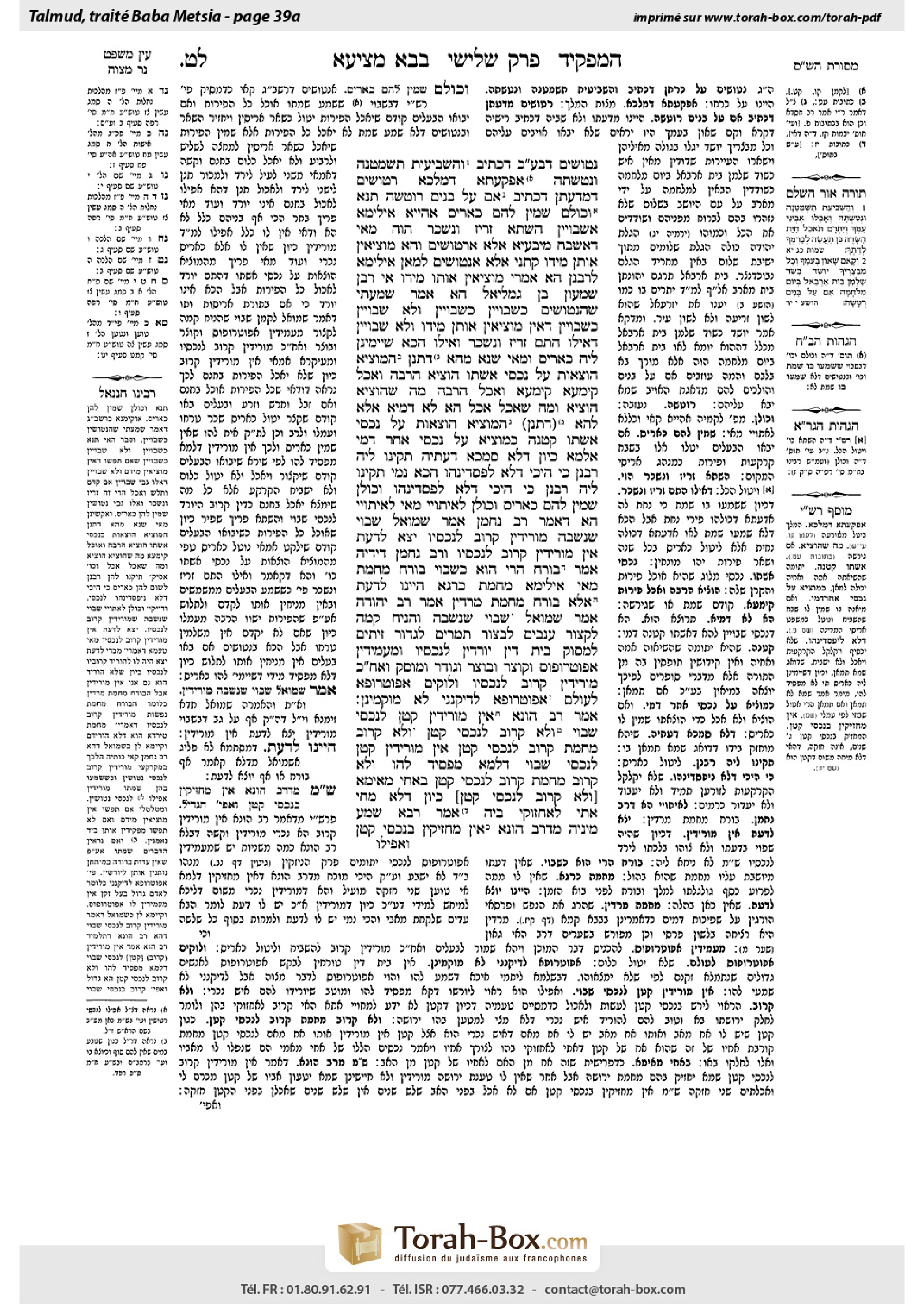
Bava Metzia 39a: Talmud study for Daf Yomi
Study the Talmud for Daf Yomi with scanned pages, Hebrew text, English translations from Sefaria and AI-generated French translations.
Passage selection and English or AI-generated French translation are available where the scan has annotations. Daf Study is independent of Torah-Box and Sefaria.
Browse Bava Metzia · בבא מציעא · All tractatesBava Metzia 39a text and translations
This page of Bava Metzia includes the Aramaic text, an English translation and an AI-generated French translation, alongside the scan above.
בבא מציעא ל״ט א · Aramaic and Hebrew text
״נְטוּשִׁים״ דִּבְעַל כׇּרְחָן, דִּכְתִיב: ״וְהַשְּׁבִיעִת תִּשְׁמְטֶנָּה וּנְטַשְׁתָּהּ״ – אַפְקַעְתָּא דְמַלְכָּא. ״רְטוּשִׁים״ דְּמִדַּעְתָּן, דִּכְתִיב: ״אֵם עַל בָּנִים רֻטָּשָׁה״.
תָּנָא: וְכוּלָּם שָׁמִין לָהֶם כְּאָרִיס. אַהֵיָיא? אִילֵּימָא אַשְּׁבוּיִין, הַשְׁתָּא זָרִיז וְנִשְׂכָּר הֲוָה, מַאי דְּאַשְׁבַּח מִיבַּעְיָא? אֶלָּא אַרְטוּשִׁים – וְהָא ״מוֹצִיאִין אוֹתָן מִיָּדוֹ״ קָתָנֵי!
אֶלָּא אַנְּטוּשִׁים. לְמַאן? אִילֵּימָא לְרַבָּנַן – הָא אָמְרִי מוֹצִיאִין אוֹתוֹ מִיָּדוֹ. אִי רַבָּן שִׁמְעוֹן בֶּן גַּמְלִיאֵל – הָא אָמַר שָׁמַעְתִּי שֶׁהַנְּטוּשִׁים כִּשְׁבוּיִין.
כִּשְׁבוּיִין וְלֹא שְׁבוּיִין. כִּשְׁבוּיִין – דְּאֵין מוֹצִיאִין אוֹתָן מִיָּדוֹ, וְלֹא שְׁבוּיִין – דְּאִילּוּ הָתָם זָרִיז וְנִשְׂכָּר, וְאִילּוּ הָכָא שָׁיְימִינַן לֵיהּ כְּאָרִיס.
וּמַאי שְׁנָא מֵהָא דִּתְנַן: הַמּוֹצִיא הוֹצָאוֹת עַל נִכְסֵי אִשְׁתּוֹ, הוֹצִיא הַרְבֵּה וְאָכַל קִימְעָא, קִימְעָא וְאָכַל הַרְבֵּה – מַה שֶּׁהוֹצִיא הוֹצִיא, וּמַה שֶּׁאָכַל אָכַל.
הָא לָא דָּמְיָא אֶלָּא לְהָא דִּתְנַן: הַמּוֹצִיא הוֹצָאוֹת עַל נִכְסֵי אִשְׁתּוֹ קְטַנָּה – כְּמוֹצִיא עַל נִכְסֵי אַחֵר דָּמֵי. אַלְמָא: כֵּיוָן דְּלָא סָמְכָא דַּעְתֵּיהּ, תַּקִּינוּ לֵיה רַבָּנַן כִּי הֵיכִי דְּלָא לַפְסְדִינְהוּ, הָכָא נָמֵי תַּקִּינוּ לֵיה רַבָּנַן כִּי הֵיכִי דְּלָא לַפְסְדִינְהוּ.
וְכוּלָּן שָׁמִין לָהֶם כְּאָרִיס – וְכוּלָּן לְאֵיתוֹיֵי מַאי?
לְאֵיתוֹיֵי הָא דְּאָמַר רַב נַחְמָן אָמַר שְׁמוּאֵל: שָׁבוּי שֶׁנִּשְׁבָּה מוֹרִידִין קָרוֹב לִנְכָסָיו, יָצָא לְדַעַת אֵין מוֹרִידִין קָרוֹב לִנְכָסָיו. וְרַב נַחְמָן דִּידֵיהּ אָמַר: בּוֹרֵחַ הֲרֵי הוּא כְּשָׁבוּי. בּוֹרֵחַ מֵחֲמַת מַאי? אִילֵימָא מֵחֲמַת כְּרָגָא – הַיְינוּ לְדַעַת, אֶלָּא בּוֹרֵחַ מֵחֲמַת מְרָדִין.
אָמַר רַב יְהוּדָה אָמַר שְׁמוּאֵל: שָׁבוּי שֶׁנִּשְׁבָּה וְהִנִּיחַ קָמָה לִקְצוֹר, עֲנָבִים לִבְצוֹר, תְּמָרִים לִגְדּוֹר, זֵיתִים לִמְסוֹק – בֵּית דִּין יוֹרְדִין לִנְכָסָיו וּמַעֲמִידִין אַפּוֹטְרוֹפּוֹס, וְקוֹצֵר וּבוֹצֵר וְגוֹדֵר וּמוֹסֵק, וְאַחַר כָּךְ מוֹרִידִין קָרוֹב לִנְכָסָיו. וְלוֹקֵים אַפּוֹטְרוֹפָּא לְעוֹלָם! אַפּוֹטְרוֹפָּא לְדִיקְנָנֵי לָא מוֹקְמִינַן.
אָמַר רַב הוּנָא: אֵין מוֹרִידִין קָטָן לְנִכְסֵי שָׁבוּי, וְלֹא קָרוֹב לְנִכְסֵי קָטָן, וְלָא קָרוֹב מֵחֲמַת קָרוֹב לְנִכְסֵי קָטָן.
אֵין מוֹרִידִין קָטָן לְנִכְסֵי שָׁבוּי, דִּלְמָא מַפְסֵיד לְהוּ. וְלָא קָרוֹב מֵחֲמַת קָרוֹב לְנִכְסֵי קָטָן, בְּאַחֵי מֵאִימָּא. וְלָא קָרוֹב לְנִכְסֵי קָטָן, כֵּיוָן דְּלָא מָחֵי – אָתֵי לְאַחְזוֹקֵי בֵּיהּ.
אָמַר רָבָא, שְׁמַע מִינֵּיהּ מִדְּרַב הוּנָא: אֵין מַחֲזִיקִין בְּנִכְסֵי קָטָן,
Bava Metzia 39a · English translation
The Gemara explains: Abandoned property [netushim]; this is referring to property that the owners vacated perforce. When it is written: “But the seventh year you shall let it rest and lie fallow [untashtah]” (Exodus 23:11), that is expropriation by edict of the King of the Universe. Forsaken property [retushim]; this is referring to property that the owners vacated of their own volition, as it is written: “A mother was forsaken [rutasha] with her sons” (Hosea 10:14), indicating that the mother was left with the sons, as all the men left.
A Sage taught with regard to the baraita discussing the case of one who descends to the property of another: And for all of them, the court appraises their work as one would appraise the work of a sharecropper. The Gemara asks: To which property in the baraita is this ruling stated? If we say it is stated with regard to captives’ property, now that the tanna stated that he is diligent and he profits, as he may take as much produce as he wishes, is it necessary to say that he can take a share of what he did to enhance the field? Rather, say that it is stated with regard to forsaken property. But isn’t it taught: The court removes it from his possession? The legal status of the one who labored in the field is not at all similar to that of a sharecropper.
Rather, say that it is stated with regard to abandoned property. The Gemara asks: In accordance with whose opinion? If we say it is in accordance with the opinion of the Rabbis, don’t they say: The court removes it from his possession? And if it is in accordance with the opinion of Rabban Shimon ben Gamliel, doesn’t he say: I heard that the legal status of abandoned property is like that of captives’ property, and the rights of the one who labored in the field are superior to those of a sharecropper.
The Gemara answers: According to the opinion of Rabban Shimon ben Gamliel, the legal status of that property is in some ways like that of captives’ property but in other ways not like that of captives’ property. It is like that of captives’ property in that the court does not remove it from his possession. But it is not like that of captives’ property, as there, in the case of captives’ property, the one working the field is diligent and he profits from the produce he takes, while here, one appraises their work as one would appraise the work of a sharecropper.
The Gemara asks: And what is different in this case from that which we learned in a mishna (79b): In the case of one who outlays expenditures to enhance his wife’s usufruct property, which belongs to his wife but whose profits are his for the duration of their marriage, if the marriage ends in divorce or his death and she reclaims the property, whether he spent much to enhance the property and consumed little and did not derive benefit commensurate with his investment, or whether he spent little and consumed much, the principle is: What he spent, he spent, and what he consumed, he consumed. His labor is not appraised like that of a sharecropper.
The Gemara answers: This case is comparable only to that which we learned in a statement that Rabbi Ya’akov said that Rav Ḥisda said: The legal status of one who outlays expenditures to enhance the usufruct property of his minor wife, whose father died and whose brother and mother married her off, is like that of one who outlays expenditures to enhance the property of another, as this is a marriage by rabbinic law and she can void the marriage by performing refusal. If the husband spent much to enhance the property and consumed little, his work is assessed like that of a sharecropper. Apparently, since he does not rely on the fact that her property will remain his, the Sages instituted on his behalf that he be reimbursed for his expenditures so that he will not devalue the property. Here too, the Sages instituted on behalf of the one who labored in the field that he be reimbursed for his labor, so that he will not devalue the property.
The Gemara asks with regard to the phrase written in the baraita: And for all of them, the court appraises their work as one would appraise the work of a sharecropper, what additional case does it serve to include, as apparently it applies only to property of those who abandoned it, in accordance with the opinion of Rabban Shimon ben Gamliel?
The Gemara answers: It comes to include that which Rav Naḥman says that Shmuel says: For a captive who was taken captive, the court authorizes a relative to descend and manage his property. If he left of his own volition, the court does not authorize a relative to descend and manage his property. And Rav Naḥman says his own statement: The legal status of one who flees is like that of a captive. The Gemara asks: One who flees for what reason? If we say that he flees due to a tax [karga] that he attempts to evade, that is the case of one who left of his own volition. Rather, the reference is to one who flees due to an allegation that he committed murder [meradin], and he flees to avoid execution. Therefore, his legal status is that of a captive.
Rav Yehuda says that Shmuel says: In the case of a captive who was taken captive and left in his field standing grain to be reaped, or grapes to be harvested, or dates to be cut, or olives to be picked, and the owner of the produce will incur significant loss if they are not harvested, the court descends to his property and appoints a steward to manage his property. And he reaps, and harvests, and cuts, and picks, and thereafter the court authorizes a relative to descend and manage his property. The Gemara asks: If that is an option, let the court always appoint a steward to manage the captive’s field. The Gemara answers: We do not appoint a steward [apoteropa] for the bearded, i.e., adults. A steward is appointed only for orphans.
Rav Huna says: The court does not authorize a minor, even if he is an heir, to descend to the property of a captive. And the court does not authorize a relative who is an heir to descend to the property of a minor that has no one to tend to it. And the court does not authorize a relative due to a relative to descend to the property of a minor.
The Gemara elaborates: The court does not authorize a minor to descend to the property of a captive, lest he devalue the property. And the court does not authorize a relative due to a relative to descend to the property of a minor. The Gemara explains: It is a case where the minor has a paternal half-brother and that brother has a maternal half-brother. The concern is that the latter, who is not at all related to the minor who owns the field, will claim that he inherited the field from his brother. And the court does not authorize a relative to descend to the property of a minor. The concern is that since the minor does not protest at the appropriate time and assert that the property does not belong to his relative, that relative will come to assume presumptive ownership of the field.
Rava said: Learn from the statement of Rav Huna that one cannot assume presumptive ownership of the property of a minor. Even if one took possession of and used the property of a minor for three years, this does not indicate that he has presumptive ownership of the property. Rav Huna restricted the descent specifically of relatives to the property of a minor, indicating that those are not concerns when it is a non-relative who descends to manage the field. Apparently, the reason that there is no concern is that one cannot assume presumptive ownership of the property of a minor.
Bava Metzia 39a · Traduction française (IA)
La Guemara explique : Les biens abandonnés [netushim] ; cela fait référence aux biens que les propriétaires ont quittés par contrainte. Lorsqu'il est écrit : « Mais le septième année, tu laisseras reposer et laisseras en jachère [untashtah] » (Exode 23:11), cela signifie une expropriation par ordre du Roi du Monde. Les biens laissés [retushim] ; cela fait référence aux biens que les propriétaires ont quittés de leur propre volonté, comme il est écrit : « Une mère fut laissée [rutasha] avec ses fils » (Ozé 10:14), indiquant que la mère était restée avec les fils, car tous les hommes étaient partis.
Un Sage a enseigné concernant la baraïta qui discute du cas d'une personne descendant aux biens d'une autre : Et pour tous, la cour évalue leur travail comme on évalue le travail d'un cultivateur en partage. La Guemara demande : À quel bien de la baraïta cette règle est-elle énoncée ? Si nous disons qu'elle est énoncée concernant les biens des captifs, maintenant que le tanna a dit qu'il est diligent et qu'il profite, car il peut prendre autant de récolte qu'il veut, est-il nécessaire de dire qu'il peut prendre une part de ce qu'il a fait pour améliorer le champ ? Plutôt, disons qu'elle est énoncée concernant les biens laissés. Mais n'est-il pas enseigné : La cour enlève cela de sa possession ? Le statut juridique de celui qui a travaillé dans le champ n'est pas du tout semblable à celui d'un cultivateur en partage.
Plutôt, disons qu'elle est énoncée concernant les biens abandonnés. La Guemara demande : Selon l'opinion de qui ? Si nous disons qu'il s'agit de l'opinion des Rabbins, n'ont-ils pas dit : La cour enlève cela de sa possession ? Et si c'est selon l'opinion de Rabban Shimon ben Gamliel, n'a-t-il pas dit : J'ai entendu que le statut juridique des biens abandonnés est comme celui des biens des captifs, et les droits de celui qui a travaillé dans le champ sont supérieurs à ceux d'un cultivateur en partage.
La Guemara répond : Selon l'opinion de Rabban Shimon ben Gamliel, le statut juridique de ce bien est en quelque sorte comme celui des biens des captifs, mais en d'autres aspects pas comme celui des biens des captifs. Il est comme celui des biens des captifs dans la mesure où la cour ne retire pas cela de sa possession. Mais il n'est pas comme celui des biens des captifs, car là, dans le cas des biens des captifs, celui qui travaille dans le champ est diligent et il profite de la récolte qu'il prend, tandis que ici, on évalue leur travail comme on évalue le travail d'un cultivateur en partage.
La Guemara demande : Et qu'y a-t-il de différent dans ce cas par rapport à ce que nous avons appris dans une mitsva (79b) : Dans le cas d'une personne qui dépense des ressources pour améliorer la propriété en usufruit de sa femme, qui appartient à sa femme mais dont les profits appartiennent à lui pendant leur mariage, si le mariage se termine par le divorce ou sa mort et qu'elle récupère la propriété, que ce soit s'il a dépensé beaucoup pour améliorer la propriété et s'il a consommé peu et n'a pas tiré un bénéfice proportionnel à son investissement, ou s'il a dépensé peu et consommé beaucoup, le principe est : Ce qu'il a dépensé, il l'a dépensé, et ce qu'il a consommé, il l'a consommé. Son travail n'est pas évalué comme celui d'un cultivateur en partage.
La Guemara répond : Ce cas est comparable uniquement à celui que nous avons appris dans une déclaration que Rabbi Ya'akov a dit que Rav Ḥisda a dit : Le statut juridique d'une personne qui dépense des ressources pour améliorer la propriété en usufruit de sa femme mineure, dont le père est décédé et dont le frère et la mère l'ont mariée, est comme celui d'une personne qui dépense des ressources pour améliorer la propriété d'une autre, car c'est un mariage selon la loi rabbinique et elle peut annuler le mariage en refusant. Si le mari a dépensé beaucoup pour améliorer la propriété et a consommé peu, son travail est évalué comme celui d'un cultivateur en partage. Apparemment, puisqu'il ne compte pas sur le fait que sa propriété restera la sienne, les Sages ont institué en son nom qu'il soit récompensé pour ses dépenses afin qu'il ne dégrade pas la propriété. Ici aussi, les Sages ont institué en faveur de celui qui a travaillé dans le champ qu'il soit récompensé pour son travail afin qu'il ne dégrade pas la propriété.
La Guemara demande concernant la phrase écrite dans la baraïta : Et pour tous, la cour évalue leur travail comme on évalue le travail d'un cultivateur en partage, à quoi cela sert-il d'inclure un cas supplémentaire, car apparemment cela s'applique uniquement aux biens de ceux qui les ont abandonnés, selon l'opinion de Rabban Shimon ben Gamliel ?
La Guemara répond : Cela vient inclure ce que Rav Naḥman dit que Shmuel dit : Pour un captif qui a été capturé, la cour autorise un parent à descendre et à gérer ses biens. Si il a quitté de sa propre volonté, la cour ne permet pas à un parent de descendre et de gérer ses biens. Et Rav Naḥman dit sa propre déclaration : Le statut juridique de celui qui fuit est comme celui d'un captif. La Guemara demande : Celui qui fuit pour quelle raison ? Si nous disons qu'il fuit en raison d'une taxe [karga] qu'il tente d'éviter, c'est le cas de celui qui a quitté de sa propre volonté. Plutôt, la référence est à celui qui fuit en raison d'une allégation qu'il a commis un meurtre [meradin], et il fuit pour éviter l'exécution. Par conséquent, son statut juridique est celui d'un captif.
Rav Yehuda dit que Shmuel dit : Dans le cas d'un captif qui a été capturé et qui a laissé dans son champ des épis à moissonner, des raisins à récolter, des dattes à couper, ou des olives à récolter, et que le propriétaire des récoltes subirait une perte considérable s'ils n'étaient pas récoltés, la cour descend dans ses biens et désigne un administrateur pour gérer ses biens. Et il moissonne, récolte, coupe et récolte, et ensuite la cour autorise un parent à descendre et à gérer ses biens. La Guemara demande : Si c'est une option, la cour devrait toujours désigner un administrateur pour gérer le champ du captif. La Guemara répond : Nous ne désignons pas un administrateur [apoteropa] pour les barbus, c'est-à-dire les adultes. Un administrateur est désigné uniquement pour les orphelins.
Rav Huna dit : La cour ne permet pas à un mineur, même s'il est héritier, de descendre aux biens d'un captif. Et la cour ne permet pas à un parent qui est héritier de descendre aux biens d'un mineur qui n'a personne pour le soigner. Et la cour ne permet pas à un parent en raison d'un parent de descendre aux biens d'un mineur.
La Guemara développe : La cour ne permet pas à un mineur de descendre sur la propriété d’un captif, de peur qu’il ne la dégrade. Et la cour ne permet pas à un parent de descendre sur la propriété d’un mineur. La Guemara explique : Il s’agit d’un cas où le mineur a un demi-frère paternel et que ce dernier a un demi-frère maternel. L’inquiétude est que ce dernier, qui n’est en aucun cas lié au mineur propriétaire du champ, affirmera qu’il a hérité du champ de son frère. Et la cour ne permet pas à un parent de descendre sur la propriété d’un mineur. L’inquiétude est que puisque le mineur ne proteste pas à temps et ne déclare pas que la propriété n’appartient pas à son parent, ce dernier viendra à considérer que la propriété est à lui.
Rava dit : Apprenez de la déclaration de Rav Huna que l’on ne peut pas considérer comme propriétaire présomptif la propriété d’un mineur. Même si l’on a pris possession et utilisé la propriété d’un mineur pendant trois ans, cela ne signifie pas qu’on en est propriétaire présomptif. Rav Huna a limité spécifiquement la descente des parents sur la propriété d’un mineur, indiquant que ces cas ne sont pas des préoccupations lorsqu’il s’agit d’un non-parent qui descend pour gérer le champ. Apparemment, la raison pour laquelle il n’y a pas de préoccupation est que l’on ne peut pas considérer comme propriétaire présomptif la propriété d’un mineur.
Traduction française générée par IA à partir de l’édition anglaise de Sefaria. Vérifie toujours un passage avec le texte source.
Text from Sefaria: William Davidson Edition - Vocalized Aramaic (CC BY NC); William Davidson Edition - English (CC BY NC).