Bava Metzia 39b: Talmud study for Daf Yomi
Study the Talmud for Daf Yomi with scanned pages, Hebrew text, English translations from Sefaria and AI-generated French translations.
Passage selection and English or AI-generated French translation are available where the scan has annotations. Daf Study is independent of Torah-Box and Sefaria.
Browse Bava Metzia · בבא מציעא · All tractatesBava Metzia 39b text and translations
This page of Bava Metzia includes the Aramaic text, an English translation and an AI-generated French translation, alongside the scan above.
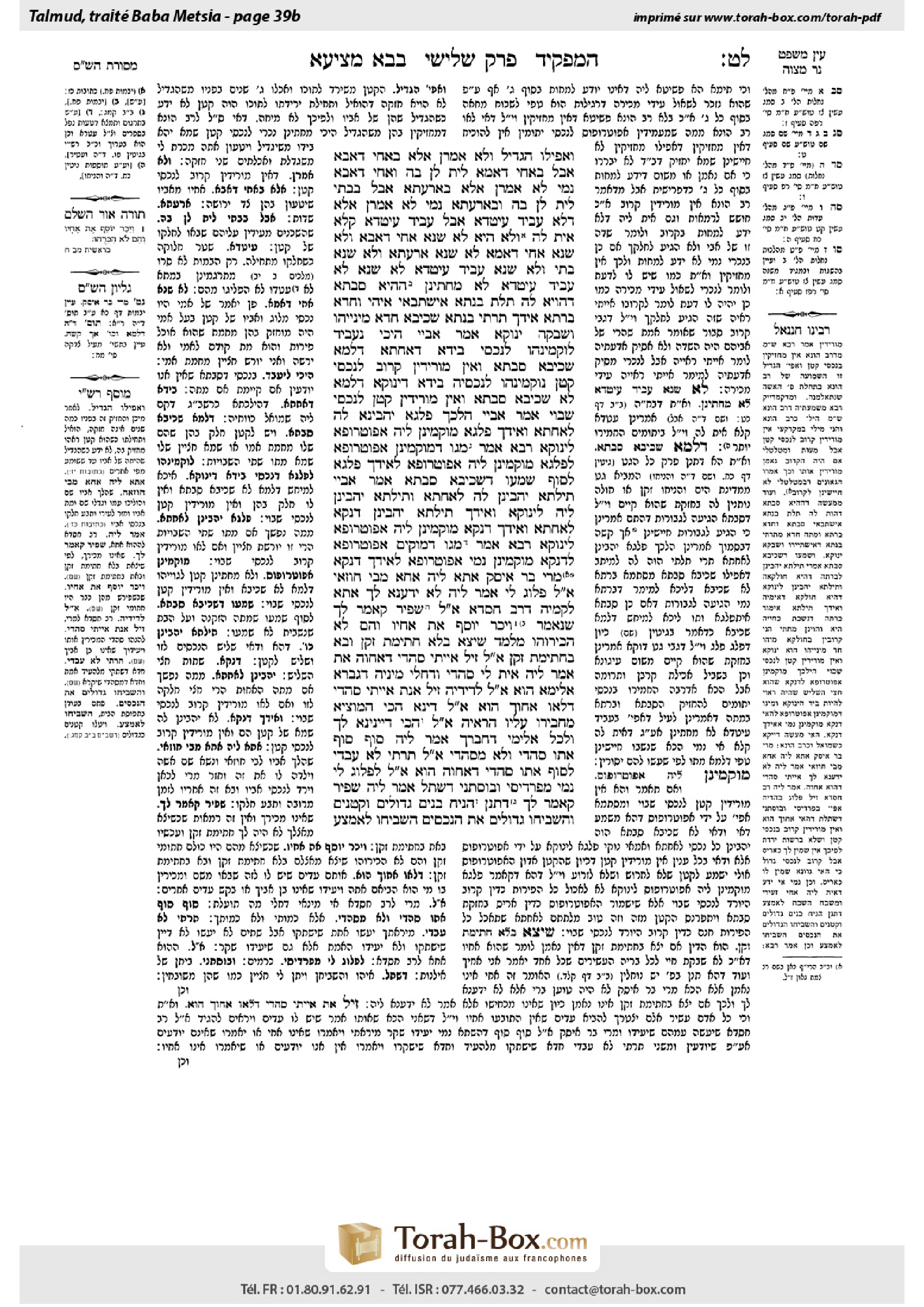
בבא מציעא ל״ט ב · Aramaic and Hebrew text
וַאֲפִילּוּ הִגְדִּיל.
וְלָא אֲמַרַן אֶלָּא בְּאַחֵי דְאַבָּא, אֲבָל בְּאַחֵי דְאִמָּא לֵית לַן בַּהּ. וַאֲחֵי דְאַבָּא נָמֵי לָא אֲמַרַן אֶלָּא בְּאַרְעָתָא, אֲבָל בְּבָתֵּי לֵית לַן בַּהּ. וּבְאַרְעָתָא נָמֵי לָא אֲמַרַן אֶלָּא דְּלָא עֲבִיד עִיטְדָּא, אֲבָל עֲבִיד עִיטְדָּא – קָלָא אִית לַהּ.
וְלָא הִיא – לָא שְׁנָא אַחֵי דְאַבָּא וְלָא שְׁנָא אַחֵי דְאִמָּא, לָא שְׁנָא אַרְעָתָא וְלָא שְׁנָא בָּתֵּי, וְלָא שְׁנָא עֲבִיד עִיטְדָּא לָא שְׁנָא לָא עֲבִיד עִיטְדָּא – לָא מַחֲתִינַן.
הָהִיא סָבְתָּא דַּהֲוַיָא לַהּ תְּלָת בְּנָתָא. אִישְׁתְּבַאי אִיהִי וַחֲדָא בְּרַתָּא. אִידַּךְ תַּרְתֵּי בְּנָתָא, שְׁכִיבָא חֲדָא מִינַּיְיהוּ וּשְׁבַקָה יָנוֹקָא. אֲמַר אַבָּיֵי: הֵיכִי נַעֲבֵיד? לוֹקְמִינְהוּ לְנִכְסֵי בִּידָא דַּאֲחָתָא – דִּלְמָא שְׁכִיבָא סָבְתָּא וְאֵין מוֹרִידִין קָרוֹב לְנִכְסֵי קָטָן! נוֹקְמִינְהוּ לְנִכְסֵיה בִּידָא דְּיָנוֹקָא – דִּלְמָא לָא שְׁכִיבָא סָבְתָּא וְאֵין מוֹרִידִין קָטָן לְנִכְסֵי שָׁבוּי!
אָמַר אַבָּיֵי: הִלְכָּךְ, פַּלְגָא יָהֲבִינָא לַהּ לַאֲחָתָא. וְאִידַּךְ פַּלְגָא מוֹקְמִינַן לֵיהּ אַפּוֹטְרוֹפָּא לְיָנוֹקָא. רָבָא אָמַר: מִגּוֹ דְּמוֹקְמִינַן אַפּוֹטְרוֹפָּא לְפַלְגָא, מוֹקְמִינַן לֵיהּ אַפּוֹטְרוֹפָּא לְאִידַּךְ פַּלְגָא.
לְסוֹף שְׁמַעוּ דִּשְׁכִיבָא סָבְתָּא. אָמַר אַבָּיֵי: תִּילְתָּא יָהֲבִינַן לַהּ לַאֲחָתָא, וְתִילְתָּא יָהֲבִינַן לֵיהּ לְיָנוֹקָא. וְאִידַּךְ תִּילְתָּא יָהֲבִינַן דַּנְקָא לַאֲחָתָא, וְאִידַּךְ דַּנְקָא מוֹקְמִינַן לֵיהּ אַפּוֹטְרוֹפָּא לְיָנוֹקָא. רָבָא אָמַר: מִגּוֹ דְּמוֹקֵים אַפּוֹטְרוֹפָּא לְדַנְקָא מוֹקְמִינַן נָמֵי אַפּוֹטְרוֹפָּא לְאִידַּךְ דַּנְקָא.
מָרִי בַּר אִיסַק אֲתָא לֵיהּ אַחָא מִבֵּי חוֹזָאֵי. אֲמַר לֵיהּ: פְּלוֹג לִי. אֲמַר לֵיהּ: לָא יָדַעְנָא לָךְ.
אֲתָא לְקַמֵּיהּ דְּרַב חִסְדָּא. אֲמַר לֵיהּ: שַׁפִּיר קָאָמַר לָךְ, שֶׁנֶּאֱמַר: ״וַיַּכֵּר יוֹסֵף אֶת אֶחָיו וְהֵם לֹא הִכִּרֻהוּ״ – מְלַמֵּד שֶׁיָּצָא בְּלֹא חֲתִימַת זָקָן וּבָא בַּחֲתִימַת זָקָן. אֲמַר לֵיהּ: זִיל אַיְיתִי סָהֲדִי דַּאֲחוּהּ אַתְּ. אֲמַר לֵיהּ: אִית לִי סָהֲדִי, וְדָחֲלִי מִינֵּיהּ דְּגַבְרָא אַלִּימָא הוּא. אֲמַר לֵיהּ לְדִידֵיהּ: זִיל אַנְתְּ אַיְיתִי סָהֲדֵי דְּלָאו אֲחוּךְ הוּא.
אֲמַר לֵיהּ: דִּינָא הָכִי?! הַמּוֹצִיא מֵחֲבֵירוֹ עָלָיו הָרְאָיָה. אֲמַר לֵיהּ: הָכִי דָּיְינִינָא לָךְ וּלְכֹל אַלִּימֵי דְּחַבְרָךְ. אֲמַר לֵיהּ: סוֹף סוֹף אָתוּ סָהֲדִי וְלָא מַסְהֲדִי. אֲמַר לֵיהּ: תַּרְתֵּי לָא עָבְדִי.
לְסוֹף אֲתוֹ סָהֲדִי דַּאֲחוּהּ הוּא. אֲמַר לֵיהּ: לִפְלוֹג לִי נָמֵי מִפַּרְדֵּיסֵי וּבוּסְתָּנִי דִּשְׁתַל. אֲמַר לֵיהּ: שַׁפִּיר קָאָמַר לָךְ, דִּתְנַן: הִנִּיחַ בָּנִים גְּדוֹלִים וּקְטַנִּים, וְהִשְׁבִּיחוּ גְּדוֹלִים אֶת הַנְּכָסִים – הִשְׁבִּיחוּ לָאֶמְצַע.
Bava Metzia 39b · English translation
And even if one continues to occupy the field after the minor reached majority, he does not assume presumptive ownership, as perhaps the minor was unaware that he is the field’s owner.
The Gemara comments: And we said only in the case of paternal brothers that the court does not authorize a relative to descend and manage the property of a minor, as they are potential heirs. But in the case of maternal brothers we have no problem with it, as they are not potential heirs. And in the case of paternal brothers, we said that the court does not authorize a relative only with regard to land. But in the case of houses we have no problem with it, as there are neighbors who can testify that the house does not belong to those brothers. And with regard to land too, we said that it is only in a case where the minor’s father did not draft a document of division of the property that the court does not authorize a relative. But in a case where the minor’s father drafted a document of division, it generates publicity, and everyone knows which portion belongs to each of the brothers.
The Gemara concludes: But this is not so, as there is no difference whether they are paternal brothers and there is no difference whether they are maternal brothers; it is no different whether it is land, and it is no different whether it is houses; and it is no different whether he drafted a document of division, and it is no different whether he did not draft a document of division. We do not authorize a relative to descend and manage the property of a minor, to avoid that relative being regarded as the owner of the property.
§ The Gemara relates: There was a certain old woman who had three daughters. She and one daughter were taken captive. Of the other two daughters, one died and left behind a minor son. Abaye said: What should we do in this case with the property of the old woman? If one suggests: Let us establish the property in the possession of the surviving sister, that is problematic. There is a concern that perhaps the old woman died in captivity, and if the old woman died, the minor inherits one-third of her property, and the court does not authorize a relative to descend and manage the property of a minor. If one suggests: Let us establish the property in the possession of the minor, that is also problematic. There is concern that perhaps the old woman did not die, and the court does not authorize a minor to descend and manage the property of a captive.
Abaye said: Consequently, half of the property is given to the surviving sister. If the captives died, she is the inheritor of half the property; if the captives are alive, this is a case where the court authorizes a relative to descend and manage the property of a captive. And for the other half of the property, we establish a steward on behalf of the minor, as it is conceivable that he inherited the property. Rava said: Once we appoint a steward for half of the property, we appoint a steward for the other half of the property, and it remains under his stewardship until the state of the captives becomes known.
Ultimately, they heard that that old woman died, and they did not hear the fate of the captive daughter. Abaye said: We give one-third of the property to the surviving daughter. And we give one-third of the property to the minor, as he inherits it from his grandmother by virtue of his deceased mother. And of the other one-third of the property, which belongs to the captive sister whose fate is unknown, we give one-sixth [danka] to the surviving sister, and for the other one-sixth, we appoint a steward on behalf of the minor, as perhaps the sister died and the property is his. Rava said: Once we appoint a steward for one-sixth of the property, we also appoint a steward for the other one-sixth of the property, until the fate of the captive sister is known.
§ The Gemara relates: Mari bar Isak, who was a wealthy and powerful man, had a brother whom he did not previously know, come to him from Bei Ḥozai, which was distant from central Babylonia. His brother said to him: Divide the property that you inherited from our father and give half to me, as I am your brother. Mari said to him: I do not know who you are.
The case came before Rav Ḥisda. He said to the brother: Mari bar Isak spoke well to you, as it is stated: “And Joseph knew his brothers and they knew him not” (Genesis 42:8). This teaches that Joseph left Eretz Yisrael without the trace of a beard, and he came with the trace of a beard. This proves that it is possible for brothers not to recognize each other. Mari bar Isak may be telling the truth when he claims he does not recognize you. Rav Ḥisda said to the brother: Go bring witnesses that you are his brother. The brother said to him: I have witnesses, but they fear Mari bar Isak because he is a violent man. Rav Ḥisda said to Mari bar Isak: You go bring witnesses that he is not your brother.
Mar bar Isak said to him: Is this the halakha? Isn’t there a principle in these cases that the burden of proof rests upon the claimant? Rav Ḥisda said to him: This is the way I judge you and all of your fellow violent people. Mari bar Isak said to him: Ultimately, if that is your concern, witnesses will come, and they will not testify in his favor. They will lie and testify in my favor. Rav Ḥisda said to him: They will not perform two wrongs; they will not refrain from telling the truth and also testify falsely.
Ultimately, witnesses came and testified that the person from Bei Ḥozai was his brother. At that point, the brother said to Mari bar Isak: Divide and give me half of the orchards and the gardens that you planted since the death of our father as well. Rav Ḥisda said to Mari bar Isak: He spoke well to you, as we learned in a mishna (Bava Batra 143b): If one died and left adult and minor sons, and the adult sons enhanced the property, they enhanced the property, and the profit goes to the middle, i.e., it is divided between the adult sons and the minor sons.
Bava Metzia 39b · Traduction française (IA)
Et même si l'on continue à occuper le champ après que l'enfant ait atteint l'âge de la majorité, il ne peut pas prétendre à la propriété par présomption, car peut-être l'enfant ne savait pas qu'il était propriétaire du champ.
La Guemara commente : Et nous avons dit cela uniquement dans le cas des frères paternels que la cour ne permet pas à un parent de descendre et de gérer la propriété d'un mineur, car ils sont des héritiers potentiels. Mais dans le cas des frères maternels, nous n'avons pas de problème, car ils ne sont pas des héritiers potentiels. Et dans le cas des frères paternels, nous avons dit que la cour ne permet pas à un parent de descendre uniquement en ce qui concerne la terre. Mais dans le cas des maisons, nous n'avons pas de problème, car il y a des voisins qui peuvent témoigner que la maison n'appartient pas à ces frères. Et concernant la terre également, nous avons dit que cela n'est valable que dans le cas où le père du mineur n'avait pas rédigé un document de division des biens, la cour ne permet pas à un parent de descendre. Mais dans le cas où le père du mineur avait rédigé un tel document, cela génère une publicité, et tout le monde sait quelle part appartient à chaque frère.
La Guemara conclut : Mais cela n'est pas ainsi, car il n'y a pas de différence entre des frères paternels et des frères maternels ; il n'y a pas de différence entre la terre et les maisons ; il n'y a pas de différence entre le fait qu'il ait rédigé un document de division et le fait qu'il n'ait pas rédigé un tel document. Nous ne permettons pas à un parent de descendre et de gérer la propriété d'un mineur, afin d'éviter que ce parent soit considéré comme propriétaire des biens.
§ La Guemara rapporte : Il y avait une certaine vieille femme qui avait trois filles. Elle et une fille furent emprisonnées. Parmi les deux autres filles, l'une mourut et laissa derrière elle un fils mineur. Abaye dit : Que devons-nous faire dans ce cas avec les biens de la vieille femme ? Si l'on suggère : Mettons les biens en possession de la sœur survivante, cela pose problème. Il y a une crainte que peut-être la vieille femme est morte en captivité, et si la vieille femme est morte, le mineur hérite d'un tiers de ses biens, et la cour ne permet pas à un parent de descendre et de gérer la propriété d'un mineur. Si l'on suggère : Mettons les biens en possession du mineur, cela pose également problème. Il y a une crainte que peut-être la vieille femme est vivante, et la cour ne permet pas à un mineur de descendre et de gérer la propriété d'une captive.
Abaye dit : Par conséquent, la moitié des biens est donnée à la sœur survivante. Si les captifs sont morts, elle est l'héritière de la moitié des biens ; si les captifs sont vivants, c'est un cas où la cour autorise un parent à descendre et à gérer la propriété d'une captive. Et pour la moitié des biens restante, nous établissons un administrateur en faveur du mineur, car il est concevable qu'il ait hérité des biens. Rava dit : Une fois que nous avons désigné un administrateur pour la moitié des biens, nous désignons un administrateur pour l'autre moitié des biens, et cela reste sous son administration jusqu'à ce que l'état des captifs soit connu.
Finalement, ils apprirent que la vieille femme était morte, et ils n'avaient pas entendu le sort de la fille captive. Abaye dit : Nous donnons un tiers des biens à la sœur survivante. Et nous donnons un tiers des biens au mineur, car il les hérite de sa grand-mère par le biais de sa mère décédée. Et pour les autres un tiers des biens, qui appartiennent à la sœur captive dont le sort est inconnu, nous donnons un sixième [danka] à la sœur survivante, et pour l'autre sixième, nous désignons un administrateur en faveur du mineur, car peut-être la sœur est morte et les biens sont les siens. Rava dit : Une fois que nous désignons un administrateur pour un sixième des biens, nous désignons également un administrateur pour l'autre sixième des biens, jusqu'à ce que le sort de la sœur captive soit connu.
§ La Guemara rapporte : Mari bar Isak, qui était un homme riche et puissant, avait un frère qu'il ne connaissait pas auparavant, qui est venu le voir à Bei Ḥozai, qui était éloigné de Babylone centrale. Son frère lui dit : Divise les biens que tu as hérités de notre père et donne la moitié à moi, car je suis ton frère. Mari dit à lui : Je ne sais pas qui tu es.
Le cas vint devant Rav Ḥisda. Il dit au frère : Mari bar Isak a bien parlé à toi, car il est dit : « Et Joseph connaissait ses frères et ils ne le connaissaient pas » (Genèse 42:8). Cela enseigne que Joseph est parti d'Eretz Yisrael sans la trace d'une barbe, et il est revenu avec la trace d'une barbe. Cela prouve qu'il est possible que des frères ne se reconnaissent pas mutuellement. Mari bar Isak peut dire la vérité lorsqu'il affirme ne pas le reconnaître. Rav Ḥisda dit au frère : Va apporter des témoins qui attestent que tu es son frère. Le frère lui dit : J'ai des témoins, mais ils craignent Mari bar Isak car il est un homme violent. Rav Ḥisda dit à Mari bar Isak : Tu vas apporter des témoins qui attestent qu'il n'est pas ton frère.
Mar bar Isak dit à lui : C'est la halakha ? N'y a-t-il pas un principe dans ces cas que la charge de la preuve repose sur le plaignant ? Rav Ḥisda dit à lui : C'est ainsi que je juge toi et tous tes camarades violents. Mar bar Isak dit à lui : Finalement, si c'est une préoccupation pour toi, des témoins viendront et ils ne témoigneront pas en faveur de lui. Ils mentiront et témoigneront en faveur de moi. Rav Ḥisda dit à lui : Ils ne commettent pas deux injustices ; ils ne se refréneront pas de dire la vérité et ne témoigneront pas faussement.
Finalement, des témoins vinrent et attestèrent que la personne de Bei Ḥozai était son frère. À ce moment-là, le frère dit à Mari bar Isak : Divise et donne-moi la moitié des vergers et des jardins que tu as plantés depuis la mort de notre père. Rav Ḥisda dit à Mari bar Isak : Il a bien parlé à toi, car nous avons appris dans une mitsna (Bava Batra 143b) : Si l'un est mort et a laissé des fils adultes et mineurs, et que les fils adultes ont amélioré les biens, ils améliorent les biens, et les profits vont au milieu, c'est-à-dire qu'ils sont divisés entre les fils adultes et les fils mineurs.
Traduction française générée par IA à partir de l’édition anglaise de Sefaria. Vérifie toujours un passage avec le texte source.
Text from Sefaria: William Davidson Edition - Vocalized Aramaic (CC BY NC); William Davidson Edition - English (CC BY NC).