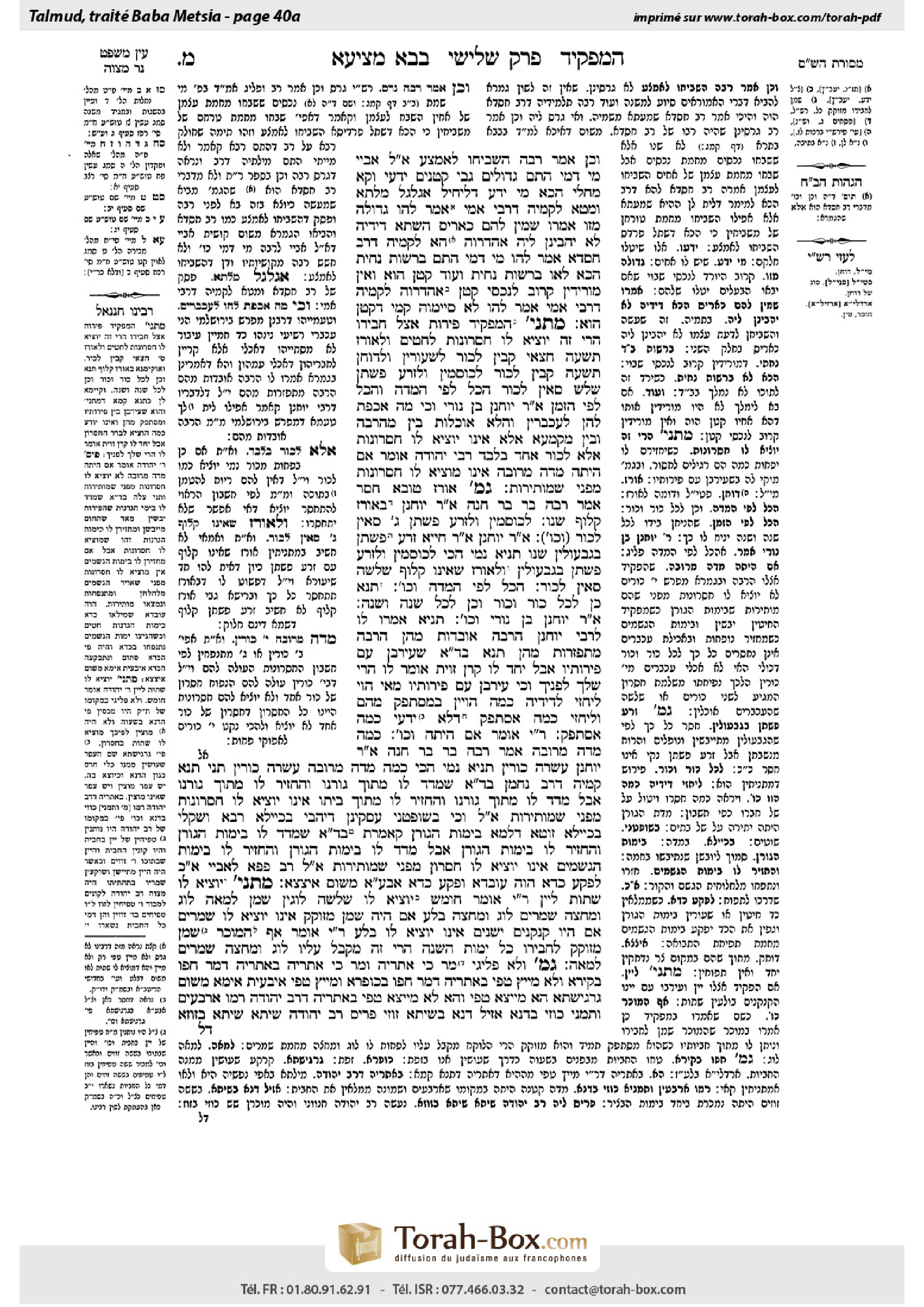
Bava Metzia 40a: Talmud study for Daf Yomi
Study the Talmud for Daf Yomi with scanned pages, Hebrew text, English translations from Sefaria and AI-generated French translations.
Passage selection and English or AI-generated French translation are available where the scan has annotations. Daf Study is independent of Torah-Box and Sefaria.
Browse Bava Metzia · בבא מציעא · All tractatesBava Metzia 40a text and translations
This page of Bava Metzia includes the Aramaic text, an English translation and an AI-generated French translation, alongside the scan above.
בבא מציעא מ׳ א · Aramaic and Hebrew text
וְכֵן אָמַר רַבָּה: הִשְׁבִּיחוּ לָאֶמְצַע. אָמַר לֵיהּ אַבָּיֵי: מִי דָּמֵי? הָתָם, גְּדוֹלִים גַּבֵּי קְטַנִּים יָדְעִי וְקָא מָחֲלִי, הָכָא מִי יָדַע דְּלֵיחִיל?
אִגַּלְגַּל מִלְּתָא וּמְטָא לְקַמֵּיהּ דְּרַבִּי אַמֵּי. אֲמַר לְהוּ: גְּדוֹלָה מִזּוֹ אָמְרוּ: שָׁמִין לָהֶם כְּאָרִיס, הַשְׁתָּא דִּידֵיהּ לָא יָהֲבִינַן לֵיהּ?
אַהְדְּרוּהָ (הָא) לְקַמֵּיהּ דְּרַב חִסְדָּא. אֲמַר לְהוּ: מִי דָּמֵי? הָתָם בִּרְשׁוּת נָחֵית, הָכָא לָאו בִּרְשׁוּת נָחֵית. וְעוֹד: קָטָן הוּא, וְאֵין מוֹרִידִין קָרוֹב לְנִכְסֵי קָטָן.
אַהְדְּרוּהָ לְקַמֵּיהּ דְּרַבִּי אַמֵּי, אֲמַר לְהוּ: לָא סַיְּימוּהָ קַמַּי דְּקָטָן הוּא.
מַתְנִי׳ הַמַּפְקִיד פֵּירוֹת אֵצֶל חֲבֵירוֹ, הֲרֵי זֶה יוֹצִיא לוֹ חֶסְרוֹנוֹת: לְחִטִּים וּלְאוֹרֶז – תִּשְׁעָה חֲצָאֵי קַבִּין לְכוֹר, לִשְׂעוֹרִין וּלְדוֹחַן – תִּשְׁעָה קַבִּין לְכוֹר, לְכוּסְּמִין וּלְזֶרַע פִּשְׁתָּן – שָׁלֹשׁ סְאִין לְכוֹר, הַכֹּל לְפִי הַמִּדָּה וְהַכֹּל לְפִי הַזְּמַן.
אָמַר רַבִּי יוֹחָנָן בֶּן נוּרִי: וְכִי מָה אִכְפַּת לָהֶן לָעַכְבָּרִין? וַהֲלֹא אוֹכְלוֹת בֵּין מֵהַרְבֵּה וּבֵין מִקִּמְעָה! אֶלָּא אֵינוֹ יוֹצִיא לוֹ חֶסְרוֹנוֹת אֶלָּא לְכוֹר אֶחָד בִּלְבַד. רַבִּי יְהוּדָה אוֹמֵר: אִם הָיְתָה מִדָּה מְרוּבָּה, אֵינוֹ מוֹצִיא לוֹ חֶסְרוֹנוֹת, מִפְּנֵי שֶׁמּוֹתִירוֹת.
גְּמָ׳ אוֹרֶז טוּבָא חָסֵר! אָמַר רַבָּה בַּר בַּר חָנָה אָמַר רַבִּי יוֹחָנָן: בְּאוֹרֶז קָלוּף שָׁנוּ. לְכוּסְּמִין וּלְזֶרַע פִּשְׁתָּן שְׁלֹשָׁה סְאִין לְכוֹר וְכוּ׳. אָמַר רַבִּי יוֹחָנָן אָמַר רַבִּי חִיָּיא: זֶרַע פִּשְׁתָּן בְּגִבְעוֹלִין שָׁנוּ. תַּנְיָא נָמֵי הָכִי: לְכוּסְּמִין וּלְזֶרַע פִּשְׁתָּן בַּגִּבְעוֹלִין, וּלְאוֹרֶז שֶׁאֵינוֹ קָלוּף – שְׁלֹשָׁה סְאִין לְכוֹר.
הַכֹּל לְפִי הַמִּדָּה וְכוּ׳. תָּנָא: כֵּן לְכׇל כּוֹר וָכוֹר, וְכֵן לְכׇל שָׁנָה וְשָׁנָה.
אָמַר רַבִּי יוֹחָנָן בֶּן נוּרִי וְכוּ׳. תַּנְיָא, אָמְרוּ לוֹ לְרַבִּי יוֹחָנָן: הַרְבֵּה אוֹבְדוֹת מֵהֶן, הַרְבֵּה מִתְפַּזְּרוֹת מֵהֶן.
תָּנָא: בַּמֶּה דְּבָרִים אֲמוּרִים? שֶׁעֵירְבָן עִם פֵּירוֹתָיו. אֲבָל יִחֵד לוֹ קֶרֶן זָוִית, אוֹמֵר לוֹ: הֲרֵי שֶׁלְּךָ לְפָנֶיךָ.
וְכִי עֵירְבָן עִם פֵּירוֹתָיו מַאי הָוֵי? לִיחְזֵי לְדִידֵיהּ כַּמָּה הָוְיָין! בְּמִסְתַּפֵּק מֵהֶם.
וְלִיחְזֵי כַּמָּה אִסְתַּפַּק! דְּלָא יָדְעִי כַּמָּה אִסְתַּפַּק.
רַבִּי יְהוּדָה אוֹמֵר: אִם הָיְתָה וְכוּ׳. כַּמָּה מִדָּה מְרוּבָּה? אָמַר רַבָּה בַּר בַּר חָנָה אָמַר רַבִּי יוֹחָנָן: עֲשָׂרָה כּוֹרִין. תַּנְיָא נָמֵי הָכִי: כַּמָּה מִדָּה מְרוּבָּה? עֲשָׂרָה כּוֹרִין.
תָּנֵי תַּנָּא קַמֵּיהּ דְּרַב נַחְמָן: בַּמֶּה דְּבָרִים אֲמוּרִים? שֶׁמָּדַד לוֹ מִתּוֹךְ גּוֹרְנוֹ וְהֶחְזִיר לוֹ מִתּוֹךְ גּוֹרְנוֹ. אֲבָל מָדַד לוֹ מִתּוֹךְ גּוֹרְנוֹ וְהֶחְזִיר לוֹ מִתּוֹךְ בֵּיתוֹ – אֵינוֹ יוֹצִיא לוֹ חֶסְרוֹנוֹת, מִפְּנֵי שֶׁמּוֹתִירוֹת.
אֲמַר לֵיהּ: וְכִי בְּשׁוּפְטָנֵי עָסְקִינַן דְּיָהֲבִי בִּכְיָילָא רַבָּא וְשָׁקְלִי בִּכְיָילָא זוּטָא? דִּלְמָא בִּימוֹת הַגּוֹרֶן קָאָמְרַתְּ. בַּמֶּה דְּבָרִים אֲמוּרִים – שֶׁמָּדַד לוֹ בִּימוֹת הַגּוֹרֶן וְהֶחְזִיר לוֹ בִּימוֹת הַגּוֹרֶן. אֲבָל מָדַד לוֹ בִּימוֹת הַגּוֹרֶן וְהֶחְזִיר לוֹ בִּימוֹת הַגְּשָׁמִים – אֵינוֹ יוֹצִיא לוֹ חֶסְרוֹן מִפְּנֵי שֶׁמּוֹתִירוֹת.
אֲמַר לֵיהּ רַב פָּפָּא לְאַבָּיֵי: אִם כֵּן, לִפְקַע כַּדָּא! הֲוָה עוֹבָדָא וּפְקַע כַּדָּא. אִיבָּעֵית אֵימָא, מִשּׁוּם אִיצְצָא.
מַתְנִי׳ יוֹצִיא לוֹ שְׁתוּת לְיַיִן. רַבִּי יְהוּדָה אוֹמֵר: חוֹמֶשׁ. יוֹצִיא לוֹ שְׁלֹשָׁה לוּגִּין שֶׁמֶן לְמֵאָה: לוֹג וּמֶחֱצָה שְׁמָרִים, לוֹג וּמֶחֱצָה בָּלַע. אִם הָיָה שֶׁמֶן מְזוּקָּק – אֵינוֹ יוֹצִיא לוֹ שְׁמָרִים. אִם הָיוּ קַנְקַנִּים יְשָׁנִים – אֵינוֹ יוֹצִיא לוֹ בֶּלַע. רַבִּי יְהוּדָה אוֹמֵר: אַף הַמּוֹכֵר שֶׁמֶן מְזוּקָּק לַחֲבֵירוֹ כׇּל יְמוֹת הַשָּׁנָה – הֲרֵי זֶה מְקַבֵּל עָלָיו לוֹג וּמֶחֱצָה שְׁמָרִים לְמֵאָה.
גְּמָ׳ וְלָא פְּלִיגִי: מָר כִּי אַתְרֵיהּ וּמָר כִּי אַתְרֵיהּ. בְּאַתְרֵיהּ דְּמָר חָפוּ בְּקִירָא וְלָא מָיֵיץ טְפֵי, בְּאַתְרֵיהּ דְּמָר חָפוּ בְּכוּפְרָא וּמָיֵיץ טְפֵי. אִיבָּעֵית אֵימָא מִשּׁוּם גַּרְגִּישְׁתָּא, הָא מָיְיצָא טְפֵי וְהָא לָא מָיְיצָא טְפֵי.
בְּאַתְרֵיהּ דְּרַב יְהוּדָה רָמוּ אַרְבָּעִים וְתַמְנֵי כּוּזֵי בְּדַנָּא. אָזֵיל דַּנָּא בְּשִׁיתָּא זוּזֵי, פָּרֵיס רַב יְהוּדָה שִׁיתָּא שִׁיתָּא בְּזוּזָא,
Bava Metzia 40a · English translation
And likewise, Rabba says: They enhanced the property, and the profit goes to the middle. Abaye said to him: Are these matters comparable? There, in the case that the adult and minor brothers were together, the adults are aware that the minors exist and forgo payment for their effort on behalf of their younger brothers. Here, in the case of Mari bar Isak, was the older brother aware of the existence of the younger brother so that he could forgo payment for his labor?
The matter continued to develop and came before Rabbi Ami. He said to those who reported Rav Ḥisda’s ruling: The Sages stated a more far-reaching halakha than that: In the case of relatives who tend to the property of a captive, the court appraises their work as one would appraise the work of a sharecropper. Although the property they tended did not belong to them at all, they receive wages for their labor. Why, then, is the ruling now, in the case of Mari bar Isak, that payment for labor on property that is his, we do not give him? Mari bar Isak should be reimbursed for his expenditures.
They returned and related this matter before Rav Ḥisda. Rav Ḥisda said to them: Are these matters comparable? There, in the case of the captive’s property, it was with authorization from the court that the relative descended to tend to the property. Here, it was without authorization that Mari bar Isak descended to tend to the property of his brother. And furthermore, Mari bar Isak’s brother was a minor when Mari inherited the property, and the court does not authorize a relative to descend and manage the property of a minor.
They returned and related this response before Rabbi Ami. Rabbi Ami said to them: They did not complete conveying all the details of the case before me, and I was unaware that Mari’s brother was a minor. Rav Ḥisda is correct.
MISHNA: In the case of one who deposits produce with another, and the bailee provides him with different produce in return, that bailee deducts from the produce that he returns an amount equal to the standard decrease of the produce. The decrease is calculated according to this formula: For wheat and for rice, he deducts nine half-kav per kor, which is 180 kav; for barley and millet, he deducts nine kav per kor; for spelt and flaxseed, he deducts three se’a, which total eighteen kav, per kor. The entire calculation is according to the measure, and the entire calculation is according to the time elapsed. This is the amount of produce that the bailee deducts per one kor of produce over the course of one year.
Rabbi Yoḥanan ben Nuri said: And what do the mice care how much produce the bailee is safeguarding? Don’t they eat the same amount whether it is from much produce and whether it is from little produce? Rather, he deducts an amount equal to the standard decrease of just one kor of produce. Rabbi Yehuda says: If the deposit was a large measure, the bailee does not deduct the decrease from it, due to the fact that for different reasons it increases. Therefore, he returns the measure of produce that was deposited with him, because the increase offsets the decrease.
GEMARA: The Gemara challenges: After decrease, rice is lacking a greater amount than what is recorded in the mishna. Rabba bar bar Ḥana says that Rabbi Yoḥanan says: It is with regard to shelled rice that the tanna’im taught the mishna. The mishna teaches: For spelt and flaxseed, he deducts three se’a per kor. Rabbi Yoḥanan says that Rabbi Ḥiyya says: It is with regard to flaxseed on its stalks that the tanna’im taught the mishna, and that is why the rate of decrease is so great. The Gemara comments: That is also taught in a baraita: For spelt and for flaxseed on its stalks and for unshelled rice, he deducts three se’a per kor.
The mishna teaches: The entire calculation is according to the measure, and the entire calculation is according to the time elapsed. It is taught in a baraita: That is the measure of decrease for each and every kor, and that is the measure of decrease for each and every year.
The mishna teaches: Rabbi Yoḥanan ben Nuri said: And what do the mice care how much produce the bailee is safeguarding? It is taught in a baraita that the Sages said to Rabbi Yoḥanan: The reduction is due not only to mice eating the produce. Much of the produce is lost, and much of the produce is scattered.
It is taught: In what cases is this statement said, that the bailee deducts these measures for the decrease? It is in a case where the bailee mixed the produce that he is safeguarding with his own produce, and he is unable to distinguish between them. But if he designated a corner for the produce that he is safeguarding, the bailee says to the owner of the produce: That which is yours is before you, and he does not calculate the decrease.
The Gemara asks: And when he mixed the produce that he is safeguarding with his own produce, what of it? Why must he calculate the decrease? Let him see how much his produce was, add the amount that was deposited with him, and calculate how much the produce diminished over time. He can then divide the loss proportionately between his produce and the deposited produce. The Gemara answers: The baraita is referring to a case where the bailee took supplies from that produce, and therefore it is impossible to ascertain the rate of decrease.
The Gemara asks: And let him see how much produce he took as supplies and include this in his calculation. The Gemara answers: The baraita is referring to a case where the bailee does not know with how much he took as supplies, and therefore he must calculate the decrease based on the measures enumerated in the mishna.
The mishna teaches that Rabbi Yehuda says: If the deposit was a large measure, the bailee does not deduct the decrease from it. The Gemara asks: How much is a large measure? Rabba bar bar Ḥana says that Rabbi Yoḥanan says: It is ten kor. This is also taught in a baraita: How much is a large measure? It is ten kor.
The tanna who recited mishnayot and baraitot taught before Rav Naḥman: In what case is this statement said, that the bailee deducts the decrease from the produce he returns? It is in a case where the owner of the produce measured the produce for the bailee from his own threshing floor, and the bailee returned the produce to him from his own threshing floor. The measures used in all threshing floors were equal, and tended to err on the side of increasing the amount measured. But in a case where the owner measured the produce for the bailee from his own threshing floor and the bailee returned the produce to him as measured by a measure from his own house, which were more precise than those used on the threshing floor, he does not deduct the decrease when returning the produce. This is because the produce the owner deposited was measured with the increased measure of the threshing floor, and that offsets the decrease.
Rav Naḥman said to him: And are we dealing with fools, who give the deposit with a large measure and take the produce back with a small measure? Clearly, the same measure was used in both cases. Perhaps you are stating a ruling about the season of the threshing floor, and this is what it means: In what case is this statement said? It is said in a case where he measured the produce for the bailee during the season of the threshing floor and the bailee returned the produce to him during the season of the threshing floor, i.e., in the same period. But in a case where he measured the produce for the bailee during the season of the threshing floor and the bailee returned the produce to him during the rainy season, he does not deduct the decrease when returning the produce, because the produce that he received absorbed moisture and expanded, so that he ultimately returns the same measure.
Rav Pappa said to Abaye: If so, if the volume of the grain expands during the rainy season, the jug in which the grain is placed should burst due to that expansion. The Gemara relates: There was an incident and the jug burst. If you wish, say instead that the volume contracted due to compression. When the produce was deposited it was loose and had greater volume. When the bailee returned it, the produce was tightly packed in the jug, resulting in lesser volume.
MISHNA: When the bailee returns liquids that were deposited with him, he deducts one-sixth of the amount for wine, to offset the decrease in volume due to absorption into the cask and evaporation. Rabbi Yehuda says: He deducts one-fifth. He deducts three log of oil for one hundred log: A log and a half for sediment that sinks to the bottom of the cask, and a log and a half for absorption into the cask. If it was refined oil, he does not deduct any of the oil for sediment because it was filtered. If the oil was stored in old casks that are already saturated, he does not deduct any of the oil for absorption. Rabbi Yehuda says: Even in a case of one who sells refined oil to another all the days of the year, this buyer accepts upon himself that the seller will deduct a log and a half of sediment for one hundred log, as that is the standard measure of sediment.
GEMARA: The Gemara comments: And the first tanna and Rabbi Yehuda do not disagree with regard to the halakha. Rather, this Sage ruled in accordance with the custom of his locale, and this Sage ruled in accordance with the custom of his locale. In the place of one Sage, i.e., the first tanna, they coat the casks with wax [bekira] and it does not absorb much. In the place of the other Sage, i.e., Rabbi Yehuda, they coat the casks with pitch and it absorbs much. If you wish, say instead that it is due to the quality of earth [gargishta] from which they make the casks. Barrels made from this earth absorb much, and barrels made from that earth do not absorb much.
The Gemara relates: In Rav Yehuda’s place they would place the contents of forty-eight pitchers of wine into a barrel, as that was the standard size of barrels there. The barrel went for six dinars, and Rav Yehuda divided the oil and sold it at six pitchersful for one dinar.
Bava Metzia 40a · Traduction française (IA)
Et de même, Rabba dit : Ils ont amélioré la propriété, et le bénéfice revient au milieu. Abaye dit à lui : Ces affaires sont-elles comparables ? Là, dans le cas où les frères aîné et mineur étaient ensemble, les adultes savent que les mineurs existent et renoncent à la rémunération de leur effort en faveur de leurs frères cadets. Ici, dans le cas de Mari bar Isak, savait-il que son frère cadet existait de sorte qu'il puisse renoncer à la rémunération de son travail ?
L'affaire a continué à se développer et est parvenue devant Rabbi Ami. Il a dit à ceux qui rapportaient la décision de Rav Ḥisda : Les Sages ont établi une halakha plus étendue : dans le cas de parents qui s'occupent de la propriété d'un prisonnier, la cour évalue leur travail comme on évalue le travail d'un cultivateur en partage. Bien que la propriété qu'ils ont tenu n'appartenne pas du tout à eux, ils reçoivent une rémunération pour leur travail. Pourquoi donc la décision actuelle, dans le cas de Mari bar Isak, est-elle que la rémunération pour le travail sur une propriété qui est la sienne, on ne la lui donne pas ? Mari bar Isak devrait être indemnisé pour ses dépenses.
Ils sont revenus et ont rapporté cette affaire devant Rav Ḥisda. Rav Ḥisda a dit à eux : Ces affaires sont-elles comparables ? Là, dans le cas de la propriété du prisonnier, c'était avec l'autorisation de la cour que le parent est descendu s'occuper de la propriété. Ici, c'était sans autorisation que Mari bar Isak est descendu s'occuper de la propriété de son frère. Et de plus, le frère de Mari était mineur lorsqu'il a hérité de la propriété, et la cour ne permet pas à un parent de descendre et de gérer la propriété d'un mineur.
Ils sont revenus et ont rapporté cette réponse devant Rabbi Ami. Rabbi Ami a dit à eux : Ils n'ont pas communiqué toutes les détails de l'affaire devant moi, et je ne savais pas que le frère de Mari était mineur. Rav Ḥisda a raison.
MICHNA : Dans le cas d'une personne qui dépose des produits avec une autre, et que le gardien lui rend des produits différents, ce gardien déduit d'une quantité égale à la baisse normale des produits. La baisse est calculée selon cette formule : Pour le blé et le riz, il déduit neuf demi-kav par kor, ce qui fait 180 kav ; pour l'orge et le millet, il déduit neuf kav par kor ; pour le seigle et les graines de lin, il déduit trois se'a, ce qui totalise dix-huit kav, par kor. Le calcul complet est selon la mesure, et le calcul complet est selon le temps écoulé. C'est la quantité de produits que le gardien déduit par un kor de produits sur une année.
Rabbi Yoḥanan ben Nuri a dit : Et qu'ont à faire les rats de savoir combien de produits le gardien garde ? Ne mangent-ils pas la même quantité qu'il soit de beaucoup de produits ou de peu de produits ? Plutôt, il déduit une quantité égale à la baisse normale d'un seul kor de produits. Rabbi Yehuda dit : Si la dépôt était une grande mesure, le gardien ne déduit pas la baisse, en raison du fait qu'en raison de raisons différentes il augmente. Il lui rend donc la mesure de produits déposé, car l'augmentation compense la baisse.
GUEMARA : La Guemara conteste : Après la baisse, le riz manque d'une quantité supérieure à ce qui est mentionné dans la mishna. Rabba bar bar Ḥana dit que Rabbi Yoḥanan dit : C'est concernant le riz épluché que les tanna'ïm ont enseigné la mishna. La mishna enseigne : Pour le seigle et les graines de lin, il déduit trois se'a par kor. Rabbi Yoḥanan dit que Rabbi Ḥiyya dit : C'est concernant les graines de lin sur leur tige que les tanna'ïm ont enseigné la mishna, et c'est pourquoi le taux de baisse est si élevé. La Guemara commente : Cela est également enseigné dans une baraïta : Pour le seigle et pour les graines de lin sur leur tige et pour le riz non épluché, il déduit trois se'a par kor.
La mishna enseigne : Le calcul complet est selon la mesure, et le calcul complet est selon le temps écoulé. Il est enseigné dans une baraïta : C'est la mesure de baisse pour chaque kor, et c'est la mesure de baisse pour chaque année.
La mishna enseigne : Rabbi Yoḥanan ben Nuri a dit : Et qu'ont à faire les rats de savoir combien de produits le gardien garde ? Il est enseigné dans une baraïta que les Sages ont dit à Rabbi Yoḥanan : La réduction est due non seulement à la consommation des rats. Une grande partie des produits est perdue, et une grande partie des produits est dispersée.
Il est enseigné : Dans quels cas cette déclaration est-elle faite, que le gardien déduit ces mesures pour la baisse ? C'est dans le cas où le gardien a mélangé les produits qu'il garde avec ses propres produits, et qu'il ne peut pas les distinguer. Mais s'il a désigné un coin pour les produits qu'il garde, le gardien dit à l'owner des produits : Ce qui est à toi est devant toi, et il ne calcule pas la baisse.
La Guemara demande : Et quand il a mélangé les produits qu'il garde avec ses propres produits, que faire ? Pourquoi doit-il calculer la baisse ? Laissez-le voir combien de produits il avait, ajoutez la quantité déposée, et calculez la diminution des produits au fil du temps. Il peut alors diviser la perte proportionnellement entre ses produits et les produits déposés. La Guemara répond : La baraïta fait référence à un cas où le gardien a pris des fournitures de ces produits, et donc il est impossible de déterminer le taux de baisse.
La Guemara demande : Et laissez-le voir combien de produits il a pris comme fournitures et inclure cela dans son calcul. La Guemara répond : La baraïta fait référence à un cas où le gardien ne sait pas avec quelle quantité il a pris comme fournitures, et donc il doit calculer la baisse selon les mesures énumérées dans la mishna.
La Michna enseigne que Rabbi Yehuda dit : Si le dépôt était une grande mesure, le gardien ne déduit pas la baisse. La Guemara demande : Quelle est une grande mesure ? Rabba bar bar Ḥana dit que Rabbi Yoḥanan dit : C'est dix kor. Cela est également enseigné dans une baraïta : Quelle est une grande mesure ? C'est dix kor.
Le tanna qui a récité les mishnayot et les baraitot a enseigné devant Rav Naḥman : Dans quel cas cette déclaration est-elle faite, à savoir que le bailee déduit la diminution du produit qu'il rend ? C'est dans le cas où l'owner du produit a mesuré le produit pour le bailee depuis son propre moulin, et que le bailee a rendu le produit à son propriétaire depuis son propre moulin. Les mesures utilisées dans tous les moulins étaient égales et tendaient à surestimer la quantité mesurée. Mais dans le cas où l'owner a mesuré le produit pour le bailee depuis son propre moulin et que le bailee a rendu le produit à son propriétaire selon une mesure de son propre domicile, qui étaient plus précises que celles utilisées dans le moulin, il ne déduit pas la diminution lorsqu'il rend le produit. Cela est dû au fait que le produit déposé avait été mesuré avec la mesure augmentée du moulin, et cela compense la diminution.
Rav Naḥman a dit à lui : Et sommes-nous en présence d'imbéciles, qui déposent avec une mesure grande et récupèrent le produit avec une mesure petite ? Évidemment, la même mesure a été utilisée dans les deux cas. Peut-être que vous énoncez une décision concernant la saison du moulin, et c'est cela qui signifie : Dans quel cas cette déclaration est-elle faite ? C'est dans le cas où il a mesuré le produit pour le bailee pendant la saison du moulin et que le bailee a rendu le produit à son propriétaire pendant la saison du moulin, c'est-à-dire pendant la même période. Mais dans le cas où il a mesuré le produit pour le bailee pendant la saison du moulin et que le bailee a rendu le produit à son propriétaire pendant la saison des pluies, il ne déduit pas la diminution lorsqu'il rend le produit, car le produit qu'il avait reçu avait absorbé de la moiteur et s'était élargi, de sorte qu'il finissait par rendre la même mesure.
Rav Pappa a dit à Abaye : Si tel est le cas, si le volume du grain s'accroît pendant la saison des pluies, le tonneau dans lequel le grain est placé devrait éclater à cause de cette expansion. La Guemara rapporte : Il y avait un incident et le tonneau s'était éclaté. Si vous le souhaitez, dites plutôt que le volume s'était réduit à cause de la compression. Lorsque le produit avait été déposé, il était lâche et avait un volume plus grand. Lorsque le bailee le rendait, le produit était serré dans le tonneau, ce qui donnait un volume plus petit.
MICHNA : Lorsque le bailee rend des liquides déposés chez lui, il déduit un sixième de la quantité pour le vin, afin de compenser la diminution de volume due à l'absorption dans le tonneau et à l'évaporation. Rabbi Yehuda dit : Il déduit un cinquième. Il déduit trois log d'huile pour cent log : un log et demi pour le dépôt qui s'accumule au fond du tonneau, et un log et demi pour l'absorption dans le tonneau. Si l'huile était raffinée, il ne déduit aucun de l'huile pour le dépôt, car elle avait été filtrée. Si l'huile avait été stockée dans des tonneaux anciens déjà saturés, il ne déduit aucun de l'huile pour l'absorption. Rabbi Yehuda dit : Même dans le cas d'une personne qui vend de l'huile raffinée à une autre toute l'année, ce dernier accepte qu'il déduise un log et demi de dépôt pour cent log, car c'est la mesure standard du dépôt.
GUEMARA : La Guemara commente : Et le premier tanna et Rabbi Yehuda ne s'opposent pas concernant la halakha. Plutôt, ce Sage a rendu son jugement selon la coutume de son lieu, et ce Sage a rendu son jugement selon la coutume de son lieu. Dans le lieu d'un Sage, c'est-à-dire le premier tanna, ils recouvrent les tonneaux de cire [bekira] et ils n'absorbent pas beaucoup. Dans le lieu de l'autre Sage, c'est-à-dire Rabbi Yehuda, ils recouvrent les tonneaux de bitume et ils absorbent beaucoup. Si vous le souhaitez, dites plutôt que cela est dû à la qualité de la terre [gargishta] d'où ils fabriquent les tonneaux. Les tonneaux faits de cette terre absorbent beaucoup, et les tonneaux faits de cette autre terre n'absorbent pas beaucoup.
La Guemara rapporte : Dans le lieu de Rav Yehuda, ils mettaient les contenants de quarante-huit outres de vin dans un tonneau, car c'était la taille standard des tonneaux là-bas. Le tonneau valait six dinars, et Rav Yehuda divisait l'huile et le vendait à six outres pour un dinar.
Traduction française générée par IA à partir de l’édition anglaise de Sefaria. Vérifie toujours un passage avec le texte source.
Text from Sefaria: William Davidson Edition - Vocalized Aramaic (CC BY NC); William Davidson Edition - English (CC BY NC).