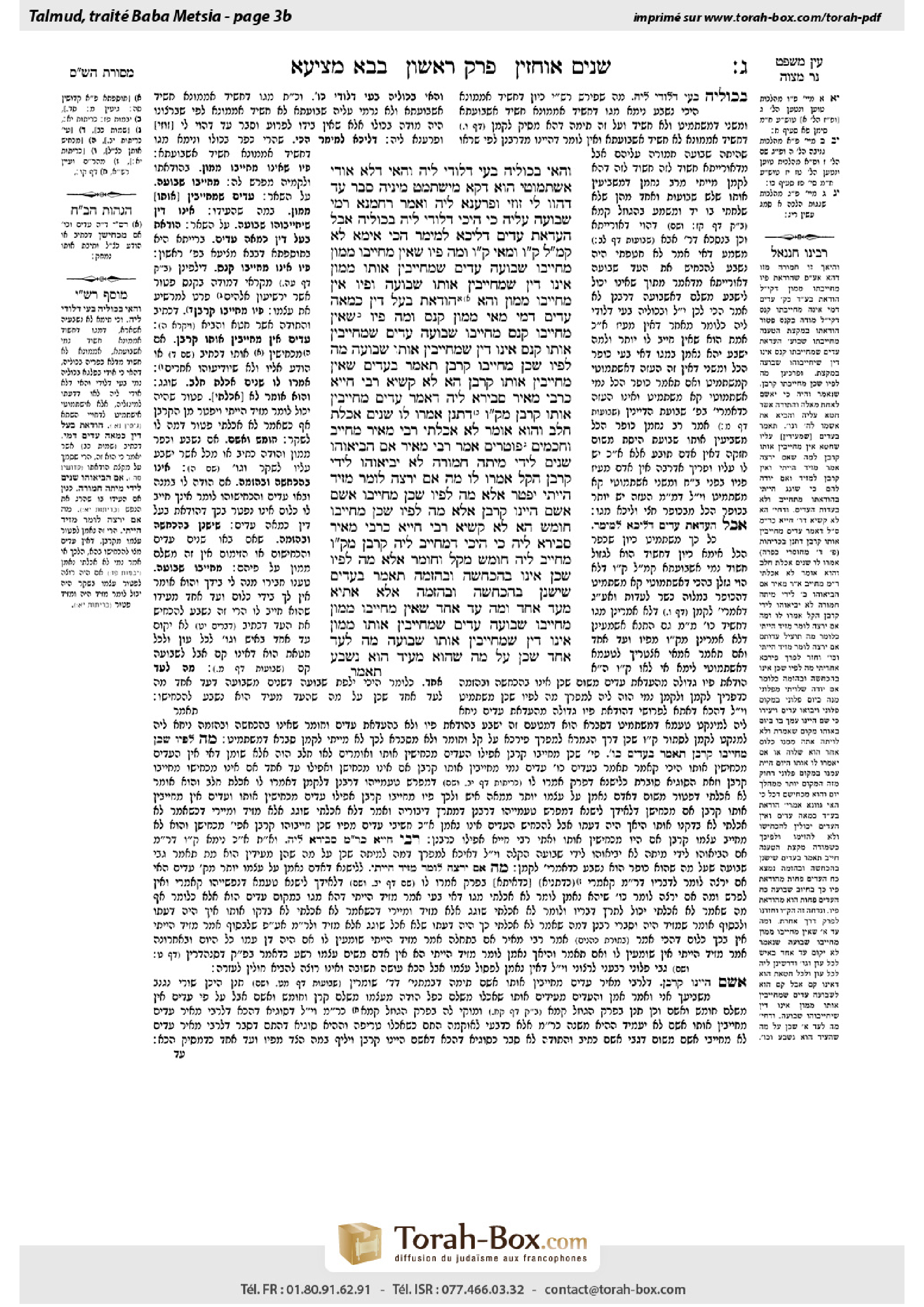
Bava Metzia 3b: Talmud study for Daf Yomi
Study the Talmud for Daf Yomi with scanned pages, Hebrew text, English translations from Sefaria and AI-generated French translations.
Passage selection and English or AI-generated French translation are available where the scan has annotations. Daf Study is independent of Torah-Box and Sefaria.
Browse Bava Metzia · בבא מציעא · All tractatesBava Metzia 3b text and translations
This page of Bava Metzia includes the Aramaic text, an English translation and an AI-generated French translation, alongside the scan above.
בבא מציעא ג׳ ב · Aramaic and Hebrew text
וְהַאי בְּכוּלֵּיהּ בָּעֵי דְּלוֹדֵי לֵיהּ. וְהַאי דְּלָא אוֹדִי – אִשְׁתְּמוֹטֵי הוּא דְּקָא מִישְׁתְּמֵט מִינֵּיהּ, סָבַר: עַד דְּהָווּ לִי זוּזִי וּפָרַעְנָא לֵיהּ, וְאָמַר רַחֲמָנָא: רְמִי שְׁבוּעָה עֲלֵיהּ כִּי הֵיכִי דְּלוֹדֵי לֵיהּ בְּכוּלֵּיהּ,
אֲבָל הַעֲדָאַת עֵדִים, דְּלֵיכָּא לְמֵימַר הָכִי – אֵימָא לָא. קָא מַשְׁמַע לַן קַל וָחוֹמֶר.
וּמַאי קַל וָחוֹמֶר? וּמָה פִּיו שֶׁאֵין מְחַיְּיבוֹ מָמוֹן – מְחַיְּיבוֹ שְׁבוּעָה, עֵדִים שֶׁמְּחַיְּיבִין אוֹתוֹ מָמוֹן – אֵינוֹ דִּין שֶׁמְּחַיְּיבִין אוֹתוֹ שְׁבוּעָה?
וּפִיו אֵין מְחַיְּיבוֹ מָמוֹן?! וְהָא הוֹדָאַת בַּעַל דִּין כְּמֵאָה עֵדִים דָּמֵי!
מַאי ״מָמוֹן״ – קְנָס. וּמָה פִּיו שֶׁאֵין מְחַיְּיבוֹ קְנָס, מְחַיְּיבוֹ שְׁבוּעָה! עֵדִים שֶׁמְּחַיְּיבִין אוֹתוֹ קְנָס, אֵינוֹ דִּין שֶׁמְּחַיְּיבִין אוֹתוֹ שְׁבוּעָה!
מָה לְפִיו – שֶׁכֵּן מְחַיְּיבוֹ קׇרְבָּן, תֹּאמַר בְּעֵדִים שֶׁאֵין מְחַיְּיבִין אוֹתוֹ קׇרְבָּן!
הָא לָא קַשְׁיָא: רַבִּי חִיָּיא כְּרַבִּי מֵאִיר סְבִירָא לֵיהּ, דְּאָמַר: עֵדִים מְחַיְּיבִין אוֹתוֹ קׇרְבָּן מִקַּל וָחוֹמֶר.
דִּתְנַן: אָמְרוּ לוֹ שְׁנַיִם ״אָכַלְתָּ חֵלֶב״, וְהוּא אוֹמֵר ״לֹא אָכַלְתִּי״, רַבִּי מֵאִיר מְחַיֵּיב, וַחֲכָמִים פּוֹטְרִים.
אָמַר רַבִּי מֵאִיר: אִם הֱבִיאוּהוּ שְׁנַיִם לִידֵי מִיתָה חֲמוּרָה, לֹא יְבִיאוּהוּ לִידֵי קׇרְבָּן הַקַּל? אָמְרוּ לוֹ: מָה אִם יִרְצֶה לוֹמַר ״מֵזִיד הָיִיתִי״ – יִפָּטֵר.
אֶלָּא: מָה לְפִיו – שֶׁכֵּן מְחַיְּיבוֹ אָשָׁם! אָשָׁם הַיְינוּ קׇרְבָּן.
אֶלָּא: מָה לְפִיו – שֶׁכֵּן מְחַיְּיבוֹ חוֹמֶשׁ. הָא לָא קַשְׁיָא, רַבִּי חִיָּיא כְּרַבִּי מֵאִיר סְבִירָא לֵיהּ, כִּי הֵיכִי דִּמְחַיֵּיב לֵיהּ קׇרְבָּן מִקַּל וָחוֹמֶר – מְחַיֵּיב לֵיהּ חוֹמֶשׁ מִקַּל וָחוֹמֶר.
אֶלָּא: מָה לְפִיו – שֶׁכֵּן אֵינוֹ בְּהַכְחָשָׁה וּבַהֲזָמָה, תֹּאמַר בְּעֵדִים שֶׁיֶּשְׁנָן בְּהַכְחָשָׁה וּבַהֲזָמָה.
אֶלָּא אָתְיָא מֵעֵד אֶחָד: וּמָה עֵד אֶחָד שֶׁאֵין מְחַיְּיבוֹ מָמוֹן, מְחַיְּיבוֹ שְׁבוּעָה – עֵדִים שֶׁמְּחַיְּיבִין אוֹתוֹ מָמוֹן, אֵינוֹ דִּין שֶׁמְּחַיְּיבִין אוֹתוֹ שְׁבוּעָה!
מָה לְעֵד אֶחָד שֶׁכֵּן עַל מָה שֶׁהוּא מֵעִיד הוּא נִשְׁבָּע,
Bava Metzia 3b · English translation
And in order not to exhibit insolence, this person wants to admit to the creditor with regard to all of the debt, and this fact that he denies owing him in part is because he reasons: If I admit to him with regard to all of the debt, he will lodge a claim against me with regard to all of it, and right now I do not have the money to pay. He was evading his creditor, and thought: I will continue doing so until I have money, and then I will pay him all of it. This rationalization enables one to falsely deny part of a claim. And therefore, the Merciful One states: Impose an oath on him, in order to ensure that he will admit to him with regard to all of the debt.
But in a case where the testimony of witnesses renders him liable to pay part of the debt, as one cannot say this explanation since this logic applies only when it is the debtor admitting to part of the claim, say that he has no intention to repay the debt at all, and he is completely dishonest and therefore his oath is worthless. Therefore, the baraita teaches us that the defendant’s obligation to take an oath is derived by means of an a fortiori inference.
The Gemara explains: And what is the explanation of this a fortiori inference? It should be explained as follows: If admitting to part of a claim by his own mouth, which does not render him liable to pay the money he admitted to owing, nevertheless obligates him to take an oath, with regard to the testimony of witnesses, which does render him liable to pay money, is it not logical that it should obligate him to take an oath with regard to the remaining sum?
The Gemara asks: But does the admission of his own mouth not render him liable to pay money? But isn’t the legal status of the admission of a litigant similar to that of one hundred witnesses?
The Gemara answers: What is the money that one is not liable to pay based on his own admission? It is referring to the payment of a fine [kenas]. In all cases where the Torah imposes a fine, if the defendant admits his liability voluntarily he is not required to pay it. Therefore, the a fortiori inference is as follows: If the admission of one’s own mouth, which does not render him liable to pay a fine, nevertheless renders him liable to take an oath with regard to the part of the claim to which he did not admit, with regard to the testimony of witnesses, which does render him liable to pay a fine, is it not logical that it should render him liable to take an oath with regard to the remaining sum?
The Gemara attempts to refute the inference: What is notable about the admission of one’s mouth? It is notable in that it renders him liable to bring an offering. One who admits that he transgressed a prohibition unwittingly is obligated to bring an offering for atonement. Would you say that the halakhot of admission apply with regard to the testimony of witnesses, which, in a case where they testify that one transgressed a prohibition, does not obligate him to bring an offering if he denies it?
The Gemara answers: This is not difficult. Rabbi Ḥiyya holds in accordance with the opinion of Rabbi Meir, who says that the testimony of witnesses renders him liable to bring an offering, based on an a fortiori inference.
As we learned in a mishna (Karetot 11b): If two witnesses say to a person: You ate forbidden fat, and he says: I did not eat it, Rabbi Meir deems him liable to bring an offering and the Rabbis deem him exempt from bringing an offering.
Rabbi Meir said to the Rabbis: If two witnesses can cause a person to receive the death penalty, which is a severe penalty, can they not also cause one to receive the light penalty of having to bring an offering? The Rabbis said to him: What if he would want to say: I sinned intentionally? Wouldn’t he be exempt? Since one does not bring an offering for an intentional sin, the testimony of witnesses has no bearing in this matter, as they cannot prove that his transgression was unwitting. Therefore, even if he claims that he did not sin at all, the testimony does not obligate him to bring an offering.
The Gemara suggests another refutation: Rather, what is notable about the admission of one’s mouth? It is notable in that it renders a robber liable to bring a guilt-offering. One who admits that he robbed another is required to bring a guilt-offering for atonement, whereas if witnesses testify that he robbed another he is not obligated to bring a guilt-offering. The Gemara answers: A guilt-offering is the same as any other offering, about which there is a dispute between Rabbi Meir and the Rabbis as to whether the testimony of witnesses renders one liable to bring an offering.
The Gemara suggests another refutation: Rather, what is notable about the admission of one’s mouth? It is notable in that it renders one who unlawfully possessed the money of another liable to pay an additional one-fifth of the value of that money when he returns it of his own accord (see Leviticus 5:20–26). By contrast, if witnesses testify that he unlawfully possessed the money of another, he is not obligated to add one-fifth to his payment. The Gemara answers: This is not difficult; Rabbi Ḥiyya holds in accordance with the opinion of Rabbi Meir. Just as Rabbi Meir holds that the testimony of witnesses renders one liable to bring an offering due to an a fortiori inference, he also holds that the testimony of witnesses renders one liable to add one-fifth, via an a fortiori inference.
The Gemara suggests another refutation: Rather, what is notable about the admission of one’s mouth? It is notable in that it is not subject to contradiction or to refutation as applies to the testimony of conspiring witnesses, as the testimony of witnesses cannot negate the admission of a litigant. Would you say the same halakhot with regard to witnesses, who are subject to contradiction and to refutation as conspiring witnesses? Evidently, the testimony of witnesses is weaker, in some aspects, than the admission of a litigant.
Rather, Rabbi Ḥiyya’s a fortiori inference is apparently derived from the halakha of the testimony of one witness. If the testimony of one witness, which does not render the defendant liable to pay money, obligates him to take an oath to contradict the testimony, is it not logical that the testimony of two witnesses, which render one liable to pay money, also obligates him to take an oath?
The Gemara rejects this inference: What is notable about the testimony of one witness? It is notable in that the defendant takes an oath with regard to the matter concerning which he testifies, not with regard to other claims raised by the claimant.
Bava Metzia 3b · Traduction française (IA)
Et afin de ne pas montrer de hauteur, cette personne veut avouer à son créancier concernant toute la dette, et ce fait qu'il nie d'emblée une partie de la dette est dû à ce qu'il raisonne ainsi : Si je lui avoue concernant toute la dette, il portera une action contre moi concernant toute la somme, et en ce moment je n'ai pas l'argent pour payer. Il fuyait son créancier et pensait : Je continuerai ainsi jusqu'à ce que j'aie de l'argent, et alors je lui paierai toute la somme. Cette justification permet à une personne de mentir en niant partiellement une réclamation. Et donc, le Très Haut dit : Imposons-lui un serment, afin de garantir qu'il avouera à son créancier concernant toute la dette.
Mais dans un cas où le témoignage des témoins rend le débiteur responsable de payer une partie de la dette, comme on ne peut pas dire cette explication, puisque cette logique s'applique uniquement lorsque c'est le débiteur qui avoue une partie de la réclamation, disons qu'il n'a pas l'intention de rembourser la dette du tout, et qu'il est totalement menteur, et donc son serment est inutile. Ainsi, la baraïta nous enseigne que l'obligation du défendeur de prendre un serment est dérivée par une inférence a fortiori.
La Guemara explique : Et quelle est l'explication de cette inférence a fortiori ? Elle devrait être expliquée ainsi : Si l'avouement de sa propre bouche, qui ne rend pas le débiteur responsable de payer la somme qu'il a avoué de devoir, n'oblige cependant pas à prendre un serment, avec le témoignage des témoins, qui rend le débiteur responsable de payer de l'argent, n'est-il pas logique qu'il doive être obligé de prendre un serment concernant la somme restante ?
La Guemara pose la question : Mais ne rend pas l'avouement de sa propre bouche le débiteur responsable de payer de l'argent ? Mais n'est-ce pas que le statut juridique de l'avouement d'un litige est similaire à celui de cent témoins ?
La Guemara répond : Quel est l'argent que l'on n'est pas tenu de payer en vertu de son propre avouement ? Il s'agit de la somme d'une amende [kenas]. Dans tous les cas où la Torah impose une amende, si le défendeur avoue volontairement sa responsabilité, il n'est pas tenu de la payer. Ainsi, l'inférence a fortiori est la suivante : Si l'avouement de sa propre bouche, qui ne rend pas le débiteur responsable d'une amende, n'oblige cependant pas à prendre un serment concernant la partie de la réclamation à laquelle il n'a pas avoué, avec le témoignage des témoins, qui rend le débiteur responsable d'une amende, n'est-il pas logique qu'il doive être obligé de prendre un serment concernant la somme restante ?
La Guemara tente de réfuter cette inférence : Qu'est-ce qui est notable dans l'avouement de sa propre bouche ? C'est qu'il rend le débiteur responsable de présenter un sacrifice. Celui qui avoue qu'il a transgressé une interdiction sans le vouloir est tenu de présenter un sacrifice pour l'atonement. Dirait-on que les halakhot de l'avouement s'appliquent concernant le témoignage des témoins, qui, dans le cas où ils témoignent qu'une personne a transgressé une interdiction, ne rendent pas le débiteur responsable de présenter un sacrifice s'il le nie ?
La Guemara répond : Ce n'est pas difficile. Rabbi Ḥiyya suit l'opinion de Rabbi Meir, qui affirme que le témoignage des témoins rend le débiteur responsable de présenter un sacrifice, selon une inférence a fortiori.
Comme nous l'avons appris dans une Michna (Karetot 11b) : Si deux témoins disent à une personne : Tu as mangé de la graisse interdite, et il répond : Je n'ai pas mangé cela, Rabbi Meir considère qu'il est tenu de présenter un sacrifice et les Rabbins considèrent qu'il est exempt de présenter un sacrifice.
Rabbi Meir dit aux Rabbins : Si deux témoins peuvent causer à une personne de recevoir la peine de mort, qui est une peine grave, ne peuvent-ils pas aussi causer une peine légère, celle de présenter un sacrifice ? Les Rabbins lui répondent : Et si il voulait dire : J'ai péché intentionnellement ? Ne serait-il pas exempt ? Puisque l'on ne présente pas un sacrifice pour un péché intentionnel, le témoignage des témoins n'a pas d'effet dans ce cas, car ils ne peuvent pas prouver que sa transgression était involontaire. Ainsi, même s'il affirme qu'il n'a pas péché du tout, le témoignage ne l'oblige pas à présenter un sacrifice.
La Guemara suggère une autre réfutation : Plutôt, qu'est-ce qui est notable dans l'avouement de sa propre bouche ? C'est qu'il rend un voleur responsable de présenter un sacrifice de culpabilité. Celui qui avoue qu'il a volé un autre est tenu de présenter un sacrifice de culpabilité pour l'atonement, tandis que si des témoins témoignent qu'il a volé un autre, il n'est pas tenu de présenter un sacrifice de culpabilité. La Guemara répond : Un sacrifice de culpabilité est le même qu'un autre sacrifice, concernant lequel il y a un débat entre Rabbi Meir et les Rabbins sur le fait que le témoignage des témoins rende une personne responsable de présenter un sacrifice.
La Guemara suggère une autre réfutation : Plutôt, qu'est-ce qui est notable dans l'avouement de sa propre bouche ? C'est qu'il rend celui qui a illégalement possédé les biens d'autrui responsable de payer une somme supplémentaire égale à un cinquième de la valeur de ces biens lorsqu'il les rend de son propre chef (voir Lévitique 5:20–26). En revanche, si des témoins témoignent qu'il a illégalement possédé les biens d'autrui, il n'est pas tenu d'ajouter un cinquième à son paiement. La Guemara répond : Ce n'est pas difficile ; Rabbi Ḥiyya suit l'opinion de Rabbi Meir. Tout comme Rabbi Meir considère que le témoignage des témoins rend une personne responsable de présenter un sacrifice grâce à une inférence a fortiori, il considère également que le témoignage des témoins rend une personne responsable d'ajouter un cinquième, grâce à une inférence a fortiori.
La Guemara suggère une autre réfutation : Plutôt, qu'est-ce qui est notable dans l'avouement de sa propre bouche ? C'est qu'il n'est pas soumis à la contradiction ou à la réfutation comme les témoins conspirateurs, car le témoignage des témoins ne peut pas annuler l'avouement d'un litige. Dirait-on la même chose concernant les témoins, qui sont soumis à la contradiction et à la réfutation comme les témoins conspirateurs ? Évidemment, le témoignage des témoins est plus faible, en certains aspects, que l'avouement d'un litige.
Plutôt, l'inférence a fortiori du Rabbi Ḥiyya semble être tirée de la halakha concernant le témoignage d'un seul témoin. Si le témoignage d'un seul témoin, qui ne rend pas le défendeur responsable de paiement, l'oblige à jurer pour contester ce témoignage, n'est-il pas logique que le témoignage de deux témoins, qui rendent le défendeur responsable de paiement, l'oblige également à jurer ?
La Guemara rejette cette inférence : Qu'est-ce qui est notable dans le témoignage d'un seul témoin ? C'est notable dans le fait que le défendeur jure concernant la matière sur laquelle il témoigne, et non concernant d'autres revendications évoquées par le plaignant.
Traduction française générée par IA à partir de l’édition anglaise de Sefaria. Vérifie toujours un passage avec le texte source.
Text from Sefaria: William Davidson Edition - Vocalized Aramaic (CC BY NC); William Davidson Edition - English (CC BY NC).