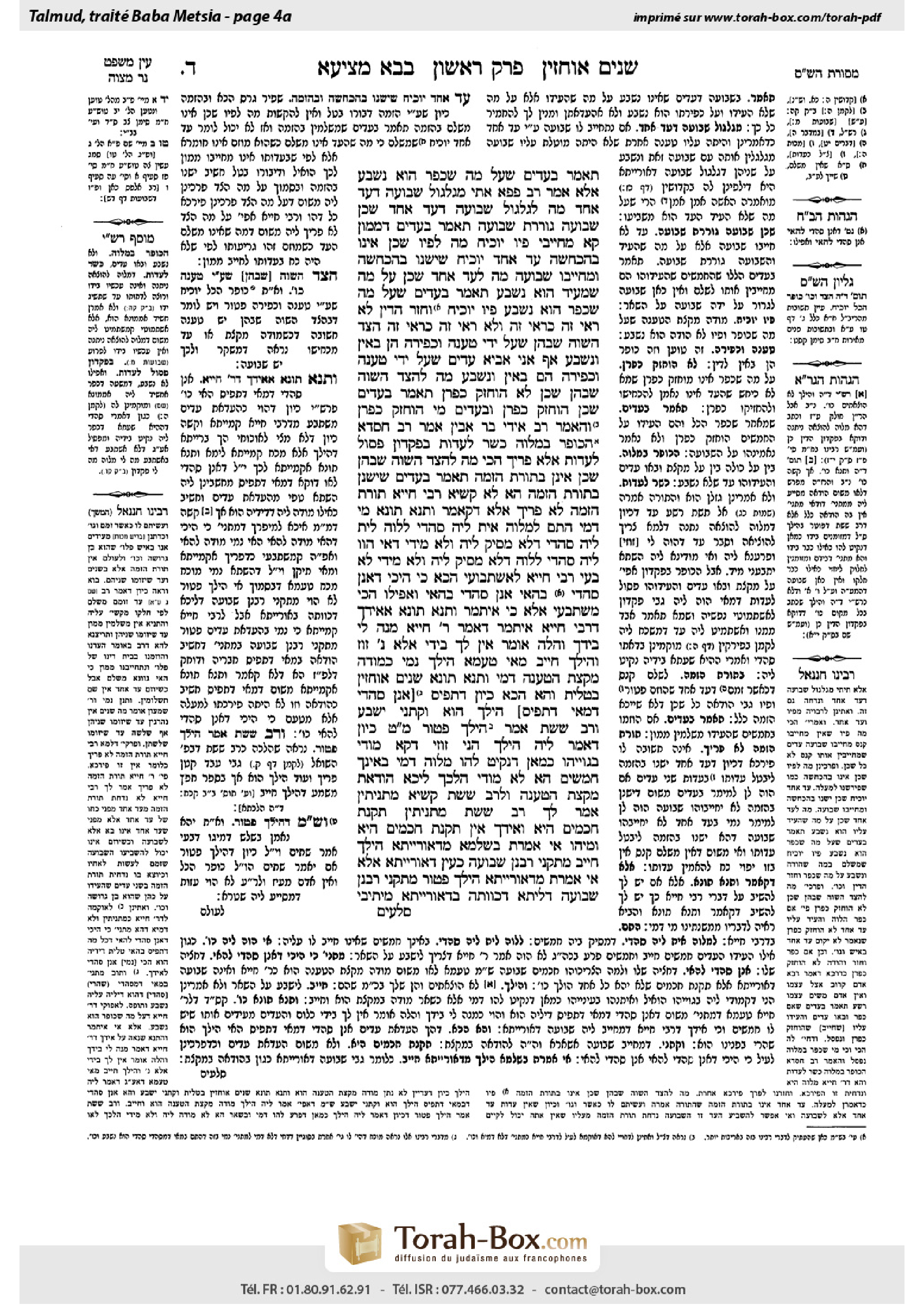
Bava Metzia 4a: Talmud study for Daf Yomi
Study the Talmud for Daf Yomi with scanned pages, Hebrew text, English translations from Sefaria and AI-generated French translations.
Passage selection and English or AI-generated French translation are available where the scan has annotations. Daf Study is independent of Torah-Box and Sefaria.
Browse Bava Metzia · בבא מציעא · All tractatesBava Metzia 4a text and translations
This page of Bava Metzia includes the Aramaic text, an English translation and an AI-generated French translation, alongside the scan above.
בבא מציעא ד׳ א · Aramaic and Hebrew text
תֹּאמַר בְּעֵדִים, שֶׁעַל מַה שֶּׁכָּפַר הוּא נִשְׁבָּע.
אֶלָּא אָמַר רַב פָּפָּא: אָתֵי מִגִּלְגּוּל שְׁבוּעָה דְּעֵד אֶחָד.
מָה לְגִלְגּוּל שְׁבוּעָה דְּעֵד אֶחָד, שֶׁכֵּן שְׁבוּעָה גּוֹרֶרֶת שְׁבוּעָה, תֹּאמַר בְּעֵדִים – דְּמָמוֹן קָא מְחַיְּיבִי!
פִּיו יוֹכִיחַ. מָה לְפִיו שֶׁכֵּן אֵינוֹ בְּהַכְחָשָׁה – עֵד אֶחָד יוֹכִיחַ שֶׁיֶּשְׁנוֹ בְּהַכְחָשָׁה וּמְחַיְּיבוֹ שְׁבוּעָה.
מָה לְעֵד אֶחָד, שֶׁכֵּן עַל מַה שֶּׁמֵּעִיד הוּא נִשְׁבָּע, תֹּאמַר בְּעֵדִים – שֶׁעַל מַה שֶּׁכָּפַר הוּא נִשְׁבָּע! פִּיו יוֹכִיחַ.
וְחָזַר הַדִּין: לֹא רְאִי זֶה כִּרְאִי זֶה, וְלֹא רְאִי זֶה כִּרְאִי זֶה. הַצַּד הַשָּׁוֶה שֶׁבָּהֶן שֶׁעַל יְדֵי טַעֲנָה וּכְפִירָה הֵן בָּאִין, וְנִשְׁבָּע. אַף אֲנִי אָבִיא עֵדִים, שֶׁעַל יְדֵי טַעֲנָה וּכְפִירָה הֵם בָּאִין – וְנִשְׁבָּע.
מָה לְהַצַּד הַשָּׁוֶה שֶׁבָּהֶן, שֶׁכֵּן לֹא הוּחְזַק כַּפְרָן. תֹּאמַר בְּעֵדִים שֶׁכֵּן הוּחְזַק כַּפְרָן.
וּבְעֵדִים מִי הוּחְזַק כַּפְרָן! וְהָאָמַר רַב אִידִי בַּר אָבִין אָמַר רַב חִסְדָּא: הַכּוֹפֵר בְּמִלְוֶה – כָּשֵׁר לְעֵדוּת. בְּפִיקָּדוֹן – פָּסוּל לְעֵדוּת.
אֶלָּא פָּרֵיךְ הָכִי: מָה לְהַצַּד הַשָּׁוֶה שֶׁבָּהֶן – שֶׁכֵּן אֵינָן בְּתוֹרַת הֲזָמָה, תֹּאמַר בְּעֵדִים שֶׁיֶּשְׁנָן בְּתוֹרַת הֲזָמָה!
הָא לָא קַשְׁיָא: רַבִּי חִיָּיא תּוֹרַת הֲזָמָה לָא פָּרֵיךְ.
אֶלָּא דְּקָאָמַר וְתַנָּא תּוּנָא מִי דָּמֵי? הָתָם לְמַלְוֶה אִית לֵיהּ סָהֲדֵי, לְלֹוֶה לֵית לֵיהּ סָהֲדֵי דְּלָא מַסֵּיק לֵיהּ וְלָא מִידֵּי, דְּאִי הֲווֹ לֵיהּ סָהֲדֵי לְלֹוֶה דְּלָא מַסֵּיק לֵיהּ וְלָא מִידֵּי – לָא בָּעֵי רַבִּי חִיָּיא לְאִשְׁתְּבוֹעֵי, הָכָא כִּי הֵיכִי דַּאֲנַן סָהֲדֵי בְּהַאי – אֲנַן סָהֲדֵי בְּהַאי, וַאֲפִילּוּ הָכִי מִשְׁתַּבְעִי!
אֶלָּא כִּי אִיתְּמַר ״וְתַנָּא תּוּנָא״ – אַאִידַּךְ דְּרַבִּי חִיָּיא אִיתְּמַר, דְּאָמַר רַבִּי חִיָּיא: ״מָנֶה לִי בְּיָדְךָ״ וְהַלָּה אוֹמֵר: ״אֵין לְךָ בְּיָדִי אֶלָּא חֲמִישִּׁים זוּז, וְהֵילָךְ״ – חַיָּיב.
מַאי טַעְמָא – ״הֵילָךְ״ נָמֵי כְּמוֹדֶה מִקְצָת הַטְּעָנָה דָּמֵי.
וְתַנָּא תּוּנָא: שְׁנַיִם אוֹחֲזִין בְּטַלִּית.
וְהָא הָכָא, כֵּיוָן דְּתָפֵיס – אֲנַן סָהֲדֵי דְּמַאי דְּתָפֵיס הֵילָךְ הוּא, וְקָתָנֵי: יִשָּׁבַע.
וְרַב שֵׁשֶׁת אָמַר ״הֵילָךְ פָּטוּר״. מַאי טַעְמָא? כֵּיוָן דְּאָמַר לֵיהּ ״הֵילָךְ״, הָנֵי זוּזִי דְּקָא מוֹדֵי בְּגַוַּיְיהוּ – כְּמַאן דְּנָקֵיט לְהוּ מַלְוֶה דָּמֵי. בְּאִינָךְ חֲמִשִּׁים הָא לָא מוֹדֵי, הִלְכָּךְ לֵיכָּא הוֹדָאַת מִקְצָת הַטְּעָנָה.
וּלְרַב שֵׁשֶׁת קַשְׁיָא מַתְנִיתִין! אָמַר לְךָ רַב שֵׁשֶׁת: מַתְנִיתִין תַּקָּנַת חֲכָמִים הִיא.
וְאִידַּךְ? אִין תַּקָּנַת חֲכָמִים הִיא. וּמִיהוּ, אִי אָמְרַתְּ בִּשְׁלָמָא מִדְּאוֹרָיְיתָא ״הֵילָךְ״ חַיָּיב – מְתַקְּנִי רַבָּנַן שְׁבוּעָה כְּעֵין דְּאוֹרָיְיתָא, אֶלָּא אִי אָמְרַתְּ מִדְּאוֹרָיְיתָא ״הֵילָךְ״ פָּטוּר – מְתַקְּנִי רַבָּנַן שְׁבוּעָה דְּלֵיתָא דִּכְווֹתַהּ בִּדְאוֹרָיְיתָא?
מֵיתִיבִי:
Bava Metzia 4a · English translation
Would you say the same with regard to two witnesses, in which case the defendant takes an oath with regard to the claim that he denies, and not with regard to the debt about which they testify?
Rather, Rav Pappa said: Rabbi Ḥiyya’s a fortiori inference is derived from the extension of an oath that the testimony of one witness obligates him to take. Once a defendant is obligated to take an oath, the plaintiff can demand that he take an oath with regard to other claims that he has against him as well.
The Gemara rejects this: What is notable about the extension of an oath that is obligated by the testimony of one witness? It is notable in that one oath leads to another oath. The obligation to take the second oath is not caused directly by the witness. Would you say the same in the case of witnesses, whose testimony renders the defendant liable to pay money? Incurring liability to pay one part of the claim does not extend further and incur liability to pay the rest.
The Gemara responds: The admission of one’s mouth can prove that an element other than an oath can cause the defendant to be obligated to take an oath with regard to the rest of the claim. Although the a fortiori inference from admission alone was already rejected, due to the claim of: What is notable about the admission of one’s mouth, it is notable in that it is not subject to contradiction; the testimony of one witness can prove that even testimony that is subject to contradiction renders one liable to take an oath.
The a fortiori inference from the testimony of one witness was also rejected, as what is notable about the extension of an oath resulting from the testimony of one witness? It is notable in that the defendant takes an oath with regard to the matter concerning that which he testifies. Would you say the same with regard to two witnesses, in which case the defendant takes an oath with regard to the claim that he denies? Admission to part of a claim by one’s mouth can prove this difference irrelevant, as a defendant can be required to take an oath even with regard to a claim that he denies.
And the derivation has reverted to its starting point. At this point, the halakha is derived from a combination of the two sources: The aspect of this case, admission, is not like the aspect of that case, the extension of an oath resulting from the testimony of one witness, and the aspect of that case is not like the aspect of this case. Their common denominator is that these cases come before the court with a claim and its denial, and the defendant is obligated to take an oath. I will also include in the obligation to take an oath the case of Rabbi Ḥiyya, where there is testimony of two witnesses about part of the debt, which comes before the court with a claim and its denial. And therefore the defendant is obligated to take an oath. This is the inference to which Rabbi Ḥiyya was referring.
The Gemara rejects this: What is notable about their common denominator, i.e., the common denominator shared by admission to part of a claim by the defendant and the extension of an oath resulting from the testimony of one witness? It is notable in that the defendant does not assume the presumptive status of one who falsely denies his debts. He has not been proven to be lying, so he is trusted to take an oath. Would you say the same with regard to the case of two witnesses who contradict the defendant’s denial of the plaintiff’s claim, where the defendant assumes the presumptive status of one who falsely denies his debts? In this case, he is no longer deemed trustworthy and his oath may not be credible.
The Gemara asks: But in a case where his denial is contradicted by two witnesses, does he assume the presumptive status of one who falsely denies his debts? But doesn’t Rav Idi bar Avin say that Rav Ḥisda says: One who denies a claim that he received a loan and is contradicted by witnesses is fit to bear witness in a different case. He does not assume the status of a confirmed liar, as perhaps he intended to return the money afterward and denied the claim only in order to buy time until he acquired the necessary funds to repay the loan. By contrast, if one denies receiving a deposit and witnesses testify that he is lying, he is disqualified from bearing witness in other cases, as in that case he has no reason to buy time and is clearly a robber. Therefore, Rabbi Ḥiyya’s a fortiori inference stands.
Rather, refute the inference like this: What is notable about their common denominator, i.e., the common denominator shared by admission to part of a claim by the defendant and the extension of an oath resulting from the testimony of one witness? It is notable in that these cases are not subject to the halakhot of conspiring witnesses. Even if witnesses testify that the single witness lied, he is not required to pay the defendant the sum that he sought to require him to pay, which is the punishment exacted upon conspiring witnesses. Would you say the same halakhot with regard to two witnesses, who are subject to the halakhot of conspiring witnesses?
The Gemara rejects this: This is not difficult, as Rabbi Ḥiyya does not refute this inference based on the punishment accompanying the halakhot of conspiring witnesses. In other words, Rabbi Ḥiyya does not accept this refutation, as while this halakha does not apply at all to the admission of a defendant, it does apply to the testimony of a single witness in that if two witnesses testify that the single witness is a conspiring witness, his testimony is rendered void.
The Gemara asks: But with regard to that which was stated (3a): And the tanna of the mishna also taught a similar halakha to that of Rabbi Ḥiyya, there is a difficulty. Is the case of the mishna comparable to the halakha of Rabbi Ḥiyya? There, in the case of witnesses to a loan, the creditor has witnesses to support his claim that there was a loan while the debtor does not have witnesses to support his claim that he does not owe the creditor anything. As, if the debtor had witnesses to support his claim that he does not owe the creditor anything, Rabbi Ḥiyya would not require him to take an oath. By contrast, here, in the case of the mishna, just as it is clear to us that this claimant has a right to the garment, as he is holding it, so too, is it clear to us that that other claimant has a right to the garment, as he is also holding it. Yet nevertheless, in the mishna each party is required to take an oath.
Rather, when the phrase was stated: And the tanna of the mishna also taught a similar halakha, it was stated with regard to another statement of Rabbi Ḥiyya. As Rabbi Ḥiyya says: If one says to another: I have one hundred dinars in your possession, and the other says in response: You have only fifty dinars in my possession, and here you are, handing him the money, he is obligated to take an oath that he does not owe the remainder.
What is the reason? One who says: Here you are, while immediately giving the money, is also considered like one who admits to part of the claim. It cannot be reasoned that by immediately handing over the amount to which he admits, the defendant thereby reduces the claim by the fifty dinars that he denies owing, and he is consequently exempt from taking an oath like any defendant who denies the claim entirely.
Concerning this ruling of Rabbi Ḥiyya, the Gemara comments: And the tanna of the mishna taught a similar halakha, citing the mishna beginning: If two people came to court holding a garment.
The Gemara explains the comparison: And here, in the mishna, since each one grasps half the garment, it is clear to us that what one grasps is in his possession, just as if the other one had said to him: Here you are, I am giving it to you. And the mishna teaches that he takes an oath. Evidently, in a case where one denies part of a claim that is brought against him, and with regard to the rest of the claim he says to the claimant: Here you are, he is obligated to take an oath.
And Rav Sheshet says: One who says about part of the claim: Here you are, and denies the rest of the claim, is exempt from taking an oath about the rest. What is the reason? Since he said to him: Here you are, those dinars that he admitted to owing are considered as if the creditor has them in his possession already, and with regard to the other fifty dinars, the defendant did not admit to owing them. Therefore, there is no admission to part of the claim.
The Gemara asks: But according to the opinion of Rav Sheshet, the mishna is difficult, as it seems to be a comparable case and yet an oath is required. The Gemara answers: Rav Sheshet could have said to you: The oath mentioned in the mishna is a rabbinic ordinance, which pertains specifically to that case. In general, a debtor who immediately hands over the money that he admits to owing is exempt from taking an oath.
And how would the other amora, Rabbi Ḥiyya, respond to this assertion? Indeed, he would agree that it is a rabbinic ordinance. However, granted, if you say that by Torah law one who says: Here you are, is obligated to take an oath, that explains why the Sages instituted the oath mentioned in the mishna, as it is similar to an oath administered by Torah law. But if you say that by Torah law one who says: Here you are, is exempt from taking an oath, would the Sages institute an oath that has no corresponding oath in Torah law? Clearly, there is a basis for the oath instituted by the Sages in Torah law, and that basis is the case where the defendant says: Here you are.
The Gemara raises an objection to the opinion of Rabbi Ḥiyya from a baraita:
Bava Metzia 4a · Traduction française (IA)
Diraites-vous la même chose dans le cas de deux témoins, dans lequel cas le défendeur prend un serment concernant la revendication qu'il nie, et non concernant la dette à laquelle ils témoignent ?
Plutôt, Rav Pappa a dit : L'inférence a fortiori de Rabbi Ḥiyya est tirée de l'extension du serment que le témoignage d'un seul témoins impose. Une fois que le défendeur est tenu de prendre un serment, le plaignant peut exiger qu'il prenne un serment concernant d'autres revendications qu'il a contre lui également.
La Guemara rejette cela : Qu'est-ce qui est notable dans l'extension du serment qui est imposé par le témoignage d'un seul témoins ? C'est notable dans le fait qu'un serment entraîne un autre serment. L'obligation de prendre le second serment n'est pas causée directement par le témoignage. Dirait-on la même chose dans le cas de témoins, dont le témoignage rend le défendeur responsable de payer de l'argent ? L'incurrence de responsabilité de payer une partie de la revendication ne s'étend pas davantage et ne rend pas responsable de payer le reste.
La Guemara répond : L'admission de la bouche peut prouver que l'élément autre qu'un serment peut rendre le défendeur tenu de prendre un serment concernant le reste de la revendication. Bien que l'inférence a fortiori à partir de l'admission seule ait déjà été rejetée, en raison de la question : Qu'est-ce qui est notable dans l'admission de la bouche ? C'est notable dans le fait qu'elle n'est pas sujette à contradiction ; le témoignage d'un seul témoin peut prouver que même un témoignage sujette à contradiction rend l'individu responsable de prendre un serment.
L'inférence a fortiori à partir du témoignage d'un seul témoin a également été rejetée, car qu'est-ce qui est notable dans l'extension du serment résultant du témoignage d'un seul témoin ? C'est notable dans le fait que le défendeur prend un serment concernant la matière concernant laquelle il témoigne. Dirait-on la même chose dans le cas de deux témoins, dans lequel cas le défendeur prend un serment concernant la revendication qu'il nie ? L'admission à une partie d'une revendication par la bouche peut prouver que cette différence est insignifiante, car un défendeur peut être tenu de prendre un serment même concernant une revendication qu'il nie.
Et la déduction est retournée à son point de départ. À ce point, la halakha est déduite d'une combinaison des deux sources : L'aspect de ce cas, l'admission, n'est pas comme l'aspect de l'autre cas, l'extension du serment résultant du témoignage d'un seul témoin, et l'aspect de l'autre cas n'est pas comme l'aspect de ce cas. Leur point commun est que ces cas viennent devant le tribunal avec une revendication et sa négation, et le défendeur est tenu de prendre un serment. Je vais également inclure dans l'obligation de prendre un serment le cas de Rabbi Ḥiyya, où il y a témoignage de deux témoins concernant une partie de la dette, qui vient devant le tribunal avec une revendication et sa négation. Et donc le défendeur est tenu de prendre un serment. C'est l'inférence à laquelle Rabbi Ḥiyya faisait référence.
La Guemara rejette cela : Qu'est-ce qui est notable dans leur point commun, c'est-à-dire le point commun partagé par l'admission à une partie d'une revendication par le défendeur et l'extension du serment résultant du témoignage d'un seul témoin ? C'est notable dans le fait que le défendeur ne prend pas le statut présomptif de celui qui ment sur ses dettes. Il n'a pas été prouvé qu'il ment, donc il est considéré comme digne de confiance pour prendre un serment. Dirait-on la même chose dans le cas de deux témoins qui contredisent la négation du défendeur de la revendication du plaignant, où le défendeur prend le statut présomptif de celui qui ment sur ses dettes ? Dans ce cas, il n'est plus considéré comme digne de confiance et son serment peut ne pas être crédible.
La Guemara pose la question : Mais dans un cas où sa négation est contredite par deux témoins, assume-t-il le statut présomptif de celui qui ment sur ses dettes ? Mais ne dit-il pas Rav Idi bar Avin que Rav Ḥisda dit : Celui qui nie une revendication qu'il a reçu un prêt et est contredit par des témoins est digne de témoigner dans un autre cas. Il ne prend pas le statut de menteur confirmé, car peut-être il avait l'intention de rendre l'argent plus tard et a nié la revendication uniquement pour gagner du temps jusqu'à ce qu'il ait acquis les fonds nécessaires pour rembourser le prêt. À l'inverse, si l'on nie avoir reçu un dépôt et que des témoins témoignent qu'il ment, il est disqualifié pour témoigner dans d'autres cas, car dans ce cas il n'a pas de raison de gagner du temps et est clairement un voleur. Par conséquent, l'inférence a fortiori de Rabbi Ḥiyya tient.
Plutôt, réfutez l'inférence ainsi : Qu'est-ce qui est remarquable dans leur point commun, c'est-à-dire le point commun partagé par l'admission d'une part d'une réclamation par le défendeur et l'extension du serment issu du témoignage d'un seul témoin ? C'est remarquable dans le fait que ces cas ne sont pas soumis aux halakhot des témoins conjurés. Même si des témoins affirment que le seul témoin ment, il n'est pas requis de payer au défendeur la somme qu'il souhaitait l'exiger, qui est la punition infligée aux témoins conjurés. Dirait-on la même chose concernant deux témoins, qui sont soumis aux halakhot des témoins conjurés ?
La Guemara rejette cela : Ce n'est pas difficile, car Rabbi Ḥiyya ne réfute pas cette inférence en se basant sur la punition liée aux halakhot des témoins conjurés. En d'autres termes, Rabbi Ḥiyya ne considère pas cette réfutation comme valable, car bien que cette halakha ne s'applique pas du tout à l'admission du défendeur, elle s'applique au témoignage d'un seul témoin dans la mesure où, si deux témoins affirment que le seul témoin est un témoin conjuré, son témoignage est annulé.
Le Guemara pose la question : Mais concernant ce qui a été dit (3a) : Et le tanna de la mitsva a également enseigné une halakha similaire à celle de Rabbi Ḥiyya, il y a une difficulté. La situation de la mitsva est-elle comparable à la halakha de Rabbi Ḥiyya ? Là, dans le cas des témoins d'un prêt, le créancier a des témoins pour soutenir sa revendication selon laquelle il y a eu un prêt, tandis que le débiteur n'a pas de témoins pour soutenir sa revendication selon laquelle il ne doit rien au créancier. En effet, si le débiteur avait des témoins pour soutenir sa revendication selon laquelle il ne doit rien au créancier, Rabbi Ḥiyya n'aurait pas exigé qu'il prenne serment. À l'inverse, ici, dans le cas de la mitsva, tout comme nous savons clairement que ce demandeur a le droit à la robe, puisqu'il la tient, de même savons-nous clairement que l'autre demandeur a le droit à la robe, puisqu'il la tient également. Pourtant, malgré cela, dans la mitsva, chaque partie est tenue de prendre serment.
Plutôt, lorsque la phrase a été dite : Et le tanna de la mitsva a également enseigné une halakha similaire, cela a été dit concernant une autre déclaration de Rabbi Ḥiyya. Car Rabbi Ḥiyya dit : Si l'un dit à l'autre : J'ai cent dinars à votre possession, et l'autre répond : Vous avez seulement cinquante dinars à ma possession, et ici vous voilà, lui donnant l'argent, il est tenu de prendre serment qu'il ne doit pas le reste.
Quelle est la raison ? Celui qui dit : Ici vous voilà, tout en donnant immédiatement l'argent, est considéré comme celui qui admet partiellement la revendication. On ne peut pas raisonner que, en donnant immédiatement la somme à laquelle il admet, le défendeur réduit ainsi la revendication de cinquante dinars qu'il nie de devoir, et il est donc exempt de prendre serment comme tout défendeur qui nie entièrement la revendication.
Concernant cette décision de Rabbi Ḥiyya, le Guemara commente : Et le tanna de la mitsna a enseigné une halakha similaire, en citant la mitsna qui commence par : Si deux personnes viennent devant le tribunal avec une robe.
Le Guemara explique la comparaison : Et ici, dans la mitsna, puisque chacun saisit la moitié de la robe, nous savons clairement que ce que l'un saisit est à sa possession, tout comme si l'autre avait dit à lui : Ici vous voilà, je vous la donne. Et la mitsna enseigne qu'il prend serment. Évidemment, dans un cas où l'un nie une partie d'une revendication portée contre lui et, concernant le reste de la revendication, il dit à l'individu : Ici vous voilà, il est tenu de prendre serment.
Et Rav Sheshet dit : Celui qui dit concernant une partie de la revendication : Ici vous voilà, et nie la reste de la revendication, est exempt de prendre serment concernant la reste. Quelle est la raison ? Parce que, lorsqu'il dit à lui : Ici vous voilà, ces dinars qu'il admet de devoir sont considérés comme si le créancier les avait déjà en sa possession, et concernant les autres cinquante dinars, le défendeur n'a pas admis de les devoir. Ainsi, il n'y a pas d'admission à une partie de la revendication.
Le Guemara pose la question : Mais selon l'opinion de Rav Sheshet, la mitsna est difficile, car elle semble être un cas comparable et pourtant un serment est requis. Le Guemara répond : Rav Sheshet aurait pu dire à vous : Le serment mentionné dans la mitsna est un ordonnance rabbinique, qui concerne spécifiquement ce cas. En général, un débiteur qui remet immédiatement l'argent qu'il admet de devoir est exempt de prendre serment.
Et comment l'autre amora, Rabbi Ḥiyya, répondrait-il à cette affirmation ? En effet, il serait d'accord que c'est une ordonnance rabbinique. Cependant, en admettant que, selon la loi divine, celui qui dit : Ici vous voilà, est tenu de prendre serment, cela explique pourquoi les Sages ont institué le serment mentionné dans la mitsna, car il est similaire à un serment administré par la loi divine. Mais si vous dites que, selon la loi divine, celui qui dit : Ici vous voilà, est exempt de prendre serment, serait-ce que les Sages institueraient un serment qui n'a pas de corollaire dans la loi divine ? Évidemment, il y a une base pour le serment institué par les Sages dans la loi divine, et cette base est le cas où le défendeur dit : Ici vous voilà.
Le Guemara soulève une objection contre l'opinion de Rabbi Ḥiyya à partir d'une baraïta :
Traduction française générée par IA à partir de l’édition anglaise de Sefaria. Vérifie toujours un passage avec le texte source.
Text from Sefaria: William Davidson Edition - Vocalized Aramaic (CC BY NC); William Davidson Edition - English (CC BY NC).