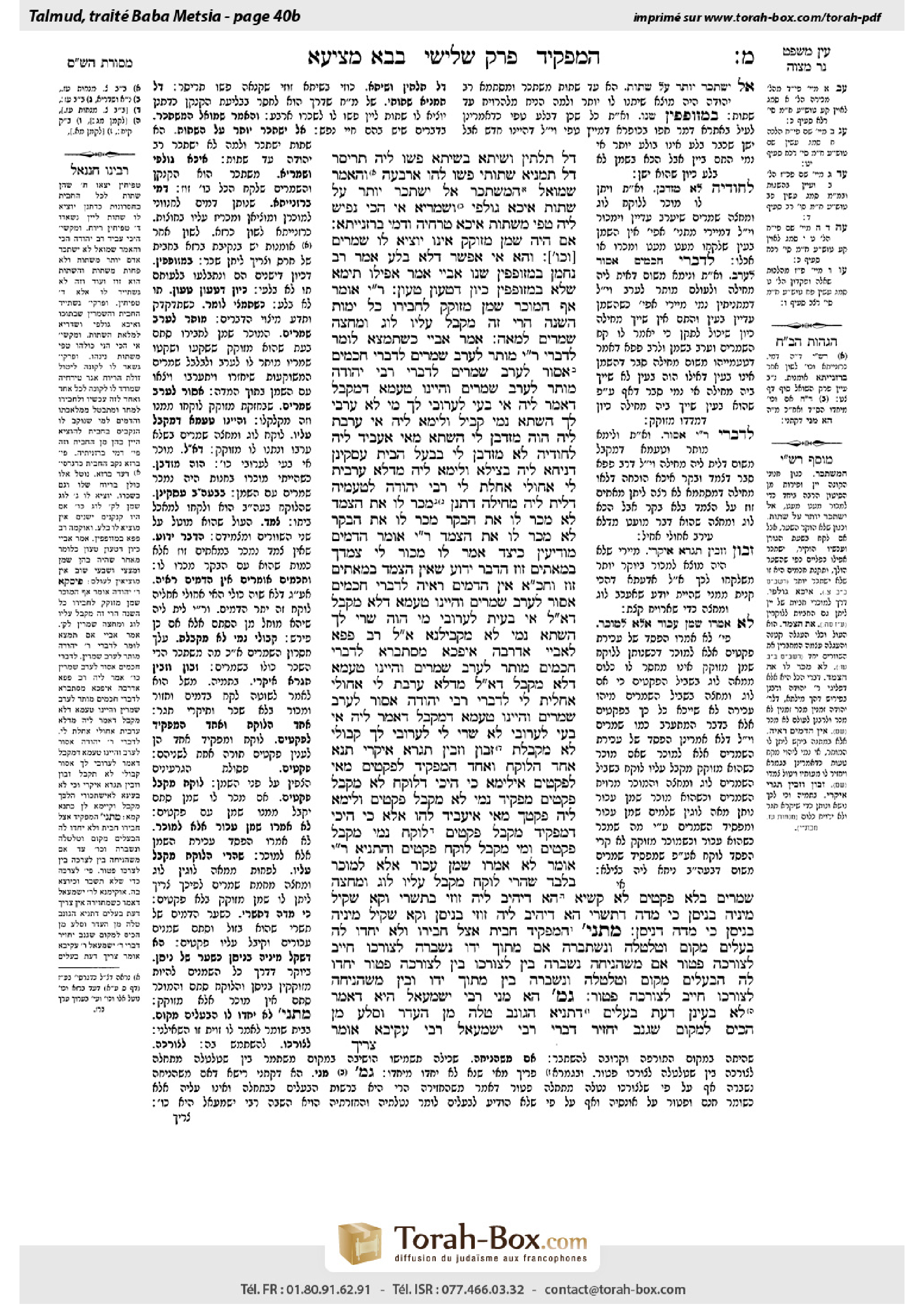
Bava Metzia 40b: Talmud study for Daf Yomi
Study the Talmud for Daf Yomi with scanned pages, Hebrew text, English translations from Sefaria and AI-generated French translations.
Passage selection and English or AI-generated French translation are available where the scan has annotations. Daf Study is independent of Torah-Box and Sefaria.
Browse Bava Metzia · בבא מציעא · All tractatesBava Metzia 40b text and translations
This page of Bava Metzia includes the Aramaic text, an English translation and an AI-generated French translation, alongside the scan above.
בבא מציעא מ׳ ב · Aramaic and Hebrew text
דַּל תְּלָתִין וְשִׁיתָּא בְּשִׁיתָּא, פָּשׁוּ לֵיהּ תְּרֵיסַר. דַּל תְּמָנְיָא שְׁתוּתֵי, פָּשׁוּ לְהוּ אַרְבְּעָה.
וְהָאָמַר שְׁמוּאֵל: הַמִּשְׂתַּכֵּר אַל יִשְׂתַּכֵּר יוֹתֵר עַל שְׁתוּת!
אִיכָּא גּוּלְפֵי וּשְׁמָרַיָּא. אִי הָכִי נְפִישׁ לֵיהּ טְפֵי מִשְּׁתוּת? אִיכָּא טִרְחֵיהּ וּדְמֵי בַּרְזַנְיָיתָא.
אִם הָיָה שֶׁמֶן מְזוּקָּק אֵינוֹ יוֹצִיא לוֹ שְׁמָרִים וְכוּ׳. וְהָא אִי אֶפְשָׁר דְּלָא בָּלַע! אָמַר רַב נַחְמָן: בִּמְזוּפָּפִין שָׁנוּ. אַבָּיֵי אָמַר: אֲפִילּוּ תֵּימָא שֶׁלֹּא בִּמְזוּפָּפִין, כֵּיוָן דִּטְעוּן – טְעוּן.
רַבִּי יְהוּדָה אוֹמֵר: אַף הַמּוֹכֵר שֶׁמֶן מְזוּקָּק לַחֲבֵירוֹ כׇּל יְמוֹת הַשָּׁנָה, הֲרֵי זֶה מְקַבֵּל עָלָיו לוֹג וּמֶחֱצָה שְׁמָרִים לְמֵאָה. אָמַר אַבָּיֵי: כְּשֶׁתִּמְצָא לוֹמַר, לְדִבְרֵי רַבִּי יְהוּדָה מוּתָּר לְעָרֵב שְׁמָרִים, לְדִבְרֵי חֲכָמִים אָסוּר לְעָרֵב שְׁמָרִים.
לְדִבְרֵי רַבִּי יְהוּדָה מוּתָּר לְעָרֵב שְׁמָרִים, וְהַיְינוּ טַעְמָא דִּמְקַבֵּל, דַּאֲמַר לֵיהּ: אִי בְּעַי לְעָרוֹבֵי לָךְ – מִי לָא עָרֵבִי לָךְ? הַשְׁתָּא נָמֵי קַבֵּיל.
וְלֵימָא לֵיהּ: אִי עָרֵבְתְּ לֵיהּ – הֲוָה מִזְדַּבַּן לִי, הַשְׁתָּא מַאי אֶעֱבֵיד לֵיהּ? לְחוֹדֵיהּ לָא מִזְדַּבַּן לִי! בְּבַעַל הַבַּיִת עָסְקִינַן – דְּנִיחָא לֵיהּ בְּצִילָא. וְלֵימָא לֵיהּ: מִדְּלָא עָרֵבִית לִי – אַחוֹלֵי אַחֵלְתְּ לִי!
רַבִּי יְהוּדָה לְטַעְמֵיהּ, דְּלֵית לֵיהּ מְחִילָה. דִּתְנַן: מָכַר לוֹ אֶת הַצֶּמֶד – לֹא מָכַר לוֹ אֶת הַבָּקָר. מָכַר לוֹ אֶת הַבָּקָר – לֹא מָכַר לוֹ אֶת הַצֶּמֶד.
רַבִּי יְהוּדָה אוֹמֵר: הַדָּמִים מוֹדִיעִין. כֵּיצַד? אָמַר לוֹ: מְכוֹר לִי צִמְדְּךָ בְּמָאתַיִם זוּז – הַדָּבָר יָדוּעַ שֶׁאֵין הַצֶּמֶד בְּמָאתַיִים זוּז. וַחֲכָמִים אוֹמְרִים: אֵין הַדָּמִים רְאָיָה.
לְדִבְרֵי חֲכָמִים אָסוּר לְעָרֵב שְׁמָרִים, וְהַיְינוּ טַעְמָא דְּלָא מְקַבֵּל – דַּאֲמַר לֵיהּ: אִי בָּעֵית לְעָרוֹבֵי מִי הֲוָה שְׁרֵי לָךְ? הַשְׁתָּא נָמֵי לָא מְקַבֵּילְנָא.
אֲמַר לֵיהּ רַב פָּפָּא לְאַבָּיֵי: אַדְּרַבָּה, אִיפְּכָא מִסְתַּבְּרָא! לְדִבְרֵי חֲכָמִים מוּתָּר לְעָרֵב שְׁמָרִים, וְהַיְינוּ טַעְמָא דְּלָא מְקַבֵּל – דַּאֲמַר לֵיהּ: מִדְּלָא עָרֵבְתְּ לִי, אַחוֹלֵי אַחֵלְיתְּ לִי. לְדִבְרֵי רַבִּי יְהוּדָה אָסוּר לְעָרֵב שְׁמָרִים, וְהַיְינוּ טַעְמָא דִּמְקַבֵּל – דְּאָמַר לֵיהּ: אִי בְּעַי לְעָרוֹבֵי – לָא שְׁרֵי לִי לְעָרוֹבֵי לָךְ, קַבּוֹלֵי לָא מְקַבְּלַתְּ. זְבוֹן וְזַבֵּין תַּגָּרָא אִיקְּרִי?
תַּנָּא: אֶחָד הַלּוֹקֵחַ וְאֶחָד הַמַּפְקִיד לִפְקָטִים. מַאי לִפְקָטִים? אִילֵימָא כִּי הֵיכִי דְּלוֹקֵחַ לָא מְקַבֵּל פְּקָטִים, מַפְקִיד נָמֵי לָא מְקַבֵּל פְּקָטִים – וְלֵימָא לֵיהּ: פְּקָטָךְ מַאי אֶיעְבֵּיד לְהוּ?
אֶלָּא כִּי הֵיכִי דְּמַפְקִיד מְקַבֵּל פְּקָטִים, לוֹקֵחַ נָמֵי מְקַבֵּל פְּקָטִים. וּמִי מְקַבֵּל לוֹקֵחַ פְּקָטִים? וְהָתַנְיָא, רַבִּי יְהוּדָה אוֹמֵר: לֹא אָמְרוּ שֶׁמֶן עָכוּר אֶלָּא לַמּוֹכֵר בִּלְבָד, שֶׁהֲרֵי לוֹקֵחַ מְקַבֵּל עָלָיו לוֹג וּמֶחֱצָה שְׁמָרִים, בְּלֹא פְּקָטִים.
לָא קַשְׁיָא: הָא דְּיָהֵיב לֵיהּ זוּזֵי בְּתִשְׁרִי וְקָא שָׁקֵיל מִינֵּיהּ בְּנִיסָן, כִּי מִדָּה דְתִשְׁרִי. הָא דְּיָהֵיב לֵיהּ זוּזֵי בְּנִיסָן וְקָא שָׁקֵיל מִינֵּיהּ בְּנִיסָן, כִּי מִדָּה דְנִיסָן.
מַתְנִי׳ הַמַּפְקִיד חָבִית אֵצֶל חֲבֵירוֹ וְלֹא יִחֲדוּ לָהּ בְּעָלִים מָקוֹם, וְטִלְטְלָהּ וְנִשְׁתַּבְּרָה – אִם מִתּוֹךְ יָדוֹ נִשְׁבְּרָה, לְצוֹרְכּוֹ – חַיָּיב, לְצוֹרְכָּהּ – פָּטוּר. אִם מִשֶּׁהִנִּיחָהּ נִשְׁבְּרָה, בֵּין לְצוֹרְכּוֹ בֵּין לְצוֹרְכָּהּ – פָּטוּר. יִחֲדוּ לָהּ הַבְּעָלִים מָקוֹם, וְטִלְטְלָהּ וְנִשְׁבְּרָה – בֵּין מִתּוֹךְ יָדוֹ וּבֵין מִשֶּׁהִנִּיחָהּ, לְצוֹרְכּוֹ – חַיָּיב, לְצוֹרְכָּהּ – פָּטוּר.
גְּמָ׳ הָא מַנִּי? רַבִּי יִשְׁמָעֵאל הִיא, דְּאָמַר: לָא בָּעִינַן דַּעַת בְּעָלִים. דְּתַנְיָא: הַגּוֹנֵב טָלֶה מִן הָעֵדֶר וְסֶלַע מִן הַכִּיס – לִמְקוֹם שֶׁגָּנַב יַחְזִיר, דִּבְרֵי רַבִּי יִשְׁמָעֵאל. רַבִּי עֲקִיבָא אוֹמֵר:
Bava Metzia 40b · English translation
The Gemara now analyzes Rav Yehuda’s calculation: Subtract thirty-six pitchersful that were sold for six dinars each, with which he recoups the purchase price of the barrel. Twelve pitchersful remained for him. Subtract eight pitchers full, which is one-sixth of the total amount, as that is the measure absorbed in the barrels. Four pitchersful remained as profit for Rav Yehuda.
The Gemara asks: But doesn’t Shmuel say that one who profits from the sale of matters related to one’s existence may not profit more than one-sixth? One can infer that it is permitted for one to profit up to one-sixth. But according to the calculation, Rav Yehuda’s profit was much lower. Why did he not sell the oil at a higher price?
The Gemara answers: There are the barrel and the sediment to account for. These remain in his possession, as he purchased the barrel and all its contents for six dinars, and they supplement the profit. The Gemara challenges: If so, once the barrel and sediment are taken into account, the profit is greater than one-sixth. How did Rav Yehuda profit beyond the permitted amount? The Gemara answers: There is the payment for his exertion, as he sold the oil, and there is the payment for tapping, as a craftsman is needed to install a tap in the barrel. When those payments are included in the calculation, the profit is precisely one-sixth.
§ The mishna teaches: If it was refined oil, he does not deduct any of the oil for sediment. If they were stored in old casks that are already saturated, he does not deduct any of the oil for absorption. The Gemara asks: But isn’t it impossible that the cask did not absorb any oil at all, even if it was saturated? Rav Naḥman says: It is with regard to casks coated with pitch that the tanna’im taught the mishna, and if the cask is old and coated with pitch it does not absorb anything. Abaye said: Even if you say that the mishna is not referring to casks coated with pitch, once they are saturated they are saturated, and no more oil is absorbed.
The mishna teaches that Rabbi Yehuda says: Even in the case of one who sells refined oil to another all the days of the year, this buyer accepts upon himself that the seller will deduct a log and a half of sediment for one hundred log, as that is the standard measure of sediment. Abaye said: When you analyze the matter, you will find it necessary to say that according to the statement of Rabbi Yehuda, it is permitted to mix sediment that settled at the bottom of the barrel with the clear oil and sell the mixture. And according to the statement of the Rabbis, it is prohibited to mix sediment with the clear oil.
The Gemara elaborates. According to the statement of Rabbi Yehuda, it is permitted to mix sediment, and that is the reason that the buyer accepts upon himself that the seller will deduct a log and a half of sediment for one hundred log, as the seller says to him: If I wished to mix sediment and sell it to you, couldn’t I mix it and sell it to you? Now too, accept upon yourself the deduction due to sediment.
The Gemara asks: And let the buyer say to him: If you had mixed sediment into the oil, it could have been sold for me to another. Now what will I do with it? The sediment cannot be sold on its own, and I will suffer a loss. The Gemara answers: We are dealing with a buyer who is a homeowner, not a merchant. He needs oil for his own use, and filtered oil is preferable for him, as his use of the oil is facilitated by removal of the sediment. The Gemara asks: And let the buyer say to him: From the fact that you did not mix the sediment with the oil for me, it is an indication that you renounced your rights to it to me.
The Gemara answers: Rabbi Yehuda conforms to his standard line of reasoning, as he is not of the opinion that one can presume renunciation, and therefore the buyer cannot presume that the seller renounced his right to receive the standard price, as we learned in a mishna (Bava Batra 77b): If one sold the yoke [tzemed] to another, he did not sell the cattle to him. Literally, tzemed means the yoke that holds the animals together [tzamud] while plowing. It can be understood as referring to the two animals held together by the yoke. If one sold the cattle to another, he did not sell the yoke to him. The sale is limited to the literal meaning of what he said.
The mishna continues: Rabbi Yehuda says: The money informs the scope of the sale. Based on the price, one can determine what is included in the sale. How so? If the buyer said to the seller: Sell me your tzemed for two hundred dinars, the matter is well-known that a yoke does not cost two hundred dinars, and he certainly meant the cattle. And the Rabbis say: The money is not a proof, as it is possible that one of the parties renounced part of the sale price.
The Gemara concludes its elaboration of the statement of Abaye: According to the statement of the Rabbis, it is prohibited to mix sediment, and this is the reason that the buyer does not accept that the seller deduct a log and a half of sediment for one hundred log, as the buyer says to him: If you wished to mix sediment and sell it, would it be permitted for you to do so? Now too, I do not accept that deduction.
Rav Pappa said to Abaye: On the contrary, the opposite is reasonable. According to the statement of the Rabbis, it is permitted to mix sediment. And this is the reason that the buyer does not accept the deduction, as the buyer said to the seller: From the fact that you did not mix the sediment for me, apparently you renounced that sum to me. According to the statement of Rabbi Yehuda, it is prohibited to mix sediment. And this is the reason that the buyer accepts the deduction, as the seller says to him: If I wished to mix sediment, it is prohibited for me to mix it for you, and if you do not accept the deduction, I earn nothing from this sale. That is unacceptable according to the maxim: One who buys and sells at the same price, is he called a merchant?
It is taught: The legal status of both one who buys and one who deposits oil with regard to residue [piktim], e.g., olive pits floating on the oil, is the same. The Gemara asks: What is the meaning of: With regard to residue? If we say that this is teaching: Just as the buyer does not accept upon himself a deduction in the quantity of oil to account for the residue, so too, the one who deposits the oil does not accept upon himself a deduction in the quantity of oil to account for the residue when he returns the oil and is required to return the full amount deposited with him, this is difficult. But let the bailee say to the owner: What shall I do with your residue?
Rather, it is teaching: Just as the one who deposits the oil accepts the residue when his oil is returned to him, so too, the buyer accepts the residue with the oil he purchases. The Gemara asks: And does the buyer accept upon himself a deduction for residue? But isn’t it taught in a baraita that Rabbi Yehuda says: The Sages stated that the loss for murky oil is only for the seller, as the buyer accepts upon himself a deduction for a log and a half of sediment without residue?
The Gemara answers: This is not difficult, as this baraita, in which it is taught that the buyer accepts residue, is referring to a case where the buyer gave the seller money in Tishrei, when olives are harvested, and he takes the oil from him in Nisan according to the measure of Tishrei. In Tishrei, due to the substantial supply, the price is lower, and immediately after the harvest the oil is murky. That baraita, in which it is taught that the loss for murky oil is only for the seller, is referring to a case where the buyer gave the seller money in Nisan, and he takes the oil from him in Nisan according to the measure of Nisan, as in Nisan both the buyer and the seller assume that the oil is refined.
MISHNA: In the case of one who deposits a barrel with another, and the owners did not designate a specific place for the barrel to be stored in the bailee’s house, and the bailee moved it and it broke, if it broke while still in his hand, there is a distinction: If he moved the barrel for his purposes, he is liable to pay for the damage. If he moved the barrel for its own purposes, to prevent it from being damaged, he is exempt. If, after he replaced the barrel it broke, whether he initially moved it for his purposes or whether he moved it for its own purposes, he is exempt. But if the owners designated a specific place for the barrel, and the bailee moved it and it broke, whether it broke while still in his hand or whether it broke after he replaced the barrel, if he moved it for his purposes he is liable to pay, and if he moved it for its own purposes, he is exempt.
GEMARA: In accordance with whose opinion is this mishna? It is in accordance with the opinion of Rabbi Yishmael, who says: When a thief returns an item that he stole, we do not require the knowledge of the owner for the item to be considered returned, as it is taught in a baraita: In a case of one who steals a lamb from the flock or a sela from the purse, he should return it to the place from which he stole it, and it is unnecessary to inform the owner; this is the statement of Rabbi Yishmael. Rabbi Akiva says:
Bava Metzia 40b · Traduction française (IA)
La Guemara analyse maintenant le calcul de Rav Yehuda : On soustrait trente-six outres qui ont été vendues à six dinars chacune, avec lesquelles il récupère le prix d'achat du tonneau. Douze outres lui restent. On soustrait huit outres, soit un sixième de la quantité totale, car c'est la mesure absorbée par les tonneaux. Quatre outres restent comme bénéfice pour Rav Yehuda.
La Guemara demande : Mais ne dit pas Shmuel que celui qui profite de la vente de choses liées à son existence ne peut pas profiter plus d'un sixième ? On peut en déduire que c'est permis de profiter jusqu'à un sixième. Mais selon le calcul, le bénéfice de Rav Yehuda était bien inférieur. Pourquoi ne l'a-t-il pas vendu à un prix plus élevé ?
La Guemara répond : Il faut tenir compte du tonneau et des dépôts. Ces éléments restent en son possession, car il a acheté le tonneau et tout son contenu pour six dinars, et ils complètent le bénéfice. La Guemara conteste : Si tel est le cas, une fois que le tonneau et les dépôts sont pris en compte, le bénéfice est supérieur à un sixième. Comment Rav Yehuda a-t-il pu profiter au-delà de la quantité autorisée ? La Guemara répond : Il y a le paiement pour son effort, car il a vendu l'huile, et il y a le paiement pour l'installation, car un artisan est nécessaire pour installer un robinet dans le tonneau. Lorsque ces paiements sont inclus dans le calcul, le bénéfice est exactement un sixième.
§ La Michna enseigne : Si c'était de l'huile raffinée, il ne déduit aucun de l'huile pour les dépôts. Si elles étaient stockées dans des tonneaux anciens déjà saturés, il ne déduit aucun de l'huile pour l'absorption. La Guemara demande : Mais n'est-ce pas impossible que le tonneau n'ait pas absorbé du tout l'huile, même s'il était saturé ? Rav Naḥman dit : C'est concernant les tonneaux recouverts de cire que les tanna'ïm ont enseigné la Michna, et si le tonneau est ancien et recouvert de cire, il ne capte rien. Abaye dit : Même si vous dites que la Michna ne fait pas référence aux tonneaux recouverts de cire, une fois qu'ils sont saturés, ils sont saturés, et plus d'huile n'est absorbée.
La Michna enseigne que Rabbi Yehuda dit : Même dans le cas d'une personne qui vend de l'huile raffinée à un autre toute l'année, ce dernier accepte de lui-même que le vendeur déduira un log et demi de dépôts pour cent log, car c'est la mesure standard des dépôts. Abaye dit : Lorsque vous analysez la question, vous trouverez nécessaire de dire que selon l'affirmation de Rabbi Yehuda, il est permis de mélanger les dépôts qui se sont déposés au fond du tonneau avec l'huile claire et de les vendre ensemble. Et selon l'affirmation des Rabbins, il est interdit de mélanger les dépôts avec l'huile claire.
La Guemara développe. Selon l'affirmation de Rabbi Yehuda, il est permis de mélanger les dépôts, et c'est la raison pour laquelle le acheteur accepte de lui-même que le vendeur déduira un log et demi de dépôts pour cent log, car le vendeur dit à lui : Si j'avais mélangé les dépôts et les ai vendus à vous, ne pouvais-je pas le faire ? Maintenant aussi, acceptez-vous la déduction due aux dépôts.
La Guemara demande : Et que l'acheteur dise au vendeur : Si tu avais mélangé les dépôts dans l'huile, il aurait pu être vendu à un autre. Maintenant, que vais-je en faire ? Les dépôts ne peuvent être vendus seuls, et je subirais une perte. La Guemara répond : Nous parlons d'un acheteur qui est un propriétaire, pas un marchand. Il a besoin d'huile pour son propre usage, et l'huile filtrée est préférable pour lui, car son usage de l'huile est facilité par l'élimination des dépôts. La Guemara demande : Et que l'acheteur dise au vendeur : Du fait que tu n'as pas mélangé les dépôts avec l'huile pour moi, c'est une indication que tu as renoncé à tes droits sur eux.
La Guemara répond : Rabbi Yehuda suit sa ligne de raisonnement standard, car il ne considère pas que l'on puisse présupposer un renoncement, et donc l'acheteur ne peut pas présupposer que le vendeur a renoncé à ses droits à recevoir le prix standard, comme nous l'avons appris dans une michna (Bava Batra 77b) : Si l'on vend le joug [tzemed] à un autre, il ne vend pas les bêtes à lui. Littéralement, tzemed signifie le joug qui maintient les animaux ensemble [tzamud] pendant la moisson. On peut le comprendre comme faisant référence aux deux animaux maintenus ensemble par le joug. Si l'on vend les bêtes à un autre, il ne vend pas le joug à lui. La vente est limitée au sens littéral de ce que l'on a dit.
La michna continue : Rabbi Yehuda dit : L'argent détermine la portée de la vente. Selon le prix, on peut déterminer ce qui est inclus dans la vente. Comment ? Si l'acheteur dit au vendeur : Vends-moi ton tzemed pour deux cents dinars, la chose est bien connue que le joug ne coûte pas deux cents dinars, et il a certainement voulu dire les bêtes. Et les Rabbins disent : L'argent n'est pas une preuve, car il est possible que l'une des parties ait renoncé à une partie du prix de vente.
La Guemara conclut son développement de l'affirmation d'Abaye : Selon l'affirmation des Rabbins, il est interdit de mélanger les dépôts, et c'est la raison pour laquelle l'acheteur ne accepte pas que le vendeur déduise un log et demi de dépôts pour cent log, car l'acheteur dit au vendeur : Si vous aviez voulu mélanger les dépôts et les vendre, serait-il permis pour vous de le faire ? Maintenant aussi, je ne accepte pas cette déduction.
Rav Pappa dit à Abaye : Au contraire, l'opposé est raisonnable. Selon l'affirmation des Rabbins, il est permis de mélanger les dépôts. Et c'est la raison pour laquelle l'acheteur ne accepte pas la déduction, car l'acheteur dit au vendeur : Du fait que vous n'avez pas mélangé les dépôts pour moi, apparemment vous avez renoncé à cette somme pour moi. Selon l'affirmation de Rabbi Yehuda, il est interdit de mélanger les dépôts. Et c'est la raison pour laquelle l'acheteur accepte la déduction, car le vendeur dit à lui : Si j'avais voulu mélanger les dépôts, il est interdit pour moi de le faire pour vous, et si vous ne acceptez pas la déduction, je gagne rien de cette vente. Cela est inacceptable selon le principe : Celui qui achète et vend au même prix, est-il appelé marchand ?
Il est enseigné : Le statut juridique de celui qui achète et de celui qui dépose l'huile concernant les résidus [piktim], par exemple, les noyaux d'olive flottant dans l'huile, est le même. La Guemara pose la question : Quelle est la signification de « concernant les résidus » ? Si nous disons que cela enseigne : Tout comme l'acheteur ne s'engage pas à une déduction quant à la quantité d'huile pour tenir compte des résidus, de même celui qui dépose l'huile ne s'engage pas à une déduction quant à la quantité d'huile pour tenir compte des résidus lorsqu'il rend l'huile et est tenu de rendre la quantité déposée, cela est difficile. Mais que le dépositaire dise à l'owner : Que dois-je faire avec vos résidus ?
Au contraire, il enseigne : Tout comme celui qui dépose l'huile accepte les résidus lorsqu'il récupère son huile, de même l'acheteur accepte les résidus avec l'huile qu'il achète. La Guemara pose la question : Et l'acheteur s'engage-t-il à une déduction pour les résidus ? Mais n'est-il pas enseigné dans une baraïta que Rabbi Yéhuda dit : Les Sages ont dit que la perte pour l'huile trouble est uniquement pour le vendeur, car l'acheteur s'engage à une déduction pour un log et demi de dépôt sans résidus ?
La Guemara répond : Cela n'est pas difficile, car cette baraïta, dans laquelle il est enseigné que l'acheteur accepte les résidus, fait référence à un cas où l'acheteur a donné à la vendeur de l'argent en Tishri, lorsque les olives sont récoltées, et il récupère l'huile en Nisan selon la mesure de Tishri. En Tishri, en raison de l'abondance, le prix est plus bas, et immédiatement après la récolte, l'huile est trouble. Cette baraïta, dans laquelle il est enseigné que la perte pour l'huile trouble est uniquement pour le vendeur, fait référence à un cas où l'acheteur a donné à la vendeur de l'argent en Nisan, et il récupère l'huile en Nisan selon la mesure de Nisan, comme en Nisan à la fois l'acheteur et le vendeur supposent que l'huile est raffinée.
MICHNA : Dans le cas d'une personne qui dépose une barrique à une autre, et les propriétaires n'ont pas désigné un lieu spécifique pour que la barrique soit stockée dans la maison du dépositaire, et le dépositaire a déplacé la barrique et elle s'est brisée, il y a une distinction : Si elle s'est brisée alors qu'elle était encore en sa possession, il y a une distinction : Si le dépositaire a déplacé la barrique à ses propres fins, il est tenu responsable du préjudice. Si le dépositaire a déplacé la barrique à ses propres fins, pour la préserver, il est exempt. Si, après qu'il ait remplacé la barrique, elle s'est brisée, qu'il s'agisse de l'avoir déplacé à ses propres fins ou à ses propres fins, il est exempt. Mais si les propriétaires avaient désigné un lieu spécifique pour la barrique, et le dépositaire l'a déplacé et elle s'est brisée, qu'elle s'agisse de l'avoir déplacé alors qu'elle était encore en sa possession ou après qu'il l'ait remplacée, si le dépositaire l'a déplacé à ses propres fins, il est tenu responsable, et si le dépositaire l'a déplacé à ses propres fins, il est exempt.
GUEMARA : Selon l'opinion de qui est cette mishna ? C'est selon l'opinion de Rabbi Yishmael, qui dit : Lorsqu'un voleur rend un objet qu'il a volé, nous ne requérons pas la connaissance du propriétaire pour que l'objet soit considéré comme rendu, car il est enseigné dans une baraïta : Dans le cas d'une personne qui vole un agneau du troupeau ou un sela de la bourse, il doit le rendre au lieu d'où il l'a volé, et il n'est pas nécessaire d'informer le propriétaire ; c'est l'opinion de Rabbi Yishmael. Rabbi Akiva dit :
Traduction française générée par IA à partir de l’édition anglaise de Sefaria. Vérifie toujours un passage avec le texte source.
Text from Sefaria: William Davidson Edition - Vocalized Aramaic (CC BY NC); William Davidson Edition - English (CC BY NC).