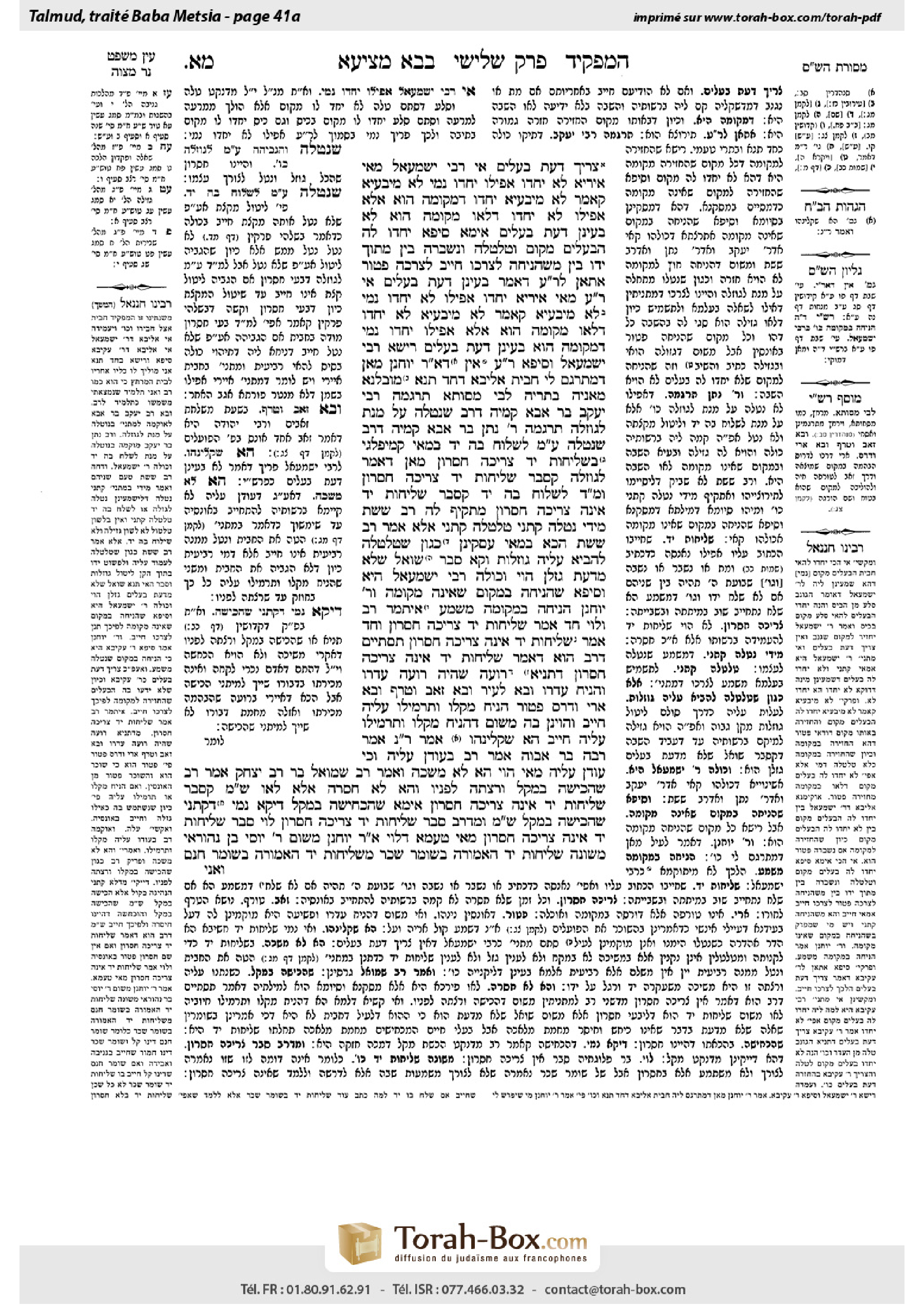
Bava Metzia 41a: Talmud study for Daf Yomi
Study the Talmud for Daf Yomi with scanned pages, Hebrew text, English translations from Sefaria and AI-generated French translations.
Passage selection and English or AI-generated French translation are available where the scan has annotations. Daf Study is independent of Torah-Box and Sefaria.
Browse Bava Metzia · בבא מציעא · All tractatesBava Metzia 41a text and translations
This page of Bava Metzia includes the Aramaic text, an English translation and an AI-generated French translation, alongside the scan above.
בבא מציעא מ״א א · Aramaic and Hebrew text
צָרִיךְ דַּעַת בְּעָלִים.
אִי רַבִּי יִשְׁמָעֵאל, מַאי אִירְיָא לֹא יִחֲדוּ? אֲפִילּוּ יִחֲדוּ נָמֵי!
לָא מִיבַּעְיָא קָאָמַר: לָא מִיבַּעְיָא יִחֲדוּ דִּמְקוֹמָהּ הוּא, אֶלָּא אֲפִילּוּ לֹא יִחֲדוּ דְּלָאו מְקוֹמָהּ הוּא – לָא בָּעֵינַן דַּעַת בְּעָלִים.
אֵימָא סֵיפָא: יִחֲדוּ לָהּ הַבְּעָלִים מָקוֹם וְטִלְטְלָהּ וְנִשְׁבְּרָה, בֵּין מִתּוֹךְ יָדוֹ, בֵּין מִשֶּׁהִנִּיחָהּ, לְצׇרְכּוֹ – חַיָּיב, לְצׇרְכָּהּ – פָּטוּר. אֲתָאן לְרַבִּי עֲקִיבָא, דְּאָמַר: בָּעֵינַן דַּעַת בְּעָלִים.
אִי רַבִּי עֲקִיבָא – מַאי אִירְיָא יִחֲדוּ? אֲפִילּוּ לֹא יִחֲדוּ נָמֵי!
לָא מִיבַּעְיָא קָאָמַר: לָא מִיבַּעְיָא לֹא יִחֲדוּ דְּלָאו מְקוֹמָהּ הוּא, אֶלָּא אֲפִילּוּ יִחֲדוּ נָמֵי, דִּמְקוֹמָהּ הוּא – בָּעֵינַן דַּעַת בְּעָלִים.
רֵישָׁא רַבִּי יִשְׁמָעֵאל וְסֵיפָא רַבִּי עֲקִיבָא? אִין, דְּאָמַר רַבִּי יוֹחָנָן: מַאן דִּמְתַרְגֵּם לִי חָבִית אַלִּיבָּא דְּחַד תַּנָּא, מוֹבֵלְנָא מָאנֵיהּ בָּתְרֵיהּ לְבֵי מַסּוּתָא.
תַּרְגְּמַהּ רַבִּי יַעֲקֹב בַּר אַבָּא קַמֵּיהּ דְּרַב: שֶׁנְּטָלָהּ עַל מְנָת לְגוֹזְלָהּ.
תַּרְגְּמַהּ רַבִּי נָתָן בַּר אַבָּא קַמֵּיהּ דְּרַב: שֶׁנְּטָלָהּ עַל מְנָת לִשְׁלוֹחַ בָּהּ יָד.
בְּמַאי קָמִיפַּלְגִי? בִּשְׁלִיחוּת יָד צְרִיכָה חֶסְרוֹן. מַאן דְּאָמַר לְגוֹזְלָהּ – קָסָבַר שְׁלִיחוּת יָד צְרִיכָה חֶסְרוֹן, וּמַאן דְּאָמַר לִשְׁלוֹחַ בָּהּ יָד – קָסָבַר שְׁלִיחוּת יָד אֵינָהּ צְרִיכָה חֶסְרוֹן.
מַתְקֵיף לַהּ רַב שֵׁשֶׁת: מִידֵּי ״נְטָלָהּ״ קָתָנֵי? ״טִלְטְלָהּ״ קָתָנֵי! אֶלָּא אָמַר רַב שֵׁשֶׁת: הָכָא בְּמַאי עָסְקִינַן – כְּגוֹן שֶׁטִּלְטְלָהּ לְהָבִיא עָלֶיהָ גּוֹזָלוֹת, וְקָא סָבַר: שׁוֹאֵל שֶׁלֹּא מִדַּעַת – גַּזְלָן הָוֵי. וְכוּלָּהּ רַבִּי יִשְׁמָעֵאל הִיא, וְסֵיפָא: שֶׁהִנִּיחָהּ בְּמָקוֹם שֶׁאֵינָהּ מְקוֹמָהּ.
וְרַבִּי יוֹחָנָן: ״הִנִּיחָהּ״ בִּמְקוֹמָהּ מַשְׁמַע.
אִיתְּמַר רַב וְלֵוִי. חַד אָמַר: שְׁלִיחוּת יָד צְרִיכָה חֶסְרוֹן, וְחַד אָמַר: שְׁלִיחוּת יָד אֵינָהּ צְרִיכָה חֶסְרוֹן. תִּסְתַּיֵּים דְּרַב הוּא דְּאָמַר שְׁלִיחוּת יָד אֵינָהּ צְרִיכָה חֶסְרוֹן, דְּתַנְיָא: רוֹעֶה שֶׁהָיָה רוֹעֶה עֶדְרוֹ, וְהִנִּיחַ עֶדְרוֹ וּבָא לָעִיר, וּבָא זְאֵב וְטָרַף וּבָא אֲרִי וְדָרַס – פָּטוּר. הִנִּיחַ מַקְלוֹ וְתַרְמִילוֹ עָלֶיהָ – חַיָּיב.
וְהָוֵינַן בָּהּ: מִשּׁוּם דְּהִנִּיחַ מַקְלוֹ וְתַרְמִילוֹ עָלֶיהָ חַיָּיב? הָא שַׁקְלִינְהוּ!
אָמַר רַב נַחְמָן אָמַר רַבָּה בַּר אֲבוּהּ אָמַר רַב: בְּעוֹדָן עָלֶיהָ. וְכִי עוֹדָן עָלֶיהָ מַאי הָוֵי? הָא לָא מַשְׁכַהּ!
וְאָמַר רַב שְׁמוּאֵל בַּר רַב יִצְחָק אָמַר רַב: שֶׁהִכִּישָׁהּ בְּמַקֵּל וְרָצְתָה לְפָנָיו. וְהָא לָא חַסְּרַהּ! אֶלָּא לָאו שְׁמַע מִינַּהּ קָסָבַר שְׁלִיחוּת יָד אֵינָהּ צְרִיכָה חֶסְרוֹן?
אֵימָא שֶׁהִכְחִישָׁהּ בְּמַקֵּל. דַּיְקָא נָמֵי, דְּקָתָנֵי ״שֶׁהִכִּישָׁהּ בְּמַקֵּל״. שְׁמַע מִינַּהּ.
וּמִדְּרַב סָבַר שְׁלִיחוּת יָד צְרִיכָה חֶסְרוֹן, לֵוִי סָבַר שְׁלִיחוּת יָד אֵינָהּ צְרִיכָה חֶסְרוֹן. מַאי טַעְמָא דְּלֵוִי? אָמַר רַבִּי יוֹחָנָן מִשּׁוּם רַבִּי יוֹסֵי בֶּן נְהוֹרַאי: מְשׁוּנָּה שְׁלִיחוּת יָד הָאֲמוּרָה בְּשׁוֹמֵר שָׂכָר מִשְּׁלִיחוּת יָד הָאֲמוּרָה בְּשׁוֹמֵר חִנָּם.
Bava Metzia 41a · English translation
One requires the knowledge of the owner for the item to be considered returned.
The Gemara asks: If the baraita is in accordance with the opinion of Rabbi Yishmael, why did the tanna in the first clause of the mishna establish the case specifically where the owner did not designate a specific place for the barrel to be stored in the bailee’s house? Even in a case where the owner designated a place for the barrel, the bailee should be exempt because he replaced the barrel.
The Gemara answers: The tanna is speaking utilizing the style: It is not necessary. It is not necessary to state the halakha in a case where the owners designated a place for the barrel, as after the bailee replaced the barrel, that is its place. But even in a case where the owner did not designate a place for the barrel, and after the bailee replaces the barrel that is not its place, we do not require the knowledge of the owners. In both cases, once he replaces the barrel, he is exempt from payment.
The Gemara asks: Say the latter clause of the mishna: If the owners designated a specific place for the barrel, and the bailee moved it and it broke, whether it broke while still in his hand or whether it broke after he replaced the barrel, if he moved it for his purposes he is liable to pay, and if he moved it for its own purposes, he is exempt. We arrive at the opinion of Rabbi Akiva, who says: We require the knowledge of the owners. Since the bailee moved the barrel from its place for his own purposes, he is a robber and is responsible for damages.
The Gemara asks: If the baraita is in accordance with the opinion of Rabbi Akiva, why did the tanna in the latter clause of the mishna establish the case specifically where the owner designated a particular place for the barrel to be stored in the bailee’s house? Even in a case where the owner did not designate a place for the barrel, the bailee should be liable to pay, because the barrel is not considered to have been returned.
The Gemara answers: The tanna is speaking utilizing the style: It is not necessary. It is not necessary to state the halakha in a case where the owners did not designate a place for the barrel, as the place that the bailee placed the barrel is not its place. But even in a case where the owner designated a place for the barrel, where the place that the bailee placed the barrel is its place, we require the knowledge of the owners for it to be considered as if the bailee returned the barrel.
The Gemara asks: The result of that explanation is that the first clause of the mishna is in accordance with the opinion of Rabbi Yishmael and the latter clause is in accordance with the opinion of Rabbi Akiva. The Gemara answers: Indeed, it is as Rabbi Yoḥanan says: Anyone who explains to me both clauses of the mishna with regard to a barrel according to the opinion of one tanna I will honor, and carry his garments after him to the bathhouse, and treat him as a servant treats his master.
The Gemara relates that Rabbi Ya’akov bar Abba interpreted the mishna before Rav: The mishna is referring to a case where the bailee took the barrel in order to rob the owner of it, and that is the meaning of the term: For his purposes. Since he intended to rob the owner of the barrel, he must return it to its place. In the first clause of the mishna, where the owner of the barrel did not designate a place for it, anywhere that he places it constitutes a return to its place. In the latter clause of the mishna, where the owner designated a place for the barrel, since the bailee did not return the barrel to that place, it is not considered to have been returned.
Rabbi Natan bar Abba interpreted the mishna before Rav: The mishna is referring to a case where the bailee took the barrel in order to misappropriate it, as one who misappropriates the property of another is responsible for any subsequent damage to it.
The Gemara asks: With regard to what do Rabbi Ya’akov and Rabbi Natan disagree? The Gemara answers: It is with regard to whether misappropriation requires loss: Is one liable for misappropriation only if it results in depreciation of the deposit, or is one liable for misappropriation even if he only intended to damage the deposit but there was no depreciation? The one who says that the bailee took the barrel in order to rob the owner of it holds that misappropriation requires loss. And the one who says that the bailee took the barrel in order to misappropriate it holds that misappropriation does not require loss.
Rav Sheshet objects to that explanation: Does the tanna teach that the bailee took it? It is taught in the mishna: The bailee moved it, indicating that he sought neither to misappropriate it nor to rob the owner of it. Rather, Rav Sheshet said: With what are we dealing here? We are dealing with a case where the bailee moved the barrel to stand upon it and bring fledglings from a nest in a tree. The bailee did not attempt to use its contents. He merely climbed on the barrel. And the tanna of the mishna holds: The legal status of one who borrows without the knowledge of the owners is that of a robber in terms of responsibility. And the entire mishna is in accordance with the opinion of Rabbi Yishmael. And the latter clause is referring to a case where the bailee is responsible because he placed the barrel in a place that is not its designated place.
The Gemara asks: And why doesn’t Rabbi Yoḥanan, who claimed that it is not possible to establish both clauses of the mishna in accordance with the opinion of the same tanna, explain the mishna in that manner? He holds that the term: He placed it, indicates that he replaced it in its designated place. Therefore, the latter clause cannot be explained in accordance with the opinion of Rabbi Yishmael, and the contradiction remains.
§ It was stated that there is an amoraic dispute between Rav and Levi. One says: Misappropriation requires loss. And one says: Misappropriation does not require loss. The Gemara comments: It may be concluded that it is Rav who says: Misappropriation does not require loss, as it is taught in a baraita: In the case of a shepherd who was herding his flock, which included the animals of others, and he abandoned his flock and went to the city, and a wolf came and devoured an animal, and a lion came and clawed an animal, the shepherd is exempt, as in any case, the attacks occurred through circumstances beyond his control. If he placed his staff and his satchel on the animal that was later attacked, he is liable to pay for the animal. Since he utilized the animal, it is as if he misappropriated it, and therefore he is liable to pay even in a case involving circumstances beyond his control.
And we discussed this baraita: Due to the fact that he placed his staff and his satchel on the animal, is he liable to pay? Didn’t he already remove them? Even if he improperly used the animal, he already removed his staff and satchel, and it is tantamount to returning it to the owners.
And Rav Naḥman says that Rabba bar Avuh said that Rav said: The tanna is referring to a case where the wolf devoured the animal when the staff and satchel were still on the animal. Since the bailee is still using the animal, it is considered his in terms of liability to pay for the damage caused. The Gemara asks: And if the staff and satchel are still on the animal, what of it? But he did not pull the animal and therefore did not acquire it.
And Rav Shmuel bar Yitzḥak says that Rav says: The tanna is referring to a case where the shepherd struck the animal with a staff and it ran before him, which is a form of pulling. The Gemara asks: But by causing the animal to run, he did not cause a loss to the animal. Why is he liable to pay? Rather, must one not conclude from it that Rav holds: Misappropriation does not require loss?
The Gemara rejects that proof: Say that he weakened the animal with a staff, and that is the only reason that he is liable to pay. The Gemara comments: Rav’s language is also precise, as he teaches: Where the shepherd struck the animal with a staff. The reason that he explains that he struck the animal with a staff, as opposed to his hand, is to indicate that the animal was weakened. The Gemara affirms: Learn from it that Rav holds that misappropriation requires loss.
The Gemara comments: And from the fact that Rav holds that misappropriation requires loss, it may be inferred that Levi holds that misappropriation does not require loss. The Gemara asks: What is the reason for the opinion of Levi? Rabbi Yoḥanan says in the name of Rabbi Yosei ben Nehorai: Misappropriation that is stated with regard to a paid bailee is different from misappropriation that is stated with regard to an unpaid bailee. There is no need for the Torah to state the halakha of misappropriation twice. If an unpaid bailee is liable to pay for misappropriation, all the more so is a paid bailee liable to pay. The reason that the Torah repeated this halakha is to teach that a paid bailee is liable to pay for misappropriation even if there is no loss.
Bava Metzia 41a · Traduction française (IA)
On a besoin de la connaissance du propriétaire pour que l'objet soit considéré comme rendu.
La Guemara pose la question : Si la baraïta est conforme à l'opinion de Rabbi Yishmael, pourquoi le tanna dans la première partie de la mishna a-t-il établi le cas spécifiquement où le propriétaire n'avait pas désigné un lieu précis pour le tonneau à conserver chez le baal kessef ? Même dans un cas où le propriétaire avait désigné un lieu pour le tonneau, le baal kessef devrait être exempt, car il a remplacé le tonneau.
La Guemara répond : Le tanna parle en utilisant le style : Il n'est pas nécessaire. Il n'est pas nécessaire d'énoncer la halakha dans un cas où le propriétaire avait désigné un lieu pour le tonneau, car après que le baal kessef ait remplacé le tonneau, c'est là son lieu. Mais même dans un cas où le propriétaire n'avait pas désigné un lieu pour le tonneau, et après que le baal kessef ait remplacé le tonneau qui n'était pas son lieu, nous n'avons pas besoin de la connaissance des propriétaires. Dans les deux cas, une fois qu'il a remplacé le tonneau, il est exempt de paiement.
La Guemara pose la question : Disons la seconde partie de la Michna : Si les propriétaires avaient désigné un lieu précis pour le tonneau, et que le baal kessef l'a déplacé et qu'il s'est cassé, que ce soit pendant qu'il était encore en sa possession ou après qu'il l'ait remplacé, s'il l'a déplacé à ses propres fins, il est responsable de payer, et s'il l'a déplacé à ses propres fins, il est exempt. Nous arrivons à l'opinion de Rabbi Akiva, qui dit : Nous avons besoin de la connaissance des propriétaires. Puisque le baal kessef a déplacé le tonneau de son lieu à ses propres fins, il est un voleur et doit être responsable des dommages.
La Guemara pose la question : Si la baraïta est conforme à l'opinion de Rabbi Akiva, pourquoi le tanna dans la seconde partie de la Michna a-t-il établi le cas spécifiquement où le propriétaire avait désigné un lieu précis pour le tonneau à conserver chez le baal kessef ? Même dans un cas où le propriétaire n'avait pas désigné un lieu pour le tonneau, le baal kessef devrait être responsable de payer, car le tonneau n'est pas considéré comme rendu.
La Guemara répond : Le tanna parle en utilisant le style : Il n'est pas nécessaire. Il n'est pas nécessaire d'énoncer la halakha dans un cas où les propriétaires n'avaient pas désigné un lieu pour le tonneau, car le lieu où le baal kessef a placé le tonneau n'est pas son lieu. Mais même dans un cas où le propriétaire avait désigné un lieu pour le tonneau, où le lieu où le baal kessef a placé le tonneau est son lieu, nous avons besoin de la connaissance des propriétaires pour que cela soit considéré comme si le baal kessef avait rendu le tonneau.
La Guemara pose la question : Le résultat de cette explication est que la première partie de la Michna est conforme à l'opinion de Rabbi Yishmael et la seconde partie à celle de Rabbi Akiva. La Guemara répond : En effet, c'est comme Rabbi Yoḥanan dit : Quiconque m'explique les deux parties de la Michna concernant un tonneau selon l'opinion d'un seul tanna, je le honorerai, je porterai ses vêtements après lui à la bain, et je le traiterai comme un serviteur traite son maître.
La Guemara rapporte que Rabbi Ya’akov bar Abba a interprété la Michna devant Rav : La Michna fait référence à un cas où le baal kessef a pris le tonneau afin de voler le propriétaire, et c'est la signification du terme : Pour ses propres fins. Puisque il avait l'intention de voler le propriétaire du tonneau, il doit le rendre à son lieu. Dans la première partie de la Michna, où le propriétaire du tonneau n'avait pas désigné un lieu pour le conserver, n'importe où qu'il le place constitue un retour à son lieu. Dans la seconde partie de la Michna, où le propriétaire avait désigné un lieu pour le tonneau, puisque le baal kessef n'a pas rendu le tonneau à ce lieu, il n'est pas considéré comme rendu.
Rabbi Natan bar Abba a interprété la Michna devant Rav : La Michna fait référence à un cas où le baal kessef a pris le tonneau afin de le détourner, car celui qui détourne la propriété d'autrui est responsable de tout dommage ultérieur.
La Guemara pose la question : Sur quel point Rabbi Ya’akov et Rabbi Natan s’opposent-ils ? La Guemara répond : C’est sur la question de savoir si le détournement exige une perte : Est-on responsable du détournement uniquement si cela entraîne une dépréciation du dépôt, ou est-on responsable du détournement même si l’on n’a que l’intention de nuire au dépôt mais qu’il n’y a pas eu de dépréciation ? Celui qui dit que le baal kessef a pris le tonneau afin de voler le propriétaire du tonneau considère que le détournement exige une perte. Et celui qui dit que le baal kessef a pris le tonneau afin de le détourner considère que le détournement n’exige pas une perte.
Rav Sheshet s’oppose à cette explication : Le tanna enseigne-t-il que le baal kessef l’a pris ? Il est enseigné dans la mishna : Le baal kessef l’a déplacé, indiquant qu’il n’avait ni l’intention de le détourner ni de voler le propriétaire du tonneau. Rav Sheshet a dit : Avec quoi sommes-nous en train de nous occuper ? Nous sommes en train de nous occuper d’un cas où le baal kessef a déplacé le tonneau pour le poser sur lui et ramener des poussins d’un nid dans un arbre. Le baal kessef n’avait pas l’intention d’utiliser son contenu. Il a simplement monté sur le tonneau. Et le tanna de la mishna considère que la situation juridique de celui qui emprunte sans la connaissance des propriétaires est celle d’un voleur en termes de responsabilité. Et toute la mishna est conforme à l’opinion de Rabbi Yishmael. Et la seconde partie fait référence à un cas où le baal kessef est responsable car il a placé le tonneau dans un lieu qui n’était pas son lieu désigné.
La Guemara pose la question : Et pourquoi Rav Yoḥanan, qui affirmait que c’était impossible d’établir les deux clauses de la mishna selon l’opinion d’un seul tanna, ne donne-t-il pas cette explication ? Il considère que le terme : Il l’a placé, indique qu’il l’a remis à son lieu désigné. Par conséquent, la seconde clause ne peut pas être expliquée selon l’opinion de Rabbi Yishmael, et le paradoxe reste.
§ Il a été dit qu'il existe un débat entre les amoraim, Rav et Levi. L'un dit : La détournement exige une perte. L'autre dit : Le détournement ne nécessite pas une perte. La Guemara commente : On peut conclure que c'est Rav qui dit : Le détournement ne nécessite pas une perte, car il est enseigné dans une baraïta : Dans le cas d'un berger qui faisait paître son troupeau, qui comprenait les animaux des autres, et qui avait abandonné son troupeau pour aller en ville, et qu'un loup est venu dévorer un animal, et qu'un lion est venu griffer un animal, le berger est exempt, car dans tous les cas, les attaques sont survenues en dehors de son contrôle. Si il avait placé sa batte et son sac sur l'animal qui a été plus tard attaqué, il serait tenu responsable de payer pour l'animal. Puisqu'il utilisait l'animal, c'est comme s'il l'avait détourné, et donc il est tenu responsable de payer même dans un cas où les circonstances sont en dehors de son contrôle.
Et nous avons discuté de cette baraïta : En raison du fait qu'il avait placé sa batte et son sac sur l'animal, est-il tenu responsable de payer ? N'avait-il pas déjà retiré ces objets ? Même s'il avait mal utilisé l'animal, il avait déjà retiré sa batte et son sac, et cela équivaut à le rendre à ses propriétaires.
Et Rav Naḥman dit que Rabba bar Avuh a dit que Rav a dit : Le tanna fait référence à un cas où le loup a dévoré l'animal alors que la batte et le sac étaient encore sur l'animal. Puisqu'il utilise encore l'animal, il est considéré comme sien en termes de responsabilité de payer les dommages causés. La Guemara demande : Et si la batte et le sac sont encore sur l'animal, qu'y a-t-il ? Mais il n'a pas tiré l'animal et donc n'a pas acquis la propriété.
Et Rav Shmuel bar Yitzḥak dit que Rav dit : le tanna évoque un cas où le berger frappe l'animal avec un bâton et il court devant lui, ce qui constitue une forme de traction. La Guemara demande : mais en faisant courir l'animal, il n'a pas causé de préjudice à l'animal. Pourquoi est-il tenu responsable de le payer ? Plutôt, ne doit-on pas conclure de cela que Rav considère que la détournement ne nécessite pas de préjudice ?
La Guemara rejette cette preuve : disons qu'il a affaibli l'animal avec un bâton, et c'est la seule raison pour laquelle il est tenu de payer. La Guemara commente : la formulation de Rav est aussi précise, car il enseigne : où le berger a frappé l'animal avec un bâton. La raison pour laquelle il explique qu'il a frappé l'animal avec un bâton, plutôt que de sa main, est pour indiquer que l'animal était affaibli. La Guemara affirme : apprends-en que Rav considère que la détournement exige une perte.
La Guemara commente : et du fait que Rav considère que le détournement exige une perte, on peut en déduire que Lévi considère que le détournement ne nécessite pas de perte. La Guemara pose la question : quelle est la raison de l'opinion de Lévi ? Rabbi Yoḥanan cite Rabbi Yosei ben Nehorai : le détournement mentionné dans le cas d'un baal késoubat rémunéré est différent du détournement mentionné dans le cas d'un baal késoubat non rémunéré. Il n'y a pas besoin que la Torah répète la halakha du détournement deux fois. Si un baal késoubat non rémunéré est tenu de payer pour un détournement, encore plus un baal késoubat rémunéré est tenu de payer. La raison pour laquelle la Torah a répété cette halakha est pour enseigner qu'un baal késoubat rémunéré est tenu de payer pour un détournement même s'il n'y a pas de perte.
Traduction française générée par IA à partir de l’édition anglaise de Sefaria. Vérifie toujours un passage avec le texte source.
Text from Sefaria: William Davidson Edition - Vocalized Aramaic (CC BY NC); William Davidson Edition - English (CC BY NC).