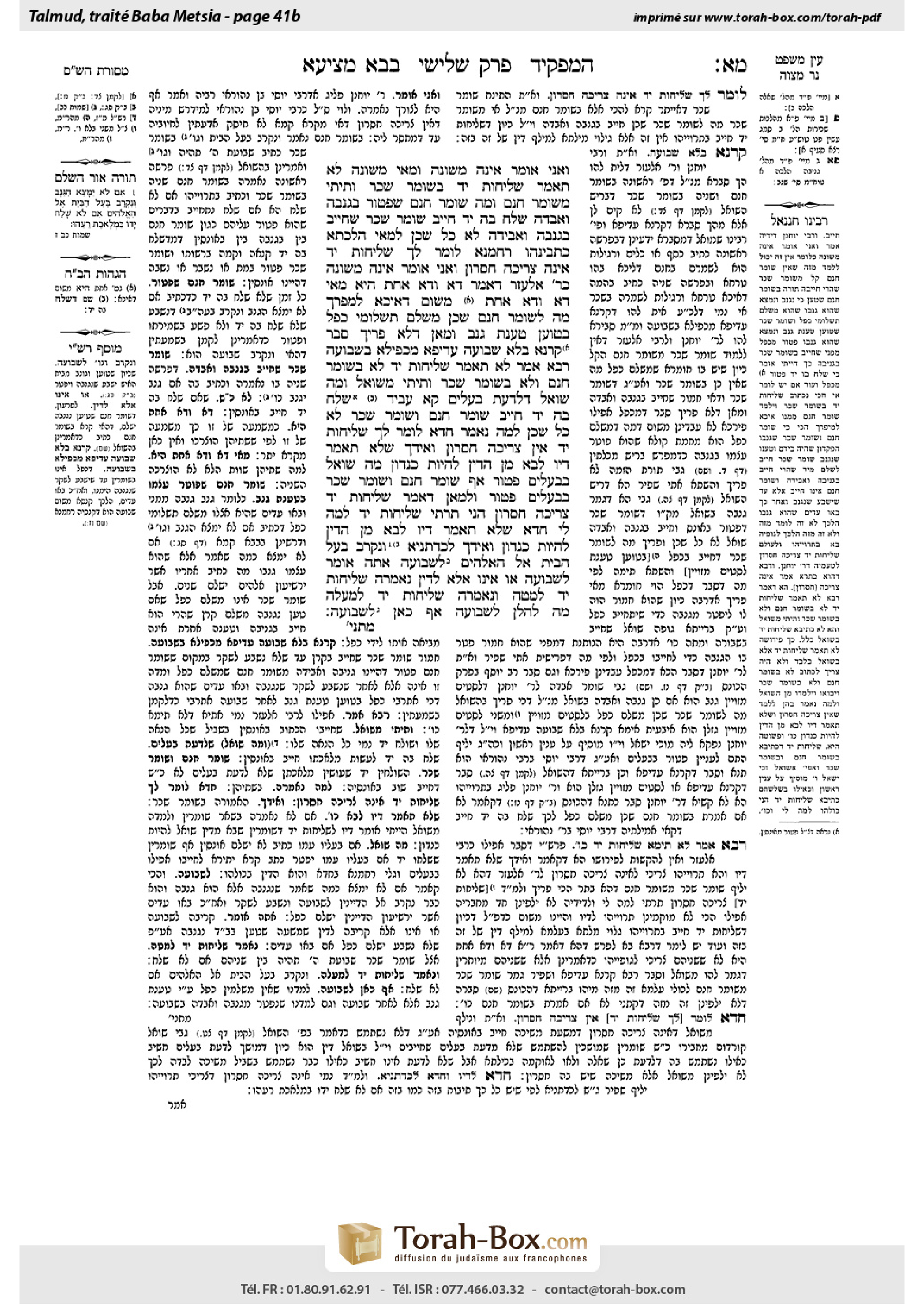
Bava Metzia 41b: Talmud study for Daf Yomi
Study the Talmud for Daf Yomi with scanned pages, Hebrew text, English translations from Sefaria and AI-generated French translations.
Passage selection and English or AI-generated French translation are available where the scan has annotations. Daf Study is independent of Torah-Box and Sefaria.
Browse Bava Metzia · בבא מציעא · All tractatesBava Metzia 41b text and translations
This page of Bava Metzia includes the Aramaic text, an English translation and an AI-generated French translation, alongside the scan above.
בבא מציעא מ״א ב · Aramaic and Hebrew text
וַאֲנִי אוֹמֵר אֵינָהּ מְשׁוּנָּה.
וּמַאי מְשׁוּנָּה? לֹא תֵּאָמֵר שְׁלִיחוּת יָד בְּשׁוֹמֵר שָׂכָר, וְתֵיתֵי מִשּׁוֹמֵר חִנָּם: וּמָה שׁוֹמֵר חִנָּם שֶׁפָּטוּר בִּגְנֵבָה וַאֲבֵדָה שָׁלַח בָּהּ יָד – חַיָּיב, שׁוֹמֵר שָׂכָר שֶׁחַיָּיב בִּגְנֵבָה וַאֲבֵידָה לֹא כׇּל שֶׁכֵּן. לְמַאי הִלְכְתָא כַּתְבִינְהוּ רַחֲמָנָא? לוֹמַר לָךְ: שְׁלִיחוּת יָד אֵינָהּ צְרִיכָה חֶסְרוֹן.
וַאֲנִי אוֹמֵר: אֵינָהּ מְשׁוּנָּה כְּרַבִּי אֶלְעָזָר, דְּאָמַר: דָּא וְדָא אַחַת הִיא. מַאי דָּא וְדָא אַחַת? מִשּׁוּם דְּאִיכָּא לְמִפְרַךְ: מָה לְשׁוֹמֵר חִנָּם, שֶׁכֵּן מְשַׁלֵּם תַּשְׁלוּמֵי כֶפֶל בְּטוֹעֵן טַעֲנַת גַּנָּב.
וּמַאן דְּלָא פָּרֵיךְ סָבַר: קַרְנָא בְּלָא שְׁבוּעָה עֲדִיפָא מִכְּפֵילָא בִּשְׁבוּעָה.
רָבָא אָמַר: לֹא תֵּאָמֵר שְׁלִיחוּת יָד לֹא בְּשׁוֹמֵר חִנָּם וְלֹא בְּשׁוֹמֵר שָׂכָר, וְתֵיתֵי מִשּׁוֹאֵל. וּמַה שׁוֹאֵל דִּלְדַעַת בְּעָלִים קָא עָבֵיד שָׁלַח בָּהּ יָד – חַיָּיב, שׁוֹמֵר חִנָּם וְשׁוֹמֵר שָׂכָר לֹא כׇּל שֶׁכֵּן.
לָמָּה נֶאֱמַר? חֲדָא לוֹמַר לָךְ: שְׁלִיחוּת יָד אֵין צְרִיכָה חֶסְרוֹן. וְאִידָּךְ: שֶׁלֹּא תֹּאמַר, דַּיּוֹ לַבָּא מִן הַדִּין לִהְיוֹת כְּנִידּוֹן. מָה שׁוֹאֵל בִּבְעָלִים פָּטוּר – אַף שׁוֹמֵר חִנָּם וְשׁוֹמֵר שָׂכָר בִּבְעָלִים פָּטוּר.
וּלְמַאן דְּאָמַר שְׁלִיחוּת יָד צְרִיכָה חֶסְרוֹן, הָנֵי תַּרְתֵּי שְׁלִיחוּת יָד לְמָה לִי? חֲדָא שֶׁלֹּא תֹּאמַר דַּיּוֹ לַבָּא מִן הַדִּין לִהְיוֹת כַּנִּדּוֹן.
וְאִידָּךְ לְכִדְתַנְיָא: ״וְנִקְרַב בַּעַל הַבַּיִת אֶל הָאֱלֹהִים״ לִשְׁבוּעָה. אַתָּה אוֹמֵר לִשְׁבוּעָה, אוֹ אֵינוֹ אֶלָּא לְדִין? נֶאֶמְרָה שְׁלִיחוּת יָד לְמַטָּה, וְנֶאֶמְרָה שְׁלִיחוּת יָד לְמַעְלָה, מָה לְהַלָּן לִשְׁבוּעָה – אַף כָּאן לִשְׁבוּעָה.
Bava Metzia 41b · English translation
Rabbi Yoḥanan continues: And I say that misappropriation by a paid bailee is not different.
The Gemara elaborates: And what is meant by: Misappropriation that is stated with regard to a paid bailee is different from misappropriation that is stated with regard to an unpaid bailee? As one could claim: Let misappropriation not be stated with regard to a paid bailee, and derive it from misappropriation with regard to an unpaid bailee by means of an a fortiori inference: And if an unpaid bailee, who is exempt in cases where he claims theft and loss, misappropriated the deposit, he is liable to pay, then a paid bailee, who is liable in cases where he claims theft and loss, all the more so is it not clear that he is liable if he misappropriated the deposit? With regard to what halakha did the Merciful One write misappropriation in the case of a paid bailee? It is to say to you: Misappropriation does not require loss; intent to misappropriate is enough to render him liable to pay.
Rabbi Yoḥanan stated: And I say that it is not different, in accordance with the opinion of Rabbi Elazar, who says: This case and that case are one. The Gemara elaborates: What is the meaning of: This and that are one? It means that it was necessary to teach misappropriation in both cases due to the fact that it can be refuted by an a fortiori inference: What is notable about an unpaid bailee? He is notable in that he pays the double payment when he falsely states the claim that a thief stole the deposit. A paid bailee reimburses the owner only for the cost of the deposit in that case. The legal status of the paid bailee is not consistently more stringent than that of an unpaid bailee, and therefore no a fortiori inference is possible.
The Gemara comments: And the one who does not refute the a fortiori inference holds: The absolute requirement to pay the principal even without having taken a false oath is more stringent than the requirement to pay the double payment that is effected only with the bailee taking a false oath. In his opinion, the legal status of the paid bailee is consistently more stringent than that of an unpaid bailee, and therefore an a fortiori inference is possible.
Rava says: The verse should not state misappropriation, neither with regard to an unpaid bailee nor with regard to a paid bailee, and one can derive it by means of an a fortiori inference from misappropriation with regard to a borrower: And if a borrower, who utilizes the deposit with the knowledge of the owner, misappropriated the deposit, he is liable to pay, then with regard to an unpaid bailee and a paid bailee, who may not utilize the deposit at all, all the more so is it not clear that they are liable to pay if they misappropriate the deposit?
Why, then, is the halakha of misappropriation stated in the cases of the unpaid and paid bailees? One mention is to say to you: Misappropriation does not require loss. And the other mention is so that you will not say: With regard to this a fortiori inference, there is a principle: It is sufficient for the conclusion inferred from an a fortiori inference to be like the source of the inference, and thereby conclude: Just as a borrower who is in partnership with the owner is exempt, so too, an unpaid bailee and a paid bailee who are in partnership with the owner are exempt. Consequently, it was necessary for the verse to mention the halakha of misappropriation with regard to both the paid and unpaid bailee.
The Gemara asks: And according to the one who says: Misappropriation requires a loss, why do I need these two mentions of misappropriation? The Gemara explains: One mention is so that you will not say with regard to this a fortiori inference the principle: It is sufficient for the conclusion that emerges from an a fortiori inference to be like its source.
And the other mention is for that which is taught in a baraita. It is written: “And the master of the house shall approach the judges to determine whether he misappropriated his neighbor’s goods” (Exodus 22:7). This is stated with regard to an oath. Do you say that it is stated with regard to an oath, or is it stated only with regard to judgment? Misappropriation is stated below, in a later verse in the chapter: “Whether he misappropriated his neighbor’s goods” (Exodus 22:10), and misappropriation is stated above, in an earlier verse in the chapter: “Whether he misappropriated his neighbor’s goods” (Exodus 22:7). Just as below it is stated explicitly with regard to an oath: “The oath of the Lord shall be between them both to determine whether he misappropriated his neighbor’s goods” (Exodus 22:10), so too here, it is stated with regard to an oath and not merely for judgment.
Bava Metzia 41b · Traduction française (IA)
Rabbi Yoḥanan continue : Et je dis que le détournement d'un dépositaire rémunéré n'est pas différent.
Le Guemara développe : Et que signifie : le détournement qui est mentionné en ce qui concerne un dépositaire rémunéré est différent du détournement qui est mentionné en ce qui concerne un dépositaire non rémunéré ? On pourrait dire : ne mentionnez pas le détournement en ce qui concerne un dépositaire rémunéré, et déduisez-le du détournement en ce qui concerne un dépositaire non rémunéré par une inférence a fortiori : Et si un dépositaire non rémunéré, qui est exempt dans les cas où il affirme un vol et une perte, a détourné le dépôt, il est tenu de payer, alors un dépositaire rémunéré, qui est tenu de payer dans les cas où il affirme un vol et une perte, tout autant que cela est clair qu'il est tenu de payer s'il a détourné le dépôt ? Par rapport à quelle halakha l'Éternel Miséricordieux a-t-il écrit le détournement dans le cas d'un dépositaire rémunéré ? Il dit : le détournement ne nécessite pas une perte ; l'intention de détournement suffit à le rendre tenu de payer.
Rabbi Yoḥanan a dit : Et je dis qu'il n'est pas différent, conformément à l'opinion de Rabbi Elazar, qui dit : ce cas et celui-ci sont un seul. Le Guemara développe : Que signifie : ce et cela sont un seul ? Cela signifie que l'enseignement du détournement a été nécessaire dans les deux cas en raison du fait qu'il peut être réfuté par une inférence a fortiori : Qu'est-ce qui est notable d'un dépositaire non rémunéré ? C'est qu'il paie double en cas où il affirme faussement que un voleur a volé le dépôt. Un dépositaire rémunéré répare l'owner uniquement pour le coût du dépôt dans ce cas. Le statut juridique du dépositaire rémunéré n'est pas systématiquement plus exigeant que celui du dépositaire non rémunéré, et par conséquent, aucune inférence a fortiori n'est possible.
Le Guemara commente : Et celui qui ne réfute pas l'inférence a fortiori dit : la nécessité absolue de payer le principal même sans avoir pris un faux serment est plus exigeante que la nécessité de payer doublement qui est effectuée uniquement lorsque le dépositaire prend un faux serment. À son avis, le statut juridique du dépositaire rémunéré est systématiquement plus exigeant que celui du dépositaire non rémunéré, et par conséquent, une inférence a fortiori est possible.
Rava dit : Le verset ne devrait pas mentionner le détournement, ni en ce qui concerne un dépositaire non rémunéré ni en ce qui concerne un dépositaire rémunéré, et l'on peut le déduire par une inférence a fortiori à partir du détournement en ce qui concerne un emprunteur : Et si un emprunteur, qui utilise le dépôt avec la connaissance du propriétaire, a détourné le dépôt, il est tenu de payer, alors en ce qui concerne un dépositaire non rémunéré et un dépositaire rémunéré, qui ne peuvent pas utiliser le dépôt du tout, tout autant que cela est clair qu'ils sont tenu de payer s'ils détournent le dépôt.
Pourquoi, alors, la halakha du détournement est-elle mentionnée dans les cas des dépositaires non rémunérés et rémunérés ? Une mention est pour vous dire : le détournement ne nécessite pas une perte. Et l'autre mention est afin que vous ne disiez pas : en ce qui concerne cette inférence a fortiori, il y a un principe : la conclusion tirée d'une inférence a fortiori suffit à être comme la source de l'inférence, et par conséquent, conclure : Tout comme un emprunteur qui est en partenariat avec le propriétaire est exempt, ainsi un dépositaire non rémunéré et un dépositaire rémunéré qui sont en partenariat avec le propriétaire sont exempt. Par conséquent, il a été nécessaire que le verset mentionne la halakha du détournement en ce qui concerne les deux dépositaires rémunérés et non rémunérés.
Le Guemara pose la question : Et selon celui qui dit : le détournement nécessite une perte, pourquoi ai-je besoin de ces deux mentions du détournement ? Le Guemara explique : une mention est afin que vous ne disiez pas en ce qui concerne cette inférence a fortiori le principe : il suffit que la conclusion qui émerge d'une inférence a fortiori soit comme sa source.
Et l'autre mention est pour ce qui est enseigné dans une baraïta. Il est écrit : « Et le maître de la maison approchera les juges pour déterminer s'il a détourné les biens de son voisin » (Exode 22:7). Cela est mentionné en ce qui concerne un serment. Dis-tu que cela est mentionné en ce qui concerne un serment, ou est-il mentionné uniquement en ce qui concerne un jugement ? Le détournement est mentionné plus bas, dans un verset ultérieur du chapitre : « S'il a détourné les biens de son voisin » (Exode 22:10), et le détournement est mentionné plus haut, dans un verset antérieur du chapitre : « S'il a détourné les biens de son voisin » (Exode 22:7). Tout comme plus bas il est mentionné explicitement en ce qui concerne un serment : « Le serment de l'Éternel sera entre eux deux pour déterminer s'il a détourné les biens de son voisin » (Exode 22:10), ainsi ici, il est mentionné en ce qui concerne un serment et non pas uniquement pour le jugement.
Traduction française générée par IA à partir de l’édition anglaise de Sefaria. Vérifie toujours un passage avec le texte source.
Text from Sefaria: William Davidson Edition - Vocalized Aramaic (CC BY NC); William Davidson Edition - English (CC BY NC).