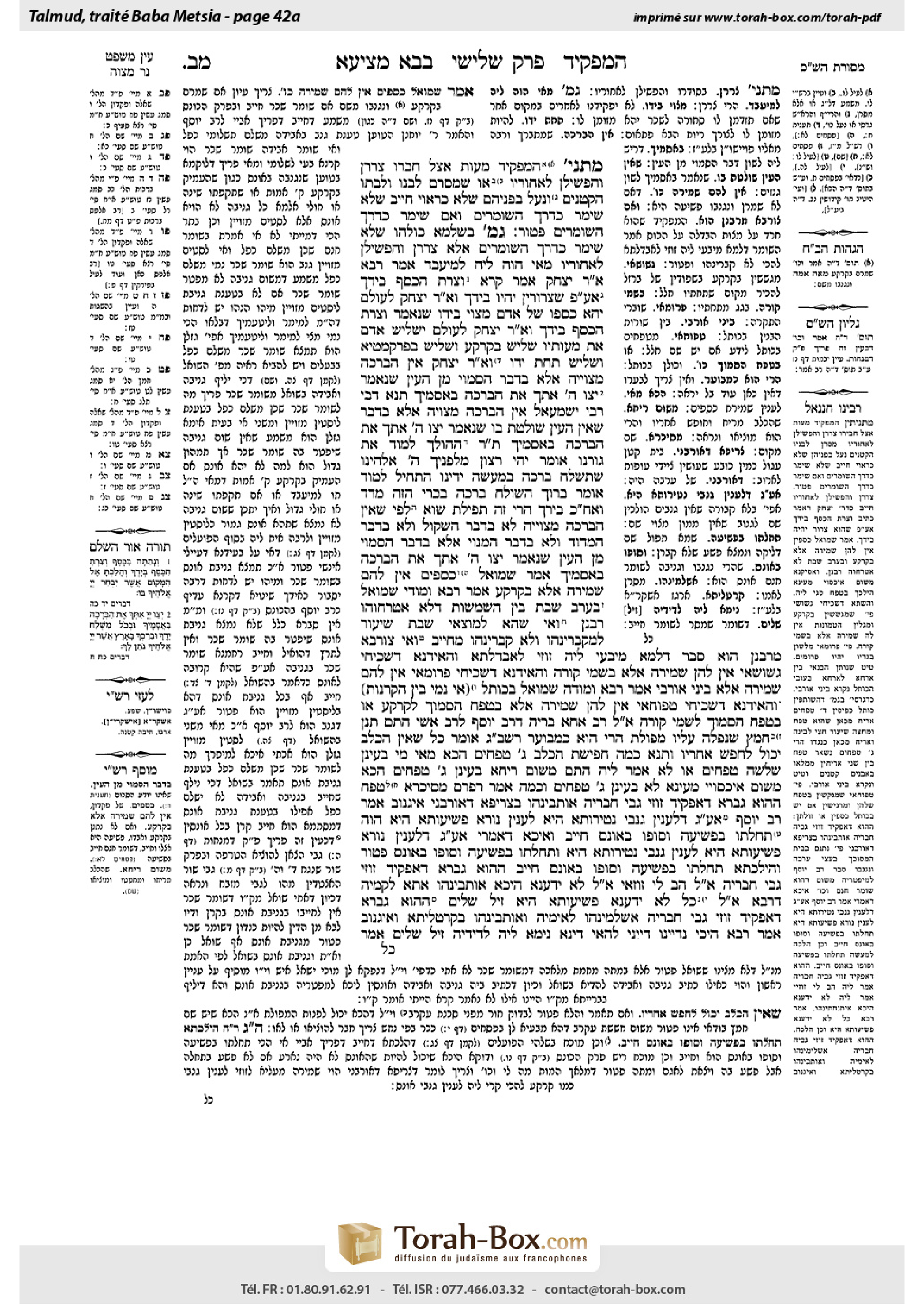
Bava Metzia 42a: Talmud study for Daf Yomi
Study the Talmud for Daf Yomi with scanned pages, Hebrew text, English translations from Sefaria and AI-generated French translations.
Passage selection and English or AI-generated French translation are available where the scan has annotations. Daf Study is independent of Torah-Box and Sefaria.
Browse Bava Metzia · בבא מציעא · All tractatesBava Metzia 42a text and translations
This page of Bava Metzia includes the Aramaic text, an English translation and an AI-generated French translation, alongside the scan above.
בבא מציעא מ״ב א · Aramaic and Hebrew text
מַתְנִי׳ הַמַּפְקִיד מָעוֹת אֵצֶל חֲבֵרוֹ, צְרָרָן וְהִפְשִׁילָן לַאֲחוֹרָיו, אוֹ שֶׁמְּסָרָם לִבְנוֹ וּלְבִתּוֹ הַקְּטַנִּים, וְנָעַל בִּפְנֵיהֶם שֶׁלֹּא כָּרָאוּי – חַיָּיב, שֶׁלֹּא שִׁימֵּר כְּדֶרֶךְ הַשּׁוֹמְרִים. וְאִם שִׁימֵּר כְּדֶרֶךְ הַשּׁוֹמְרִים – פָּטוּר.
גְּמָ׳ בִּשְׁלָמָא כּוּלְּהוּ שֶׁלֹּא שִׁימֵּר כְּדֶרֶךְ הַשּׁוֹמְרִים. אֶלָּא צְרָרָן וְהִפְשִׁילָן לַאֲחוֹרָיו, מַאי הֲוָה לֵיהּ לְמִיעְבַּד? אָמַר רָבָא אָמַר רַבִּי יִצְחָק אָמַר קְרָא: ״וְצַרְתָּ הַכֶּסֶף בְּיָדְךָ״, אַף עַל פִּי שֶׁצְּרוּרִין – יִהְיוּ בְּיָדְךָ.
וְאָמַר רַבִּי יִצְחָק: לְעוֹלָם יְהֵא כַּסְפּוֹ שֶׁל אָדָם מָצוּי בְּיָדוֹ, שֶׁנֶּאֱמַר: ״וְצַרְתָּ הַכֶּסֶף בְּיָדְךָ״. וְאָמַר רַבִּי יִצְחָק: לְעוֹלָם יַשְׁלִישׁ אָדָם אֶת מְעוֹתָיו, שְׁלִישׁ בְּקַרְקַע, וּשְׁלִישׁ בִּפְרַקְמַטְיָא, וּשְׁלִישׁ תַּחַת יָדוֹ.
וְאָמַר רַבִּי יִצְחָק: אֵין הַבְּרָכָה מְצוּיָה אֶלָּא בְּדָבָר הַסָּמוּי מִן הָעַיִן, שֶׁנֶּאֱמַר: ״יְצַו ה׳ אִתְּךָ אֶת הַבְּרָכָה בַּאֲסָמֶיךָ״. תָּנָא דְּבֵי רַבִּי יִשְׁמָעֵאל: אֵין הַבְּרָכָה מְצוּיָה אֶלָּא בְּדָבָר שֶׁאֵין הָעַיִן שׁוֹלֶטֶת בּוֹ, שֶׁנֶּאֱמַר: ״יְצַו ה׳ אִתְּךָ אֶת הַבְּרָכָה בַּאֲסָמֶיךָ״.
תָּנוּ רַבָּנַן: הַהוֹלֵךְ לָמוֹד אֶת גּוֹרְנוֹ, אוֹמֵר: ״יְהִי רָצוֹן מִלְּפָנֶיךָ ה׳ אֱלֹהֵינוּ שֶׁתִּשְׁלַח בְּרָכָה בְּמַעֲשֵׂה יָדֵינוּ״. הִתְחִיל לָמוֹד, אוֹמֵר: ״בָּרוּךְ הַשּׁוֹלֵחַ בְּרָכָה בַּכְּרִי הַזֶּה״. מָדַד וְאַחַר כָּךְ בֵּירַךְ – הֲרֵי זֶה תְּפִילַּת שָׁוְא, לְפִי שֶׁאֵין הַבְּרָכָה מְצוּיָה לֹא בְּדָבָר הַשָּׁקוּל וְלֹא בְּדָבָר הַמָּדוּד וְלֹא בְּדָבָר הַמָּנוּי, אֶלָּא בְּדָבָר הַסָּמוּי מִן הָעַיִן, שֶׁנֶּאֱמַר: ״יְצַו ה׳ אִתְּךָ אֶת הַבְּרָכָה בַּאֲסָמֶיךָ״.
אָמַר שְׁמוּאֵל: כְּסָפִים אֵין לָהֶם שְׁמִירָה אֶלָּא בַּקַּרְקַע. אָמַר רָבָא: וּמוֹדֵי שְׁמוּאֵל בְּעֶרֶב שַׁבָּת בֵּין הַשְּׁמָשׁוֹת, דְּלָא אַטְרְחוּהּ רַבָּנַן. וְאִי שְׁהָא לְמוֹצָאֵי שַׁבָּת שִׁעוּר לְמִקְבְּרִינְהוּ וְלָא קַבְרִינְהוּ – מְחַיַּיב. וְאִי צוּרְבָּא מֵרַבָּנַן הוּא סָבַר: דִּלְמָא מִיבְּעֵי לֵיהּ זוּזֵי לְאַבְדַּלְתָּא.
וְהָאִידָּנָא דִּשְׁכִיחִי גָּשׁוֹשָׁאֵי – אֵין לָהֶן שְׁמִירָה אֶלָּא בִּשְׁמֵי קוֹרָה. וְהָאִידָּנָא דִּשְׁכִיחִי פָּרוֹמָאֵי – אֵין לָהֶם שְׁמִירָה אֶלָּא בֵּינֵי אוּרְבֵי. אָמַר רָבָא: וּמוֹדֶה שְׁמוּאֵל בְּכוֹתֶל, אִי נָמֵי בֵּין הַקְּרָנוֹת. וְהָאִידָּנָא דִּשְׁכִיחִי טָפוֹחָאֵי – אֵין לָהֶן שְׁמִירָה אֶלָּא בְּטֶפַח הַסָּמוּךְ לַקַּרְקַע, אוֹ בְּטֶפַח הַסָּמוּךְ לִשְׁמֵי קוֹרָה.
אֲמַר לֵיהּ רַב אַחָא בְּרֵיהּ דְּרַב יוֹסֵף לְרַב אָשֵׁי: הָתָם תְּנַן: חָמֵץ שֶׁנָּפְלָה עָלָיו מַפּוֹלֶת – הֲרֵי הוּא כִּמְבוֹעָר. רַבָּן שִׁמְעוֹן בֶּן גַּמְלִיאֵל אוֹמֵר: כֹּל שֶׁאֵין הַכֶּלֶב יָכוֹל לְחַפֵּשׂ אַחֲרָיו. וְתָנָא: כַּמָּה חֲפִישַׂת הַכֶּלֶב – שְׁלֹשָׁה טְפָחִים. הָכָא מַאי? מִי בָּעֵינַן שְׁלֹשָׁה טְפָחִים אוֹ לָא?
אֲמַר לֵיהּ: הָתָם מִשּׁוּם רֵיחָא – בָּעֵינַן שְׁלֹשָׁה טְפָחִים. הָכָא מִשּׁוּם אִיכַּסּוֹיֵי מֵעֵינָא – לָא בָּעֵינַן שְׁלֹשָׁה טְפָחִים. וְכַמָּה? אָמַר רַפְרָם מִסִּיכְרָא: טֶפַח.
הָהוּא גַּבְרָא דְּאַפְקֵיד זוּזֵי גַּבֵּי חַבְרֵיהּ, אוֹתְבִינְהוּ בִּצְרִיפָא דְאוּרְבָּנֵי, אִיגְּנוּב. אָמַר רַב יוֹסֵף: אַף עַל גַּב דִּלְעִנְיַן גַּנָּבֵי – נְטִירוּתָא הִיא, לְעִנְיַן נוּרָא – פְּשִׁיעוּתָא הִיא, הָוֵה תְּחִילָּתוֹ בִּפְשִׁיעָה וְסוֹפוֹ בְּאוֹנֶס – חַיָּיב. וְאִיכָּא דְּאָמְרִי: אַף עַל גַּב דִּלְעִנְיַן נוּרָא – פְּשִׁיעוּתָא הִיא, לְעִנְיַן גַּנָּבֵי – נְטִירוּתָא הִיא, וּתְחִלָּתוֹ בִּפְשִׁיעָה וְסוֹפוֹ בְּאוֹנֶס – פָּטוּר. וְהִילְכְתָא: תְּחִילָּתוֹ בִּפְשִׁיעָה וְסוֹפוֹ בְּאוֹנֶס – חַיָּיב.
הָהוּא גַּבְרָא דְּאַפְקֵיד זוּזֵי גַּבֵּי חַבְרֵיהּ, אֲמַר לֵיהּ: הַב לִי זוּזַאי! אֲמַר לֵיהּ: לָא יָדַעְנָא הֵיכָא אוֹתְבִינְהוּ. אֲתָא לְקַמֵּיהּ דְּרָבָא, אֲמַר לֵיהּ: כֹּל ״לָא יָדַעְנָא״ פְּשִׁיעוּתָא הִיא, זִיל שַׁלֵּם.
הָהוּא גַּבְרָא דְּאַפְקֵיד זוּזֵי גַּבֵּי חַבְרֵיהּ, אַשְׁלְמִינְהוּ לְאִימֵּיהּ, וְאוֹתְבִינְהוּ בְּקַרְטְלִיתָא, וְאִיגְּנוּב. אָמַר רָבָא: הֵיכִי נְדַיְינוּ דַּיָּינֵי לְהַאי דִּינָא?
נֵימָא לֵיהּ לְדִידֵיהּ: זִיל שַׁלֵּים, אָמַר:
Bava Metzia 42a · English translation
MISHNA: In the case of one who deposited coins with another, and that bailee bound it in a cloth and slung it behind him, or conveyed them to his minor son or daughter for safeguarding, or locked the door before them in an inappropriate, i.e., insufficient, manner to secure them, the bailee is liable to pay for the coins, as he did not safeguard the coins in the manner typical of bailees. But if he safeguarded the money in the manner that bailees safeguard items and it was nevertheless stolen, he is exempt.
GEMARA: Granted, for all the other cases, the bailee is liable to pay, as he did not safeguard the money in the manner that bailees safeguard items. But if the bailee bound it in a cloth and slung it behind him, what more was he to do? Rava says that Rabbi Yitzḥak said: The verse states: “And you shall bind up the money in your hand” (Deuteronomy 14:25), from which it is derived: Although it is bound, in order to safeguard the money, it must be in your hand.
And apropos that verse, Rabbi Yitzḥak says: A person’s money should always be found in his possession. He should not invest all of his money, leaving him with no money available for expenditures, as it is stated: “And you shall bind up the money in your hand.” And Rabbi Yitzḥak says: A person should always divide his money into three; he should bury one-third in the ground, and invest one-third in business [bifrakmatya], and keep one-third in his possession.
And Rabbi Yitzḥak says: Blessing is found only in a matter concealed from the eye, as it is stated: “The Lord will command blessing with you in your storehouses” (Deuteronomy 28:8), where the grain is concealed. The school of Rabbi Yishmael taught: Blessing is found only in a matter over which the eye has no dominion, as it is stated: “The Lord will command blessing with you in your storehouses.”
The Sages taught: One who goes to measure the grain on his threshing floor recites: May it be Your will, O Lord, our God, that You send blessing upon the product of our hands. If one began to measure the grain he says: Blessed is He Who sends blessing upon this pile of grain. If one measured and afterward recited this blessing, this is a prayer made in vain, because blessing is found neither in a matter that is weighed, nor in a matter that is measured, nor in a matter that is counted. Rather, it is found in a matter concealed from the eye, as it is stated: “The Lord will command blessing with you in your storehouses.”
§ Shmuel says: There is safeguarding for money only in the ground. Rava said: And Shmuel concedes if one received a deposit on Shabbat eve at twilight, that the Rabbis did not impose upon him to bury it in the ground immediately. And if, at the conclusion of Shabbat, he delayed and did not bury the money within the period of time needed to bury it, he is liable to pay the owner if it is stolen. And if the one who deposited the money is a Torah scholar and the bailee thought: Perhaps he requires money for havdala, and that is the reason that he did not bury the money immediately, then he may delay burying the money a bit longer.
The Gemara comments: And now that rummagers, who dig to find and steal buried property, are commonplace, there is safeguarding for money only in the beams of the roof of a house. The Gemara comments: And now that dismantlers, who attempt to find and steal property hidden in beams, are commonplace, there is safeguarding for money only between the bricks of a wall. Rava said: And Shmuel concedes that money can be safeguarded in the wall or, alternatively, between the corners of the house. And now that tappers, who tap on walls to find and steal property hidden there, are commonplace, there is safeguarding for money only in the handbreadth of the wall adjacent to the ground or in the handbreadth of the wall adjacent to the ceiling, as tapping on the wall will not reveal their existence.
Rav Aḥa, son of Rav Yosef, said to Rav Ashi: We learned in a mishna there (Pesaḥim 31b): The legal status of leavened bread upon which a rockslide fell is like that of leavened bread that was eliminated, as it will remain there forever. Rabban Shimon ben Gamliel says: This ruling applies in any case where the leavened bread is covered to the extent that a dog is unable to detect it. And it is taught: How much is the measure of detection of a dog? It is three handbreadths. The question is: Here, what is the halakha? Do we require the money to be buried at a depth of three handbreadths or not?
Rav Ashi said to Rav Aḥa: There, with regard to bread, it is due to the scent that we require three handbreadths to obscure it from the dog. Here, with regard to money, it is because it must be obscured from the eye that we bury it. Scent is not relevant, and therefore we do not need three handbreadths. The Gemara asks: And how deep must the money be buried? Rafram from Sikhera said: One handbreadth.
The Gemara relates: There was a certain man who deposited money with another, and the bailee placed it in a willow hut from which the money was stolen. Rav Yosef said: Although with regard to thieves, placing the money in the hut is effective safeguarding, with regard to fire it is negligence, as it is likely to burn. Therefore, it is a case where the incident was initially through negligence and ultimately by accident, and the bailee is liable to pay. And some say: Although with regard to fire it is negligence, with regard to thieves it is effective safeguarding. Therefore, it is a case where the beginning of the incident was negligence and ultimately the damage was caused by accident, and the bailee is exempt. The Gemara concludes: And the halakha is: In a case where the incident was initially through negligence and ultimately by accident, the bailee is liable to pay.
The Gemara relates: There was a certain man who deposited money with another. Eventually, the owner of the money said to the bailee: Give me my money. The bailee said to him: I do not know where I placed it. The matter came before Rava, who said to the bailee: Every circumstance where a bailee claims: I do not know, is in and of itself negligence; go pay.
The Gemara relates: There was a certain man who deposited money with another. The bailee gave the money to his mother, and she placed the money in a chest [bekartalita], and it was stolen. Rava said: How should judges rule in this case?
Let us say to the bailee: Go pay. But he can say: There is a principle:
Bava Metzia 42a · Traduction française (IA)
MICHNA: Dans le cas d'une personne ayant déposé des pièces auprès d'une autre, et que ce dépositaire les ait enveloppées dans un tissu et suspendues derrière lui, ou les ait confiées à son fils ou sa fille mineure pour les garder, ou qu'il ait verrouillé la porte devant elles d'une manière inappropriée, c'est-à-dire insuffisante, pour les sécuriser, le dépositaire est tenu de payer pour les pièces, car il n'a pas gardé les pièces de la manière habituelle pour un dépositaire. Mais si il a gardé l'argent de la manière dont les dépositaires gardent les objets et qu'il a toutefois été volé, il est exempt.
GUEMARA: C'est évident, pour tous les autres cas, le dépositaire est tenu de payer, car il n'a pas gardé l'argent de la manière dont les dépositaires gardent les objets. Mais si le dépositaire a enveloppé les pièces dans un tissu et les a suspendues derrière lui, qu'est-ce qu'il devait de plus faire ? Rava dit que Rabbi Yitzḥak a dit : La Parashah dit : « Et tu enverras l'argent de ta main » (Deutéronome 14:25), d'où on déduit : Bien que l'argent soit enveloppé, afin de le garder, il doit être en ta main.
Et à propos de cette Parashah, Rabbi Yitzḥak dit : L'argent d'une personne doit toujours être trouvé en sa possession. Il ne doit pas investir tout son argent, laissant ainsi à l'homme rien à dépenser, comme il est dit : « Et tu enverras l'argent de ta main ». Et Rabbi Yitzḥak dit : Une personne doit toujours diviser son argent en trois ; il doit enterrer un tiers dans le sol, investir un tiers en affaires [bifrakmatya], et garder un tiers en sa possession.
Et Rabbi Yitzḥak dit : La béatitude est trouvée seulement dans une chose cachée des yeux, comme il est dit : « L'Éternel ordonnera la béatitude avec toi dans tes entrepôts » (Deutéronome 28:8), où le grain est caché. La maison de Rabbi Yishmael enseigna : La béatitude est trouvée seulement dans une chose sur laquelle les yeux n'ont pas de pouvoir, comme il est dit : « L'Éternel ordonnera la béatitude avec toi dans tes entrepôts ».
Les Sages enseignèrent : Celui qui va mesurer le grain sur son tapis de meunier prie : Que soit ton vœu, ô Éternel, notre Dieu, que tu envoies la béatitude sur le produit de nos mains. Si l'on commence à mesurer le grain, on dit : Béni soit Celui qui envoie la béatitude sur cette pile de grain. Si l'on a mesuré et ensuite on récite cette prière, c'est une prière vaine, car la béatitude n'est trouvée ni dans une chose pesée, ni dans une chose mesurée, ni dans une chose comptée. Elle est trouvée dans une chose cachée des yeux, comme il est dit : « L'Éternel ordonnera la béatitude avec toi dans tes entrepôts ».
§ Shmuel dit : La sécurité de l'argent est seulement dans le sol. Rava dit : Et Shmuel reconnaît que si l'on a reçu un dépôt à la tombée du soir du sabbat, les Sages n'ont pas imposé à l'homme de l'enterrer immédiatement dans le sol. Et si, à la fin du sabbat, il a retardé et n'a pas enterré l'argent dans la période nécessaire pour l'enterrer, il est tenu de payer à l'owner si l'argent a été volé. Et si celui qui a déposé l'argent est un savant de la Torah et le dépositaire pensait : Peut-être qu'il a besoin d'argent pour la séparation du sabbat, et c'est pour cela qu'il n'a pas enterré l'argent immédiatement, alors il peut retarder un peu plus l'enterrage de l'argent.
La Guemara commente : Et maintenant que les voleurs, qui creusent pour trouver et voler des biens enterrés, sont nombreux, la sécurité de l'argent est seulement dans les poutres du toit d'une maison. La Guemara commente : Et maintenant que les démonteurs, qui essaient de trouver et de voler des biens cachés dans les poutres, sont nombreux, la sécurité de l'argent est seulement entre les briques d'un mur. Rava dit : Et Shmuel reconnaît que l'argent peut être sécurisé dans le mur ou, alternativement, entre les angles de la maison. Et maintenant que les tapoteurs, qui tapent sur les murs pour trouver et voler des biens cachés là, sont nombreux, la sécurité de l'argent est seulement dans la largeur d'un doigt du mur adjacent au sol ou dans la largeur d'un doigt du mur adjacent au plafond, car le tapotage sur le mur ne révélerait pas leur existence.
Rav Aḥa, fils de Rav Yosef, dit à Rav Ashi : Nous avons appris dans une mishna là (Pesaḥim 31b) : Le statut légal du pain levé sur lequel un glissement de rochers s'est produit est comme celui du pain levé qui a été éliminé, car il restera là pour toujours. Rabban Shimon ben Gamliel dit : Cette décision s'applique à tout cas où le pain levé est couvert à tel point que même un chien ne peut le détecter. Et il est enseigné : Quelle est la mesure de la détection d'un chien ? C'est trois doigts. La question est : Ici, quelle est la halakha ? Doit-on exiger que l'argent soit enterré à une profondeur de trois doigts ou non ?
Rav Ashi dit à Rav Aḥa : Là, concernant le pain, c'est à cause de l'odeur que nous exigeons trois doigts pour le cacher du chien. Ici, concernant l'argent, c'est à cause de la nécessité de le cacher des yeux que nous l'enterrons. L'odeur n'est pas pertinente, et par conséquent nous n'avons pas besoin de trois doigts. La Guemara pose la question : Et à quelle profondeur doit-on enterrer l'argent ? Rafram de Sikhera dit : Un doigt.
La Guemara rapporte : Il y avait un certain homme qui a déposé de l'argent auprès d'un autre, et le dépositaire l'a mis dans une hutte de saule, et l'argent a été volé. Rav Yosef dit : Bien que, concernant les voleurs, mettre l'argent dans la hutte soit une sécurité efficace, concernant le feu, c'est négligence, car il est susceptible de brûler. Donc, c'est un cas où l'incident a commencé par négligence et s'est terminé par accident, et le dépositaire est tenu de payer. Et certains disent : Bien que, concernant le feu, c'est négligence, concernant les voleurs, c'est une sécurité efficace. Donc, c'est un cas où le début de l'incident était négligence et la détérioration a été causée par accident, et le dépositaire est exempt. La Guemara conclut : Et la halakha est : Dans un cas où l'incident a commencé par négligence et s'est terminé par accident, le dépositaire est tenu de payer.
La Guemara rapporte : Il y avait un certain homme qui avait déposé de l'argent chez un autre. Finalement, le propriétaire de l'argent dit au dépositaire : Donne-moi mon argent. Le dépositaire lui dit : Je ne sais pas où je l'ai mis. L'affaire est venue devant Rava, qui a dit au dépositaire : Tout cas où un dépositaire affirme : Je ne sais pas, est en soi-même négligence ; va payer.
La Guemara rapporte : Il y avait un certain homme qui avait déposé de l'argent chez un autre. Le dépositaire a donné l'argent à sa mère, et elle l'a mis dans un coffre [bekartalita], et il a été volé. Rava a dit : Comment les juges doivent-ils décider dans ce cas-là ?
Disons au dépositaire : Va payer. Mais il peut dire : Il y a un principe :
Traduction française générée par IA à partir de l’édition anglaise de Sefaria. Vérifie toujours un passage avec le texte source.
Text from Sefaria: William Davidson Edition - Vocalized Aramaic (CC BY NC); William Davidson Edition - English (CC BY NC).