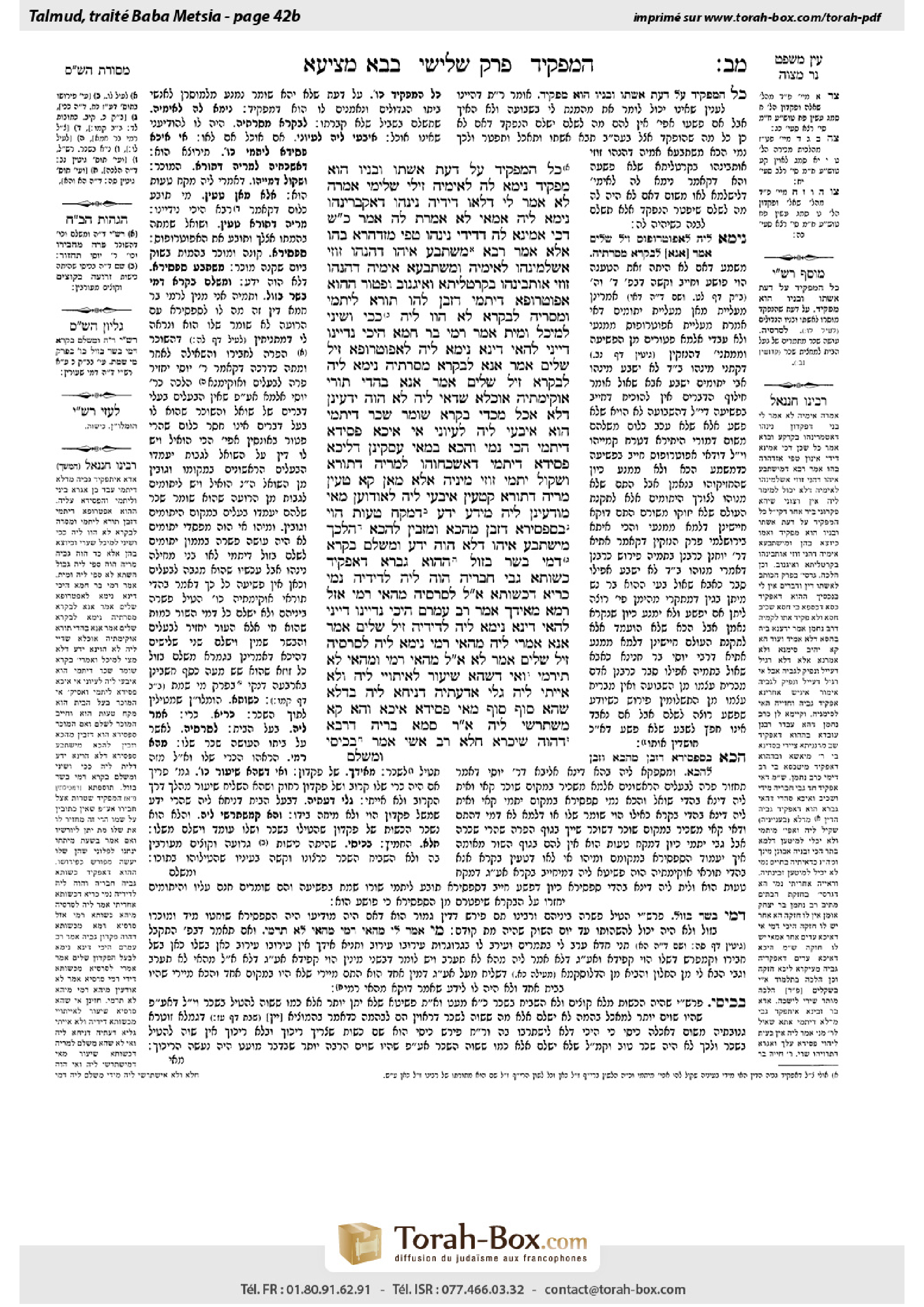
Bava Metzia 42b: Talmud study for Daf Yomi
Study the Talmud for Daf Yomi with scanned pages, Hebrew text, English translations from Sefaria and AI-generated French translations.
Passage selection and English or AI-generated French translation are available where the scan has annotations. Daf Study is independent of Torah-Box and Sefaria.
Browse Bava Metzia · בבא מציעא · All tractatesBava Metzia 42b text and translations
This page of Bava Metzia includes the Aramaic text, an English translation and an AI-generated French translation, alongside the scan above.
בבא מציעא מ״ב ב · Aramaic and Hebrew text
כׇּל הַמַּפְקִיד, עַל דַּעַת אִשְׁתּוֹ וּבָנָיו הוּא מַפְקִיד.
נֵימָא לַהּ לְאִימֵּיהּ: זִילִי שַׁלִּימִי, אָמְרָה: לָא אֲמַר לִי דְּלָאו דִּידֵיהּ נִינְהוּ דְּאֶקְבְּרִינְהוּ.
נֵימָא לֵיהּ: אַמַּאי לָא אֲמַרְתְּ לַהּ? אָמַר: כׇּל שֶׁכֵּן, דְּכִי אָמֵינָא לַהּ דְּדִידִי נִינְהוּ – טְפֵי מִזְדַּהֲרָא בְּהוּ.
אֶלָּא אָמַר רָבָא: מִשְׁתְּבַע אִיהוּ דְּהָנְהוּ זוּזֵי אַשְׁלְמִינְהוּ לְאִימֵּיהּ, וּמִשְׁתַּבְעָא אִימֵּיהּ דְּהָנְהוּ זוּזֵי אוֹתְבִינְהוּ בְּקַרְטְלִיתָא וְאִיגְּנוּב – וּפָטוּר.
הָהוּא אַפּוֹטְרוֹפָּא דְיַתְמֵי דִּזְבַן לְהוּ תּוֹרָא לְיַתְמֵי וּמַסְרֵיהּ לְבַקָּרָא. לָא הֲווֹ לֵיהּ כַּכֵּי וְשִׁינֵּי לְמֵיכַל, וּמִית. אָמַר רָמֵי בַּר חָמָא: הֵיכִי נְדַיְינוּ דַּיָּינֵי לְהַאי דִּינָא?
נֵימָא לֵיהּ לְאַפּוֹטְרוֹפָּא: זִיל שַׁלֵּים, אָמַר: אֲנָא לְבַקָּרָא מְסַרְתֵּיהּ.
נֵימָא לֵיהּ לְבַקָּרָא: זִיל שַׁלֵּים, אָמַר: אֲנָא בַּהֲדֵי תּוֹרֵי אוֹקֵימְתֵּיהּ, אוּכְלָא שְׁדַאי לֵיהּ, לָא הֲוָה יָדַעְינָא דְּלָא אֲכַל.
מִכְּדֵי בַּקָּרָא שׁוֹמֵר שָׂכָר דְּיַתְמֵי הוּא! אִיבְּעִי לֵיהּ לְעַיּוֹנֵי אִי אִיכָּא פְּסֵידָא דְיַתְמֵי. הָכִי נָמֵי, וְהָכָא בְּמַאי עָסְקִינַן – דְּלֵיכָּא פְּסֵידָא דְיַתְמֵי, דְּאַשְׁכְּחוּהּ לְמָרֵיהּ דְּתוֹרָא וּשְׁקוּל יַתְמֵי זוּזֵי מִינֵּיהּ.
אֶלָּא מַאן קָא טָעֵין? מָרֵיהּ דְּתוֹרָא קָטָעֵין. אִיבְּעִי לֵיהּ לְאוֹדוֹעַן! מַאי מוֹדְעִינַן לֵיהּ? מִידָּע יָדַע דְּמִקָּח טָעוּת הָוֵי. בְּסַפְסֵירָא דְּזָבֵן מֵהָכָא וּמְזַבֵּין לְהָכָא, הִלְכָּךְ מִישְׁתְּבַע אִיהוּ דְּלָא הֲוָה יָדַע, וּמְשַׁלֵּם בַּקָּרָא דְּמֵי בָשָׂר בְּזוֹל.
הָהוּא גַּבְרָא דְּאַפְקֵיד כְּשׁוּתָא גַּבֵּי חַבְרֵיהּ, הֲוָה לֵיהּ לְדִידֵיהּ נָמֵי כַּרְיָא דִכְשׁוּתָא. אֲמַר לֵיהּ לְסַרְסְיֵהּ: מֵהַאי רְמֵי. אֲזַל רְמָא מֵאִידַּךְ. אָמַר רַב עַמְרָם: הֵיכִי נְדַיְינוּ דַּיָּינֵי לְהַאי דִּינָא?
נֵימָא לֵיהּ לְדִידֵיהּ: זִיל שַׁלֵּים, אָמַר: אֲנָא אָמְרִי לֵיהּ מֵהַאי רְמִי.
נֵימָא לֵיהּ לְסַרְסְיֵהּ: זִיל שַׁלֵּים, אָמַר: לָא אֲמַר לִי מֵהַאי רְמִי וּמֵהַאי לָא תִּרְמֵי.
וְאִי דִּשְׁהָא שִׁיעוּר לְאֵיתוֹיֵי לֵיהּ וְלָא אַיְיתִי לֵיהּ – גַּלִּי אַדַּעְתֵּיהּ דְּנִיחָא לֵיהּ! בִּדְלָא שְׁהָא.
סוֹף סוֹף, מַאי פְּסֵידָא אִיכָּא? וְהָא קָא מִשְׁתָּרְשִׁי לֵיהּ! אָמַר רַב סַמָּא בְּרֵיהּ דְּרָבָא: דַּהֲוָה שִׁיכְרָא חַלָּא. רַב אָשֵׁי אָמַר: בְּכִיסֵי,
Bava Metzia 42b · English translation
With regard to anyone who deposits an item with another, it is with the awareness that at times, the bailee’s wife and his children will safeguard the item that he deposits it. Therefore, I was within my rights to give the deposit to my mother.
Let us say to his mother: Go and pay. She can say: My son did not tell me that the money is not his so that I should bury it, which is the optimal method to safeguard money.
Let us say to the bailee: Why did you not say to her that the money is not yours? He can say: All the more so that my omission of this information was preferable, as when I say to her that the money is mine, she is even more careful with it.
Rather, Rava said: The bailee takes an oath that he gave the money to his mother, and his mother takes an oath that she placed the money in the chest and it was stolen, and the bailee is exempt from payment.
The Gemara relates: There was a certain steward who acted on behalf of orphans, who purchased an ox for the orphans and passed it to the cowherd. This ox did not have molars and other teeth with which to eat, and the ox died because it was unable to eat the standard food of oxen. Rami bar Ḥama said: How should judges rule in this case?
Let them say to the steward: Go pay for the dead ox. But he can say: I gave it to the cowherd with the expectation that he would care for it.
Let us say to the cowherd: Go pay for the dead ox. He can say: I placed the ox with other oxen and I threw food before it. We did not know that it did not eat.
The Gemara asks: After all, the cowherd is a paid bailee of the orphans. Therefore, he was required to examine the situation and ascertain if the ox was eating. The Gemara answers: If there was loss for the orphans, indeed, the cowherd would be liable to pay. And with what are we dealing here? It is a case where there is no loss incurred by the orphans, as they found the previous owner of the ox, who sold it to them, and the orphans took their money back from him after discovering that the ox had this deficiency.
The Gemara asks: Rather, who then claims compensation from the cowherd? The previous owner of the ox claims compensation from the steward: He should have informed us that the ox was not eating. The Gemara answers: What would we inform the previous owner? He knows that it is a mistaken transaction, as he would be aware that the ox had no teeth. The Gemara explains: This is a case with regard to a trader who buys from here and sells to there and does not know the condition of the ox. Therefore, the trader takes an oath that he did not know about the ox’s defect, and the cowherd pays the value of the meat of the ox based on the cheapest price available in the market.
The Gemara relates: There was a certain man who deposited hops, used in the production of beer, with another. The bailee himself had a pile of hops. The bailee said to his brewer: Cast hops in the beer from this pile. The brewer went and cast from the other pile, the pile of the one who deposited the hops, into the beer. Rav Amram said: How should judges rule in this case?
Let us say to the bailee: Go pay. But he can say: I said to him, i.e., the brewer: Cast hops from this pile, and I am not at fault.
Let us say to the brewer: Go pay. He can say: The bailee did not say to me: Cast hops from this pile and do not cast hops from that pile. I thought he was merely giving advice, and I did not know that he was insistent that I refrain from using the other hops.
The Gemara comments: And if the hops of the bailee were closer to where he and the brewer were located than those that were deposited with him, the bailee should be liable. As, if the brewer delayed bringing the hops for the period of time that it would take to bring the bailee hops from his own pile and he did not yet bring them to him, it is assumed that the bailee understood that the brewer had gone to bring the more distant, deposited, hops. By not objecting, the bailee revealed that he was amenable to brewing the beer from the deposited hops. The Gemara answers: This is a case where he did not delay bringing the hops, or alternatively, the two piles were equidistant from him.
The Gemara asks: Ultimately, what loss is there? But doesn’t the bailee profit in this case? Let the bailee give the owner beer equal to the value of the hops that he took from the deposit and no one loses. Rav Sama, son of Rava, said: The Gemara is referring to a case where the beer ferments and becomes vinegar. Therefore, it is impossible to take the value of the hops from the beer. Rav Ashi said: It is referring to a case where the hops were mixed with thorns and did not enhance the beer.
Bava Metzia 42b · Traduction française (IA)
Concernant celui qui dépose un objet chez un autre, il est conscient que parfois la femme et les enfants du dépositaire préservent l'objet qu'il dépose. Ainsi, je suis dans mon droit de donner le dépôt à ma mère.
Disons à sa mère : Va payer. Elle peut répondre : Mon fils ne m'a pas dit que l'argent n'est pas le sien afin que je le mette en terre, ce qui est la méthode optimale pour préserver l'argent.
Disons au dépositaire : Pourquoi ne lui as-tu pas dit que l'argent n'est pas à elle ? Il peut répondre : Tout autant que cela, mon omission d'information était préférable, car lorsque je dis à elle que l'argent est à moi, elle est même plus attentive à le préserver.
En réalité, Rava a dit : Le dépositaire prend un serment qu'il a donné l'argent à sa mère, et sa mère prend un serment qu'elle a mis l'argent dans le coffre et qu'il a été volé, et le dépositaire est exempt de paiement.
La Guemara rapporte : Il y avait un certain steward qui agissait au nom des orphelins, qui a acheté un taureau pour les orphelins et l'a confié au berger. Ce taureau n'avait pas de molaires et d'autres dents pour manger, et le taureau est mort car il ne pouvait pas manger la nourriture habituelle des taureaux. Rami bar Ḥama a dit : Comment les juges doivent-ils décider dans ce cas ?
Disons au steward : Va payer pour le taureau mort. Mais il peut répondre : J'ai donné le taureau au berger en espérant qu'il le prendrait soin.
Disons au berger : Va payer pour le taureau mort. Il peut répondre : J'ai mis le taureau avec d'autres taureaux et j'ai mis de la nourriture devant lui. Nous ne savions pas qu'il ne mangeait pas.
La Guemara demande : Après tout, le berger est un dépositaire payé des orphelins. Il était donc tenu de vérifier la situation et d'assurer que le taureau mangeait. La Guemara répond : Si les orphelins avaient subi une perte, le berger serait responsable. Et avec quoi nous sommes ici ? C'est un cas où il n'y a pas de perte pour les orphelins, car ils ont trouvé le propriétaire précédent du taureau, qui les avait vendu, et les orphelins ont récupéré leur argent après avoir découvert que le taureau avait cette déficience.
La Guemara demande : En réalité, qui alors réclame une compensation au berger ? Le propriétaire précédent du taureau réclame une compensation au steward : Il aurait dû nous informer que le taureau ne mangeait pas. La Guemara répond : Qu'informons-nous alors au propriétaire précédent ? Il sait que c'est une transaction erronée, car il serait conscient que le taureau n'avait pas de dents. La Guemara explique : C'est un cas concernant un marchand qui achète ici et vend là, sans connaître l'état du taureau. Ainsi, le marchand prend un serment qu'il ne savait pas de l'avarie du taureau, et le berger paie la valeur de la viande du taureau selon le prix le plus bas du marché.
La Guemara rapporte : Il y avait un certain homme qui avait déposé des houblons, utilisés pour la fabrication de la bière, chez un autre. Le dépositaire avait lui-même une pile de houblons. Le dépositaire a dit à son boulanger : Mets des houblons dans la bière de cette pile. Le boulanger est allé mettre des houblons de la pile du déposant dans la bière. Rav Amram a dit : Comment les juges doivent-ils décider dans ce cas ?
Disons au dépositaire : Va payer. Mais il peut répondre : J'ai dit au boulanger, c'est-à-dire au boulanger : Mets des houblons de cette pile, et je ne suis pas coupable.
Disons au boulanger : Va payer. Il peut répondre : Le dépositaire n'a pas dit à moi : Mets des houblons de cette pile et ne mets pas des houblons de celle-ci. Je pensais qu'il me donnait simplement un conseil, et je ne savais pas qu'il insistait pour que je ne prenne pas les houblons de l'autre pile.
La Guemara commente : Et si les houblons du dépositaire étaient plus proches de l'endroit où il et le boulanger se trouvaient que ceux qui avaient été déposés chez lui, le dépositaire devrait être responsable. En effet, si le boulanger avait retardé l'apport des houblons pendant le temps nécessaire pour apporter les houblons du dépositaire depuis sa propre pile et qu'il n'avait pas encore apporté les houblons, on suppose que le dépositaire savait que le boulanger était allé apporter les houblons plus éloignés, déposés. En ne s'opposant pas, le dépositaire a montré qu'il était d'accord pour faire la bière avec les houblons déposés. La Guemara répond : C'est un cas où il n'y a pas eu de retard dans l'apport des houblons, ou bien les deux piles étaient à égale distance.
La Guemara demande : En fin de compte, quelle perte y a-t-il ? Mais ne profite-t-il pas le dépositaire dans ce cas ? Que le dépositaire donne à l'owner une bière égale à la valeur des houblons qu'il a pris du dépôt et personne ne perd. Rav Sama, fils de Rava, a dit : La Guemara parle d'un cas où la bière fermentait et devenait du vinaigre. Ainsi, il est impossible de prendre la valeur des houblons de la bière. Rav Ashi a dit : C'est un cas où les houblons étaient mélangés avec des épineux et n'avaient pas amélioré la bière.
Traduction française générée par IA à partir de l’édition anglaise de Sefaria. Vérifie toujours un passage avec le texte source.
Text from Sefaria: William Davidson Edition - Vocalized Aramaic (CC BY NC); William Davidson Edition - English (CC BY NC).