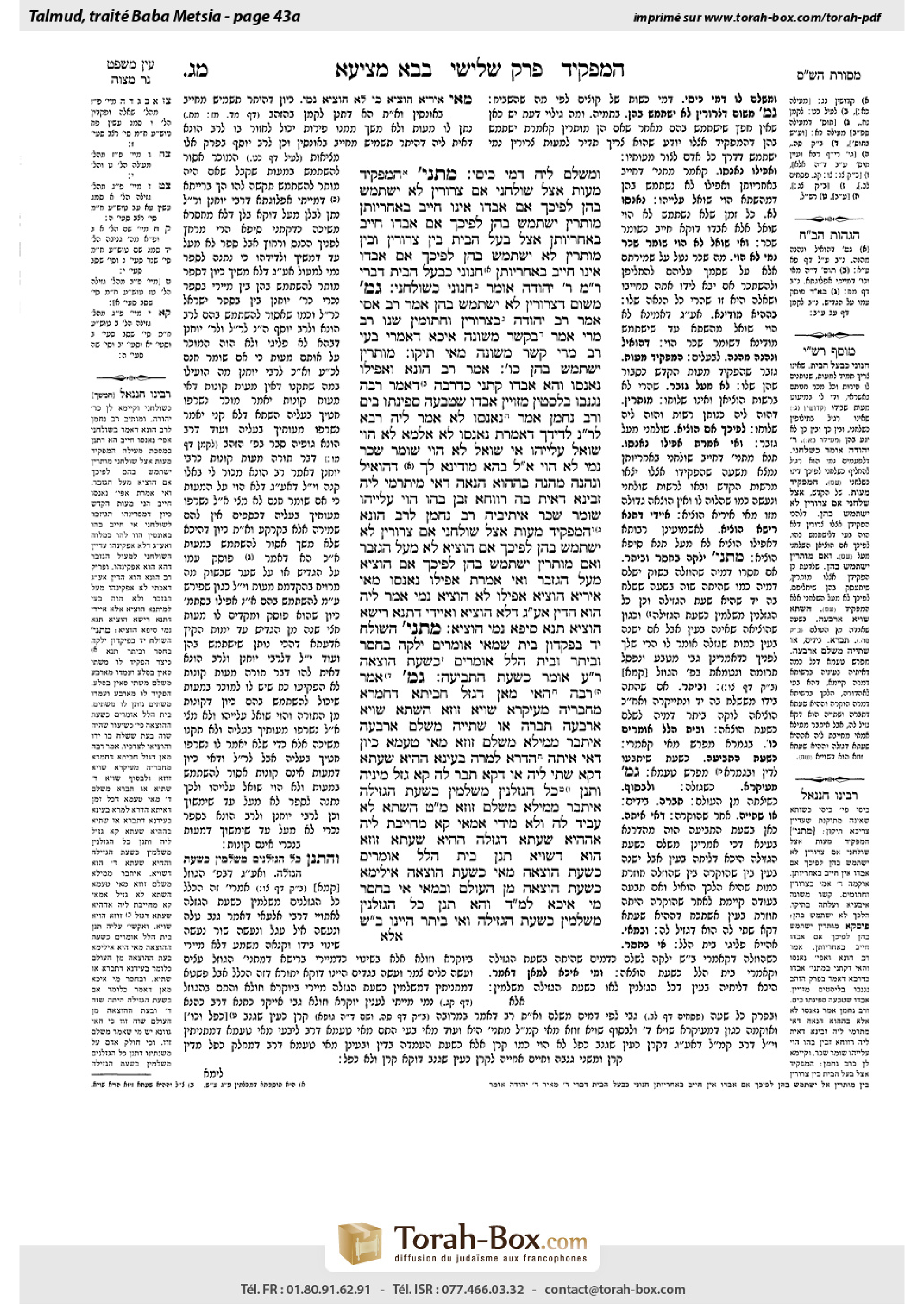
Bava Metzia 43a: Talmud study for Daf Yomi
Study the Talmud for Daf Yomi with scanned pages, Hebrew text, English translations from Sefaria and AI-generated French translations.
Passage selection and English or AI-generated French translation are available where the scan has annotations. Daf Study is independent of Torah-Box and Sefaria.
Browse Bava Metzia · בבא מציעא · All tractatesBava Metzia 43a text and translations
This page of Bava Metzia includes the Aramaic text, an English translation and an AI-generated French translation, alongside the scan above.
בבא מציעא מ״ג א · Aramaic and Hebrew text
וּמְשַׁלֵּם לֵיהּ דְּמֵי כִּיסֵי.
מַתְנִי׳ הַמַּפְקִיד מָעוֹת אֵצֶל שׁוּלְחָנִי, אִם צְרוּרִין – לֹא יִשְׁתַּמֵּשׁ בָּהֶן, לְפִיכָךְ אִם אָבְדוּ אֵינוֹ חַיָּיב בְּאַחְרָיוּתָן. מוּתָּרִין – יִשְׁתַּמֵּשׁ בָּהֶן, לְפִיכָךְ אִם אָבְדוּ חַיָּיב בְּאַחְרָיוּתָן. אֵצֶל בַּעַל הַבַּיִת, בֵּין צְרוּרִין וּבֵין מוּתָּרִין – לֹא יִשְׁתַּמֵּשׁ בָּהֶן, לְפִיכָךְ אִם אָבְדוּ אֵינוֹ חַיָּיב בְּאַחְרָיוּתָן. חֶנְוָנִי כְּבַעַל הַבַּיִת, דִּבְרֵי רַבִּי מֵאִיר. רַבִּי יְהוּדָה אוֹמֵר: חֶנְוָנִי כַּשּׁוּלְחָנִי.
גְּמָ׳ מִשּׁוּם דִּצְרוּרִין לֹא יִשְׁתַּמֵּשׁ בָּהֶן? אָמַר רַב אַסִּי אָמַר רַב יְהוּדָה: בִּצְרוּרִין וַחֲתוּמִין שָׁנוּ. רַב מָרִי אָמַר: בְּקֶשֶׁר מְשׁוּנֶּה. אִיכָּא דְאָמְרִי, בָּעֵי רַב מָרִי: קֶשֶׁר מְשׁוּנֶּה מַאי? תֵּיקוּ.
מוּתָּרִין יִשְׁתַּמֵּשׁ בָּהֶן כּוּ׳. אָמַר רַב הוּנָא: וַאֲפִילּוּ נֶאֶנְסוּ. וְהָא ״אָבְדוּ״ קָתָנֵי! כִּדְרַבָּה. דְּאָמַר רַבָּה: ״נִגְנְבוּ״ – בְּלִסְטֵיס מְזוּיָּין, ״אָבְדוּ״ – שֶׁטָּבְעָה סְפִינָתוֹ בַּיָּם.
וְרַב נַחְמָן אָמַר: נֶאֶנְסוּ לָא. אֲמַר לֵיהּ רָבָא לְרַב נַחְמָן: לְדִידָךְ דְּאָמְרַתְּ נֶאֶנְסוּ לָא, אַלְמָא לָא הָוֵי שׁוֹאֵל עֲלַיְיהוּ, אִי שׁוֹאֵל לָא הָוֵי שׁוֹמֵר שָׂכָר נָמֵי לָא הָוֵי! אֲמַר לֵיהּ: בְּהָא מוֹדֵינָא לָךְ, דְּהוֹאִיל וְנֶהֱנָה מַהֲנֶה, בְּהָהוּא הֲנָאָה דְּאִי מִיתְרְמֵי לֵיהּ זְבִינָא דְּאִית בֵּהּ רַוְוחָא זָבֵן בְּהוּ, הָוֵי עֲלַיְיהוּ שׁוֹמֵר שָׂכָר.
אֵיתִיבֵיהּ רַב נַחְמָן לְרַב הוּנָא: הַמַּפְקִיד מָעוֹת אֵצֶל שׁוּלְחָנִי, אִם צְרוּרִין – לֹא יִשְׁתַּמֵּשׁ בָּהֶן, לְפִיכָךְ אִם הוֹצִיא – לֹא מָעַל הַגִּזְבָּר. וְאִם מוּתָּרִין – יִשְׁתַּמֵּשׁ בָּהֶן, לְפִיכָךְ אִם הוֹצִיא – מָעַל הַגִּזְבָּר.
וְאִי אָמְרַתְּ אֲפִילּוּ נֶאֶנְסוּ, מַאי אִירְיָא הוֹצִיא? אֲפִילּוּ לֹא הוֹצִיא נָמֵי!
אֲמַר לֵיהּ: הוּא הַדִּין אַף עַל גַּב דְּלֹא הוֹצִיא, וְאַיְּידֵי דִּתְנָא רֵישָׁא ״הוֹצִיא״, תְּנָא סֵיפָא נָמֵי ״הוֹצִיא״.
מַתְנִי׳ הַשּׁוֹלֵחַ יָד בְּפִקָּדוֹן, בֵּית שַׁמַּאי אוֹמְרִים: יִלְקֶה בְּחָסֵר וּבְיָתֵר. וּבֵית הִלֵּל אוֹמְרִים: כִּשְׁעַת הוֹצָאָה. רַבִּי עֲקִיבָא אוֹמֵר: כִּשְׁעַת הַתְּבִיעָה.
גְּמָ׳ אָמַר רַבָּה: הַאי מַאן דִּגְזַל חָבִיתָא דְחַמְרָא מֵחַבְרֵיהּ, מֵעִיקָּרָא שָׁוְיָא זוּזָא, הַשְׁתָּא שָׁוְיָא אַרְבְּעָה. תַּבְרַהּ אוֹ שַׁתְיַיהּ – מְשַׁלֵּם אַרְבְּעָה, אִיתְּבַר מִמֵּילָא – מְשַׁלֵּם זוּזָא.
מַאי טַעְמָא? כֵּיוָן דְּאִי אִיתַהּ הָדְרָא לְמָרַהּ בְּעֵינָא, הָהִיא שַׁעְתָּא דְּקָא שָׁתֵי לַיהּ אוֹ דְּקָא תָּבַר לַהּ, קָא גָזֵל מִינֵּיהּ, וּתְנַן: כׇּל הַגַּזְלָנִין מְשַׁלְּמִין כִּשְׁעַת הַגְּזֵילָה. אִיתְּבַר מִמֵּילָא מְשַׁלֵּם זוּזָא. מַאי טַעְמָא? הַשְׁתָּא לָא עָבֵיד לַהּ וְלָא מִידֵּי, אַמַּאי קָא מְחַיְּיבַתְּ לֵיהּ? אַהָהִיא שַׁעְתָּא דְּגַזְלַהּ, הָהִיא שַׁעְתָּא זוּזָא הוּא דְּשָׁוְיָא.
תְּנַן: בֵּית הִלֵּל אוֹמְרִים כִּשְׁעַת הוֹצָאָה. מַאי כִּשְׁעַת הוֹצָאָה? אִילֵימָא כִּשְׁעַת הוֹצָאָה מִן הָעוֹלָם.
וּבְמַאי? אִי בְּחָסֵר, מִי אִיכָּא לְמַאן דְּאָמַר? וְהָא תְּנַן: כׇּל הַגַּזְלָנִין מְשַׁלְּמִין כִּשְׁעַת הַגְּזֵילָה! וְאִי בְּיָתֵר – הַיְינוּ בֵּית שַׁמַּאי!
Bava Metzia 43a · English translation
And he pays him the value of the hops mixed with thorns according to his profit.
MISHNA: In the case of one who deposits money with a money changer, if the money is bound, the money changer may not use it. Therefore, if it is lost he does not bear responsibility for it. If the money was unbound, the money changer may use it. Therefore, if it is lost he bears responsibility for it. If he deposited money with a homeowner, whether it is bound or whether it is unbound, the homeowner may not use it, as it never entered the mind of the depositor that the homeowner might use the money. Therefore, if the homeowner lost the money, he does not bear responsibility for it. If the bailee is a storekeeper, his status is like that of a homeowner; this is the statement of Rabbi Meir. Rabbi Yehuda says: If the bailee is a storekeeper, his status is like that of a money changer.
GEMARA: The Gemara asks: Why is it that due to the fact that the money is bound the money changer may not use it? Don’t people typically bind their money? Binding is no indication that the intent of the one who deposited the money is that it not be used. Rav Asi said that Rav Yehuda said: It is in a case where the money is bound and sealed, a clear indication that he does not want the bundle to be opened, that the mishna is taught. Rav Mari says: It is in a case where the money is bound with an atypical knot, also indicating that he does not want the bundle to be opened. There are those who say that there is a variant reading: Rav Mari raises a dilemma: What is the legal status of money bound with an atypical knot? Is it like that of money that is sealed or not? The Gemara concludes: The dilemma shall stand unresolved.
§ The mishna teaches that if the money is unbound the money changer may use it, and therefore he bears responsibility if it is lost. Rav Huna says: And even if it was taken from him under circumstances beyond his control he is liable to pay. The Gemara asks: But isn’t it taught in the mishna: It is lost, from which it may be inferred that only if the money was lost does he bear responsibility, but not if it was taken by force? The Gemara answers: This must be understood in accordance with that which Rabba stated in a different context, as Rabba says: They were stolen; this is referring to a case where the items were stolen by force by armed bandits. They were lost; this is referring to a case where his ship sunk at sea.
And Rav Naḥman says: If it was taken from him under circumstances beyond his control, he is not liable to pay. Rava said to Rav Naḥman: According to your opinion, that you said if it was taken from him due to circumstances beyond his control, he is not liable to pay; apparently, the money changer is not considered a borrower with regard to the money. If he is not a borrower, he is not a paid bailee either. Why, then, does he bear responsibility for the money if it is lost? His status should be that of an unpaid bailee, and he should be exempt. Rav Naḥman said to him: In this case, I concede that he is a paid bailee, since he benefits from the money. It is with the benefit the money changer derives, based on the fact that if a profitable purchase would happen to present itself to him he can purchase it with the deposited money, that he is considered a paid bailee with regard to the money.
Rav Naḥman raised an objection to the opinion of Rav Huna from a mishna (Me’ila 21b): With regard to the Temple treasurer who deposits money with a money changer, if the money is bound, the money changer may not use it. Therefore, if he spent the money, the Temple treasurer is not liable for misuse of Temple property because the money changer is liable. If the money was unbound, the money changer may use it. Therefore, if the money changer spent the money, the Temple treasurer is liable for misuse of Temple property, as the money changer serves as an agent for the treasurer.
Rav Naḥman explains his objection: And if you say that even if the money was taken from the money changer under circumstances beyond his control, he bears responsibility for the money, why did the tanna specifically teach that the Temple treasurer bears responsibility if the money changer spent the money? Even if he did not spend the money the treasurer should bear responsibility. Since the Temple treasurer gave him unbound money, it is tantamount to a loan. The treasurer should be liable for misappropriation at the moment that he gave unbound money to the money changer.
Rav Huna said to him: The same is true even if he did not spend the money, and the treasurer is liable the moment he gives the money to the money changer. And since the tanna taught in the first clause of the mishna that the money changer is liable if he spent the money, the tanna taught in the latter clause of the mishna as well that the treasurer is liable if he spent the money, although he is liable even if he did not spend the money.
MISHNA: With regard to one who misappropriates a deposit, Beit Shammai say: He is penalized for its decrease and its increase. If the value of the deposit decreases, the bailee is liable to pay in accordance with its value at the time of the misappropriation. If it increases in value, he is liable to pay in accordance with its value at the time of repayment. And Beit Hillel say: He pays in accordance with its value at the time of removal. Rabbi Akiva says: He pays in accordance with its value at the time of the claim.
GEMARA: Rabba says: In a case of this one who robbed another of a barrel of wine, where initially it was worth one dinar and now it is worth four dinars; if the robber broke the barrel or drank the wine, he pays four dinars. If it broke by itself, he pays one dinar.
The Gemara elaborates: What is the reason for the difference? Since if the barrel were intact, it would return to its owner in its original state and there would be no need to calculate its price, that moment that he drank it or that he broke it is the moment that he stole from the owner of the wine. And we learned in a mishna (Bava Kamma 93b): All robbers pay in accordance with the value of the stolen item at the moment of the robbery. Here, that is four dinars. If the barrel broke by itself, the robber pays one dinar. What is the reason for this? He did not do anything to the barrel now. Why do you deem him liable to pay? Because of that moment that he robbed the other of it. At that moment, it was worth only one dinar.
We learned in the mishna that Beit Hillel say: One who misappropriates a deposit pays in accordance with its value at the time of removal. The Gemara asks: What is the meaning of: In accordance with its value at the time of removal? If we say it means in accordance with its value at the time of its removal from the world, when he drank the wine or broke the barrel, that is difficult.
The Gemara clarifies the difficulty: And with regard to what case is this referring? If it is with regard to a case where there was a decrease in value before its removal, is there anyone who says that the bailee pays the lower price? But didn’t we learn in a mishna: All robbers pay in accordance with the value of the stolen item at the moment of the robbery, and no less than that? And if it is with regard to a case where there was an increase in value before its removal, that is the opinion of Beit Shammai, as the one who misappropriates a deposit always pays the higher value, not the opinion of Beit Hillel.
Bava Metzia 43a · Traduction française (IA)
Et il lui paie la valeur des houblons mélangés à des épines selon son profit.
MICHNA : Dans le cas d'une personne qui dépose de l'argent chez un changeur, si l'argent est lié, le changeur ne peut pas l'utiliser. Par conséquent, si l'argent est perdu, il n'assume pas la responsabilité. Si l'argent était non lié, le changeur peut l'utiliser. Par conséquent, si l'argent est perdu, il assume la responsabilité. Si une personne dépose de l'argent chez un propriétaire, qu'il soit lié ou non, le propriétaire ne peut pas l'utiliser, car il n'a jamais été dans l'esprit du déposant que le propriétaire puisse utiliser l'argent. Par conséquent, si le propriétaire perd l'argent, il n'assume pas la responsabilité. Si le dépositaire est un marchand, son statut est celui d'un propriétaire ; c'est l'opinion du Rabbi Meïr. Le Rabbi Yéhuda dit : Si le dépositaire est un marchand, son statut est celui d'un changeur.
GUEMARA : La Guemara pose la question : Pourquoi est-ce que, du fait que l'argent est lié, le changeur ne peut pas l'utiliser ? N'est-ce pas habituel de lier son argent ? Le fait de lier n'indique pas l'intention du déposant que l'argent ne soit pas utilisé. Rav Asi a dit que Rav Yéhuda a dit : C'est dans le cas où l'argent est lié et scellé, un signe clair qu'il ne veut pas que le paquet soit ouvert, que la Michna est enseignée. Rav Mari dit : C'est dans le cas où l'argent est lié avec un nœud inhabituel, ce qui indique également qu'il ne veut pas que le paquet soit ouvert. Certains disent qu'il y a une lecture variant : Rav Mari soulève un dilemme : Quel est le statut juridique de l'argent lié avec un nœud inhabituel ? Est-ce celui de l'argent scellé ou non ? La Guemara conclut : Ce dilemme restera sans réponse.
§ La Michna enseigne que si l'argent est libre, le changeur peut l'utiliser, et par conséquent il assume la responsabilité si l'argent est perdu. Rav Huna dit : Et même si l'argent a été enlevé sous des circonstances hors de son contrôle, il est tenu responsable de le payer. La Guemara pose la question : Mais n'est-ce pas enseigné dans la Michna : Il est perdu, d'où on peut en déduire que seul si l'argent est perdu il assume la responsabilité, mais pas si l'argent a été enlevé par la force ? La Guemara répond : Cela doit être compris selon ce que Rabba a dit dans un contexte différent, car Rabba dit : Ils ont été volés ; cela fait référence à un cas où les objets ont été volés par la force par des bandits armés. Ils ont été perdus ; cela fait référence à un cas où son bateau a coulé en mer.
Et Rav Naḥman dit : Si l'argent a été enlevé sous des circonstances hors de son contrôle, il n'est pas tenu responsable de le payer. Rava a dit à Rav Naḥman : Selon votre opinion, que vous avez dit que si l'argent a été enlevé en raison de circonstances hors de son contrôle, il n'est pas tenu responsable de le payer ; apparemment, le changeur n'est pas considéré comme un prêteur concernant l'argent. Si ce n'est pas un prêteur, il n'est pas non plus un dépositaire payé. Pourquoi alors assume-t-il la responsabilité de l'argent s'il est perdu ? Son statut devrait être celui d'un dépositaire non payé, et il devrait être exempt. Rav Naḥman a dit à lui : Dans ce cas, je reconnais qu'il est un dépositaire payé, car il en tire un bénéfice. C'est grâce au bénéfice que le changeur tire, en raison du fait qu'un achat rentable pourrait se présenter à lui et qu'il pourrait l'acheter avec l'argent déposé, qu'il est considéré comme un dépositaire payé concernant l'argent.
Rav Naḥman a soulevé une objection contre l'opinion de Rav Huna à partir d'une Michna (Me’ila 21b) : Concernant le trésorier du Temple qui dépose de l'argent chez un changeur, si l'argent est lié, le changeur ne peut pas l'utiliser. Par conséquent, si le changeur a dépensé l'argent, le trésorier du Temple n'est pas tenu responsable de l'abus de la propriété du Temple, car le changeur est tenu responsable. Si l'argent était non lié, le changeur peut l'utiliser. Par conséquent, si le changeur a dépensé l'argent, le trésorier du Temple est tenu responsable de l'abus de la propriété du Temple, car le changeur agit en tant qu'agent du trésorier.
Rav Naḥman explique son objection : Et si vous dites que même si l'argent a été enlevé du changeur sous des circonstances hors de son contrôle, il assume la responsabilité de l'argent, pourquoi la tanna a-t-elle spécifiquement enseigné que le trésorier du Temple est tenu responsable si le changeur a dépensé l'argent ? Même si le changeur n'a pas dépensé l'argent, le trésorier devrait être tenu responsable. Puisque le trésorier a donné de l'argent non lié, cela équivaut à un prêt. Le trésorier devrait être tenu responsable de l'abus au moment où il a donné de l'argent non lié au changeur.
Rav Huna a dit à lui : C'est la même chose même si le changeur n'a pas dépensé l'argent, et le trésorier est tenu responsable au moment où il donne l'argent au changeur. Et puisque la tanna a enseigné dans la première partie de la Michna que le changeur est tenu responsable si l'argent a été dépensé, la tanna a enseigné dans la seconde partie de la Michna également que le trésorier est tenu responsable si l'argent a été dépensé, même si le trésorier est tenu responsable même si l'argent n'a pas été dépensé.
MICHNA : Concernant celui qui détient un dépôt de manière malveillante, Beit Shammai disent : Il est puni selon la baisse et l'accroissement de sa valeur. Si la valeur du dépôt diminue, le dépositaire est tenu de payer selon sa valeur au moment de l'abus. Si sa valeur augmente, il est tenu de payé selon sa valeur au moment du remboursement. Et Beit Hillel disent : Il paie selon sa valeur au moment de l'extirpation. Rabbi Akiva dit : Il paie selon sa valeur au moment de la réclamation.
GUEMARA : Rabba dit : Dans le cas d'une personne qui a volé une barrique de vin à un autre, où initialement elle valait un dinar et maintenant elle vaut quatre dinars ; si le voleur a brisé la barrique ou a bu le vin, il paie quatre dinars. Si la barrique s'est brisée toute seule, il paie un dinar.
La Guemara développe : Quelle est la raison de cette différence ? Puisque si le tonneau était intact, il reviendrait à son propriétaire dans son état originel et il n'aurait pas été nécessaire de calculer son prix, ce moment où il l'a bu ou où il l'a brisé est le moment où il a volé au propriétaire du vin. Et nous avons appris dans une mitsna (Bava Kamma 93b) : Tous les voleurs paient selon la valeur de l'objet volé au moment du vol. Ici, cela fait quatre dinars. Si le tonneau s'est brisé tout seul, le voleur paie un dinar. Quelle est la raison de cela ? Il n'a rien fait au tonneau maintenant. Pourquoi considère-t-on qu'il est tenu responsable de payer ? Parce que ce moment où il a volé à l'autre. À ce moment-là, sa valeur était seulement un dinar.
Nous avons appris dans la mitsna que Beit Hillel disent : Celui qui détourné une dépôt paie selon sa valeur au moment de son retrait. La Guemara pose la question : Quelle est la signification de : selon sa valeur au moment de son retrait ? Si nous disons que cela signifie selon sa valeur au moment de son retrait du monde, quand il a bu le vin ou brisé le tonneau, cela est difficile.
La Guemara clarifie cette difficulté : Et à quel cas fait référence cela ? Si c'est au cas où la valeur a diminué avant son retrait, y a-t-il quelqu'un qui dit que le dépositaire paie le prix inférieur ? Mais n'avons-nous pas appris dans une mitsna : Tous les voleurs paient selon la valeur de l'objet volé au moment du vol, et pas moins ? Et si c'est au cas où la valeur a augmenté avant son retrait, c'est l'opinion de Beit Shammai, car celui qui détourné une dépôt paie toujours la valeur supérieure, pas l'opinion de Beit Hillel.
Traduction française générée par IA à partir de l’édition anglaise de Sefaria. Vérifie toujours un passage avec le texte source.
Text from Sefaria: William Davidson Edition - Vocalized Aramaic (CC BY NC); William Davidson Edition - English (CC BY NC).