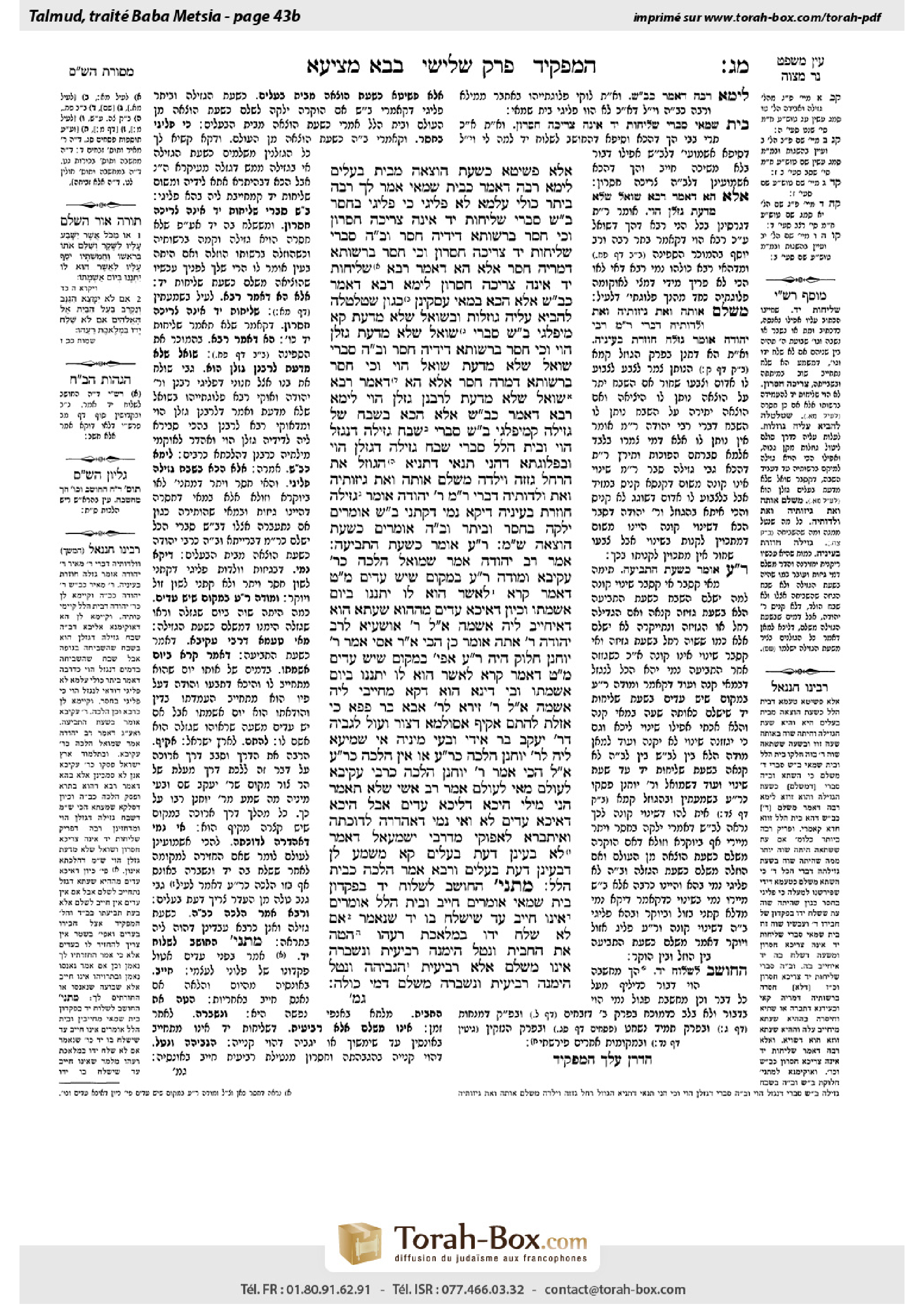
Bava Metzia 43b: Talmud study for Daf Yomi
Study the Talmud for Daf Yomi with scanned pages, Hebrew text, English translations from Sefaria and AI-generated French translations.
Passage selection and English or AI-generated French translation are available where the scan has annotations. Daf Study is independent of Torah-Box and Sefaria.
Browse Bava Metzia · בבא מציעא · All tractatesBava Metzia 43b text and translations
This page of Bava Metzia includes the Aramaic text, an English translation and an AI-generated French translation, alongside the scan above.
בבא מציעא מ״ג ב · Aramaic and Hebrew text
אֶלָּא פְּשִׁיטָא כִּשְׁעַת הוֹצָאָה מִבֵּית בְּעָלִים. לֵימָא רַבָּה דְּאָמַר כְּבֵית שַׁמַּאי?! אָמַר לָךְ רַבָּה: בְּיָתֵר כּוּלֵּי עָלְמָא לָא פְלִיגִי, כִּי פְּלִיגִי בְּחָסֵר.
בֵּית שַׁמַּאי סָבְרִי: שְׁלִיחוּת יָד אֵינָהּ צְרִיכָה חֶסְרוֹן – וְכִי חָסַר בִּרְשׁוּתָא דִידֵיהּ חָסַר. וּבֵית הִלֵּל סָבְרִי: שְׁלִיחוּת יָד צְרִיכָה חֶסְרוֹן – וְכִי חָסַר בִּרְשׁוּתָא דְּמָרֵיהּ חָסַר.
אֶלָּא הָא דְּאָמַר רָבָא שְׁלִיחוּת יָד אֵינָהּ צְרִיכָה חֶסְרוֹן, לֵימָא רָבָא דְּאָמַר כְּבֵית שַׁמַּאי?! אֶלָּא, הָכָא בְּמַאי עָסְקִינַן? כְּגוֹן שֶׁטִּלְטְלָהּ לְהָבִיא עָלֶיהָ גּוֹזָלוֹת, וּבְשׁוֹאֵל שֶׁלֹּא מִדַּעַת קָא מִיפַּלְגִי;
בֵּית שַׁמַּאי סָבְרִי: שׁוֹאֵל שֶׁלֹּא מִדַּעַת – גַּזְלָן הָוֵי, וְכִי חָסַר – בִּרְשׁוּתָא דִּידֵיהּ חָסַר. וּבֵית הִלֵּל סָבְרִי: שׁוֹאֵל שֶׁלֹּא מִדַּעַת – שׁוֹאֵל הָוֵי, וְכִי חָסַר – בִּרְשׁוּתָא דְּמָרֵהּ חָסַר.
אֶלָּא הָא דְּאָמַר רָבָא: שׁוֹאֵל שֶׁלֹּא מִדַּעַת – לְרַבָּנַן גַּזְלָן הָוֵי, לֵימָא רָבָא דְּאָמַר כְּבֵית שַׁמַּאי?! אֶלָּא הָכָא בְּשֶׁבַח (שֶׁל) גְּזֵילָה קָמִיפַּלְגִי. בֵּית שַׁמַּאי סָבְרִי: שֶׁבַח גְּזֵילָה דְּנִגְזָל הָוֵי, וּבֵית הִלֵּל סָבְרִי: שֶׁבַח גְּזֵילָה דְּגַזְלָן הָוֵי.
וּבִפְלוּגְתָּא דְּהָנֵי תַּנָּאֵי, דְּתַנְיָא: הַגּוֹזֵל אֶת הָרָחֵל, גְּזָזָהּ וְיָלְדָה מְשַׁלֵּם אוֹתָהּ וְאֶת גִּיזּוֹתֶיהָ וְאֶת וַלְדוֹתֶיהָ, דִּבְרֵי רַבִּי מֵאִיר. רַבִּי יְהוּדָה אוֹמֵר: גְּזֵילָה חוֹזֶרֶת בְּעֵינֶיהָ.
דַּיְקָא נָמֵי, דְּקָתָנֵי: בֵּית שַׁמַּאי אוֹמְרִים יִלְקֶה בְּחָסֵר וּבְיָתֵר, וּבֵית הִלֵּל אוֹמְרִים: כִּשְׁעַת הוֹצָאָה. שְׁמַע מִינַּהּ.
רַבִּי עֲקִיבָא אוֹמֵר כִּשְׁעַת הַתְּבִיעָה. אָמַר רַב יְהוּדָה אָמַר שְׁמוּאֵל: הֲלָכָה כְּרַבִּי עֲקִיבָא. וּמוֹדֶה רַבִּי עֲקִיבָא בִּמְקוֹם שֶׁיֵּשׁ עֵדִים. מַאי טַעְמָא – דְּאָמַר קְרָא ״לַאֲשֶׁר הוּא לוֹ יִתְּנֶנּוּ בְּיוֹם אַשְׁמָתוֹ״, וְכֵיוָן דְּאִיכָּא עֵדִים, מֵהָהוּא שַׁעְתָּא – הוּא דְּאִיחַיַּיב לֵיהּ אַשְׁמָה.
אֲמַר לֵיהּ רַב אוֹשַׁעְיָא לְרַב יְהוּדָה: רַבִּי, אַתָּה אוֹמֵר כֵּן? הָכִי אָמַר רַבִּי אַסִּי אָמַר רַבִּי יוֹחָנָן: חָלוּק הָיָה רַבִּי עֲקִיבָא אֲפִילּוּ בִּמְקוֹם שֶׁיֵּשׁ עֵדִים, מַאי טַעְמָא? דְּאָמַר קְרָא ״לַאֲשֶׁר הוּא לוֹ יִתְּנֶנּוּ בְּיוֹם אַשְׁמָתוֹ״, וּבֵי דִינָא הוּא דְּקָא מְחַיְּיבִי לֵיהּ אַשְׁמָה.
אֲמַר לֵיהּ רַבִּי זֵירָא לְרַבִּי אַבָּא בַּר פָּפָּא: כִּי אָזְלַתְּ לְהָתָם, אַקֵּיף אַסּוּלָּמָא דְצוֹר, וְעוּל לְגַבֵּיהּ דְּרַבִּי יַעֲקֹב בַּר אִידִי, וּבְעִי מִינֵּיהּ אִי שְׁמִיעָא לֵיהּ לְרַבִּי יוֹחָנָן: הֲלָכָה כְּרַבִּי עֲקִיבָא אוֹ אֵין הֲלָכָה כְּרַבִּי עֲקִיבָא? אֲמַר לֵיהּ: הָכִי אָמַר רַבִּי יוֹחָנָן: הֲלָכָה כְּרַבִּי עֲקִיבָא לְעוֹלָם.
מַאי לְעוֹלָם? אָמַר רַב אָשֵׁי: שֶׁלֹּא תֹּאמַר הָנֵי מִילֵּי הֵיכָא דְּלֵיכָּא עֵדִים, אֲבָל הֵיכָא דְּאִיכָּא עֵדִים לָא.
וְאִי נָמֵי דְּאַהְדְּרַהּ לְדוּכְתַּהּ וְאִיתְּבַרָא לְאַפּוֹקֵי מִדְּרַבִּי יִשְׁמָעֵאל, דְּאָמַר: לָא בָּעֵינַן דַּעַת בְּעָלִים, קָא מַשְׁמַע לַן דְּבָעֵינַן דַּעַת בְּעָלִים. וְרָבָא אָמַר: הֲלָכָה כְּבֵית הִלֵּל.
מַתְנִי׳ הַחוֹשֵׁב לִשְׁלוֹחַ יָד בְּפִקָּדוֹן, בֵּית שַׁמַּאי אוֹמְרִים: חַיָּיב, וּבֵית הִלֵּל אוֹמְרִים: אֵינוֹ חַיָּיב עַד שֶׁיִּשְׁלַח בּוֹ יָד, שֶׁנֶּאֱמַר: ״אִם לֹא שָׁלַח יָדוֹ בִּמְלֶאכֶת רֵעֵהוּ״. הִטָּה אֶת הֶחָבִית וְנָטַל הֵימֶנָּה רְבִיעִית וְנִשְׁבְּרָה – אֵינוֹ מְשַׁלֵּם אֶלָּא רְבִיעִית. הִגְבִּיהָהּ וְנָטַל הֵימֶנָּה רְבִיעִית וְנִשְׁבְּרָה – מְשַׁלֵּם דְּמֵי כוּלָּהּ.
Bava Metzia 43b · English translation
Rather, it is obvious that Beit Hillel hold that the bailee pays in accordance with its value at the time of its removal from the owner’s house, i.e., at the time of the misappropriation. The Gemara asks: If so, shall we say that Rabba stated his opinion in accordance with the opinion of Beit Shammai and not the opinion of Beit Hillel? The Gemara rejects this: Rabba could have said to you: With regard to a subsequent increase in the value of the misappropriated deposit, everyone, Beit Shammai and Beit Hillel, agrees that the bailee pays in accordance with its value when the deposit was destroyed. When they disagree, it is in the case of a subsequent decrease in the value of the misappropriated deposit.
Rabba clarifies: Beit Shammai hold that misappropriation does not require loss, and even if the deposit remains intact, his legal status is that of a robber from the moment of misappropriation. And therefore, when the value of the misappropriated deposit decreases, it decreases in his possession. Therefore, he pays in accordance with its value at the time of misappropriation. And Beit Hillel hold that misappropriation requires loss, and only when the deposit decreases in value after the misappropriation is the bailee liable to pay. And therefore, when the value of the misappropriated deposit decreases, it decreases in the possession of its owner. Therefore, he pays in accordance with its value at the time that it was damaged.
The Gemara asks: But according to that explanation, concerning this halakha that Rava says: Misappropriation does not require loss, shall we say that the opinion that Rava stated is in accordance with the opinion of Beit Shammai? Rather, with what are we dealing here? It is with a case where the bailee moved the barrel to stand upon it and bring fledglings from a nest in a tree. And they disagree with regard to one who borrows an item without the knowledge of the owner.
Beit Shammai hold: The legal status of one who borrows an item without the knowledge of the owner is that of a robber in terms of responsibility. He is accorded that legal status the moment he moves the barrel. And therefore, when the value of the misappropriated deposit decreases, it decreases in his possession. Consequently, he pays in accordance with its value at the time that he borrowed the barrel. And Beit Hillel hold: The legal status of one who borrows without the knowledge of the owners is that of a borrower, and only when the barrel is broken is the bailee rendered liable to pay. And therefore, when the value of the barrel decreases, it decreases in the possession of its owner. Consequently, he pays in accordance with the barrel’s value at the time that it was damaged.
The Gemara asks: But according to that explanation, concerning this halakha that Rava says: The legal status of one who borrows an item without the knowledge of the owner, according to the opinion of the Rabbis, is that of a robber in terms of responsibility, shall we say that the opinion that Rava stated is in accordance with the opinion of Beit Shammai? Rather, contrary to the previous explanations, the terms decrease and increase are not referring to changes in market value. They are referring to the decrease in the value of the animal when its wool is sheared and the increase in its value due to the birth of offspring. And here, it is with regard to the enhancement of stolen property that they disagree. Beit Shammai hold: The enhancement of stolen property belongs to the one who was robbed. And Beit Hillel hold: The enhancement of stolen property belongs to the robber.
And it is with regard to the issue that is the subject of the dispute between these tanna’im that they disagree, as it is taught in a baraita: With regard to one who robs another of a ewe, if he sheared it or if it gave birth, the robber pays the owner for it and for its fleece or for its offspring; this is the statement of Rabbi Meir. Rabbi Yehuda says: The stolen property returns to the owner in its current state.
The Gemara comments: The language of the mishna is also precise, as it is taught that Beit Shammai say: He is penalized for its decrease and its increase. And Beit Hillel say: He pays in accordance with the time of removal. When recording the opinion of Beit Shammai, the mishna does not state: He is penalized for its rise and fall in value. The Gemara affirms: Learn from the wording of the mishna that they disagree with regard to fleece and offspring.
§ The mishna teaches that Rabbi Akiva says: He pays in accordance with its value at the time of the claim. Rav Yehuda says that Shmuel says: The halakha is in accordance with the opinion of Rabbi Akiva. And Rabbi Akiva concedes in a case where there are witnesses to the misappropriation, as in that case the payment is calculated in accordance with the value of the deposit at the time of the misappropriation. What is the reason for that halakha? It is as the verse states concerning, among others, one who misappropriated a deposit: “To whom it appertains shall he give it on the day of his being guilty” (Leviticus 5:24). And in this case, since there are witnesses to the robbery, from that moment he is liable to pay him for his guilt. He is rendered guilty at the moment the witnesses saw him misappropriate the deposit.
Rav Oshaya said to Rav Yehuda: My teacher, is that what you say? This is what Rabbi Asi says that Rabbi Yoḥanan says: Rabbi Akiva was in disagreement even in a case where there are witnesses to the misappropriation. What is the reason for that halakha? It is as the verse states: “To whom it appertains shall he give it on the day of his being guilty,” and it is the court, not the witnesses, that renders him liable to pay him for his guilt.
Rabbi Zeira said to Rabbi Abba bar Pappa: When you go there, to Eretz Yisrael, take a circuitous route to the Ladder of Tyre, and enter before Rabbi Ya’akov bar Idi, and ask of him if he heard whether according to Rabbi Yoḥanan the halakha is in accordance with the opinion of Rabbi Akiva or whether the halakha is not in accordance with the opinion of Rabbi Akiva. He went and asked. Rabbi Ya’akov bar Idi said to him: This is what Rabbi Yoḥanan says: The halakha is always in accordance with the opinion of Rabbi Akiva.
The Gemara asks: What is the meaning of always? Rav Ashi said: Rabbi Yoḥanan used this term so that you will not say the following: This statement, that the halakha is in accordance with the opinion of Rabbi Akiva, applies specifically in a case where there are no witnesses, but in a case where there are witnesses, no, payment is calculated in accordance with the value of the deposit when they witnessed the misappropriation.
Or alternatively, the halakha will not be in accordance with the opinion of Rabbi Akiva in a case where he returns the barrel to its place and it broke. Rabbi Yoḥanan stated that the halakha is always in accordance with the opinion of Rabbi Akiva, to exclude the opinion of Rabbi Yishmael, who says that if one stole from another and returned it we do not require the knowledge of the owners for the item to be considered returned. Rabbi Yoḥanan teaches us that the halakha is that we require the knowledge of the owners, in accordance with the opinion of Rabbi Akiva (see 40b). And Rava says: Contrary to the opinion of Rabbi Yoḥanan, the halakha is in accordance with the opinion of Beit Hillel.
MISHNA: With regard to one who intends to misappropriate a deposit and voices that intent in the presence of witnesses, Beit Shammai say: He is liable to pay for any damage to the deposit from that point forward, and Beit Hillel say: He is liable to pay only if he actually misappropriates the deposit, as it is stated concerning a bailee: “Whether he has misappropriated his neighbor’s goods” (Exodus 22:7). If he tilted the deposited barrel and took from it a quarter-log of wine for his own use, and the barrel broke, then he pays only for that quarter-log. If he lifted the barrel and took from it a quarter-log of wine, and the barrel broke, since he acquired the barrel by lifting it, he pays the value of the entire barrel.
Bava Metzia 43b · Traduction française (IA)
En effet, il est évident que Beit Hillel affirme que le gardien paie selon la valeur du dépôt au moment de son retrait de la maison du propriétaire, c'est-à-dire au moment de la détournement. La Guemara pose la question : Si c'est ainsi, devons-nous dire que Rabba a exprimé son opinion conformément à celle de Beit Shammai et non à celle de Beit Hillel ? La Guemara rejette cette idée : Rabba aurait pu dire à l'égard d'une augmentation ultérieure de la valeur du dépôt détourné, tout le monde, Beit Shammai et Beit Hillel, s'accordent à ce que le gardien paie selon la valeur du dépôt au moment de sa destruction. Le désaccord existe dans le cas d'une diminution ultérieure de la valeur du dépôt détourné.
Rabba clarifie : Beit Shammai affirme que le détournement ne nécessite pas de perte, et même si le dépôt reste intact, son statut juridique est celui d'un voleur dès le moment du détournement. Ainsi, lorsque la valeur du dépôt détourné diminue, elle diminue en son possession. Par conséquent, il paie selon la valeur du dépôt au moment du détournement. Et Beit Hillel affirme que le détournement nécessite une perte, et seulement lorsque le dépôt perd de sa valeur après le détournement, le gardien est tenu de payer. Ainsi, lorsque la valeur du dépôt détourné diminue, elle diminue en possession du propriétaire. Par conséquent, il paie selon la valeur du dépôt au moment de sa destruction.
La Guemara pose la question : Mais selon cette explication, concernant cette halakha que Rava dit : Le détournement ne nécessite pas de perte, devons-nous dire que l'opinion que Rava a exprimée est conforme à celle de Beit Shammai ? En réalité, de quoi sommes-nous en train de parler ? C'est d'un cas où le gardien a déplacé la barrique pour la poser sur elle et ramener des poussins d'un nid dans un arbre. Et ils s'opposent concernant celui qui emprunte un objet sans la connaissance du propriétaire.
Beit Shammai affirme : Le statut juridique de celui qui emprunte un objet sans la connaissance du propriétaire est celui d'un voleur en termes de responsabilité. Il est considéré comme tel dès qu'il déplace la barrique. Ainsi, lorsque la valeur du dépôt détourné diminue, elle diminue en son possession. Par conséquent, il paie selon la valeur du dépôt au moment de son emprunt. Et Beit Hillel affirme : Le statut juridique de celui qui emprunte sans la connaissance du propriétaire est celui d'un emprunteur, et seulement lorsque la barrique est brisée, le gardien est tenu de payer. Ainsi, lorsque la valeur de la barrique diminue, elle diminue en possession du propriétaire. Par conséquent, il paie selon la valeur de la barrique au moment de son dégradation.
La Guemara pose la question : Mais selon cette explication, concernant cette halakha que Rava dit : Le statut juridique de celui qui emprunte un objet sans la connaissance du propriétaire, selon l'opinion des Rabbins, est celui d'un voleur en termes de responsabilité, devons-nous dire que l'opinion que Rava a exprimée est conforme à celle de Beit Shammai ? En réalité, contrairement aux explications précédentes, les termes 'diminuer' et 'augmenter' ne se réfèrent pas à des changements de valeur marchande. Ils se réfèrent à la diminution de la valeur de l'animal lorsqu'on lui retire sa laine et à l'augmentation de sa valeur en raison de la naissance de ses petits. Et ici, il s'agit de l'amélioration des biens volés, sur laquelle ils s'opposent. Beit Shammai affirme : L'amélioration des biens volés appartient à celui qui a été volé. Et Beit Hillel affirme : L'amélioration des biens volés appartient au voleur.
Et c'est à propos de cette question qui est au centre du désaccord entre ces tannaïm que ils s'opposent, comme il est enseigné dans une baraïta : Concernant celui qui vole une brebis à un autre, si elle a été tondu ou si elle a donné naissance à des petits, le voleur paie l'propriétaire pour la brebis et pour sa laine ou pour ses petits ; c'est l'opinion de Rabbi Meir. Rabbi Yéhuda dit : Les biens volés retournent à l'propriétaire dans leur état actuel.
La Guemara commente : La formulation de la mishna est aussi précise, comme il est enseigné que Beit Shammai disent : Il est puni pour sa diminution et son augmentation. Et Beit Hillel disent : Il paie selon le moment de l'extirpation. Lors de l'enregistrement de l'opinion de Beit Shammai, la mishna ne dit pas : Il est puni pour son montant et sa baisse. La Guemara affirme : Apprenez de la formulation de la mishna qu'ils s'opposent concernant la laine et les petits.
§ La mishna enseigne que Rabbi Akiva dit : Il paie selon la valeur au moment de la réclamation. Rav Yéhuda dit que Shmuel dit : La halakha suit l'opinion de Rabbi Akiva. Et Rabbi Akiva reconnaît dans le cas où il y a des témoins au détournement, comme dans ce cas le paiement est calculé selon la valeur du dépôt au moment du détournement. Quelle est la raison de cette halakha ? C'est comme le verset qui dit concernant, parmi d'autres, celui qui a détourné un dépôt : « À celui à qui il appartient, il le rendra le jour de son péché » (Lévitique 5:24). Et dans ce cas, puisque des témoins ont assisté au vol, à ce moment-là il est tenu de payer pour son péché. Il est rendu coupable dès que les témoins ont vu le détournement.
Rav Oshaya a dit à Rav Yéhuda : Mon maître, c'est cela que tu dis ? C'est ce que Rabbi Asi dit que Rabbi Yochanan dit : Rabbi Akiva s'est opposé même dans le cas où il y a des témoins au détournement. Quelle est la raison de cette halakha ? C'est comme le verset : « À celui à qui il appartient, il le rendra le jour de son péché », et c'est le tribunal, et non les témoins, qui rend le voleur tenu de payer pour son péché.
Rabbi Zéira a dit à Rabbi Abba bar Pappa : Lorsque tu iras en Terre d'Israël, prends un chemin détourné vers l'Échelle de Tyr, et entre avant Rabbi Ya'akov bar Idi, et demande-lui s'il a entendu si, selon Rabbi Yoḥanan, la halakha suit l'opinion de Rabbi Akiva ou si la halakha ne suit pas l'opinion de Rabbi Akiva. Il est allé demander. Rabbi Ya'akov bar Idi a dit à lui : C'est ce que Rabbi Yoḥanan dit : La halakha suit toujours l'opinion de Rabbi Akiva.
Le Guemara demande : Quelle est la signification de « toujours » ? Rav Ashi a dit : Rabbi Yoḥanan a utilisé ce terme afin que l'on ne dise pas ceci : Cette déclaration, que la halakha suit l'opinion de Rabbi Akiva, s'applique spécifiquement dans un cas où il n'y a pas de témoins, mais dans un cas où il y a des témoins, non, le paiement est calculé selon la valeur du dépôt lorsqu'ils ont témoin de la détournement.
Ou, de manière alternative, la halakha ne suit pas l'opinion de Rabbi Akiva dans un cas où il rend le tonneau à sa place et qu'il se brise. Rabbi Yoḥanan a dit que la halakha suit toujours l'opinion de Rabbi Akiva, afin d'exclure l'opinion de Rabbi Yishmael, qui dit que si l'on vole à un autre et qu'on le rend, on n'exige pas la connaissance des propriétaires pour que l'objet soit considéré comme rendu. Rabbi Yoḥanan nous enseigne que la halakha est que l'on exige la connaissance des propriétaires, conformément à l'opinion de Rabbi Akiva (voir 40b). Et Rava dit : Contre l'opinion de Rabbi Yoḥanan, la halakha suit l'opinion de Beit Hillel.
MICHNA : Concernant celui qui a l'intention de détourner un dépôt et exprime cette intention en présence de témoins, Beit Shammai disent : Il est tenu responsable de tout dommage au dépôt à partir de ce moment, et Beit Hillel disent : Il est tenu responsable uniquement s'il détourne effectivement le dépôt, comme il est dit concernant un dépositaire : « Qu'il ait détourné les biens de son voisin » (Exode 22:7). Si l'on a penché le tonneau déposé et en a pris un quart de log de vin à son usage, et que le tonneau s'est brisé, alors il paie seulement pour ce quart de log. Si l'on a soulevé le tonneau et en a pris un quart de log de vin, et que le tonneau s'est brisé, puisqu'il a acquis le tonneau en le soulevant, il paie la valeur du tonneau entier.
Traduction française générée par IA à partir de l’édition anglaise de Sefaria. Vérifie toujours un passage avec le texte source.
Text from Sefaria: William Davidson Edition - Vocalized Aramaic (CC BY NC); William Davidson Edition - English (CC BY NC).