Bava Metzia 44b: Talmud study for Daf Yomi
Study the Talmud for Daf Yomi with scanned pages, Hebrew text, English translations from Sefaria and AI-generated French translations.
Passage selection and English or AI-generated French translation are available where the scan has annotations. Daf Study is independent of Torah-Box and Sefaria.
Browse Bava Metzia · בבא מציעא · All tractatesBava Metzia 44b text and translations
This page of Bava Metzia includes the Aramaic text, an English translation and an AI-generated French translation, alongside the scan above.
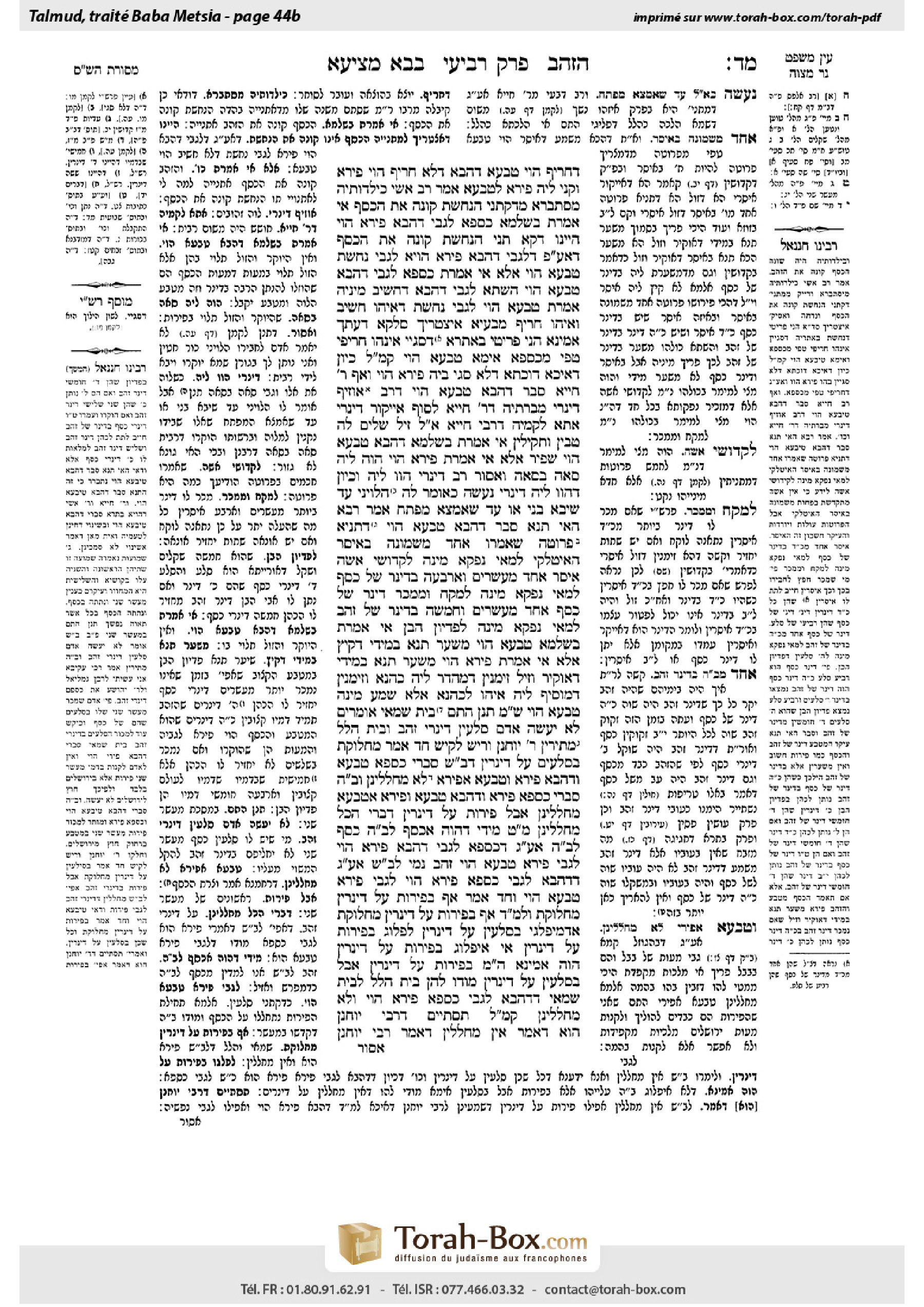
בבא מציעא מ״ד ב · Aramaic and Hebrew text
דְּחָרִיף – הָוֵי טִבְעָא. דַּהֲבָא דְּלָא חָרִיף – הָוֵי פֵּירָא, וְקָנֵי לֵיהּ פֵּירָא לְטִבְעָא.
אָמַר רַב אָשֵׁי: כְּיַלְדוּתֵיהּ מִסְתַּבְּרָא, מִדְּקָתָנֵי: ״הַנְּחֹשֶׁת קוֹנָה אֶת הַכֶּסֶף״.
אִי אָמְרַתְּ בִּשְׁלָמָא כַּסְפָּא לְגַבֵּי דַּהֲבָא פֵּירָא הָוֵי, הַיְינוּ דְּקָא תָנֵי: ״הַנְּחֹשֶׁת קוֹנָה אֶת הַכֶּסֶף״, דְּאַף עַל פִּי דִּלְגַבֵּי דַּהֲבָא פֵּירָא הָוֵיא, לְגַבֵּי נְחֹשֶׁת טִבְעָא הָוֵי. אֶלָּא אִי אָמְרַתְּ כַּסְפָּא לְגַבֵּי דַּהֲבָא טִבְעָא הָוֵי, הַשְׁתָּא לְגַבֵּי דַּהֲבָא דַּחֲשִׁיב מִינֵּיהּ, אָמְרַתְּ טִבְעָא הָוֵי, לְגַבֵּי נְחֹשֶׁת, דְּאִיהוּ חֲשִׁיב וְאִיהוּ חָרִיף – מִבַּעְיָא?
אִיצְטְרִיךְ, סָלְקָא דַּעְתָּךְ אָמֵינָא: הָנֵי פְּרִיטֵי, בְּאַתְרָא דְּסָגַיִי – אִינְהוּ חֲרִיפִי טְפֵי מִכַּסְפָּא, אֵימָא טִבְעָא הָוֵי! קָא מַשְׁמַע לַן, כֵּיוָן דְּאִיכָּא דּוּכְתָּא דְּלָא סָגֵי בֵּיהּ – פֵּירָא הָוֵי.
וְאַף רַבִּי חִיָּיא סְבַר דַּהֲבָא טִבְעָא הָוֵי. דְּרַב אוֹזֵיף דִּינָרֵי מִבְּרַתֵּיה דְּרַבִּי חִיָּיא, לְסוֹף אִיַּיקּוּר דִּינָרֵי. אֲתָא לְקַמֵּיהּ דְּרַבִּי חִיָּיא, אֲמַר לֵיהּ: זִיל שַׁלֵּים לַהּ טָבִין וּתְקִילִין. אִי אָמְרַתְּ בִּשְׁלָמָא דַּהֲבָא טִבְעָא הָוֵי – שַׁפִּיר. אֶלָּא אִי אָמְרַתְּ פֵּירָא הָוֵי, הָוֵה לֵיהּ סְאָה בִּסְאָה, וְאָסוּר!
רַב דִּינָרֵי הֲווֹ לֵיהּ, וְכֵיוָן דַּהֲווֹ לֵיהּ דִּינָרֵי – נַעֲשָׂה כְּאוֹמֵר לָהּ: הַלְוֵינִי עַד שֶׁיָּבֹא בְּנִי אוֹ עַד שֶׁאֶמְצָא מַפְתֵּחַ.
אָמַר רָבָא: הַאי תַּנָּא סָבַר דַּהֲבָא טִבְעָא הָוֵי, דְּתַנְיָא: פְּרוּטָה שֶׁאָמְרוּ – אֶחָד מִשְּׁמוֹנָה בָּאִיסָּר הָאִיטַלְקִי. לְמַאי נָפְקָא מִינַּהּ? לְקִדּוּשֵׁי אִשָּׁה. אִיסָּר – אֶחָד מֵעֶשְׂרִים וְאַרְבָּעָה בְּדִינָר שֶׁל כֶּסֶף. לְמַאי נָפְקָא מִינַּהּ? לְמִקָּח וּמִמְכָּר.
דִּינָר שֶׁל כֶּסֶף – אֶחָד מֵעֶשְׂרִים וַחֲמִשָּׁה בְּדִינָר שֶׁל זָהָב. לְמַאי נָפְקָא מִינַּהּ? לְפִדְיוֹן הַבֵּן.
אִי אָמְרַתְּ בִּשְׁלָמָא טִבְעָא הָוֵי, מְשַׁעֵר תַּנָּא בְּמִידֵּי דְּקִיץ! אֶלָּא אִי אָמְרַתְּ פֵּירָא הָוֵי, מְשַׁעֵר תַּנָּא בְּמִידֵּי דְּאוֹקֵיר וְזִיל? זִימְנִין דְּמַהְדַּר לֵיהּ כָּהֲנָא וְזִימְנִין דְּמוֹסֵיף לֵיהּ אִיהוּ לְכָהֲנָא. אֶלָּא, שְׁמַע מִינַּהּ: טִבְעָא הָוֵי. שְׁמַע מִינַּהּ.
תְּנַן הָתָם, בֵּית שַׁמַּאי אוֹמְרִים: לֹא יַעֲשֶׂה אָדָם סְלָעִין דִּינְרֵי זָהָב, וּבֵית הִלֵּל מַתִּירִין. רַבִּי יוֹחָנָן וְרֵישׁ לָקִישׁ חַד אָמַר: מַחְלוֹקֶת בִּסְלָעִים עַל דִּינָרִין, דְּבֵית שַׁמַּאי סָבְרִי: כַּסְפָּא טִבְעָא, וְדַהֲבָא פֵּירָא, וְטִבְעָא אַפֵּירָא לָא מְחַלְּלִינַן. וּבֵית הִלֵּל סָבְרִי: כַּסְפָּא פֵּירָא, וְדַהֲבָא טִבְעָא, וּפֵירָא אַטִּבְעָא מְחַלְּלִינַן. אֲבָל פֵּירוֹת עַל דִּינָרִין – דִּבְרֵי הַכֹּל מְחַלְּלִינַן.
מַאי טַעְמָא – מִידֵּי דְּהָוֵה אַכֶּסֶף לְבֵית הִלֵּל. כֶּסֶף לְבֵית הִלֵּל, אַף עַל גַּב דְּכַסְפָּא לְגַבֵּי דַּהֲבָא פֵּירָא הָוֵי, לְגַבֵּי פֵּירָא טִבְעָא הָוֵי. זָהָב נָמֵי לְבֵית שַׁמַּאי, אַף עַל גַּב דְּדַהֲבָא לְגַבֵּי כַּסְפָּא פֵּירָא הָוֵי, לְגַבֵּי פֵּירָא טִבְעָא הָוֵי. וְחַד אָמַר: אַף בְּפֵירוֹת עַל דִּינָרִין מַחְלוֹקֶת.
וּלְמַאן דְּאָמַר: אַף בְּפֵירוֹת עַל דִּינָרִין מַחְלוֹקֶת, אַדְּמִיפַּלְגִי בְּסִלְעִין עַל דִּינָרִין – לִפְלוּג בְּפֵירוֹת עַל דִּינָרִין! אִי אִיפְּלוּג בְּפֵירוֹת עַל דִּינָרִין, הֲוָה אָמֵינָא: הָנֵי מִילֵּי בְּפֵירוֹת עַל דִּינָרִין, אֲבָל בְּסִלְעִין עַל דִּינָרִין – מוֹדוּ לָהֶן בֵּית הִלֵּל לְבֵית שַׁמַּאי דְּדַהֲבָא לְגַבֵּי כַּסְפָּא פֵּירָא הָוֵי וְלָא מְחַלְּלִינַן, קָא מַשְׁמַע לַן.
תִּסְתַּיֵּים דְּרַבִּי יוֹחָנָן הוּא דְּאָמַר אֵין מְחַלְּלִין, דְּאָמַר רַבִּי יוֹחָנָן:
Bava Metzia 44b · English translation
which circulate, in the sense that they are universally accepted by merchants, in contrast to gold coins, which merchants are less willing to accept as payment for inexpensive items, are currency; gold coins, which do not circulate, are a commodity. And the principle is: When one party takes possession of the commodity, the other party acquires the currency.
Rav Ashi said: It is reasonable to teach the halakha in accordance with that which he taught in his youth. This is from the fact that the tanna teaches later in the mishna: When one party takes possession of the copper coins, the other party acquires the silver coins.
Rav Ashi explains: Granted, if you say that the silver coins relative to the gold coins are a commodity, that is the reason that the tanna teaches: When one party takes possession of the copper coins, the other party acquires the silver coins, as, even though relative to the gold coins, the silver coins are a commodity, the tanna teaches that relative to copper coins, they are currency. But if you say that the silver coins relative to the gold coins are currency the subsequent ruling is self-evident, as now, relative to the gold coins, which are more valuable than the silver coins, you say that silver coins are currency, then relative to copper coins, as the silver coins are more valuable than the copper coins and they also circulate more easily, is it necessary for the mishna to state that the silver coins are currency and the copper coins are a commodity?
The Gemara rejects this proof. Even if you teach the halakha in accordance with the opinion of Rabbi Yehuda HaNasi in his old age, it was necessary for the tanna to teach the halakha of silver and copper coins as well. This is because it might enter your mind to say that in a place where these copper perutot circulate, they circulate more easily than silver coins. Therefore, say that they are the currency and the silver coins are the commodity. Therefore, the tanna teaches us that since silver coins are universally accepted as currency and there is a place where copper coins do not circulate, the copper coins are a commodity.
§ The Gemara comments: And Rabbi Ḥiyya, as well, holds that gold coins are currency relative to silver. This is seen from the incident where Rav borrowed gold dinars from the daughter of Rabbi Ḥiyya. Ultimately, the gold dinars appreciated in value. Rav came before Rabbi Ḥiyya to ask his opinion. Rav was concerned that by returning more valuable dinars than he borrowed, this would violate the prohibition against paying interest. Rabbi Ḥiyya said to Rav: Go and pay her unflawed and weighed dinars. Return the number of dinars that you borrowed, as their monetary value is irrelevant. The Gemara asks: Granted, if you say that the gold coins are currency, this works out well, as he borrowed and repaid the same coins. But if you say that the gold coins are a commodity, this is parallel to the case of one who borrows a se’a of produce and repays a se’a of produce, which is prohibited, as the price of the produce may increase in the interim (see 75a).
The Gemara rejects this proof. The dinars that Rav received from the daughter of Rabbi Ḥiyya did not constitute a standard loan, as Rav had dinars elsewhere, but he needed money immediately. And since he had dinars, it is tantamount to saying to her: Lend me money until my son comes or until I find the key. As the mishna on 75a teaches, when the borrower possesses the same item he is borrowing, and merely does not have momentary access to it, this type of borrowing and repayment is permitted.
Rava said: This following tanna also holds that the gold coins are currency, as it is taught in a baraita: The peruta of which the Sages spoke in all places in the mishna is one-eighth of an Italian issar. The Gemara asks: What is the practical difference that emerges from this calculation? Ostensibly, a peruta is a peruta. The Gemara explains: Its consequences are for the betrothal of a woman with money, which can be effected only with money or an item worth at least one peruta. This peruta is assessed by means of the Italian issar. The baraita continues: An issar is one twenty-fourth of a silver dinar. The Gemara asks: What is the practical difference that emerges from this calculation? The Gemara answers: Its consequences are for buying and selling, to establish its value for use in commercial transactions.
The baraita continues: A silver dinar is one twenty-fifth of a gold dinar. What is the practical difference that emerges from this calculation? The Gemara explains: Its consequences are with regard to redemption of the firstborn son. The father of a firstborn gives the priest five sela, which are worth twenty silver dinars. Were he to give the priest a gold dinar he would receive five silver dinars change.
The Gemara asks: Granted, if you say that the gold coins are currency, the tanna calculates the value of the coins based on an item whose value is fixed. The value of the gold coin is the currency with fixed value, relative to which the silver dinar is a commodity, whose value fluctuates. But if you say that gold is a commodity, would the tanna calculate the value of a silver coin based on an item that appreciates and depreciates? If the value of gold fluctuates, sometimes the priest returns more than five silver dinars to the father who redeemed his son with a gold dinar, and sometimes the father must add to the gold dinar and give this additional sum along with the gold dinar to the priest to complete the sum of five sela. Rather, learn from it that the tanna holds that the gold coins are currency. The Gemara affirms: Learn from it that this is so.
§ We learned in a mishna there (Ma’aser Sheni 2:7): Beit Shammai say: A person may not transfer silver sela coins of tithe money or other consecrated coins into gold dinars through redemption, and Beit Hillel permit doing so. Rabbi Yoḥanan and Reish Lakish disagreed. One said: The dispute between Beit Shammai and Beit Hillel is with regard to exchanging silver sela coins for gold dinars, as Beit Shammai hold that the silver coins are currency and the gold coins are a commodity, and we do not desacralize currency with a commodity. And Beit Hillel hold that the silver coins are a commodity and the gold coins are currency, and we desacralize a commodity with currency. But everyone agrees that we desacralize produce with gold dinars.
What is the reason for the difference between sela coins and produce? The reason is just as it is with regard to silver coins according to Beit Hillel. With regard to silver coins according to Beit Hillel, although silver coins relative to gold coins are a commodity, relative to produce they are currency. So too is the status of gold coins according to Beit Shammai: Although gold coins are a commodity relative to silver coins, relative to produce they are currency. Therefore, one may desacralize produce with gold dinars. And one said: Even with regard to the exchange of produce for dinars there is a dispute between Beit Shammai and Beit Hillel.
The Gemara asks: And according to the one who says: There is a dispute even with regard to the exchange of produce for dinars, then rather than disagreeing with regard to the exchange of sela coins for dinars let them disagree with regard to the fundamental case of desacralizing, the exchange of produce for dinars. The Gemara answers: Had they disagreed with regard to the exchange of produce for dinars, I would say: This matter applies only with regard to the exchange of produce for dinars. But with regard to the exchange of sela coins for dinars, Beit Hillel concede to Beit Shammai that gold coins relative to silver coins are a commodity, and we do not desacralize currency with a commodity. Therefore, the tanna teaches us that they disagree in that case as well.
The Gemara suggests: Conclude that in this dispute between Rabbi Yoḥanan and Reish Lakish it is Rabbi Yoḥanan who said: One does not desacralize produce with gold dinars, as Rabbi Yoḥanan said:
Bava Metzia 44b · Traduction française (IA)
Ce sont des monnaies qui circulent, au sens où elles sont universellement acceptées par les marchands, contrairement aux pièces d'or, que les marchands sont moins enclins à accepter comme paiement pour des objets peu coûteux, sont considérées comme de la monnaie ; les pièces d'or, qui ne circulent pas, sont un bien. Et le principe est : Lorsqu'une partie prend possession du bien, l'autre partie acquiert la monnaie.
Rav Ashi a dit : Il est raisonnable d'enseigner la halakha selon ce qu'il a enseigné dans son jeune âge. Cela vient du fait que le tanna enseigne plus tard dans la mitsna : Lorsqu'une partie prend possession des pièces de cuivre, l'autre partie acquiert les pièces d'argent.
Rav Ashi explique : Bien sûr, si vous dites que les pièces d'argent, par rapport aux pièces d'or, sont un bien, c'est la raison pour laquelle le tanna enseigne : Lorsqu'une partie prend possession des pièces de cuivre, l'autre partie acquiert les pièces d'argent, car, même si par rapport aux pièces d'or, les pièces d'argent sont un bien, le tanna enseigne que par rapport aux pièces de cuivre, elles sont de la monnaie. Mais si vous dites que les pièces d'argent, par rapport aux pièces d'or, sont de la monnaie, la décision subséquente est évidente, car maintenant, par rapport aux pièces d'or, qui sont plus précieuses que les pièces d'argent, vous dites que les pièces d'argent sont de la monnaie, alors par rapport aux pièces de cuivre, comme les pièces d'argent sont plus précieuses que les pièces de cuivre et circulent plus facilement, est-il nécessaire que la mitsna indique que les pièces d'argent sont de la monnaie et les pièces de cuivre sont un bien ?
La Guemara rejette cette preuve. Même si vous enseignez la halakha selon l'opinion de Rabbi Yehuda HaNasi à son âge avancé, il était nécessaire que le tanna enseigne la halakha des pièces d'argent et des pièces de cuivre. Cela vient du fait qu'il pourrait entrer en vous l'idée de dire qu'ici, où ces pièces de cuivre circulent, elles circulent plus facilement que les pièces d'argent. Par conséquent, dites qu'elles sont la monnaie et que les pièces d'argent sont le bien. Par conséquent, le tanna nous enseigne que puisque les pièces d'argent sont universellement acceptées comme monnaie et qu'il existe un lieu où les pièces de cuivre ne circulent pas, les pièces de cuivre sont un bien.
§ La Guemara commente : Rabbi Ḥiyya, lui aussi, considère que les pièces d'or sont de la monnaie par rapport aux pièces d'argent. Cela est vu à partir de l'incident où Rav a emprunté des dinars d'or à la fille de Rabbi Ḥiyya. Finalement, les dinars d'or ont augmenté en valeur. Rav est venu devant Rabbi Ḥiyya pour demander son avis. Rav avait peur que, en rendant des dinars d'or plus précieux que ceux qu'il avait empruntés, cela viole l'interdiction de payer des intérêts. Rabbi Ḥiyya a dit à Rav : Va et lui rendre des dinars d'or purs et pesés. Rends le nombre de dinars que tu as empruntés, car leur valeur monétaire n'a pas d'importance. La Guemara demande : Bien sûr, si vous dites que les dinars d'or sont de la monnaie, cela fonctionne bien, car il a emprunté et rendu les mêmes dinars. Mais si vous dites que les dinars d'or sont un bien, cela est comparable au cas d'une personne qui emprunte un se'a de produits et rend un se'a de produits, ce qui est interdit, car la valeur des produits peut augmenter pendant l'intervalle (voir 75a).
La Guemara rejette cette preuve. Les dinars que Rav a reçus de la fille de Rabbi Ḥiyya ne constituaient pas un prêt standard, car Rav avait des dinars ailleurs, mais il avait besoin d'argent immédiatement. Et puisqu'il avait des dinars, cela équivaut à lui dire : Prête-moi de l'argent jusqu'à ce que mon fils arrive ou que je trouve la clé. Comme la mitsna de 75a enseigne, lorsque le prêteur possède le même objet qu'il emprunte et n'a simplement pas accès à celui-ci à l'instant, ce type de prêt et de remboursement est permis.
Rava a dit : Ce tanna suivant considère également que les dinars d'or sont de la monnaie, car il est enseigné dans une baraïta : La peruta dont les Sages parlent dans toutes les mitsvot est un huitième d'un issar italien. La Guemara demande : Quelle est la différence pratique qui découle de ce calcul ? Apparemment, une peruta est une peruta. La Guemara explique : Ses conséquences sont pour le mariage d'une femme avec de l'argent, qui peut être effectué uniquement avec de l'argent ou un objet valant au moins une peruta. Cette peruta est évaluée par le biais de l'issar italien. La baraïta continue : Un issar est un vingt-quatrième d'un dinar d'argent. La Guemara demande : Quelle est la différence pratique qui découle de ce calcul ? La Guemara répond : Ses conséquences sont pour l'achat et la vente, afin d'établir sa valeur pour les transactions commerciales.
La baraïta continue : Un dinar d'argent est un vingtième-cinquième d'un dinar d'or. Quelle est la différence pratique qui découle de ce calcul ? La Guemara explique : Ses conséquences sont concernant le rachat du premier-né. Le père d'un premier-né donne au prêtre cinq sela, qui valent vingt dinars d'argent. S'il donnait au prêtre un dinar d'or, il recevrait cinq dinars d'argent comme monnaie.
La Guemara demande : Bien sûr, si vous dites que les dinars d'or sont de la monnaie, le tanna calcule la valeur des pièces en se basant sur un objet dont la valeur est fixe. La valeur du dinar d'or est la monnaie à valeur fixe, par rapport à laquelle le dinar d'argent est un bien, dont la valeur fluctue. Mais si vous dites que l'or est un bien, la valeur d'un dinar d'argent serait-elle calculée en se basant sur un objet dont la valeur fluctue ? Si la valeur de l'or fluctue, parfois le prêtre rend plus de cinq dinars d'argent au père qui a racheté son fils avec un dinar d'or, et parfois le père doit ajouter à ce dinar d'or et lui donner cette somme supplémentaire avec le dinar d'or au prêtre pour compléter la somme de cinq sela. Par conséquent, apprenez-en que le tanna considère que les dinars d'or sont de la monnaie. La Guemara affirme : Apprenez-en que c'est ainsi.
§ Nous avons appris dans une mitsna là (Ma’aser Sheni 2:7) : Beit Shammai disent : Une personne ne peut pas transférer des sela d'argent de l'argent de dîme ou d'autres pièces consacrées en dinars d'or par l'achat, et Beit Hillel autorisent cela. Rabbi Yoḥanan et Reish Lakish étaient en désaccord. L'un disait : Le désaccord entre Beit Shammai et Beit Hillel concerne l'échange de sela d'argent contre des dinars d'or, car Beit Shammai considère que les sela d'argent sont de la monnaie et les dinars d'or sont un bien, et nous ne déconsacralisons pas la monnaie avec un bien. Et Beit Hillel considère que les sela d'argent sont un bien et les dinars d'or sont de la monnaie, et nous déconsacralisons un bien avec la monnaie. Mais tout le monde convient que nous déconsacralisons les produits avec des dinars d'or.
Quelle est la raison de la différence entre les sela et les produits ? La raison est la même que celle des sela selon Beit Hillel. Selon Beit Hillel, bien que les sela soient un bien par rapport aux dinars d'or, ils sont de la monnaie par rapport aux produits. De même, le statut des dinars d'or selon Beit Shammai est le suivant : bien que les dinars d'or soient un bien par rapport aux sela, ils sont de la monnaie par rapport aux produits. Par conséquent, on peut déconsacraliser les produits avec des dinars d'or. Et l'un disait : Même concernant l'échange de produits contre des dinars, il y a un désaccord entre Beit Shammai et Beit Hillel.
Le Guemara pose la question : Et selon celui qui dit : Il y a un désaccord même concernant l'échange de produits contre des dinars, alors plutôt que de s'opposer concernant l'échange de sela contre des dinars, qu'ils s'opposent concernant le cas fondamental de déconsacralisation, l'échange de produits contre des dinars. Le Guemara répond : S'ils avaient s'opposé concernant l'échange de produits contre des dinars, je dirais : cette question s'applique uniquement à l'échange de produits contre des dinars. Mais concernant l'échange de sela contre des dinars, Beit Hillel reconnaissent à Beit Shammai que les dinars d'or par rapport aux sela sont un bien, et nous ne déconsacralisons pas la monnaie avec un bien. Par conséquent, le tanna nous apprend que cela est aussi le cas.
Le Guemara suggère : Concluez que dans ce désaccord entre Rabbi Yoḥanan et Reish Lakish, c'est Rabbi Yoḥanan qui a dit : On ne déconsacralise pas les produits avec des dinars d'or, car Rabbi Yoḥanan a dit :
Traduction française générée par IA à partir de l’édition anglaise de Sefaria. Vérifie toujours un passage avec le texte source.
Text from Sefaria: William Davidson Edition - Vocalized Aramaic (CC BY NC); William Davidson Edition - English (CC BY NC).