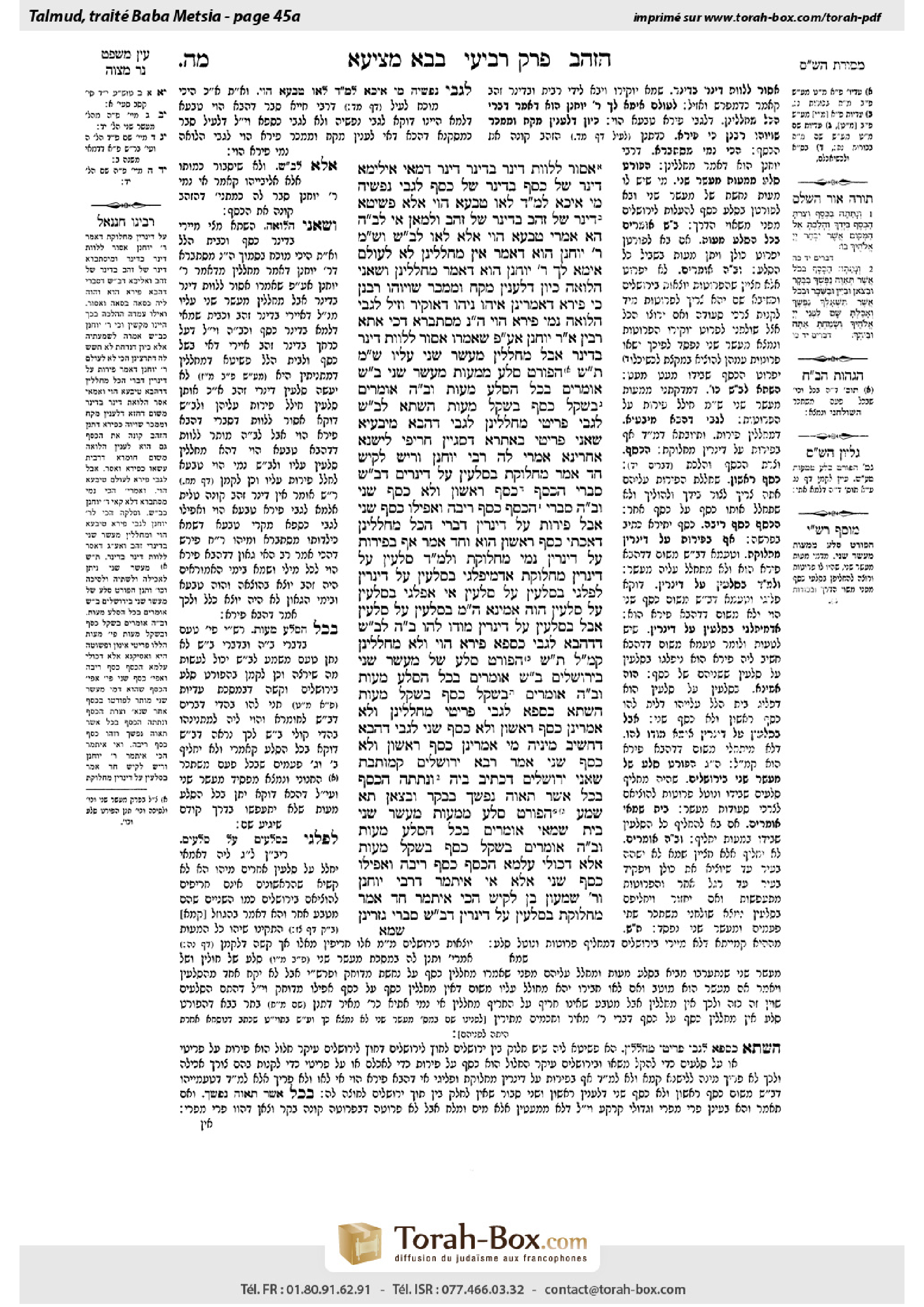
Bava Metzia 45a: Talmud study for Daf Yomi
Study the Talmud for Daf Yomi with scanned pages, Hebrew text, English translations from Sefaria and AI-generated French translations.
Passage selection and English or AI-generated French translation are available where the scan has annotations. Daf Study is independent of Torah-Box and Sefaria.
Browse Bava Metzia · בבא מציעא · All tractatesBava Metzia 45a text and translations
This page of Bava Metzia includes the Aramaic text, an English translation and an AI-generated French translation, alongside the scan above.
בבא מציעא מ״ה א · Aramaic and Hebrew text
אָסוּר לִלְווֹת דִּינָר בְּדִינָר.
דִּינָר דְּמַאי? אִילֵּימָא דִּינָר שֶׁל כֶּסֶף בְּדִינָר שֶׁל כֶּסֶף, לְגַבֵּי נַפְשֵׁיהּ מִי אִיכָּא לְמַאן דְּאָמַר לָאו טִבְעָא הָוֵי? אֶלָּא פְּשִׁיטָא דִּינָר שֶׁל זָהָב בְּדִינָר שֶׁל זָהָב, וּלְמַאן? אִי לְבֵית הִלֵּל – הָא אָמְרִי טִבְעָא הָוֵי. אֶלָּא לָאו לְבֵית שַׁמַּאי, וּשְׁמַע מִינַּהּ רַבִּי יוֹחָנָן הוּא דְּאָמַר: אֵין מְחַלְּלִין!
לָא, לְעוֹלָם אֵימָא לָךְ רַבִּי יוֹחָנָן הוּא דְּאָמַר מְחַלְּלִין, וְשָׁאנֵי הַלְוָאָה כֵּיוָן דִּלְעִנְיַן מִקָּח וּמִמְכָּר שַׁוְּיוּהּו רַבָּנַן כִּי פֵירָא, דְּאָמְרִינַן: אִיהוּ נִיהוּ דְּאוֹקֵיר וְזִיל – לְגַבֵּי הַלְוָאָה נָמֵי פֵּירָא הָוֵי.
הָכִי נָמֵי מִסְתַּבְּרָא, דְּכִי אֲתָא רָבִין אָמַר רַבִּי יוֹחָנָן: אַף עַל פִּי שֶׁאָמְרוּ אָסוּר לִלְווֹת דִּינָר בְּדִינָר, אֲבָל מְחַלְּלִין מַעֲשֵׂר שֵׁנִי עָלָיו. שְׁמַע מִינַּהּ.
תָּא שְׁמַע: הַפּוֹרֵט סֶלַע מִמְּעוֹת מַעֲשֵׂר שֵׁנִי, בֵּית שַׁמַּאי אוֹמְרִים: בְּכׇל הַסֶּלַע מָעוֹת, וּבֵית הִלֵּל אוֹמְרִים: בְּשֶׁקֶל כֶּסֶף, בְּשֶׁקֶל מָעוֹת. הַשְׁתָּא לְבֵית שַׁמַּאי לְגַבֵּי פְּרִיטֵי מְחַלְּלִינַן, לְגַבֵּי דַּהֲבָא מִיבַּעְיָא? שָׁאנֵי פְּרִיטֵי בְּאַתְרָא דְּסָגַיִין חֲרִיפֵי.
לִישָּׁנָא אַחֲרִינָא אָמְרִי לַהּ, רַבִּי יוֹחָנָן וְרֵישׁ לָקִישׁ. חַד אָמַר: מַחְלוֹקֶת בִּסְלָעִין עַל דִּינָרִים, דְּבֵית שַׁמַּאי סָבְרִי: ״הַכֶּסֶף״ – כֶּסֶף רִאשׁוֹן וְלֹא כֶּסֶף שֵׁנִי.
וּבֵית הִלֵּל סָבְרִי: ״הַכֶּסֶף״, ״כֶּסֶף״, רִיבָּה – וַאֲפִילּוּ כֶּסֶף שֵׁנִי. אֲבָל פֵּירוֹת עַל דִּינָרִין – דִּבְרֵי הַכֹּל מְחַלְּלִינַן, דְּאַכַּתִּי כֶּסֶף רִאשׁוֹן הוּא.
וְחַד אָמַר: אַף בְּפֵירוֹת עַל דִּינָרִין נָמֵי מַחְלוֹקֶת.
וּלְמַאן דְּאָמַר סְלָעִין עַל דִּינָרִין מַחְלוֹקֶת, אַדְּמִיפַּלְגִי בִּסְלָעִין עַל דִּינָרִין, לִיפְלוֹג בִּסְלָעִין עַל סְלָעִין!
אִי אִפְּלוּג בִּסְלָעִין עַל סְלָעִין, הֲוָה אָמֵינָא: הָנֵי מִילֵּי בִּסְלָעִין עַל סְלָעִין, אֲבָל בִּסְלָעִין עַל דִּינָרִין – מוֹדוּ לְהוּ בֵּית הִלֵּל לְבֵית שַׁמַּאי דְּדַהֲבָא לְגַבֵּי כַּסְפָּא פֵּירָא הָוֵי וְלָא מְחַלְּלִינַן, קָא מַשְׁמַע לַן.
תָּא שְׁמַע: הַפּוֹרֵט סֶלַע שֶׁל מַעֲשֵׂר שֵׁנִי בִּירוּשָׁלַיִם, בֵּית שַׁמַּאי אוֹמְרִים: בְּכׇל הַסֶּלַע מָעוֹת, וּבֵית הִלֵּל אוֹמְרִים: בְּשֶׁקֶל כֶּסֶף, בְּשֶׁקֶל מָעוֹת. הַשְׁתָּא כַּסְפָּא לְגַבֵּי פְּרִיטֵי מְחַלְּלִינַן, וְלָא אָמְרִינַן ״כֶּסֶף רִאשׁוֹן וְלֹא כֶּסֶף שֵׁנִי״, לְגַבֵּי דַּהֲבָא דַּחֲשִׁיב מִינֵּיהּ, מִי אָמְרִינַן ״כֶּסֶף רִאשׁוֹן וְלֹא כֶּסֶף שֵׁנִי״?
אָמַר רָבָא: יְרוּשָׁלַיִם קָמוֹתְבַתְּ? שָׁאנֵי יְרוּשָׁלַיִם, דִּכְתִיב בֵּיהּ ״וְנָתַתָּה הַכֶּסֶף בְּכֹל אֲשֶׁר תְּאַוֶּה נַפְשְׁךָ בַּבָּקָר וּבַצֹּאן״.
תָּא שְׁמַע: הַפּוֹרֵט סֶלַע מִמְּעוֹת מַעֲשֵׂר שֵׁנִי – בֵּית שַׁמַּאי אוֹמְרִים: בְּכׇל הַסֶּלַע מָעוֹת, וּבֵית הִלֵּל אוֹמְרִים: בְּשֶׁקֶל כֶּסֶף, בְּשֶׁקֶל מָעוֹת!
אֶלָּא דְּכוּלֵּי עָלְמָא ״הַכֶּסֶף״ ״כֶּסֶף״ רִיבָּה, וַאֲפִילּוּ כֶּסֶף שֵׁנִי. אֶלָּא אִי אִיתְּמַר דְּרַבִּי יוֹחָנָן וְרַבִּי שִׁמְעוֹן בֶּן לָקִישׁ, הָכִי אִיתְּמַר: חַד אָמַר מַחְלוֹקֶת בִּסְלָעִין עַל דִּינָרִין, דְּבֵית שַׁמַּאי סָבְרִי: גָּזְרִינַן
Bava Metzia 45a · English translation
It is prohibited for one to borrow a dinar and repay the loan with a dinar, because if the value of the dinar changes in the interim, both the borrower and the lender will have violated the prohibition against interest.
The Gemara elaborates: The reference is to a dinar of what type of metal? If we say the reference is to one who borrowed a silver dinar and repaid the loan with a silver dinar, is there anyone who says that silver relative to itself is not currency? Rather, it is obvious that the reference is to one who borrowed a gold dinar and repaid the loan with a gold dinar. The Gemara continues its analysis: And in accordance with whose opinion does Rabbi Yoḥanan state this halakha? If it is in accordance with the opinion of Beit Hillel, don’t they say that a gold dinar is currency? Rather, isn’t it in accordance with the opinion of Beit Shammai? And learn from it that it is Rabbi Yoḥanan who said that according to Beit Shammai we do not desacralize produce with gold dinars, as he holds that they are not considered currency.
The Gemara rejects this proof: No, actually I will say to you that it is Rabbi Yoḥanan who said that even according to Beit Shammai we desacralize produce with gold dinars. And the halakha of a loan is different from the halakha of desacralizing second tithe, as with regard to buying and selling, the Sages deemed the legal status of a gold dinar like that of a commodity. As we say: It is the gold that appreciates and depreciates in value, in accordance with the halakha in the mishna: When one party takes possession of the gold coins, the other party acquires the silver coins. With regard to a loan as well, the legal status of a gold dinar is like that of a commodity, and therefore there is concern that they may violate the prohibition against interest.
The Gemara comments: So too, it is reasonable to say that this is Rabbi Yoḥanan’s opinion, as when Ravin came from Eretz Yisrael he said that Rabbi Yoḥanan says: Even though they said that it is prohibited to borrow a gold dinar and repay the loan with a gold dinar, yet, one may desacralize second tithe with a gold dinar. Conclude from it that it is Rabbi Yoḥanan who said that one desacralizes second-tithe produce with a gold dinar.
Apropos redemption of second-tithe produce with gold, the Gemara cites proof from a mishna (Ma’aser Sheni 2:8). Come and hear: With regard to one who exchanges copper coins of second-tithe money for a silver sela coin to ease its transport to Jerusalem, Beit Shammai say: He may exchange the copper coins for the entire silver sela. And Beit Hillel say: He may exchange the copper coins for a silver shekel, which is equivalent to half a sela, and with regard to the other shekel, he must retain the copper coins. Now, if according to Beit Shammai we desacralize second-tithe produce with copper perutot, is it necessary to mention the fact that it may be desacralized with gold coins? The Gemara rejects that proof: Perutot are different, as in a place where they are in circulation, they circulate more easily than silver coins.
§ There is another version of this discussion, and some say that this is the dispute between Rabbi Yoḥanan and Reish Lakish. One said: The dispute between Beit Shammai and Beit Hillel is with regard to exchanging silver sela coins for gold dinars, as Beit Shammai hold that when the verse states: “And you shall bestow the money and you shall bind the money in your hand” (Deuteronomy 14:25), the term “the money” is referring to the first money, i.e., the very money with which the second-tithe produce was desacralized, and it is not referring to the second money, e.g., gold coins that became second-tithe money by virtue of their being exchanged with second-tithe silver sela coins. Evidently, the money with which the second-tithe produce was desacralized must be taken to Jerusalem and it may not be exchanged for other coins.
And Beit Hillel hold that since it is written: “The money,” and this second mention of money in that verse is superfluous, the term “the money” serves to include even second money. Accordingly, the verse teaches that money with which the produce was desacralized may be exchanged for other money that will be brought to Jerusalem. The Gemara continues its citation of this first explanation of the dispute between Beit Shammai and Beit Hillel: But with regard to desacralizing produce with dinars, everyone agrees that we desacralize produce in that manner, as the gold dinars are still the first money used for desacralizing, as any type of money can be used for desacralizing second-tithe produce.
And one said: There is a dispute between Beit Shammai and Beit Hillel even with regard to the desacralizing of produce with dinars, as to whether desacralizing must be accomplished with silver or if it can be accomplished even with gold.
The Gemara challenges: But according to the one who says: The dispute between Beit Shammai and Beit Hillel is with regard to exchanging silver sela coins for gold dinars, rather than disagreeing with regard to exchanging of silver sela coins for gold dinars, let Beit Shammai and Beit Hillel disagree with regard to the more straightforward case of exchanging sela coins for sela coins, as according to those who forbid exchanging a sela for dinars, exchanging a sela for a sela is also forbidden, as one may not convert the second-tithe sanctity to second money.
The Gemara explains: Had they disagreed with regard to the exchange of sela coins for sela coins, I would say: This matter applies only with regard to exchanging sela coins for sela coins, but with regard to exchanging sela coins for dinars, Beit Hillel concede to Beit Shammai that gold coins relative to silver coins are a commodity, and we do not desacralize currency with a commodity. Therefore, the tanna teaches us that they disagree in the case of exchanging silver sela coins for gold dinars as well.
The Gemara suggests: Come and hear proof to the correct ruling in this dispute from a mishna (Ma’aser Sheni 2:9): With regard to one who exchanges a silver sela of second-tithe money for copper coins in Jerusalem, Beit Shammai say: With the entire sela he executes the exchange for copper coins; and Beit Hillel say: He may exchange half the sela for a silver shekel, and half the sela for copper coins having the value of a shekel. The Gemara analyzes the mishna: Now if we allow him to desacralize silver coins for perutot, and we do not say that there is a Torah decree of first money and not second money, then with regard to gold, which is more valuable than silver, do we say that there is a Torah decree of first money and not second money?
Rava said in response: Are you raising an objection from the halakha of exchanging coins within Jerusalem in order to apply it to the halakha of exchanging coins outside of Jerusalem? The legal status of Jerusalem is different with regard to exchanging second-tithe coins, as it is written with regard to Jerusalem: “And you shall bestow the money for whatever your soul desires, for cattle or for sheep” (Deuteronomy 14:26). One may utilize the money in Jerusalem in any manner he chooses.
Come and hear proof from the mishna (Ma’aser Sheni 2:8): With regard to one who exchanges copper coins of second-tithe money for a silver sela coin to ease its transport to Jerusalem, Beit Shammai say: He may exchange the copper coins for the entire silver sela. And Beit Hillel say: He may exchange the copper coins for a silver shekel, which is equivalent to half a sela, and with regard to the other shekel, he must retain the copper coins. This constitutes proof that everyone agrees one may exchange second-tithe coins for other coins.
Rather, the Gemara abandons its previous explanation of the dispute and states that everyone agrees that since it is written: “The money,” and this second mention of money in that verse is superfluous, the term “the money” serves to include even second money. Rather, if the dispute between Rabbi Yoḥanan and Rabbi Shimon ben Lakish was stated, it was stated like this: One said: The dispute between Beit Shammai and Beit Hillel is with regard to the exchange of silver sela coins for gold dinars. As Beit Shammai hold: We issue a decree rendering it prohibited to do so,
Bava Metzia 45a · Traduction française (IA)
Il est interdit à une personne de prêter un dinar et de rembourser le prêt avec un dinar, car si la valeur du dinar change pendant la durée du prêt, à la fois le prêteur et le prêteur auront violé l'interdiction d'intérêt.
La Guemara développe : De quel type de métal s'agit-il lorsqu'on parle d'un dinar ? Si nous disons qu'il s'agit d'un dinar en argent que l'on prête et que l'on rembourse avec un dinar en argent, y a-t-il quelqu'un qui affirme que l'argent ne constitue pas une monnaie par rapport à lui-même ? Plutôt, il est évident que la référence est à un dinar en or que l'on prête et que l'on rembourse avec un dinar en or. La Guemara continue son analyse : Et selon quel avis Rabbi Yoḥanan énonce cette halakha ? Si c'est selon l'avis de Beit Hillel, ne disent-ils pas que le dinar en or est une monnaie ? Plutôt, n'est-ce pas selon l'avis de Beit Shammai ? Et tirez-en la conclusion que c'est Rabbi Yoḥanan qui a dit que selon Beit Shammai, on ne désacralise pas les produits avec des dinars en or, car il considère qu'ils ne sont pas considérés comme de la monnaie.
La Guemara rejette cette preuve : Non, en réalité, je vous dirai que c'est Rabbi Yoḥanan qui a dit que même selon Beit Shammai, on désacralise les produits avec des dinars en or. Et la halakha concernant un prêt diffère de la halakha concernant la désacralisation de la deuxième tithe, car concernant l'achat et la vente, les Sages ont considéré le statut juridique d'un dinar en or comme celui d'un bien. Comme nous le disons : C'est l'or qui augmente ou diminue en valeur, conformément à la halakha du mitsna : Lorsqu'une partie prend possession des pièces d'or, l'autre partie acquiert les pièces d'argent. Concernant un prêt également, le statut juridique d'un dinar en or est celui d'un bien, et par conséquent, il y a une crainte qu'ils puissent violer l'interdiction d'intérêt.
La Guemara commente : De même, il est raisonnable de dire que c'est l'avis de Rabbi Yoḥanan, car lorsque Rabin est venu d'Éretz Yisrael, il a dit que Rabbi Yoḥanan dit : Même s'ils disent qu'il est interdit de prêter un dinar en or et de rembourser le prêt avec un dinar en or, cependant, on peut désacraliser la deuxième tithe avec un dinar en or. Concluez-en que c'est Rabbi Yoḥanan qui a dit qu'on désacralise les produits de la deuxième tithe avec un dinar en or.
En ce qui concerne la désacralisation des produits de la deuxième tithe avec de l'or, la Guemara cite une preuve tirée d'un mitsva (Ma’aser Sheni 2:8). Venez écouter : Concernant celui qui échange des pièces de cuivre de l'argent de la deuxième tithe contre une pièce d'argent sela pour faciliter son transport à Jérusalem, Beit Shammai disent : Il peut échanger les pièces de cuivre contre toute la pièce d'argent sela. Et Beit Hillel disent : Il peut échanger les pièces de cuivre contre une pièce d'argent shekel, qui équivaut à la moitié d'un sela, et concernant l'autre shekel, il doit conserver les pièces de cuivre. Maintenant, si selon Beit Shammai on désacralise les produits de la deuxième tithe avec des perutot en cuivre, est-il nécessaire de mentionner le fait qu'on peut les désacraliser avec des pièces d'or ? La Guemara rejette cette preuve : Les perutot sont différentes, car dans un lieu où elles circulent, elles circulent plus facilement que les pièces d'argent.
§ Il existe une autre version de cette discussion, et certains disent que c'est le débat entre Rabbi Yoḥanan et Reish Lakish. L'un dit : Le débat entre Beit Shammai et Beit Hillel concerne l'échange de pièces d'argent sela contre des dinars en or, car Beit Shammai considère que lorsque le verset dit : « Et tu donneras l'argent et tu attacheras l'argent dans ta main » (Deutéronome 14:25), le terme « l'argent » fait référence au premier argent, c'est-à-dire l'argent même avec lequel les produits de la deuxième tithe ont été désacralisés, et il ne fait pas référence au second argent, par exemple, les pièces d'or devenues argent de la deuxième tithe par leur échange avec les sela d'argent de la deuxième tithe. Évidemment, l'argent avec lequel les produits de la deuxième tithe ont été désacralisés doit être apporté à Jérusalem et ne peut être échangé contre d'autres monnaies.
Et Beit Hillel considère que puisque cela est écrit : « L'argent », et cette seconde mention d'argent dans ce verset est superflue, le terme « l'argent » sert à inclure même l'argent secondaire. Ainsi, le verset enseigne que l'argent avec lequel les produits ont été désacralisés peut être échangé contre d'autres monnaies qui seront apportés à Jérusalem. La Guemara continue la citation de cette première explication du débat entre Beit Shammai et Beit Hillel : Mais concernant la désacralisation des produits avec des dinars, tout le monde convient qu'on désacralise les produits ainsi, car les dinars en or sont encore la monnaie première utilisée pour la désacralisation, car toute monnaie peut être utilisée pour désacraliser les produits de la deuxième tithe.
Et l'un dit : Il existe un débat entre Beit Shammai et Beit Hillel même concernant la désacralisation des produits avec des dinars, à savoir si la désacralisation doit être accomplie avec de l'argent ou si elle peut être accomplie même avec de l'or.
La Guemara conteste : Mais selon celui qui dit que le débat entre Beit Shammai et Beit Hillel concerne l'échange de sela en argent contre des dinars en or, plutôt que de désaccorder concernant l'échange de sela en argent contre des dinars en or, que Beit Shammai et Beit Hillel désaccordent concernant l'échange de sela contre sela, car selon ceux qui interdisent l'échange d'un sela contre des dinars, l'échange d'un sela contre un sela est également interdit, car on ne peut pas convertir la sanctité de la deuxième tithe en monnaie secondaire.
La Guemara explique : Si ils avaient désaccordé concernant l'échange de sela contre sela, je dirais : Cette affaire s'applique uniquement à l'échange de sela contre sela, mais concernant l'échange de sela contre des dinars, Beit Hillel reconnaît à Beit Shammai que les dinars en or par rapport aux sela en argent sont un bien, et nous ne désacralisons pas la monnaie avec un bien. Par conséquent, le tanna nous enseigne que leur débat s'applique également au cas de l'échange de sela en argent contre des dinars en or.
La Guemara suggère : Viens écouter une preuve de la décision correcte dans ce litige, tirée d’une mitsva (Ma’aser Sheni 2:9) : Concernant celui qui échange un sela d’argent de la deuxième dîme contre des pièces de cuivre à Jérusalem, Beit Shammai disent : Avec l’intégralité du sela, il exécute l’échange contre des pièces de cuivre ; et Beit Hillel disent : Il peut échanger la moitié du sela contre un shekel d’argent, et la moitié du sela contre des pièces de cuivre ayant la valeur d’un shekel. La Guemara analyse la mitsva : Maintenant, si nous permettons à l’individu d’échanger des pièces d’argent contre des perutot, et que nous ne disons pas qu’il y a un décret de la Torah concernant la première dîme et non la deuxième, alors concernant l’or, qui est plus précieux que l’argent, disons-nous qu’il y a un décret de la Torah concernant la première dîme et non la deuxième dîme ?
Rava répondit : Est-ce que tu soulèves une objection à partir de la halakha de l’échange de pièces à Jérusalem afin d’appliquer cette halakha à l’échange de pièces en dehors de Jérusalem ? Le statut de Jérusalem est différent concernant l’échange de pièces de la deuxième dîme, car il est écrit à propos de Jérusalem : « Et tu donneras l’argent pour ce que ton âme désire, pour des bêtes ou pour des brebis » (Deutéronome 14:26). On peut utiliser l’argent à Jérusalem de toute manière qu’il veut.
Viens écouter une preuve tirée de la mitsva (Ma’aser Sheni 2:8) : Concernant celui qui échange des pièces de cuivre de la deuxième dîme contre un sela d’argent afin de faciliter son transport à Jérusalem, Beit Shammai disent : Il peut échanger les pièces de cuivre contre l’intégralité du sela d’argent. Et Beit Hillel disent : Il peut échanger les pièces de cuivre contre un shekel d’argent, qui équivaut à la moitié d’un sela, et concernant l’autre shekel, il doit conserver les pièces de cuivre. Cela constitue une preuve que tout le monde convient qu’on peut échanger des pièces de la deuxième dîme contre d’autres pièces.
Plutôt, la Guemara abandonne son explication précédente du litige et affirme que tout le monde convient que puisque cela est écrit : « L’argent », et cette seconde mention d’argent dans cette verset est superflue, le terme « l’argent » sert à inclure même l’argent de la deuxième dîme. Plutôt, si le litige entre Rabbi Yoḥanan et Rabbi Shimon ben Lakish a été évoqué, il a été évoqué ainsi : L’un disait : Le litige entre Beit Shammai et Beit Hillel concerne l’échange de sela d’argent contre des dinars d’or. Comme Beit Shammai tiennent : Nous édictons un décret interdisant de le faire,
Traduction française générée par IA à partir de l’édition anglaise de Sefaria. Vérifie toujours un passage avec le texte source.
Text from Sefaria: William Davidson Edition - Vocalized Aramaic (CC BY NC); William Davidson Edition - English (CC BY NC).