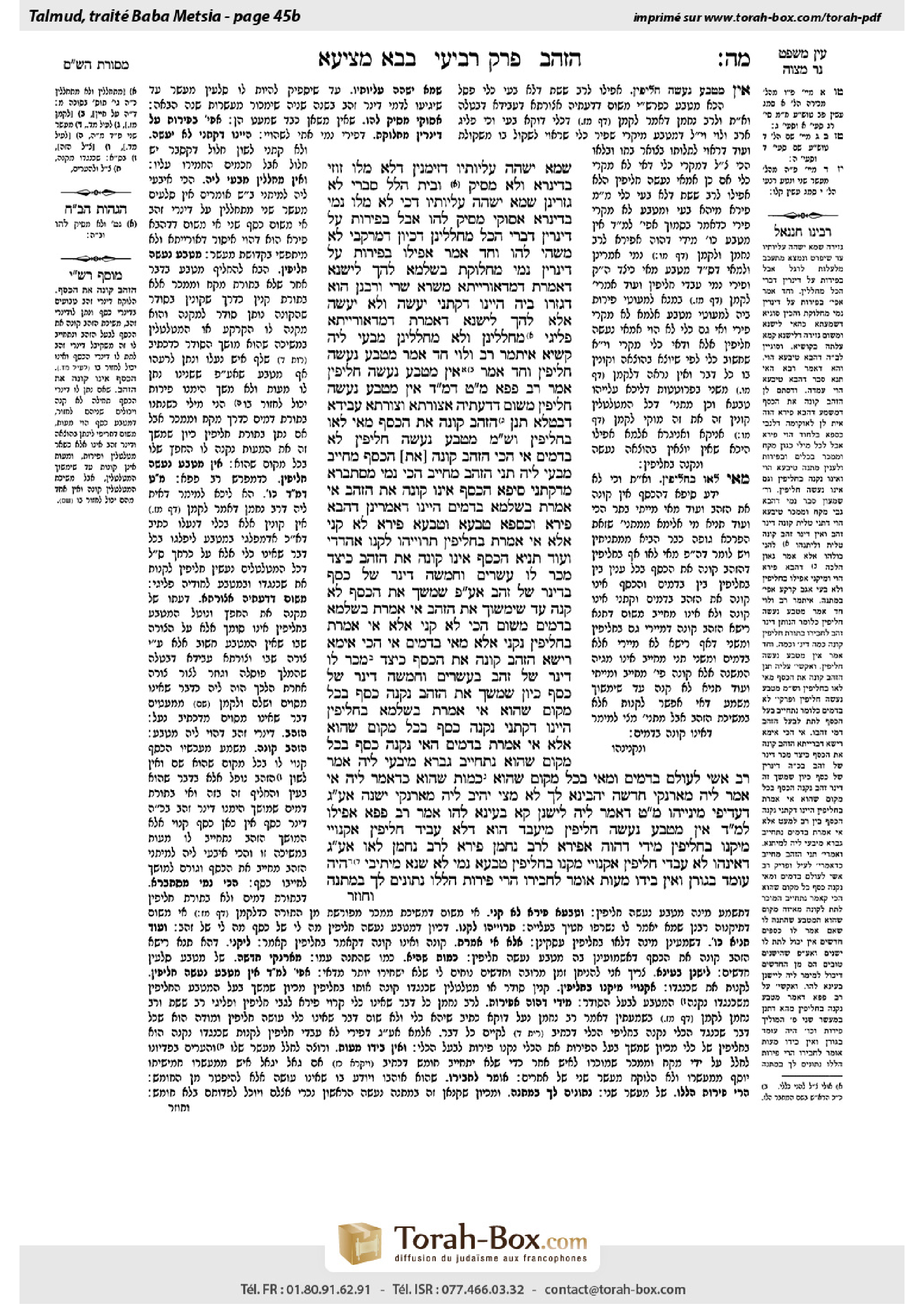
Bava Metzia 45b: Talmud study for Daf Yomi
Study the Talmud for Daf Yomi with scanned pages, Hebrew text, English translations from Sefaria and AI-generated French translations.
Passage selection and English or AI-generated French translation are available where the scan has annotations. Daf Study is independent of Torah-Box and Sefaria.
Browse Bava Metzia · בבא מציעא · All tractatesBava Metzia 45b text and translations
This page of Bava Metzia includes the Aramaic text, an English translation and an AI-generated French translation, alongside the scan above.
בבא מציעא מ״ה ב · Aramaic and Hebrew text
שֶׁמָּא יְשַׁהֶה עֲלִיּוֹתָיו, דְּזִימְנִין דְּלָא מָלוּ זוּזֵי בְּדִינָרָא וְלָא מַסֵּיק. וּבֵית הִלֵּל סָבְרִי: לָא גָּזְרִינַן שֶׁמָּא יְשַׁהֶה עֲלִיּוֹתָיו, דְּכִי לָא מָלוּ נָמֵי בְּדִינָרָא אַסּוֹקֵי מַסֵּיק לְהוּ. אֲבָל בְּפֵירוֹת עַל דִּינָרִין – דִּבְרֵי הַכֹּל מְחַלְּלִינַן, דְּכֵיוָן דְּמַרְקְבִי לָא מְשַׁהֵי לְהוּ.
וְחַד אָמַר: אֲפִילּוּ בְּפֵירוֹת עַל דִּינָרִין נָמֵי מַחְלוֹקֶת.
בִּשְׁלָמָא לְהָךְ לִישָּׁנָא דְּאָמְרַתְּ דְּמִדְּאוֹרָיְיתָא מִשְׁרָא שְׁרֵי וְרַבָּנַן הוּא דִּגְזַרוּ בֵּיהּ – הַיְינוּ דְּקָתָנֵי ״יַעֲשֶׂה״ וְ״לֹא יַעֲשֶׂה״, אֶלָּא לְהָךְ לִישָּׁנָא דְּאָמְרַתְּ דְּמִדְּאוֹרָיְיתָא פְּלִיגִי: מְחַלְּלִינַן וְלָא מְחַלְּלִינַן מִבְּעֵי לֵיהּ? קַשְׁיָא.
אִיתְּמַר: רַב וְלֵוִי, חַד אָמַר: מַטְבֵּעַ נַעֲשֶׂה חֲלִיפִין, וְחַד אָמַר: אֵין מַטְבֵּעַ נַעֲשֶׂה חֲלִיפִין. אָמַר רַב פָּפָּא: מַאי טַעְמָא דְּמַאן דְּאָמַר אֵין מַטְבֵּעַ נַעֲשֶׂה חֲלִיפִין – מִשּׁוּם דְּדַעְתֵּיהּ אַצּוּרְתָּא, וְצוּרְתָּא עֲבִידָא דְּבָטְלָא.
תְּנַן: הַזָּהָב קוֹנֶה אֶת הַכֶּסֶף, מַאי לָאו בַּחֲלִיפִין, וּשְׁמַע מִינַּהּ מַטְבֵּעַ נַעֲשֶׂה חֲלִיפִין? לֹא, בְּדָמִים. אִי הָכִי הַזָּהָב קוֹנֶה אֶת הַכֶּסֶף, מְחַיֵּיב מִבְּעֵי לֵיהּ! תְּנִי: הַזָּהָב מְחַיֵּיב.
הָכִי נָמֵי מִסְתַּבְּרָא, מִדְּקָתָנֵי סֵיפָא: הַכֶּסֶף אֵינוֹ קוֹנֶה אֶת הַזָּהָב. אִי אָמְרַתְּ בִּשְׁלָמָא בְּדָמִים – הַיְינוּ דְּאָמְרִינַן דַּהֲבָא פֵּירָא, וְכַסְפָּא טִבְעָא, וְטִבְעָא פֵּירָא לָא קָנֵי. אֶלָּא אִי אָמְרַתְּ בַּחֲלִיפִין, תַּרְוַיְיהוּ לִקְנוֹ אַהֲדָדֵי.
וְעוֹד, תַּנְיָא: הַכֶּסֶף אֵינוֹ קוֹנֶה אֶת הַזָּהָב, כֵּיצַד? מָכַר לוֹ עֶשְׂרִים וַחֲמִשָּׁה דִּינָר שֶׁל כֶּסֶף בְּדִינָר שֶׁל זָהָב, אַף עַל פִּי שֶׁמָּשַׁךְ אֶת הַכֶּסֶף – לֹא קָנָה עַד שֶׁיִּמְשׁוֹךְ אֶת הַזָּהָב. אִי אָמְרַתְּ בִּשְׁלָמָא בְּדָמִים – מִשּׁוּם הָכִי לָא קָנֵי. אֶלָּא אִי אָמְרַתְּ בַּחֲלִיפִין – נִקְנֵי.
אֶלָּא מַאי, בְּדָמִים? אִי הָכִי אֵימָא רֵישָׁא: הַזָּהָב קוֹנֶה אֶת הַכֶּסֶף, כֵּיצַד? מָכַר לוֹ דִּינָר שֶׁל זָהָב בְּעֶשְׂרִים וַחֲמִשָּׁה דִּינָר שֶׁל כֶּסֶף, כֵּיוָן שֶׁמָּשַׁךְ אֶת הַזָּהָב נִקְנָה כֶּסֶף בְּכׇל מָקוֹם שֶׁהוּא.
אִי אָמְרַתְּ בִּשְׁלָמָא בַּחֲלִיפִין, הַיְינוּ דְּקָתָנֵי ״נִקְנֶה כֶּסֶף בְּכׇל מָקוֹם שֶׁהוּא״. אֶלָּא אִי אָמְרַתְּ בְּדָמִים, הַאי ״נִקְנֶה כֶּסֶף בְּכׇל מָקוֹם שֶׁהוּא״, נִתְחַיֵּיב גַּבְרָא מִיבְּעֵי לֵיהּ.
אָמַר רַב אָשֵׁי: לְעוֹלָם בְּדָמִים. וּמַאי ״בְּכׇל מָקוֹם שֶׁהוּא״? כְּמוֹת שֶׁהוּא, כְּדַאֲמַר לֵיהּ. אִי אֲמַר לֵיהּ: מֵאַרְנָקִי חֲדָשָׁה יָהֲבִינָא לָךְ, לָא מָצֵי יָהֵיב לֵיהּ מֵאַרְנָקִי יְשָׁנָה, אַף עַל גַּב דַּעֲדִיפִי מִינַּיְיהוּ. מַאי טַעְמָא, דְּאָמַר לֵיהּ: לְיַשְּׁנָן קָא בָעֵינָא לְהוּ.
אָמַר רַב פָּפָּא: אֲפִילּוּ לְמַאן דְּאָמַר אֵין מַטְבֵּעַ נַעֲשֶׂה חֲלִיפִין – מֶיעְבָּד הוּא דְּלָא עָבֵיד חֲלִיפִין, אַקְנוֹיֵי מִיקְּנוּ בַּחֲלִיפִין, מִידֵּי דְּהָוֵה אַפֵּירֵא לְרַב נַחְמָן. פֵּירֵא לְרַב נַחְמָן, לָאו אַף עַל גַּב דְּאִינְהוּ לָא עָבְדִי חֲלִיפִין – אַקְנוֹיֵי מִקְּנוּ בַּחֲלִיפִין, טִבְעָא נָמֵי לָא שְׁנָא.
מֵיתִיבִי: הָיָה עוֹמֵד בַּגּוֹרֶן וְאֵין בְּיָדוֹ מָעוֹת, אוֹמֵר לַחֲבֵירוֹ: הֲרֵי פֵּירוֹת הַלָּלוּ נְתוּנִים לְךָ בְּמַתָּנָה,
Bava Metzia 45b · English translation
lest one delay his ascension to Jerusalem due to this exchange, as sometimes the silver coins do not amount to the entire gold dinar, and he will not ascend to Jerusalem until he has collected enough silver dinars to exchange for a gold dinar. And Beit Hillel hold: We do not issue a decree lest he delay his ascension, as even if the silver coins do not amount to the entire gold dinar he will ascend with the silver coins. But with regard to desacralizing produce with dinars, everyone agrees that we desacralize produce in this manner, due to the fact that since the produce rots, he certainly does not delay taking the produce to Jerusalem until they equal an entire gold dinar.
And one said: Even with regard to the exchange of produce for dinars there is a dispute, due to the concern that one will delay bringing his produce to Jerusalem until the value of his second-tithe produce is equal to a gold coin.
The Gemara asks: Granted, according to that version of the dispute in which you said that everyone agrees the exchange of silver sela coins for gold dinars is permitted by Torah law and it is the Sages who issued a decree forbidding it, this is the reason that the dispute between Beit Hillel and Beit Shammai is taught in terms of the formulation: One may do, and: One may not do, as this is the language of a prohibition ab initio. But according to that version of the dispute in which you said that it is with regard to the halakha by Torah law that they disagree, it should have been phrased in terms of the formulation: We desacralize, and: We do not desacralize, since if the practice is forbidden by Torah law, the exchange of silver sela coins for gold dinars is ineffective even after the fact. The Gemara concludes: Indeed, according to the latter version, it is difficult.
§ It was stated that there is a dispute between Rav and Levi. One said: Money can be an item used to effect exchange. And one said: Money cannot be the item used to effect a transaction by means of exchange, as that form of transaction is effective only with regard to items such as produce and vessels. Rav Pappa said: What is the reason for the opinion of the one who says that money cannot be the item used to effect a transaction by means of exchange? It is because the mind of the one acquiring the coin is on the form minted on the coin, not the value of the metal, and the value due to the form is apt to be canceled by the authorities. Therefore, in the eyes of the party acquiring it, the coin itself has no real value and therefore cannot be an item used to effect exchange.
We learned in the mishna: When one party takes possession of the gold coins the other party acquires the silver coins. What, is the reference not to a case where the gold coins were given in order to acquire the silver coins by means of exchange, and therefore one can learn from it that a coin can be an item used to effect exchange? The Gemara rejects this proof: No, it is referring to a standard purchase effected by means of giving money. The Gemara raises a difficulty: If so, the language of the mishna is imprecise, as what is the meaning of: When one party takes possession of the gold coins, the other party acquires the silver coins? It should have stated: When one party takes possession of the gold coins, it obligates him to give the silver coins. The Gemara answers: Emend the text and teach: When one party takes possession of the gold coins, it obligates him to give the silver coins.
The Gemara comments: So too, it is reasonable to interpret the mishna in that manner, from the fact that it teaches in the latter clause of the mishna: When one party takes possession of the silver coins, the other party does not acquire the gold coins. Granted, if you say that this is a purchase effected by means of giving money, this is the meaning of that which we said: Gold is a commodity, and silver is currency, and currency does not effect acquisition of a commodity. But if you say that the mishna is referring to an acquisition effected by means of exchange, let both acquire the coins simultaneously from each other.
And furthermore, it is taught in a baraita: When one party takes possession of the silver coins, the other party does not acquire the gold coins. How so? If one sold twenty-five silver dinars to another for a gold dinar, even though he pulled the silver into his possession, he does not acquire it until the other person pulls the gold into his possession. Granted, if you say that this is a purchase effected by means of giving money, it is due to that reason that he does not acquire the gold coins; the transaction is effected only by taking possession of the purchase item. But if you say that this is an acquisition effected by means of exchange, let him acquire the gold by pulling the silver; in a transaction of exchange the two parties acquire the two items simultaneously.
The Gemara continues: Rather, what then is the nature of the transaction? Is it a purchase effected by means of giving money? If so, then say the first clause of the baraita: When one party takes possession of the gold coins the other party acquires the silver coins. How so? If one sold a gold dinar to another for twenty-five silver dinars, once he pulled the gold coin into his possession the silver coins are acquired wherever they are.
The Gemara challenges: Granted, if you say that this is an acquisition effected by means of exchange, this is the meaning of that which is taught: The silver coins are acquired wherever they are, as that is the nature of the transaction of exchange. But if you say that this is a purchase effected by means of giving money, this phrase: The silver coins are acquired wherever they are, is incorrect, as the tanna should have stated: Once he pulled the gold coin into his possession the man is obligated to pay for his acquisition, as he is not required to pay with those particular silver coins.
Rav Ashi said: Actually, the reference is to a purchase effected by means of giving money. And what is the meaning of: Wherever they are? It means, as they are, i.e., exactly as the owner of the silver said to him, and he cannot replace them with a different classification of coins. How so? If the owner of the silver coins said to the owner of the gold coin: I will give you payment from a purse in which there are new coins, he cannot give him payment from a purse in which there are old coins, even though old coins are preferable relative to new coins because people trust that used coins are authentic. What is the reason that the owner of the gold would prefer new silver coins? It is that he says to the owner of the silver: I need them in order to age them; i.e., these coins will remain in my possession for a long time, and old coins will blacken in these circumstances.
Rav Pappa says: Even according to the one who says: Money cannot be the item used to effect a transaction by means of exchange, this means only that money does not effect a transaction of exchange; but he concedes that money is acquired by means of a transaction of exchange. If one party pulls a vessel into his possession, the other party acquires silver coins in exchange, just as it is with regard to produce, according to the opinion of Rav Naḥman. Is it not the case that even though according to the opinion of Rav Naḥman produce itself does not effect a transaction of exchange, nevertheless produce is acquired by means of a transaction of exchange? Currency, too, is no different.
The Gemara raises an objection to the opinion of Rav Pappa from a baraita: One was standing on the threshing floor and had no money in his hand, and wanted to desacralize his second-tithe produce without paying an additional one-fifth. The halakha is that one who desacralizes his own produce must add one-fifth to its value. This man wants to engage in artifice as if he sold the produce to another, thereby enabling him to desacralize it without adding one-fifth. To that end, he says to another: This produce is hereby given to you as a gift,
Bava Metzia 45b · Traduction française (IA)
de peur que l'on ne retarde son ascension à Jérusalem à cause de cet échange, car parfois les pièces d'argent ne sont pas équivalentes à l'ensemble du dinar d'or, et il ne montera à Jérusalem qu'une fois avoir collecté suffisamment de dinars d'argent pour échanger contre un dinar d'or. Et Beit Hillel disent : Nous ne décrétions pas pour éviter qu'il retarde son ascension, car même si les pièces d'argent ne sont pas équivalentes à l'ensemble du dinar d'or, il montera avec les pièces d'argent. Mais concernant la désacralisation des produits avec des dinars, tout le monde est d'accord sur le fait que nous désacralisons les produits ainsi, car, puisque les produits pourrissent, il ne retarde certainement pas l'envoi des produits à Jérusalem jusqu'à ce qu'ils soient équivalents à un dinar d'or.
Et l'on dit : Même concernant l'échange des produits contre des dinars, il y a un désaccord, à cause de la crainte qu'on ne retarde l'envoi de ses produits à Jérusalem jusqu'à ce que la valeur de ses dixièmes de produit soit égale à une pièce d'or.
Le Guemara pose la question : C'est évident, selon cette version du désaccord où vous dites que tout le monde est d'accord sur le fait que l'échange des pièces d'argent sela contre des dinars d'or est permis par la Loi et que c'est les Sages qui ont émis un décret l'interdisant, c'est la raison pour laquelle le désaccord entre Beit Hillel et Beit Shammai est enseigné dans le sens : On peut faire, et : On ne peut pas faire, car c'est la formulation d'un interdiction dès le début. Mais selon cette version du désaccord où vous dites que c'est concernant la halakha par la Loi que les deux s'opposent, il aurait dû être formulé dans le sens : Nous désacralisons, et : Nous ne désacralisons pas, car si la pratique est interdite par la Loi, l'échange des pièces d'argent sela contre des dinars d'or est inefficace même après coup. Le Guemara conclut : En effet, selon cette dernière version, c'est difficile.
§ On a dit qu'il y a un désaccord entre Rav et Levi. L'un dit : L'argent peut être un objet utilisé pour effectuer un échange. L'autre dit : L'argent ne peut pas être l'objet utilisé pour effectuer une transaction par l'échange, car cette forme de transaction est efficace uniquement concernant des objets tels que les produits et les vases. Rav Pappa dit : Quelle est la raison de l'opinion de celui qui dit que l'argent ne peut pas être l'objet utilisé pour effectuer une transaction par l'échange ? C'est parce que l'esprit de celui qui acquiert la pièce est sur la forme gravée sur la pièce, pas sur la valeur du métal, et la valeur due à la forme peut être annulée par les autorités. Ainsi, aux yeux de celui qui l'acquiert, la pièce elle-même n'a pas de valeur réelle et donc ne peut pas être un objet utilisé pour effectuer un échange.
Nous avons appris dans la mitsva : Lorsqu'une partie prend possession des pièces d'or, l'autre partie acquiert les pièces d'argent. Qu'est-ce que cela signifie, pas dans un cas où les pièces d'or ont été données pour acquérir les pièces d'argent par l'échange, et donc on peut en tirer la conclusion que la pièce peut être un objet utilisé pour effectuer un échange ? Le Guemara rejette cette preuve : Non, cela fait référence à une vente normale effectuée par le paiement d'argent. Le Guemara soulève une difficulté : Si c'est ainsi, la formulation de la mitsva est imprecise, car que signifie : Lorsqu'une partie prend possession des pièces d'or, l'autre partie acquiert les pièces d'argent ? Il aurait dû dire : Lorsqu'une partie prend possession des pièces d'or, cela engage l'autre à donner les pièces d'argent. Le Guemara répond : Corrigez le texte et enseignez : Lorsqu'une partie prend possession des pièces d'or, cela engage l'autre à donner les pièces d'argent.
Le Guemara commente : De même, il est raisonnable d'interpréter la mitsna ainsi, du fait qu'elle enseigne dans la dernière partie de la mitsna : Lorsqu'une partie prend possession des pièces d'argent, l'autre partie ne acquiert pas les pièces d'or. C'est évident, si vous dites que c'est une vente effectuée par le paiement d'argent, c'est la signification de ce que nous avons dit : L'or est un produit, et l'argent est une monnaie, et la monnaie ne permet pas l'acquisition d'un produit. Mais si vous dites que la mitsna fait référence à une acquisition effectuée par l'échange, laissez les deux acquérir les pièces simultanément l'un de l'autre.
Et de plus, il est enseigné dans une baraïta : Lorsqu'une partie prend possession des pièces d'argent, l'autre partie ne acquiert pas les pièces d'or. Comment cela ? Si l'un vend vingt-cinq dinars d'argent à un autre contre un dinar d'or, même s'il ramène les pièces d'argent dans sa possession, il ne les acquiert pas jusqu'à ce que l'autre personne ramène le dinar d'or dans sa possession. C'est évident, si vous dites que c'est une vente effectuée par le paiement d'argent, c'est pour cette raison qu'il ne les acquiert pas ; la transaction est effective uniquement par la prise en possession de l'objet acheté. Mais si vous dites que c'est une acquisition effectuée par l'échange, laissez-le acquérir l'or en ramenant l'argent ; dans une transaction d'échange, les deux parties acquièrent les deux objets simultanément.
Le Guemara continue : Plutôt, qu'est-ce donc la nature de la transaction ? Est-ce une vente effectuée par le paiement d'argent ? Si c'est ainsi, alors dites la première partie de la baraïta : Lorsqu'une partie prend possession des pièces d'or, l'autre partie acquiert les pièces d'argent. Comment cela ? Si l'un vend un dinar d'or à un autre contre vingt-cinq dinars d'argent, une fois qu'il ramène la pièce d'or dans sa possession, les dinars d'argent sont acquis là où ils sont.
Le Guemara conteste : C'est évident, si vous dites que c'est une acquisition effectuée par l'échange, c'est la signification de ce qui est enseigné : Les pièces d'argent sont acquises là où elles sont, car c'est la nature de la transaction d'échange. Mais si vous dites que c'est une acquisition effectuée par le paiement d'argent, cette phrase : Les pièces d'argent sont acquises là où elles sont, est incorrecte, car le tanna aurait dû dire : Une fois qu'il a ramené la pièce d'or dans sa possession, l'homme est tenu de payer pour son acquisition, car il n'est pas tenu de payer avec ces pièces d'argent spécifiques.
Rav Ashi a dit : En réalité, la référence est à un achat effectué par le biais du paiement en argent. Et que signifie : « Où ils sont ? » Cela signifie, tels qu'ils sont, c'est-à-dire exactement comme l'owner des monnaies d'argent les avait dit à l'owner des monnaies d'or, et il ne peut pas les remplacer par une autre catégorie de monnaies. Comment cela se passe-t-il ? Si l'owner des monnaies d'argent disait à l'owner des monnaies d'or : Je vais te payer avec un sac contenant des pièces neuves, il ne peut pas lui payer avec un sac contenant des pièces anciennes, même si les pièces anciennes sont préférables aux pièces neuves car les gens ont confiance en leur authenticité. Pourquoi l'owner des monnaies d'or préfère-t-il les pièces d'argent neuves ? C'est parce qu'il dit à l'owner des monnaies d'argent : J'ai besoin d'elles pour les faire vieillir ; c'est-à-dire que ces pièces resteront en mon possession pendant longtemps, et les pièces anciennes s'assombrissent dans ces circonstances.
Rav Pappa dit : Même selon celui qui dit : L'argent ne peut pas être l'objet utilisé pour effectuer une transaction par échange, cela signifie seulement que l'argent ne permet pas une transaction d'échange ; mais il reconnaît que l'argent est acquis par une transaction d'échange. Si une partie fait entrer un objet dans sa possession, l'autre partie acquiert des monnaies d'argent en échange, tout comme c'est le cas avec les produits, selon l'opinion de Rav Naḥman. N'est-ce pas le cas que même si, selon l'opinion de Rav Naḥman, les produits eux-mêmes ne permettent pas une transaction d'échange, les produits sont tout de même acquis par une transaction d'échange ? La monnaie n'est pas différente.
La Guemara soulève un objet contre l'opinion de Rav Pappa, à partir d'une baraïta : On était debout sur le plan de meunier et n'avait pas d'argent en main, et voulait désacraliser ses dixièmes de seconde récolte sans payer un cinquième supplémentaire. La halakha est que celui qui désacralise ses propres produits doit ajouter un cinquième à leur valeur. Ce homme veut pratiquer un artifice, comme s'il vendait les produits à un autre, permettant ainsi de désacraliser les produits sans ajouter un cinquième supplémentaire. A cet effet, il dit à un autre : Ces produits sont donnés à toi en cadeau,
Traduction française générée par IA à partir de l’édition anglaise de Sefaria. Vérifie toujours un passage avec le texte source.
Text from Sefaria: William Davidson Edition - Vocalized Aramaic (CC BY NC); William Davidson Edition - English (CC BY NC).