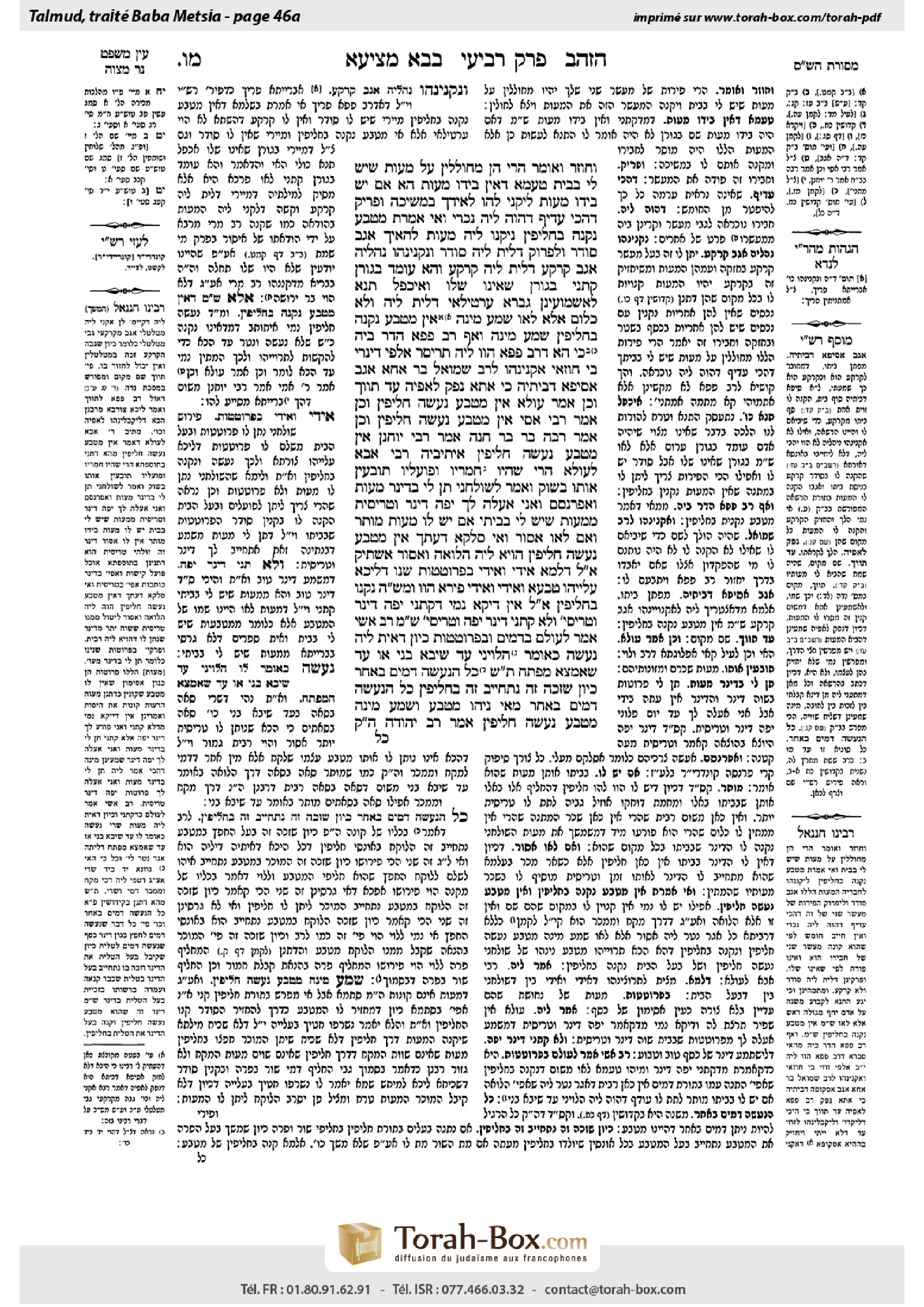
Bava Metzia 46a: Talmud study for Daf Yomi
Study the Talmud for Daf Yomi with scanned pages, Hebrew text, English translations from Sefaria and AI-generated French translations.
Passage selection and English or AI-generated French translation are available where the scan has annotations. Daf Study is independent of Torah-Box and Sefaria.
Browse Bava Metzia · בבא מציעא · All tractatesBava Metzia 46a text and translations
This page of Bava Metzia includes the Aramaic text, an English translation and an AI-generated French translation, alongside the scan above.
בבא מציעא מ״ו א · Aramaic and Hebrew text
וְחוֹזֵר וְאוֹמֵר: הֲרֵי הֵן מְחוּלָּלִין עַל מְעוֹת שֶׁיֵּשׁ לִי בַּבַּיִת. טַעְמָא דְּאֵין בְּיָדוֹ מָעוֹת, הָא אִם יֵשׁ בְּיָדוֹ מָעוֹת – לַיקְנֵי לְהוּ לְאִידַּךְ בִּמְשִׁיכָה וּפָרֵיק, דְּהָכִי עֲדִיף, דְּהָוֵה לֵיהּ נֻכְרַאי.
וְאִי אָמְרַתְּ מַטְבֵּעַ נִקְנֶה בַּחֲלִיפִין: נִיקְּנוֹ לֵיהּ מָעוֹת לְהַיְאךְ אַגַּב סוּדָר, וְלִפְרוֹק! דְּלֵית לֵיהּ סוּדָר. וְנַקְנִינְהוּ נִהֲלֵיהּ אַגַּב קַרְקַע! דְּלֵית לֵיהּ קַרְקַע.
וְהָא עוֹמֵד בַּגּוֹרֶן קָתָנֵי! בְּגוֹרֶן שֶׁאֵינוֹ שֶׁלּוֹ. וְאִיכְּפַל תַּנָּא לְאַשְׁמוֹעִינַן גַּבְרָא עַרְטִילַאי דְּלֵית לֵיהּ וְלָא כְּלוּם? אֶלָּא לָאו, שְׁמַע מִינַּהּ: אֵין מַטְבֵּעַ נִקְנֶה בַּחֲלִיפִין. שְׁמַע מִינַּהּ.
וְאַף רַב פָּפָּא הֲדַר בֵּיהּ. כִּי הָא דְּרַב פָּפָּא הֲווֹ לֵיהּ תְּרֵיסַר אַלְפֵי דִּינָרֵי בֵּי חוֹזָאֵי, אַקְנִינְהוּ לְרַב שְׁמוּאֵל בַּר אַחָא אַגַּב אַסִּיפָּא דְּבֵיתֵיהּ. כִּי אֲתָא, נְפַק לְאַפֵּיהּ עַד תְּווֹךְ.
וְכֵן אָמַר עוּלָּא: אֵין מַטְבֵּעַ נַעֲשֶׂה חֲלִיפִין. וְכֵן אָמַר רַב אַסִּי: אֵין מַטְבֵּעַ נַעֲשֶׂה חֲלִיפִין, וְכֵן אָמַר רַבָּה בַּר בַּר חָנָה אָמַר רַבִּי יוֹחָנָן: אֵין מַטְבֵּעַ נַעֲשֶׂה חֲלִיפִין.
אֵיתִיבֵיהּ רַבִּי אַבָּא לְעוּלָּא: הֲרֵי שֶׁהָיוּ חֲמָרָיו וּפוֹעֲלָיו תּוֹבְעִין אוֹתוֹ בַּשּׁוּק, וְאָמַר לַשּׁוּלְחָנִי: תֵּן לִי בְּדִינָר מָעוֹת וַאֲפַרְנְסֵם, וַאֲנִי אַעֲלֶה לְךָ יָפֶה דִּינָר וּטְרֵיסִית מִמָּעוֹת שֶׁיֵּשׁ לִי בְּבֵיתִי. אִם יֵשׁ לוֹ מָעוֹת – מוּתָּר, וְאִם לָאו – אָסוּר. וְאִי סָלְקָא דַעְתָּךְ אֵין מַטְבֵּעַ נַעֲשֶׂה חֲלִיפִין, הָוְיָא לֵיהּ הַלְוָאָה, וְאָסוּר! אִשְׁתִּיק.
אֲמַר לֵיהּ: דִּלְמָא אִידֵּי וְאִידֵּי בִּפְרוּטָטוֹת שָׁנוּ, דְּלֵיכָּא עֲלַיְיהוּ טִבְעָא. וְאִידֵּי וְאִידֵּי פֵּירָא הָווּ, וּמִשּׁוּם הָכִי נִקְּנוֹ בַּחֲלִיפִין. אֲמַר לֵיהּ: אִין, דַּיְקָא נָמֵי, דְּקָתָנֵי: יָפֶה דִּינָר וּטְרֵיסִית, וְלָא קָתָנֵי: דִּינָר יָפֶה וּטְרֵיסִית. שְׁמַע מִינַּהּ.
רַב אָשֵׁי אָמַר: לְעוֹלָם בְּדָמִים וּבִפְרוּטָטוֹת, כֵּיוָן דְּאִית לֵיהּ, נַעֲשֶׂה כְּאוֹמֵר: הַלְוֵינִי עַד שֶׁיָּבֹא בְּנִי אוֹ עַד שֶׁאֶמְצָא מַפְתֵּחַ.
תָּא שְׁמַע: כׇּל הַנַּעֲשֶׂה דָּמִים בְּאַחֵר, כֵּיוָן שֶׁזָּכָה זֶה – נִתְחַיֵּיב זֶה בַּחֲלִיפִין. כׇּל הַנַּעֲשֶׂה דָּמִים בְּאַחֵר, מַאי נִיהוּ – מַטְבֵּעַ, וּשְׁמַע מִינַּהּ מַטְבֵּעַ נַעֲשֶׂה חֲלִיפִין!
אָמַר רַב יְהוּדָה, הָכִי קָאָמַר:
Bava Metzia 46a · English translation
and then he says: This second-tithe produce that now belongs to you is hereby desacralized on coins that I have at home. The Gemara infers: The reason that it is necessary to employ this artifice is that he does not have coins in his hand. But if he has coins in his hand let him transfer ownership of the coins to the other person by means of the transaction of pulling, and then that other person will desacralize the second-tithe produce. The reason for this is that this procedure is preferable, as the one who desacralizes the produce is a stranger, not the owner of the produce. Therefore, it appears less like artifice designed to circumvent paying the additional one-fifth.
The Gemara continues to state its objection to the opinion of Rav Pappa. And if you say a coin is acquired by means of a transaction of exchange, then even if the owner of produce has no money in his hand, let the owner transfer ownership of the coins, wherever they are, to the other person by means of a cloth, as he can perform a transaction of symbolic exchange with a cloth; and then let the other person desacralize the produce. The Gemara answers: The case in the baraita is one in which he does not have a cloth. The Gemara challenges: And let the owner transfer ownership of the coins to the other person by means of land, i.e., perform an act of transaction concerning the land and include the coins in the transaction. The Gemara answers: The case in the baraita is one in which he does not have land.
The Gemara asks: But isn’t it taught in the baraita that he is standing on the threshing floor? The Gemara answers: He is standing on a threshing floor that is not his. The Gemara asks: And did the tanna go to all that trouble just to teach us the case of a naked man, i.e., one who has nothing at all? It is unlikely that a baraita would be devoted to so remote a case. Rather, must one not conclude from it that money is not acquired by means of a transaction of exchange? The Gemara affirms: Learn from it that this is the halakha.
The Gemara relates: And even Rav Pappa retracted his previous statement that coins are acquired by means of a transaction of exchange, as in this incident in which Rav Pappa had twelve thousand dinars that he lent to another in Bei Ḥozai. He transferred ownership of the dinars to his agent, Rav Shmuel bar Aḥa, by means of granting acquisition of the threshold of his house to him, to enable the agent to demand repayment of the loan on his own behalf. This obviated the need for him to consult Rav Pappa in the case of every contingency, which would complicate matters. It is apparent from the fact that the transaction was effected by means of granting acquisition of the threshold that Rav Pappa concedes that coins are not acquired by means of a transaction of exchange. When Rav Shmuel bar Aḥa came after repayment of the loan, Rav Pappa was so pleased that he went out as far as Tevakh to meet him.
The Gemara adds: And likewise, Ulla says: Money cannot be the item used to effect a transaction by means of exchange. And likewise, Rav Asi says: Money cannot be the item used to effect a transaction by means of exchange. And likewise, Rabba bar bar Ḥana says that Rabbi Yoḥanan says: Money cannot be the item used to effect a transaction by means of exchange.
Rabbi Abba raised an objection to the opinion of Ulla from a baraita: With regard to one whose donkey drivers or laborers were demanding payment of their wages from him in the marketplace, and he said to the money changer: Give me coins worth a dinar and I will provide for them, and later I will give you coins worth a dinar and a tereisit, a coin of lesser value, from money that I have at home, then if he has money at home at that time it is permitted, as it is not considered a loan and therefore the additional payment is not interest. But if he does not have money at home at that time, it is a loan and the additional payment is forbidden as interest. And if it enters your mind that money cannot be the item used to effect a transaction by means of exchange, then even in the case where the employer had money at home, since the money changer does not acquire the employer’s money at home by means of exchange, it is a loan and the additional payment is forbidden as interest. Ulla was silent.
Rabbi Abba then said the following suggestion to Ulla: Perhaps the Sages taught this halakha in a case where both these coins that are in his house and those coins that he took from the money changer are perotetot, small perutot that are unminted, and the legal status of both these coins and those coins is that of a commodity; and due to that status they are acquired by means of a transaction of exchange. Ulla said to him: Yes, that is the case in the baraita, and the language of the baraita is also precise, as it teaches: I will give you coins worth a dinar and a tereisit, and it does not teach: I will give you an unflawed dinar and a tereisit. Evidently, the baraita is not referring to his giving an actual dinar coin but to other coins of lesser value that equal that value. The Gemara affirms: Learn from it that this is the case.
Rav Ashi said: Actually, it can be explained that there is no transaction by means of exchange in this case. Rather, it is a purchase with money and the tanna is referring to perotetot, and nevertheless there is no violation of the prohibition against interest. Since he has money at home, it is tantamount to saying: Lend me money until my son comes or until I find the key. That is not a loan, and the halakhot of interest do not apply.
The Gemara suggests: Come and hear proof from a mishna (Kiddushin 28a): With regard to all items used as monetary value for another item, i.e., instead of a buyer paying money to the seller, they exchange items of value with each other, once one party in the transaction acquires the item he is receiving, this party is obligated with regard to the item being exchanged for it. The Gemara analyzes this mishna: With regard to all items used as monetary value for another item, what does the mishna mean in this phrase? It means a coin, and learn from the mishna that a coin can be an item used to effect exchange.
Rav Yehuda said: This is what the mishna is saying:
Bava Metzia 46a · Traduction française (IA)
et il dit : ce produit de la deuxième part de la tithe qui vous appartient maintenant est désormais désacralisé sur des pièces que j'ai à la maison. La Guemara déduit : la raison pour laquelle il est nécessaire d'utiliser cet artifice est qu'il n'a pas de pièces à la main. Mais si il a des pièces à la main, qu'il transfère la propriété des pièces à l'autre personne par le moyen de l'acte de tirage, et alors cette autre personne désacralisera le produit de la deuxième part de la tithe. La raison en est que cette procédure est préférable, car celui qui désacralise le produit est un étranger, pas le propriétaire du produit. Ainsi, cela semble moins être un artifice conçu pour contourner le paiement de la part supplémentaire de un cinquième.
La Guemara continue à énoncer son objection à l'opinion de Rav Pappa. Et si vous dites qu'une pièce est acquise par l'acte d'échange, alors même si le propriétaire du produit n'a pas d'argent à la main, qu'on transfère la propriété des pièces, où qu'elles soient, à l'autre personne par un linge, car il peut effectuer un acte d'échange symbolique avec un linge ; et alors qu'on permette à cette autre personne de désacraliser le produit. La Guemara répond : le cas dans la baraïta est celui où il n'a pas de linge. La Guemara conteste : et qu'on transfère la propriété des pièces à l'autre personne par la terre, c'est-à-dire effectuer un acte de transaction concernant la terre et inclure les pièces dans la transaction. La Guemara répond : le cas dans la baraïta est celui où il n'a pas de terre.
La Guemara pose la question : mais n'est-il pas enseigné dans la baraïta qu'il est debout sur le plancher de meunier ? La Guemara répond : il est debout sur un plancher de meunier qui n'est pas le sien. La Guemara pose la question : et le tanna est-il allé jusqu'à ce point de peine juste pour nous enseigner le cas d'un homme nu, c'est-à-dire celui qui n'a rien du tout ? Il est peu probable que la baraïta soit consacrée à un cas si éloigné. Plutôt, ne devons-nous pas conclure de cela que l'argent n'est pas acquis par l'acte d'échange ? La Guemara affirme : apprenez-en que c'est la halakha.
La Guemara rapporte : et même Rav Pappa a rétracté sa déclaration précédente selon laquelle les pièces sont acquises par l'acte d'échange, comme dans cet incident où Rav Pappa avait douze mille dinars qu'il avait prêtés à un autre à Bei Ḥozai. Il a transféré la propriété des dinars à son agent, Rav Shmuel bar Aḥa, par l'acte d'acquisition du seuil de sa maison, afin que l'agent puisse exiger le remboursement du prêt à sa place. Cela a évité la nécessité de consulter Rav Pappa dans chaque cas, ce qui aurait compliqué les choses. Il est évident du fait que l'acte a été effectué par l'acquisition du seuil que Rav Pappa reconnaît que les pièces ne sont pas acquises par l'acte d'échange. Lorsque Rav Shmuel bar Aḥa est venu après le remboursement du prêt, Rav Pappa était si content qu'il est sorti jusqu'à Tevakh pour le rencontrer.
La Guemara ajoute : de même, Ulla dit : l'argent ne peut pas être l'élément utilisé pour effectuer un acte d'échange. De même, Rav Asi dit : l'argent ne peut pas être l'élément utilisé pour effectuer un acte d'échange. De même, Rabba bar bar Ḥana dit que Rabbi Yoḥanan dit : l'argent ne peut pas être l'élément utilisé pour effectuer un acte d'échange.
Rabbi Abba souleva une objection contre l'opinion d'Ulla à partir d'une baraïta : concernant celui dont les conducteurs de mule ou les ouvriers exigeaient le paiement de leurs salaires dans le marché, et il dit au changeur d'argent : donne-moi des pièces valant un dinar et je leur fournirai, et plus tard je te donnerai des pièces valant un dinar et un tereisit, une pièce de moindre valeur, à partir de l'argent que j'ai à la maison, alors si l'employeur a de l'argent à la maison à ce moment-là, cela est permis, car ce n'est pas considéré comme un prêt et donc la rémunération supplémentaire n'est pas un intérêt. Mais si l'employeur n'a pas d'argent à la maison à ce moment-là, c'est un prêt et la rémunération supplémentaire est interdite comme intérêt. Et si cela entre dans votre esprit que l'argent ne peut pas être l'élément utilisé pour effectuer un acte d'échange, alors même dans le cas où l'employeur avait de l'argent à la maison, puisque le changeur n'acquiert pas l'argent de l'employeur à la maison par l'acte d'échange, c'est un prêt et la rémunération supplémentaire est interdite comme intérêt. Ulla resta silencieux.
Rabbi Abba dit ensuite à Ulla la suggestion suivante : peut-être les Sages ont-ils enseigné cette halakha dans un cas où ces pièces qui sont à sa maison et ces pièces qu'il a prises au changeur sont des perutot, des petites perutot non mises en circulation, et le statut légal de ces pièces et de ces autres pièces est celui d'un bien ; et en raison de ce statut, elles sont acquises par l'acte d'échange. Ulla répondit à Rabbi Abba : oui, c'est le cas dans la baraïta, et la formulation de la baraïta est aussi précise, car elle enseigne : je te donnerai des pièces valant un dinar et un tereisit, et elle ne dit pas : je te donnerai un dinar parfait et un tereisit. Évidemment, la baraïta ne fait pas référence à son donner un dinar réel, mais à d'autres pièces de moindre valeur égales à cette valeur. La Guemara affirme : apprenez-en que c'est le cas.
Rav Ashi a dit : en réalité, cela peut être expliqué qu'il n'y a pas d'acte d'échange dans ce cas. Plutôt, c'est un achat avec de l'argent et le tanna fait référence aux perotetot, et néanmoins il n'y a pas de violation de l'interdiction contre l'intérêt. Puisqu'il a de l'argent à la maison, cela équivaut à dire : prête-moi de l'argent jusqu'à ce que mon fils arrive ou jusqu'à ce que je trouve la clé. Ce n'est pas un prêt, et les halakhot de l'intérêt ne s'appliquent pas.
La Guemara suggère : viens et écoute la preuve d'une mitsna (Kiddushin 28a) : concernant tous les objets utilisés comme valeur monétaire pour un autre objet, c'est-à-dire au lieu d'un acheteur payant de l'argent au vendeur, ils échangent des objets de valeur entre eux, une fois que l'une des parties de la transaction acquiert l'objet qu'elle reçoit, cette partie est tenue responsable de l'objet échangé. La Guemara analyse cette mitsna : concernant tous les objets utilisés comme valeur monétaire pour un autre objet, que signifie cette phrase ? Elle signifie une pièce, et apprends-en de cette mitsna que la pièce peut être un objet utilisé pour l'échange.
Rav Yehuda a dit : C’est ce que la michna enseigne :
Traduction française générée par IA à partir de l’édition anglaise de Sefaria. Vérifie toujours un passage avec le texte source.
Text from Sefaria: William Davidson Edition - Vocalized Aramaic (CC BY NC); William Davidson Edition - English (CC BY NC).