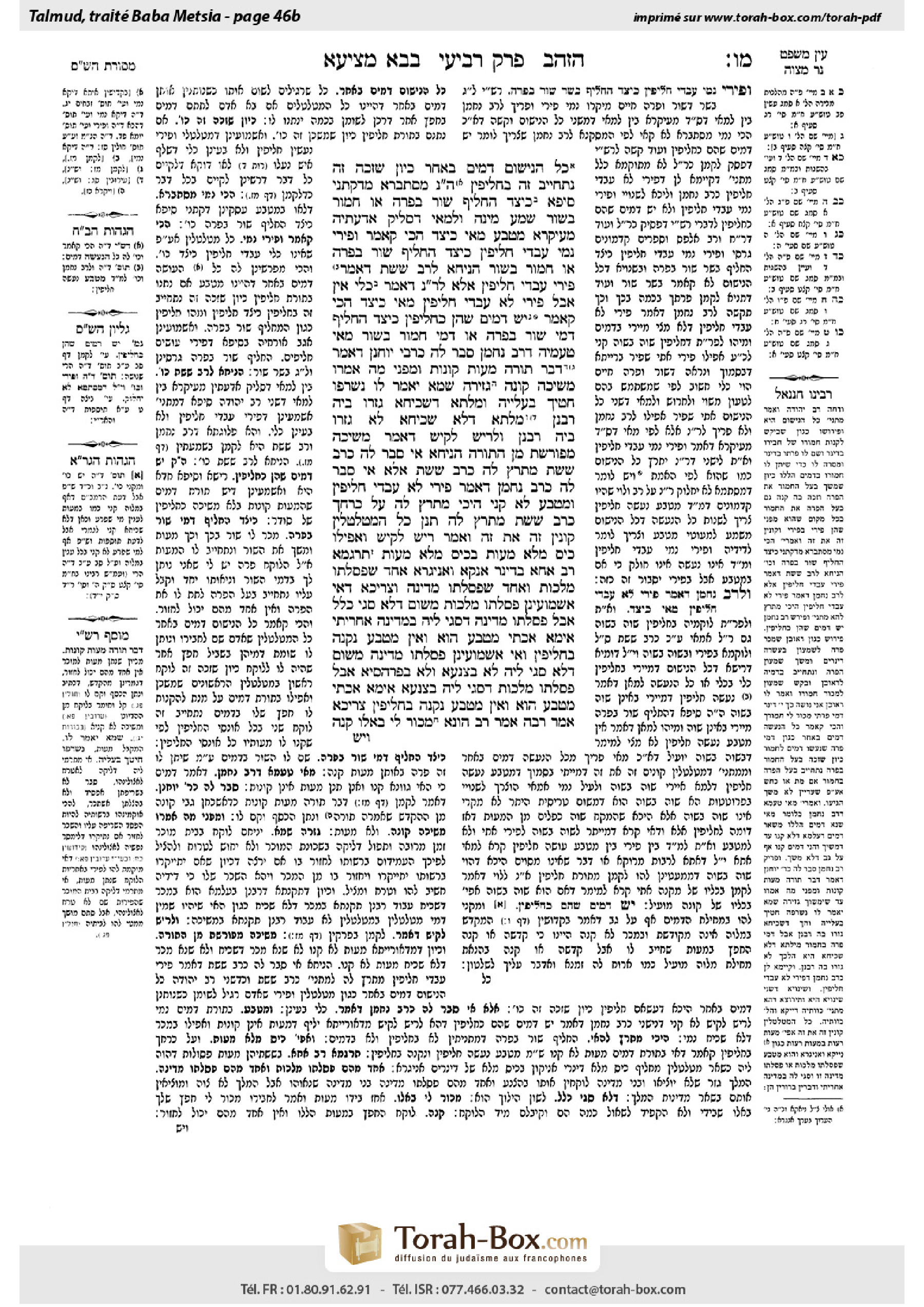
Bava Metzia 46b: Talmud study for Daf Yomi
Study the Talmud for Daf Yomi with scanned pages, Hebrew text, English translations from Sefaria and AI-generated French translations.
Passage selection and English or AI-generated French translation are available where the scan has annotations. Daf Study is independent of Torah-Box and Sefaria.
Browse Bava Metzia · בבא מציעא · All tractatesBava Metzia 46b text and translations
This page of Bava Metzia includes the Aramaic text, an English translation and an AI-generated French translation, alongside the scan above.
בבא מציעא מ״ו ב · Aramaic and Hebrew text
כׇּל הַנִּישּׁוֹם דָּמִים בְּאַחֵר, כֵּיוָן שֶׁזָּכָה זֶה נִתְחַיֵּיב זֶה בַּחֲלִיפִין.
הָכִי נָמֵי מִסְתַּבְּרָא, מִדְּקָתָנֵי סֵיפָא: כֵּיצַד? הֶחְלִיף שׁוֹר בְּפָרָה אוֹ חֲמוֹר בְּשׁוֹר. שְׁמַע מִינַּהּ.
וּלְמַאי דִּסְלֵיק אַדַּעְתֵּיהּ מֵעִיקָּרָא – מַטְבֵּעַ, מַאי ״כֵּיצַד״? הָכִי קָאָמַר, וּפֵירֵי נָמֵי עָבְדִי חֲלִיפִין, כֵּיצַד – הֶחְלִיף שׁוֹר בְּפָרָה אוֹ חֲמוֹר בְּשׁוֹר.
הָנִיחָא לְרַב שֵׁשֶׁת, דְּאָמַר פֵּירֵי עָבְדִי חֲלִיפִין, אֶלָּא לְרַב נַחְמָן, דְּאָמַר: כְּלִי – אִין, אֲבָל פֵּירֵי לָא עָבְדִי חֲלִיפִין, מַאי ״כֵּיצַד״?
הָכִי קָאָמַר: יֵשׁ דָּמִים שֶׁהֵן כַּחֲלִיפִין, כֵּיצַד? הֶחְלִיף דְּמֵי שׁוֹר בְּפָרָה אוֹ דְמֵי חֲמוֹר בְּשׁוֹר.
מַאי טַעְמֵיהּ דְּרַב נַחְמָן? סָבַר לַהּ כְּרַבִּי יוֹחָנָן. דְּאָמַר: דְּבַר תּוֹרָה מָעוֹת קוֹנוֹת. וּמִפְּנֵי מָה אָמְרוּ מְשִׁיכָה קוֹנָה – גְּזֵירָה שֶׁמָּא יֹאמַר לוֹ: נִשְׂרְפוּ חִטֶּיךָ בָּעֲלִיָּיה.
וּמִלְּתָא דִּשְׁכִיחָא – גְּזַרוּ בֵּיהּ רַבָּנַן. מִלְּתָא דְּלָא שְׁכִיחָא – לָא גְּזַרוּ בֵּיהּ רַבָּנַן.
וּלְרֵישׁ לָקִישׁ דְּאָמַר מְשִׁיכָה מְפוֹרֶשֶׁת מִן הַתּוֹרָה, הָנִיחָא אִי סָבַר לַהּ כְּרַב שֵׁשֶׁת, מְתָרֵץ לַהּ כְּרַב שֵׁשֶׁת.
אֶלָּא אִי סָבַר לַהּ כְּרַב נַחְמָן, דְּאָמַר: פֵּירֵי לָא עָבְדִי חֲלִיפִין וּמַטְבֵּעַ לָא קָנֵי, הֵיכִי מְתָרֵץ לַהּ? עַל כֻּרְחָךְ כְּרַב שֵׁשֶׁת מְתָרֵץ לַהּ.
תְּנַן: כׇּל הַמִּטַּלְטְלִין קוֹנִין זֶה אֶת זֶה. וְאָמַר רֵישׁ לָקִישׁ: וַאֲפִילּוּ כִּיס מָלֵא מָעוֹת בְּכִיס מָלֵא מָעוֹת! תַּרְגְּמָא רַב אַחָא: בְּדִינָר אַנְ[יָ]קָא וַאֲנִיגְרָא, אֶחָד שֶׁפְּסָלַתּוּ מַלְכוּת, וְאֶחָד שֶׁפְּסָלַתּוּ מְדִינָה.
וּצְרִיכָא, דְּאִי אַשְׁמְעִינַן פְּסָלַתּוּ מַלְכוּת – מִשּׁוּם דְּלָא סָגֵי כְּלָל. אֲבָל פְּסָלַתּוּ מְדִינָה, דְּסָגֵי לֵיהּ בִּמְדִינָה אַחֲרִיתִי – אֵימָא אַכַּתִּי מַטְבֵּעַ הוּא וְאֵין מַטְבֵּעַ נִקְנֶה בַּחֲלִיפִין.
וְאִי אַשְׁמְעִינַן פְּסָלַתּוּ מְדִינָה – מִשּׁוּם דְּלָא סָגֵי לֵיהּ לָא בְּצִנְעָא וְלָא בְּפַרְהֶסְיָא. אֲבָל פְּסָלַתּוּ מַלְכוּת, דְּסָגֵי לֵיהּ בְּצִנְעָא – אֵימָא אַכַּתִּי מַטְבֵּעַ הוּא, וְאֵין מַטְבֵּעַ נִקְנֶה בַּחֲלִיפִין. צְרִיכָא.
אָמַר רַבָּה אָמַר רַב הוּנָא: ״מְכוֹר לִי בְּאֵלּוּ״, קָנָה,
Bava Metzia 46b · English translation
With regard to all items that can be appraised when used as monetary value for another item, i.e., their value can be appraised relative to the value of another item, excluding a coin, whose value is apparent, once one party in the transaction acquires the item he is receiving, this party is obligated with regard to the item being exchanged for it. The novelty of the mishna is that all items, not only vessels, can be used to perform the act of acquisition of exchange. Therefore, one should not infer that the halakha is the same with regard to coins.
The Gemara comments: So too, it is reasonable to interpret the mishna in that manner, from the fact that the latter clause of that mishna teaches: How so? If one exchanges an ox for a cow, or a donkey for an ox, once this party acquires the animal that he is receiving, this party is obligated with regard to the item being exchanged for it. This clause apparently explains the previous clause, and employs the example of animals, not coins. The Gemara concludes: Learn from it that the reference in the mishna is to movable property, not to coins.
The Gemara asks: And with regard to what entered our minds initially, that a coin effects symbolic exchange, what is the meaning of the clause: How so; if one exchanges an ox for a cow, once this party acquires the animal that he is receiving, this party is obligated with regard to the item being exchanged for it? This example does not involve a coin. The Gemara explains that it was assumed that this is what the mishna is saying: Not only can a coin be used in the act of acquisition of exchange, but produce, i.e., movable property, can also effect exchange. How so? If one exchanged the meat of an ox for a cow, or the meat of a donkey for an ox, once this party acquires the item that he is receiving, this party is obligated with regard to the item being exchanged for it.
The Gemara comments: This works out well according to the opinion of Rav Sheshet, who said: Produce effects a transaction of exchange. But according to the opinion of Rav Naḥman, who said: A vessel, yes, it effects a transaction of exchange, but produce does not effect a transaction of exchange, what is the meaning of the continuation of the mishna beginning with the question: How so?
The Gemara answers that this is what the mishna is saying: There is a purchase with money where one acquires the purchase item without pulling it that is like a transaction of exchange. How so? It is in a case where one exchanged the monetary value of an ox for a cow, or the monetary value of a donkey for an ox. In this case, one sold his ox to another for an agreed sum of money, and after the buyer acquired the ox by pulling it, he then offered to give the seller his cow in exchange for the money that he owes him. In this case the cow is acquired without the seller having to pull it. Although this acquisition initially was to be an exchange, it is ultimately a purchase for money, as the second animal is acquired as a result of the forgiving of the monetary debt.
The Gemara inquires: What is the reason for the opinion of Rav Naḥman? The Gemara explains: Rav Naḥman holds in accordance with the opinion of Rabbi Yoḥanan, who says: By Torah law money effects acquisition, i.e., when one pays money he acquires the item, even if he has not yet performed another act of acquisition. And for what reason did the Sages say that pulling acquires an item and money does not? This is a rabbinic decree lest the seller say to the buyer after receiving the money: Your wheat was burned in the upper story. If a fire breaks out or some other mishap occurs after a seller receives the money, he will not bother to save the goods in his house because they no longer belong to him, and the buyer may incur a loss.
The Sages therefore decreed that acquisition takes effect only when a buyer pulls the item. The mishna allows a transaction that indicates that one can effect acquisition using only money because that case of the mishna as explained by Rav Naḥman is an uncommon occurrence. It is rare for one who has sold his animal in exchange for money to change his mind and request an animal from the purchaser instead. And it is only with regard to a common matter that the Sages issued a decree, whereas with regard to an uncommon matter, the Sages did not issue a decree. Consequently, the Sages did not apply their decree to this situation.
The Gemara asks: And how is the mishna explained according to the opinion of Reish Lakish, who disagrees with Rabbi Yoḥanan and says that pulling is explicitly stated in the Torah? Reish Lakish maintains that the acquisition of movable property cannot be performed with money by Torah law, and therefore there can be no distinction between common and uncommon cases. This works out well if Reish Lakish holds in accordance with the opinion of Rav Sheshet, who says that produce effects exchange. If so, he can explain the mishna in accordance with the opinion of Rav Sheshet.
But if he holds in accordance with the opinion of Rav Naḥman, who says that produce does not effect exchange and a coin does not effect acquisition by Torah law or by rabbinic law, how does he explain the mishna? The Gemara answers: Perforce Reish Lakish explains the mishna in accordance with the opinion of Rav Sheshet.
We learned in the mishna: With regard to those who exchange all forms of movable property, each acquires the property of the other. And Reish Lakish says: The expression: All forms of movable property, includes even a case where they exchange a money pouch full of coins for a money pouch full of coins. Apparently, coins effect exchange and are acquired by means of a transaction of exchange. The Gemara rejects this: Rav Aḥa interpreted that the exchange of coins is referring to the exchange of a money pouch filled with anka dinars and a money pouch filled with anigera dinars. One is a coin that the kingdom invalidated, as the king decreed that the coin will no longer be used, and one is a coin that the residents of a province invalidated, as they no longer use it as currency.
And it is necessary to teach the halakha in both cases, as, if the tanna taught us this halakha only with regard to a coin that the kingdom invalidated, I would have said it is not a coin due to the fact that it does not circulate at all, as the king banned its use. But with regard to a coin that the residents of a province invalidated, which circulates in a different state, say that its legal status is still that of a coin, and money cannot be acquired by means of a transaction of exchange.
And if the tanna taught us this halakha only with regard to a coin that the residents of a province invalidated, I would have said it is not a coin due to the fact that in that place it neither circulates in private nor in public, as the local residents do not use it as currency. But with regard to a coin that the kingdom invalidated, which could circulate in private, say that its legal status is still that of a coin, and money cannot be acquired by means of a transaction of exchange. Therefore, it was necessary to teach the halakha in both cases.
§ Rabba says that Rav Huna says: If one said to another: Sell me your item for these coins that are in my hand, and when taking the money the owner of the item did not determine the sum, the buyer acquired the article and the transaction is complete, and neither can renege on the deal.
Bava Metzia 46b · Traduction française (IA)
Concernant tous les objets pouvant être évalués lorsqu'ils sont utilisés comme valeur monétaire pour un autre objet, c'est-à-dire dont la valeur peut être évaluée par rapport à la valeur d'un autre objet, en excluant une pièce, dont la valeur est apparente, une fois qu'une partie de la transaction acquiert l'objet qu'elle reçoit, cette partie est tenue responsable de l'objet échangé contre celui-ci. La nouveauté de la mitsna est que tous les objets, pas seulement les ustensiles, peuvent être utilisés pour accomplir l'acte d'acquisition par échange. Par conséquent, on ne doit pas en déduire que la halakha est la même concernant les pièces.
Le Guemara commente : De même, il est raisonnable d'interpréter la mitsna ainsi, du fait que la dernière partie de cette mitsna enseigne : Comment cela se passe-t-il ? Si l'on échange un bœuf contre une vache, ou un âne contre un bœuf, une fois que cette partie acquiert l'animal qu'elle reçoit, cette partie est tenue responsable de l'objet échangé contre celui-ci. Cette clause semble expliquer la clause précédente et utilise l'exemple d'animaux, pas de pièces. Le Guemara conclut : Apprenez-en que la référence de la mitsna est aux biens mobiliers, pas aux pièces.
Le Guemara pose la question : Et concernant ce qui nous a traversé l'esprit initialement, à savoir qu'une pièce effectue un échange symbolique, quelle est la signification de la clause : Comment cela se passe-t-il ; si l'on échange un bœuf contre une vache, une fois que cette partie acquiert l'animal qu'elle reçoit, cette partie est tenue responsable de l'objet échangé contre celui-ci ? Cet exemple ne concerne pas une pièce. Le Guemara explique que cela était supposé : c'est ce que la mitsna dit : Non seulement une pièce peut être utilisée dans l'acte d'acquisition par échange, mais aussi les produits, c'est-à-dire les biens mobiliers, peuvent également effectuer l'échange. Comment cela se passe-t-il ? Si l'on échange la viande d'un bœuf contre une vache, ou la viande d'un âne contre un bœuf, une fois que cette partie acquiert l'objet qu'elle reçoit, cette partie est tenue responsable de l'objet échangé contre celui-ci.
Le Guemara commente : Cela correspond bien à l'opinion de Rav Sheshet, qui a dit : Les produits effectuent une transaction d'échange. Mais selon l'opinion de Rav Naḥman, qui a dit : Un ustensile, oui, il effectue une transaction d'échange, mais les produits ne l'effectuent pas, quelle est la signification de la continuation de la mitsna qui commence par la question : Comment cela se passe-t-il ?
Le Guemara répond que c'est ce que la mitsna dit : Il y a une vente avec de l'argent où l'on acquiert l'objet sans le tirer, ce qui est comme une transaction d'échange. Comment cela se passe-t-il ? C'est dans un cas où l'on échange la valeur monétaire d'un bœuf contre une vache, ou la valeur monétaire d'un âne contre un bœuf. Dans ce cas, l'on vend son bœuf à un autre pour une somme d'argent convenue, et après que l'acheteur ait acquis le bœuf en le tirant, il propose alors de donner à l'acheteur sa vache en échange de l'argent qu'il lui doit. Dans ce cas, la vache est acquise sans que le vendeur ne doive la tirer. Bien que cette acquisition ait été initialement une échange, elle est finalement une vente d'argent, car la vache est acquise en raison de la remise de la dette monétaire.
Le Guemara interroge : Quelle est la raison de l'opinion de Rav Naḥman ? Le Guemara explique : Rav Naḥman suit l'opinion de Rabbi Yoḥanan, qui dit : L'argent effectue l'acquisition selon la Loi divine, c'est-à-dire que lorsqu'on paie de l'argent, on acquiert l'objet, même si on n'a pas encore accompli un autre acte d'acquisition. Et pour quelle raison les Sages ont-ils dit que tirer acquiert un objet et que l'argent ne l'effectue pas ? C'est un décret rabbinique afin que le vendeur ne dise pas à l'acheteur après avoir reçu l'argent : Votre blé a brûlé au premier étage. Si un incendie éclate ou si une autre catastrophe survient après que le vendeur ait reçu l'argent, il ne s'occupera pas de sauver les biens dans sa maison, car ils n'appartiennent plus à lui, et l'acheteur pourrait subir une perte.
Les Sages ont donc édicté que l'acquisition s'effectue uniquement lorsque l'acheteur retire l'objet. La mitsna permet une transaction indiquant qu'on peut effectuer l'acquisition uniquement avec de l'argent, car ce cas de la mitsna, comme expliqué par Rav Naḥman, est un cas rare. Il est rare qu'une personne qui a vendu son animal en échange d'argent change d'avis et demande un animal à l'acheteur. Et c'est seulement concernant une affaire courante que les Sages ont édicté un décret, alors qu'avec une affaire rare, les Sages n'ont pas édicté de décret. Par conséquent, les Sages n'ont pas appliqué leur décret à cette situation.
Le Guemara pose la question : Et comment la mitsna est-elle expliquée selon l'opinion de Reish Lakish, qui s'oppose à Rabbi Yoḥanan et affirme que tirer est explicitement mentionné dans la Torah ? Reish Lakish maintient que l'acquisition des biens mobiliers ne peut pas être accomplie avec de l'argent selon la Loi divine, et par conséquent, il n'y a pas de distinction entre les cas courants et les cas rares. Cela s'aligne bien si Reish Lakish suit l'opinion de Rav Sheshet, qui affirme que les produits effectuent l'échange. Si tel est le cas, il peut expliquer la mitsna selon l'opinion de Rav Sheshet.
Mais si il suit l'opinion de Rav Naḥman, qui affirme que les produits ne font pas l'échange et que la pièce ne fait pas l'acquisition selon la Loi divine ou selon le décret rabbinique, comment explique-t-il la mitsna ? Le Guemara répond : Par conséquent, Reish Lakish explique la mitsna selon l'opinion de Rav Sheshet.
Nous avons appris dans la Michna : Concernant ceux qui échangent tous les types de biens mobiliers, chacun acquiert la propriété de l'autre. Et Reish Lakish dit : L'expression : tous les types de biens mobiliers, inclut même le cas où ils échangent un sac de monnaie rempli de pièces contre un sac de monnaie rempli de pièces. Apparemment, les pièces effectuent l'échange et sont acquises par une transaction d'échange. La Guemara rejette cela : Rav Aḥa a interprété que l'échange de pièces fait référence à l'échange d'un sac rempli d'anka dinars et d'un sac rempli d'anigera dinars. L'un est une pièce que le roi a invalidée, car le roi a décrété que la pièce ne serait plus utilisée, et l'autre est une pièce que les habitants d'une province ont invalidée, car ils ne l'utilisent plus comme monnaie.
Et il est nécessaire d'enseigner la halakha dans les deux cas, car, si le tanna nous a enseigné cette halakha uniquement concernant une monnaie que le roi a invalidée, je dirais qu'il ne s'agit pas d'une monnaie en raison du fait qu'elle ne circule du tout, puisque le roi a interdit son utilisation. Mais concernant une monnaie que les habitants d'une province ont invalidée, qui circule dans un autre État, disons que son statut légal reste celui d'une monnaie, et l'argent ne peut être acquis par un échange.
Et si le tanna nous a enseigné cette halakha uniquement concernant une monnaie que les habitants d'une province ont invalidée, je dirais qu'il ne s'agit pas d'une monnaie en raison du fait qu'elle ne circule ni en privé ni en public dans cette région, puisque les habitants locaux ne l'utilisent pas comme monnaie. Mais concernant une monnaie que le roi a invalidée, qui pouvait circuler en privé, disons que son statut légal reste celui d'une monnaie, et l'argent ne peut être acquis par un échange. Ainsi, il était nécessaire d'enseigner la halakha dans les deux cas.
§ Rabba dit que Rav Huna dit : Si l'on dit à un autre : Vends-moi ton objet contre ces monnaies que j'ai en main, et lors de la prise de l'argent, le propriétaire de l'objet n'a pas déterminé la somme, l'acheteur acquiert l'objet et l'acte est accompli, et aucun des deux ne peut revenir sur la transaction.
Traduction française générée par IA à partir de l’édition anglaise de Sefaria. Vérifie toujours un passage avec le texte source.
Text from Sefaria: William Davidson Edition - Vocalized Aramaic (CC BY NC); William Davidson Edition - English (CC BY NC).