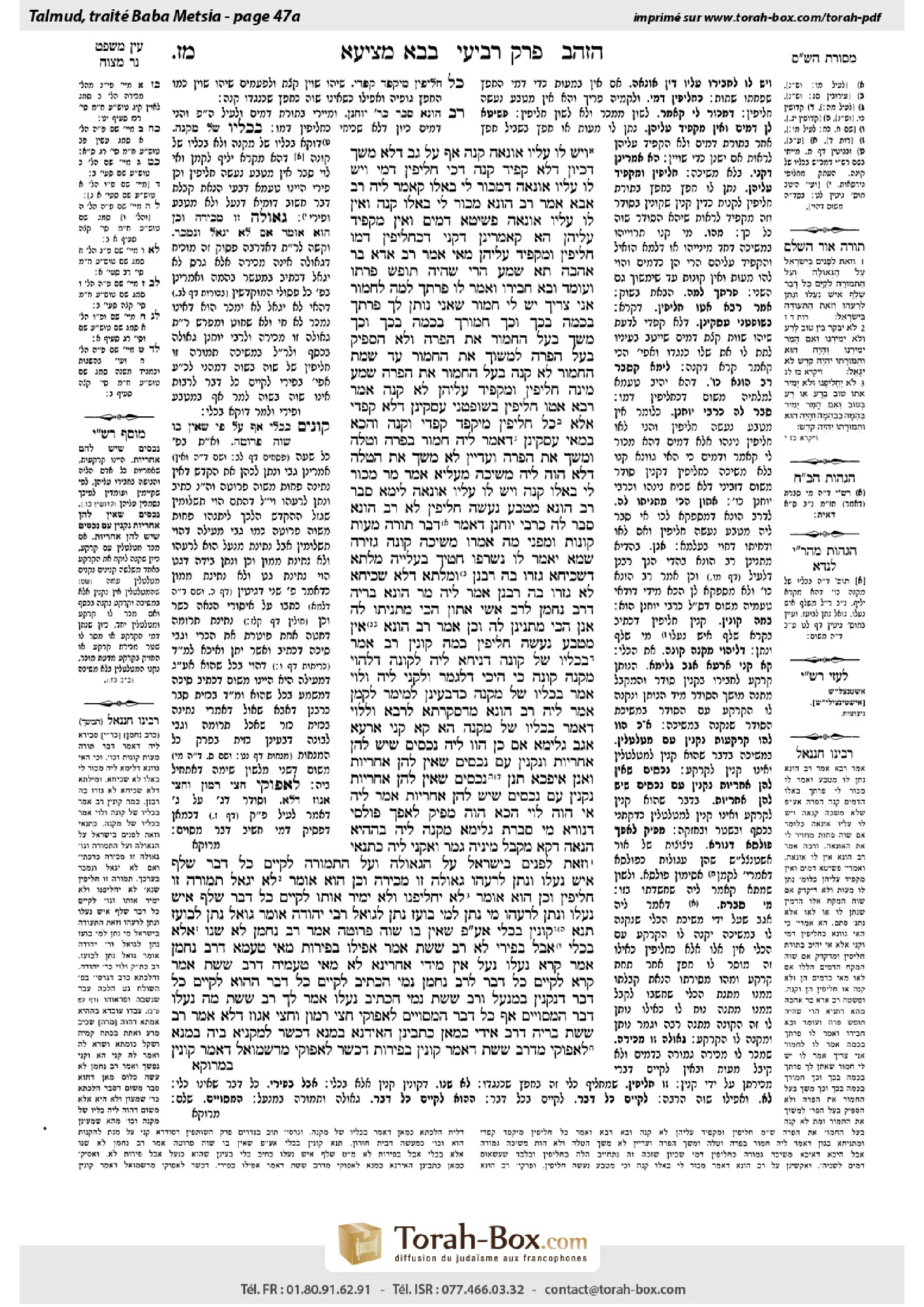
Bava Metzia 47a: Talmud study for Daf Yomi
Study the Talmud for Daf Yomi with scanned pages, Hebrew text, English translations from Sefaria and AI-generated French translations.
Passage selection and English or AI-generated French translation are available where the scan has annotations. Daf Study is independent of Torah-Box and Sefaria.
Browse Bava Metzia · בבא מציעא · All tractatesBava Metzia 47a text and translations
This page of Bava Metzia includes the Aramaic text, an English translation and an AI-generated French translation, alongside the scan above.
בבא מציעא מ״ז א · Aramaic and Hebrew text
וְיֵשׁ לוֹ עָלָיו אוֹנָאָה.
קָנָה – אַף עַל גַּב דְּלָא מָשַׁךְ, דְּכֵיוָן דְּלָא קָפֵיד – קָנָה, דְּכִי חֲלִיפִין דָּמֵי. וְיֵשׁ לוֹ עָלָיו אוֹנָאָה – דִּ״מְכוֹר לִי בְּאֵלּוּ״ קָאָמַר לֵיהּ. רַב אַבָּא אָמַר רַב הוּנָא: ״מְכוֹר לִי בְּאֵלּוּ״ – קָנָה, וְאֵין לוֹ עָלָיו אוֹנָאָה.
פְּשִׁיטָא: דָּמִים וְאֵין מַקְפִּיד עֲלֵיהֶן – הָא קָאָמְרִינַן דְּקָנֵי, דְּכַחֲלִיפִין דָּמוּ. חֲלִיפִין וּמַקְפִּיד עֲלֵיהֶן, מַאי?
אָמַר רַב אַדָּא בַּר אַהֲבָה, תָּא שְׁמַע: הֲרֵי שֶׁהָיָה תּוֹפֵשׂ פָּרָתוֹ וְעוֹמֵד, וּבָא חֲבֵירוֹ וְאָמַר לוֹ: פָּרָתְךָ לָמָּה? לַחֲמוֹר אֲנִי צָרִיךְ. יֵשׁ לִי חֲמוֹר שֶׁאֲנִי נוֹתֵן לְךָ. פָּרָתְךָ בְּכַמָּה? בְּכָךְ וְכָךְ. חֲמוֹרְךָ בְּכַמָּה? בְּכָךְ וְכָךְ.
מָשַׁךְ בַּעַל הַחֲמוֹר אֶת הַפָּרָה, וְלֹא הִסְפִּיק בַּעַל הַפָּרָה לִמְשׁוֹךְ אֶת הַחֲמוֹר עַד שֶׁמֵּת הַחֲמוֹר – לֹא קָנָה בַּעַל הַחֲמוֹר אֶת הַפָּרָה.
שְׁמַע מִינַּהּ: חֲלִיפִין וּמַקְפִּיד עֲלֵיהֶן – לֹא קָנָה.
אָמַר רָבָא: אַטּוּ חֲלִיפִין בְּשׁוּפְטָנֵי עָסְקִינַן, דְּלָא קָפְדִי? אֶלָּא כׇּל חֲלִיפִין מִיקְפָּד קָפְדִי וְקָנָה. וְהָכָא בְּמַאי עָסְקִינַן – דַּאֲמַר לֵיהּ: חֲמוֹר בְּפָרָה וְטָלֶה, וּמָשַׁךְ אֶת הַפָּרָה וַעֲדַיִין לֹא מָשַׁךְ אֶת הַטָּלֶה, דְּלָא הָוֵה לֵיהּ מְשִׁיכָה מַעַלְיָא.
אָמַר מָר: ״מְכוֹר לִי בְּאֵלּוּ״ – קָנָה, וְיֵשׁ לוֹ עָלָיו אוֹנָאָה. לֵימָא סָבַר רַב הוּנָא מַטְבֵּעַ נַעֲשֶׂה חֲלִיפִין?
לָא, רַב הוּנָא סָבַר לַהּ כְּרַבִּי יוֹחָנָן דְּאָמַר: דְּבַר תּוֹרָה מָעוֹת קוֹנוֹת. וּמִפְּנֵי מָה אָמְרוּ מְשִׁיכָה קוֹנָה – גְּזֵירָה שֶׁמָּא יֹאמַר לוֹ נִשְׂרְפוּ חִטֶּיךָ בַּעֲלִיָּיה. מִלְּתָא דִּשְׁכִיחָא – גְּזַרוּ בַּהּ רַבָּנַן, וּמִלְּתָא דְּלָא שְׁכִיחָא – לָא גְּזַרוּ בַּהּ רַבָּנַן. אֲמַר לֵיהּ מָר הוּנָא בְּרֵיהּ דְּרַב נַחְמָן לְרַב אָשֵׁי: אַתּוּן, הָכִי מַתְנִיתוּ לַהּ, אֲנַן הָכִי מַתְנֵינַן לַהּ: וְכֵן אָמַר רַב הוּנָא, אֵין מַטְבֵּעַ נַעֲשֶׂה חֲלִיפִין.
בַּמֶּה קוֹנִין?
רַב אָמַר: בְּכִלְיוֹ שֶׁל קוֹנֶה. דְּנִיחָא לֵיהּ לְקוֹנֶה דְּלֶהֱוֵי מַקְנֶה קוֹנֶה, כִּי הֵיכִי דְּלִגְמַר וְלַקְנֵי לֵיהּ. וְלֵוִי אָמַר: בְּכִלְיוֹ שֶׁל מַקְנֶה, כִּדְבָעֵינַן לְמֵימַר לְקַמַּן.
אֲמַר לֵיהּ רַב הוּנָא מִדִּסְקַרְתָּא לְרָבָא: וּלְלֵוִי, דְּאָמַר בְּכִלְיוֹ שֶׁל מַקְנֶה, הָא קָא קָנֵי אַרְעָא אַגַּב גְּלִימָא. אִם כֵּן, הָווּ לֵיהּ נְכָסִים שֶׁיֵּשׁ לָהֶן אַחְרָיוּת וְנִקְנִין עִם נְכָסִים שֶׁאֵין לָהֶן אַחְרָיוּת. וַאֲנַן אִיפְּכָא תְּנַן: נְכָסִים שֶׁאֵין לָהֶן אַחְרָיוּת נִקְנִין עִם נְכָסִים שֶׁיֵּשׁ לָהֶן אַחְרָיוּת!
אֲמַר לֵיהּ: אִי הֲוָה לֵוִי הָכָא, הֲוָה מַפֵּיק לְאַפָּךְ פּוּלְסֵי דְנוּרָא! מִי סָבְרַתְּ גְּלִימָא מַקְנֵה לֵיהּ? בְּהָהִיא הֲנָאָה דְּקָא מְקַבֵּל מִינֵּיהּ – גָּמַר וּמַקְנֵי לֵיהּ.
כְּתַנָּאֵי: ״וְזֹאת לְפָנִים בְּיִשְׂרָאֵל עַל הַגְּאוּלָּה וְעַל הַתְּמוּרָה לְקַיֵּם כׇּל דָּבָר שָׁלַף אִישׁ נַעֲלוֹ וְנָתַן לְרֵעֵהוּ״. ״גְּאוּלָּה״ – זוֹ מְכִירָה, וְכֵן הוּא אוֹמֵר: ״לֹא יִגָּאֵל״. ״תְּמוּרָה״ – זוֹ חֲלִיפִין, וְכֵן הוּא אוֹמֵר: ״לֹא יַחֲלִיפֶנּוּ וְלֹא יָמִיר אוֹתוֹ״.
״לְקַיֵּם כׇּל דָּבָר שָׁלַף אִישׁ נַעֲלוֹ וְנָתַן לְרֵעֵהוּ״. מִי נָתַן לְמִי? בּוֹעַז נָתַן לַגּוֹאֵל. רַבִּי יְהוּדָה אוֹמֵר: גּוֹאֵל נָתַן לְבוֹעַז.
תָּנָא: קוֹנִין בִּכְלִי אַף עַל פִּי שֶׁאֵין בּוֹ שָׁוֶה פְּרוּטָה. אָמַר רַב נַחְמָן: לֹא שָׁנוּ אֶלָּא בִּכְלִי, אֲבָל בְּפֵירֵי – לָא. רַב שֵׁשֶׁת אָמַר: אֲפִילּוּ בְּפֵירוֹת. מַאי טַעְמָא דְּרַב נַחְמָן? אָמַר קְרָא ״נַעֲלוֹ״, נַעַל – אִין, מִידֵּי אַחֲרִינָא – לָא.
מַאי טַעְמֵיהּ דְּרַב שֵׁשֶׁת, אָמַר קְרָא: ״לְקַיֵּם כׇּל דָּבָר״. לְרַב נַחְמָן נָמֵי, הָכְתִיב: ״לְקַיֵּם כׇּל דָּבָר״! הַהוּא לְקַיֵּם כׇּל דָּבָר, דְּנִיקְנִין בְּמִנְעָל. וְרַב שֵׁשֶׁת נָמֵי, הָכְתִיב: ״נַעֲלוֹ״! אָמַר לְךָ רַב שֵׁשֶׁת: מָה נַעֲלוֹ דָּבָר הַמְסוּיָּים – אַף כׇּל דָּבָר הַמְסוּיָּים, לְאַפּוֹקֵי חֲצִי רִמּוֹן וַחֲצִי אֱגוֹז, דְּלָא.
אָמַר רַב שֵׁשֶׁת בְּרֵיהּ דְּרַב אִידִי: כְּמַאן כָּתְבִינַן הָאִידָּנָא ״בְּמָנָא דְּכָשַׁר לְמִקְנְיָא בֵּיהּ״. ״בְּמָנָא״ – לְאַפּוֹקֵי מִדְּרַב שֵׁשֶׁת, דְּאָמַר קוֹנִין בְּפֵירוֹת. ״דְּכָשַׁר״ – לְאַפּוֹקֵי מִדִּשְׁמוּאֵל, דְּאָמַר קוֹנִין
Bava Metzia 47a · English translation
And if the sum of money is one-sixth lower than the value of the item, the seller of the item has a claim of exploitation against the buyer, who must pay the difference to the seller.
The Gemara elaborates: The buyer acquires the item even though he did not pull it, because since the seller is not particular about the sum, the buyer acquired the item, as it is similar to a transaction effected by means of exchange. And the seller has a claim of exploitation against the buyer because the buyer said to him: Sell me your item for these coins. The use of the language of sale indicates that it will be for an acceptable price. Rav Abba says that Rav Huna says that if the buyer said: Sell me your item for these coins, the buyer acquired the item; and the seller of the item has no claim of exploitation against the buyer, as it is a full-fledged transaction effected by means of exchange.
The Gemara analyzes these halakhot: It is obvious that in a case where there is a sale of an item for money and the seller is not particular about the sum, we say that the buyer acquires the item immediately upon receiving the money, as it is similar to a transaction effected by means of exchange. But if it is a transaction effected by means of exchange and one of the parties is particular that the value of the items is equal, what is the halakha? Is its legal status that of a sale, or that of a transaction effected by means of exchange?
Rav Adda bar Ahava says: Come and hear a resolution to the dilemma from a baraita: There is a case where one was grasping his cow and standing in place, and another came and said to him: Why is your cow standing here? The owner of the cow replied: I need a donkey, and I hope to exchange this cow for one. The other person said: I have a donkey that I can give you; for how much are you selling your cow? The owner of the cow responded: I am selling it for such and such a price. He then said: For how much are you selling your donkey? The owner of the donkey responded: I am selling it for such and such a price.
If, after this discussion, the owner of the donkey pulled the cow, but the owner of the cow did not manage to pull the donkey before the donkey died, the owner of the donkey did not acquire the cow, even though ostensibly this was a transaction effected by means of exchange, which is typically complete once one of the parties pulls the item he is acquiring.
The Gemara suggests: Learn from it that in a case where there is a transaction effected by means of exchange and one of the parties is particular that the value of the items is equal, he does not acquire the item immediately. In contrast to the standard case of exchange, the owners of the cow and donkey assessed the value of the animals before the transaction. Since they are particular about the price, the acquisition is not completed until each pulls the item he is acquiring.
Rava said: Is that to say that in a standard case of exchange we are dealing with fools, who are not particular about the value of the items that they are acquiring? Rather, in every case of exchange, the parties are particular about the value of the items, and when one party pulls an item the other party acquires the other item immediately and pays for it later. And with what are we dealing here? The case in the baraita is where one party said to the other party: Let us exchange a donkey for a cow and a lamb, and the owner of the donkey pulled the cow and did not yet pull the lamb, as in that case he has not performed a proper act of pulling.
The Master, Rav Huna, said above that if one said to another: Sell me your item for these coins, the buyer acquired the article, and if the sum of money is one-sixth lower than the value of the item, the seller of the item has a claim of exploitation against the buyer. The Gemara suggests: Let us say based on that halakha that Rav Huna holds that a coin can be an item used to effect exchange.
The Gemara rejects this suggestion: No, Rav Huna holds in accordance with the opinion of Rabbi Yoḥanan, who says: By Torah law money effects acquisition. And for what reason did the Sages say that pulling acquires an item and money does not? This is a rabbinic decree lest the seller say to the buyer after receiving the money: Your wheat was burned in the upper story. And it is only with regard to a common matter that the Sages issued a decree, but with regard to an uncommon matter the Sages did not issue a decree. Therefore, in this case there is no decree, and the transaction is governed by Torah law. Mar Huna, son of Rav Naḥman, said to Rav Ashi: You teach this halakha in that manner; we teach it in this manner, not by inference but as an explicit ruling: And likewise, Rav Huna said: Money cannot be the item used to effect a transaction by means of exchange.
§ Above, the Gemara mentioned a form of exchange in which there are not two items of equal value being exchanged, but rather one person attempts to transfer possession of his item to the buyer by means of a symbolic exchange involving, e.g., a cloth. With regard to that symbolic transaction, the Gemara asks: With what vessel does one acquire the item in question, i.e., whose vessel is used in order to effect this symbolic transaction?
Rav says: One effects the transaction with the vessels of the one acquiring the item, who effects the transaction by giving the vessels to the owner of the item. The moment that the owner pulls the vessel into his possession, the transaction is complete and ownership of the item in question is transferred to his counterpart. Rav explains that the one acquiring the item is amenable to having the one transferring ownership of the item acquire his vessel, so that he will resolve to transfer ownership to him. And Levi says: One effects the transaction by having the one acquiring the item pull the vessels of the one transferring ownership, as we seek to explain below.
Rav Huna from Diskarta said to Rava: But according to Levi, who says that one effects the transaction with the vessels of the one transferring ownership, there is a difficulty. In a case where one acquires land by means of symbolic exchange where the item used is a cloak, it turns out that he is acquiring land by means of a cloak. If so, this is a case of property that is guaranteed, i.e., land, and it is acquired with movable property that is not guaranteed, by means of a transaction performed on the latter. And we learned the opposite in a mishna (Kiddushin 26a): Property that is not guaranteed is acquired with property that is guaranteed, i.e., land, by means of a transaction performed on the latter.
Rava said to him: If Levi, whose opinion you questioned, were here, he would take out rods of fire before you and flog you for your unwarranted question. Do you maintain that he said that at the moment he transfers ownership of the cloak he transfers ownership of the land to him? That is not the case; rather, in exchange for that pleasure the owner of the item experiences from the fact that the one acquiring the cloak accepted it from him, he resolves to transfer ownership to him. This is unlike the acquisition of movable items by means of a transaction of land, where both are acquired simultaneously. Here, the transfer of ownership of the cloak effects the subsequent transfer of ownership of the land.
The Gemara comments: This dispute between Rav and Levi is parallel to a dispute between tanna’im. The verse states: “Now this was the custom in former time in Israel concerning redemption and concerning substitution, to confirm all matters; a man drew off his shoe, and gave it to his neighbor” (Ruth 4:7). The verse is interpreted: “Redemption”; that is a sale. And likewise it says: “Neither shall be sold nor shall be redeemed” (Leviticus 27:28). “Substitution”; that is the transaction of exchange. And likewise it says: “He may neither exchange it nor substitute it” (Leviticus 27:10).
With regard to the phrase “To confirm all matters; a man drew off his shoe, and gave it to his neighbor,” the baraita asks: Who gave the shoe to whom? Boaz gave his shoe to the redeemer, the closest relative of Elimelech, who had the right of first refusal to the land that Naomi, Elimelech’s widow, was planning to sell. The redeemer was transferring that right to the land to Boaz, who was acquiring it by means of his shoe. Rabbi Yehuda says: The redeemer gave his shoe to Boaz. The dispute between Rav and Levi is parallel to the dispute between the first tanna and Rabbi Yehuda.
§ It was taught: One can acquire property through a symbolic exchange by using a vessel, even if it does not have the value of one peruta. Rav Naḥman says: The Sages taught that this symbolic exchange can be effected only by using a vessel, but not by using produce, i.e., any item other than a vessel. Rav Sheshet says: It can be effected even by using produce. The Gemara explains: What is the reason for the opinion of Rav Naḥman? The verse states: “His shoe” (Ruth 4:7), from which it is derived: With regard to a shoe and any other item similar to a shoe, i.e., a vessel, yes, the symbolic exchange can be effected; with regard to any item other than a vessel, no, it cannot be effected.
What is the reason for the opinion of Rav Sheshet? The verse in Ruth states: “To confirm all matters,” from which it is derived that all items, even if they are not vessels, can effect the exchange. The Gemara asks: According to Rav Naḥman as well, isn’t it written: “To confirm all matters”? The Gemara explains: In his opinion, that phrase: “To confirm all matters,” is referring to all items that can be acquired through an exchange effected by using a shoe. The Gemara asks: And according to Rav Sheshet as well, isn’t it written: “His shoe”? The Gemara explains: Rav Sheshet could have said to you that from that term it is derived: Just as his shoe is a complete item, so too, every complete item can effect a symbolic exchange, to exclude half a pomegranate and half a nut, which cannot effect a symbolic exchange. A whole pomegranate or nut can be used for that purpose.
Rav Sheshet, son of Rav Idi, said: In accordance with whose opinion do we write today in documents that the transaction was effected with a vessel that is fit to acquire items with it? The Gemara explains: The term with a vessel serves to exclude the opinion of Rav Sheshet, who says: One acquires an item through a transaction of symbolic exchange by using produce. The term that is fit serves to exclude the opinion of Shmuel, who says: One acquires an item
Bava Metzia 47a · Traduction française (IA)
Et si la somme d'argent est inférieure de un sixième à la valeur de l'objet, le vendeur a un droit de préférence contre l'acheteur, qui doit verser la différence au vendeur.
La Guemara développe : L'acheteur acquiert l'objet même s'il ne l'a pas tiré, car puisque le vendeur n'est pas exigeant quant à la somme, l'acheteur a acquis l'objet, comme c'est semblable à une transaction effectuée par échange. Et le vendeur a un droit de préférence contre l'acheteur, car l'acheteur a dit au vendeur : Vends-moi ton objet pour ces pièces. L'usage de la langue de vente indique qu'il s'agit d'un prix acceptable. Rav Abba dit que Rav Huna dit que si l'acheteur a dit : Vends-moi ton objet pour ces pièces, l'acheteur a acquis l'objet ; et le vendeur n'a pas de droit de préférence contre l'acheteur, car c'est une transaction complète effectuée par échange.
La Guemara analyse ces halakhot : Il est évident qu'en cas de vente d'un objet contre de l'argent et que le vendeur n'est pas exigeant quant à la somme, nous disons que l'acheteur acquiert l'objet immédiatement après avoir reçu l'argent, comme c'est semblable à une transaction effectuée par échange. Mais si c'est une transaction effectuée par échange et qu'un des parties est exigeant que la valeur des objets soit égale, quelle est la halakha ? Est-ce que son statut juridique est celui d'une vente, ou celui d'une transaction effectuée par échange ?
Rav Adda bar Ahava dit : Viens écouter une résolution à ce dilemme d'une baraïta : Il y a un cas où l'un tenait son bœuf et était immobile, et un autre est venu et a dit à lui : Pourquoi ton bœuf est-il ici ? L'propriétaire du bœuf a répondu : J'ai besoin d'un âne, et j'espère échanger ce bœuf contre un. L'autre personne a dit : J'ai un âne que je peux te donner ; à quel prix vends-tu ton bœuf ? L'propriétaire du bœuf a répondu : Je le vends pour telle et telle somme. Il a ensuite dit : À quel prix vends-tu ton âne ? L'propriétaire de l'âne a répondu : Je le vends pour telle et telle somme.
Si, après cette discussion, l'propriétaire de l'âne a tiré le bœuf, mais l'propriétaire du bœuf n'a pas réussi à tirer l'âne avant que l'âne ne meure, l'propriétaire de l'âne n'a pas acquis le bœuf, même si apparemment c'était une transaction effectuée par échange, qui est généralement achevée lorsque l'un des parties tire l'objet qu'il acquiert.
La Guemara suggère : Apprends-y que dans un cas où il y a une transaction effectuée par échange et qu'un des parties est exigeant que la valeur des objets soit égale, il ne s'acquiert pas immédiatement l'objet. Contrairement au cas standard d'échange, les propriétaires du bœuf et de l'âne ont évalué la valeur des animaux avant la transaction. Puisqu'ils sont exigeants quant au prix, l'acquisition n'est pas achevée jusqu'à ce que chacun tire l'objet qu'il acquiert.
Rava a dit : Est-ce que cela signifie que dans un cas standard d'échange nous avons affaire à des imbéciles, qui ne sont pas exigeants quant à la valeur des objets qu'ils acquièrent ? Plutôt, dans chaque cas d'échange, les parties sont exigeantes quant à la valeur des objets, et lorsque l'une des parties tire un objet, l'autre acquiert immédiatement l'autre objet et paie plus tard. Et avec quoi sommes-nous ici ? Le cas dans la baraïta est celui où l'un a dit à l'autre : Échangeons un âne contre un bœuf et un agneau, et l'propriétaire de l'âne a tiré le bœuf et n'a pas encore tiré l'agneau, car dans ce cas il n'a pas accompli un acte correct de tirage.
Le Maître, Rav Huna, a dit ci-dessus que si l'un a dit à l'autre : Vends-moi ton objet pour ces pièces, l'acheteur a acquis l'objet, et si la somme d'argent est inférieure de sixième à la valeur de l'objet, le vendeur a un droit de préférence contre l'acheteur. La Guemara suggère : Apprenons-y selon cette halakha que Rav Huna considère que la pièce peut être un objet utilisé pour effectuer un échange.
La Guemara rejette cette suggestion : Non, Rav Huna considère selon l'opinion de Rabbi Yoḥanan, qui dit : Selon la loi divine, l'argent acquiert. Et pourquoi les Sages ont-ils dit que tirer acquiert un objet et que l'argent ne le fait pas ? C'est un décret rabbinique afin que le vendeur ne dise pas à l'acheteur après avoir reçu l'argent : Ton blé a brûlé au premier étage. Et c'est seulement concernant une affaire commune que les Sages ont émis un décret, mais concernant une affaire inhabituelle, ils n'ont pas émis de décret. Ainsi, dans ce cas, il n'y a pas de décret, et la transaction est réglementée par la loi divine. Mar Huna, fils de Rav Naḥman, a dit à Rav Ashi : Tu enseignes cette halakha ainsi ; nous l'enseignons ainsi, pas par déduction mais comme un arrêt explicite : Et de même, Rav Huna a dit : L'argent ne peut pas être l'objet utilisé pour effectuer une transaction par échange.
§ Ci-dessus, la Guemara a mentionné une forme d'échange où il n'y a pas deux objets de valeur égale, mais plutôt une personne tente de transférer la possession de son objet à l'acheteur par un échange symbolique, par exemple en utilisant un tissu. Concernant cette transaction symbolique, la Guemara pose la question : Avec quel vase acquiert-on l'objet en question, c'est-à-dire quel est le vase utilisé pour effectuer cette transaction symbolique ?
Rav dit : On effectue la transaction avec les vases de celui qui acquiert l'objet, qui effectue la transaction en donnant les vases à l'propriétaire de l'objet. Le moment où l'propriétaire tire le vase dans sa possession, la transaction est achevée et la possession de l'objet en question est transférée à son contrepartie. Rav explique que celui qui acquiert l'objet est disposé à ce que celui qui transfère la possession de l'objet acquière son vase, afin qu'il résolve de transférer la possession à lui. Et Levi dit : On effectue la transaction en ayant celui qui acquiert l'objet tirer les vases de celui qui transfère la possession, comme nous allons l'expliquer ci-dessous.
Rav Huna de Diskarta dit à Rava : Mais selon Levi, qui affirme qu'on effectue la transaction avec les objets du propriétaire, il y a une difficulté. Dans un cas où l'on acquiert une terre par échange symbolique et l'objet utilisé est une cape, il s'avère qu'on acquiert une terre par une cape. Si c'est ainsi, c'est un cas d'acquisition d'une propriété garantie, c'est-à-dire une terre, avec une propriété non garantie, par une transaction faite sur celle-ci. Et nous avons appris l'inverse dans une mitsva (Kiddushin 26a) : Une propriété non garantie est acquise avec une propriété garantie, c'est-à-dire une terre, par une transaction faite sur celle-ci.
Rava dit à lui : Si Levi, dont vous avez interrogé l'opinion, était ici, il sortirait des bâtons de feu devant vous et vous flagellerait pour votre question inappropriée. Maintenez-vous que ce qu'il a dit est que lorsqu'il transfère la propriété de la cape, il transfère la propriété de la terre à l'autre ? Ce n'est pas le cas ; plutôt, en échange de ce plaisir que l'propriétaire éprouve du fait que l'acquéreur accepte la cape, il décide de transférer la propriété à l'autre. Cela diffère de l'acquisition d'objets mobiles par une transaction de terre, où les deux sont acquis simultanément. Ici, le transfert de propriété de la cape provoque le transfert ultérieur de propriété de la terre.
La Guemara commente : Ce débat entre Rav et Levi est parallèle à un débat entre tannaïm. La Sainte Écriture dit : « C'était la coutume autrefois en Israël concernant le rachat et la substitution, pour confirmer toutes les choses ; un homme retirait son sandale et la donnait à son voisin » (Ruth 4:7). La Sainte Écriture est interprétée : « Le rachat » ; c'est une vente. Et de même, il dit : « Ni ne sera vendu ni ne sera racheté » (Lévitique 27:28). « La substitution » ; c'est la transaction d'échange. Et de même, il dit : « Il ne peut ni échanger ni substituer » (Lévitique 27:10).
Concernant la phrase « Pour confirmer toutes les choses ; un homme retirait son sandale et la donnait à son voisin », la baraïta pose la question : Qui a donné la sandale à qui ? Boaz a donné sa sandale au rédempteur, le parent proche d'Elimelech, qui avait le droit de préférence à la terre que Naomi, la veuve d'Elimelech, prévoyait de vendre. Le rédempteur transférait ce droit à la terre à Boaz, qui l'acquérait par sa sandale. Rabbi Yehuda dit : Le rédempteur a donné sa sandale à Boaz. Le débat entre Rav et Levi est parallèle au débat entre le premier tanna et Rabbi Yehuda.
§ Il a été enseigné : On peut acquérir une propriété par échange symbolique en utilisant un objet, même s'il n'a pas la valeur d'un peruta. Rav Naḥman dit : Les Sages ont enseigné que cet échange symbolique peut être effectué uniquement en utilisant un objet, mais pas en utilisant des produits, c'est-à-dire tout objet autre qu'un objet. Rav Sheshet dit : On peut l'effectuer même en utilisant des produits. La Guemara explique : Quelle est la raison de l'opinion de Rav Naḥman ? La Sainte Écriture dit : « Sa sandale » (Ruth 4:7), d'où on déduit : Concernant une sandale et tout autre objet semblable à une sandale, c'est-à-dire un objet, oui, l'échange symbolique peut être effectué ; concernant tout objet autre qu'un objet, non, il ne peut pas être effectué.
Quelle est la raison de l'opinion de Rav Sheshet ? La Sainte Écriture dans Ruth dit : « Pour confirmer toutes les choses », d'où on déduit que tous les objets, même s'ils ne sont pas des objets, peuvent effectuer l'échange. La Guemara pose la question : Selon Rav Naḥman également, n'est-il pas écrit : « Pour confirmer toutes les choses » ? La Guemara explique : Selon son opinion, cette phrase : « Pour confirmer toutes les choses », fait référence à tous les objets qui peuvent être acquis par un échange effectué avec une sandale. La Guemara pose la question : Et selon Rav Sheshet également, n'est-il pas écrit : « Sa sandale » ? La Guemara explique : Rav Sheshet aurait pu dire à vous que d'après ce terme, on déduit : Comme sa sandale est un objet complet, ainsi tout objet complet peut effectuer un échange symbolique, pour exclure la moitié d'une pomele et la moitié d'un noix, qui ne peuvent pas effectuer un échange symbolique. Une pomele ou un noix entier peut être utilisé à cet effet.
Rav Sheshet, fils de Rav Idi, dit : Selon l'opinion de qui écrivons-nous aujourd'hui dans les documents que la transaction a été effectuée avec un objet qui est propre à acquérir des choses avec lui ? La Guemara explique : Le terme « avec un objet » sert à exclure l'opinion de Rav Sheshet, qui dit : On acquiert une chose par un échange symbolique en utilisant des produits. Le terme « qui est propre » sert à exclure l'opinion de Shmuel, qui dit : On acquiert une chose par un échange symbolique en utilisant des objets propres.
Traduction française générée par IA à partir de l’édition anglaise de Sefaria. Vérifie toujours un passage avec le texte source.
Text from Sefaria: William Davidson Edition - Vocalized Aramaic (CC BY NC); William Davidson Edition - English (CC BY NC).