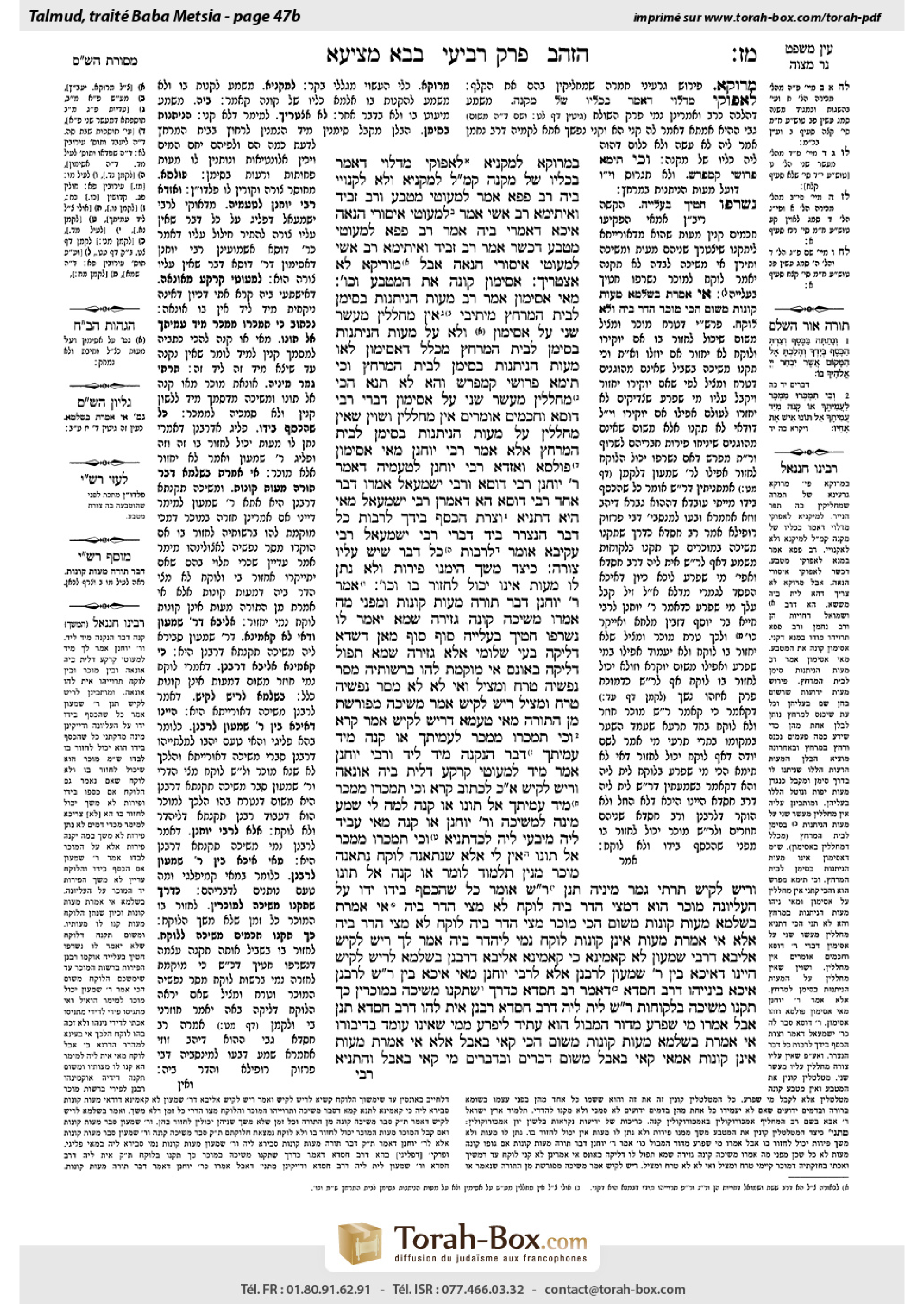
Bava Metzia 47b: Talmud study for Daf Yomi
Study the Talmud for Daf Yomi with scanned pages, Hebrew text, English translations from Sefaria and AI-generated French translations.
Passage selection and English or AI-generated French translation are available where the scan has annotations. Daf Study is independent of Torah-Box and Sefaria.
Browse Bava Metzia · בבא מציעא · All tractatesBava Metzia 47b text and translations
This page of Bava Metzia includes the Aramaic text, an English translation and an AI-generated French translation, alongside the scan above.
בבא מציעא מ״ז ב · Aramaic and Hebrew text
בְּמָרוֹקָא. ״לְמִקְנְיָא״ – לְאַפּוֹקֵי מִדְּלֵוִי, דְּאָמַר בְּכִלְיוֹ שֶׁל מַקְנֶה, קָא מַשְׁמַע לַן ״לְמִקְנְיָא״ וְלָא ״לְ[אַ]קְנוֹיֵי״. ״בֵּיהּ״ – רַב פָּפָּא אָמַר: לְמַעוֹטֵי מַטְבֵּעַ. וְרַב זְבִיד, וְאִיתֵּימָא רַב אָשֵׁי אָמַר: לְמַעוֹטֵי אִיסּוּרֵי הֲנָאָה.
אִיכָּא דְּאָמְרִי: ״בֵּיהּ״ – אָמַר רַב פָּפָּא: לְמַעוֹטֵי מַטְבֵּעַ. ״דְּכָשַׁר״ – אָמַר רַב זְבִיד, וְאִיתֵּימָא רַב אָשֵׁי: לְמַעוֹטֵי אִיסּוּרֵי הֲנָאָה. אֲבָל מוֹרִיקָא לָא אִצְטְרִיךְ.
אֲסִימוֹן קוֹנֶה אֶת הַמַּטְבֵּעַ וְכוּ׳. מַאי ״אֲסִימוֹן״? אָמַר רַב: מָעוֹת הַנִּיתָּנוֹת בְּסִימָן לְבֵית הַמֶּרְחָץ.
מֵיתִיבִי: אֵין מְחַלְּלִין מַעֲשֵׂר שֵׁנִי עַל אֲסִימוֹן וְלֹא עַל מָעוֹת הַנִּיתָּנוֹת בְּסִימָן לְבֵית הַמֶּרְחָץ. מִכְּלַל דַּאֲסִימוֹן לָאו מָעוֹת הַנִּיתָּנוֹת בְּסִימָן לְבֵית הַמֶּרְחָץ! וְכִי תֵּימָא פָּרוֹשֵׁי קָמְפָרֵשׁ – וְהָא לָא תַּנָּא הָכִי: מְחַלְּלִין מַעֲשֵׂר שֵׁנִי עַל אֲסִימוֹן, דִּבְרֵי רַבִּי דּוֹסָא. וַחֲכָמִים אוֹמְרִים: אֵין מְחַלְּלִין. וְשָׁוִין שֶׁאֵין מְחַלְּלִין עַל מָעוֹת הַנִּיתָּנוֹת בְּסִימָן לְבֵית הַמֶּרְחָץ!
אֶלָּא אָמַר רַבִּי יוֹחָנָן: מַאי אֲסִימוֹן – פּוּלְסָא. וְאַזְדָּא רַבִּי יוֹחָנָן לְטַעְמֵיהּ, דְּאָמַר רַבִּי יוֹחָנָן: רַבִּי דּוֹסָא וְרַבִּי יִשְׁמָעֵאל אָמְרוּ דָּבָר אֶחָד, רַבִּי דּוֹסָא – הָא דַּאֲמַרַן. רַבִּי יִשְׁמָעֵאל מַאי הִיא, דְּתַנְיָא: ״וְצַרְתָּ הַכֶּסֶף בְּיָדְךָ״ – לְרַבּוֹת כׇּל דָּבָר הַנִּצְרָר בַּיָּד, דִּבְרֵי רַבִּי יִשְׁמָעֵאל. רַבִּי עֲקִיבָא אוֹמֵר: לְרַבּוֹת כׇּל דָּבָר שֶׁיֵּשׁ עָלָיו צוּרָה.
כֵּיצַד: מָשַׁךְ הֵימֶנּוּ פֵּירוֹת וְלֹא נָתַן לוֹ מָעוֹת – אֵינוֹ יָכוֹל לַחֲזוֹר בּוֹ וְכוּ׳. אָמַר רַבִּי יוֹחָנָן: דְּבַר תּוֹרָה מָעוֹת קוֹנוֹת, וּמִפְּנֵי מָה אָמְרוּ מְשִׁיכָה קוֹנָה – גְּזֵירָה שֶׁמָּא יֹאמַר לוֹ ״נִשְׂרְפוּ חִטֶּיךָ בָּעֲלִיָּיה״.
סוֹף סוֹף, מַאן דִּשְׁדָא דְּלֵיקָה בָּעֵי שַׁלּוֹמֵי! אֶלָּא: גְּזֵירָה שֶׁמָּא תִּפּוֹל דְּלֵיקָה בְּאוֹנֶס. אִי מוֹקְמַתְּ לְהוּ בִּרְשׁוּתֵיהּ – מָסַר נַפְשֵׁיהּ, טָרַח וּמַצֵּיל. וְאִי לָא – לָא מָסַר נַפְשֵׁיהּ, טָרַח וּמַצֵּיל.
רֵישׁ לָקִישׁ אָמַר: מְשִׁיכָה מְפוֹרֶשֶׁת מִן הַתּוֹרָה. מַאי טַעְמָא דְּרֵישׁ לָקִישׁ? אָמַר קְרָא: ״וְכִי תִמְכְּרוּ מִמְכָּר לַעֲמִיתֶךָ אוֹ קָנֹה מִיַּד עֲמִיתֶךָ״, דָּבָר הַנִּקְנֶה מִיָּד לְיָד.
וְרַבִּי יוֹחָנָן אָמַר: ״מִיַּד״ – לְמַעוֹטֵי קַרְקַע, דְּלֵית בַּהּ אוֹנָאָה.
וְרֵישׁ לָקִישׁ, אִם כֵּן לִכְתּוֹב קְרָא: ״וְכִי תִמְכְּרוּ מִמְכָּר מִיַּד עֲמִיתֶךָ אַל תּוֹנוּ״, ״אוֹ קָנֹה״ לְמָה לִי? שְׁמַע מִינַּהּ לִמְשִׁיכָה.
וְרַבִּי יוֹחָנָן: ״אוֹ קָנֹה״ מַאי עָבֵיד לֵיהּ? מִיבְּעֵי לֵיהּ, לְכִדְתַנְיָא: ״וְכִי תִמְכְּרוּ מִמְכָּר אַל תּוֹנוּ״, אֵין לִי אֶלָּא שֶׁנִּתְאַנָּה לוֹקֵחַ, נִתְאַנָּה מוֹכֵר מִנַּיִן? תַּלְמוּד לוֹמַר: ״אוֹ קָנֹה אַל תּוֹנוּ״.
וְרֵישׁ לָקִישׁ: תַּרְתֵּי גָּמַר מִינֵּיהּ.
תְּנַן, רַבִּי שִׁמְעוֹן אוֹמֵר: כֹּל שֶׁהַכֶּסֶף בְּיָדוֹ – יָדוֹ עַל הָעֶלְיוֹנָה. מוֹכֵר הוּא דְּמָצֵי הָדַר בֵּיהּ, לוֹקֵחַ לָא מָצֵי הָדַר בֵּיהּ. אִי אָמְרַתְּ בִּשְׁלָמָא מָעוֹת קוֹנוֹת – מִשּׁוּם הָכִי מוֹכֵר מָצֵי הָדַר בֵּיהּ, לוֹקֵחַ לָא מָצֵי הָדַר בֵּיהּ. אֶלָּא אִי אָמְרַתְּ מָעוֹת אֵינָן קוֹנוֹת – לוֹקֵחַ נָמֵי לִיהְדַּר בֵּיהּ!
אָמַר לָךְ רֵישׁ לָקִישׁ: אַלִּיבָּא דְּרַבִּי שִׁמְעוֹן – לָא קָאָמֵינָא, כִּי קָאָמֵינָא – אַלִּיבָּא דְּרַבָּנַן.
בִּשְׁלָמָא לְרֵישׁ לָקִישׁ – הַיְינוּ דְּאִיכָּא בֵּין רַבִּי שִׁמְעוֹן לְרַבָּנַן. אֶלָּא לְרַבִּי יוֹחָנָן, מַאי אִיכָּא בֵּין רַבִּי שִׁמְעוֹן לְרַבָּנַן? אִיכָּא בֵּינַיְיהוּ דְּרַב חִסְדָּא. דְּאָמַר רַב חִסְדָּא: כְּדֶרֶךְ שֶׁתִּקְּנוּ מְשִׁיכָה בַּמּוֹכְרִין כָּךְ תִּקְנוּ מְשִׁיכָה בַּלָּקוֹחוֹת. רַבִּי שִׁמְעוֹן לֵית לֵיהּ דְּרַב חִסְדָּא, רַבָּנַן אִית לְהוּ דְּרַב חִסְדָּא.
תְּנַן: אֲבָל אָמְרוּ, מִי שֶׁפָּרַע מִדּוֹר הַמַּבּוּל – הוּא עָתִיד לִיפָּרַע מִמִּי שֶׁאֵינוֹ עוֹמֵד בְּדִיבּוּרוֹ. אִי אָמְרַתְּ בִּשְׁלָמָא מָעוֹת קוֹנוֹת – מִשּׁוּם הָכִי קָאֵי בַּ״אֲבָל״, אֶלָּא אִי אָמְרַתְּ מָעוֹת אֵינָן קוֹנוֹת, אַמַּאי קָאֵי בַּ״אֲבָל״? מִשּׁוּם דְּבָרִים.
וּבִדְבָרִים מִי קָאֵי בַּ״אֲבָל״? וְהָתַנְיָא,
Bava Metzia 47b · English translation
with date pits used for cleaning and smoothing parchment. The term to acquire items serves to exclude the opinion of Levi, who says that the symbolic exchange is effected by means of the vessels of the one transferring ownership of the item. This latter expression teaches us that the vessel is given to acquire and not to transfer ownership to the other. With regard to the term: With it, Rav Pappa said: It serves to exclude a coin, which cannot effect a symbolic exchange. And Rav Zevid, and some say Rav Ashi, said: It serves to exclude items from which deriving benefit is prohibited.
Some say a different version of the dispute, as follows. With regard to the term: With it, Rav Pappa said: It serves to exclude a coin, which cannot effect a symbolic exchange. With regard to the term: That is fit, Rav Zevid, and some say Rav Ashi, said: It serves to exclude items from which deriving benefit is prohibited. But according to this version, a verse to exclude date pits is not necessary, as they are of no significance at all.
§ The Gemara returns to an analysis of a passage in the mishna. When one party takes possession of an asimon, the other party acquires the minted coin. The Gemara asks: What is an asimon? Rav said: It is one of the coins given as a token to gain entry into the bathhouse, for which the bathers would pay later.
The Gemara raises an objection from a baraita: One desacralizes second-tithe produce neither with an asimon nor with one of the coins given as a token to gain entry into the bathhouse. This proves by inference that an asimon is not one of the coins given as tokens in a bathhouse. And if you would say the tanna is explaining the meaning of the term asimon, there is a difficulty with that explanation. But wasn’t it taught in another baraita like this: One desacralizes second-tithe produce with an asimon; this is the statement of Rabbi Dosa. And the Rabbis say: One does not desacralize second-tithe produce with an asimon. And they agree that one does not desacralize the second-tithe produce by transferring its sanctity onto one of the coins given as a token to gain entry into the bathhouse. It is clear from this baraita that an asimon is not a token given in a bathhouse.
Rather, Rabbi Yoḥanan said: What is an asimon? It is a blank, i.e., a piece of metal in the shape of a coin that was not yet imprinted. The Gemara comments: And Rabbi Yoḥanan follows his standard line of reasoning, as Rabbi Yoḥanan said: Rabbi Dosa and Rabbi Yishmael said the same thing. Rabbi Dosa, as we stated, said that the legal status of an asimon is that of a coin. With regard to Rabbi Yishmael, what is his statement? It is as it is taught in a baraita: “And you shall bind up [vetzarta] the money in your hand” (Deuteronomy 14:25). This serves to include any type of money that is bound [hanitzrar] in one’s hand, i.e., that has monetary value; this is the statement of Rabbi Yishmael. Rabbi Akiva says: It serves to include any type of money that has an imprint [tzura]. Rabbi Akiva requires a minted coin in order to desacralize a second-tithe produce coin, while Rabbi Yishmael says that a blank can be used as well.
§ The mishna teaches: How so? If the buyer pulled produce from the seller, but the buyer did not yet give the seller their value in coins, he cannot renege on the transaction, but if the buyer gave the seller coins, but did not yet pull produce from him, he can renege on the transaction, as the transaction is not yet complete. By Torah law money effects acquisition, i.e., when one pays money he acquires the item, even if he has not yet performed another act of acquisition. And for what reason did the Sages say that pulling acquires an item and money does not? This is a rabbinic decree lest the seller say to the buyer after receiving the money: Your wheat was burned in the upper story. If a fire breaks out or some other mishap occurs after a seller receives the money, he will not bother to save the goods in his house because they no longer belong to him, and the buyer may incur a loss.
The Gemara asks: Ultimately, the one who ignited the fire is required to pay for the damage caused, and the one who purchased the movable items with money will be reimbursed for his loss, so why was there a need to issue this decree? Rather, it is a rabbinic decree lest a fire be ignited spontaneously due to circumstances beyond one’s control, where no one is liable to pay for the damage caused. If you establish the purchase item in the possession of the seller, he will expend great effort, exert himself, and rescue the item, as it is still his own property. But if you do not establish the purchase item in the possession of the seller, he will not expend great effort, exert himself, and rescue the item. That is the opinion of Rabbi Yoḥanan.
Reish Lakish says: The act of acquisition of pulling is explicit in the Torah, and it is not merely by rabbinic decree that payment of money does not effect acquisition of movable property. The Gemara asks: What is the reason for the opinion of Reish Lakish? He derives it from the Torah, as the verse states: “And if you sell to your colleague an item that is sold, or acquire from your colleague’s hand, you shall not exploit his brother” (Leviticus 25:14), and the reference is to an item that is acquired from hand to hand, i.e., by means of pulling.
And Rabbi Yoḥanan said: The term “from your colleague’s hand” is not teaching that an item can be acquired by pulling. Rather, it serves to exclude land, which is not subject to the halakha of exploitation because it is not physically handed over from one to another.
The Gemara asks: And how does Reish Lakish respond to that explanation? The Gemara answers: Reish Lakish agrees that the verse serves to exclude land from the halakha of exploitation. But if it is so that this was its only purpose, let the verse write: And if you sell, from your colleague’s hand, an item that is sold, you shall not exploit. Why do I need the additional phrase “or acquire”? Learn from it that acquisition by Torah law is effected by means of pulling.
The Gemara asks: And as for Rabbi Yoḥanan, what does he do with the phrase “or acquire”? What halakha does he derive? The Gemara answers: He requires that phrase for that which is taught in a baraita: From the phrase in the verse: “And if you sell to your colleague an item that is sold…you shall not exploit,” I have derived only a case where the buyer was exploited. From where is it derived that the halakha is the same in a case where the seller was exploited? The verse states: “Or acquire…you shall not exploit,” indicating that it is prohibited for the one who acquires the item to exploit the seller.
The Gemara asks: And from where does Reish Lakish derive this halakha? He derives two halakhot from the phrase “or acquire from your colleague’s hand.” He derives that it is prohibited to exploit the seller and that movable items are acquired by means of pulling.
We learned in the mishna that Rabbi Shimon says: Anyone who has the money in his possession has the advantage. It is the seller who can retract from the transaction; the buyer cannot retract from the transaction. The Gemara asks: Granted, if you say that giving money effects acquisition of movable property, it is due to that reason that the seller can retract from the transaction and the buyer cannot retract from the transaction. Rabbi Yoḥanan explained that the Sages instituted pulling to complete the transaction for the benefit of the buyer so that the seller will expend great effort and rescue the item, as it is still his own property. But the seller acquires the money immediately. But if you say in general that giving money does not effect acquisition of movable property, let the buyer also renege on the transaction.
The Gemara answers: Reish Lakish could have said to you: I did not state my opinion in accordance with the opinion of Rabbi Shimon; when I stated my opinion it was in accordance with the opinion of the Rabbis.
The Gemara asks: Granted, according to Reish Lakish, that is the dispute between the opinions of Rabbi Shimon and the Rabbis, as Rabbi Shimon holds that money effects acquisition of the item and the Rabbis hold that only pulling the item effects its acquisition. But according to Rabbi Yoḥanan, what difference is there between the opinion of Rabbi Shimon and that of the Rabbis? The Gemara responds: The difference between them is with regard to the statement of Rav Ḥisda, as Rav Ḥisda says: Just as the Sages instituted pulling for the sellers, likewise, they instituted pulling for the buyers. Until the item is pulled, the buyer can also renege on the transaction. Rabbi Shimon does not hold in accordance with the statement of Rav Ḥisda, and the Rabbis hold in accordance with the statement of Rav Ḥisda.
We learned in the mishna: But the Sages said: He Who exacted payment from the people of the generation of the flood, and from the generation of the dispersion, will in the future exact payment from whoever does not stand by his statement. Granted, if you say that giving money effects acquisition of movable property, it is due to that reason that one who reneges on the transaction after the money is paid stands subject to the curse: But the Sages said: He Who exacted payment. But if you say that giving money does not effect acquisition of movable property, why does one who reneges after the money is paid stand subject to the curse: But the Sages said: He Who exacted payment? The Gemara answers: It is due to the fact that he reneged on a statement of his committing himself to buy the item.
The Gemara asks: And does one who reneged on a statement of commitment stand subject to the curse: But the Sages said: He Who exacted payment? But isn’t it taught in a baraita:
Bava Metzia 47b · Traduction française (IA)
avec des noyaux de figue utilisés pour nettoyer et lustrer le parchemin. Le terme d'acquisition sert à exclure l'opinion de Levi, qui affirme que l'échange symbolique est réalisé par les vases du propriétaire transférant la propriété de l'objet. Cette dernière expression nous apprend que le vase est donné pour l'acquisition et non pour transférer la propriété à l'autre. En ce qui concerne le terme : Avec cela, Rav Pappa a dit : Il sert à exclure une monnaie, qui ne peut pas réaliser un échange symbolique. Et Rav Zevid, et certains disent Rav Ashi, a dit : Il sert à exclure des objets dont l'usage est interdit.
Certains avancent une version différente du débat, comme suit. En ce qui concerne le terme : Avec cela, Rav Pappa a dit : Il sert à exclure une monnaie, qui ne peut pas réaliser un échange symbolique. En ce qui concerne le terme : Cela est adapté, Rav Zevid, et certains disent Rav Ashi, a dit : Il sert à exclure des objets dont l'usage est interdit. Mais selon cette version, un verset pour exclure les noyaux de figue n'est pas nécessaire, car ils n'ont aucune importance.
§ Le Guemara reprend l'analyse d'un passage de la Michna. Lorsqu'une partie prend possession d'un asimon, l'autre partie acquiert la monnaie moulue. Le Guemara pose la question : Qu'est-ce qu'un asimon ? Rav a dit : C'est l'une des monnaies données comme token pour entrer dans la salle de bain, pour lesquelles les baigneurs devaient payer plus tard.
Le Guemara soulève une objection tirée d'une baraïta : On désacralise les produits de la deuxième dîme ni avec un asimon ni avec l'une des monnaies données comme token pour entrer dans la salle de bain. Cela prouve par déduction que l'asimon n'est pas l'une des monnaies données comme token dans une salle de bain. Et si l'on dit que le tanna explique le sens du terme asimon, il y a une difficulté avec cette explication. Mais n'était-il pas enseigné dans une autre baraïta comme suit : On désacralise les produits de la deuxième dîme avec un asimon ; c'est l'opinion de Rabbi Dosa. Et les Sages disent : On ne désacralise pas les produits de la deuxième dîme avec un asimon. Et ils s'accordent sur le fait qu'on ne désacralise pas les produits de la deuxième dîme en transférant leur sanctité sur l'une des monnaies données comme token pour entrer dans la salle de bain. Il est clair à partir de cette baraïta que l'asimon n'est pas un token donné dans une salle de bain.
Plutôt, Rabbi Yoḥanan a dit : Qu'est-ce qu'un asimon ? C'est un blanc, c'est-à-dire un morceau de métal en forme de monnaie qui n'était pas encore imprimé. Le Guemara commente : Et Rabbi Yoḥanan suit sa ligne de raisonnement habituelle, car Rabbi Dosa et Rabbi Yishmael ont dit la même chose. Rabbi Dosa, comme nous l'avons dit, affirme que le statut juridique d'un asimon est celui d'une monnaie. En ce qui concerne Rabbi Yishmael, quelle est son opinion ? C'est ce qui est enseigné dans une baraïta : « Et tu enfermeras [vetzarta] l'argent dans ta main » (Deutéronome 14:25). Cela sert à inclure toute sorte d'argent qui est enfermé [hanitzrar] dans la main, c'est-à-dire qui a de la valeur monétaire ; c'est l'opinion de Rabbi Yishmael. Rabbi Akiva dit : Cela sert à inclure toute sorte d'argent qui a une impression [tzura]. Rabbi Akiva exige une monnaie moulée pour désacraliser un produit de la deuxième dîme, tandis que Rabbi Yishmael affirme que le blanc peut être utilisé également.
§ La Michna enseigne : Comment cela ? Si l'acheteur tire des produits du vendeur, mais n'a pas encore donné au vendeur leur valeur en monnaies, il ne peut pas annuler la transaction, mais si l'acheteur donne au vendeur des monnaies, mais n'a pas encore tiré des produits de lui, il peut annuler la transaction, car la transaction n'est pas encore achevée. Selon la loi divine, la monnaie produit l'acquisition, c'est-à-dire que lorsqu'on paie de l'argent, on acquiert l'objet, même si l'on n'a pas encore effectué un autre acte d'acquisition. Et pour quelle raison les Sages ont-ils dit que tirer produit l'acquisition d'un objet et que la monnaie ne le fait pas ? C'est un décret rabbinique afin que le vendeur ne dise pas à l'acheteur après avoir reçu l'argent : Votre blé a brûlé dans l'étage supérieur. Si un feu éclate ou si un autre désastre survient après que le vendeur a reçu l'argent, il ne se donnera pas la peine de sauver les biens dans sa maison, car ils n'appartiennent plus à lui, et l'acheteur pourrait subir une perte.
Le Guemara pose la question : Finalement, celui qui a allumé le feu est tenu de payer pour les dommages causés, et celui qui a acheté les biens mobiles avec de l'argent sera indemnisé pour sa perte, donc pourquoi avait-il besoin de ce décret ? Plutôt, c'est un décret rabbinique afin que le feu ne soit pas allumé spontanément en raison de circonstances hors de contrôle, où personne ne soit tenu de payer pour les dommages causés. Si l'on établit le produit d'achat dans la possession du vendeur, il se donnera beaucoup de soins, s'efforcera et sauvagera le produit, car il est encore la propriété du vendeur. Mais si l'on ne met pas le produit d'achat dans la possession du vendeur, il ne se donnera pas beaucoup de soins, s'efforcera et sauvagera le produit. C'est l'opinion de Rabbi Yoḥanan.
Reish Lakish dit : L'acte d'acquisition par le tirage est explicite dans la Torah, et ce n'est pas seulement par un décret rabbinique que le paiement de l'argent ne produit pas l'acquisition des biens mobiles. Le Guemara pose la question : Quelle est la raison de l'opinion de Reish Lakish ? Il en dérive de la Torah, car la versette dit : « Et si tu vends à ton frère un objet qui est vendu, ou que tu acquiers de la main de ton frère, tu ne devras pas exploiter ton frère » (Lévitique 25:14), et la référence est à un objet acquis de main en main, c'est-à-dire par le tirage.
Et Rabbi Yoḥanan a dit : Le terme « de la main de ton frère » ne signifie pas que l'objet peut être acquis par le tirage. Plutôt, il sert à exclure la terre, qui n'est pas soumise à la halakha de l'exploitation, car elle n'est pas physiquement transmise d'une personne à une autre.
Le Guemara pose la question : Et comment Reish Lakish répond-il à cette explication ? Le Guemara répond : Reish Lakish accepte que la versette sert à exclure la terre de la halakha de l'exploitation. Mais si c'est ainsi que c'était son seul but, la versette aurait dû écrire : Et si tu vends, de la main de ton frère, un objet qui est vendu, tu ne devras pas exploiter. Pourquoi ai-je besoin de la phrase supplémentaire « ou acquiers » ? Apprends-en que l'acquisition par la loi divine est réalisée par le tirage.
Le Guemara demande : Et quant à Rabbi Yoḥanan, que fait-il avec la phrase « ou acheter » ? Quelle halakha tire-t-il ? Le Guemara répond : Il exige cette phrase pour ce qui est enseigné dans une baraïta : De la phrase du verset : « Et si tu vends à ton collègue un objet qui est vendu… tu ne devras pas exploiter », j’ai tiré uniquement le cas où l’acheteur a été exploité. D’où tire-t-on que la halakha est la même dans le cas où le vendeur a été exploité ? Le verset dit : « Ou acheter… tu ne devras pas exploiter », indiquant que c’est interdit à celui qui achète l’objet d’exploiter le vendeur.
Le Guemara demande : D’où Reish Lakish tire-t-il cette halakha ? Il tire deux halakhot de la phrase « ou acheter de la main de ton collègue ». Il tire que c’est interdit d’exploiter le vendeur et que les objets mobiles sont acquis par le moyen de l’arrachement.
Nous avons appris dans la mishna que Rabbi Shimon dit : Celui qui a l’argent en sa possession a l’avantage. C’est le vendeur qui peut rétracter la transaction ; l’acheteur ne peut pas rétracter la transaction. Le Guemara demande : D’accord, si tu dis que donner de l’argent produit l’acquisition des objets mobiles, c’est pour cette raison que le vendeur peut rétracter la transaction et que l’acheteur ne peut pas rétracter la transaction. Rabbi Yoḥanan explique que les Sages ont institué l’arrachement pour achever la transaction au bénéfice de l’acheteur afin que le vendeur dépense d’énormes efforts et sauve l’objet, puisque c’est encore sa propriété. Mais le vendeur acquiert l’argent immédiatement. Mais si tu dis en général que donner de l’argent ne produit pas l’acquisition des objets mobiles, laisse l’acheteur également rétracter la transaction.
Le Guemara répond : Reish Lakish aurait pu te dire : Je n’ai pas exprimé mon opinion conformément à l’opinion de Rabbi Shimon ; lorsque j’ai exprimé mon opinion, c’était conformément à l’opinion des Rabbins.
Le Guemara demande : D’accord, selon Reish Lakish, c’est le débat entre les opinions de Rabbi Shimon et des Rabbins, car Rabbi Shimon considère que l’argent produit l’acquisition de l’objet et les Rabbins considèrent que seul l’arrachement produit l’acquisition de l’objet. Mais selon Rabbi Yoḥanan, quelle différence y a-t-il entre l’opinion de Rabbi Shimon et celle des Rabbins ? Le Guemara répond : La différence entre eux concerne l’affirmation de Rav Ḥisda, car Rav Ḥisda dit : Comme les Sages ont institué l’arrachement pour les vendeurs, ainsi aussi ils ont institué l’arrachement pour les acheteurs. Jusqu’à ce que l’objet soit arraché, l’acheteur peut aussi rétracter la transaction. Rabbi Shimon ne suit pas l’affirmation de Rav Ḥisda, et les Rabbins suivent l’affirmation de Rav Ḥisda.
Nous avons appris dans la mishna : Mais les Sages dirent : Celui qui a exigé des impôts des gens de la génération de la diluvion, et de la génération de la dispersion, exigera à l’avenir des impôts de celui qui ne se tient pas par sa déclaration. D’accord, si tu dis que donner de l’argent produit l’acquisition des objets mobiles, c’est pour cette raison que celui qui rétracte la transaction après avoir payé l’argent est soumis à la malédiction : Mais les Sages dirent : Celui qui a exigé des impôts. Mais si tu dis que donner de l’argent ne produit pas l’acquisition des objets mobiles, pourquoi celui qui rétracte la transaction après avoir payé l’argent est-il soumis à la malédiction : Mais les Sages dirent : Celui qui a exigé des impôts ? Le Guemara répond : C’est à cause du fait qu’il a rétracté une déclaration de son engagement à acheter l’objet.
Le Guemara demande : Et celui qui a rétracté une déclaration d’engagement est-il soumis à la malédiction : Mais les Sages dirent : Celui qui a exigé un paiement ? Mais n’est-il pas enseigné dans une baraïta :
Traduction française générée par IA à partir de l’édition anglaise de Sefaria. Vérifie toujours un passage avec le texte source.
Text from Sefaria: William Davidson Edition - Vocalized Aramaic (CC BY NC); William Davidson Edition - English (CC BY NC).